Showing posts with label washi. Show all posts

Thursday, January 22, 2026

Insect Break: Seven-spotted Ladybettle and the Alfalfa Leafcutting Bee

Seven-spotted Ladybeetle on Blossom, 8" x 8" linocut by Ele Willoughby, 2026
 Ladybeetle on Blossom, 8" x 8" linocut by Ele Willoughby, 2026

The 5th prompt for #PrintmakerSolstice2526 was odd. I decided to veer from my series of women in STEM prints. This was partially because I couldn't think of a good mathematician or scientist choice for the theme that I had not already portrayed, and partially because describing someone as "odd" is not necessarily flattering. Also, one portrait a week is also a fast pace, what with the amount of labour involved carving and printing lino blocks.

So, I thought I would use some of the blocks I made for the Invertefest Anthology. For odd, I chose the seven-spotted ladybeetle (or ladybird or lady bug) on an apple blossom. Both the 7 spots and the 5 petals match are odd numbers of course.

Alfalfa Leafcutting Bee, 9" x 11" linocut by Ele Willoughby, 2026


A second print from blocks I made for the Invertefest Anthology is my alfalfa leafcutting bee, cutting a leaf. The alfalfa leafcutting bee (Megachile rotundata) is a solitary bee originally from Europe which has been spread to all continents but Antartica for agriculture. In North America it has become feral and widespread. A prolific pollinator (but not a honey-maker) of alfalfa, amongst other food crops, this little bee cuts telltale half-moon shaped pieces out of leaves with which to line her nest. This hand-printed linocut print is made on 9" x 11" Japanese paper.

Both prints can now be found in my shop.


Monday, May 27, 2024

Crustaceans!

 May is crustacean month for #InsertAnInvert2024. Playing on the idea of carcinisation, the process by which again and again, other crustaceans keep evolving crab-like bodies, the prompts are "crab," "false crab," "not crab" - and, shudder, "really not crab." Some of the non-crab crustacean abominations are, well, in my subjective opinion, nightmare fuel, so I veered off the path of suggested species and found a cute but distinctly non-crab crustacean for you. Also, it was a cue to try different print media. 

First up is "true crab" and I had my frog crab ready, from the warm colour prompt for Printer Solstice.

Frog crab, linocut print on washi paper, 8" x 8", by Ele Willoughby, 2024
Frog crab, linocut, 8" x 8" Ele Willoughby, 2024


Next up was false crab, so I re-shared my porcelain crab.

Porcelain crab linocut, Ele Willoughby, 2021
Porcelain crab linocut, 8" x 10", Ele Willoughby, 2021


Then was "not a crab" - I cheated a bit by sharing another false crab: the yeti crab. It has crab in its name but it's really closer to a squat lobster.

Yeti crab linocut by Ele Willoughby
Yeti crab linocut by Ele Willoughby, 2020


The last prompt is "really not a crab" with some suggestions that I honestly did not feel like contemplating at length. There are some scary looking crustaceans out there!

Daphina longispina, Tetrapak drypoint, 4" x 6" by Ele Willoughby, 2024

Instead, I went for the adorable microscope (1 to 5 mm) planktonic crustacean Daphina or water flea! Daphina longispina is a wee little freshwater water flea found worldwide in bodies of water from the size of rock pools to large lakes. They are filter feeders who mainly eat algae. This one is a female full of green eggs. I made this print using an actual Tetrapak juice container. I etched in the fine lines and peeled a bit of the surface material for coloured areas, then pushed ink into the etched areas with some card, and wiped away the excess ink. I cut my plate in a circle to suggest that this is a view through a microscope. I was able to pull a few prints on dampened watercolour paper using my etching press.

Friday, August 18, 2023

Multimedia with Kites


Linocut kites on cyanotype sky with collaged washi, Ele Willoughby, 11" x 14", 2023

Linocut kites on cyanotype sky with collaged washi, Ele Willoughby, 11" x 14", 2023

Linocut kites on cyanotype sky with collaged washi, Ele Willoughby, 11" x 14", 2023
Linocut kites on cyanotype sky with collaged washi and embroidery thread, Ele Willoughby, 11" x 14", 2023

Linocut kites on cyanotype sky with collaged washi, Ele Willoughby, 11" x 14", 2023

Linocut kites on cyanotype sky with collaged washi, Ele Willoughby, 11" x 14", 2023
Linocut kites on cyanotype sky with collaged washi, Ele Willoughby, 11" x 14", 2023 

kites, linocut by Ele Willoughby, 2023
Linocut kites with collaged washi, Ele Willoughby, 11" x 14", 2023

This is one of a series, each unique, of my hand made cyanotypes on watercolour paper (14" x 11") with an image of a cloud-filled sky overprinted with my linocut print of several kites, and wind-socks each collaged with beautiful Japanese washi papers. I made one without cyanotype and on one I hand-sewed embroidery thread for all the strings. The carp-shaped Koinobori wind socks (also known as satsuki-nobori) are flown in Japan to celebrate Tango no sekku, or Children's Day each May 5.

Monday, September 21, 2020

Trilobites, ubiquitous Paleozoic arthropods as collaged linocut prints


Trilobite: Cheirurus ingricus prints Ele Willoughby, 2020


Trilobite: Cheirurus ingricus prints Ele Willoughby, 2020

My latest Paleozoic print once again takes advantage of a segmented fossil body to add colour and pattern with collaged Japanese washi papers. This member of the ubiquitous and wildly successful trilobites, prehistoric creatures which lived for hundreds of millions of years, was a Cheirurus ingricus which lived during the Late Cambrian through the Early Devonian era.

Cheirurus lived from about 500 million years ago to 390 million years ago. Trilobites were arthropods (as are modern day insects, lobsters, shrimp and more) which left fossils of their exoskeletons worldwide. There are many thousands of different species and their fossils have been important  to biostratigraphy, paleontology, evolutionary biology, and plate tectonics. It was hard to choose which one to portray as there are tens of thousands of different species of these critters, but I thought they were well suited to collaged segments.

Monday, March 19, 2018

Pink Fairy Armadillo - What the Fukunushi?

Pink fairy armadillo, 11" x 13", multimedia by Ele Willoughby, 2018

I'm taking part in Graven Feather's collaboration with the Japanese Paper Place, the 'What the Fukunishi?' exhibit from March 21 through April 1 at 906 Queen St West, Toronto

Exhibition hours: Thursday, Friday, Saturday 12-6pm & Sunday 12-4pm. Inspired by their description of these rose and pale yellow fukunishi papers as being "an excellent support material for a huge variety of medias and techniques" I decided to mix it up. This piece combines linocut, collage and colour pencil to show the adorable sand swimmer, the pink fairy armadillo, a tiny armoured mammal, also known as a pichiciego or Chlamyphorus truncatus, who lives in desserts or xerix scrublands of central Argentina. These uncommon tiny armadillos are only 90–115 mm (3.5–4.5 in) long, subterranean and nocturnal. They are rarely seen and their numbers are declining, due to farming, hunting and predation from domestic pets. Sadly they do not survive long in captivity. Its giant forepaws allow it to dig its burrow and explain it's nickname, the "sand-swimmer". 
 
You can also find a series of prints in my shop of just the animal itself.
 
Pink Fairy Armadillo I, linocut and collage on washi paper, 12" x 8", Ele Willoughby, 2018
 

Monday, July 24, 2017

Washi Wednesday at the Japanese Paper Place

Unicorn amongst umbrellas detail, one of my linocuts on washi
and other papers
This Wednesday, July 26 from 1:00 pm to 5:00, I will be demonstrating my process of making linocuts with hand-printed, collaged Japanese washi papers at the Japanese Paper Place. This 'Washi Wenesday' is a free demo - one held the last Wednesday of every month - and you can drop in and see me work, see examples from portfolio and chat about printmaking and paper! Stop in (103 The East Mall Unit 1, Etobicoke, M8Z 5X9) and say hello!

The Japanese Paper Place has the most amazing warehouse of Japanese papers, both handmade and machine made. They supply the Paper Place on Queen West, as well as working directly with artists and selling papers online. I'm looking forward to doing a demo because I find teaching in any way is always instructive, and allows me to think about my own process. Also, it's a chance to seek the perfect paper for ideas in my head!

Wednesday, January 6, 2016

COSMIC turtles


A graphic cosmic timeline, from the
Big Bang to the present day
(Credit: NASA/WMAP Science Team)
This year, to coincide with PrintAustin, Art.Science.Gallery is hosting COSMIC, a show of prints about "Origin of the Universe. Evolution of the Universe. String Theory. Dark Matter. Dark Energy. Multiverse. Unification of Space + Time. Our Solar System. Cultural Cosmology." I mean, how could I resist? I've been working in every spare moment to produce two brand new prints for the show. (As it happens, most of my astronomy related prints have appeared in previous exhibits there, so I needed new cosmological material).

My first instinct, the first images I imagined were something like the NASA spacetime diagram shown, which is a graphical representation of a lot of the major concepts of cosmology: the Big Bang, Inflation, the formation of galaxies and so forth and even dark energy and our current accelerated expansion... It's a great use of imagery to communicate science, but it's far too literal. It's a diagram, not a piece of art. So I turned to the figurative, imaginative, metaphorical, to avoid the trap of the literal.

Turtles, All the Way Down, 11" x 14" (27.9 cm x 35.6 cm)
linocut with chine-collé by Ele Willoughby, 2016
In some cultures there are origin myths explaining that the (apparently flat) Earth is in fact supported on the back of the World Turtle (occassionally in conjunction with other beasts). In cosmology - or the astrophysics of the origins of our Universe - there is an expression "turtles all the way down" which relates to a well-known anecdote, and metaphor for the problem of infinite regress. There are many versions of the anecdote. It appears, famously, in Stephen Hawking's A Brief History of Time, amongst other sources. The story goes that a physicist, after explaining the origins of our planet, is confronted by a disgruntled audience member who claims this is nonsense. The Earth is, according to him or her, supported by a great turtle. When the physicist asks about what supports the turtle, the answer is a larger turtle, of course. When the physicist persists and asks what supports this next turtle, why, it's "turtles, all the way down!" of, course. The same problem in epistemology is known as the Münchhausen trilemma, after after the story of Baron Munchausen who claimed to have pulled himself and his horse out of the mire by pulling his own hair, in the ultimate example of bootstrapping. (Incidentally, bootstrapping is a favorite tool of physicists, and The Adventures of Baron Munchausen, is one of my favorite films).

A well-known scientist (some say it was Bertrand Russell) once gave a public lecture on astronomy. He described how the earth orbits around the sun and how the sun, in turn, orbits around the center of a vast collection of stars called our galaxy. At the end of the lecture, a little old lady at the back of the room got up and said: 'What you have told us is rubbish. The world is really a flat plate supported on the back of a giant tortoise.' The scientist gave a superior smile before replying, 'What is the tortoise standing on?' 'You're very clever, young man, very clever,' said the old lady. 'But it's turtles all the way down!'
— Hawking, A Brief History of Time, 1988

I've illustrated this expression with a variety of wonderful turtle species using collaged or chine-collé papers to show their various colours. From the top we have an eastern mud turtle (Kinosternon subrubrum), a red-eared slider (Trachemys scripta elegans), a black pond turtle (Geoclemys hamiltonii), a painted batagur (Batagur borneoensis), a Oaxaca mud turtle (Kinosternon oaxacae), a green sea turtle (Chelonia mydas) and the hint of something larger.

Those who've known me a long time will know that I've illustrated this concept before, I love turtles, am obsessed with origin myths and am rather found of zaratans. I am now wondering what, if anything, is the difference between a zaratan and an aspidochelone (incidentally, also encounted by none other than the Baron Munchausen, of course)?

The second piece I've submitted for COSMIC is Noh Spacetime. So it's metaphors all the way down.
Ele Willoughby, 'Noh Spacetime', linocut 12" x 12", 2015

Saturday, May 16, 2015

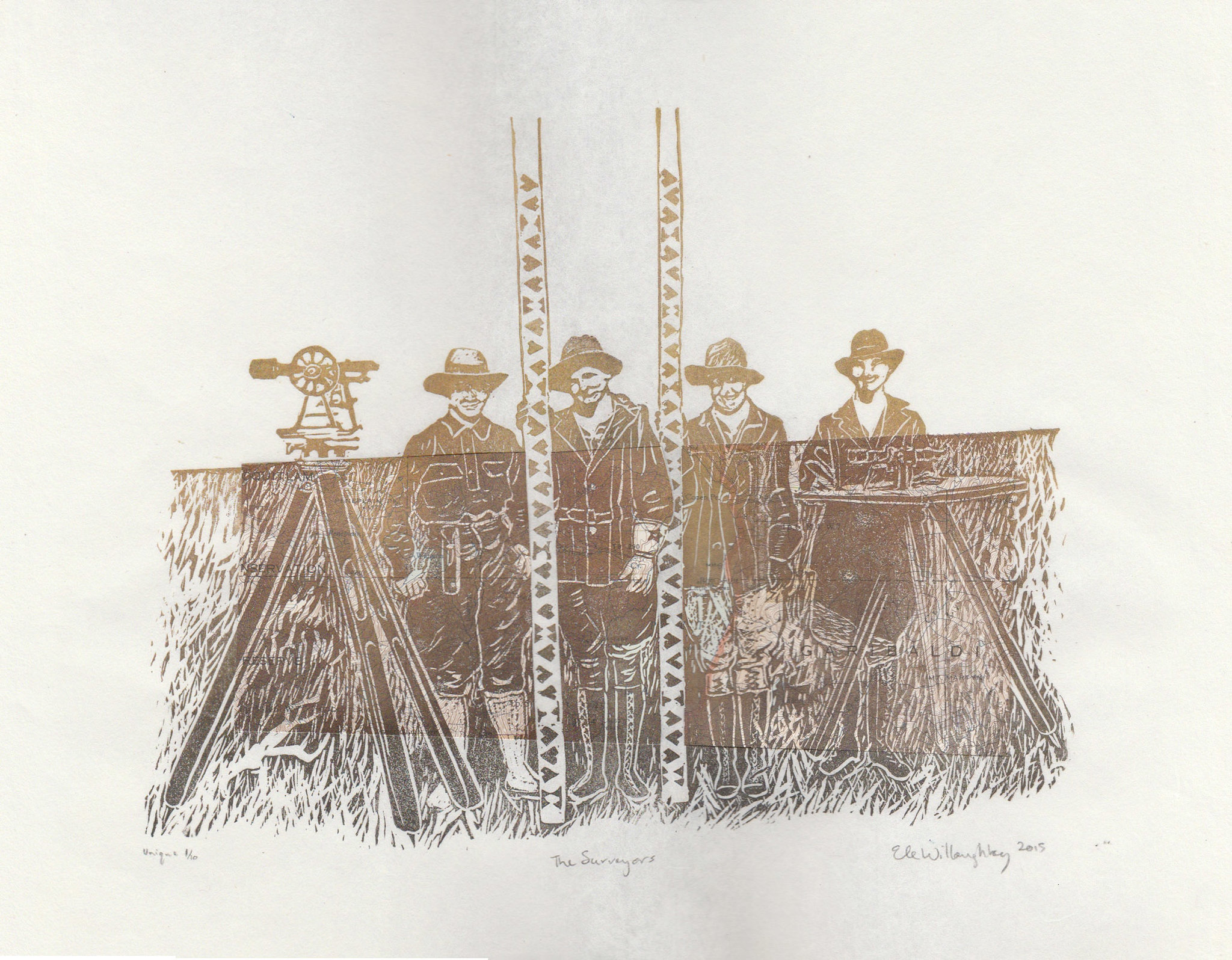
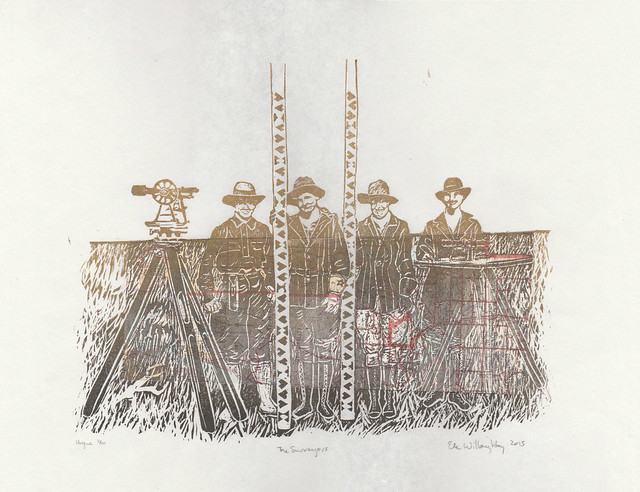
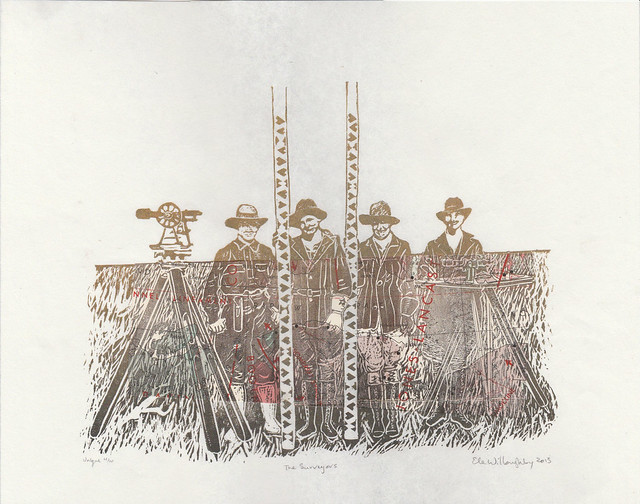
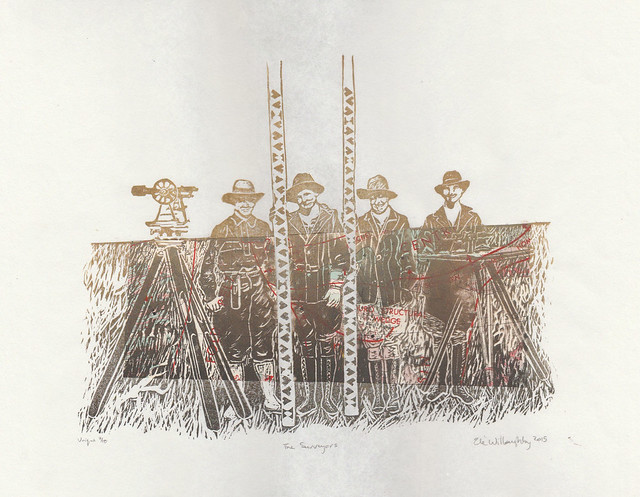
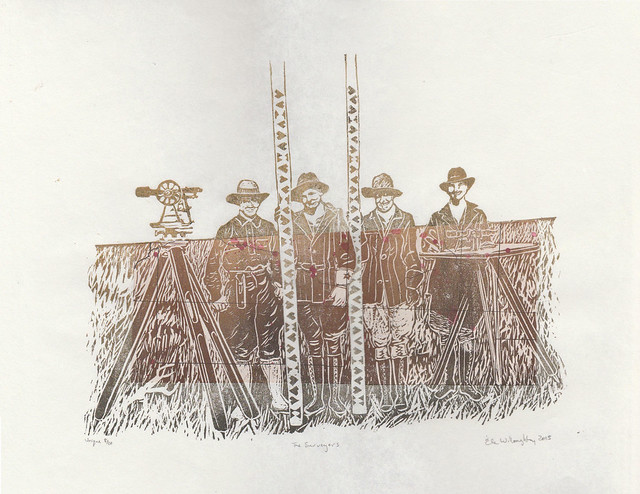
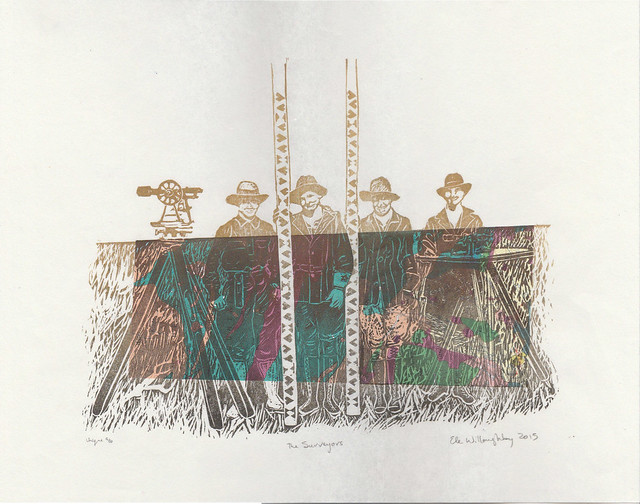
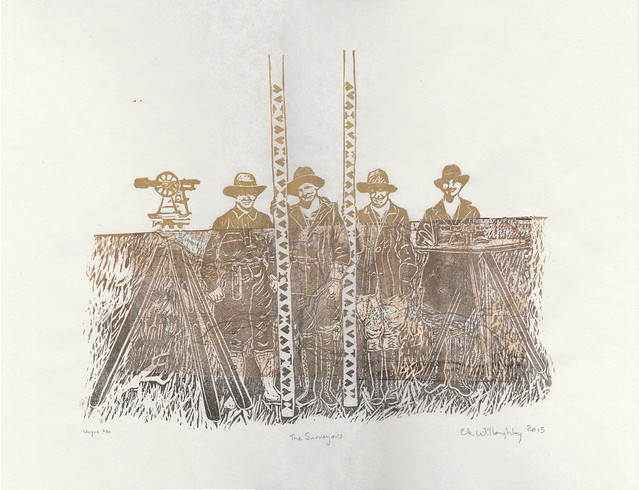
Surveyors, an all-female crew in the American west in 1918

Surveyors1
The Surveyors, linocut with vintage topographical map, 14" x 11", edition of 10 each unique, 2015 by Ele Willoughby

All female survey crew working on the Minidoka Project, Idaho, 1918.
I love when people approach me about doing a fascinating custom order. An artist, Krista Caballero who has been collaborating with many others on a project called Mapping Meaning which brought together "artists, scientists and scholars to explore questions of social, mental, and environmental ecology. Inspired by a photograph from 1918 depicting an all-female survey crew, the project is rooted in a five-day experimental workshop that takes place biennially on the Colorado Plateau." She wanted to thank her collaborators with the gift of a print and wanted to know if I could make an edition inspired by this very 1918 photo. Since one of the things I do is communicate science through art with portraits of scientists (with a special focus on women in the history of science) and I have also done a variety of earth science surveys and mapping, this is very much my thing. In fact, I worry sometimes about hagiography... about only present heroes and heroines, or perpetuating the myth that science is a series the story of a series of lone geniuses. Plus, those survey rods with their odd symbols are so graphic and tempting to one who makes relief prints.

I proposed portraying these women and incorporating vintage geological, topographic and seismicity maps of the western North America, so that each print would be unique. All of the vintage maps came from the Geological Survey of Canada and were actually used in the field - as a tip of the hat to these women. I felt that any marking on the maps actually made them more app. The maps are also from western North America, and are decades old - a little further west and north, and later than these women worked... but they can be tied to similar pioneering surveying work. These hard-working women would have produced the sorts of data fundamental to producing the maps like these geological, topographic and seismicity (or earthquake) maps. The history of science is not only a series of exploits of well-known genius experimentalists, famous for their eureka moments; nor is it simply a tale of paradigm shifts brought about by wiser theorists who suddenly saw the need to shift the entire underpinnings of a given field of science. The history of science is also a tale of hard work by countless unknowns; an all-female survey crew from the early twentieth century seem especially unknown. We have no record of their names and they do not fit our preconceived notions of who explored and mapped the west, or who did fundamental scientific grunt work. I think Idaho in 1918 would still feel like the wild west and imagine these women to be quite fearless.
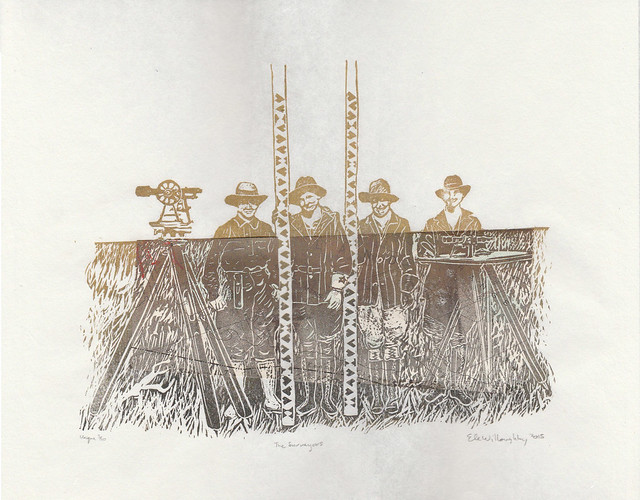
There are a few extra available here.

Surveyors2
The Surveyors, linocut with vintage topographical map, 14" x 11", edition of 10 each unique, 2015 by Ele Willoughby


Surveyors3
The Surveyors, linocut with vintage topographical map, 14" x 11", edition of 10 each unique, 2015 by Ele Willoughby
Surveyors4
The Surveyors, linocut with vintage geological map, 14" x 11", edition of 10 each unique, 2015 by Ele Willoughby

Surveyors5
The Surveyors, linocut with vintage geological map, 14" x 11", edition of 10 each unique, 2015 by Ele Willoughby

Surveyors6
The Surveyors, linocut with vintage topographical map, 14" x 11", edition of 10 each unique, 2015 by Ele Willoughby

Surveyors7
The Surveyors, linocut with vintage geological map, 14" x 11", edition of 10 each unique, 2015 by Ele Willoughby

Surveyors8
The Surveyors, linocut with vintage seismicity map, 14" x 11", edition of 10 each unique, 2015 by Ele Willoughby

And do check out Mapping Meaning - there's some very interesting stuff there!

Tuesday, April 15, 2014

Two weevils, one stone

I don't know about you, but I have some unrepentant punsters in my life. I swear, you hear enough puns, it changes the way you think. Soon, you find yourself researching weevils.


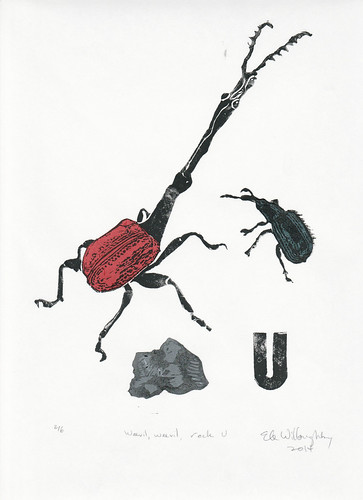
Weevil, weevil rock U
Weevil, weevil, rock U by minouette


This linocut on Japanese paper illustrates a terrible pun: 'Weevil weevil rock U' rather than "We will, we will rock you," of course. The larger of these two weevils is the extravagant, long-necked red and black giraffe weevil (or giraffe-necked weevil or Trachelophorus giraffa) from Madagascar which can grow to as long as an inch or 2.5 cm in length. The smaller of these 2 is Neocoenorrhinus germanicus, a blue-black weevil, merely 3.9 mm (0.15 inches) found in Southwest Asia, southern Siberia, Russia, and parts of Europe. They are shown roughly 4 times life-sized.

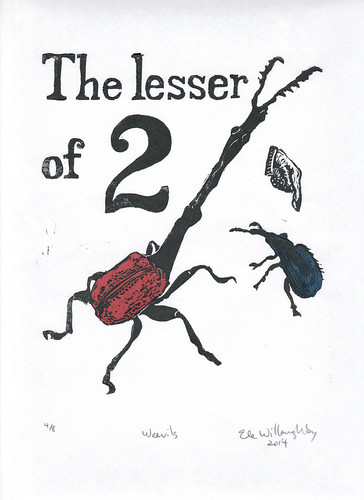
I found a way to use a single block for two terrible puns. It's the lesser of 2 weevils rather than the lesser of two evils, of course.

The lesser of 2 weevils
Weevils by minouette


This print would make a great gift for the entomologist with a sense of humour or a passion for music, the bug-loving fan of Queen or idiom or typography, the punsters and those who always seem get song lyrics hilariously bumbled. We all have a friend like that, no?


Wednesday, March 26, 2014

Hedy Lamarr, inventor of Frequency Hopping

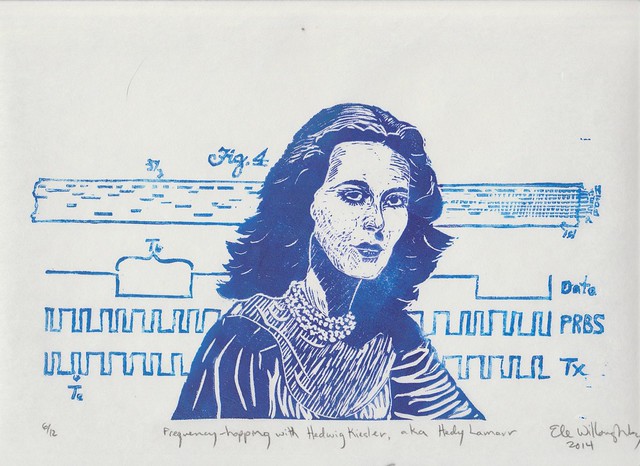
Hedy Lamarr linocut
Frequency-hopping with Hedwig Keisler, aka Heday Lamarr, linocut by minouette
This linocut portrait is of inventor and actress Hedy Lamarr (9 November 1914 – 19 January 2000), best known as a star of Hollywood's Golden Age. The linocut is printed in indigo and blue on Japanese kozo paper 9.25" by 12.5" (23.5 cm by 32 cm), inked à la poupée in an edition of 12.

Born Hedwig Keisler in 1914 in Vienna, Hedy became famous after her risqué and notorious starring role in Gustav Machatý's 1933 film Ecstasy. Friedrich Mandl, her first of six husbands (to whom she was married at the time), objected to what he felt was exploitation of his wife, including shots of her nude and simulating an orgasm. He tried unsuccessfully to buy up all copies of the film. Hedy objected to her husband, the munitions manufacturer, dealing with fascists including Mussolini and Hilter, despite the fact that she and her husband were both of Jewish heritage. Hedy had learned that the secret of her beauty was to, in her words "stand there and look stupid” though she was in fact highly intelligent, a mathematics prodigy, and an astute innovator. So while Axis leaders and arms dealers attended lavish parties at their castle home, Hedy gained a great deal of sensitive military intelligence, including intimate knowledge of the problems associate with radio-control of torpedoes. She decided to leave her controlling husband. She made her escape by disguising herself as her own maid (by drugging her and stealing her clothes), just in time to avoid the annexation of Austria. She took this intelligence with her to Paris, and on to London. In London she met Louis B. Mayer, who renamed her 'Hedy Lamarr' and hired her to work for MGM. She went on to make dozens of Hollywood films opposite all the big stars of the Golden Age, and was known as one of the most beautiful women in the world.
In 1940, spurned by the tragic sinking of a boatload of refugees, by a German U-boat torpedo, Hedy put her mind to the problem of national defense. She knew that torpedoes were guided by radio signals, of a single frequency, which were vulnerable to interference or "jamming". She had the idea that if multiple frequencies were employed, like a radio station which varied its channel unpredictably, it would not be possible for the enemy to find and interfere with the signal. This way the signal could be encoded across a broad spectrum. The difficulty would be in synchronizing the transmitter and the receiver, so they would be set at the appropriate frequency at all times. She met her neighbour, the avant-guard musician and composer George Antheil at a party. He had been working on automated control of musical instruments, including his music for Ballet Mécanique which involved synchronizing his melodies across twelve player pianos (or pianolas)! Is that not an excellent example of the wonderous region where art and science intersect? This was the answer. Together they developed Hedy's frequency-hopping idea, encorporating George's technology for synchronizing pianolas, and on the 11th of August, 1942, US Patent Number 2,292,387 for the "Secret Communications System" was granted to Antheil and to “Hedy Kiesler Markey”, which was her married name at the time. This early version of frequency hopping used a piano-roll to change among 88 frequencies (like the keys on a piano). Though the US navy did not adopt the method until 1962 (during their blockade of Cuba), and there other patents and inventors whose work contributed the modern methods, today, we recognize Hedy Lamarr as an important pioneer of wireless technology! Lamarr's and Antheil's frequency-hopping idea serves as a basis for modern spread-spectrum communication technology, such as Bluetooth, COFDM (used in Wi-Fi network connections), CDMA (used in some cordless and wireless telephones) and 4G LTE communications. You are probably using a device right now which relies on these ideas.

In the print, I show a portrait of Hedy in 1941, along with Fig.4 from Lamarr and Antheil's patent, which relates to the use of the piano roll. Below this, I show a diagram of how the modern the frequency-hopping code division multiple access (FH-CDMA) scheme works. The wide square wave labelled 'Data' is a signal to be encoded, with pulse width Tb. 'PRBS' means pseudo random binary sequence. It's the way the changes in frequency are introduced and plays the role of the piano roll today. It runs at a much higher rate than the data to be transmitted, with pulse width Tc. Data for transmission is combined via bitwise XOR (exclusive OR) with the faster code. This means that that if the two waveforms, the data and the PRBS are unequal, the transmitted signal (labelled Tx) will be high. Otherwise the transmitted signal will be low. The transmitted signal is spread across a spectrum of frequencies by a factor determined by the ratio of the two pulse widths; the bandwidth is increased by a factor of Tb/Tc. Since the PRBS, known as the "pseudo-noise" (PN) code can be can be reproduced in a deterministic manner by the intended receiver (which is equivalent to reproducing the imaginary piano roll), it can decode the signal. This spread spectrum encoding is at the heart of all our contemporary telecommunications and is only possible using the kind of frequency hopping that Hedwig Kiesler, also known as Hedy Lamarr, invented.


Tuesday, February 11, 2014

Bell Burnell and the Little Green Men

Jocelyn Bell and the LGM-1

This year, I plan to grow my collection of portraits of women in STEM. I thought I'd get an early start on this project, with my first portrait of a scientist who is still working.

This is a linocut portrait of Jocelyn Bell (now Bell Burnell) and the incredible radioastronomy dataset she gathered when only a graduate student in 1967, working with Anthony Hewlish. The block is inked "à la poupeé" in dark blue grey and green on Japanese kozo paper. The first edition is a variable run of 10 prints, each 10" by 12.5" (25.4 cm by 31.8 cm).

In November, 1967, Jocelyn Bell (Burnell) was just a graduate student when she discovered the first radio pulsar (or pulsating star), a highly magnetized, rotating neutron star that emits a beam of electromagnetic radiation. This radiation (light in the radio frequency band) can only be observed when the star is pointed towards us; so, like the light from a distant lighthouse, it appears to pulse at a precise frequency. Jocelyn Bell had been working with her supervisor Antony Hewish and others to construct a radio telescope to study quasars (quasi-stellar objects which emit radio waves). She noted some "scruff" on her chart-recorder, and then that the pulses were incredibly regular, occurring every 1.337 seconds. Hewish was initially scornful and insisted the regular pulses must be noise from a human made source. He first dubbed this object, emitting with such regularity 'LGM 1' for "Little Green Men 1", a playful joke about their uncertainty about what could emit radiation so regularly - obviously it could only be a communication from extraterrestrials hahaha! After she found other such sources, in different places with different frequencies, her colleagues became convinced. These discoveries lead to the development of the pulsar model. LGM-1 is now known PSR B1919+21.

The 1968 paper announcing this discovery in Nature has five authors, lead by Hewish, followed by Jocelyn Bell. In 1974, Hewish won the Nobel Prize for this discovery, (along with fellow radioastronomer Marlin Ryle). Jocelyn Bell was not included as it was assumed that the "senior man" was responsible for the work. This was controversial and has been condemned by many leading astronomers like Fred Hoyle (who with Thomas Gold was first able to explain the signals as due to a rapidly rotating neutron star). Jocelyn Bell Burnell herself has stated she was not upset. Bell Burnell has a great career and won many honours after her impressive start, but her exclusion from the Nobel win, based on her own research strikes me and many others as one of the more blatant and egregious examples of gender bias in the selection of Nobel prize recipients.

Cover of Joy Division's 1979 album 'Unknown Pleasures'
designed by Peter Saville, using the pulsar data
from the Cambridge Encyclopaedia of Astronomy
Not only the discovery, but the presentation of the data is impressive and elegant. The famous diagram (I've included behind her, and shown above) shows superimposed images of successive pulses. Stripped down to their essential information like sparklines (chart lines without annotation or axes, but drawn of course to a common scale) so their regularity really stands out, and they can be easily compared and contrasted. If you are used to looking at time series, you'll know that since they can be easily superimposed and the pulses line up, that the frequency is quite regular. The diagram is downright eloquent, and visually appealing, so it has been included in books on data visualization and was used in the iconic design of Joy Division's 'Unknown Pleasures' album. From there the diagram itself has become a sort of visual meme and can be found in all sorts of different media and reinterpreted in everything from tattoos to fashion. (You can read my take on this meme itself here: Astrophysical Meme: Jocelyn Bell Burnell's Pulsar, Little Green Me, Joy Division and Beautiful Data ).

Wednesday, October 2, 2013

ships & unicorns & exotic papers

I haven't posted all of my most recent work. Here is some of what I've been working on.... partially because sending work off to be sold in shops has forced me to look over my inventory and my hoard collection of beautiful and exotic papers. As well as copious amounts of Japanese washi, I have Chinese papers, and everything from wood veneer paper to papyrus.

ShipXI
SailsXIV
SailsXV
SailsXVI
ShipXII
ShipXIII
UnicornXIX

Monday, September 23, 2013

Art for Kids

I had a pleasant surprise this morning. I often check the Etsy blog every day, but this last week RJH took a vacation and we've been taking some time to make sure we're prepared for the baby. He's done a huge amount of work building furniture, and we made some purchases. Somehow it seems more real, now that we have a car seat and stroller. Decorating and preparing the nursery is an on-going project, of course. So, this morning I was particularly interested to see the Etsy blog article Art Scouting: Picks for Kids thinking I could gather some more ideas. I love that cover shot and spent some time contemplating how the T.Rex image was made. I scrolled down and was delighted to see my own 'Sailing Ship IV' featured! It and another in the series are already packaged to go to the post office this morning, since they sold yesterday (though I didn't clue in that my print had been mentioned till this morning). I do love the idea that art for kids can serve as a starting point for bedtime stories. RJH has been advocating bold, simple works for babies and that maybe the multimedia work will be better a little later (once the baby's vision is more fully developped.... after all, they can barely focus more than a foot away when they arrive). He might have a point, but I confess, I'm looking forward to the magic of imaginative bedtime story telling - and more complex art too!

There's still several ships in the series, by the way, and reproductions of a couple of the sold one of kind prints in the series are available too. There's some fabulous prints by fellow Printsy members; Cecca's Crocodile Tea Time has been in my favorites for a long time and I love Natalia the Winged Lion's prints as much as her imaginative handcrafted jewellery, as well as some artists who are new to me.


Saturday, September 7, 2013

g for giraffe

gForGiraffe001 G is for Giraffe of course!

This 'g' monogram linocut features an elegant giraffe. It's standing on the tail and peeking through the loop of the 'g'. This is an open edition print in brown ink on Japanese paper, known as washi. It is available in a variety of colours! Each sheet is 14.8 cm or 5⅞ inches square.

gForGiraffe005gForGiraffe002gForGiraffe003gForGiraffe004