Showing posts with label bees. Show all posts

Thursday, May 28, 2026

Our Fate is Tied To That of the Insects

Our Fate is Tied To That of The Insects, 16" x 20" linocut print by Ele Willoughby


I made this print for Manufactured Ecosystems, and people keep asking me if I could sell them one, so I finally got around to making a small series of them and putting them in my shop. These are quite labour-intensive and involve using 17 different blocks, so I made a slightly variable series rather than a strict edition, but you have a chance to get one now. 

I'm thinking of also having some archival reproductions made which I can offer at a more affordable price point, if people would like them. That way I can maybe reach more people with my pro-pollinator propaganda!

Thursday, January 22, 2026

Insect Break: Seven-spotted Ladybettle and the Alfalfa Leafcutting Bee

Seven-spotted Ladybeetle on Blossom, 8" x 8" linocut by Ele Willoughby, 2026
 Ladybeetle on Blossom, 8" x 8" linocut by Ele Willoughby, 2026

The 5th prompt for #PrintmakerSolstice2526 was odd. I decided to veer from my series of women in STEM prints. This was partially because I couldn't think of a good mathematician or scientist choice for the theme that I had not already portrayed, and partially because describing someone as "odd" is not necessarily flattering. Also, one portrait a week is also a fast pace, what with the amount of labour involved carving and printing lino blocks.

So, I thought I would use some of the blocks I made for the Invertefest Anthology. For odd, I chose the seven-spotted ladybeetle (or ladybird or lady bug) on an apple blossom. Both the 7 spots and the 5 petals match are odd numbers of course.

Alfalfa Leafcutting Bee, 9" x 11" linocut by Ele Willoughby, 2026


A second print from blocks I made for the Invertefest Anthology is my alfalfa leafcutting bee, cutting a leaf. The alfalfa leafcutting bee (Megachile rotundata) is a solitary bee originally from Europe which has been spread to all continents but Antartica for agriculture. In North America it has become feral and widespread. A prolific pollinator (but not a honey-maker) of alfalfa, amongst other food crops, this little bee cuts telltale half-moon shaped pieces out of leaves with which to line her nest. This hand-printed linocut print is made on 9" x 11" Japanese paper.

Both prints can now be found in my shop.


Sunday, July 20, 2025

The Future of Pollination Artist's Talk for Manufactured Ecosystems

My full artist's talk for the Future of Pollination art show for Manufactured Ecosystems is available here: Everything you ever wanted to know about my art about bees, and more ;)

Tuesday, June 17, 2025

The Future of Pollination - Manufactured Ecosystems


Our Fate Is Tied To That Of The Insects, linocut print, 16" x20", Ele Willoughby, 2025

Pollinator Week is a great time to share this print, which expresses the central theme of my work about the Future of Pollination for Manufactured Ecosystems. I have been working on a collection of 15 prints for this show for the last several months. Our food sources and ecosystems around us are dependent on pollinators (mostly bees & other insects, some birds & mammals) but insects populations have lost huge numbers and many species altogether. Our future will be linked to their fate. Each of the bees, moths, butterflies and beetles in my print are native species here. 

Next week our art show will open at Zavitz Art Gallery at the University of Guelph. Each of the visual artists has produced work on various themes in various media about our ecological future looking forward the wake of climate change and habitat loss and at what we can learn from nature. I’m really excited to see what the others have produced! I hope you’ll come see the show if you’re able. 

Photosynthesis
Artist: Yulia Shtern @magical_zoo

Soil Formation
Artist: Lynx @amour.lynx

Cultural Services
Artist: Pablo Rios @the_amazing_world_of_redacted

Biodiversity
Artist: Melanie Barnett
@melanie.barnett.ceramics

Climate Regulation
Artist: Amanda White @thetiniestseed

Thursday, July 7, 2022

Rusty patched bumblebee, In The Landscape and These Are a Few Of Our Favourite Bees


View through viewing portal into Ele Willoughby's rusty patched bumblebee lambe lambe box

In the Landscape, multimedia by Ele Willoughby and Sarah Peebles, linocut, painting, video projection, branch, wire, DNA bar codes, sound

Top of Ele Willoughby's rusty patched bumblebee lambe lambe box with view through skylight, paper flowers, twig chair, dandelion stem woven table, hand bound tiny book with linocut bee

Shot of Ele Willoughby's rusty patched bumblebee wooden lambe lambe box on legs, short table with other artifacts and bumblebee specimen

Some photos of my pieces in our art show, These are a Few of Our Favourite Bees, with my diorama like lambe lambe theatre box for a rusty patched bumblebee, and rusty patched bumblebee print along with the In the Landscape multimedia collaboration with Sarah Peebles.


Come see the show at the Campbell House Museum until July 16! Hear our artist talks this evening at the Canadian Music Centre, 20 St Joseph St, at 7:30 pm. Or you can watch the webcast here!

Wednesday, June 8, 2022

These are a Few of Our Favourite Bees


So I haven't been posting much recently, but I've been busily preparing for this collective art show about bees. If you're in Toronto, I hope you'll come check it out!


Exhibition
Campbell House Museum  
June 22 - July 16, 2022 

160 Queen Street W.

Opening event 
Campbell House,
Saturday July 2,  
2 – 4 p.m.

Artists' Talk & Webcast
The Canadian Music Centre, 
 
20 St. Joseph Street Toronto 
Thursday, July 7
7:30 – 9 p.m.
(doors open 7 pm)

Co-presented by Art-Sci Salon & The Canadian Music Centre

These are a Few of Our Favourite Bees investigates wild, native bees and their ecology through playful dioramas, video, audio, relief print and poetry. Inspired by lambe lambe – South American miniature puppet stages for a single viewer – four distinct dioramas convey surreal yet enlightening worlds where bees lounge in cozy environs, animals watch educational films and ethereal sounds animate bowls of berries (having been pollinated by their diverse bee visitors). Displays reminiscent of natural history museums invite close inspection, revealing minutiae of these tiny, diverse animals, our native bees. From thumb-sized to extremely tiny, fuzzy to hairless, black, yellow, red or emerald green, each native bee tells a story while her actions create the fruits of pollination, reflecting the perpetual dance of animals, plants and planet. With a special appearance by Toronto's official bee, the jewelled green sweat bee, Agapostemon virescens!

These are a Few of Our Favourite Bees Collective are:

Sarah Peebles, Ele Willoughby, Rob Cruickshank & Stephen Humphrey
The Works

These are a Few of Our Favourite Bees

Sarah Peebles, Ele Willoughby, Rob Cruickshank & Stephen Humphrey
Single-viewer box theatres, dioramas, sculpture, textile art, macro video, audio transducers, poetry, insect specimens, relief print, objects, electronics, colour-coded DNA barcodes.

Bees represented: rusty-patched bumble bee (Bombus affinis); jewelled green sweat bee (Agapostemon virescens); masked sweat bee (Hylaeus annulatus); leafcutter bee (Megachile relativa)

In the Landscape

Ele Willoughby & Sarah Peebles
paper, relief print, video projection, audio, audio cable, mixed media  

 Bee specimens & bee barcodes generously provided by Laurence Packer – Packer Lab, York University; Scott MacIvor – BUGS Lab, U-T Scarborough; Sam Droege – USGS; Barcode of Life Data Systems; Antonia Guidotti, Department of Natural History, Royal Ontario Museum

Saturday, September 18, 2021

Bees, and Spheres, Minerals and Becoming Crabs

There's so much science art being shared on Twitter this month for #SciArtSeptember. I have scheduled works for daily prompts for the whole month. I have also just finished working my way through the entire list of prompts for #mathyear - as well as  continuing ongoing bee-themed projects.

There was no summer camp for the last weeks of August and beginning of September before school, so I was pretty busy parenting, but here are some new works from the end of August and September so far.

The Leafcutter Bees, linocut and leaf prints by Ele Willoughby, 2021


I made a series of monoprints about leafcutter bees, and whimsically, in collaboration with leafcutter bees! These small, but multifarious native bees are important pollinators, who make nests for their babies using small telltale half-moon pieces they cut from leaves and petals. This work features two large linocuts of two leaf cutter bees: Megachile relativa and Megachile brevis. These linocuts are made on collaged Japanese washi papers and cellophane to capture the colours in their bodies and wings. Each print has its own array of leaf and petal prints from leaves and petals used by leaf cutter bees from my garden. The plants used include raspberries, roses (leaves and petals), lily of the valley, lilac, lemon balm, ash, thicket creeper, round-leaved Crane's bill and more. Each print is 17" tall by 12.5" wide (43.2 cm by 31.8 cm). 

Sphere Packing, linocut with collaged washi by Ele Willoughby, 2021


I have an ongoing thread of my #mathyear art on Twitter, and I was looking ahead at future prompts. I added a several portraits and other prints about math to fill out the remaining prompts, including this new item in my shop: a block print shows the two piles with the two possible close packing of equal spheres, each below a diagram of the plan view of the layout: Face-centered cubic (fcc) and hexagonal close packed (hcp). Each pile of spheres on water-colour paper with a deckle edge has its own unique assortment of collaged gorgeous Japanese washi papers. Each version of this print is unique.

The problem of how efficiently you can pack spheres into a volume has a long history in mathematics. It was Carl Friedrich Gauss who found the highest average density that can be achieved by lattice packing and the Kepler conjecture (as in Johannes Kepler) states that this is the highest density that can be achieved by any arrangement of spheres, either regular or irregular. When the famous mathematician David Hilbert set his 23 Problems of important unsolved problems in math in 1900, it included the question of what is the densest sphere packing. The question is generally considered solved since T.C. Hales proved the Kepler conjecture in 1998.

Though this may seem an abstract theoretical geometry problem there are real-life applications. It turns out, for instance, that many crystals with structures based on close-packed identical spheres of the fcc or hcp variety. 


Malachite, linocut, 8" x 8", by Ele Willoughby, 2021

There's also the annual social media battle of the minerals going on with #MINCUP2021. I always intended to make a series of mineral prints but never got passed making Quartz. I have managed to tie several of the minerals to existing prints and been tweeting those along with my votes, but I have managed to make one new pertinent print so far: Malachite. I have been using "cool physics and/or art applications" to determine my vote so malachite, often carved to make beautiful items, and a paint pigment since antiquity was obviously one to support. 

Jennifer Zee (ginkgozee on instagram and here on Etsy) has been working on an amazing series of mineral relief prints (including malachite and many others recently) and it reminded me I really wanted to have a whole colleciton. You should check out her work!


Porcelain crab, linocut by Ele Willoughby, 2021

For the #SciArtSeptember prompt evolving, I knew I had to talk about how things keep evolving into crabs! This is a hand-printed lino block print in black and red ink on white Japanese kozo (or mulberry) paper of a porcelain crab, Neopetrolisthes maculatus. Each print is 8” by 8” and printed by hand. Porcelain crabs are decapod crustaceans in the family Porcellanidae, which resemble true crabs but are in fact closer related to squat lobsters. They have flattened bodies as an adaptation for living in rock crevices. They first appeared in the Tithonian age of the Late Jurassic epoch, 145-152 million years ago. There are one of at least 5 groups of decapod crustaceans which have evolved to be more crab-shaped in a process known as carsinisation.

Thursday, June 7, 2018

Redbud and the Bees

Redbud and the Bees, 18" x 24", linocut with collaged washi papers by Ele Willoughby, 2018
Proof of my Eastern Carpenter Bee linocut and block
I've been working on a new artwork about urban wildlife. Creature Conserve is a non-profit outreach organization which brings artists and scientists together to "foster sustained and informed support for animal conservation," and they posted a call for artists for their Urban Wildlife: Learning to Co-exist exhibit at the Rhode Island School of Design (RISD) at the end of July and through August. Because of my on-going work on native bees, the first thing I thought about were bees in the city. The exhibit aims to get artists to collaborate with scientists and use their artworks to explore the biology and ecology of species and the way they interact with humans. Specifically, artists are invited to explore themes of how ecosystems change in time and space, how wildlife and humans may displace each other homes, the visibility or invisibility of wildlife in the city, the rhythms of animal life and their health. I'm well aware of how our native bees have been displaced and their ranges have changed through time, and also how they can be invisible to people in the city, who often are only aware of the existence of honeybees and maybe bumblebees, so I thought they would be an apt choice.

My redbud linocuts on various pink washi papers
I remembered the urbanredbud citizen science project here in Toronto. Local U of T doctoral candidate Charlotte de Keyzer is working with the public to gather data on flowering times of Eastern redbud trees (Cercis canadensis) and their pollinators using bee nest boxes and traps. She and her collaborators are particularly interested in how climate change and urbanization effect these trees and specifically the timing of their emergence and peak activity. Eastern redbud were not really known in Toronto even 30 years ago, but between climate change and its growing popularity as an ornamental landscape tree, they have became fairly common in the city and important for urban bee diversity. Local wild bees are attracted to this early flowering tree covered in pink flowers, and some also use its leaves in building their nests. Since the project addresses changes in the environment over time because of climate change and urbanization, and since it seeks to engage the public, I thought it might be a good fit and that Charlotte de Keyzer might be open to collaborating with me, and indeed she was! I asked her some questions about which bees they observe in their traps, hoping to connect this to my existing collection of native bee lino blocks, and told her about the aims and themes of the exhibit. It turns out that redbud trees are indeed popular with some of my own favourite (and previously depicted) native bees. Their early results show that amongst the most common bee visitors in Toronto foraging on redbuds are Osmia lignaria (blue orchard bee), Colletes inaequalis (polyester bee), and Xylocopa virginica (eastern carpenter bee). Leafcutters also use the leaves to build nests (though they do not yet have information on which species of leafcutter are actually doing the cutting). In my artwork I show flowering redbud branches, the small blue O. lignaria, a Megachile relativa leafeater bee (I took the liberty of simply choosing this local bee) at the top along with a telltale round hole in a leaf, and the X. virginica in the middle.

It was Charlotte's suggestion that I focus on the eastern carpenter bee. Like the redbuds themselves, the eastern carpenter bee is at the northernmost end of its range, which is advancing northward with climate change and aided by urbanization (because cities are warmer due to the urban heat island effect, which likely helps them survive our winters). In fact, since people are planting redbud trees in their gardens, we're inadvertently aiding migration of both tree and bee. She points out that "redbuds are now starting to naturalize in ravines and woodlots across southern Ontario." What brings the X. virginica into conflict with its human neighbours is that female carpenter bees of course, build nests by boring holes into untreated wood structures, including outdoor furniture and buildings. Thus these bees are often considered pests by home owners and we are still working on 'learning to co-exist.' To emphasis this conflict, I printed weathered wood with round holes like thoses bored by eastern carpenter bees.

If you live in Toronto and own or know of a nearby redbud tree, you too can take part in the urbanredbud citizen science project. Check it out here.

I got a lot of positive feedback on my linocut of the redbud before I added the bees, so I think I will also make a simpler piece of the tree branches alone. 

Tuesday, June 6, 2017

June Shows & Markets: Bees and Returning to Campbell House

Rusty-patched Bumble Bee, linocut, Ele Willoughby, 2017
This week sees a new show at the Toronto Etsy Street Team Gallery, the 3rd annual 'Bees (& the Birds)', which raises funds and awareness of our beleagered pollinators, hosted by my friend Christine Pensa of Art That Moves. Come by the gallery to see the show between June 7 to 20th or join us for the Opening party June 8! Along with 30 artists and craftspeople who've made art inspired by bees, you can see my latest linocut of the endangered rusty-patched bumble bee and a print I made for an entomologist earlier this year, Megachile brevis.

Megachile brevis, linocut by Ele Willoughbby 2017

I'm also taking part in the Toronto Etsy Street Team's Midsummer Market! This is a really fun indoor/outdoor summer show at the Campbell House museum, Queen St and University. Check out the fabulous lookbook and join us for the show June 17!


I've got a couple other exciting things coming up which I can't wait to share with you! I've been a busy week...

Friday, May 20, 2016

Bees & Stars: Opening, Book Launch and Album Cover

The 'Bees of Toronto' and the page featuring my bee art
It's been a busy week! Yesterday I had the unusual experience of a book launch in the afternoon followed by an art opening in the evening. Quite coincidentally, it was a bee-themed day. The City of Toronto hosted their official launch of their the latest titles in the biodiversity series, including the 'Bees of Toronto' at City Hall. In the evening, 'Bees (& the Birds)' opened at Graven Feather gallery. I've also been busy with meetings with Etsy and our Etsy: Made in Canada venue as well as copious behind-the-scenes planning. And, much to my surprise, I licensed my Taurus constellation linocut image as the album art to a Hungarian indie band!

I might not have gone to City Hall, but I was tickled by the idea of having a day where I could swan around from book launch to art opening, and was intrigued to meet some of the others involved in this great series of books. I think the City does have reason to be proud that they have manage to bring together a this collaboration with natural historians at the Royal Ontario Museum, as well as local academic scientists (particularly from York University for the bee book), the Toronto Public Library and the TDSB, as well as artists, writers and other contributors. I got a chance to meet some of the researchers involved, as well as artist Charmaine Lurch. When we got to talking, I figured out that I have seen her bee sculptures at Nuit Blanche. Because the world is very small, we also figured out that we have a couple of friends in common in Sarah Peebles (who got me involved in this book in the first place) and Christine Pensa (who curated the bee show as well as being part of our TEST & Made in Canada team). Charmaine ended up walking with me from City Hall to Graven Feather and we talked about balancing family life with working in the arts, whether my experience avoiding corrosion at the bottom of the ocean could help her make more weather-proof wire sculptures and some of the great projects she's working on including an illustrated historical novel set in Toronto, and bring STEAM teaching into the schools using both her bee works and knowledge and also talking about Henrietta Lacks and HeLa cells.

Some of the biologists who were at City Hall also came to the art show and I heard that Prof. Packer (who leads the bee lab at York) approved of the message of my piece. It was very crowded so while I managed to speak with his wife (a bird researcher) he actually gave a friendly thumbs up from across the room.

Some of the 'Bee (& the Birds)' show including Japneet Kaur (or Story of a Seed)'s ceramic plates and my mixed media 'Solitary bees don't dance'. If you aren't following Japneet's instagram you are missing out - and I don't say that lightly! Her drawings and ceramics are magic and her feed is filled with whimsical stop-motion animations.

Some more favourites: at the bottom left is my friend Michelle Reaney's recognizable bold, graphic style and the four tiny paintings on the right look like trails made by bees by bookbinder Carolyn of Sprout's Press Designs. Oh... and the one which looks like a black and white photo is in fact drawn in ballpoint! I must find the artist's name because it's the most amazing thing. There were many others I didn't get a chance to photograph well. Don't miss Christine's own work, all the fabulous prints (relief prints, serigraph and etchings), and clever textile works by Michelle and Katie Sorrel.  


My Taurus constellation linocut in the album art for 'Lay Low Butterfly' by Anton Vezuv
Last week I was contacted by singer Gyulai István of the Hungarian indie band Anton Vezuv. They wanted to use my Taurus constellation for their cover art for the new album Lay Low Butterfly. We had quite a lot of conversation back and forth, because they were working on a very short time line and sometimes international wire transfers can be more complicated than you would imagine. Anyway, I checked out their music (some of which is in English and is perhaps what you would imagine) and liked what he had to say about my art, including
yes, well, bull is usually visualized with head down. like your artwork. because bulls are fightin like this. BUT, with heads down they look kinda sad and vulnerable also. so for me this figure show strength and sensitivity. that's why I wanted a bull figure, and our producer found your artwork somehow, and it has a cool style, kinda handmade-vintage-illustration stuff which fits to the art concept.
so I'm pleased to be involved, and I love the idea of my art making its way out into the world and into unexpected places, like schools in Toronto, or albums in Budapest.

Tuesday, March 29, 2016

Dance of the Honeybee

Honeybee Dance, 9.25" x 12.5", linocut by Ele Willoughby, 2016
Again this year, my friend Christine Pensa of Art That Moves will be curating a pollinator themed 'Bees (& the Birds)' show, May 18 - 29, at Graven Feather Gallery. This was my instigation to make my latest linocut print, though I've been thinking about the diagram which inspired it for years.

Years ago I read the most marvellous speculative essay by Ursula K. Le Guin, 'The Author of the Acadia Seeds' (written in 1974) about therolinguistics, the scholarly study of communication in non-human animals. There is translation of fragmentary ant texts, a discussion of a glossary of Penguin and its assorted dialects with comparisons to Dolphin and other Cetacean languages, Fish texts and so forth. The essay culminates with an editorial calling for the study of possible plant communication or art... but warning, "For it is simply not possible to bring the critical and technical skills appropriate to the study of Weasel murder mysteries*, or Batrachian erotica, or the tunnel sagas of the earthworm, to bear on the art of the redwood or the zucchini," - to give you a taste of this wondrous fiction. What I particularly love is that it is written not as science fiction so much as speculative science, much in the same way that I am trying to write about my imaginary miniature linocut menagerie in progress.  And of course, in the 40 some odd years since Le Guin wrote her essay, there has been a lot of actual scientific progress on animal communication - and in fact language. Not only are there non-human primates who have been taught to sign, but there is evidence that animals have words (including evidence of prairie dogs who "describe" humans by size and clothing colour, or gibbons who have specific words for cloud leopard or snake, and of course the incredible complexity observed in whale song, as explained in this great blog I stumbled upon while trying to recall the name of Le Guin's essay). For that matter, there has been significant progress in studying plant communication too!

You may have heard about honeybee communication and how they pass information from one another through dance. One of the sorts of dance is the subject of my print. A worker bee can return to the hive and through the way it aligns itself with respect to the sun and the honeycomb, the waggles and loops of its movement convey information on the location in terms of distance and direction of tasty flower pollen sources to its fellow bees.

'Bees of Toronto' and description and images of some of my bee art.
I am considering making a more complex piece which incorporates this print along with other types of bees, to submit to the show. Part of my motivation is to "think locally". Honey bees are not native to North America. While the Colony Collapse Disorder is of great concern and honey bees are very popular, if our aim is to protect pollinators, we should perhaps focus attention on native bees. In fact, as York University's Prof. Sheila Colla points out, European honey bees are in fact "fierce competitors for pollen and nectar and can transmit diseases to our wild bees" and that we should encourage biodiversity of pollinators for ecosystem health, rather than encouraging the honey bee. I've been thinking about all this particularly since I recently received copies of 'Bees of Toronto,' which has been in the works for a few years now.  Part of their ongoing series about biodiversity in the city, it includes information about the hundreds of bee species who live here, where and when you can see them and what you can do to help our beleaguered pollinators. It also includes some cultural history of bees in Toronto and features the work of local artists (visual art, sound and poetry) inspired by bees, including my linocut and multimedia bee series. I especially love the gorgeous photos from the bee researchers at York University. If you're interested in our urban wildlife and conservation you should check this series out! Full pdf of released volumes can be found online. Complete with introduction by Margaret Atwood (and I am chuffed to think my words are published in the same book as hers).

*This also makes me happy because as a child, my mother kept my brothers and I occupied by telling us stories on long car trips, and I'll always remember the lengthy gopher murder mystery she spun as we slowly crossed the Prairies.

Sunday, May 31, 2015

Bee Homes - linocut bees interactive audiovisual multimedia piece

For a long time, I've had some version of this in my head. This week I finally managed to complete my multi-bee interactive audiovisual multimedia piece... just in time for the Bees (& the Birds) show at Graven Feather. You may recall that a few years ago, I made a linocut bee in electrically conductive in (specifically Bare Paint, which I mixed with some block printing extender to get a better viscosity for making a linocut). I combined this with an Arduino microcontroller so the bee itself could act as a capacitative sensor. In simplest terms a capacitor is made of two electrically conductive - usually metal - plates with a gap between them. The gap can be nothing but air, or a variety of electrolytes.  If there was a wire between the plates, charge would flow freely. Because of the gap, charge builds up on one plate a dissipates at a certain rate to the other. The rate at which this happens depends on the capacitance, which in turn depends on things like the physical properties of the plates, electrolyte and the size of the gap. So, a capacitative sensor takes advantage of the latter to sense proximity, or, measure capacitance to tell you the gap between two "plates". In my case the "plates" are bees printed in electrically conductive paint and my hand. This is the principle behind the theremin (though, they are of course, a great deal more sophisticated, but the idea is the same)*. Here's an example of an earlier prototype from 2012:
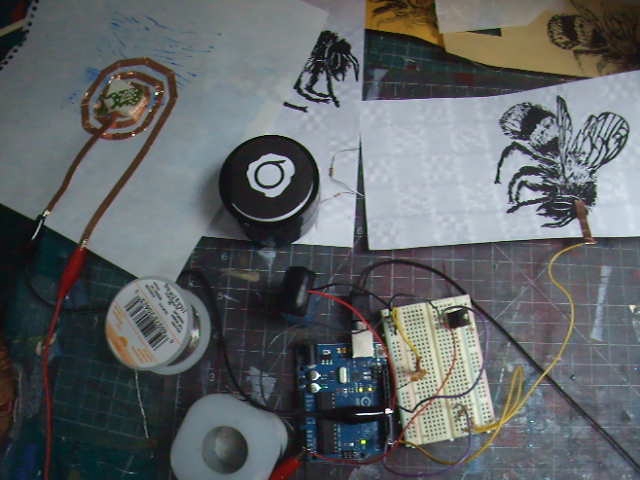
buzzing bumblebee print prototype

So, I can use my linocut on paper connected to an Arduino microcontroller as a sensor, and use the Arduino then to trigger a audio response when someone approaches the linocut. A very simple speaker can be made from a current-carrying wire in a spiral, affixed to a membrane, next to a strong magnet.** So, above I made a speaker with a piece of paper, copper tape as wire and a magnet. The next step was to carve a spiral lino block and block print a speaker on paper with electrically conductive paint, which I did. Thus an actual print, a sheet of paper, becomes both sensor and speaker. I had planned to then make a piece which had multiple bees as multiple sensors which would trigger different reponses. I created the artwork in time for my show about bees in 2013.
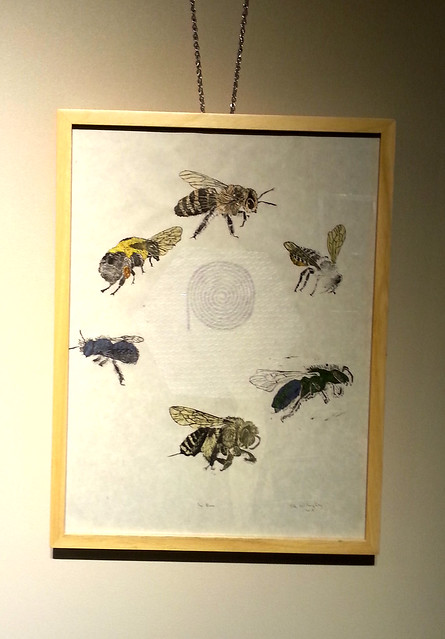
TheBees
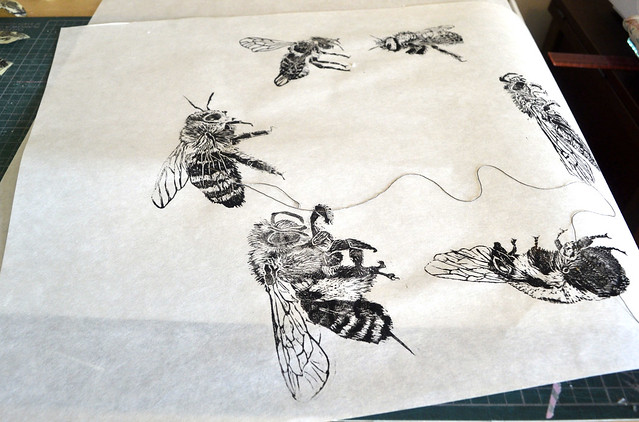
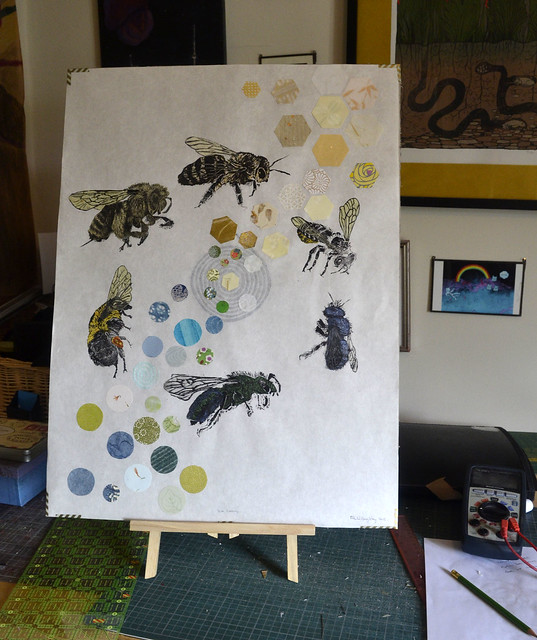
The Bees, Ele Willoughby, linocut on various Japanese washi, 18" x 24", 2013.
I had planned to add sound to this piece, but didn't have the opportunity.

I had two issues. First, my prototype used only an Arduino. I was able to play back sound by keeping the recording length quite short and the sampling rate low. There's only so much on-board RAM. I could make multiple sensors each play the same recording, but I simply ran out of memory using only an Arduino.

Secondly, I got pregnant and chose to put electronics aside for a while. I couldn't find any reliable medical guidance about soldering electronics while pregnant or in the proximity of babies (as if there aren't in fact large numbers of engineers, scientists, artists and hobbiests who are women of child-bearing age, ahem!), but jewellers were warned to avoid lead solder, and I opted to err on the side of caution. Lead and developping nervous systems struck me as a bad combination.

So, now that my son is one and a half, I've had an opportunity to return to the idea. The obvious way to add more sound to a project is the off-the-shelf solution of adding a Wave Shield to the Arduino. This is a second circuit board which plugs into the first to let you control and play files from an SD card to a speaker. (Bare Paint has recently released their own microcontroller, the Touch board based on the Arduino, but specifically with their applications for their paint, such as capacitative sensors, in mind. This might have been an easier way to go... but I had an Arduino, so I chose to add a Wave Shield).
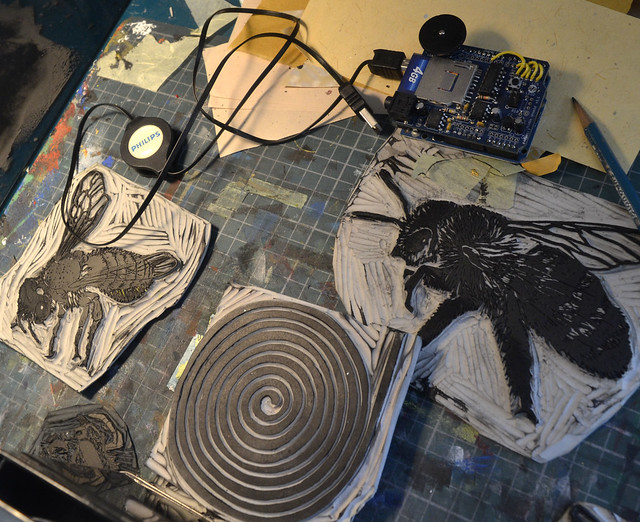
beeblocks
My bee lino blocks and spiral lino speaker block, along with the Arduino and Wave Shield. You can talk to the Arduino via serial port. I combined the open source code wavehc_play6.pde (which plays different 6 audio files when 6 different buttons are pushed) with ArduCapSenseBlinky.ino which employs a collection of capacitative sensors to trigger a collection of LEDs to flash.
beeconductive
To make an electrical connection from my 6 bees (honeybee, bumblebee, leafcutter bee, long-horned bee, blue orchard mason bee and sweat bee), which I block printed in Bare Paint with block printing extender on Japanese kozo paper, I sewed through the paper with electrically conductive thread. I wanted the speaker, magnet and electronics to be behind the sheet, so I needed to pass through it. 
beeEisel
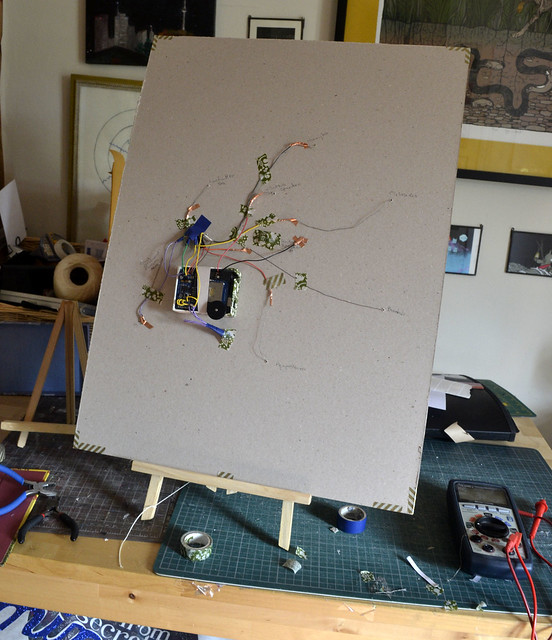
I also printed each bee block on a variety of Japanese washi papers, to get the colour and texture of the bees and wings. This also hides the stitching/electrical connections. The story I'm telling with the piece is about how bees live here. We all know the honeybee, with its hexagonal cells in its hives, but it's not native to North America. Most of our native bees live in holes and burrows. They also come in a wide range of colours. So the other collaged, handmade papers, represent how the bees live, from the hexagons with the honey bee at the top in yellows, to the circles in blues and greens at the bottom. In this shot you can also see the spiral speaker printed on the reverse. The sheet is on kozo paper which is very strong, but not at all stiff. So I backed it with book board to have something on which to mount the electronics. My trusty multimeter is there so I can check that each bee does have good connectivity through to the digital I/O pin on the Arduino.
beeElectronics
This is what's hiding behind the piece. I affixed a small box to hold the Arduino. There are six DIO pins at the top of the Wave Shield board connected to wires in purple, green, yellow, orange, red and brown. These in turn are connected using copper tape to each of the 6 conductive threads coming from the 6 bees. The threads from either end of the speak spiral are likewise connected to the speaker output and ground.
I made a short recording for each bee. I tried to find audio recordings of each different species. Back in 2012, Sarah Peebles directed me to some of her audio recordings on Reasonating Bodies. I also simply searched YouTube for videos of each type of bee. I combined these (using Audacity... which is pretty awesome freeware for simple sound applications) with my spoken words about the bees and save these as .WAV files which can be played by the Arduino Wave Shield. So I was able to say how though the honeybee might be our idea of the canonical bee, our "default" bee, it is in fact not native to North America, and many of out native bees are quite different; many are solitary, producing neither hives nor honey, and coming in all sorts of colours. You can see and hear my piece at the Graven Feather show the Bees (& the Birds), which runs June 4 through 27. I'll post a video of the piece in action later. You can find each of my bees prints separately here (and learn a little bit about each species too).

*In fact, this is how the gravimeter I used for my doctorate worked too. Picture a mass suspended on a spring such that the spring force upward is balanced by gravity downward. Should the force of gravity change as you move the sensor (due to a large buried mass below, for instance) the mass on a spring will no longer be in equilibrium. The sensor was the most extraordinary, delicate, tiny, spun quartz spring terminated with a tiny piece of quartz coated in gold between capacitative plates. When the mass moved, an electrical restoring force was applied to the plates which returned the sensor to equilibrium. This restoring force could tell you the change in gravity, or, in my case acceleration (since I kept the gravimeter still, it was the seafloor which moved up and down).

**A good source of strong magnets: old hard drives

Thursday, March 26, 2015

Art shows: Sheep, Space & Bees

I feel so behind in my blogging. Sometimes wrangling a very busy toddler, running a business, making art and running a thousand-member team (thankfully with help from excellent collaborators!) and you know, basic life stuff, like buying, cooking and eating food seems like more than enough to fill my days. Recently, we had a bit of a photoshoot in my studio... and I don't mean with the official family photojournalist (aka my husband). Some of the things I do for things from secret minouette places and for the Toronto Etsy Street Team will soon be getting a little press. Can't wait to share that! All these things keep me very busy, but, I don't want neglect blogging. Let me play catch up.


Year of the Goat show at PROOF Studio Gallery in the Distillery District
Like previous years, I was happy to take part in PROOF Studio Gallery's international print exhibit celebrating the Chinese New Year. This year of course is symbolized by yang, an animal which can be translated as sheep or goat. I've leaned towards 'sheep' and included my Cloned Sheep (the 'Hello Dolly!' one) and Yang: the Sheep or Goat prints.  (I can see them in the photo: Cloned Sheep is the colourful one with the blue mat in the centre and Yang in three over to the right). The show ran from February 18th to March 1 at PROOF and then hit the road, visiting OCADU print department, the Ottawa School of Art,  Concordia University Mouse Print Gallery in Montreal and Muskoka Arts Place.

Local gallery Artisans At Work is hosting
Terra Nova & Friends Exhibit
Show runs through April 2015

Artisans At Work
2071 Danforth Avenue, Toronto
Hours: Mon: Closed; Tues & Wed: 10-6; Thurs & Fri: 10-7; Sat & Sun: 11-5pm
Terra Nova & Friends Exhibit: Mother Nature, Intergalactic & Extraterrestrial Art.
First Friday Reception: April 3, 2015, 7:30-10pm. Music by The Sidewalkers, licensed bar, treats, art, and local artists.

So, I've been framing some of my earth and space science and scientists prints for the show!


My friend (and fellow TEST leader) Christine Pensa is co-curating a show about bees in June with the lovely women of Graven Feather gallery, so I'm planning to show my bee prints there, perhaps including some new ones. See Christine's Art That Moves blog for more information, or to apply to the show.

Coincidentally, Art.Science.Gallery in Austin is also hosting a bee themed show. The Buzz Stops Here (April 18 - May 30) will feature encaustic artworks (which involves painting with melted beeswax) about the science and conservation of bees! The medium really is the message here. I've never tried encaustic, so I won't be participating in their show, but I've recently sent a big package of my bee prints to their shop the Supply Room, to be available during the show.


Saturday, June 21, 2014

Pollinators

bees

In the US, the Pollinator Partnership is celebrating National Pollinators Week, so I thought I would share some bees and butterflies. You've probably heard about the plight of the bees and the declining populations of pollinators in general. Pollinators are vital to our ecosystem and even if we are to be purely self-centred, our own food supply. I made these prints for a show on the biodiversity of bees. As I've mentioned before, there are some great resources for fostering our own local native bees on Resonating Bodies as well links to Sarah Peebles' sound and installation bee art.

I've noticed that my flower garden is attracting bees daily and I'm looking forward to luring more! I got the Bee Friendly Garden Seed Set from TEST member, printmaker and organic farmer Laura of cubits at our Spring Marketplace.


In other news, I lent some artwork to a science outreach program, planning an event on a vital topic... more on that later. Also, much to my surprise, I'm working on some logos for a cafe in Saudi Arabia.  Some sort of theme this week...

Happy summer solstice (or winter, if you happen to be south of the equator)!

Monday, September 23, 2013

Find minouette in the Supply Room at the Art.Science.Gallery

This is a gallery I'm really excited to be associated with! I only wish they were closer to home. Very soon, you'll be able to find minouette prints in the Supply Room gallery shop for the Art.Science.Gallery, an Austin, Texas "art gallery and science communication space dedicated to art-science fusion of all kinds" and the first US gallery "to feature exclusively science-related artworks!"

You can read more about their philosophy here, and check out their exhibitions here, find them on Facebook or twitter. They are run by fellow artists/scientists and I love that this makes me feel like it's maybe not an eccentric or unheard of career path.

I sent a series of insect related artwork, including my bee series of linocuts, to coincide with an upcoming entomology-themed exhibit. I also included some general science, history of science and scientists prints.

kaleidoscope-b1
A Kaleidoscope of Butterflies


Friday, August 16, 2013

Beautiful Bugs

There's a really interesting post up on the Etsy blog, by Abbey Nova about gorgeous handmade insects. This is right up my alley, having recently had my bee biodiversity show, and also, since I've been thinking about how best to supply a certain museum shop with prints to accompagny their planned entomology show (more on that soon!). Also, I've long been a fan of Elsita who makes magical illustrations, paper cut art and sculptures and writes some lovely blogs too. Her paper bee is featured in the main photo illustrating the article. Nova notes that human-insect relations are often strained, at best, but she puts these lovely bugs into the context of the history of the still-life painting and some of the fascinating ancient symbolic associations we've harboured about insects. Some of these were new to me: ancient Spanish rock paintings of spiders are linked to the moon and fertility; I knew the butterfly could symbolize the soul and bees industriousness, but did not know that the fly and dragonfly in the 16th and 17th century Dutch still-life tradition could symbolize the devil or spiritual temptation. She includes a wonderful selection of insect-themed art and I'm flattered to see my bumblebee linocut amongst them. Check out the post and the art. There are some amazing finds. Fellow Mad Scientist of Etsy Sasha of whatnomints even made a beautiful cockroach on her hand-embroidered flour-sack tea towel.


Friday, July 19, 2013

It's Better With Bees

Bee biodiversity exhibit

If you missed the It's Better With Bees exhibit (March 30 to July 1, at the Ball's Falls Conservation Centre in Jordan, Ontario), here are a few photos. The exhibit was about bee biodiversity. Along with my prints - which were apparently a useful teaching tool for schoolkids - there was a bee audio box and bee trading cards by Sarah Peebles (check out Reasonating Bodies for more of Sarah's work, lots of resources and a wealth of information on bees), various beekeeping artifacts and a large collection of specimens of different species. I really enjoyed getting so see the exotic bees up close.

The Bees
Detail of The Bees
Detail of The Bees
Bee biodiversity exhibit with The Bees

You can find all of my available bee prints here, or at the gift shop at the Ball's Fall's Conservation Centre. It's a lovely spot, not too far from Hamilton, and only an hour from Toronto or Buffalo - a great place for a picnic. The large print showing all six bees around a hexagon (with lovely Japanese washi tissue paper with a honeycomb pattern) has sold, but I have more multi-bee works in mind! I wanted to comment on the fact that we always think about the honeybee, which is actually a bit atypical and a European import. Our native pollinators are often solitary bees, who live in the ground or simple nests (rather than hives), do not make honey, and can be very unexpected irridescent colours.