Showing posts with label biodiversity. Show all posts

Thursday, May 23, 2024

Turtles, all the way down for World Turtle Day


Turtles, all the way down, world, linocut by Ele Willoughby, 2024
Turtles, all the way down, world, 11" x 14" linocut by Ele Willoughby, 2024

Today is World Turtle Day, a day to celebrate and protect turtles and their habitats worldwide. Years ago I made a print called ‘Turtles, all the way down’ for an art show about cosmology, where the expression is used as a metaphor for infinity regress. This echos origin myths that the Earth is supported on the back of the World Turtle. Though ostensibly about astrophysics, I took the opportunity to depict many species of turtles to celebrate their biodiversity.

This year I was commissioned by Turtle Survival Alliance, to illustrated this expression again, with a variety of wonderful but sadly endangered turtle species of special focus, in two prints: one for turtles from around the world, and one for North American species. Turtle Survival Alliance works to prevent extinctions of these amazing and varied animals worldwide, so I am very glad to make art for this cause!

My newly completed prints are on their way to Turtle Survival Alliance who will be auctioning them, as well as selling signed, limited edition, signed and numbered archival printed posters of each to raise funds for turtle conservation, later this summer.

The worldwide selection of turtles, from top to bottom are:
1 - Vallarta Mud Turtle (Kinosternon vogti), from Mexico
2 - Pancake Tortoise (Malacochersus tornieri), from Africa
3 - Indochinese Box Turtle (Cuora galbinifrons), from Asia
4 - Radiated Tortoise (Astrochelys radiata), from Madagascar
5 - Burmese Roofed Turtle (Batagur trivittata), from Myanmar
6 - Asian Giant Tortoise (Manouria emys phayrei), from Bangladesh


Turtles, all the way, North America, linocut by Ele Willoughby, 2024
Turtles, all the way, North America, 11" x 14" linocut by Ele Willoughby, 2024

Turtles from North America are:
1 - Bog Turtle (Glyptemys muhlenbergii)
2 - Spotted Turtle (Clemmys guttata)
3 - Eastern Box Turtle (Terrapene carolina carolina)
4 - Diamondback Terrapin (Malaclemys terrapin)
5 - Wood Turtle (Glyptemys insculpta)
6 - Alligator Snapping Turtle (Macrochelys temminckii)


My original Turtles, all the way down:


Turtles, All the Way Down, 11" x 14" (27.9 cm x 35.6 cm)
linocut with chine-collé by Ele Willoughby, 2016

The turtles in my original print are from the top we have an eastern mud turtle (Kinosternon subrubrum), a red-eared slider (Trachemys scripta elegans), a black pond turtle (Geoclemys hamiltonii), a painted batagur (Batagur borneoensis), a Oaxaca mud turtle (Kinosternon oaxacae), a green sea turtle (Chelonia mydas) and the hint of something larger.

Friday, May 20, 2016

Bees & Stars: Opening, Book Launch and Album Cover

The 'Bees of Toronto' and the page featuring my bee art
It's been a busy week! Yesterday I had the unusual experience of a book launch in the afternoon followed by an art opening in the evening. Quite coincidentally, it was a bee-themed day. The City of Toronto hosted their official launch of their the latest titles in the biodiversity series, including the 'Bees of Toronto' at City Hall. In the evening, 'Bees (& the Birds)' opened at Graven Feather gallery. I've also been busy with meetings with Etsy and our Etsy: Made in Canada venue as well as copious behind-the-scenes planning. And, much to my surprise, I licensed my Taurus constellation linocut image as the album art to a Hungarian indie band!

I might not have gone to City Hall, but I was tickled by the idea of having a day where I could swan around from book launch to art opening, and was intrigued to meet some of the others involved in this great series of books. I think the City does have reason to be proud that they have manage to bring together a this collaboration with natural historians at the Royal Ontario Museum, as well as local academic scientists (particularly from York University for the bee book), the Toronto Public Library and the TDSB, as well as artists, writers and other contributors. I got a chance to meet some of the researchers involved, as well as artist Charmaine Lurch. When we got to talking, I figured out that I have seen her bee sculptures at Nuit Blanche. Because the world is very small, we also figured out that we have a couple of friends in common in Sarah Peebles (who got me involved in this book in the first place) and Christine Pensa (who curated the bee show as well as being part of our TEST & Made in Canada team). Charmaine ended up walking with me from City Hall to Graven Feather and we talked about balancing family life with working in the arts, whether my experience avoiding corrosion at the bottom of the ocean could help her make more weather-proof wire sculptures and some of the great projects she's working on including an illustrated historical novel set in Toronto, and bring STEAM teaching into the schools using both her bee works and knowledge and also talking about Henrietta Lacks and HeLa cells.

Some of the biologists who were at City Hall also came to the art show and I heard that Prof. Packer (who leads the bee lab at York) approved of the message of my piece. It was very crowded so while I managed to speak with his wife (a bird researcher) he actually gave a friendly thumbs up from across the room.

Some of the 'Bee (& the Birds)' show including Japneet Kaur (or Story of a Seed)'s ceramic plates and my mixed media 'Solitary bees don't dance'. If you aren't following Japneet's instagram you are missing out - and I don't say that lightly! Her drawings and ceramics are magic and her feed is filled with whimsical stop-motion animations.

Some more favourites: at the bottom left is my friend Michelle Reaney's recognizable bold, graphic style and the four tiny paintings on the right look like trails made by bees by bookbinder Carolyn of Sprout's Press Designs. Oh... and the one which looks like a black and white photo is in fact drawn in ballpoint! I must find the artist's name because it's the most amazing thing. There were many others I didn't get a chance to photograph well. Don't miss Christine's own work, all the fabulous prints (relief prints, serigraph and etchings), and clever textile works by Michelle and Katie Sorrel.  


My Taurus constellation linocut in the album art for 'Lay Low Butterfly' by Anton Vezuv
Last week I was contacted by singer Gyulai István of the Hungarian indie band Anton Vezuv. They wanted to use my Taurus constellation for their cover art for the new album Lay Low Butterfly. We had quite a lot of conversation back and forth, because they were working on a very short time line and sometimes international wire transfers can be more complicated than you would imagine. Anyway, I checked out their music (some of which is in English and is perhaps what you would imagine) and liked what he had to say about my art, including
yes, well, bull is usually visualized with head down. like your artwork. because bulls are fightin like this. BUT, with heads down they look kinda sad and vulnerable also. so for me this figure show strength and sensitivity. that's why I wanted a bull figure, and our producer found your artwork somehow, and it has a cool style, kinda handmade-vintage-illustration stuff which fits to the art concept.
so I'm pleased to be involved, and I love the idea of my art making its way out into the world and into unexpected places, like schools in Toronto, or albums in Budapest.

Sunday, May 31, 2015

Bee Homes - linocut bees interactive audiovisual multimedia piece

For a long time, I've had some version of this in my head. This week I finally managed to complete my multi-bee interactive audiovisual multimedia piece... just in time for the Bees (& the Birds) show at Graven Feather. You may recall that a few years ago, I made a linocut bee in electrically conductive in (specifically Bare Paint, which I mixed with some block printing extender to get a better viscosity for making a linocut). I combined this with an Arduino microcontroller so the bee itself could act as a capacitative sensor. In simplest terms a capacitor is made of two electrically conductive - usually metal - plates with a gap between them. The gap can be nothing but air, or a variety of electrolytes.  If there was a wire between the plates, charge would flow freely. Because of the gap, charge builds up on one plate a dissipates at a certain rate to the other. The rate at which this happens depends on the capacitance, which in turn depends on things like the physical properties of the plates, electrolyte and the size of the gap. So, a capacitative sensor takes advantage of the latter to sense proximity, or, measure capacitance to tell you the gap between two "plates". In my case the "plates" are bees printed in electrically conductive paint and my hand. This is the principle behind the theremin (though, they are of course, a great deal more sophisticated, but the idea is the same)*. Here's an example of an earlier prototype from 2012:
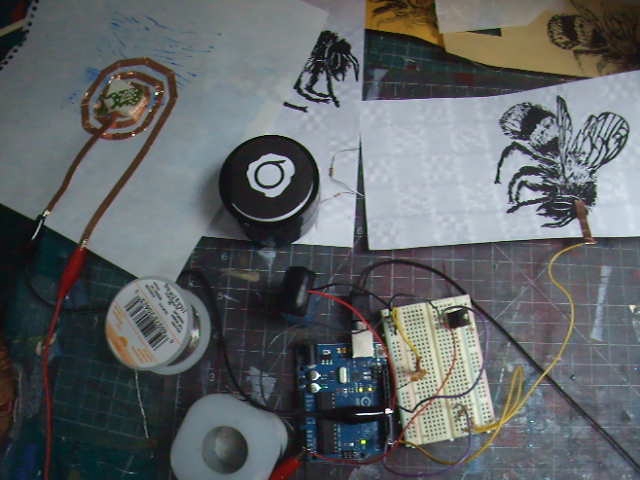
buzzing bumblebee print prototype

So, I can use my linocut on paper connected to an Arduino microcontroller as a sensor, and use the Arduino then to trigger a audio response when someone approaches the linocut. A very simple speaker can be made from a current-carrying wire in a spiral, affixed to a membrane, next to a strong magnet.** So, above I made a speaker with a piece of paper, copper tape as wire and a magnet. The next step was to carve a spiral lino block and block print a speaker on paper with electrically conductive paint, which I did. Thus an actual print, a sheet of paper, becomes both sensor and speaker. I had planned to then make a piece which had multiple bees as multiple sensors which would trigger different reponses. I created the artwork in time for my show about bees in 2013.
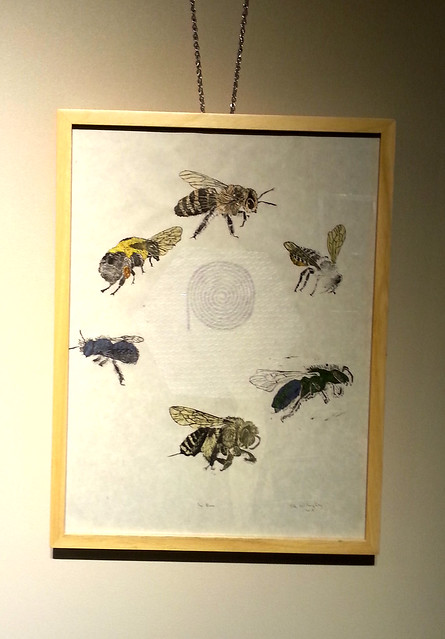
TheBees
The Bees, Ele Willoughby, linocut on various Japanese washi, 18" x 24", 2013.
I had planned to add sound to this piece, but didn't have the opportunity.

I had two issues. First, my prototype used only an Arduino. I was able to play back sound by keeping the recording length quite short and the sampling rate low. There's only so much on-board RAM. I could make multiple sensors each play the same recording, but I simply ran out of memory using only an Arduino.

Secondly, I got pregnant and chose to put electronics aside for a while. I couldn't find any reliable medical guidance about soldering electronics while pregnant or in the proximity of babies (as if there aren't in fact large numbers of engineers, scientists, artists and hobbiests who are women of child-bearing age, ahem!), but jewellers were warned to avoid lead solder, and I opted to err on the side of caution. Lead and developping nervous systems struck me as a bad combination.

So, now that my son is one and a half, I've had an opportunity to return to the idea. The obvious way to add more sound to a project is the off-the-shelf solution of adding a Wave Shield to the Arduino. This is a second circuit board which plugs into the first to let you control and play files from an SD card to a speaker. (Bare Paint has recently released their own microcontroller, the Touch board based on the Arduino, but specifically with their applications for their paint, such as capacitative sensors, in mind. This might have been an easier way to go... but I had an Arduino, so I chose to add a Wave Shield).
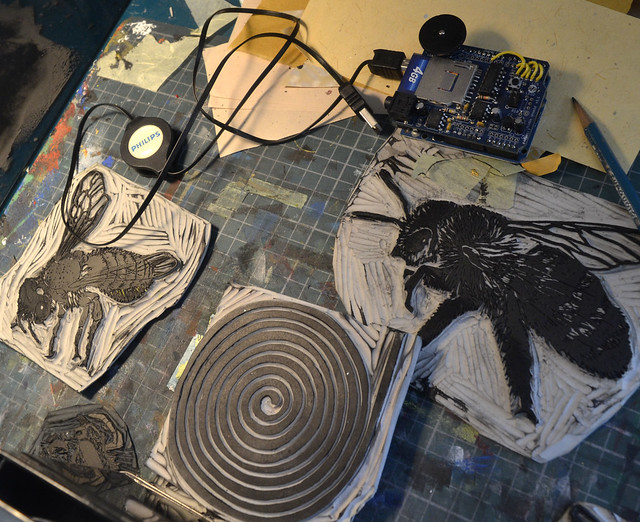
beeblocks
My bee lino blocks and spiral lino speaker block, along with the Arduino and Wave Shield. You can talk to the Arduino via serial port. I combined the open source code wavehc_play6.pde (which plays different 6 audio files when 6 different buttons are pushed) with ArduCapSenseBlinky.ino which employs a collection of capacitative sensors to trigger a collection of LEDs to flash.
beeconductive
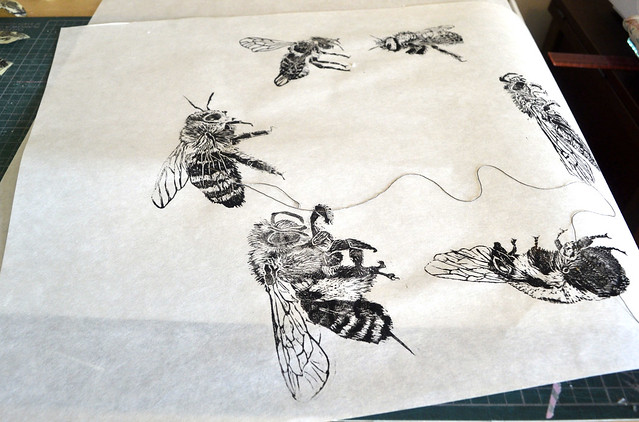
To make an electrical connection from my 6 bees (honeybee, bumblebee, leafcutter bee, long-horned bee, blue orchard mason bee and sweat bee), which I block printed in Bare Paint with block printing extender on Japanese kozo paper, I sewed through the paper with electrically conductive thread. I wanted the speaker, magnet and electronics to be behind the sheet, so I needed to pass through it. 
beeEisel
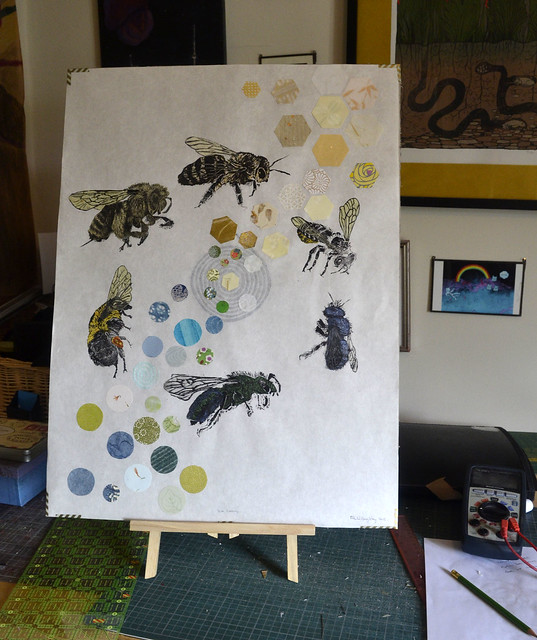
I also printed each bee block on a variety of Japanese washi papers, to get the colour and texture of the bees and wings. This also hides the stitching/electrical connections. The story I'm telling with the piece is about how bees live here. We all know the honeybee, with its hexagonal cells in its hives, but it's not native to North America. Most of our native bees live in holes and burrows. They also come in a wide range of colours. So the other collaged, handmade papers, represent how the bees live, from the hexagons with the honey bee at the top in yellows, to the circles in blues and greens at the bottom. In this shot you can also see the spiral speaker printed on the reverse. The sheet is on kozo paper which is very strong, but not at all stiff. So I backed it with book board to have something on which to mount the electronics. My trusty multimeter is there so I can check that each bee does have good connectivity through to the digital I/O pin on the Arduino.
beeElectronics
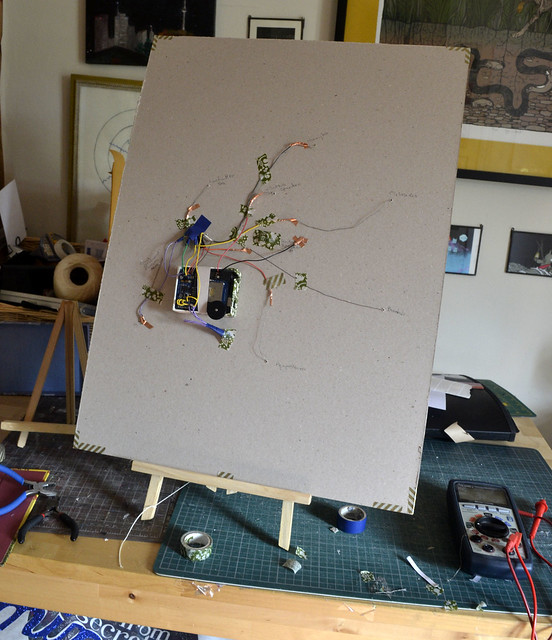
This is what's hiding behind the piece. I affixed a small box to hold the Arduino. There are six DIO pins at the top of the Wave Shield board connected to wires in purple, green, yellow, orange, red and brown. These in turn are connected using copper tape to each of the 6 conductive threads coming from the 6 bees. The threads from either end of the speak spiral are likewise connected to the speaker output and ground.
I made a short recording for each bee. I tried to find audio recordings of each different species. Back in 2012, Sarah Peebles directed me to some of her audio recordings on Reasonating Bodies. I also simply searched YouTube for videos of each type of bee. I combined these (using Audacity... which is pretty awesome freeware for simple sound applications) with my spoken words about the bees and save these as .WAV files which can be played by the Arduino Wave Shield. So I was able to say how though the honeybee might be our idea of the canonical bee, our "default" bee, it is in fact not native to North America, and many of out native bees are quite different; many are solitary, producing neither hives nor honey, and coming in all sorts of colours. You can see and hear my piece at the Graven Feather show the Bees (& the Birds), which runs June 4 through 27. I'll post a video of the piece in action later. You can find each of my bees prints separately here (and learn a little bit about each species too).

*In fact, this is how the gravimeter I used for my doctorate worked too. Picture a mass suspended on a spring such that the spring force upward is balanced by gravity downward. Should the force of gravity change as you move the sensor (due to a large buried mass below, for instance) the mass on a spring will no longer be in equilibrium. The sensor was the most extraordinary, delicate, tiny, spun quartz spring terminated with a tiny piece of quartz coated in gold between capacitative plates. When the mass moved, an electrical restoring force was applied to the plates which returned the sensor to equilibrium. This restoring force could tell you the change in gravity, or, in my case acceleration (since I kept the gravimeter still, it was the seafloor which moved up and down).

**A good source of strong magnets: old hard drives

Friday, July 19, 2013

It's Better With Bees

Bee biodiversity exhibit

If you missed the It's Better With Bees exhibit (March 30 to July 1, at the Ball's Falls Conservation Centre in Jordan, Ontario), here are a few photos. The exhibit was about bee biodiversity. Along with my prints - which were apparently a useful teaching tool for schoolkids - there was a bee audio box and bee trading cards by Sarah Peebles (check out Reasonating Bodies for more of Sarah's work, lots of resources and a wealth of information on bees), various beekeeping artifacts and a large collection of specimens of different species. I really enjoyed getting so see the exotic bees up close.

The Bees
Detail of The Bees
Detail of The Bees
Bee biodiversity exhibit with The Bees

You can find all of my available bee prints here, or at the gift shop at the Ball's Fall's Conservation Centre. It's a lovely spot, not too far from Hamilton, and only an hour from Toronto or Buffalo - a great place for a picnic. The large print showing all six bees around a hexagon (with lovely Japanese washi tissue paper with a honeycomb pattern) has sold, but I have more multi-bee works in mind! I wanted to comment on the fact that we always think about the honeybee, which is actually a bit atypical and a European import. Our native pollinators are often solitary bees, who live in the ground or simple nests (rather than hives), do not make honey, and can be very unexpected irridescent colours.


Friday, January 8, 2010

The Phylomon Project - Sneak Peak

foxcard mock-up If kids can learn 120 Pokémon 'species', why not their local flora and fauna? A study* showed that despite kids' staggering ability to learn to identify fictional critters on gaming cards, they could identify less than 50% of common wildlife. Next week, UBC's Science Creative Quarterly is launching a collaborative, interactive antidote to ignorance of our ecosystem called The Phylomon Project in honour of 2010, the International Year of Biodiversity.

The image is a sort of mock-up of how a Pokémon-type card might look, featuring my 'Vixen in the Snow' lino block print. Since I volunteered my image, you can have a sneak peak at the site and what is planned.

You can find out more about participation at this link** or in the flickr group. So, all you artists, people who care about biodiversity, people with kids, educators, people who like art, people who are kids, and people into gaming (have I got everyone yet?)- check it out!


*Balmford A, Clegg L, Coulson T, Taylor J., Why conservationists should heed Pokémon., Science. 2002 Mar 29;295(5564):2367.
** This includes an email address for comments and feedback to project creator Dave Ng, for anyone with comments and suggestions on gaming. Eventually they will set up a blog to facilitate discussion. They foresee a wiki-like process to determine the biodiversity content, and I suspect everything will come together in a similar community-driven way.