This month is parasite month for #InsertAnInvert2024, so I have been kind of dancing around the prompts and choosing somewhat different species than those suggested, cause, to be quite honest, some of these inverts give me the creeps. For the first two prompts I chose plant rather than animal parasites and reposted art I had previously made: the Dropsophila (fruit fly) and carmine prints. For the third week a shark barnacle was a suggested species, but I decided to look at the whale barnacles.
This hand-printed lino block print with gel plate printed
areas is about Coronula diadema, a barnacle which specializes in
humpback and some other baleen whales. Each print is 20.3 cm x 20.3 cm
(8" x 8") on lovely Japanese mulberry paper and shows the humpback whale
swimming above and a close up of the whale below with six barnacles.
The
Coronula diadema name comes from its barrel and crown-like shape, which
can grow to 5 cm (2") tall and 6 cm (2.4") in diameter. They are common
to abundant on humpback whales. Barnacles are actually crustaceans, and
C. diadema has 6 plates and a hexagonal opening on top, protected with a
pair of opercular valves. The hermaphrodite parasites cluster together
in order to breed. The barnacles use the whales as host, and the whales
may in turn use the barnacles as a sort of armour and to inflict more
damage when fighting in mating battles or against predators. So theirs
is a likely a mutually beneficial relationship and are considered
commensals.
Roaslind Franklin, linocut, 11" x 14", by Ele Willoughby 2020
Rosalind Elsie Franklin (25 July 1920 – 16 April 1958), the English chemist and x-ray crystallographer whose x-ray diffraction images were instrumental to discovering the double-helix structure of DNA, has been on my to do list for scientist portraits for years and I've finally got around to it. I think it's the messiness and tragedy of her story that made it a challenge. The version of Franklin which is best known by the general public, is the version presented by the Nobel laureate once described by E. O. Wilson as "the most unpleasant human being I had ever met" James Watson, in his biography The Double Helix, published in 1968. Not only does he call her patronizingly Rosy, he presents her as a dowdy data-hoarding scold who "had to go or be put in her place". Ironically, his biography hurt his own reputation (though he's quite skilled at hurting his reputation more recently, what with the repeated pro-eugenics, racist, homophobic and sexist comments). Watson confessed, “Rosy, of course, did not directly give us her data. For that matter, no one at King's realized they were in our hands.” Strangely, after the publication of their DNA structure papers, Watson and Franklin were on friendly terms, exchanged letters and he even once offered her a lift across the US. His version of her as the villain emerged years after her death, when he wrote the book; some (like Franklin's biographer Maddox) suggest guilty feelings about the irregular way her data was accessed and insufficiently cited are the explanation. Before the book was published, Francis Crick, Maurice Wilkins, Linus Pauling, Max Perutz and Rosalind's brother Colin all protested angrily at her portrayal (as well, often, as the portrayal of themselves and other scientists), especially as she could not defend herself. This forced Watson to add an epilogue praising her as a scientist and claiming he hadn't sufficiently appreciated the experience of women in science at that time. Wilkins wrote to Harvard University Press that the book remained disgraceful and they dropped it; it was published instead by Athenaeum Press, becoming a bestseller.
There's a joke amongst scientists that goes, "What did Watson and Crick discover?" "Rosalind Franklin's notes." And while it's important that her contributions are now recognized posthumously, there's more to her story and to the story of DNA research. Ironically, the famous Photo 51 produced by Franklin's graduate student Raymond Gosling, which Maurice Wilkins quietly shared with Watson and Crick and cemented their thinking about molecular structure, is a photo that Franklin had previously presented at a seminar attended by Watson (where he failed to notice it, presumably thinking patronizing thoughts about "Rosy"). Watson, Crick and Wilkins were awarded Nobel prizes in 1962, after her death. Though this was prior to the institution of the informal rule against awarding posthumous Nobels, Franklin was not nominated. Before her life was cut tragically short by ovarian cancer, both prior to and after her DNA research, Franklin also made invaluable contributions across disciplines of physics, chemistry and biology, working to determining the structure of RNA, viruses, coal and graphite. Even aside from her role in determining the structure of DNA, her research was a great benefit to society. I wanted to make sure my portrait represented all of this.
But first, this is a wonderful comic by the one and only Kate Beaton:
by Kate Beaton from Hark, A Vagrant
Rosalind was born in 1920, the second of five children born to a liberal, affluent and influential London Jewish family. Her father was a merchant banker and his uncle had been Home Secretary, the first practising Jew to serve in the British Cabinet. Her father taught electricity, magnetism and history of the Great War, at the Working Men's College and eventually became Vice Principal. Her family helped settle Jewish refugees fleeing the Nazis, especially children from the Kindertransport.They took two of the children into their home. Rosalind attended St. Paul's school, a leading girls' private school, one of few girls' schools which taught physics and chemistry. She excelled at sciences, languages and sports and won a scholarship for university. Her father asked her to donate the funds to a refugee student. She studied chemistry at Newnham College, Cambridge, completing her undergraduate studies in 1941. Due to the sexist attitudes of the day, women were not granted full degrees, but "degrees titular," until 1948 (when previous women's degrees were retroactively awarded). In her last year at Cambridge she met a French refugee and former student of Marie Skłodowska-Curie, Adrienne Weill; this friendship was an opportunity to practice her French and became important in her career.
She began a PhD project on the polymerisation of acetaldehyde and formic
acid under the supervision of Ronald Norrish, Professor of Physical
Chemistry at Cambridge and later a Nobel laureate. It was not a fruitful collaboration. His own biographer described Norrish as "obstinate and almost perverse in argument, overbearing and sensitive to criticism" and Franklin grew to despise him and resigned. She gladly took an opportunity to transfer to the British Coal Utilisation Research Association (BCURA) at Kingston-upon-Thames. She began focusing on the porosity and density of coal, to learn how to increase the
efficiency of the widely used fossil fuel resource. Her work also had
important implications for the effectiveness of the activated-charcoal
filters in Second World War gas masks, issued to the entire British populace in case of gas attack. In working to accurately determine the porosity of coal, she made what was likely the first demonstration that coal acts as a molecular sieve (letting helium molecules through but not larger hexane and benzene). This property is still important to industry today.
She completed her doctorate on the structure of carbon materials in 1945 (and once again, as a woman, had to wait to be awarded her full degree until 1948). Her friend Adrienne Weill suggested she attend a Royal Institution meeting in London where she might meet Marcel Mathieu and Jacques Méring. At this conference her interest was sparked in x-ray diffraction and she met the great crystallographer J.D. Bernal (with whom she would later work). Impressed with her paper Méring offered her a researcher post in Paris to continue her work on carbons for four happy years. Méring was a x-ray crystallographer, who employed the way substances diffracted x-rays to deduce their structure and he taught her how to apply this method. By 1950 she had published a paper in Nature about the structure of carbon, and by the following year had learned that as carbon in the form of coal burns, it can form one of two structures: graphitizing and non-graphitizing (terms she coined). In my portrait, the pattern on her jacket is based on her own publication of the structure of non-graphitizing carbon. She showed these two structures explained the difference between the two possible products of burning coal: cokes and chars, and how they burn. This research had important industrial applications. She continued to write papers about the structure of carbon until she died.
She returned to England in 1950 to work with John Randall, head of the Biophysics Research Unit at King’s College, on a three-year Turner-Newall Fellowship. She planned to look at protein structure but he suggested she work on DNA, as Maurice Wilkins was doing. Randall did not clarify whether Franklin or Wilkins would lead this research, which set their relationship off on the wrong foot. Randall reassigned Wilkin's graduate student Raymond Gosling as her assistant; this surely also did not help things between them. Franklin refined and adjusted the fine-focus X-ray tube and microcamera ordered by Wilkins, improved upon his technique by manipulating the critical hydration of her specimens and employing all her physical chemistry expertise. Wilkins inquired about this and felt her reply was superior. Her directness and enjoyment of a good debate were a bad match for his shyness and distaste for arguments, and their personalities clashed badly.
As early as November 1951, Franklin presented their data at King's College London and noted,
"The results suggest a helical
structure (which must be very closely packed) containing 2, 3 or 4
co‐axial nucleic acid chains per helical unit, and having the phosphate
groups near the outside."
Franklin and Gosling found there were two forms of DNA: long and thin when wet (dubbed B-DNA) and short and fat when dry (dubbed A-DNA). Because of their conflicting personalities, Randall divided the labour so Franklin and Gosling studied the A form and Wilkins the B. They produced beautiful images of DNA during this time, including Gosling's famous Photo 51 (represented in blue in my portrait). By 1951, the King's researchers all believed B-DNA was a helix, but Franklin felt the evidence for A-DNA was still conflicting. Through painstaking work, by January 1953, Franklin reconciled the conflicting data, concluding both forms had two helices. She drafted three papers, and two noted the double helical DNA backbone. She had also decided to leave the unpleasant atmosphere at King's and move to Birkberk College. Randall insisted that the DNA research stay at King's and Gosling would be reassigned back to Wilkins.
Meanwhile in Cambridge, James Watson and Francis Crick were simultaneously working on the problem and had seen a preprint of Linus Pauling's incorrect proposal for DNA. They came to King's to urge collaboration to win the race before Pauling discovered his error. Thanks to Franklin's identification of the nature of the symmetry of the DNA crystals (that is, its space group), Crick understood that DNA strands were antiparallel (and that both Pauling's model and Watson and Crick's previous model were incorrect).
Unable to find Wilkins they spoke with Franklin who was unimpressed by Watson's implication she could not interpret her own data; they argued. Wilkins arrived, commiserated with them, and showed Watson Franklin's work and Gosling's DNA image. From Wilkins' perspective, Franklin was leaving, and Gosling was now his student; but it seems he did not let Franklin know he had done this. In February 1953, Watson and Crick began working on a molecular model of B-DNA, something Franklin felt was premature, with much of the data based on work at King's. Crick got access to many of Franklin's crystallographic calculations when his advisor Max Perutz gave him a report written for a Medical Research Council biophysics committee visit to King's in December 1952. Though not explicitly marked confidential there was an expectation that such a report would not be shared and Perutz later defended this action with inexperience with administrative matters. Franklin's A-DNA paper was submitted 6 March 1953, one day before Crick and Watson had completed their model on B-DNA. She had not seen Watson and Crick's work when she submitted her paper (though they had of course benefited from seeing her, Gosling and Wilkin's work). Her laboratory notebooks reveal that she had already Franklin noted that ‘an infinite variety of nucleotide sequences would be possible to explain the biological specificity of DNA’ all on her own. Franklin got to see the model built by Watson and Crick on April 10 and apparently commented, "It's very pretty, but how are they going to prove it?" Her philosophy as an experimentalist was to be able to rigourously prove a model correct before publishing. Franklin did modify her paper while in press, after seeing the others' work to acknowledge their work. A trio of DNA papers were published as 25 April 1953 Nature articles. Watson and Crick's paper only acknowledged "having been stimulated by a general knowledge of" Franklin and Wilkins' "unpublished" contribution. Due to agreements between the directors of the King's and Cambridge labs, Wilkins and Franklin published the two other DNA articles with x-ray diffraction data supporting Watson and Crick's model (rather than presenting them as the data which underpinned the model). Watson and Crick invited Wilkins to be a co-author but he declined because he had not help build the model. He later lamented that they can not discussed authorship more thoroughly.
It may have been less than obvious to Watson and Crick how to cite materials they used, including Photo 51 and the MRC report, but it is something that they could have been done and ethically, many argue that they should have done. Likewise, Watson and Crick were aware of Franklin and Gosling's paper (which included Photo 51), submitted before she saw their work, but they merely noted that their model was not inconsistent. Any mention they made of Franklin is in combination with, and after naming Wilkins. There is a strong case to be made that Franklin's work was insufficiently credited, and its value and role in determining the structure of DNA has only be recognized posthumously. There's no evidence that Watson and Crick ever let Franklin know what they later acknowledged, that they could not have made their model without out her work, or that she felt insufficiently recognized in their publication. They remained friends during her life and continued to correspond about their respective research projects.
By mid-March, Franklin moved to the much less fancy but much more pleasant Birkberk College, having been recruited by physicist John Desmond Bernal. She was much more comfortable at the non-denominational Birkbeck than the Anglican King's. Though Bernal wanted her to move on from nucleic acid, she continued to mentor Gosling and aid him with the completion of his thesis. The two published the first evidence of the double helix in the A form of DNA in the 25 July issue of Nature. With funding from the Agricultural Research Council, she was able to start her own research group and begin working on RNA and the structure of the Tobacco Mosaic Virus (TMV), an RNA virus. In my portrait her brooch is a model of TMV. She published her first major TMV paper in 1955 in Nature, in opposition of prominent and powerful virologistNorman Pirie, who wrote her angry, condescending letters and refused to ever again supply her with virus samples to study. But her careful observational work was once again correct. With her grad student Kenneth Holmes she found the protein covering was molecules arranged in helices. Early in 1954, she happened to meet Aaron Klug on the stairs at work. She showed him her photo of the TMV and he wrote, it sealed his fate. Captivated, he sought permission to switch to virus research. They began a long and fruitful collaboration. She oversaw a group with her students, Aaron Klug and his student John Finch and the group published on TMV, cucumber virus 4, turnip yellow mosaic virus and other plant viruses. She had a student James Watt supported by the National Coal Board and continuing her longstanding research interest in carbon. With postdoc Donald Caspar she showed that the RNA was wound on the inner surface of the hollow TMV. She had begun working on the structure of the Polio virus, receiving with Krug the large grant ever at Birkbeck. While traveling in the US in 1956, she noticed her stomach had swelled
and she went to the doctor upon her return. They found two tumours. She had ovarian cancer. She continued working when not hospitalized or convalescing with family and friends (including Francis and Odile Crick, with whom she remained close). Her group produced seven papers in 1956 and six in 1957, despite the cancer. She was promoted to Research Associate in Biophysics on the 25th of February. Tragically she was not able to proceed with the polio research as her health rapidly deteriorated. She was invited to display a large model of TMV in Brussels at Expo 58, the first major international fair after World War II; the fair opened the April 17, but she died April 16, 1958 of bronchopneumonia, secondary carcinomatosis, and ovarian cancer. It's possible that x-ray exposure played a role in the cancer. Science during the 1950s was far too laissez-faire about radiation shielding. The following year, Klug and Finch published the polio virus structure and dedicated the paper to her memory.
By 1962 the scientific community at large was convinced of the structure of DNA, and Watson, Crick and Wilkins were awarded the Nobel Prize in Physiology or Medicine. The rules preclude splitting the award more than 3 ways and Wilkins' inclusion was based not only on his role in discovery but his later work providing data to support the model. As Franklin foresaw, it took years of work to actually convincingly prove the "pretty" model. But, even Watson suggested that Wilkins and Franklin might instead have shared the Nobel in Chemistry. Franklin was never nominated, even though this predates their rule against posthumous prizes.
Also, her long-term collaborator on virus structure, Aaron Klug continued the work he began with Franklin, winning the 1982 Nobel Prize in Chemistry for his development of crystallographic electron microscopy and his structural elucidation of biologically important nucleic acid-protein complexes. Her staunchest defender, and beneficiary of her will, he spoke of her and her impact upon him in his acceptance speech.
Today, she has become one of the most widely recognized researchers in the history of science, with many awards, buildings, plaques and monuments in her honour, worldwide. Elucidating the structure of DNA has perhaps had the most impact on society at large, but her research in carbon and on viruses also has lasting significant impacts in science.
References
Brenda Maddox, 'Rosalind Franklin, The Dark Lady of the DNA,' HarperCollins, 2002.
Brenda Maddox, The double helix and the 'wronged heroine'.
Nature421, 407–408 (2003). https://doi.org/10.1038/nature01399
I have another scientific Cinderella story for you. A
daughter of a poor family makes an epic walk to the big city, makes a gown for
a princess, finds her own merchant prince and reinvents herself as scientist
and inventor, solves marine biological mysteries and is a trailblazer for women
in science!
Jeanne (sometimes Jeannette) Villepreux was born in 1794 in
Juillac, the eldest daughter of a humble shoemaker and a seamstress who died
when she was young. As a child, her education consisted merely of learning to
read and write. When she reached 18, she walked the 400 km to Paris to
try to make her fortune as a dressmaker. She found a job as an apprentice to a
society dressmaker, thanks to her artistry and skill as an embroiderer. Within
four years she had made a name for herself when she made the wedding gown of
Sicilian Princess Caroline for her marriage to Charles-Ferdinand de Bourbon,
future Duc de Berry and nephew of the King Louis XVIII. Through this newfound
fame, she met a wealthy Irish merchant James Power, who was based in Italy. She
taught herself English and Italian before the couple married and moved to
Sicily in 1818. In her new home, she dedicated herself to her studies, natural
history and inventorying the island’s ecosystem, both on and offshore. Messina,
where the couple lived, was a natural draw to visiting scientists. As a
avid reader with an excellent memory, she educated herself rapidly and became
well-connected with respected scientists. She travelled the island gathering
minerals, fossils, butterflies and shells.
She had a particular interest in
molluscs and their fossils, as well as one of their predators, the mysterious
greater Argonaut (Argonauta argo) called the paper nautilus, which she studied from 1832 to 1843. The sheltered bay at Messina made it easy for her to see life
under the calm waters. Despite its name, the paper nautilus is more closely
related to octopuses than the nautilus. These rarely seen animals had long be
the subject of myths; people commonly believed they stole their shells and
even, thanks to Aristotle's wild conjectures, that they employed them as boats
with the large dorsal arms as sails, to sail on the surface of the ocean. In
1932, she invented the aquarium to allow her to better study these marine
animals, working with local fishermen who would bring her buckets of argonauts
in seawater. She had a glass one for study, a submersible one, which fit in a
cage, and a cage, known as "cages à la Power" which could be anchored
at sea to study animals in their own environment since argonauts had not fared
well in captivity. She methodically developed techniques to care for and feed
marine creatures and change the water in the aquaria. She tracked how they fed,
how they grew, moved and developed. The source of the shells remained
mysterious, even after multiple experiments. Eventually she had the idea
to damage a shell, and observe the animal within the cage when it was supplied
with broken pieces of shells. She patiently watched for hours on end and was
rewarded; she saw the animal repair its shell with the membranes on its front
arms (which Aristotle mistook for sails). The membranes in fact secrete
calcite, and the animal gently crafted and repaired its shell, evidence that it
had created the shell itself.
She found not only that the paper nautilus did produce its
own shells but that these were egg-sacks. She did the first studies of how
these creatures reproduce. Argonauts have extreme sexual dimorphism; the
females are twelve times as large as the males and the tiny males had not yet
even been identified by science. She deduced that the small organisms which
accompanied the egg sacks must be the male of the species, but later the truth
was revealed to be even less probable; they were simply detached male
reproductive organs which attach themselves to the female mantle. But, she was
right to deduce these were part of the species' reproduction, yet her male
peers dismissed her observations, insisting these were merely parasitic worms.
She observed how the animals increase their shell sizes three times from August
to December to make room for their young. She reported her results to the Academy
of Catania in 1934 (and then was elected a member of this learned society) and
in 1935 she sent her results to Paris to the Academy of Science. Her results
were well received in Europe, though she faced some of her male peers doubted
her; French zoologist Henri Marie Ducrotay de Blainville insisted argonauts
scavenged their shells to the French Academy in 1936. She did not allow this to
discourage her and she persisted in her work. Others like Sir Richard Owen, who
defended her work in 1839 to the London Zoological Society and French
malacologist Sander Rang who presented one of her papers, supported her
research.
She published her first book in 1839, in French Observations
et expériences physiques sur plusieurs animaux marins et terrestres (Observations and Physical Experiments on
Several Marine and Terrestrial Animals) which included her evidence solving the
mystery of the paper nautilus’ shell and her second in Italian, Guida per la
Sicilia, a comprehensive guide to the local environment, including
descriptions and illustrations of hundreds of plants, animals, fossils and
minerals, was published in 1842. In 1860, she published a paper on the Octopus
vulgaris, and showed that the animal uses tools, including stone to hold
open Pinna
nobilis,
the noble pen shell or fan mussel shells.
She wrote passionately about
conservation issues and developed the principles of sustainable aquaculture in
Sicily. She was a talented artist and made lovely scientific illustrations of
the species she observed. She was recognized for her science by her peers,
admitted as the first woman in the scientific academy Catania Accademia
Gioenia, as a correspondent member of the London Zoological Society and sixteen
other learned societies. The famous biologist and paleontologist Sir Richard
Owen called her "Mother of
Aquariophily."
Tragically when she and her husband left Sicily in 1843, she
lost most of her collections, many of her records and scientific illustrations
in a shipwreck. This loss may explain how she gave up experimenting in her
later life, though she continued to write and speak publically about the natural
world. The couple divided their time between Paris and London. She fled Paris
during a siege by the Prussian Army in 1870, and she returned to Juillac where
she died in 1871.
A crater on Venus has been named Villepreux-Power in her
honour in 1997.
Celeste Olalquiaga, 'The Artificial Kingdom,' Pantheon Books, 1998.
Allcock,
A. & Von Boletzky, Sigurd & Bonnaud, Laure & Brunetti,
Norma & Cazzaniga, Nestor J. & Hochberg, Eric & Ivanovic,
Marcela & Lipinski, Marek & Marian, José & Nigmatullin,
Chingis & Nixon, Marion & Robin, Jean-Paul & Rodhouse, P.
& Vidal, Erica. (2015). The role of female cephalopod researchers:
past and present. Journal of Natural History. 49. 1235-1266.
10.1080/00222933.2015.1037088.
He coined the terms "recessive" and "dominant"
traits. Some of his findings are subtlely alluded to in the layout of
the pea flowers, like a Punnett square depicting a cross between two pea
plants heterozygous for purple and white blossoms - that is, purple flowers are a dominant characteristic and the first generation of crossbread plants will have all purple flowers, but the recessive white flowers can reappear in subsequent generations. The first edition is
a variable run of 8 prints, each 11" by 14" (28 cm by 35.6 cm), on
ivory Japanese kozo paper with "chine-collé" white and mauve paper.
Apart from completing this print this weekend, I unfortunately got to spend most of the beautiful Sunday afternoon inside, in line. A few weeks ago, I was thinking that I don't get out enough with the baby and still had not used gift certificates I got at Christmas. It's a challenge sometimes to work around his meals and naps and get anywhere on public transit (especially if that means carrying him and his stoller up and down three flights of stairs cause so many stations are still not accessible in 2015!). So, I made a point to go to a certain shop with the intent of replacing my 10 year old, twice-repaired shoes. I found the shop mostly empty of shoes but I did buy myself a dress on sale, and went across the street and bought myself an organic fruit smoothie at the Big Carrot, which I shared with the baby. At the time, I thought I'd done really well. As locals will know, a server has since been diagnosed with Hep A, and thus, like hundreds of other patrons, Gabriel and I got to wait in line to be vaccinated. It's unlikely we've been exposed; we would have had to have been served by the particular person and he or she would have had to had improperly washed hands... but it's not worth risking (and the young can show no symptoms while readily infecting others). Not how I would have liked to have spent the first lovely warm day of the year... though I was kind of impressed that everyone took the public health advice, turned up, and waited patiently. The elderly couple behind us offered to push the stroller and hold out place in line so I could at least let Gabriel run around a little. He's not too rambunctious and people were patient with him, which I appreciated. It helps that he smiles at everyone.
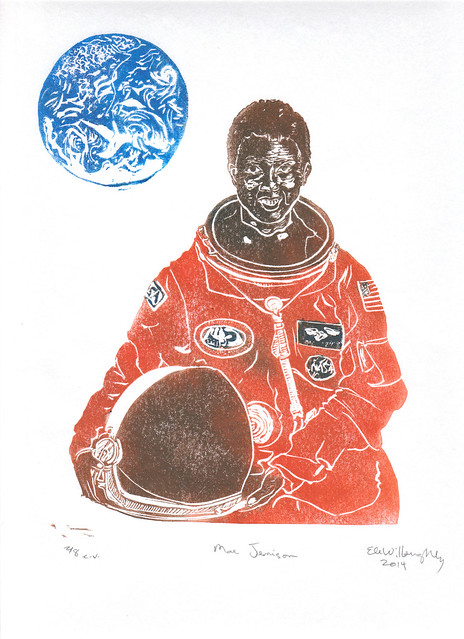
I'm working on my series of women in science protraits for the show in the fall. The latest in my scientist portrait series is American astronaut Mae Jemison. Astronauts are generally extraordinary, but I love that not only was she a trailblazer, she is someone with twin passions for art and science, who danced professionally, was well as being a chemical engineer and medical doctor.
Mae Jemison, linocut on Japanese kozo paper, 9.25" by 12.5" (23.5 cm by 32 cm) in an edition of eight by Ele Willoughby, 2014
Mae Jemison (born October 17, 1956), is a physician who became the first African American woman to travel in space when she went into orbit aboard the Space Shuttle Endeavour for NASA, on September 12, 1992. She also has a B.S. in chemical engineering, served in the Peace Corps, is a dancer and choreographer, formed and runs her own company researching the application of technology to daily life, and even appeared on Star Trek: The Next Generation. Inspired to join NASA by Nichelle Nichols, who portrayed Lieutenant Uhura on Star Trek, she was the first real astronaut to appear on any Star Trek show.
Jemison is a Professor-at-Large at Cornell University and was a professor of Environmental Studies at Dartmouth College from 1995 to 2002. As well as her own company the Jemison Group, she founded the Dorothy Jemison Foundation for Excellence with projects like The Earth We Share (TEWS), an international science camp for students, ages 12 to 16, and biotech company BioSentient Corp.
I made a 2nd edition of my 'Darwin on Galapagos' block print on pale gray Japanese washi paper. Each sheet is 10.5 inches (26.7 cm) tall and 7 inches (17.8 cm) wide. This is one of the 2nd edition of 3.
"The inhabitants believe that these animals are absolutely deaf; certainly they do not overhear a person walking closely behind them. I was always amused, when overtaking one of these great monsters as it was quietly pacing along, to see how suddenly, the instant I passed, it would draw in its head and legs, and uttering a deep hiss fall to the ground with a heavy sound, as if struck dead. I frequently got on their backs, and then, upon giving a few raps on the hinder part of the shell, they would rise up and walk away; but I found it very difficult to keep my balance."
Going in a manned submersible is definitely on my bucket list. My mother has made me promise not to tell her about it until I'm on dry land again. I've been obsessed with the idea, and with bioluminesce since I first witnessed many of these creatures over a decade ago. It is true what she says, that it's addictive. You have to order the scientists out of the lab and remind them they need to sleep in order to be awake for their next shift.
The communication aspect is something I'd like to capture.
So, I got home from England and immediately went to Victoria. Well, no, not immediately. I slept for 15 hours, comforted the cat, ate some food, packed my bags, and then flew to Victoria. It was surprisingly cold there (generally, except for two sunny days it was below 22C, often overcast and rainy). This is unusual in July, when they usually have a drought. Though we encountered some really problems and challenges, we actually fixed them, and everything went quite reasonably well.
I didn't see any whales, which is also unusual. I saw dolfins, lots of seals, the usual assortment of marine birds, and several of what I now suspect were sea cucumbers (of the less fancy sort).
This is the seal hangout:
For most of our time at sea, the seas were very calm. I will make do with overcast skies if it means the seas are calm, though the Bos'un was tired of clouds and complained bitterly (with a twinkle in his eye). He was old-school, and missed the days when science ships were for science.
This is Crofton, which is beautiful, except for the pulp and paper mill, which we saw, for days.
This pickle-like creature was a stowaway on our equipment. I thought he was a sea slug, but now, I think he's a sea cucumber. Though they often have antenna and look fancier, there are definitely creatures which look much more like this, which live offshore BC and are identified as sea cucumbers. As a scientist, I often get asked questions about biology... but I'm a physicist by training (and am specifically a marine geophysicist) and have no biology education whatsoever. Friends know that I get irked by the way the media often treat scientists as some sort of undifferentiated mass of people ("Scientists say..." the tv says and I holler back, "What sort of scientists?! Do they have names?"). I've met biologists, and even occasionally collaborated, and since everything in the ocean can be thought of as inter-related, there are some things I must know. Most of these facts are about micro-organisms. I've learned a fair bit about sea birds, and whales, because they are extraordinaire... and often the sailors can identify them at a glance. I can also identify some fish, shellfish and octopi, which we commonly see with ROVs. But, "slightly irridescent, wrinkly, greenish, legless, bottom-dweller in only a few hundred metres of water" definitely falls into a gap in my knowledge.
Ernst Haekel (February 16, 1834 – August 9, 1919), the famed German biologist, naturalist, philosopher, physician, professor and artist, whose book "Art Forms in Nature" filled with lovely 19th century scientific illustrations of biology has inspired many of my prints. This month the mad scientists of etsy challenge theme is Ernst Haeckel, so here we have the man himself, surrounded by several of the creatures he depicted. Clockwise from the top we have: rugosa, a foraminifer (or foram), a tubularid hydroid, homo sapiens (Ernst Haeckel), a dinoflagellate, and a sea slug or nudibranch.
This is an original lino block print printed in various colours, water-based block printing ink on Japanese kozo (or mulberry) paper. The first edition is limited to four prints The sheets are 30.5 cm by 30.5 cm (12 inches by 12 inches).
I had to choose a nudibranch because they are so spectacular looking, like a sea cucumber dressed for carnivale. There are some weird looking creatures in the ocean. When tasked with documenting what we see with a submersible ROV, we are often left with little option but to type 'critter' or even more vaguely 'life'. I can't help but recall an animated short I saw at the NFB with , 'Chloe the sea cucumber' which was in fact weirder than any critter I've seen yet.
Haeckel seems to have a Louis Riel thing going on. The print is based on a photo of him, clearly after doing field work, in 1866 (hence the posture, leaning on the table).
I left Awakino and headed for Waitomo. As I approached the town, I saw one of the 'blackwater' rafting companies. I wanted to see the glow-worm caves. RM & AS stopped and saw the caves on their drive from Auckland to Wellington and they were really impressed. I might have done a simpler (cheaper) tour or gone to see the glow-worms in one of the publicly accessible caves, but a) I was open to doing something more adventuresome and b) Graham said the blackwater rafting wasn't to be missed. I stopped at this first place and asked what they did and when they had tours. It was clear that I would have to spend the night in Waitomo and go in the morning, but it sounded like a good option. The girl there told me I could also book through the i-Site and compare what different companies had on offer. This is what I did, but I ended up going with that first company (Rap, Raft 'n' Rock, which was great, despite its name). They offer a bit of everything and a three hour tour for a fair price. It includes entry to the Glow-worm Museum, at the i-Site, which I visited that evening. It was a hokey, but it was informative about the geology and biology of the 'glow-worms' (though their chemistry was a bit absurd... not that that would bother most people... and the history seemed a bit sanitized... but anyhow, they serve their purpose).
I found myself a motel for the night. Motels in New Zealand are usually accommodations for families. They are large, not fancy, but include a mini-kitchen area. As soon as you arrive at a motel they present you with your milk. You see, you necessarily need tea (having just arrived), but you wouldn't have milk (having just arrived). I do drink tea, but not with milk, so I just saved mine in the fridge and drank it in the mornings.
At 8:45, I and the other participants (a young Danish couple and a Taiwanese guy) met our guide Mike at the Backpackers inn where they have their offices. (All photos are by Mike or other employees. Cavers are asked not to bring cameras. We really needed both hands free). We had to fill in a form (and I confessed to my previous knee injuries) and then were driven to their "five-star changing facilities" (our guide was blessed with the typical Kiwi humour - like the geophysicist who told me sheep are now rare since they are down to 35 million). These were shippping containers on a hillside, with toilet, shower and tub for washing wet suits. We were given wet suits and boots, and then climbing gear. We then drove to the entry of the cave, where we practiced using the climbing gear on the open hillside. Then, one by one we abseiled the 27 m into the cave with our guide as brake man at the top. Once inside, we got an inner tube and began our walk through the (black) water. I saw an eel, a common resident of the caves (along with weta - a giant New Zealand insect like a grasshopper, spiders, and things I did not see like rats or possums).
We climbed through the caves for a while, both on the rock and through the river. Then we came to a larger cavern area where we were able to really see the glow-worms (rather than just the odd glint of bluish light). The glow-worms are really the larval stage of the Arachnocampa luminosa, a type a gnat which makes sticky threads to trap food like a spider. The threads are covered in sticky mucus and look like tiny chandeliers. The larvae can only eat and not excrete (and the adult has no mouth so the larvae must do all of the eating). The bioluminescence is a biproduct of digestion and used to attract food. Insects instinctively fly up, and in the dark of the caves, pinpoints of blue lights do look like the night sky. We were efficient enough in hiking through the caves that we had time to stop and watch a glow-worm eat a gnat which Mike caught and stuck on a thread.
We had a couple a periods of floating along the river on the inner tubes, or sort of swimming along on top of the inner tubes, freely or in a chain. And there were a few person-sized tunnels one could carefully crawl through. The caves themselves were pretty amazing.
Then we stopped for a snack of chocolate and hot juice and had a chance to hear about the formation of the caves and caving exploration. We climbed back out of the cave, drove the the changing rooms and showered. We returned to their offices where they fed us hot soup and showed the photographs that Mike had taken.
It was a great, fun and fascinating experience and I'm really glad I did this. I've wondered about caving before. I'm a little claustrophobic. Mainly that means I don't like being trapped. But, all of the tunnels we climbed through were short enough that I could see either the exit or at least light from the opposite side, so it didn't bother me. It was really a different world for me. Plus, bioluminescence is high on my 'things which are inherently cool' list. It was quite magical to float down the river in the dark with bluish star-like illumination from the glow-worms above.