Showing posts with label invertebrates. Show all posts

Thursday, April 30, 2026

Meet the Pollinators


Meet the Pollinators book cover
Cover of 'Meet The Pollinators' board book, written by Lisa Jaffe and illustrated by me, Ele Willoughby

The last week of April is InverteFest, of one three yearly week-long celebrations of all things invertebrate. I usually participate in sharing invertebrate art, and often in their collections of invertebrate art. This year they decided to also publish an online anthology. They paired up artists and writers, and the pairs all collaborated on different projects. I was paired up with the lovely Seattle-based writer Lisa Jaffe. Last fall worked together to come up with a project. She wrote the sweetest little book, introducing little ones to some of our favourite pollinators. We chose a collection featuring some of our favourites from where I live in Ontario, and where she lives in the Pacific Northwest. I designed and illustrated the book with my linocuts of plants and pollinators.

You can find the entire book, and download it for free, along all with all the other wonderful and varied contributions to the InverteFest Anthology on Saimi Hanma's website. It's really an amazing assortment. There's poetry, short stories, sci-fi, satire, children's lit, historical fiction, and fantasy by some very talented writers and artists. You can also enjoy the collection of art books put together by Franz Anthony and information about joining on observing (or making art or writing about) invertebrates for InverteFests. Check it out!

Friday, October 18, 2024

More Invertebrate Prints


Motyxia sequoia, linocut, 8" x 8" by Ele Willoughby, 2024


Motyxia are blind, bioluminescent, cyanide-producing millipedes known as Sierra luminous millipedes  from the southern Sierra Nevada, Tehachapi, and Santa Monica mountain ranges of California. I made this print for #InsertAnInvert2024 prompt "eyeless." My hand-printed linocut is printed in both regular and glow-in-the-dark ink so like Motyxia sequoia itself, the prints glow-in-the dark! Each print is on 8" x 8" cream coloured Japanese washi paper with bark inclusions.

Motyxia sequoia, linocut 8" x 8" by Ele Willoughby, 2024
Motyxia sequoia, glowing in the dark, linocut 8" x 8" by Ele Willoughby, 2024

These millipedes grow to 3 to 4 cm in length, 4.5 to 8 mm wide, with 20 body segments, excluding the head. Like other polydesmidans ("flat-backed" millipedes) they lack eyes and have prominent paranota (lateral keels). They are typically tan to orange-pink in colour with a dark mid-dorsal line;  they are fluorescent under black light and bioluminescent.


Diving Beetle Paroster pallescens, linocut, 8" x 8" by Ele Willoughby, 2024

This is a hand-printed of the Paroster pallescens beetle, surface diving water beetle from Australia. It is printed on 8" x 8" Japanese paper. I made this print for the #InsertAnInvert2024 prompt diver.

I decided I should finally make an actual edition of my fruit fly Drosophila melanogaster.

Drosophila melanogaster, 9" x 12" linocut by Ele Willoughby, 2024

This linocut print highlights the model organism Drosophila melanogaster, the common fruit fly or vinegar fly. A hind-printed ring with 5 of the different eye colour genetic mutations appear on lovely handmade Japanese washi paper with flecks of bark inclusions. Each print is 9" by 12" (22.9 cm by 30.4 cm).

A species of fly (the taxonomic order Diptera) in the family Drosophilidae, D. melanogaster is used as a model organism for biological research in genetics, physiology, microbial pathogenesis, and life history evolution.  It breads quickly, has only four pairs of chromosomes, and is easy to raise in the lab anywhere in the world. It's also a well-known pest in kitchens worldwide!


Tuesday, October 15, 2024

Deep Sea Invertebrates


Vampire Squid, linocut, 9.25" x 12.5", by Ele Willoughby, 2024
Vampire Squid, linocut, 9.25" x 12.5", by Ele Willoughby, 2024 

For the #InsertAnInvert2024 prompt bathyal I made a linocut vampire squid (Vampyroteuthis infernalis). The 'vampire squid from hell' is a small deep sea cephalopod  found throughout temperate and tropical oceans with two long retractile filaments, located between the first two pairs of arms on its dorsal side, unlike either octopuses or squids. Though most closely related to octopods it is the only surviving memeber of its own order Vampyromorphida. It survives in the deep sea thanks to bioluminescent organs and its unique slow oxygen metabolism.

It is up to 30 cm long and has a webbing of skin connecting its eight arms, each lined with rows of fleshy spines or cirri. It can be a range of colours but lacks the sort of colour-changing ability of some cephalopods; it is however, covered in photophores which allow it to produce disorienting flashes of light in its ligtless (aphotic) environment, 600 m to 3300 m below the surface. It can also eject a sticky cloud of bioluminescent mucus containing innumerable orbs of blue light from its arm tips if agitated, coating predators in glowing ink. Its eyes are disproportionately large. Its ear-like fins protruding from the mantle are the adults main means of propulsion. Despite its name it feeds on detritus, not blood.

Dumbo Octopus, linocut 9.25” by 12.5” by Ele Willoughby, 2024

For the #InsertAnInvert2024 prompt abyssal I made this lino block print of a charming Grimpoteuthis octopus, one of a genus of pelagic cirrate (finned) octopods known as the dumbo octopuses. The fins reminded scientists of ears on the elephant in Disney’s 1941 film Dumbo. Hence their common name dumbo octopuses. 

It's believed dumbo octopuses have a worldwide distribution, living in the cold, abyssal depths ranging from 1000–7000meters and they have even been observed at hadal depths.
Headless Chicken Monster, 8" x 8" linocut print by Ele Willoughby, 2024

For the #InsertAnInvert2024 prompt hadal, I made this lino block print of the headless chicken monster! A strange-looking sea cucumber called Enypniastes eximia, the swimming sea cucumber or the pink see-through fantasia. It is printed by hand on delicate 8" x 8" Japanese mulberry paper. Their swimming fin allows them to move up 1 km in the water column to avoid predators or find new feeding ground. The semi-transparent 11 to 25 cm long, benthic, bulbous creatures with bifurcated tentacles, large anterior sail and visible intestines go from light pink to reddish-brown as they age. They can also be bioluminescent. They feed on benthic sediments during brief forays onto the seafloor. These animals can be found at extreme depths including an observation at 5,775 m in the Marianas Trench.

Friday, July 26, 2024

Anemones!

Clownfish and Anemone, linocut, 9.25" x 12.5", by Ele Willoughby, 2024
Clownfish and Anemone, linocut, 9.25" x 12.5" by Ele Willoughby, 2024
 

August is coastal month for #InsertAnInvert2024 so I made a couple of anemone prints. For the first prompt 'tropical reef' I made a rose bubble anemone.This is a handprinted linocut of two ocean creatures with a mutualistic symbiotic relationship: anemone and anemonefish. Specifically it's a rose bubble-tip anemone (Entacmaea quadricolor) and a clownfish (in the genus Amphiprion), also known as an anemonefish. Sea anemones protect anemonefish from predators, and serve as a safe nest. The anemonefish get food from anemone leftovers and the occasional dead anemone tentacles. In return, the anemonefish defends the anemone from its predators and parasites and nitrogen excreted by the anemonefish increases the number of algae incorporated into the tissue of their hosts, which aids the anemone in tissue growth and regeneration. The fish even aerate their hosts with their movements and may lure anemone pray with their bright colours.

For prompt 'temperate reef', I shared my lemon lolly nudibranch again. For the prompt 'intertidal' I re-posted the ochre sea stars. But, for the prompt 'sand' I made a wandering anemone linocut.


Wandering Sea Anemone, linocut, 8" x 10", Ele Willoughby, 2024

This is my hand-printed Lino block print of a wandering sea anemone (Phlyctenactis tuberculosa) on 8” x 10” Japanese mulberry paper. The wandering sea anemone or swimming anemone, is a species of venomous sea anemone in the family Actiniidae native to sheltered reefs of shallow seas around Australia and New Zealand/Aotearoa. They are covered in bubble like sacks in a variety of colours (including pink!) with lighter coloured tentacles. It bundles together during the day and its appearance has been likened to baked beans. At night it comes alive and goes wandering; though generally attached to rock, seagrasses and kelp, it can detach its pedestal disk and creep along the seabed, climb sea grasses or algae to find better places to hunt prey.

Thursday, July 18, 2024

More Troglofauna and Stygofauna


Paroster macrosturtensis, linocut print, 8" x 8" by Ele Willoughby, 2024

The other two #InsertAnInvert2024 prompts were troglofauna or cave fauna and stygofauna or subterranean but aquatic fauna. 

This is a hand-printed of the Paroster macrosturtensis beetle, a blind predatory subterranean diving water beetle from the calcrete aquifers of the Western Australian desert. Trapped underground for million of years as the calcrete caves formed these beetles have evolved to no longer have eyes. It is printed on 8" x 8" Japanese paper.


Neoniphargidae, 8" x 8" linocut print by Ele Willoughby, 2024

This is a hard-carved and hand-printed linocut print of a little semi-transparent, white amphipod crustacean in the Neoniphargidae group from the Pilbara. This is a large, dry, sparsely populated region in northern part of Western Australia which is a global biodiversity hotspot for subterranean fauna including aquatic animals that live in groundwater called stygofauna like this. Stygofauna can live in subterranean caves but most commonly live in alluvial, karstic or fractured rock aquifers within pore space and fractures in the rock.  In the absence of light, stygofauna lack eyes and pigmentation. Stygofauna have evolved and survived over millions of years in the ecologically important Pilbara groundwater environment.

Tuesday, June 25, 2024

Parasitoid Wasp, Blue Velvet Worm and Glowworm Caves of Waitomo


Long-tailed Ichneumoid Wasp, linocut, 8" x 8" by Ele Willoughby, 2024

Next up for #InsertAnInvert2023 is my hand-printed lino block print on 8" x 8" Japanese washi paper of Megarhyssa macrurus, the long-tailed ichneumoid wasp or ichneumon wasp. It's a parasitoid wasp and its "long-tail" is in fact it's extremely long ovipositor which you can see looping from its back end into the tree. The wasp uses it to deposit an egg into a tunnel in dead wood bored by its host, the larva of a similarly large species of horntail or wood wasp. Its body is up to 51 mm long and the ovipositor on the female wasps can be 130 mm. It can be found in the eastern US and southern Canada around the Great Lakes. 

Blue Velvet Worm, linocut 8" x 8" by Ele Willoughby, 2024


July is Subterranean month, which as it turns out, requires some new art. Here's a sneak peek! I stuck fairly close to the first prompt, simply choosing a different velvet worm, than the one suggested, because the colour is so gorgeous. Hence, my Blue Velvet Worm. Velvet worms (phylum: Onychophora) are named for their velvet-like texture and somewhat wormlike appearance. They are elongate, soft-bodied, many-legged nocturnal animals who spit slime to trap prey, somewhere between worms and arthropods. Like an arthropod their heads have segments but otherwise they have wormlike bodies. They have flexible wormlike skin but like insect skeleton in composition. They have insect-like limbs, but they are unjointed and conical in shape. They look like caterpillars who don't become butterflies. The two extant families of velvet worms are Peripatidae and Peripatopsidae. And amongst the latter there are some in the genus Peripatoides which exhibits lecithotrophic ovoviviparity; that is, mothers in this genus produce and retain yolky eggs in their uteri. The eggs are fertilized internally, and babies develop inside their mother until large enough to be born, in batches of 4–6, as colourless miniatures of the parents! Peripatoides novaezealandiae is a species complex of velvet worms in the genus Peripatoides, found throughout New Zealand. This print is made based on photos of P. aurorbis, but all the Peripatoides novaezealandiae have no morphological characters that distinguish them.


Glowworm Caves, linocut in regular and glow-in-the-dark ink, 8" x 8" by Ele Willoughby, 2024

Glowworm Caves, linocut in regular and glow-in-the-dark ink, 8" x 8" by Ele Willoughby, 2024, shot in the dark so you can see how it glows.
 

Third week was troglofauna, or invertebrates who live in caves.  I strayed from the suggested species, because I wanted to illustrate invertebrates I travelled to see, in the glowworm caves of Waitomo. My love of bioluminescence overcame my claustrophobia, and I was proud I ventured into caves, even where it was a tight squeeze.

Glowworm cave photo by by Rap, Raft 'n' Rock, Waitomo


That's me, photo
by Rap, Raft 'n' Rock, Waitomo, May 2010


On the North Island of New Zealand or Aotearoa, there are caves near Waitomo with large populations of Arachnocampa luminosa, a glowworm (insect larvae and adult larviform females that glow through bioluminescence) native to the country.

In the limestone caves, these glowworms, a species of fungus gnat endemic to New Zealand, dot the ceilings with glowing light like blue constellations in the night sky. The larval stage and the imago produce a blue-green bioluminescence. They are found in caves and sheltered banks where humidity is high, hence its Māori name "titiwai", meaning "projected over water." They lay eggs on cave walls and the glowing 3 to 5 mm larva emerge, generally in the spring, and select a site to begin producing its silk nest where it will grow to 30 to 40 mm over several months.

The larva spins silk nests on cave ceilings from where they hang up to 30 threads along which it regularly places small sticky droplets to trap prey like other small Diptera (especially midges), spiders and other non-flying invertebrates. Prey is attracted by the bioluminescence and then sticks to the threads. When prey gets stuck, the larva pulls it up by ingesting the snare and starts feeding on the prey alive.

These are a limited edition reduction lino block print. Each is made with glow in the dark ink, so the 8" x 8" prints themselves glow like the glowworms.


Tuesday, June 18, 2024

Humpback and Barnacle


Humpback and Barnacle, linocut, 8" x 8" by Ele Willoughby, 2024

This month is parasite month for #InsertAnInvert2024, so I have been kind of dancing around the prompts and choosing somewhat different species than those suggested, cause, to be quite honest, some of these inverts give me the creeps. For the first two prompts I chose plant rather than animal parasites and reposted art I had previously made: the Dropsophila (fruit fly) and carmine prints. For the third week a shark barnacle was a suggested species, but I decided to look at the whale barnacles.

This hand-printed lino block print with gel plate printed areas is about Coronula diadema, a barnacle which specializes in humpback and some other baleen whales. Each print is 20.3 cm x 20.3 cm (8" x 8") on lovely Japanese mulberry paper and shows the humpback whale swimming above and a close up of the whale below with six barnacles.

The Coronula diadema name comes from its barrel and crown-like shape, which can grow to 5 cm (2") tall and 6 cm (2.4") in diameter. They are common to abundant on humpback whales. Barnacles are actually crustaceans, and C. diadema has 6 plates and a hexagonal opening on top, protected with a pair of opercular valves. The hermaphrodite parasites cluster together in order to breed. The barnacles use the whales as host, and the whales may in turn use the barnacles as a sort of armour and to inflict more damage when fighting in mating battles or against predators. So theirs is a likely a mutually beneficial relationship and are considered commensals.

Tuesday, April 23, 2024

Worms!

April is worm month for #InsertAnInvert2024 and I confess, worms are not my favourite invertebrates. But, I have been making some science art about the worms, especially some flamboyant marine worms. For the prompts long no limbs, long with limbs, not long no limbs and not long no limbs, I made a six-lined ribbon worm, Y, a fuchsia flat worm and an Elvis worm.


Six-lined Ribbon Worm, linocut, 8" x 8" by Ele Willoughby, 2024
 

The suggested species for the "long, no limbs" theme was Tubalanus sexlineatus. The six-lined ribbon worm (Tubulanus sexlineatus) is dark brown with five narrow, (sometimes discontinuous) longitudinal, white stripes, with indications of a sixth stripe midventrally and encircled in up to 150 white bands. Tubulanus is a genus of primitive nemertean worms in the order Palaeonemertea. It lives on the Pacific coast of North America from Alaska to California. Amazingly this is a species which can  to regrow a head after amputation!

What’s inside this cigar box? A black smoker - with giant tube worms (Riftia pachyptila) for #InsertAnInvert2024. I’ve had the idea for this multimedia in my head for years! Cigar box, collaged papers, gouache, Posca pen, glue, washi tape.


I’ve never had the opportunity to go on a research cruise to a hydrothermal vent, though I have contributed to plans for monitoring and seen a lot of footage shot by marine geophysicist/geologist/geochemist colleagues. I used to walk by the top of a chimney daily at work at PGC; it had been recovered by an ROV (something scientists no longer do, as these vents are protected).

Black Smoker multimedia: Cigar box, collaged papers, gouache, Posca pen, glue, washi tape. Three photos of inside and outside of box.
Black Smoker multimedia: Cigar box, collaged papers, gouache, Posca pen, glue, washi tape. Ele Willoughby, 2024


They are extraordinary, otherworldly environments and it tells us a lot about life that such vents, called black smokers or white smokers (for fluids emitted from the natural chimneys) are home to so many creatures. Crustal fluids in the seabed are vented due to volcanic heating near mid-ocean ridges and chimneys are built with the deposition of minerals in fluids coming out of solution when hot vent fluids (~60°C!) come in contact with the cool ~2°C ocean bottom water. These high pressure environments with hot fluids filled with the sorts of chemicals we find toxic like sulfides, are actually home to vibrant communities based on a food chain founded by chemosynthetic bacteria. These black smokers in the Pacific are often carpeted with these giant tube worms (& home to other invertebrates like limpets, clams, shrimp and more). These extremophiles may also be showing us that hydrothermal vents may have been a nursery for early life on this planet.

The giant tube worms (diameter ~4 cm, length up to 3 m) tolerate extremely high hydrogen sulfide levels and they were a great shock to the geologists who found them in this hostile environment. As adults they make a white chitinous tube, with a bright red branchial plume & NO digestive system but rely on symbiosis with chemosynthetic bacteria for nutrition!
 
Black Smoker multimedia: Cigar box, collaged papers, gouache, Posca pen, glue, washi tape.
Black Smoker multimedia: Cigar box, collaged papers, gouache, Posca pen, glue, washi tape. Ele Willoughby, 2024

 
Fuchsia Flatworm, linocut by Ele Willoughby, 2024 
Fuchsia Flatworm, linocut by Ele Willoughby, 2024

You'll remember I posted this one before: the strange and beautiful fuchsia flatworm (Pseudoceros ferrugineus) with its gorgeous aposematic colours, a warning to predators that it's not worth the trouble to try and eat. A flexible ruffled oval creature it is a little hard to capture in an illustration. It crawls around eating on the reefs of the Indo-Pacific without any fear of predators.


Elvis worm, linocut on washi, 8" x 8" by Ele Willoughby, 2024

In 2020, scientists discovered 4 types of scale worms, with shimmering lavender, blue, orange and exoskeletons, which looked like they were wearing sequined jumpsuits like Elvis Presley! They named these worms Elvis worms. These species in the genus the genus Peinaleopolynoe are called P. goffrediae, P. mineoi, P. orphanae, and P. elvisi. The worm in my print is Peinaleopolynoe orphanae, a iridescent and lavender worm named for geobiologist Victoria Orphan. These fancy scale worms live in the nutrient-rich deep sea. P. orphanae have been observed biting and fighting each other. No matter how pretty, they are actually fierce little creatures in their sequined outfits.

To recreate these iconic worms in print form, I have used layers of delicate handmade Japanese washi paper and iridescent cellophane. It's a challenging thing to photograph or scan but the colours change with the angle of the light.

Thursday, March 7, 2024

Triadic Colours, CYMK, Primary Colours, and Warm Colours and My Printer Solstice Prints


Ochre Sea Stars, linocut by Ele Willoughby on 8" x 8" washi paper

For the #PrinterSolstice prompt triadic colours, I choose the secondary colours orange, purple and green, which are three equidistant on the colour wheel. I was looking forward to #InsertAnInvert2024 and needing an intertidal creature.

My lino block print of two Pisaster ochraceus, generally known as the purple sea star, ochre sea star, or ochre starfish, on a bed of kelp, is hand-printed on 8" x 8" (20 cm x 20 cm) delicate white Japanese paper with bark inclusions. A common sea star, or starfish of the Pacific, it is a keystone species considered an indicator of health in the intertidal zone. Most of these starfish are purple but they can also come in orange (as shown), or ochre, yellow and brown.

These were amongst my favorite finds on the beaches of Vancouver Island.


A collection of small gel prints made with cyan, magenta, yellow and black ink, cut paper stencils, lino blocks and plant materials

For the #PrinterSolstice prompt CMYK I spent a morning experimenting with my gel plate, using paper stencils, lino blocks and plant materials and my process cyan, magenta, yellow and black inks.

For the #PrinterSolstice prompt primary colours, I thought I would play with adding yellow and red to a cyanotype (which are in tones of blue of course). I decided to return to my idea of contrasting a fractal Sierpiński triangle and the naturally occurring fractal shape of a fern leaf. The Sierpiński triangle (also called the Sierpiński gasket or Sierpiński sieve) is a fractal equilateral triangle, subdivided recursively into smaller equilateral triangles. It's a self-similar sets—that is, it is a mathematically generated pattern that is reproducible at any magnification or reduction named after the Polish mathematician Wacław Sierpiński. This was a decorative pattern many centuries before Sierpiński. I made a cyanotype of a fern leaf and used a gel plate to add a red circle. I lino block printed the yellow Sierpiński triangle.

Fractal Geometry, cyanotype with gel print and linocut, 9" x11" by Ele Willoughby, 2024
 

And for the final prompt warm colours, I looked ahead once again to prompts for #InsertAnInvert2024 and decided I needed to make a true crab.

Frog crab, linocut print on washi paper, 8" x 8", by Ele Willoughby, 2024

 My hand-printed red frog crab (Ranina ranina), also known as a spanner crab or Huỳnh Đế crab, is hand-printed on Japanese kozo (or mulberry) paper 8" x 8" (20.3 cm x 20.3 cm) square. This crab is found in tropical and sub-tropical waters offshore Australia, the Philippines, Vietnam, the east coast of Africa, through the Indian ocean to  the Pacific offshore Japan and Hawai'i. It is the sole known member of its genus and it is fished for its meat. The 5.9" (15 cm) crabs live in 10 to 100 m (33–328 ft) or water, where they bury themselves in the sand during the day and hunt bottom-dwelling fish. Known as "frog crabs", on account of their elongated carapace and frog-like appearance. Their claws are modified into tools for digging, and the body is a rounded shape that is easy to bury in sand. Unlike most other true crabs, the abdomens of raninids are not curled under the cephalothorax, so they are a little unusual looking.

Ranina ranina is a regional specialty in some regions of the Philippines where it is known as curacha. It is generally eaten steamed as halabos, or cooked in coconut milk as ginataan. In Vietnam the species is named as "Huỳnh Đế crab", literally means "emperor crab" as it has been a favorite high-ranked cuisine of historical Vietnamese monarchs hailed "monarch of all the crab".


Wednesday, February 28, 2024

Mussels and Chitons - New marine invertebrate prints

 Looking ahead to some #InsertAnInvert2024 prompts, I made some linocut marine invertebrates.


Blue Mussel, linocut, 8" x 8" by Ele Willoughby, 2024

The blue mussel (Mytilus edulis), or common mussel, is a medium-sized edible marine bivalve mollusc in the family Mytilidae. They are aptly called common mussels and are found on temperate beaches worldwide. They are also yummy.

A more complicated print is my lined chiton. They are extraordinary wee animals, which come in all sorts of colours. 

Lined Chiton, Linocut, 5" x 7" by Ele Willoughby, 2024

The lined chiton, Tonicella lineata, is a beautiful, colourful tiny marine mollusc of the North Pacific. Each 5 cm (2") long animal has zigzag purple or black lines on eight valves on a array of different colours like brown, red or burgundy like here but can also be bright blue or yellow to orange with a hairless girdle in colours like brown to red or pink, often with regular yellow or white patches. It is found from the Aleutian Islands of Alaska to San Miguel Island of California, as well as the Sea of Okhotsk of Russia and northern Japan in the intertidal to subtidal waters of 30 to 90 m (100 ft to 300 ft) depth. It's thought their colourful bodies are intended to camouflage against algae. They are prey of the ochre starfish.

Chitons are also sometimes known as sea cradles or coat-of-mail shells or suck-rocks, or more formally as loricates, polyplacophorans, and occasionally as polyplacophores.

Each print is made on 12.7 cm x 17.7 cm (5" x 7") printmaking paper. Because this is a reduction print, after each colour, I carved away more of the block, this is a limited edition of 12 prints. When they are gone, there will be no more originals.


Wednesday, January 17, 2024

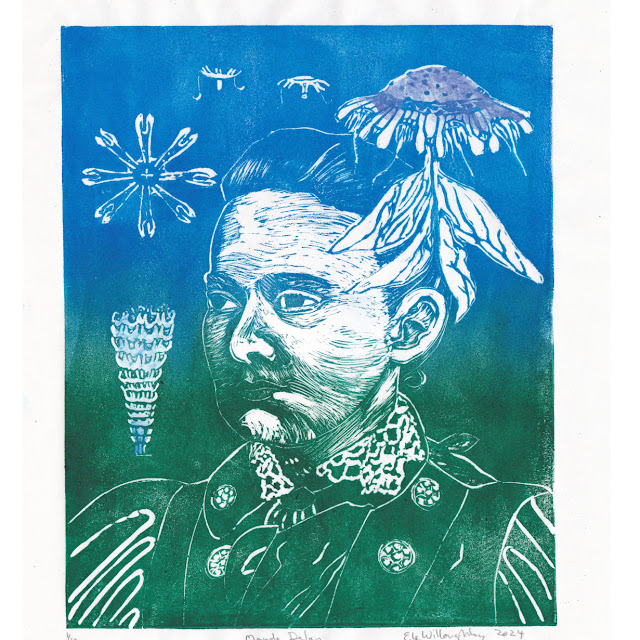
Marine Biologist Maude Jane Delap and the Jellyfish


Maude  Delap, linocut, 11" x 14" by Ele Willoughby, 2024
Maude  Delap, linocut, 11" x 14" by Ele Willoughby, 2024

The next prompt for #PrinterSolstice is "cool colours" and I was reminded of the sea, and a woman suggested to me for my women in STEM series. 

This is my linocut portrait of self-taught trail-blazing Irish marine biologist Maude Jane Delap (1866 – 1953) who was the first person to successfully breed jellyfish in captivity and document their full lifecycle, something extraordinarily hard to do. Her work is still cited in laboratory manuals for jellyfish rearing. She made an extensive study of plankton over many years near her remote home on Valentia Island, off Ireland's west coast. She also discovered a sea anemone named in her honour, Edwardsia delapiae. In my portrait she is surrounded by different stages in the blue jellyfish (Cyanea lamarckii) based on her own illustrations of her published research.

Born the seventh of ten children to Rev Alexander Delap and Anna Jane (née Goslett) in Templecrone Rectory, County Donegal, Maude moved with her family to Valentia Island at age 8. Her father had been assigned to the parishes of Valentia and Cahersiveen, and, a keen sailor, he sailed around the coast with two of her brothers. Their possessions, following in a second boat, arrived a little worse for wear. Her mother and the rest of the children travelled by train. While the girls had less formal education than their brothers, they had some progressive primary school education and their naturalist father encouraged Maude and her sister Constance (1868–1935) in their interest in biology and zoology. He himself had published articles in the Irish Naturalist and the whole family were avid naturalists. Maude and Constance became prolific collectors of marine specimen, many of which are still housed by the Natural History Museum, Dublin. Maude and her sister got reports from visiting fishermen of interesting species in all the their catch, for which they would pay a few shillings, encouraging what is now often known as "citizen science" or "community science."  They were sometimes invited aboard to observe finds and jellyfish. Since the family enjoyed boating and fishing, Maude and Constance learned how to handle a boat and would row out alone, exploring the coast and caves. The Fisheries Board granted them part-time access to their steam boat for their research.

The sisters' work lead to a survey by the Royal Irish Academy headed by Edward T. Browne of University College London in 1895 and 1896. Browne was particularly interested in plankton, the floating marine organisms ranging in size from microbes to large jellyfish, which are often the basis of the food chain and indicative of ocean health. Maude and Constance continued with their systematic study, gathering specimen of often tiny jellyfish and plankton by dredging and tow-netting, as well as recording sea temperature and changes in marine life for 28 years! They brought specimen back to the lab to identify and sketch them. Maude's patience, attention to detail, skill with her microscope and as an artist allowed her to document microscopic details of jellyfish structures and organs. Maude corresponded with Browne for forty years until his death in 1937. It's speculated that she had fallen in love with him; it was unrequited and he married a colleague. She sent him a box of violets she grew in her garden each year for his birthday. Browne thanked both sisters in his publications and jointly published research with Maude.

Maude became fascinated by the life cycle of jellyfish. She painstakingly developed a means of keeping them alive in captivity - something which other scientists had struggled and failed to achieve. She determined their diet, at each stage of development, through trial and error and explained the paramount role proper diet plays in being able to keep them in captivity. She changed the water daily, adjusting temperature to match that in the habour, where they thrived, and carefully monitored the jellyfish. She was the first person to breed them successfully in her home laboratory. The life cycle of the jellyfish is unusual: an adult medusa can procreate by producing a planuala (or egg), which implants on a surface like the seafloor and grows into a polyp (which looks a little like a plant rooted in the ground). The polyp can grow into a budding polyp. This stage of the cycle can go either direction; in less than optimal conditions the budding polyp can revert to the polyp stage. In optimal conditions the budding polyp will bud off ephyrae and these eventually grow into adult medusae. Previous to Delap's work, these various stages could be misinterpreted as separate species. She bred four species of jellyfish including Chrysaora isosceles (the compass jellyfish) and Cyanea lamarckii (the blue jellyfish shown in my print) and documented their life cycles and feeding habits and published her results. Her trailblazing research was the first identification of the various life cycle stages (medusa and hydra) that belong to which species. Quite unusually for a woman at the time, Maude published several influential scientific papers under her own name: she published six articles, and three short notes, including two co-authored by Constance. Thanks to her contributions to marine biology she was offered a position in 1906 at the Plymouth Marine Biological Station in England. She declined the job; her father had apparently declared,  "No daughter of mine will leave home, except as a married woman." While this lost opportunity must have been an immense disappointment, she continued her work at home. Leaving Valentia, and her sisters, at age 40 might also have been quite a daunting prospect. Staying in Valentia allowed her to produce her incredible lengthy study of Valentia harbour, and support her unmarried sisters for the rest of their lives, growing and fishing for food and earning income from selling flowers from her garden.

When her father died later that year, the her mothers, two sisters and Maude moved out of the Parsonage and were permitted to use Reenellen House by the Knight of Kerry. There, they hosted many guests including friends, family, visiting scientists and naturalists, and fishermen seeking safety and shelter in bad weather. While remote, Valentia was home to a telegraph station which was the European terminus for the trans-Atlantic cable, a weather station and an observatory, which did lead to a number of visiting engineers, scientists and marine biologist. The Delap sisters were highly-regarded members of their community, who helped run the local cottage hospital and fisherman's hall, known for their charity and generosity but also for wearing outdated Edwardian clothes, both for propriety and economic necessity. Her nephews recalled going fishing in the evening to feed all the guests, along with fruits and vegetables they grew in the garden. They set up a laboratory they fondly dubbed "The Department" which was described by her nephew as an "heroic jumble of books, specimens, aquaria, with its pervasive low-tide smell." Aquaria contained not only jellyfish, but fish, starfish and even a thornback ray Maude reared from an egg. She buried dead marine vertebrates in her garden to recover their skeletons.

In 1920, as the official whale-stranding officer for south west Ireland, appointed by the British Museum and the local contact for interesting wildlife, she was alerted to a stranded 16-foot whale on the rocks beyond the lighthouse. So she rowed out with her handyman, and she correctly identified a rare True's beaked whale, only previously been known from an incomplete US specimen. Unable to save it, she sent its head and flippers (on request) to the Natural History Museum and buried the rest in her garden. The Museum later requested the rest of the skeleton, causing her to dig up her asparagus garden to gather them. The Museum wrote again that two tiny vestigial pelvic bones were missing so Maude dug up her garden again and sieved the soil until she received a telegram from the Museum which read, “Stop! New York Museum informs us that True’s beaked whale does not possess vestigial pelvic bones."  

In 1928, she found a previously undescribed sea anemone burrowing deep into the eelgrass. Named in her honour, the Burrowing Sea Anemone (Edwardsia delapiae) has only been observed in Valentia habour.  In 1936, she was made an associate of the Linnean Society of London. In 1937 she was made an associate member of the Marine Biological Association. She submitted specimen and corresponded with the Natural History Museum from 1894 until 1949, when she was 83. Like her father before her, she submitted observations to Dr Scully’s “Flora and Fauna of Kerry” and both are acknowledged in the text. Maude was also interested in folklore, geology, botany and archaeology and she published several papers in the Kerry Archaeological Magazine. Her grand-nephew recalled Maude, the "old-school Victorian all-round naturalist”, saying, “Wherever we went, she was instantly recognized and greeted with delight”. She died in 1953, and was buried alongside her sisters near Knightstown, Valentia Island, County Kerry. There is now a plaque from the Irish National Committee for Commemorative Plaques in Science and Technology to commemorate her and her work, on the island.


References,

Byrne, Patricia M. Delap, Maude Jane. Dictionary of Irish Biography.

DOI: https://doi.org/10.3318/dib.002516.v1
Originally published October 2009 as part of the Dictionary of Irish Biography
Last revised October 2009
 

M. J. Delap. 1905. Notes on the rearing, in an aquarium of Cyanea Lamarcki, Peron et Lesueur. Annual report of Fisheries, Ireland 1902-03. II (I(ii)) 20-22.

Maude Delap, Wikipedia, accessed January, 2024. 

Muka, Samantha Kay. Maude Delap: Jellyfish Goddess of the North Atlantic, Through the Aquarium Glass blog, October 29, 2012.

Sheehan, Jane. Finding Maude Delap, LIVE – Llŷn, Iveragh Ecomuseum blog, accessed January, 2024

Sheehan, Jane. Finding Maude Delap, Online Lunchetime Talk, LIVE – Llŷn, Iveragh Ecomuseum, YouTube, February 11, 2022.

Sheehan, Jane. Maude Delap Heritage Trail. 27 July 2023. (Accessed January 2024)