Showing posts with label natural history. Show all posts

Tuesday, June 25, 2024

Parasitoid Wasp, Blue Velvet Worm and Glowworm Caves of Waitomo


Long-tailed Ichneumoid Wasp, linocut, 8" x 8" by Ele Willoughby, 2024

Next up for #InsertAnInvert2023 is my hand-printed lino block print on 8" x 8" Japanese washi paper of Megarhyssa macrurus, the long-tailed ichneumoid wasp or ichneumon wasp. It's a parasitoid wasp and its "long-tail" is in fact it's extremely long ovipositor which you can see looping from its back end into the tree. The wasp uses it to deposit an egg into a tunnel in dead wood bored by its host, the larva of a similarly large species of horntail or wood wasp. Its body is up to 51 mm long and the ovipositor on the female wasps can be 130 mm. It can be found in the eastern US and southern Canada around the Great Lakes. 

Blue Velvet Worm, linocut 8" x 8" by Ele Willoughby, 2024


July is Subterranean month, which as it turns out, requires some new art. Here's a sneak peek! I stuck fairly close to the first prompt, simply choosing a different velvet worm, than the one suggested, because the colour is so gorgeous. Hence, my Blue Velvet Worm. Velvet worms (phylum: Onychophora) are named for their velvet-like texture and somewhat wormlike appearance. They are elongate, soft-bodied, many-legged nocturnal animals who spit slime to trap prey, somewhere between worms and arthropods. Like an arthropod their heads have segments but otherwise they have wormlike bodies. They have flexible wormlike skin but like insect skeleton in composition. They have insect-like limbs, but they are unjointed and conical in shape. They look like caterpillars who don't become butterflies. The two extant families of velvet worms are Peripatidae and Peripatopsidae. And amongst the latter there are some in the genus Peripatoides which exhibits lecithotrophic ovoviviparity; that is, mothers in this genus produce and retain yolky eggs in their uteri. The eggs are fertilized internally, and babies develop inside their mother until large enough to be born, in batches of 4–6, as colourless miniatures of the parents! Peripatoides novaezealandiae is a species complex of velvet worms in the genus Peripatoides, found throughout New Zealand. This print is made based on photos of P. aurorbis, but all the Peripatoides novaezealandiae have no morphological characters that distinguish them.


Glowworm Caves, linocut in regular and glow-in-the-dark ink, 8" x 8" by Ele Willoughby, 2024

Glowworm Caves, linocut in regular and glow-in-the-dark ink, 8" x 8" by Ele Willoughby, 2024, shot in the dark so you can see how it glows.
 

Third week was troglofauna, or invertebrates who live in caves.  I strayed from the suggested species, because I wanted to illustrate invertebrates I travelled to see, in the glowworm caves of Waitomo. My love of bioluminescence overcame my claustrophobia, and I was proud I ventured into caves, even where it was a tight squeeze.

Glowworm cave photo by by Rap, Raft 'n' Rock, Waitomo


That's me, photo
by Rap, Raft 'n' Rock, Waitomo, May 2010


On the North Island of New Zealand or Aotearoa, there are caves near Waitomo with large populations of Arachnocampa luminosa, a glowworm (insect larvae and adult larviform females that glow through bioluminescence) native to the country.

In the limestone caves, these glowworms, a species of fungus gnat endemic to New Zealand, dot the ceilings with glowing light like blue constellations in the night sky. The larval stage and the imago produce a blue-green bioluminescence. They are found in caves and sheltered banks where humidity is high, hence its Māori name "titiwai", meaning "projected over water." They lay eggs on cave walls and the glowing 3 to 5 mm larva emerge, generally in the spring, and select a site to begin producing its silk nest where it will grow to 30 to 40 mm over several months.

The larva spins silk nests on cave ceilings from where they hang up to 30 threads along which it regularly places small sticky droplets to trap prey like other small Diptera (especially midges), spiders and other non-flying invertebrates. Prey is attracted by the bioluminescence and then sticks to the threads. When prey gets stuck, the larva pulls it up by ingesting the snare and starts feeding on the prey alive.

These are a limited edition reduction lino block print. Each is made with glow in the dark ink, so the 8" x 8" prints themselves glow like the glowworms.


Monday, May 27, 2024

Crustaceans!

 May is crustacean month for #InsertAnInvert2024. Playing on the idea of carcinisation, the process by which again and again, other crustaceans keep evolving crab-like bodies, the prompts are "crab," "false crab," "not crab" - and, shudder, "really not crab." Some of the non-crab crustacean abominations are, well, in my subjective opinion, nightmare fuel, so I veered off the path of suggested species and found a cute but distinctly non-crab crustacean for you. Also, it was a cue to try different print media. 

First up is "true crab" and I had my frog crab ready, from the warm colour prompt for Printer Solstice.

Frog crab, linocut print on washi paper, 8" x 8", by Ele Willoughby, 2024
Frog crab, linocut, 8" x 8" Ele Willoughby, 2024


Next up was false crab, so I re-shared my porcelain crab.

Porcelain crab linocut, Ele Willoughby, 2021
Porcelain crab linocut, 8" x 10", Ele Willoughby, 2021


Then was "not a crab" - I cheated a bit by sharing another false crab: the yeti crab. It has crab in its name but it's really closer to a squat lobster.

Yeti crab linocut by Ele Willoughby
Yeti crab linocut by Ele Willoughby, 2020


The last prompt is "really not a crab" with some suggestions that I honestly did not feel like contemplating at length. There are some scary looking crustaceans out there!

Daphina longispina, Tetrapak drypoint, 4" x 6" by Ele Willoughby, 2024

Instead, I went for the adorable microscope (1 to 5 mm) planktonic crustacean Daphina or water flea! Daphina longispina is a wee little freshwater water flea found worldwide in bodies of water from the size of rock pools to large lakes. They are filter feeders who mainly eat algae. This one is a female full of green eggs. I made this print using an actual Tetrapak juice container. I etched in the fine lines and peeled a bit of the surface material for coloured areas, then pushed ink into the etched areas with some card, and wiped away the excess ink. I cut my plate in a circle to suggest that this is a view through a microscope. I was able to pull a few prints on dampened watercolour paper using my etching press.

Tuesday, October 10, 2023

Hildegard von Bingen, Medieval Medicine and Natural History for Ada Lovelace Day


Hildegard von Bingen, linocut, 11" x 14" by Ele Willoughby, 2023


Ada Lovelace, 3rd edition
Ada, Countess Lovelace, 3rd edition linocut by Ele Willoughby
It is once again Ada Lovelace Day, the 15th annual international day of blogging to celebrate the achievements of women in technology, science and math, Ada Lovelace Day 2023 (ALD23). I'm sure you'll all recall, Ada, brilliant proto-software engineer, daughter of absentee father, the mad, bad, and dangerous to know, Lord Byron, she was able to describe and conceptualize software for Charles Babbage's computing engine, before the concepts of software, hardware, or even Babbage's own machine existed! She foresaw that computers would be useful for more than mere number-crunching. For this she is rightly recognized as visionary - at least by those of us who know who she was. She figured out how to compute Bernouilli numbers with a Babbage analytical engine. Tragically, she died at only 36. Today, in Ada's name, people around the world are blogging.

 
You can find my previous Ada Lovelace Day posts here.

Despite some biased ideas about the Medieval period, which we inherited from Enlightenment scholars, the Dark Ages were only "dark" in the sense that there is a dearth of documentation. All too often, people have the idea that this was a stagnant period in the pursuit of knowledge after the end of the Classical period. Many documents of the time have simply been lost, so we don't have a lot of information about many individuals and their specific advancements in scientific thought. But the sheer fame and productivity of Hildegard von Bingen (1098-1179) is an exception. Her writings preserve not only her own knowledge and theories but much of the nature of institutional medicine and folk healing of her day (which she deftly combined). While she might be best remembered today as a composer of seventy Gregorian chants and musical dramas and as a Catholic saint, author of biblical commentaries, three books on her visions and two biographies, she is also recognized as the progenitor of natural history in German-speaking lands and author of medical and natural history texts. She even invented her own script and language!

Likely born the tenth child in her rural Rhineland family, her religious parents raised her intending for her to be a tithe to the church, and she entered the double-monastery at Disibodenberg at 14. Her well-respected magistra Jutta (1092-1136) became her mentor and teacher, and it is believed Hildegard was assigned to the infirmary. There she would have been responsible for, in particular, for but likely not limited to, the health of the women at the monastery and adjoining community. She would also have had access to the books and knowledge of her male counterpart, who was responsible in particular for the health of the men. After Jutta's death, Hildegard was elected magistra and she lead the Disibodenberg nuns until 1148, when at age 50, inspired by a vision, she moved them all to a new monastery at Rupertsberg at Bingen. She immediately began writing her text books. Physica describes elements, mammals, reptiles, fish, birds, trees, metals, and precious stones and medicinal uses of 293 plants (230 herbaceous plants and 63 trees). Causae et curae was written presumably to ensure that her replacement in the infirmary had all the knowledge she would need. It describes 47 diseases along with causes, symptoms and treatments and goes on to document 300 plants used to treat diseases. It reads both like a Medieval first aid manual and technical scientific writing of her day. She lived in the new monastery until her death at 81. People traveled to Rupertsberg to receive healing from Hildegard and her order. She was a prodigious correspondent and has been called a Medieval "Dear Abby" because of her letters to such luminaries as King Henry II of England, King Louis VII of France, the Holy Roman Emperor Frederic I Barbarossa, the Byzantine Empress Agnes of France, Bernard of Clairvaux, four popes and others. She was invited to preach at nearby cathedrals including at Cologne, Mainz and Worms. By the time she reached 80, she was so respected and renown that she could defy the pope and it was the pope who had to back down. Commanded to excommunicate a man in her community, she simply declined to do so.

Outside of Salerno, those practicing medicine in her day were not university educated, but either working in monasteries and infirmaries or were folk healers using herbal folklore. Hildegard's contemporary woman in medicine Trota of Salerno is a notable exception, as she was formally educated at the medical school in Salerno. The rise of universities and formal medical schools actually lead to greater exclusion of women from medical practice; universities usually excluded women. 

Hildegard developed a holistic understanding of medicine and was systematic and scientific in her approach within her Christian worldview. She is believed to have access to ancient Greco-Roman medical sources, typically available and shared between monasteries, including the works of Hippocrates, Galen and Pendanius Dioscoride. The Classical humoural theory was central to medicine until the 17th century. It related humours, or the vital bodily fluids, namely, according to Hipocrates, the blood, phlegm, yellow bile, and black bile to human health and behaviour. Blood was considered hot and wet, yellow bile hot and dry, black bile cold and dry and phlegm cold and wet; these properties were used to try and diagnose how these humours might be unbalanced and causing disease. She likely also had access to texts by pioneering Arab and Persian physicians, and was abreast of some of the contemporary advancements from the Salerno school of medicine. Her medical philosophy is influenced by St. Augustine, Isidore Hispalensis, Bernard Sylvestris of Tours, and perhaps Boethius. She would have been trained in nursing, diagnosis, prognosis, pharmacy and treatment by her monk colleague in the infirmary at Disibodenberg. She herself wrote about how the infirmarian was responsible for the infirmary garden and the "spices and medicinally active herbs," thus, she became expert at gardening and botany too. In addition to Latin terms, Hildegard includes German names for plants she could not name in Latin, so scholars believe she also incorporated knowledge from the folk herbalist, magical and medical tradition. Some instructions even prescribed charms and incantations. Importantly, she synthesized these disparate sources of knowledge. Along with the humoural theory, she believed that everything on Earth was made by God for man, so there's very little which could not be used in medicine to counter a humoural imbalance. For instance, she prescribed a poultice of quince, deemed "dry" to treat the "dampness" of an ulcer. Her writings actually allow an unusual insight into "wise woman" healing practices, as it was rare for other women to be literate in Latin. She wrote that she was told to ‘write down that which you see and hear’ in a vision, and thus recorded her visions. But she takes the same approach with medicine, writing down observations and supplementing her observations with knowledge from books rather than simply relying on their authority. This strategy hints at the beginnings of the scientific method.

Her philosophy of medicine was deeply influenced by her experience in the garden and she gives a special focus on "viriditas" or the greening power of plants, expanding on Galen and Hippocrates' four humors, connecting plants to human health, and viewing this greening force as also vital within the human body. She ties viriditas directly to fertility and vigor and describes it as a humour that can dry up. She approaches medicine the way a gardener nurtures a garden. Her approach in all things was quite holistic and she believed spiritual health complemented physical health. She begins her text Causae et curae with the creation of the cosmos and connects the human person as microcosm to the sacred macrocosm of the cosmos. Her work documents causes of disease, sexuality, psychology, physiology, diagnosis, treatments and prognosis. Illness, she wrote, was a result of falling into disharmony with creation and could be treated with rest, herbal cures, steam baths, a proper diet, and achieving spiritual peace. Her goal was to heal body, spirit and mind; in the 12th century healers commonly viewed health as involving all of these things. 

She discussed sexuality openly and women's reproductive health. She described female orgasm, nocturnal ejaculation, coitus as therapy, conception, birth, complications in childbirth, gynecological diseases, menstruation (including botanical emmenagogues or menstruation stimulators), abortifacients (substances which can induce an abortion including sarum, white hellebore, feverfew, tansy, oleaster, and farn) and menopause. Medieval Christian healers would not hesitate to proscribe abortifacients to save a mother's life if it were at risk. She wrote about determining an embryo's sex and noted that children need affection for their psychological development, writing “The strength of the male seed determines the sex of the embryo, while the love of one parent to the other determines the moral qualities of the child.” She is likely the first woman to write about skin diseases and treatments including leprosy, scabies, lice, insect bites, burns and conditions now believed to be erysipela, paronychia, contact allergies, rosacea, and rhinophyma. Hers is the first description of a peeling for rosacea, a method still used; she used plants that promote blistering on the skin, which would then rapidly heal. She recommended skin treatments with plants which we now can confirm have anti-inflammatory and antibacterial properties. She recommended a balanced diet including cutting back on food high in fats and cholesterol and that salt should be taken in moderation to avoid hypertension. She writes about kidney and liver ailments and treatments; in her day, uroscopy and examining urine was considered a doctor or healer's most reliable tool. She herself suffered migraines and she wrote about headaches and remedies. She precisely described toothache and even how nerves run from the brain to gums and the need for dental hygiene. She addresses depression, anxiety and schizophrenia. A modern study investigated whether her correct herbal remedies were mere lucky strikes - that is whether herbal remedies she reports which are still supported by modern science are just a result of chance. They found this could not be the case. Though most of her claims are not correct, she is correct far too often for it to be by mere chance. Further, she does not repeat all claims in ancient sources, suggesting she was independent in her thinking. Most of her remedies are ingredients from the kitchen or garden but she also recommends the use of minerals including gold for arthritis, emerald for heart pain, jasper for hay fever or for cardiac arrhythmia, gold topaz for loss of vision, sulfur ointment for scabies and blue sapphire for eye inflammation; most of these play no role in modern medicine, though gold is still used for arthritis and sulfur is still used for skin treatments for people and domestic animals. While all her writings and worldview were firmly planted within her faith, she did not presume sin was the primary cause for disease; bad humours, bad lifestyle or the weather were more often suspected. She makes pragmatic practical suggestions rather than trying to treat illness with prayer, penitence or pilgramage.

She invented her own alternate alphabet or secret code with symbols for each letter and applied it to her own Lingua ignota (Unknown Language), which consisted of 1000 invented words for a list of nouns. Scholars are divided on her intentions; was this a secret language to increase solidarity within nuns in her order, or was this intended for anyone? Modern conlangers (aficionados of constructed languages) view her as a Medieval precursor.  

She formed a deep friendship and love for her assistant Richardis von Stade, who worked beside her on her major work Scivias. When Ricardis was elected abbess of a monastery at Bassum, far from Rupertsberg in 1151, Hildegard was bereft. She wrote to Richardis' mother, to the Archbishop of Bremen and even to the pope, trying to get them to intervene, to no avail. She wrote letters of her grief to Ricardis, writing "Now, let all who have grief like mine mourn with me, all who, in the love of God, have had such great love in their hearts and minds for a person- as I had for you- but who was snatched away from them in an instant, as you were from me." Tragically, Richardis died the next year. 

My portrait includes some of her prescribed treatments which we can now confirm do have medical benefits (or at least effects). Clockwise from the top, she is surrounded: by tansy (Tanacetum vulgare) which has antibacterial and toxic contents; common comfrey (Symphytum officinale) is sometimes used on the skin to treat wounds and reduce inflammation from sprains and broken bones, it roots and leaves contain allantoin, a substance that helps new skin cells grow, along with other substances that reduce inflammation and keep skin healthy; mandrake (species in the genus Mandragora, either Mandragora officinarum or Mandragora autumnalis) which contain hallucinogenic tropane alkaloids which are poisonous; sulfur she prescribed for skin ailments does indeed act as a fungicide; lemon balm (Melissa officinalis) which has been shown to have some calming effects, some antibacterial properties and positive effects on indigestion; and quince (Cydonia oblonga), which is understudied, but there is some early evidence that it may help prevent stomach ulcers (which would actually coincide with her advice). 

Above and below Hildegard is the alphabet along with her own alternate alphabet Litterae ignotae which she used for her own Lingua ignota (Unknown Language). The scroll in her hand also shows medieval musical notation to represent her compositions. 

Her map of the universe from her book Scivias in illustrated on her habit. She correctly viewed the Earth as spherical, and then in the typical Medieval worldview, she posits a series of concentric celestial spheres, influencing events on Earth. Other Medieval thinkers describe a spherical universe. The shape of Hildegard's map of the universe is unique; some describe it as oval, or egg-shaped others, more directly, as vulva-shaped. In the centre of her diagram is the Earth, as as you move upward, you see the moon, then the inner planets Mercury and Venus (which look like stars), then beyond the ring there is the Sun (the large flower-like shape) and outer planets Mars, Jupiter and Saturn (the three outermost star shapes). Recall, the further planets are not visible to the naked eye. She wrongly assumes the antipodes are uninhabitable, without a more modern understating of the cause of the seasons. Seasonal variations in the heavens and seasons on Earth were attributed to winds.

While you could not call a Medieval woman a feminist, she did believe that men and women were equal before God, and rejected the prevailing Aristotelian idea that women were inferior inversions of men, with opposite but inferior relationships with humors and elements. She wrote, rather that, that women had different but not opposite or inferior relationships to the elements. To her, men and women were complimentary aspects of the divine.

Hildegard entered the monastery an uneducated child and grew to be a renown, respected thinker and healer, with a tremendous output in music, theology, natural history and medicine, who has been recognized as a saint. Her writings on medicine and reputation as a healer were used as arguments by early feminists that women should be admitted to medical schools. Her music has seen a resurgence of interest. Her impact and influence can still be felt today. 


* Offering the tenth child as a tithe to the church was a common practice, and many scholars believe Hildegard was the tenth child in her family, but we lack surviving documentation of 9 older siblings, so we can't state this with complete certainty.

Sources

Brady, Erika. Healing Logics: Culture and Medicine in Modern Health Belief Systems. 1 ed. Utah State University Press, 2001. Project MUSE muse.jhu.edu/book/9398. 
 
Campbell, Olivia, Abortion remedies from a Medieval Catholic nun (!), JSTOR Daily, October 13, 2021.
 
Janega, Eleanor, Going Medieval blog, posts tagged 'Hildegard of Bingen,' accessed October, 2023.

Hay, K.A., "Hildegard's Medicine: A Systematic Science of Medieval Europe." Proceedings of the 17th Annual History of Medicine Days, March 7th and 8th, 2008, Heath Science Centre, Calgary, AB. http://hdl.handle.net/1880/47483 Downloaded from PRISM Repository, University of Calgary

Hildegard of Bingen, Wikipedia, accessed October, 2023

Johnston, Sophie., Hildegard of Bingen, Bluestocking Online Journal of Women's History, January 1, 2008.

Lockett, Charles J., Was Hildegard von Bingen the First Medieval Scientist? Medieval Blog, July 18, 2022

The Medieval Garden Enclosed, posts tagged 'Hildegard of Bingen', The Metropolitan Museum of Art blog, accessed October, 2023.

Mount Sinai Health Library, accessed October, 2023.

Sharratt, Mary, "Hildegard the Healer," on Feminism and Religion, May 13, 2015.

Singer, Charles. 'The Scientific Views and Visions of Saint Hildegard (1098-1180)', in Studies in the History and Method of Science, edited by Charles Singer, Oxford at the Claredon Press, 1917.

Stefanidis, Ioannis, Theodoros Eleftheriadis, Maria Efthymiadi, Maria Kalientzidou, and Elias Valiakos, Remedies for Kidney Ailments in Physica by Hildegard von Bingen (1098-1179), Volume: 21 Issue: 6 June 2023 - Supplement - 2, Pages: 53 - 56, June 2023.

Sweet, Victoria, 'Hildegard of Bingen and the Greening of Medieval Medicine', Bulletin of the History of Medicine , Fall 1999, Vol. 73, No. 3 (Fall 1999), pp. 381-403 Published by: The Johns Hopkins University Press, Stable URL: https://www.jstor.org/stable/44445287

Ramos-e-Silva, Marcia., Saint Hildegard von Bingen (1098-1179): “the light of her people and of her time”. International Journal of Dermatology 1999; 38(4):315-320.

Uehleke, Bernhard, Werner Hopfenmueller, Rainer Stange and Reinhard Saller, Are the Correct Herbal Claims by Hildegard von Bingen Only Lucky Strikes? A New Statistical Approach. Complementary Medicine Research Forschende Komplementärmedizin / Research in Complementary Medicine (2012) 19 (4): 187–190. https://doi.org/10.1159/000341548 Published Online: 01 April 2012


Friday, September 15, 2023

New Natural History Prints for SciArtSeptember


Cochineal, linocut 8" x 8" by Ele Willoughby, 2023


For the SciArtSeptember prompt carmine, a bright red pigment derived from carminic acid, traditionally harvested from cochineal, a sessile parasite on Opuntia cacti in South America, north through to Mexico and the southwest US, I made this linocut. The cochineal are laboriously collected by brushing them off the pads of prickly pear cacti. The insect makes carminic acid to deter predators but it’s precisely what attracts people, who dry them out, extract the acid and mix it with aluminum or calcium salts to make carmine dye.

The dye was important historically for textiles (prior to the invention of synthetic dyes in the 19th century). Aztec and Maya peoples were using it as early as the second century BCE. It was used in Peru from the Middle Horizon period (600-1000 CE). Moctezuma II demanded yearly tributes of cochineal dye by the 15th century. Aztecs used it in manuscripts. Colonial powers exploited the dye in the 16th century. It produced in places controlled by Spain and Portugal. It was the second most valuable export after silver. The British began using it to dye their red coats and were frustrated by the Mexican monopoly on trade. There have been various disastrous attempts to export the insects and dye production to places like Australia.

Today, in an effort to avoid synthetic dyes, cochineal is used in food and cosmetics and it may be in your lipstick.


Hummingbird Clearwing, linocut, 8" x 8" by Ele Willoughby, 2023


This is a hand-printed lino block print of the charming Hummingbird Clearwing moth (Hermaris thysbe) seeking pollen from cherry blossoms. The olive-headed burgundy moth has transparent wings (though colour can be variable). It beats its wings rapidly to hover above flowers, like a hummingbird, meaning it is often confused with a hummingbird or bee. It has a 5 cm wingspan. Its bulky abdomen has lead to its adorable nickname "the flying shrimp." The caterpillar likes to feed on cherry amongst other things and as a moth, it feeds on a wide range of flowers, with a preference for pink and purple, so I chose to illustrate it with cherry blossoms.

Its range covers most of North America. It is a migratory species which is common here in Ontario, and in the eastern US.

Its scientific name Hermaris thysbe is likely a reference to Thisbe, half of a pair of ill-fated lovers in Ovid's Metamorphoses and her blood-stained scarf. It's a reference to the moth's reddish-brown colour. 


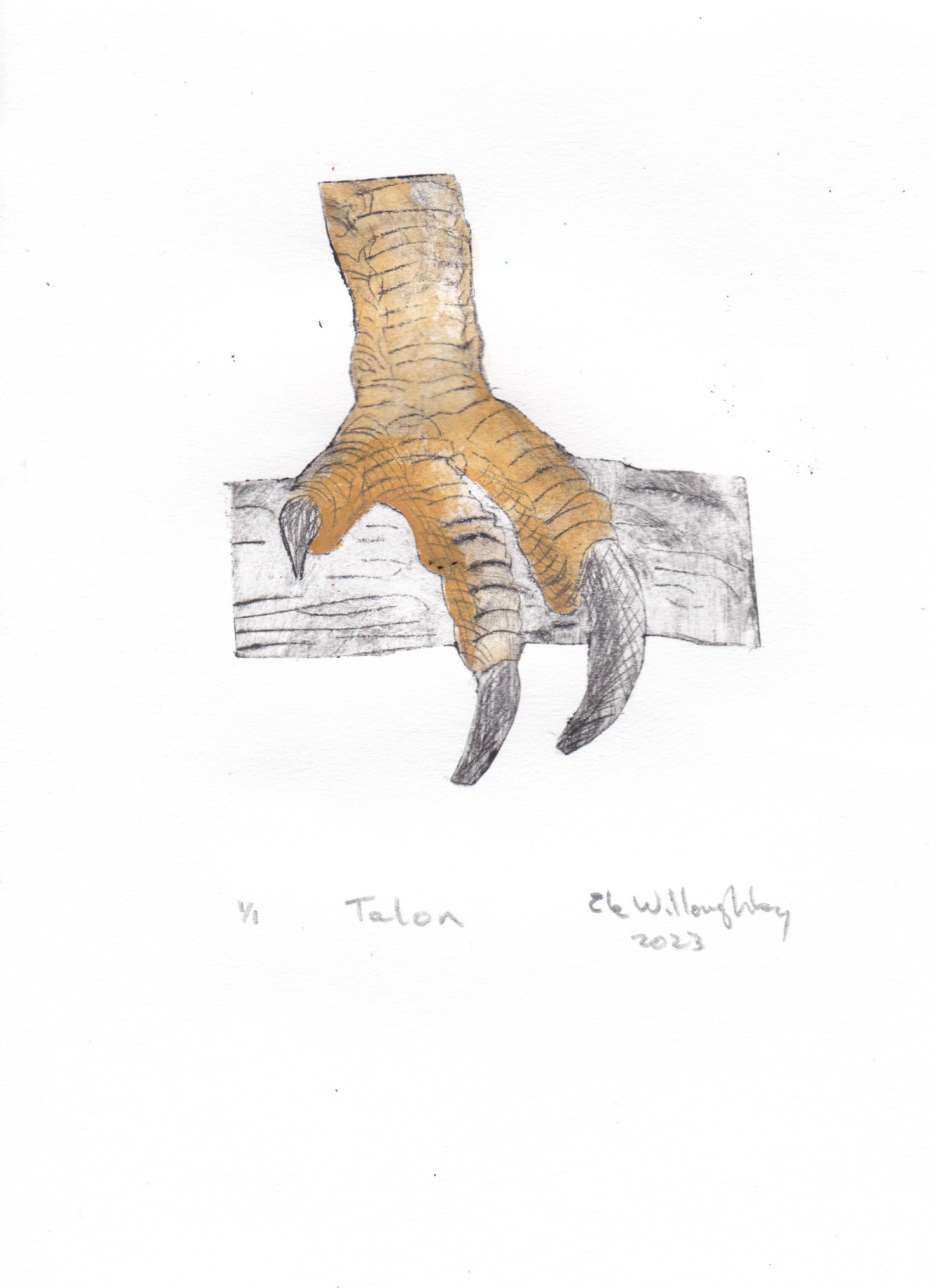
Talon, tinted drypoint print by Ele Willoughby, 2023


For the #SciArtSeptember prompt talon, I tried drypoint using an aluminum pop can! I cut it open with strong kitchen scissors and incised a drawing of a harpy eagle talon with an exacto knife. I used some small leftover rectangles of mat board to get black relief printing ink into the lines and wiped away the excess with junkmail on newsprint - so the entire process was done using what would otherwise be garbage. I printed it using my small etching press, and tinted the talon by hand with gouache.

Tuesday, March 8, 2016

SciArt, women and wunderkammers

my linocut portraits of women in STEM, left to right, top to bottom:
Hypatia, Skłodowska-Curie, Nightingale, Atkins, Leavitt, Jemison, Merian and Lamarr


my linocut portraits of women in STEM, left to right, top to bottom:
Anning, Wu, Lovelace, Lehmann, Kovalevski, Tharp, Bell (Burnell), Meitner, Herschel

I'm sharing my women in STEM portraits for International Women's Day today. We're fresh off the second annual #SciArt tweetstorm, which is rapidly becoming a fabulous institution on Twitter. For the second year, the first week of March has been a celebration of the place where art and science intersect - everything from technical drawings and data visualizations to comics to fine art in all media to textiles and fashion and basically, whatever you can imagine. It's a great way to find like-minded creators and share your work, brought to us by the great team at the Symbiartic blog on Scientific American.

Like other participants I'm really thankful for this opportunity to connect with a greater audiance. This just blows my mind. I've shared my leaf prints before and usually get great feedback, a few favorites and retweets, but during the tweetstorm this was the response:


Though my friend @faunalia likes to think I'm some sort of craft celebrity, I'm not remotely famous and 107 retweets and 130 favorites are astronomical numbers for me! The tweetstorm brought my art to the eyes of chemists and plant scientists. It really has the power to help bring people together and forge a SciArt community.

Some SciArt from TEST teammates: The Vexed Muddler,
Slashpile Designs, nanopod, The Chemist Tree, Honey Thistle,
HOPSCOTCH, Tanya Harrison Photo and Wild Whimsy Woolies
During February, the Toronto Etsy Street Team did a daily #WeBeTEST Instagram challenge, and that too was great for community building. On Valentine's we shared some love of our teammates work and amongst other things, I wrote about other science-artists on the team. I've long been a fan of the otherworldly jewellery and sculpture metal and glasswork of Tosca from nanopod. You can see that Haeckel is a influence to her too, along with myth and some of the more astounding natural history. You can find radiolarians, jellyfish and other biomorphic forms in her work. She's decided to add a some retail to her studio and teaching space Nanotopia (322 Harbord St, at Grace). She's invited Honey Thistle and Never Wares and I to also sell a cabinet of curiosity of items, along with her works, minerals, fossils, bones, taxidermy and other strange ephemera! So I brought her some small prints of weird (real and imaginary) creatures as well as some stuffed animals (extant and extinct) today. Next week, two women from Brooklyn's Morbid Anatomy Museum and Evolution store will be in town and teaching Entomology 101 and Jackalope and Squirrel taxidermy mounts at Nanotopia. The retail space is planned to coincide with their visit March 11 -13. If you're in the neighbourhood you should go check it out! To be honest, this is pretty well my definition of cool and it was all I could do not to squeal with delight and act like I'm a professional grown-up doing something normal and every day, because how cool is that?

This is a photo I took of the window of Evolution, NYC, June 18, 2011
The Morbid Anatomy blog, by the way,  is somewhere you could loose hours of your life if you too are inspired by the intersection of art and science, or love magpie&whiskeyjack but wish it were more gothic.

Tosca said she would like more stuffed things and I think I really must make tardigrades. By the way, I printed a linocut tardigrade last week. If you don't know, these mighty microscopic creatures of 0.5 mm (0.02") maximum in length are found in environments from mountaintops to the deep sea, from tropical rain forests to the Antarctic, and can survive conditions leathal to most other animals including: temperature ranges from near absolute zero 1 K (−458 °F; −272 °C) to about 420 K (300 °F; 150 °C); roughly six times the pressures found in the deepest oceanic trenches on Earth; ionizing radiation at dosages hundreds of times what would kill a mere human; the vaccuum of space. That's right; these animals have been to outer space and lived to tell the tale (or, at least lived and had someone tell the tale). The can go without food for 30 years, dehydrate, and then just rehydrate and go about their lives.
Tardigrade, linocut 8.5" x 11" on Japanese paper, Ele Willoughby, 2016

Tardigrades have short, plump legs and are prevalent in mosses and lichens and feed on plant cells, algae, and small invertebrates, hence their second nickname in case "water bear" isn't cute enough for you: the moss piglet. Tardigrades have been around at least 530 million years to the Cambrian. Don't you think it would make a cuddly plushie?

When you're done catching up on the #SciArt hashtag on Twitter, be sure to look up #5womenartists - another great one for this #WomensHistoryMonth. It occurs to me that all the work I'm writing about here today are all by women artists, and if you like what I do, you'll love their work too.


Wednesday, May 20, 2015

SciArt meet-up

Austin Monthly for October 2014 included my linocut of
Florence Nightingale in their write-up of the 'X Marks the Spot' show
at Art.Science.Gallery
Today I got to meet-up with a group of scientists/artists: Hayley Gillespie (ecologist, artist and founder of Art.Science.Gallery), Peggy Muddles (aka the Vexed Muddler, who works on the genetics of bacteria in lungs of CF patients by day, and amazing SciArt ceramics by night) and Rovena Tey (cancer researcher on mat leave and science-inspired cardmaking genius behind Handmade By Rovena)* and have a tour behind the scenes at the Royal Ontario Museum! The ROM is a rightfully famous museum, which boasts not only a world class archeological (especially Egyptian) collection, but a proper natural history museum, which has always meant that it was a research institution as well as a public museum. One of Hayley's friends from grad school is the curator of freshwater fish, and he was kind enough to give us a tour of the freshwater fish, and mammals and enlist his colleague to show us the invertebrate collection. Sadly, photographs were not allowed for security reasons (as it's best not to publicize the inner workings of a museum which houses some very valuable artifacts).

As token physical scientist, when the conversation turned to finer details of genetics and mapping family trees (if you will) of huge datasets of species, I felt like saying, "Oh! Bayesian regression! I know what that means!" with a little wink. The physical specimen themselves and the tour was fascinating. I could certainly relate to the problems of data archiving and preserving physical specimen, as these are serious problems for earth scientists too (especially the marine ones, as some ocean bottom cores need to be frozen and pressurized to avoid essentially melting or exploding, or both). I wouldn't have guessed that most of the ROM's collection of fishes is housed outside of the city, because that many tens of thousands of alcohol filled jars is deemed too great a fire risk downtown! It really is an incredible feat for these scientists to have even gathered all these species, let alone all the work of detailing and studying them, tracing their evolution, afterwards - and an invaluable resource.

We saw a few thousand sample jars of fishes, as well as some mammals (like bats) which are stored in alcohol. We saw their large collection of mammal pelts, which sort of takes your breathe away. The ROM is a museum of a certain age; at some time in the past they were gifted a large collection of mounted mammal heads (presumably from the estate of a hunter). I saw the head of a black rhino, now on the brink of extinction. It was staggering in size, even compared to the other rhino head. There were more heads of assorted quadrupeds than I knew how to identify.

I was pleased to happen to see a giraffe weevil along with a fabulous, large bronze sculpture of a giraffe weevil, on a plinth in the hallway between offices for scientists. I had only seen photos when I made my linocut. The invertebrates curator was an expert on leeches (which yes, are gathered the hard way... as any Canadian who has portaged a canoe through swampy water will be familiar). There were marvellous and/or scary arthropods including a mantis shrimp the size of my forearm, a roughly metre long South American earthworm, delicate and beautiful shell of a paper nautilus (or argonaut), adorable slipper lobster, and all sorts of other crustaceans... as well and swapped tales of fieldwork and labwork (mis)adventure.

Afterwards we were joined by Hayley's husband Cole (a psychiatrist) for a lovely lunch and discussion about that inspiring intersection of art and science. It was a real treat!

Hayley also brought me a copy of the Austin Monthly from October 2014. They included (part of) my portrait of Florence Nightingale in their write-up of the 'X Marks the Spot' exhibit at Art.Science.Gallery. It's always great to see my artwork in print, but I especially like that they've selected the perhaps unexpected. People will know her name, but as a nursing pioneer, rather than a statistician and data visualization pioneer, but she was both. She also brought me Ada Lovelace bookmarks from the 'Go Ahead and Do It' women in STEM show. Gabriel promptly ate one when I got home.

*We missed Glendon Mellow (aka the Flying Trilobite), scientific illustrator, SciArtist and Scientific American blogger, who couldn't make it.

Monday, November 5, 2012

Banners

I spent my free time making new banners and doing blog and shop make-overs (including making-over the Toronto Etsy Street Team blog with its new look thanks to thunderpeep). What do you think?

This is for the minouette Etsy shop.
Before

minouetteBanner

After
dinothings banner

And, for the minouette blog, where there was initially the same banner as the shop...

After
minouette

The original banner meant something to me and did say something about what my shop was about. It shows a manipulated photo of the Toronto skyline (so, where I am) with an image of a sea creature which I captured when using a ROV during fieldwork in the north Pacific (which hints at some of my interests). The image is scientific, yet surreal, and the colours and typeface are supposed to suggest art and specifically printmaking. However, it's been there since 2007, it's a photo rather than a handmade print, and I thought I could make something which was a better representation of me and my art.

The shop banner shows two of my linocut dinosaurs (an euoplocephalus and a torosaurus, respectively), so it shows the sort of natural history (and specifically paleontology) which appears in my work, along with the idiosyncratic lettering, stars and the thought-bubble with a heart to show the quirky side of what I create.

The blog banner is made of the monograms I've been printing, so we get a little typography and natural history (complete with dinosaurs) and a few mythical creatures thrown in for good measure. This strikes me a a pretty good synopsis of my subjects of late.

Monday, November 15, 2010

more block printed ornaments

We had a mini photo shoot yesterday. All photos by RJH.

nesting doll ornaments
fly agaric ornament
radiolarian ornaments
snowflake ornament set
monarch butterfly ornament
blue whale ornament


Apart from the matrioshka (Russian nesting dolls), I like to think of this as the 'Natural History Collection'. We've got microorganisms, fungi, insects, mammals and crystals. I plan more moons and mammals, and maybe, a bumblebee or two. You can find them all here.

Sunday, March 21, 2010

Entomology Pillow

Watch minouette compulsively avoid grocery shopping by wasting time on the internet. I hate grocery shopping. It's a problem. Anyhow, here's a new pillow:

entomology pillow
entomology reverse
butterfly detailentomology pillow beeentomology pillow monarchentomology fabric

This one of a kind pillow features three original, hand-pulled block prints on fabric, of some of the loveliest insects: butterflies and a bumblebee. The front is a patchwork of a contemporary faux-bois print in deep blue, with a butterfly on a grass green cotton, a bumblebee on a delicate pin-striped umber and sunny yellow, and a monarch butterfly on a vintage floral. The reverse combines a rustic, hand-woven Nepalese fabric with a contemporary print like a scientific illustration of butterflies, moths, ladybugs (ladybirds) and bees.

I like the idea of combining vintage and rustic fabrics with contemporary fabrics, and embellishing things through printmaking to make something new.

The Mad Scientists of Etsy challenge for March is entomology. Natural history is still hot. When I was an undergrad studying physics, people would invariably ask, "Why would you want to do that?!" assuming, erroneously that their own tastes were universal and I was some sort of masochist. I always thought about the entomologists, because, while I know intellectually, they must derive pleasure from it, and probably think bugs are cool, I feel that the fear of creepy-crawlies is primordial. Though, it's the helminthologists I really worry about. If there's ever a helmintology challenge, I think I'll sit that one out.

Sunday, November 15, 2009

Garlic and spice

garlic with shadow
garlic back


I've made another "Natural History" ornament. I had no plants (only fungi), but now I have a garlic bulb - which serves double duty as my entry to the Trans-Canada Etsy Team challenge for November: SPICE. I think of the textured cream fabric on the reverse as echoing the lines in garlic paper. Part of me wants to print this block on paper I make from hand with garlic skins, but more of me would like to preserve my sanity. I've made enough paper by hand to know what a monumental task that would be. Despite its papery texture, garlic skins are low on fibres, and brittle.

The Trans-Canada Etsy Team has a great give-away planned... I'll let you know when it begins. My fellow TCET member, the charming rikrak does a lot of give-aways on her blog. Soon there will be one involving a secret thing from a minouette place. Follow her blog or watch for a mention here. I'll let you know when there is a chance at free minouette loot.

The second interview for the Toronto Etsy Street Team will be with me. Check the blog tomorrow to find out what I had to say. I find this interview process interesting - like a means to learn something about myself.

Thursday, October 29, 2009

Natural History

Ah, yes, what we have all been waiting for... a way to combine our raging obsession with the wunderkammer, the Cabinet of Curiosity, with... the holidays. In fact, Natural History is rather hip, for home decor.

The Mad Scientists of Etsy challenge for October is to re-invent the ornament in the light of science. So, this is what I've been up to:

natural history all
natural history reverse

This collection of ornaments ranges from the microscopic radiolarian (inspired by the 19th century German naturalist and artist Ernst Haeckel) to the Moon in scale. Mammals are represented by their largest member: the blue whale (Balaenoptera musculus). The insect class is represented by the mighty traveller, the Monarch butterfly (Danaus plexippus). The fungi are represented by the pretty, but poisonous fly agaric (Amanita muscaria).

fly agaric ornament

Cause who doesn't want poisonous mushrooms on their tree? Bwhahahaha!

radiolarianradiolarian
radiolarian