Showing posts with label #SciArtSeptember. Show all posts

Monday, September 21, 2026

Brains and Buckmoths

A couple more new prints I made for #SciArtSeptember are 'Amygdala' and 'Bogbean Buckmoth' which I made for the almond (shape) and silk prompts respectively. Did you know that amygdala literally means almond-shaped? I did not, but it inspired my print. 

Amygdala, cyanotype print by Ele Willoughby, 2026
Amygdala, 8" x10" cyanotype print, by Ele Willoughby, 2026

This one of a kind cyanotype on water colour paper has an image of an open source brain MRI with the amygdala highlighted in gold. The amygdala is a paired nuclear complex in the cerebral hemispheres of our brains (and those of other vertebrates). Part of the limbic system, the amygdala has a primary role in the processing of memory, decision-making, and emotional responses (including fear, anxiety, and aggression) but also plays a role in things like social communication and understanding. 

The Bogbean Buckmoth is an endangered giant silk moth, here in Ontario.

Bogbean Buckmoth, 8" x 8" linocut by Ele Willoughby, 2026

This is a hand-printed lino block print of the endangered Bogbean Buckmoth (Hemileuca sp.). It is printed by hand in dark brown, black and rusty-orange in on lovely Japanese washi (or mulberry) paper, 8" x 8".

A day flying silk moth and the only buckmoth (Hemileuca) in eastern Canada, the Bogbean Buckmoth is very distinct with its black and white wings with eyespots and its black body with both white and rusty orange markings on the thorax and abdomen. It is a medium-sized moth with forewing lengths of 26–32 mm for males and 32–36 mm for females. Bogbean Buckmoth populations are known only from eastern Ontario and New York; it is listed as endangered in both jurisdictions. It only lives in open, chalky, low shrub fens containing large amounts of bogbean, an emergent wetland flowering plant which is the primary food of its larvae along with bog cranberry. Though the adults can fly for several kilometres they rarely leave the region around their home in the fens, increasing their isolation.

The Bogbean Buckmoth has a one-year life cycle. These moths spend the winter as eggs and emerge as larvae (black with reddish-orange branched spines along the back) the next spring, becoming adults in mid- to late September.

Here in Ontario they are threatened by habitat loss and changes like water level fluctuations, land development, pesticide use and climate change and its impact on wetlands. Also, its preferred food, the bogbean, is threatened by invasive plants, especially the European Common Reed and Narrow-leaved Cattail.

Wednesday, September 9, 2026

Pollinators by moonlight and in the garden

Still enjoying playing with cyanotype combined with linocut. Here are a couple of recent ones where I combined a moon cyanotype with varies plants and linocuts of insects.

Moon, moths and lanternfly
Moon, moths and lanternfly. 11" x 14" cyanotype and linocut by Ele Willoughby, 2026


Moon and Plants Cyanotype With Linocut Butterfly and Moths
Moon, plants, moths and butterfly 11" x 14" cyanotype and linocut by Ele Willoughby, 2026


September is a busy #scicomm month with the Mineral Cup (which you can catch on bluesky or mastodon) and SciArtSeptember. If you've been following along, some of my art that I am sharing daily will be familiar. I also made a brand new linocut for the prompt ruby: a male ruby-throated hummingbird with Canada columbine. 

Ruby-throated hummingbird, 8" x 8" linocut by Ele Willoughby, 2026


Wednesday, September 10, 2025

New Natural History Prints

Every September I take part in #SciArtSeptember and post art on the daily prompts. You can see my picks and new prints on my socials  (Bluesky or Instagram or Cara). I'm going to share my new prints, including sneak peeks here.

First up, for the prompt islet, I made a mono print on my gel plate using pencil and acrylics. 


Islet monoprint, 11" x 14" by Ele Willoughby, 2015


I was thinking about the tiny islands in the lake in New Brunswick. Islets, too small for human habitation can be a refuge for wildlife.

For the prompt jewel, I made a linocut ebony jewelwing damselfly. The forests of southeastern Canada and the eastern US are home to these metallic blue-green beauties known as ebony jewelwing (Calopteryx maculata) or black-winged damselflies. The males, like the one in my hand-carved and hand-printed linocut are turquoise with elegant black wings. The females are a duller brown with a white spot on their wings. Each print is on handmade khaki green paper with fibre inclusions and a deckle edge. I designed my linocut based on a photo I took in the Rouge National Park. Each print is 8" x 10".

my photo of an ebony jewelwing from earlier this summer 

Ebony Jewelwing, 8" x 10", by Ele Willoughby, 2025

For mimic, I shared the flower fly from my last post. The prompt trawl was also one which needed something new.

Glass Sponge Reef, 11" x 14" by Ele Willoughby, 2025
The Glass Sponge Reef, linocut print, 11" x 14", by Ele Willoughby, 2025

Glass sponges are fragile, brittle, living animals with skeletons made of silica, the same material we use to make glass. Reefs, widespread during the age of dinosaurs, are now quite rare, and in fact, were long believed to have gone extinct 40 million years ago. Then in 1987, scientists discovered 9,000 year glass sponge reefs or bioherms offshore northern British Columbia. All known glass sponge reefs today are found offshore BC, and its neighbours Alaska and Washington state. These important and beautiful biomes filter bacteria out of water, provide habitat for several species like spot prawns, halibut, squat lobsters and the rockfish in my print, store carbon and fertilize the ocean. These reefs in Canadian waters are now in marine protected areas as they can be destroyed, literally shattered, by pawn and crab traps, fishing lines, anchors and bottom trawling. Ocean warming and acidification are also damaging to these unique, vital ecosystems and natural wonders.

My 11" x 14" limited edition linocut print is made in watercolour paper and illustrates different glass sponges and a rock fish at the seafloor. The edition is limited to 8 prints.


Friday, September 15, 2023

New Natural History Prints for SciArtSeptember


Cochineal, linocut 8" x 8" by Ele Willoughby, 2023


For the SciArtSeptember prompt carmine, a bright red pigment derived from carminic acid, traditionally harvested from cochineal, a sessile parasite on Opuntia cacti in South America, north through to Mexico and the southwest US, I made this linocut. The cochineal are laboriously collected by brushing them off the pads of prickly pear cacti. The insect makes carminic acid to deter predators but it’s precisely what attracts people, who dry them out, extract the acid and mix it with aluminum or calcium salts to make carmine dye.

The dye was important historically for textiles (prior to the invention of synthetic dyes in the 19th century). Aztec and Maya peoples were using it as early as the second century BCE. It was used in Peru from the Middle Horizon period (600-1000 CE). Moctezuma II demanded yearly tributes of cochineal dye by the 15th century. Aztecs used it in manuscripts. Colonial powers exploited the dye in the 16th century. It produced in places controlled by Spain and Portugal. It was the second most valuable export after silver. The British began using it to dye their red coats and were frustrated by the Mexican monopoly on trade. There have been various disastrous attempts to export the insects and dye production to places like Australia.

Today, in an effort to avoid synthetic dyes, cochineal is used in food and cosmetics and it may be in your lipstick.


Hummingbird Clearwing, linocut, 8" x 8" by Ele Willoughby, 2023


This is a hand-printed lino block print of the charming Hummingbird Clearwing moth (Hermaris thysbe) seeking pollen from cherry blossoms. The olive-headed burgundy moth has transparent wings (though colour can be variable). It beats its wings rapidly to hover above flowers, like a hummingbird, meaning it is often confused with a hummingbird or bee. It has a 5 cm wingspan. Its bulky abdomen has lead to its adorable nickname "the flying shrimp." The caterpillar likes to feed on cherry amongst other things and as a moth, it feeds on a wide range of flowers, with a preference for pink and purple, so I chose to illustrate it with cherry blossoms.

Its range covers most of North America. It is a migratory species which is common here in Ontario, and in the eastern US.

Its scientific name Hermaris thysbe is likely a reference to Thisbe, half of a pair of ill-fated lovers in Ovid's Metamorphoses and her blood-stained scarf. It's a reference to the moth's reddish-brown colour. 


Talon, tinted drypoint print by Ele Willoughby, 2023


For the #SciArtSeptember prompt talon, I tried drypoint using an aluminum pop can! I cut it open with strong kitchen scissors and incised a drawing of a harpy eagle talon with an exacto knife. I used some small leftover rectangles of mat board to get black relief printing ink into the lines and wiped away the excess with junkmail on newsprint - so the entire process was done using what would otherwise be garbage. I printed it using my small etching press, and tinted the talon by hand with gouache.

Thursday, September 14, 2023

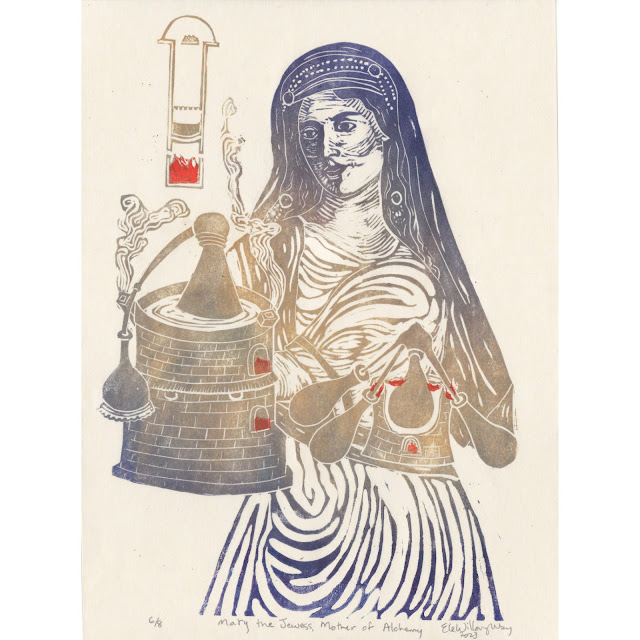
Mary the Jewess The Mother of Alchemy


Mary the Jewess, Mother of Alchemy, linocut 11" x 14" by Ele Willoughby, 2023


This is my hand-printed linocut portrait of the earliest recorded alchemist: Mary the Jewess (also known as Maria Hebraea, or Miriam, or Maria Prophetissa). The ancient alchemist Zosimos of Panopolis (who lived in Hellenistic Egypt around 300 CE), cites her research and innovations and calls her "the divine Maria". He even states that she opened an academy for studying alchemy, and taught, "the inner, concealed nature of the metals could be discerned by a complex alchemical process that was revealed to her by God himself and that was to be transmitted only to the Jewish people." She must have predated him, in the early centuries of the common era, and several scholars suspect she lived in Alexandria, Egyptian in the first century. Zosimos relates that she wrote a treatise called "On Furnaces and Apparatuses" and she invented, or at least described ovens, apparatuses for cooking and distilling, and other alchemical experimentation, made of metal, clay, and glass with joints sealed using fat, wax, starch paste, and fatty clay. She favored glass vessels which allowed one to observe reactions without disturbing them and provided some protection fro poisonous materials like mercury, sulfurous and arsenic compounds. Amongst inventions attributed to her are the bain-marie (named in her honour, essentially a double boiler, still used in cooking and chemistry today), the kerotakis (which allowed one to heat items while collecting vapors) and the tribikos (a kind of alembic with three arms that was used to obtain substances purified by distillation, still used in chemistry labs today). The kerotakis was an extractor for vapors which had a metallic palette supported inside to hold samples on which the vapors would act. When working properly it made an airtight seal and we get the term "hermetically sealed" from its use in the "hermetic arts" (that is, in alchemy). It played a role in alchemy and the advent of chemistry up to the late19th century when German chemist Franz von Soxhlet produced the modern, modified kerotakis, known as the Soxhlet extractor in 1879, which is used to this day. I've included these three devices in my portrait. Her name also comes down to us in the term "Mary's Black" for the iron(II) sulfide coating on metal after using the kerotakis. She appears in the writings of other alchemists in the Greek tradition, like Olympiodorus the Younger (c. 495 – 570)  and Christianos in the 7th century, and in the writings of early Arab authors. Arab writer al-HabÄ«b (dates unknown) must have had access to a now lost Hellenistic treatise by or about Mary. The tenth century Arab author Ibn Umail quotes Mary's books with information not found in other sources, suggesting he possessed her actual writings.

Sadly we know very little about Mary's life, but some of her books are quoted by others, and she casts quite the long shadow across centuries of alchemy. Like other alchemists, her words about her explorations of substances are quite mystical and hard to understand. Her axiom, known as the 'Axiom of Maria': "One becomes two, two becomes three, and by means of the third and fourth achieves unity; thus two are but one," was quoted by many alchemists who followed her; C.G. Jung called it a leitmotiv which runs seventeen centuries of alchemy. It's enigmatic and unscientific to the modern reader, but during her life, philosophers in the Mediterranean held an Aristotelian view of mater. She was expressing the idea that all materials were one. Aristotelians believed that mater was composed of four elements (air, fire, earth, and water), with four qualities in opposing pairs (hot/cold and wet/dry). It was commonly believed that by appropriately adjusting the proportions of the four elements by adjusting the balance of the qualities, a material could be transformed into any other. Alchemists in Egypt believed that a base metal like lead could be transmuted into gold with four steps: 1) melanosis, or blackening, to kill the base metal; 2) leukosis, or whitening the metal (using arsenic compounds); 3) xanthosis, or yellowing silver into gold (which might involve sulfur); and 4) iosis, or making the metal violet, which was purported to make it transformable into other metals. Much of their exploration involved producing these colour changes in metals.

Alchemists disguised their works to avoid accusations of witchcraft or sorcery or to keep their research findings secret from most people, so it is hard for us to interpret. Her interests were broader that we tend to assume for alchemists; she was interested in more than attempting to transmute lead into gold or producing the Philosopher's Stone and the Elixir of Life. Alchemy was more a religious view of life for her. She spoke of joining metals of different sexes, or the death of metals - things which do not fit with our modern scientific knowledge. Nonetheless some people credit her with discovering hydrochloric acid. She is credited with inventing the silver sulfide process, still used in metalworking today. She is believed to have discovered caput mortum, a dark purple dye. Though alchemists' understanding of materials was not scientific, the methodologies and apparatus developed definitely involved scientific thinking and form the foundation of what was to become chemistry. Mary's "On Furnaces and Apparatuses" contains the first description of a still. The instruments attributed to her, and her innovations for sealing apparatus were well-designed and played a role in chemistry and cooking for many many centuries or even persist today. And that is truly extraordinary!

My colour scheme is influenced by the deep purple of caput mortum. In Arab texts she was called "Daughter of Plato" - a term used in Western alchemy for white sulfur, so I also use a yellow-gold colour in my portrait. There's a portrait of her in German physician and alchemist Michael Maier's book 'Symbola Aurea Mensae Duodecim Nationum,' but since it was published in 1617, I don't think it actually provides any insight to her appearance or clothing. I was more influenced in imagining what she would have looked like by researching the clothing of Hellenistic Jews of the first to third century of the common era and the frescos of the Dura-Europos synagogue built in Syria in 244 CE. I made this print for the #SciArtSeptember prompt: alchemy.

References 

Cohen, Stephen Michael. "Maria the Jewess." Shalvi/Hyman Encyclopedia of Jewish Women. 25 June 2021. Jewish Women's Archive. (Viewed on September 14, 2023) <https://jwa.org/encyclopedia/article/maria-jewess>.

Hendrickson, Kristin. Maria the Prophetess: Mother of Alchemy, lecture given at Arizona Center of Medieval and Renaissance Studies, Tempe, Arizona, as part of the ACMRS Fearless Females series program, on September 20, 2013, https://www.medievalists.net/2015/07/maria-the-prophetess-mother-of-alchemy/

Lewis, Jone Johnson. "Mary the Jewess, First Known Alchemist." ThoughtCo, Aug. 25, 2020, thoughtco.com/mary-the-jewess-biography-3530346.

Mary the Jewess, Wikipedia, accessed September, 2023

Patai, Raphael. The Jewish Alchemists: A History Source Book. New Jersey: Princeton University Press. pp. 60–91. ISBN 978-0-691-00642-0. 1995

Sacks, Harold. Mary the Jewess and the Origins of Chemistry, SciHi Blog, May 8, 2020. http://scihi.org/mary-the-jewess-origins-chemistry/

van der Horst, P.W. (2002). Maria Alchemista, the First Female Jewish Author. In: Berger, S., Brocke, M., Zwiep, I. (eds) Zutot 2001. Zutot: Perspectives on Jewish Culture, vol 1. Springer, Dordrecht. https://doi.org/10.1007/978-94-017-3730-2_6

Thursday, September 7, 2023

Some SciArt for September and New Things for ... the uh, end of the year

I've been taking part in #SciArtSeptember for the last several years. Check out the hashtag on Instagram!* Since I have such a big portfolio of prints I am often re-sharing art to match the daily prompts but each year I make a lot of new science art each September. Here's some of my new work.


Vincetoxicum rossicum, gel plate print, 11" x 14" by Ele Willoughby, 2023

For the #SciArtSeptember theme “strangling” I made gel plate prints of Vincetoxicum rossicum, also known as European swallowwort, or Dog-strangling Vine. Introduced to the northeastern US gardens in the mid-1800s, it’s become wildly invasive in south and central Ontario. While it doesn’t actually strangle dogs, it can be a risk to native plants and animals. It’s illegal to buy, sell, trade or purposely sell dog-strangling vine in Ontario; nonetheless I found this unwelcome plant in my garden. It can produce 28,000 seeds per square metre which are spread by the wind. They can crowd out native plants and mats of tangled vines make it hard to even walk through the forest. The leaves and roots can be toxic so animals avoid them and thus end up putting even more pressure on yummier native plants. They are also a threat to the monarch butterfly, a species at risk; their eggs laid on the vines do not survive to adulthood.

European swallowwort, gel plate print, 11" x 14" by Ele Willoughby, 2023
European Swallow-wort, gel plate print, 11" x 14" by Ele Willoughby, 2023

If you find them in your garden (here in North America) you should dig it up and place it in a black plastic bag; don’t add it to compost or it can spread. Or, if you are like me, use it as free art supplies!

Tomorrow, the prompt is simian, so here's a sneak peak at my post.

A Conspiracy of Lemurs, linocut, 9.25" x 12.5" by Ele Willoughby, 2023

I decided to extend my ongoing series of Terms of Venery prints by adding a primate. The term for a group of lemurs is irresistible: a conspiracy. Looking at photos of ring-tailed lemurs I can imagine where the term arose. They are very social and live in large groups, huddling to socialize and for warmth. I wanted them to look like they were up to something and made the word lemur with their famously striped tails. Endemic to Madagascar, these wet-nosed primates are sadly endangered due to habitat loss.

I've also been thinking ahead, and though I don't mention [REDACTED winter holidays] until after Halloween, because it can all be a bit too much hype, if you like to send cards, check this out. I have new and returning  [REDACTED winter holidays] cards in my shop! It's good to order early to receive them with plenty of time to send them out to your friends and loved ones.

12 days of Christmas card by Ele Willoughby


12 days of Christmas by Ele Willoughby
My 12 Days of Christmas card design - find it in my shop!

*I'm also posting on Bluesky, where I'm @minouette and at @minouette@spore.social on Mastodon. Sadly, I think I am going to have to remove my account on what is left of Twitter.

Saturday, September 18, 2021

Bees, and Spheres, Minerals and Becoming Crabs

There's so much science art being shared on Twitter this month for #SciArtSeptember. I have scheduled works for daily prompts for the whole month. I have also just finished working my way through the entire list of prompts for #mathyear - as well as  continuing ongoing bee-themed projects.

There was no summer camp for the last weeks of August and beginning of September before school, so I was pretty busy parenting, but here are some new works from the end of August and September so far.

The Leafcutter Bees, linocut and leaf prints by Ele Willoughby, 2021


I made a series of monoprints about leafcutter bees, and whimsically, in collaboration with leafcutter bees! These small, but multifarious native bees are important pollinators, who make nests for their babies using small telltale half-moon pieces they cut from leaves and petals. This work features two large linocuts of two leaf cutter bees: Megachile relativa and Megachile brevis. These linocuts are made on collaged Japanese washi papers and cellophane to capture the colours in their bodies and wings. Each print has its own array of leaf and petal prints from leaves and petals used by leaf cutter bees from my garden. The plants used include raspberries, roses (leaves and petals), lily of the valley, lilac, lemon balm, ash, thicket creeper, round-leaved Crane's bill and more. Each print is 17" tall by 12.5" wide (43.2 cm by 31.8 cm). 

Sphere Packing, linocut with collaged washi by Ele Willoughby, 2021


I have an ongoing thread of my #mathyear art on Twitter, and I was looking ahead at future prompts. I added a several portraits and other prints about math to fill out the remaining prompts, including this new item in my shop: a block print shows the two piles with the two possible close packing of equal spheres, each below a diagram of the plan view of the layout: Face-centered cubic (fcc) and hexagonal close packed (hcp). Each pile of spheres on water-colour paper with a deckle edge has its own unique assortment of collaged gorgeous Japanese washi papers. Each version of this print is unique.

The problem of how efficiently you can pack spheres into a volume has a long history in mathematics. It was Carl Friedrich Gauss who found the highest average density that can be achieved by lattice packing and the Kepler conjecture (as in Johannes Kepler) states that this is the highest density that can be achieved by any arrangement of spheres, either regular or irregular. When the famous mathematician David Hilbert set his 23 Problems of important unsolved problems in math in 1900, it included the question of what is the densest sphere packing. The question is generally considered solved since T.C. Hales proved the Kepler conjecture in 1998.

Though this may seem an abstract theoretical geometry problem there are real-life applications. It turns out, for instance, that many crystals with structures based on close-packed identical spheres of the fcc or hcp variety. 


Malachite, linocut, 8" x 8", by Ele Willoughby, 2021

There's also the annual social media battle of the minerals going on with #MINCUP2021. I always intended to make a series of mineral prints but never got passed making Quartz. I have managed to tie several of the minerals to existing prints and been tweeting those along with my votes, but I have managed to make one new pertinent print so far: Malachite. I have been using "cool physics and/or art applications" to determine my vote so malachite, often carved to make beautiful items, and a paint pigment since antiquity was obviously one to support. 

Jennifer Zee (ginkgozee on instagram and here on Etsy) has been working on an amazing series of mineral relief prints (including malachite and many others recently) and it reminded me I really wanted to have a whole colleciton. You should check out her work!


Porcelain crab, linocut by Ele Willoughby, 2021

For the #SciArtSeptember prompt evolving, I knew I had to talk about how things keep evolving into crabs! This is a hand-printed lino block print in black and red ink on white Japanese kozo (or mulberry) paper of a porcelain crab, Neopetrolisthes maculatus. Each print is 8” by 8” and printed by hand. Porcelain crabs are decapod crustaceans in the family Porcellanidae, which resemble true crabs but are in fact closer related to squat lobsters. They have flattened bodies as an adaptation for living in rock crevices. They first appeared in the Tithonian age of the Late Jurassic epoch, 145-152 million years ago. There are one of at least 5 groups of decapod crustaceans which have evolved to be more crab-shaped in a process known as carsinisation.