Showing posts with label alchemy. Show all posts

Wednesday, March 5, 2025

Master Geng: Chinese Alchemist Geng Xiansheng, 'Refining Snow' or Using Mercury to Extract Silver from Snow

Geng Xiansheng, linocut 9.25" x 12.5" by Ele Willoughby, 2025

Mercury is the final prompt for #printerSolstice2425, which again made me think of alchemy. It is an element the alchemists favoured and felt was fundamental in their efforts to transmute base metals into precious metals, both in western and Chinese alchemy (from whence the more familiar western alchemy emerged). Chinese alchemy (煉丹術 liàndānshù), a name which literally means a method for refining cinnabar, or mercury sulphide (HgS) focused on longevity (and alignment with Tao) . It can be divided into the esoteric "inner alchemy" and "external alchemy" focused on making elixirs. 

The earliest recorded woman in Chinese alchemy was Fang (Chinese: 方), who lived roughly the first century BCE and is credited with a method for turning mercury into silver. So little is known about her, and what little that is known is so tragic, that I opted for another woman alchemist associated with "turning" mercury into silver, ten centuries later.  

This is my hand-printed linocut portrait of a woman alchemist known as Master Geng who flourished some time before the year 975 (Chinese: 耿先生; pinyin: Gěng Xiānshēng; Wade–Giles: Kêng Hsien-shêng). According to legend, this daughter of a scholar named Geng Qian (sometimes spelled Keng Chhien),  was known from adolescence for her intelligence, curiosity and skill in alchemy. She appears in the writing of alchemist Wu Shu, in his book Chiang Huai I Jen Lu (or Records of Twenty-five Strange Magician-Technicians between the Yangtze and Huai River) written in 975. An expert in what was called "the art of the yellow and the white" (that is, alchemy), she distilled perfumes and was also known as a talented poet and magician. Her fame grew to the point that the Emperor Xuanzong (circa 846-859) invited her to the palace, where rather than being counted amongst the palace women, she was honoured as a scholar and given the title Master, as in teacher. She was eloquent, spoke with confidence and known for wearing green robes and for her skills in performing alchemical transformations in the Imperial Court. In particular, she was known for using mercury for "creating" silver. One story tells that she could even transform snow into silver. The Emperor wished to test her skills and noted that all her transformations employed fire  and enquired whether she could perform a transformation without it. 

"She answered, 'Let me try. It might be.' So the Emperor took some mercury and enveloped it in several layers of beaten bark-cloth, closing it with the [Imperial] seal; this she placed forthwith in her bosom. After a long time there suddenly came a sound like the tearing of a piece of silk. The Teacher [Geng Xiansheng] smiled and said: 'Your Majesty did not believe in my methods, but now you will see for yourself. Ought you not to trust me ever hereafter?' Then she handed the packet back to the Emperor who saw that the seal was unbroken and upon opening it found that the mercury had all turned to silver."

Song Dynasty scroll painting "Master Geng of the Southern Tang Dynasty refining snow'"

Modern chemists speculate that she might in fact have been using a legitimate chemical process which uses mercury to extract silver from ore. Likewise, her distilling of perfumes could have employed early prohibitive form of the Soxhlet process to continuously extract camphor into alcohol. Thus while alchemy differs from modern chemistry in aims and understanding, she would have been using some methods which we can recognize as scientific and can be seen as part of history of chemistry.

In her personal life she was known for her love of wine and romantic liaisons. 

My portrait is inspired by Song Dynasty paintings including one scroll painting called 'Master Geng of the Southern Tang Dynasty refining snow' and illustrations of alchemists and their tools like the large three-legged ting furnace in which medicines were prepared.


Detail Song Dynasty scroll painting "Master Geng of the Southern Tang Dynasty refining snow'"
Detail of Song Dynasty scroll painting "Master Geng of the Southern Tang Dynasty refining snow'"

References
Chinese alchemy, Wikipedia, accessed March, 2025
Fitzgerald, C.P. The Horizon History of China, American Publishing Co., Inc., New York, 1969.
Gordon, Robin L. Chinese Women Alchemists, Women Alchemists 2.0 website, accessed March, 2025.
Master Geng, Wikipedia, accessed March, 2025
Maxwell-Stuart, P. G. (2012-03-01). The Chemical Choir: A History of Alchemy. A&C Black. p. 13. ISBN 9781441132970.
Rayner-Canham, Marelene F.; Rayner-Canham, Marelene; Rayner-Canham, Geoffrey (2001). Women in Chemistry: Their Changing Roles from Alchemical Times to the Mid-twentieth Century. Chemical Heritage Foundation. pp. 4–5. ISBN 9780941901277.
Xin, Yang, Barnhart, Richard M., Chongzheng, Nie, Cahill, James, Shaojun, Lang and Hung, Wu. Three Thousand Years of Chinese Painting, Yale University Press, 1997


Wednesday, February 19, 2025

Marie Meudrac, where the transition from alchemy to chemistry meets medicine, cooking and cosmetics: chemistry by a woman for women

Marie Meurdrac, linocut, 9.25" x 12.5" by Ele Willoughby, 2025

This is my hand-printed linocut portrait of Marie Meurdrac (c. 1610-1680), one of the first chemistry textbook authors and the first woman to publish a book on early chemistry. Working right at the transition between alchemy and chemistry, in 1666 she published 'La Chymie charitable & facile, en faveur des dames' (Charitable and easy chemistry for ladies). I selected her for the #printerSolstice2425 prompt sodium, as for her, salt, "the father of generation" was the first of the 3 elements, salt, sulphur and mercury, from which all materials were made. 

We do not know a great deal about her life for certain. Born to a land-owning family, in Mandres-les-Roses, now a suburb of Paris, to Vincent Meurdrac or Meurdrat, a notary, and Elisabeth Dove.  Her younger sister Catherine, became the author and memoirist with the nom de plume Madame de la Guette.  She married a military man. Her sister recorded his name as Monsieur de Vibrac, captain du château de Grosbois, where she moved after her marriage. He was commander of Charles de Valois, Duke of Angoulême (illegitimate son of Charles IX of France)'s guard unit. However the Abbot Sanson recorded that she married Guillaume de Brisset; but this discrepancy might be explained if Guillaume de Brisset succeeded his father Monsieur de Vibrac to both the fiefdom of Vibrac and the captaincy.  In any account, living there, she became good friends with Countess de Guiche. She taught herself chemistry following the works and experiments of her contemporaries and reading books on chemistry and alchemy. She had her own lab where she tested all her remedies and recipes. She dared to write a handbook of practical chemistry, which helped popularize the subject throughout Europe, at a time when the very idea of scholarly women was ridiculed in France. The  woman question ("la querelle des femmes")- or rather the question of whether women should be educated at all was widely debated. The book is dedicated to the countess; Meurdrac had access to a high temperature furnace which required permission of the king which she might have got thanks to the countess. 

Chemistry had long been practiced by women in cooking in the kitchen, in making household remedies and cosmetics, but as sciences became formalized it became a man's world. Meurdrac had been keeping notes of all her experiments so as not to forget her results when she realized she had enough for a book as complete or more so than other available chemistry handbooks. The word “chymie” comes from 16th century Swiss doctor Paracelsus, and following in his tradition, she believed that matter is made of various quantities of 3 elements: salt, mercury, and sulphur, but unlike previous alchemist authors (including those she cites like Raymond Lull and Basil Valentine) her writing is clear and unpretentious rather than obscure. She wants to expose what alchemists would keep a secret for the select few. She omits the astrological conditions so come in alchemical recipes. 


The Preface from Marie Meurdrac's  'La Chymie charitable & facile, en faveur des dames' complete with her argument "les Esprits n'ont point de sexe"


She wrote about her uncertainty in daring to publish as a woman, concerned that it might be above her station and knowing that men scorn the products of women's minds but concludes that but minds "have no sex and that if the minds of women were cultivated like those of men, and that if as much time and energy were used to instruct the minds of the former, they would equal those of the latter.” Her words, "les Esprits n'ont point de sexe" appear in my print, as in her book. Knowing that bourgeois or even aristocratic women were denied formal scientific education in universities, she wanted to provide accessible chemistry, botany, pharmacology, medicine, as well as in cosmetics knowledge and hands-on training to women. As women could not legally practice medicine, providing free healing services and lessons was a sort of loophole for her, hence the word "charitable" in her title.  She covered items such as lab techniques, properties of medicines, and cosmetics. She also had a table of weights and 106 alchemical symbols that were used in medicine at the time. The jars behind are marked with these symbols. She presents ingredients as "principles" rather than materials, in the manor of the alchemists and describes methods used both by alchemists and early chemists such as distillation, sublimation, rectification, calcination, cohobation and so forth, with specific vessels and fires to be used. She includes recipes which could be found in contemporary chemistry texts such as for Flowers of Bezoin, or Salt of Saturn. Following Paracelsus she writes about plants in medicine, as they believed them superior to other matter, created prior to animals according to Genesis and having survived the great flood. She was wary of using metals in medicine, viewing such treatment as more aggressive. She brought her knowledge to a wide audience, empowering women to make their own remedies and cosmetics safely, for instance, correctly warning of the dangers of using poisonous mercury sublimate to whiten skin as was done at the time. 

She is surrounded with books, tools, supplies and plants she would have used including scales, glassware, tongs, and a furnace, inspired by the frontispiece in one of the several editions of her book. The plants are rosemary, which she describes as a universal antidote to all sorts of illnesses, and tansy, used to facilitate childbirth. The book was popular for more than 50 years, with five editions in France, six in Germany, and one in Italy. She encouraged her readers to follow her lead and use their skills to freely treat the poor. Recognizing the cost of materials and tools she offers her readers some more accessible alternative suggestions and offers advice on finding the more rare ingredients. She even offers to answer readers' questions or even make demonstrations in person. Writing about chemistry for women, when it was claimed by men for men, was transgressive, and she defends her ability to do so with her strong feminist argument. She made hands-on training in chemistry, botany, pharmacology, and medicine, as well as in cosmetics accessible to generations of women. 

References

Bulletin du bibliophile, Volume 24, Techner, 1859. pp. 252-253


Fiendstein, Sandy. Experience, Authority and Alchemy of Language: Margaret Cavendish and Marie Meurdrac Respond to the Art. Early Modern Women, Volume 15, Number 2, Spring 2021, pp. 133-142 (Article) Published by Arizona Center for Medieval and Renaissance Studies. DOI: https://doi.org/10.1353/emw.2021.0028

Fiendstein, Sandy. La Chymie for Women: Engaging Chemistry's Bodies. Early Modern Women: An Interdisciplinary Journal, vol 4, 2009, pp. 223-234.

Findlay, Sam. 'Mind has no sex': The story of Marie Meurdrac, First Lady of Chemistry, ARC Centre of Excellence for Electromaterials Science, March 10, 2015.

Gordon, Robin L. 2015. Marie Meurdrac. Women Alchemists: Stories and  Reflections on their Place in History, Psyche and Science. accessed, February, 2025

Marie Meudrac - La chymie pour les femmes, YouTube video by Sur les épaules des géantes, February 3, 2021

Marie Meudrac, Wikipedia, accessed February 2025 (both English and French versions)

Meurdrac, Marie.  La chymie charitable & facile, en faveur des dames : 1666, Paris, CNRS, (réimpr. présentée et annotée par Jean Jacques) (1re éd. 1666), 249 p. (ISBN 2-271-05726-4).

Rayner-Canham, Marelene F.; Rayner-Canham, Marelene; Rayner-Canham, Geoffrey (2001). Women in Chemistry: Their Changing Roles from Alchemical Times to the Mid-twentieth Century. Chemical Heritage Foundation. pp. 4–5. ISBN 9780941901277.


Wednesday, January 8, 2025

Sophie Brahe, Horticulturalist, Astronomer, Chemist, Genealogist and Sister to Tycho

Sophie Brahe, linocut 11" x 14" by Ele Willoughby, 2025

Born in either 1556 or 1559,  the 12th child (9 survived infancy) of Otte Brahe, advisor to the Danish king Frederick II, and Beate Bille Brahe, leader of Queen Sophie’s royal household, in Knudstrup Castle, Sophie Brahe was a horticulturalist, astronomer, chemist, and genealogist. At least a decade her senior and adopted and raised by his uncle Jørgen Thygesen Brahe, Sophie did not grow up with brother, the famous astronomer Tycho but the two became close when she reached adolescence. They found they were alike, sharing a determination to pursue science despite their family’s attitude this was an unsuitable activity for an aristocrat. Eventually they also shared a determination to each marry for love without regard for financial concerns or familial approval. They married a commoner and penniless noble respectively. 

Sophie married Otto Thott in 1579 and they two had a son, Tage Thott in 1580, but Otto died in 1588. As a widow, Sophie was responsible for maintaining and running the estate (now known as Trolleholm Castle in Eriksholme) until her son came of age. She studied chemistry, medicine and horticulture, growing medicinal plants and an exceptional garden. Following the theories of Paracelsus, she produced medicines to treat the poor, but as a woman, she could not formally study medicine.  


She became a regular visitor to her brother’s astronomical and alchemical laboratory, first at Herrevad Abbey and then later at Uranienborg, on the island of Hven. Tycho trained her in horticulture and chemistry but initially discouraged astronomy, but she pursued it on her own. She taught herself with textbooks in German and texts she had translated at her own expense from Latin. Even if he initially thought she might have the skills and education to pursue astronomy, he realized she could help him with his observations. With time he realized she had the skills she needed, to the point that he eventually, when he was often absent from 1588 to 1597, he started to delegate his duties to her, getting her to calculate the astrological charts which were the bread and butter of Renaissance astronomers. 

Specifically she made observations for Tycho on 11 November 1572, which led to the discovery of the supernova that is now called SN 1572, as well as a lunar eclipse in 1573 while still a girl. Tycho published De nova stella, or On the New Star about the supernova; the stars in my portrait are based on De nova stella and SN 1572 is the large star above Sophie’s head. The discovery of supernova was important to the ongoing revolution in astronomy as an observable change in the sky seemed counter to the prevailing geocentric model of the universe. Sophie was instrumental to Tycho’s meticulous observations of planetary orbits. Tycho developed instrumentation that allowed the most precision observations ever made prior to the invention of the telescope; Sophie, along with some other assistants, used these to make measurements. The incredible dataset proved invaluable to Kepler and lead to his laws of planetary motion, an important precursor to Newton’s law of universal gravitation. 

While at Uranienborg, she met Tycho’s friend, the alchemist Erik Lange. Lange's sister was married to another Brahe brother, so they had a family connection as well. Tycho trusted Erik to the extent that he made him the executor of his children's estate. Sophie returned to visit Erik over a dozen times and the two became engaged in 1590. Lange’s passion for alchemy had bankrupted him; he was obsessed with trying to produce gold from base metals. Sophie stood by him and financially supported his efforts after he used up his own fortune. Their wedding was delayed for years when Lange had to flee to Germany to avoid his creditors. The 600-line epic poem “Urani Titani” was published in 1594, as the love letters between Sophie as Urania, the muse of astronomy and Erik as a titan, studying alchemy abroad, written from Sophie’s point of view. The printer thought she was the author, but Tycho later claimed it. It seems likely he was either author, or at minimum translator and interpreter of Sophie’s thoughts, as Sophie was not fluent in Latin and Tycho was more likely to have known of its unusual poetic form. The poem denounces the futile search for the philosophers’ stone and promotes instead allegiance to Phoebus, god of healing. This shows the closeness of the two siblings, his respect for her as an astronomer, and that they likely both doubted that alchemy could produce gold. Nonetheless, Sophie was devoted to Erik and supported his research. 

She was able to visit Lange in Hamburg in 1599 but the two were not able to wed until 1602 in Eckernförde, where the couple lived in extreme poverty. Sophie complained to her sister that she had to wear stockings with holes in them to her own wedding and the groom needed to return his wedding clothes to the pawn broker after the wedding. She also complained of the family’s objections to her pursuit of science and their failure to pay money she was owed. She was often allow as he fled due to his debts. Even jewellery and clothes her sisters gave her out of pity were hawked to support his alchemical research. Erik had moved to Prague by 1608, where he died in 1613.

After Erik’s death, she regained enough wealth to fund repairs to the church at Ivetofta near where Frederick II had previously granted her the nearby manor of Årup. She nonetheless moved to Zealand and settled in Helsingør in 1616 where he son Tyge Thott had become a State Councillor. There she pursued her studies of horticulture and healing plants, teaching her servant all she knew of botany and healing. Despite any disdain she felt about the social norms of the aristocracy, she produced a genealogy of the Brahe family in 1600 and by 1626 she published a 900 page genealogy of 60 Danish noble families, still considered a major source for the history Danish nobility. Even in her 80s she was receiving visitors who came to see her famous gardens. She died in 1643 and is buried in the village of Torrlösa in the Thott family chapel, which is now part of Sweden.

References

Alenius, Marianne, The Honey-Sweet Delicacies of the Muses,  The History of Nordic Women's Literature,  July 27, 2011

Murray, Caroline, Sister of the more famous Tycho, Professor Hedgehog’s Journal,  September 10, 2018

Neill, Crystal, Sophie Brahe: Tycho’s Urania, on Before Newton: Explorations of pre-modern science, medicine and technology blog, accessed January, 2025

Sophie Brahe, Wikipedia, accessed January, 2025.

Tycho Brahe, Wikipedia, accessed January, 2025.

Wentrup, Curt. Chemistry, Medicine and Gold-Making: Tycho Brahe, Helwig Dieterich, Otto Tachenius, and Johan Glauber, Chem Plus Chem, Volume 88, Issue 1, 24 November 2022 https://doi.org/10.1002/cplu.202200289

Sophie Ottesdatter Brahe, www.skbl.se/sv/artikel/SophieBrahe, Svenskt kvinnobiografiskt lexikon (article by Sara Griberg), retrieved 2025-01-07.

Hoyrup, Else. Sophie Brahe, on Grandma Got STEM blog, July 22, 2013, accessed January, 2025.

Rönneus, Maria Yrsa, Urania Titani: Sofie Brahe, guest post on Samantha Wilcoxson Blog, March 29, 2024, accessed January 2025.

Thursday, September 14, 2023

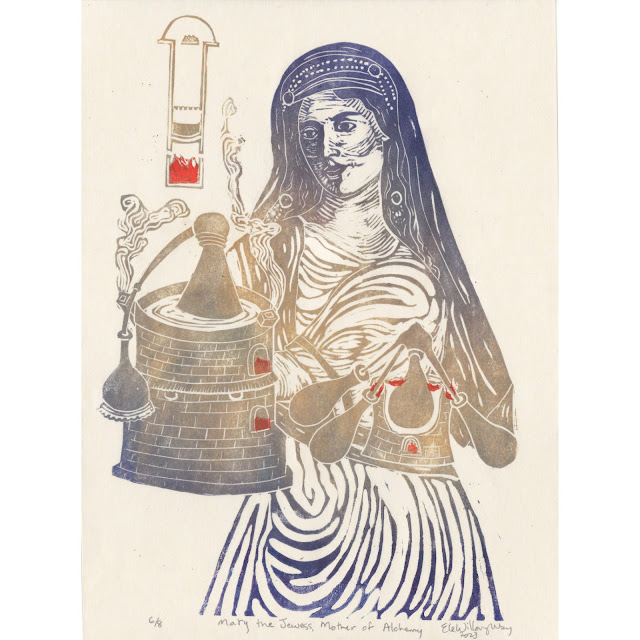
Mary the Jewess The Mother of Alchemy


Mary the Jewess, Mother of Alchemy, linocut 11" x 14" by Ele Willoughby, 2023


This is my hand-printed linocut portrait of the earliest recorded alchemist: Mary the Jewess (also known as Maria Hebraea, or Miriam, or Maria Prophetissa). The ancient alchemist Zosimos of Panopolis (who lived in Hellenistic Egypt around 300 CE), cites her research and innovations and calls her "the divine Maria". He even states that she opened an academy for studying alchemy, and taught, "the inner, concealed nature of the metals could be discerned by a complex alchemical process that was revealed to her by God himself and that was to be transmitted only to the Jewish people." She must have predated him, in the early centuries of the common era, and several scholars suspect she lived in Alexandria, Egyptian in the first century. Zosimos relates that she wrote a treatise called "On Furnaces and Apparatuses" and she invented, or at least described ovens, apparatuses for cooking and distilling, and other alchemical experimentation, made of metal, clay, and glass with joints sealed using fat, wax, starch paste, and fatty clay. She favored glass vessels which allowed one to observe reactions without disturbing them and provided some protection fro poisonous materials like mercury, sulfurous and arsenic compounds. Amongst inventions attributed to her are the bain-marie (named in her honour, essentially a double boiler, still used in cooking and chemistry today), the kerotakis (which allowed one to heat items while collecting vapors) and the tribikos (a kind of alembic with three arms that was used to obtain substances purified by distillation, still used in chemistry labs today). The kerotakis was an extractor for vapors which had a metallic palette supported inside to hold samples on which the vapors would act. When working properly it made an airtight seal and we get the term "hermetically sealed" from its use in the "hermetic arts" (that is, in alchemy). It played a role in alchemy and the advent of chemistry up to the late19th century when German chemist Franz von Soxhlet produced the modern, modified kerotakis, known as the Soxhlet extractor in 1879, which is used to this day. I've included these three devices in my portrait. Her name also comes down to us in the term "Mary's Black" for the iron(II) sulfide coating on metal after using the kerotakis. She appears in the writings of other alchemists in the Greek tradition, like Olympiodorus the Younger (c. 495 – 570)  and Christianos in the 7th century, and in the writings of early Arab authors. Arab writer al-Habīb (dates unknown) must have had access to a now lost Hellenistic treatise by or about Mary. The tenth century Arab author Ibn Umail quotes Mary's books with information not found in other sources, suggesting he possessed her actual writings.

Sadly we know very little about Mary's life, but some of her books are quoted by others, and she casts quite the long shadow across centuries of alchemy. Like other alchemists, her words about her explorations of substances are quite mystical and hard to understand. Her axiom, known as the 'Axiom of Maria': "One becomes two, two becomes three, and by means of the third and fourth achieves unity; thus two are but one," was quoted by many alchemists who followed her; C.G. Jung called it a leitmotiv which runs seventeen centuries of alchemy. It's enigmatic and unscientific to the modern reader, but during her life, philosophers in the Mediterranean held an Aristotelian view of mater. She was expressing the idea that all materials were one. Aristotelians believed that mater was composed of four elements (air, fire, earth, and water), with four qualities in opposing pairs (hot/cold and wet/dry). It was commonly believed that by appropriately adjusting the proportions of the four elements by adjusting the balance of the qualities, a material could be transformed into any other. Alchemists in Egypt believed that a base metal like lead could be transmuted into gold with four steps: 1) melanosis, or blackening, to kill the base metal; 2) leukosis, or whitening the metal (using arsenic compounds); 3) xanthosis, or yellowing silver into gold (which might involve sulfur); and 4) iosis, or making the metal violet, which was purported to make it transformable into other metals. Much of their exploration involved producing these colour changes in metals.

Alchemists disguised their works to avoid accusations of witchcraft or sorcery or to keep their research findings secret from most people, so it is hard for us to interpret. Her interests were broader that we tend to assume for alchemists; she was interested in more than attempting to transmute lead into gold or producing the Philosopher's Stone and the Elixir of Life. Alchemy was more a religious view of life for her. She spoke of joining metals of different sexes, or the death of metals - things which do not fit with our modern scientific knowledge. Nonetheless some people credit her with discovering hydrochloric acid. She is credited with inventing the silver sulfide process, still used in metalworking today. She is believed to have discovered caput mortum, a dark purple dye. Though alchemists' understanding of materials was not scientific, the methodologies and apparatus developed definitely involved scientific thinking and form the foundation of what was to become chemistry. Mary's "On Furnaces and Apparatuses" contains the first description of a still. The instruments attributed to her, and her innovations for sealing apparatus were well-designed and played a role in chemistry and cooking for many many centuries or even persist today. And that is truly extraordinary!

My colour scheme is influenced by the deep purple of caput mortum. In Arab texts she was called "Daughter of Plato" - a term used in Western alchemy for white sulfur, so I also use a yellow-gold colour in my portrait. There's a portrait of her in German physician and alchemist Michael Maier's book 'Symbola Aurea Mensae Duodecim Nationum,' but since it was published in 1617, I don't think it actually provides any insight to her appearance or clothing. I was more influenced in imagining what she would have looked like by researching the clothing of Hellenistic Jews of the first to third century of the common era and the frescos of the Dura-Europos synagogue built in Syria in 244 CE. I made this print for the #SciArtSeptember prompt: alchemy.

References 

Cohen, Stephen Michael. "Maria the Jewess." Shalvi/Hyman Encyclopedia of Jewish Women. 25 June 2021. Jewish Women's Archive. (Viewed on September 14, 2023) <https://jwa.org/encyclopedia/article/maria-jewess>.

Hendrickson, Kristin. Maria the Prophetess: Mother of Alchemy, lecture given at Arizona Center of Medieval and Renaissance Studies, Tempe, Arizona, as part of the ACMRS Fearless Females series program, on September 20, 2013, https://www.medievalists.net/2015/07/maria-the-prophetess-mother-of-alchemy/

Lewis, Jone Johnson. "Mary the Jewess, First Known Alchemist." ThoughtCo, Aug. 25, 2020, thoughtco.com/mary-the-jewess-biography-3530346.

Mary the Jewess, Wikipedia, accessed September, 2023

Patai, Raphael. The Jewish Alchemists: A History Source Book. New Jersey: Princeton University Press. pp. 60–91. ISBN 978-0-691-00642-0. 1995

Sacks, Harold. Mary the Jewess and the Origins of Chemistry, SciHi Blog, May 8, 2020. http://scihi.org/mary-the-jewess-origins-chemistry/

van der Horst, P.W. (2002). Maria Alchemista, the First Female Jewish Author. In: Berger, S., Brocke, M., Zwiep, I. (eds) Zutot 2001. Zutot: Perspectives on Jewish Culture, vol 1. Springer, Dordrecht. https://doi.org/10.1007/978-94-017-3730-2_6