Showing posts with label astronomy. Show all posts

Tuesday, October 13, 2026

Nancy Grace Roman, NASA Chief of Astronomy and "Mother of Hubble" for Ada Lovelace Day

Nancy Grace Roman, linocut, 11" x 14" on Japanese paper by Ele Willoughby, 2026


It is once again Ada Lovelace Day, the 17th annual international day of blogging to celebrate the 

Ada Lovelace, 3rd edition
Ada, Countess Lovelace, 3rd edition linocut by Ele Willoughby 

achievements of women in technology, science and math, Ada Lovelace Day 2026 (ALD26). I'm sure you'll all recall, Ada, brilliant proto-software engineer, daughter of absentee father, the mad, bad, and dangerous to know, Lord Byron, she was able to describe and conceptualize software for Charles Babbage's computing engine, before the concepts of software, hardware, or even Babbage's own machine existed! She foresaw that computers would be useful for more than mere number-crunching. For this she is rightly recognized as visionary - at least by those of us who know who she was. She figured out how to compute Bernouilli numbers with a Babbage analytical engine. Tragically, she died at only 36. Today, in Ada's name, people around the world are blogging.

You can find my previous Ada Lovelace Day posts here.


This is a hand-carved and hand-printed lino block print portrait of trail-blazing astronomer Nancy Grace Roman (1925-2018), NASA's first chief of astronomy throughout the 1960s and 1970s, who helped shape NASA's space astronomy program. Nicknamed the "mother of Hubble" for her role in planning the revolutionary Hubble Space Telescope, she was active in science communication and an advocate for women in science throughout her career. Recently, the Wide Field Infrared Survey Telescope was renamed the Nancy Grace Roman Space Telescope in recognition of her enduring contributions to astronomy, and launched August 30, 2026. 

Born in Nashville, Nancy came by her love of school and science honestly from her music teacher mother Georgia Frances Smith Roman and physicist and mathematician father Irwin Roman. Her father got an oil industry geophysics job and moved the family to Oklahoma when Nancy was only 3 months old. His job also brought them to Texas, New Jersey, Michigan (where the dark night skies allowed her mother to show her the constellations and northern lights), and, when he joined the Civil Service as a geophysicist in 1936, to Nevada. The frequent moves meant that Nancy had to repeatedly work on her own to catch up with her new class and curriculum and that she did not have a lot of chance to make close friends. The next year, when Nancy was about 12, her father was hired as Senior Geophysicist at the Baltimore office of the U.S. Geological Survey, and Nancy started an astronomy club with her classmates so they could learn the constellations. By the 7th grade, she knew she would be an astronomer. She completed an accelerated program at Western High School in Baltimore, graduating in only 3 years. She never had a telescope but read every book on astronomy in the Baltimore library. As a girl, her science interests were not encouraged; when she requested a second year of algebra instead of taking Latin, her guidance counsellor "looked down her nose at me and sneered, 'What kind of lady would take mathematics instead of Latin?' That was the sort of reception I got most of the way”, Nancy recalled. But because the US entered the war, Nancy got the chance to substitute a summer of chemistry for her senior year of high school and started college early. 
 
Nancy went to Swarthmore, where she said of the dean of women "if you insisted on majoring in science or engineering, she wouldn't have anything more to do with you" but she did refer her to the astronomy department. The chair Peter van de Kamp tried to discourage her from this path but did teach her astronomy. She was able to work with two previously defunct student telescopes which gave her a feel for instruments and instrumentation and let her have "the fun of playing around with observing techniques." In her second year she began working at Swarthmore's Sproul Observatory processing astronomical photographic plates. Van de Kamp gave her a solo lecture on astrometry, which studies the precise positions and movements of celestial bodies and was his field of expertise. He suggested she learn about professional astronomy from the astronomical library. She recalls the only encouragement she got was from the Physics Department head who said, "I usually try to discourage girls from going into physics, but I think maybe you might make it." When she graduated in February 1946, Van de Kamp recommended she pursue graduate studies at the University of Chicago, which was rebuilding its astronomy department after the war. 

By March she was enrolled and finding classes easier than those at Swarthmore, so she asked three professors, Otto Struve, George van Biesbroeck, and William Wilson Morgan, for extra projects to help her decide what she would like to focus on for her thesis. Biesbroeck asked her to solve the orbit of a double-star. Struve gave her a couple of interesting stellar spectra to analyse. Morgan's observational project using a 12 inch (30 cm) telescope expanded into her thesis. The first time she meet her supervisor Morgan he asked her to go to his house and change the bed because his wife was sick, a task he would never have asked a male student. Surprised and flummoxed, she acquiesced. Professors complained about teaching women whom they assumed would quit to get married. Morgan was not encouraging and at one point did not even speak to her to say hello for six months. Nevertheless, she got the guidance Morgan neglected to offer from visiting scientists Bengt Stromgren and Adriaan Blaauw and she succeeded in completing her doctorate on the Ursa Major Moving Group in 1949. The stars in Ursa Major featured in my portrait, are bright remnants of a now scattered cluster; she found 200 stars that had left the Dipper at the same time, and knowing their distances from geometry she was able to determine their actual intrinsic brightnesses. This was an improvement on getting intrinsic brightness from their spectra. The night before her defence, Morgan who typically worked late, insisted on meeting her at midnight and "decided to use it as an occasion for petting"; she moved his hand several times and tried to continue their conversation. Mercifully he did not try this again. Since the disinterested Morgan was unable to tell other faculty how her research was going, they had assumed she wasn't working and were surprised when she had no trouble defending her thesis. While in graduate school she also began a life-long association with the American Association of University Women (AAUW). 

She spent two months at Warner and Swasey Observatory, in Cleveland, before agreeing to be Morgan's research associate at Yerkes Observatory in Williams Bay, Wisconsin. During her six years there she was able to visit the University of Chicago's McDonald Observatory in Texas for four months every year. When the position ended she was employed as an instructor and then assistant professor. As was typical at the time her salary was less than two thirds of a similarly qualified male. Department Chair and Nobel laureate Subramanyan Chandrasekhar (whom had certainly been subject of racial discrimination, but unable to recognize sexual discrimination) told her, "We don't discriminate against women - we can just get them for less." She made a study of naked-eye visible stars and noticed that the proportion of elements heavier than helium (that astronomers call metals) varied; those with stronger metal lines moved in more circular orbits closer to the galactic centre and plane of the Milky Way, and those with weaker lines moved more elliptically and further away. Younger stars are made from the expelled nuclear remnants of exploded stars that had built up heavier metals over their lifetime and then gone nova. So younger stars are more metal-rich. Older, redder, less metal-rich stars had slower, more elliptical and inclined orbits than the bluer metal-rich younger stars moving in circular orbits and sticking close to the galactic plane as they form. This gave some of the first clues about the formation of the Galaxy. Her 1950 paper was selected as one of most important 100 papers of the century in Astrophysical Journal. She then looked at star colours and spectra and found that since more of the metal lines are in the violet and UV, stars with weaker metals were slightly bluer in the UV than their colours in the red would suggest. This "UV excess" proved an easier way to distinguish the metallicity of stars and is still a useful tool. I allude to this work and later research in the stellar spectrum (at the blue end) illustrated on her shirt in my portrait. These she considered her two most important discoveries. Morgan tried to take credit for her work, though he had not been involved. Her research was very impactful and amongst the most highly-cited papers of the time, including, in 1950, three top-100 papers in a single year, with over 3,000 citations. But she was dubious of her ability to get a tenure as a woman, at an institution which could support her research. She turned down positions at Wayne State University and the University of Southern California, because they could not offer access to astronomical instrumentation she needed. She was able to use a new astrometry device for measuring photographic plates at the Argonne National Laboratory, but Yerkes would not acquire one. Likewise when she argued in 1954, they should acquire a digital computer for data analysis, still novel at the time, the department chair Chandrasekhar declared computers not useful for this purpose! While studying stars at different Galactic latitudes during her visit to the David Dunlap Observatory in Toronto she noted one which was not sun-like as expected. She thought she must have made an error and so she checked it again when she returned to Yerkes.  She had discovered that the emission spectrum of the star AG Draconis had completely changed from earlier observations. She called it a stroke of luck; this star is only in this altered state 2 to 3% of the time. This observation raised her profile. She published her new "spectral types, photoelectric magnitudes and colors, and spectroscopic parallaxes for about 600 high-velocity stars," in 1955 as part of the Astrophysical Journal Supplement Series. She also published on the detection of exoplanets. 

She met a Scottish postdoc and fell in love. Since it would have been a challenge to find two astronomy positions in the same place, she considered giving up astronomy to marry, but their relationship did not work out. His fellowship required him to go to a commonwealth country and he found a position in Australia. They wrote regularly for a few years but it was not to be. A couple of years later she was surprised by a proposal of marriage from a man with whom she had not spent a great deal of time alone; she considered it seriously but turned him down. They remained friends until he died.

Knowing the university had never appointed a woman to the academic staff she decided to move on. Morgan wanted her to stay and deliberately did not inform her of job openings but another faculty member, Gerard Kuiper had recommended to her a position and the Naval Research Laboratories in the new field of radio astronomy. She enjoyed teaching but did not want to only be a teacher, so decided government science might be her best bet. She moved to Washington, D.C. and remained there for the rest of her life. She found women were better tolerated, and better paid in government science. She spent three years at NRL, where she worked on radio astronomy, using radio astronomy for geodesy, the propagation of sound in water, and became head of the microwave spectroscopy section of the radio astronomy program. She mapped the Milky Way at 440 MHz. She also consulted on the Project Vanguard satellite program, which introduced her to space astronomy. Because of her observation of the unexpected spectra of AG Draconis, she was invited to speak in Armenia, then part of the Soviet Union, in 1956 for the dedication of the Byurakan Observatory, making her the first civilian to visit since the Cold War. NRL leaders were very interested and this and it lead to higher profile and a series of invitations to give astronomy lectures back home. Most of the science section at NASA came from NRL, so they knew Roman. She attended a talk at the newly-formed NASA by Harold Urey, where Jack Clark asked her if knew anyone interested in starting a space astronomy program there; she took that as an invitation to apply. She was offered the job, and accepted in 1959 even though she suspected a management position would mean giving up research because "the chance to start with a clean slate to map out a program that I thought would influence astronomy for fifty years was more than I could resist." 

Dr. Nancy Grace Roman is shown with a model of the Orbiting Solar Observatory (OSO) in 1962
Dr. Nancy Grace Roman is shown with a model of the Orbiting Solar Observatory (OSO) in 1962 (NASA)

She found her time at NRL had taught her how to work with engineers and translate between the engineers and scientists, which proved very useful at NASA. In the beginning there was no bureaucracy and plenty of funding. She recalled asking the grant office about a certain idea and being told, "Don't ask me what you ca do. Tell me what you want to do. It is up to be to find a way." She was put in charge of the Orbiting Solar Observatories (both the OSO 1 satellite in the top left and a model of the Advanced Orbiting Solar Observatory or AOSO in her hand are part of my portrait), worked on the first gamma-ray telescope, as well as their existing work on geodesy and relativity. As early as 1959 she suggested a space telescope could be used for exoplanet detection, and even suggested a technique employing a rotated coronagraphic mask to block the direct light from stars to resolve bodies which might otherwise been obscured by the glare, as was ultimately used by the Hubble Space Telescope and will soon be used by the Nancy Grace Roman Space Telescope. In 1960, she was made the first Chief of Astronomy in NASA's Office of Space Science, and the first woman to hold a NASA executive position. She gave lectures to introduce astronomers to the program and to meet with astronomers to find out what they wanted to research from space. As surprising as it may be today, astronomers were initially skeptical of what NASA could do for their field. She decided that NASA should manage major astronomy projects to benefit the wider scientific community rather than individual projects by scientists. She wrote in 1960, "A fundamental part of all of these plans is the participation of the entire astronomical community. NASA will act as a coordinating agency to enable astronomers to obtain the basic observations they need from outer space." Until peer-review was introduced in 1970, Roman alone judged the merit of all proposals and distributed the science budget. She lead the orbiting astronomical observatories program. The learning curve was steep. The first in a series of optical and ultraviolet telescopes was four years behind schedule and failed three days after reaching orbit in 1966. The OAO-2 launched in 1968 was the first successful space telescope and the OAO-3 Copernicus was very successful from 1972-1981. NASA learned that unforeseen technical problems were inevitable and that it was wise to keep launch dates classified. She oversaw astronomical satellites Uhuru (1970), the gamma-ray telescope Small Astronomy Satellite 2 (1972), x-ray telescope Small Astronomy Satellite 3 (1975), geodetic satellites, the Astronomy Rocket Program, the Scout Probe to measure the relativistic gravity redshift, and experiments on Spacelab, Gemini, Apollo and Skylab. She set up NASA’s scientific ballooning program and the airborne astronomy program starting with a 12 inch (30 cm) telescope on a Learjet in 1968 and the Kuiper Airborne Observatory with a 36 inch (91 cm) telescope on Lockheed C-141A Starlifter jet. She was skeptical it would pass review, but the Cosmic Background Explorer mission began during her tenure, and its results lead to the 2006 Nobel Prize for its leading scientists, as did the Infrared Astronomy Satellite, overseen by Nancy Boggess. She was most proud of the International Ultraviolet Explorer. She fought to collaborate internationally with the UK’s Science and Engineering Research Council and the European Space Agency saying, "IUE was an uphill fight. I don't mean I didn't have some support, but I think I carried it on almost single handedly.” 

Henrietta Swan Leavitt, 9.5" x 12.5" linocut by Ele Willoughby, 2010 

She is most famous for her last major program, the Large Space Telescope which has since been named the Hubble Space Telescope. Though quick to share credit with her many colleagues, Nancy Grace Roman was known as the “mother of Hubble.” Getting above the atmosphere avoids the distortions it causes and allows astronomers to observe a much wider range of frequencies (which otherwise would be filtered out by the atmosphere). A large mirror is required to collect enough light from dim and distant objects. First proposed in 1946 by Lyman Spitzer, the possibility of a 3 m space telescope became more feasible in the 60s with the development of the Saturn V rocket. Roman chose to focus first on the small telescopes of OAO as proof-of-concept for the deployment and remote operation of space telescopes. Some astronomers argued for a moon-based telescope but Roman felt logistics, including the lunar dust were insurmountable. Colleagues from NASA’s Langley Research Center argued for space telescopes with human operators, but Roman considered that absurdly complicated. People need atmospheres to breathe, and the atmosphere was precisely what they were hoping to avoid. But with the success of the OAO she began lecturing on the possibility of a large space telescope. In 1969 NASA commissioned a report from the National Science Foundation which endorsed the idea. With astronomer Charles Robert O'Dell, hired in 1972 to be the Project Scientist, she was the driving force behind the project and developed the standard process by which NASA operates large astronomical projects. She set up the Space Telescope Science Institute (STScI) to run mission science operations. As the design process continued engineers requested a smaller mirror for technical reasons; Roman argued for a 2.4 m minimum size in order to accurately resolve Cepheid Variables in Virgo. Edwin Hubble had shown that the speed at which distant galaxies recede was proportional to distance, but the proportionality constant was not well determined. Henrietta Swan Leavitt had shown that luminosity of the class of stars called Cepheid Variables was a function of their period of variation. This let astronomers calibrate their distance in the Milky Way, and so if they could resolve these stars in Virgo, they could determine its distance. After convincing NASA and the astronomical community she next tackled policy makers, writing testimony for Congress throughout the 1970s to continue to justify the telescope and convince them to fund it. She invested in detector technology and served on the selection board for Hubble’s science operations. She argued that for the price of a trip to the movies every American would have 15 years of exciting discoveries, to justify the large price tag. Costs ultimately ran much higher, but the Hubble Space Telescope more than doubled this lifespan. Goddard wanted control of the STScI and Hubble science operations but Nancy sided with the astronomical community that it should be their hands; this nearly cost her job and lead to her retirement. 

Nancy Grace Roman with Hubble model
Roman, posing here in 1966 with a model of the observatory that would become the Hubble Space Telescope (NASA)

She took early retirement in 1979 so she could care for her elderly mother (until her death in 1992), but remained as a consultant for a year while selection of the STScI continued. Interested in programming she audited a FORTRAN course and became a consultant for ORI, Inc. from 1980 to 1988, supporting research on geodesy and astronomical catalogues. 

Hubble was scheduled to be flown on the Space Shuttle flight after Challenger; then the Challenger disaster lead to a three year delay. NASA chose to redesign payloads for robotic deployment but Hubble was too far along in its design. It was quite lucky that it could be serviced by the Space Shuttle, which allowed its initial mirror problem to be fixed and later for instruments to be sporadically upgraded, greatly increasing its abilities and lifetime. 

This in turn lead to her becoming head of the Astronomical Data Center NASA's Goddard Space Flight Center in 1995 and working with contractors supporting it until 1997. She spent three years training K-12 science teachers including those for underserved districts and spent ten years recording astronomy textbooks for Reading for the Blind and Dyslexic until her mid-eighties. In 1962 she was awarded with the Federal Women's Award (introduced in 1961 when they realized that the major awards for civil servants were restricted to men) by John F. Kennedy, and was selected as one of Life Magazine's 100 Most Important Young People. She received four honorary doctorates (including one from Swarthmore), NASA's Exceptional Scientific Achievement Award (1969), NASA's Outstanding Scientific Leadership Award (1978), the American Astronomical Society's William Randolf Lovelace II Award and Asteroid 2516 was named in her honour.  She was frequently recognized for her achievements and her support for women in STEM, but described her 2017 inclusion in the LEGO Women of NASA set as “by far the most fun.” She died in 2018 after a long illness.

References
 Nancy Grace Roman, Wikipedia, accessed October 2, 2026

Dr. Nancy Grace Roman (1925-2018), NASA website https://science.nasa.gov/people/nancy-roman/, accessed October 4, 2026

Hyman, Randall. How Vera Rubin and Nancy Grace Roman Transformed Astronomy. Astronomy.com, November 30, 2022. 

Roman, Nancy Grace. Nancy Grace Roman and the Dawn of Space Astronomy, Annu. Rev. Astron. Atrophy's., 2019, 57: 1-34.


See also: Nancy Grace Roman, The Mother of Hubble - Media Resources, Scientific Visualization Studio, NASA

Thursday, March 5, 2026

Elisabeth Koopmann-Hevelius Set Her Sight on Being an Astronomer

Elisabeth Koopmann-Hevelius, linocut print 11" x 14" by Ele Willoughby, 2026

For the 11th #PrinterSolstice2526 prompt angle, I've made a portrait of astronomer Elisabeth Koopman Hevelius using (sextant or ) an octant, literally measuring angles to astronomical bodies. 

One of the earliest recorded women astronomers, Elisabeth Catherina Koopmann-Hevelius (Elżbieta Heweliusz, 1647-1693) was born to a wealthy, land-holding, Dutch Lutheran, merchant Nicolas Koopman (1601-1672) and his wife Joanna Mennings (or Mennix; 1602-1676) in the largely German-speaking city of Danzig, then part of the Pomeranian Vovoidship of Royal Prussia in the Polish-Lithuanian Commonwealth, part of the Hanseatic League, now known as GdaÅ„sk, Poland.  Her parents had been married in Amsterdam in 1633, then moved to Hamburg and again to Danzig by 1636. Her education included languages (including at some point Latin, the international language of science of the day) and natural sciences. Elisabeth was fascinated with astronomy from the time she was a child. The year she was born, local politician, brewer and astronomer Johannes Hevelius (1611-1687) published his beautifully and elaborately illustrated Selanographia, about the moon, the first geographical book about a body other than the Earth. By 1650 he already had an international reputation, a complex of three houses and 200 square metre observatory equipped with several large telescopes, the largest observatory in Europe. The young Elisabeth approached him and he promised he would show her the splendour of the night sky when she was older. In 1662, his first wife Katharina Rebeschke died. Elisabeth had become ever more fascinated by astronomy and had realized that Johannes was in fact a renown astronomer, and her admiration of him grew. She reminded the elder astronomer of his promise. Despite their age difference, based largely on their mutual love of astronomy, the two decided they could be happy together and wed when Elisabeth was 16 and he was 52, in 1663. Such an age gap would not have shocked their contemporaries, and for a young woman like Elisabeth, barred from university education, marriage would have been the only means for her to pursue astronomy. Elisabeth had to run the complicated Hevelius household and she both assisted Johannes and pursued her own astronomical interests. They had four children; a son, who died in infancy and three surviving daughters. 

Detail of Johannes and Elisabeth Hevelius observing the sky with a brass octant (1673).

While awaiting the arrival a new assistant, Elisabeth aided her husband in his observations; she excelled at the job and loved observing. In 1663, France awarded him a pension for his astronomical work, and Johannes began corresponding with Henry Oldenburg, secretary of the Royal Society in London. Elisabeth became his partner in observation from 1664 onwards. That year, Johannes was inducted as the first foreign member of the Royal Society of London. Also that year their son John Adeodatus was born but he died a year later. Their daughters Catherine Elisabeth, Julia Renata and Flora Constance were born in 1666, 1668 and 1672, respectively.  In 1668, Johannes published their work in Cometographia, listing comets and sunspots. Showing herself to be competent in the use of the large sextants and quadrants, when Johannes published his Machina coelestis in 1673 he included two engravings showing Elisabeth using the octant and sextant with him respectively. These are the first printed images of a woman astronomer at work. They employed advanced astronomical instruments such as brass quadrants, sextants and octants (named for the amount of a circle they encompassed) and their observatory was a hub of innovation. The large sextants and octants required two people to operate. Each were equipped with an alidade, a sort of ruler to fix on the distant object being observed, and then its position could be read off. Johannes had invented his own precise alidade with cylinder to fix an objects position. With her knowledge of language, Elisabeth corresponded and struck up friendships with other astronomers. The French physicist and astronomer François Arago recounted that that she was both making useful observations and preforming calculations. In 1677 they were visited by King Jan III Sobieski, who gave them a stipend. Despite owning telescopes with which he had for instance, carefully observed the surface of the moon, Johannes was a hold-out where it came to making observations of stellar positions with telescopes, first employed for astronomy by Galileo Galilei (1564-1642) in 1609.  Johannes feared that telescopic observations might introduce distortions in locations. He is considered the last great astronomer to make observations with the unaided eye. 

This unusual attitude towards telescopes lead Johannes into controversy. In England, at the Royal Society, Robert Hooke accused him of making inaccurate observations and sent fellow astronomer Edmond Halley to visit Danzig, from May 26, to July 18, 1679. While Hooke was right about the utility of using telescopes, Halley was very impressed with the precision of Johannes and Elisabeth's naked-eye observations. Though privately he doubted naked-eye observations were the way to go, he confessed that in his controlled test, he could not determine which observations were more accurate. Six separate observers, including Johannes, Elisabeth and Halley with his with a 2-foot quadrant with telescopic sights made the same observations and Halley compared the data. Hooke was quite rude about the entire debacle, and Hevelius responded in kind. Other astronomers, like John Wallis, defended Hevelius because they were annoyed with Hooke. None of the members of the Royal Society involved in the bitter dispute came away with their reputations unbesmirched, with the exception of Halley, who had more diplomatic sense than the rest of them. That summer, they published Machina coelestis par posterior 'Astronomical instruments, second part' including a biography of Johannes, description of their instruments and 1,564-star catalogue of stars based on their observations.  

Then September 26, 1679 they suffered a devastating fire which destroyed their home, their observatory, their instruments, their library and printing press. Luckily, as Johannes wrote, before the fire he was feeling uneasy and "To lift my spirits, I persuaded my young wife, the faithful assistant for my nightly observations, to spend the night in our country retreat outside the walls of the city..." so they were unharmed. People present, including their 13 year old daughter Catherine Elisabeth managed to save several books including Kepler's works (purchased from his son), his new and improved celestial globe, thirteen volumes of his correspondence with scientists and royalty and the most importantly, the star catalogue by breaking into the burning house and throwing them out the windows! Luckily, dozens of copies of Machina coelestis which had already been sent out were not destroyed, but they lost everything else. Elisabeth had asked Halley to buy her a silk dress in London, in exchange for three of Johannes' books, and he wrote how when choosing the fabric he was uncertain if she would be in mourning because, having heard about the fire, astronomers in England feared Johannes had perished. Both King Jan III Sobieski and King Louis XIV of France sent them thousands of thalers to help them rebuild, and Sobieski granted him a yearly stipend of 1,000 Danzig gulden for the remainder of his life,  but it was nowhere near the estimated value of what they lost, which was over thirty thousand thalers. Undetered, they rebuilt their observatory by August 1781 and resumed work on their star catalogue, incorporating 341 stars only visible in the southern hemisphere, reported to them by their friend Edmond Halley. Elisabeth did much of the mathematical calculations and editing of the text. 

Johannes and Elisabeth Hevelius observing the sky with a brass octant (1673)
Johannes and Elisabeth Hevelius observing the sky with a brass octant (1673), Engraving from Johannes Hevelius' Machine Colestis: Pars Prior fig. O, facing p. 254. 

In 1685, Johannes published Annus climacterius 'Climactic Year' documenting their most recent observations and retelling the tale of the 1679 fire. Swiss mathematician and astronomer, Johann III Bernouilli wrote that Elisabeth contracted smallpox and was badly marked by it. Though Johannes had never contracted the disease he nursed her and never left her sick-bed. They began working on what would be Johannes' final publication. He died on his 76th birthday in 1687. After his death, she secured funding, took over the completion and publication of the Prodomus Astronomicae, 'The Elements of Astronomy". In 1690 she published the Prodomus Astronomicae, documenting two decades of observations, in three parts: the Prodomus was a preface with unpublished observations, which Elisabeth completed as well as writing and signing the dedication to the king as "Elisabeth, widow of Hevelius";  Catalogus Stellar Fixarum 'Catalogue of the Fixed Stars' (dated 1687) was a star catalogue including the positions and relevant data for 1,888 stars; and Firmamentum Sobiescianum sive Uranographia 'Sobieksi's Heavens, or a Map of the Heavens' (dated 1687) was a 56 sheet atlas of constellations for both northern and southern hemispheres from the catalogue complete with seven new constellations he delineated which are still in use (Canes Venatici, Lecerta, Leo Minor, Lynx, Scutum, Sextans, and Vulpecula) plus three which are now obsolete (Cerebus, Mons Maenads, and Triangulum Minus). Hevelius named one of these constellations for the king (Scutum Sobiescianum, or 'Shield of Sobieski' shortened now to Scutum) and one for his precious sextant, as well as several animals. It represented a significant advancement in astronomical observations and knowledge, containing both more stars and more accurate positions than Johan Bayer's Uranometria (based on Tycho Brahe's measurements). Elisabeth had not only ushered the book through publication, she participated in observations and calculations in a meticulous and systematic way. She died three years later, December 22, 1693 at 46 and was buried in the same tomb as her late husband. Arago wrote, "A complimentary remark was always made about Madame Hevelius, who was the first woman, to my knowledge, who was not frighted to face the fatigue of making astronomical observations and calculations." Arago was unaware of how Sophia Brahe (1556 or 1559-1643) had aided her brother Tycho, or of their near-contemporary Maria Cunitz (1610-1664), who was rather isolated from the astronomical community, so we should say that Elisabeth was amongst the first but not the earliest woman bravely facing late night observing and astronomical calculations. But her correspondence and friendships with fellow astronomers, as well as her collaboration with her husband, appearance in his books and her publication of the Prodomus, means that she and her accomplishments were recognized and remembered. A minor planet discovered at the Palomar Observatory in 1960 was named 12625 Koopman and a crater on Venus is named Corpman, a variant on the spelling of her maiden name, were named in her honour.

References

Ashworth, William B. Scientist of the Day - Elisabeth Hevelius. Linda Hall Library, University of Missouri-Kansas City. December 22, 2017.

Elisabeth Hevelius, Wikipedia, accessed February, 2026.

Jardine, Lisa. The Curious Life of Robert Hooke - The Man Who Measured London. Harper Collins. New York. 2003.

Masters, Karen. The Astronomers' Library. Ivy Press. London. 2024. 

Lutz, R.C. Elisabeth Hevelius, EBSCO Knowledge Advantage, 2022.

O'Connor, J.J. and E.F. Robertson. Elisabetha Koopman (1647-1493) - Biography. MacTutor. School of Mathematics and Statistics, St Andrews University. December, 2008.

O'Connor, J.J. and E.F. Robertson. Johannes Hevelius (1611-1687) - Biography. MacTutor. School of Mathematics and Statistics, St Andrews University. December, 2008.

Popova, Maria. Ordering the Heavens: Hevelius's Revolutionary 17th-Century Star-Catalog and the First Moon Map. The Marginalian. 2014.

Wednesday, January 8, 2025

Sophie Brahe, Horticulturalist, Astronomer, Chemist, Genealogist and Sister to Tycho

Sophie Brahe, linocut 11" x 14" by Ele Willoughby, 2025

Born in either 1556 or 1559,  the 12th child (9 survived infancy) of Otte Brahe, advisor to the Danish king Frederick II, and Beate Bille Brahe, leader of Queen Sophie’s royal household, in Knudstrup Castle, Sophie Brahe was a horticulturalist, astronomer, chemist, and genealogist. At least a decade her senior and adopted and raised by his uncle Jørgen Thygesen Brahe, Sophie did not grow up with brother, the famous astronomer Tycho but the two became close when she reached adolescence. They found they were alike, sharing a determination to pursue science despite their family’s attitude this was an unsuitable activity for an aristocrat. Eventually they also shared a determination to each marry for love without regard for financial concerns or familial approval. They married a commoner and penniless noble respectively. 

Sophie married Otto Thott in 1579 and they two had a son, Tage Thott in 1580, but Otto died in 1588. As a widow, Sophie was responsible for maintaining and running the estate (now known as Trolleholm Castle in Eriksholme) until her son came of age. She studied chemistry, medicine and horticulture, growing medicinal plants and an exceptional garden. Following the theories of Paracelsus, she produced medicines to treat the poor, but as a woman, she could not formally study medicine.  


She became a regular visitor to her brother’s astronomical and alchemical laboratory, first at Herrevad Abbey and then later at Uranienborg, on the island of Hven. Tycho trained her in horticulture and chemistry but initially discouraged astronomy, but she pursued it on her own. She taught herself with textbooks in German and texts she had translated at her own expense from Latin. Even if he initially thought she might have the skills and education to pursue astronomy, he realized she could help him with his observations. With time he realized she had the skills she needed, to the point that he eventually, when he was often absent from 1588 to 1597, he started to delegate his duties to her, getting her to calculate the astrological charts which were the bread and butter of Renaissance astronomers. 

Specifically she made observations for Tycho on 11 November 1572, which led to the discovery of the supernova that is now called SN 1572, as well as a lunar eclipse in 1573 while still a girl. Tycho published De nova stella, or On the New Star about the supernova; the stars in my portrait are based on De nova stella and SN 1572 is the large star above Sophie’s head. The discovery of supernova was important to the ongoing revolution in astronomy as an observable change in the sky seemed counter to the prevailing geocentric model of the universe. Sophie was instrumental to Tycho’s meticulous observations of planetary orbits. Tycho developed instrumentation that allowed the most precision observations ever made prior to the invention of the telescope; Sophie, along with some other assistants, used these to make measurements. The incredible dataset proved invaluable to Kepler and lead to his laws of planetary motion, an important precursor to Newton’s law of universal gravitation. 

While at Uranienborg, she met Tycho’s friend, the alchemist Erik Lange. Lange's sister was married to another Brahe brother, so they had a family connection as well. Tycho trusted Erik to the extent that he made him the executor of his children's estate. Sophie returned to visit Erik over a dozen times and the two became engaged in 1590. Lange’s passion for alchemy had bankrupted him; he was obsessed with trying to produce gold from base metals. Sophie stood by him and financially supported his efforts after he used up his own fortune. Their wedding was delayed for years when Lange had to flee to Germany to avoid his creditors. The 600-line epic poem “Urani Titani” was published in 1594, as the love letters between Sophie as Urania, the muse of astronomy and Erik as a titan, studying alchemy abroad, written from Sophie’s point of view. The printer thought she was the author, but Tycho later claimed it. It seems likely he was either author, or at minimum translator and interpreter of Sophie’s thoughts, as Sophie was not fluent in Latin and Tycho was more likely to have known of its unusual poetic form. The poem denounces the futile search for the philosophers’ stone and promotes instead allegiance to Phoebus, god of healing. This shows the closeness of the two siblings, his respect for her as an astronomer, and that they likely both doubted that alchemy could produce gold. Nonetheless, Sophie was devoted to Erik and supported his research. 

She was able to visit Lange in Hamburg in 1599 but the two were not able to wed until 1602 in Eckernförde, where the couple lived in extreme poverty. Sophie complained to her sister that she had to wear stockings with holes in them to her own wedding and the groom needed to return his wedding clothes to the pawn broker after the wedding. She also complained of the family’s objections to her pursuit of science and their failure to pay money she was owed. She was often allow as he fled due to his debts. Even jewellery and clothes her sisters gave her out of pity were hawked to support his alchemical research. Erik had moved to Prague by 1608, where he died in 1613.

After Erik’s death, she regained enough wealth to fund repairs to the church at Ivetofta near where Frederick II had previously granted her the nearby manor of Ã…rup. She nonetheless moved to Zealand and settled in Helsingør in 1616 where he son Tyge Thott had become a State Councillor. There she pursued her studies of horticulture and healing plants, teaching her servant all she knew of botany and healing. Despite any disdain she felt about the social norms of the aristocracy, she produced a genealogy of the Brahe family in 1600 and by 1626 she published a 900 page genealogy of 60 Danish noble families, still considered a major source for the history Danish nobility. Even in her 80s she was receiving visitors who came to see her famous gardens. She died in 1643 and is buried in the village of Torrlösa in the Thott family chapel, which is now part of Sweden.

References

Alenius, Marianne, The Honey-Sweet Delicacies of the Muses,  The History of Nordic Women's Literature,  July 27, 2011

Murray, Caroline, Sister of the more famous Tycho, Professor Hedgehog’s Journal,  September 10, 2018

Neill, Crystal, Sophie Brahe: Tycho’s Urania, on Before Newton: Explorations of pre-modern science, medicine and technology blog, accessed January, 2025

Sophie Brahe, Wikipedia, accessed January, 2025.

Tycho Brahe, Wikipedia, accessed January, 2025.

Wentrup, Curt. Chemistry, Medicine and Gold-Making: Tycho Brahe, Helwig Dieterich, Otto Tachenius, and Johan Glauber, Chem Plus Chem, Volume 88, Issue 1, 24 November 2022 https://doi.org/10.1002/cplu.202200289

Sophie Ottesdatter Brahe, www.skbl.se/sv/artikel/SophieBrahe, Svenskt kvinnobiografiskt lexikon (article by Sara Griberg), retrieved 2025-01-07.

Hoyrup, Else. Sophie Brahe, on Grandma Got STEM blog, July 22, 2013, accessed January, 2025.

Rönneus, Maria Yrsa, Urania Titani: Sofie Brahe, guest post on Samantha Wilcoxson Blog, March 29, 2024, accessed January 2025.

Friday, February 2, 2024

Annie Jump Cannon, Census Taker of the Sky

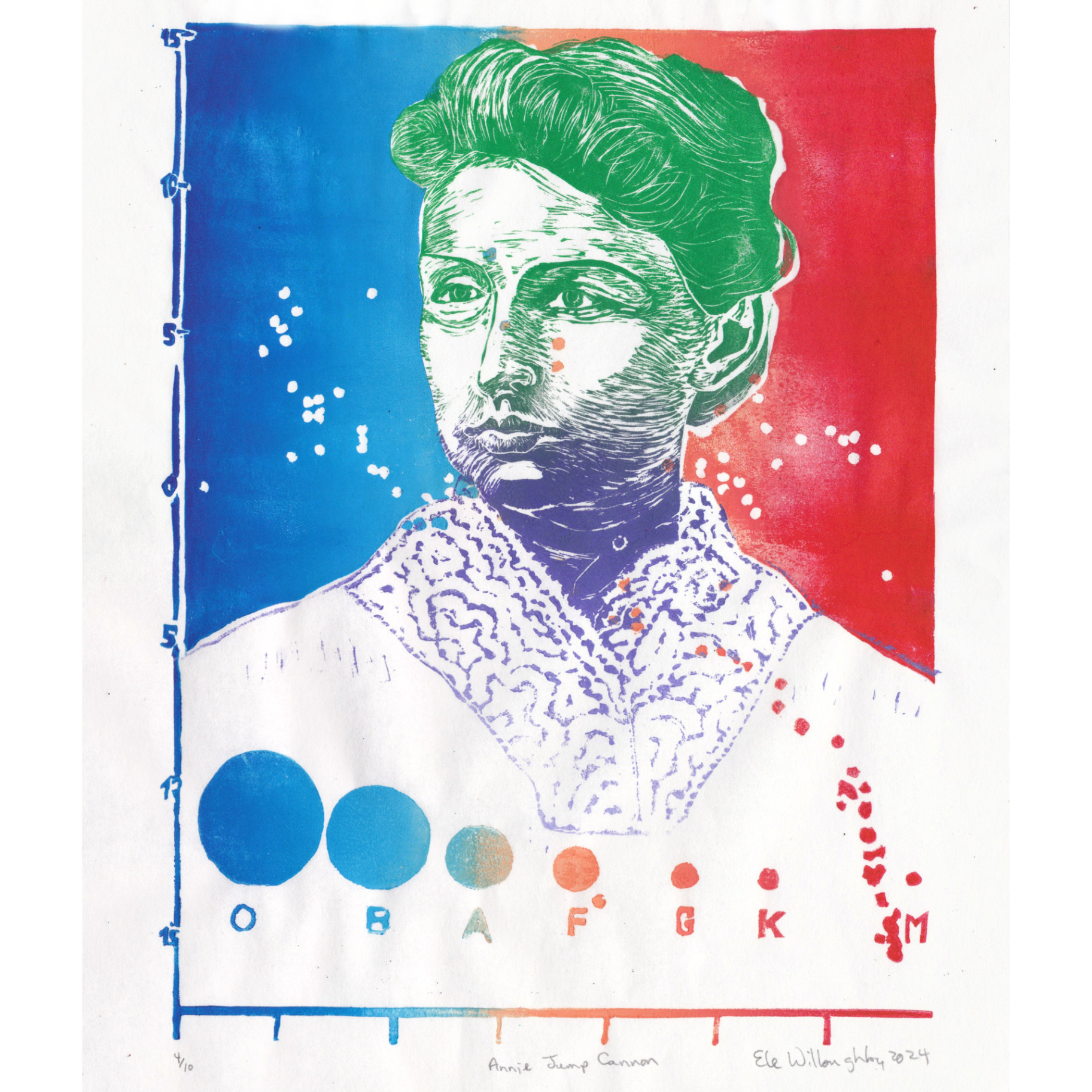
Annie Jump Cannon, 11" x 14" linocut by Ele Willoughby, 2024

I knew the #PrinterSolstice prompt "spectrum" called for another scientist portrait!

My hand printed lino block portrait of trailblazing American astronomer Annie Jump Cannon (December 11, 1863 – April 13, 1941) shows her with her stellar classification system which sorted stars based on spectral types and turned out to reveal their temperature from hot blue stars through cool red stars into O,B,A, F, G, K and M, as shown on the Hertzsprung-Russell diagram behind her. Along with her supervisor Edward C. Pickering, she is credited with the creation of the Harvard Classification Scheme, the first serious stellar classification scheme. The name, citing Harvard rather than Cannon herself, who still lacked a university appointment, makes her achievement less visible than it might have been.

The eldest of three daughters of Delaware shipbuilder and state senator Wilson Cannon and his second wife Mary Jump, Annie was born in Dover, Delaware. Her mother taught her the constellations, home economics (and the organization skills she would later need) and encouraged her to pursue her own interests. Annie and her mother used old astronomy textbooks to identify stars they could see by climbing out a trapdoor onto their roof. She studied mathematics, chemistry, and biology at Wellesley College, a top school for women, where she excelled at math. She studied physics with Sarah Frances Whiting, one of the few US women physicists at the time, and became the valedictorian. She graduated with a degree in physics in 1884 and returned home to Delaware. Over the next decade she studied the new art of photography, photographing her travels through Europe with her Blair box camera. The Blair company published her photos and prose about Spain, "In the Footsteps of Columbus" and distributed it as a souvenir at the Chicago World's Columbian Exposition of 1893.

A cheerful and energetic person, she lost most of her hearing as a young adult, possibly due to scarlet fever. She found it made it hard to socialize. Then her mother died in 1894, which made family life difficult too. She wrote Sarah Frances Whiting seeking a job and was hired as a junior physics teacher, which allowed her to take graduate physics and astronomy classes and study spectroscopy on her own. She gained access to a better telescope by enrolling in Radcliffe College (a women's college affiliated with Harvard) in 1894 as a "special student" which allowed her to use the he Harvard College Observatory. Harvard astronomer Edward C. Pickering hired her as his assistant in 1896. He was running a program to map and catalogue every visible star in the sky to a photographic magnitude of about 9 (16 times fainter than visible by human eye alone) to complete the Henry Draper Catalogue, a research program fund by the widow of a wealthy physician and amateur astronomer. He hired men to do the physical jobs of operating heavy telescopes and making photographs. He hired and supervised a group of women (whom he could pay as little as 25 cents an hour to work seven hours a day, six days a week) known as the Harvard Computers to do examine data, do calculations and catalogue photos - work he did not deem proper scientific analysis. Though hired as mere "computers" this team included such astronomy luminaries as Cannon, Henrietta Swan Leavitt, Williamina Fleming and Antonia Maury who made important advancements in the field. Pickering wanted the optical spectra of as many spectra as possible with the goal of indexing and classifying stars by spectra. The Draper Catalogue became an indispensable tool for astronomers.

Cannon worked at the Observatory until 1940. In her first three years, she classified 1000 stars. By 1911 she was made the Curator of Astronomical Photographs at Harvard and by 1913 she had learned to accurately classify 200 stars an hour! She published her first star catalogue in 1901. She finished her studies at Wellesley and was awarded a master's in 1907. In 1927, Pickering  said "Miss Cannon is the only person in the world—man or woman—who can do this work so quickly," about her skills in star classification.

The classification work was begun by Nettie Farrar, but she left the Observatory after a few months to get married. Antonia Maury (the first person to detect an calculate the orbit of a spectroscopic binary, and Draper's niece) took over. She insisted on a complex scheme, to the dismay of project manager Williamina Fleming (who catalogues ten thousand stars, 59 gaseous nebulae, over 310 variable stars, 10 novae and other astronomical phenomena including discovering the Horsehead Nebula) who wanted a simpler scheme. Cannon negotiated a compromise, applying a scheme dividing of stars into the spectral classes O, B, A, F, G, K, M, based on the Balmer absorption lines of hydrogen. Later when the scheme was understood to reflect stellar temperatures her initial sequence of the classes was reordered to go from hot to cold.

Cannon excelled at the work thanks to her organizational skills and patience with the tediousness of the work. Her calm, friendly and hardworking personality lead her to a sort of ambassador-like role, brokering exchanges of equipment between male colleagues.  Nicknamed "Census Taker of the Sky,"  she catalogued an estimated  350,000 stars, more than any other person. She also discovered 300 variable stars, five novas, and one spectroscopic binary.

In 1914, she was admitted as an honorary member of the Royal Astronomical Society. Awarded an honorary doctor's degree in math and astronomy from Groningen University in 1921, she became one of the first women to receive an honorary doctorate from a European university. On May 9, 1922, the International Astronomical Union passed the resolution to formally adopt Cannon's stellar classification system. With minor changes (to include intensity as well as temperature) Annie Jump Cannon's classification system is still in use today. She got the opportunity to spend six months in Arequipa, Peru, photographing stars in the Southern hemisphere. In 1925 she became the first woman to receive an honorary science doctorate from Oxford and was elected to the American Philosophical Society. In 1929 she chosen as one of the "greatest living American women" by the League of Women Voters. In 1931, she was the first woman to win the Henry Draper Medal. In 1932 she won the Ellen Richards prize from the Association to Aid Scientific Research by Woman. She represented professional woman at at the World's Fair in Chicago in 1933. She became the William C. Bond Astronomer at Harvard University in 1938.

Cecilia Payne (later Payne-Gaposchkin) used Cannon's data to show that stars are mainly composed of hydrogen and helium.

Cannon retired in 1940 but kept working at the Observatory until a few weeks before she died at 77. Her work helped women gain acceptance and respect in the field. A dedicated suffragette she was also a member of the National Women’s Party. As The Woman Citizen’s noted in 1924, despite her achievements “The traffic policeman on Harvard Square does not recognize her name. The brass and parades are missing. She steps into no polished limousine at the end of the day’s session to be driven by a liveried chauffeur to a marble mansion.” But her legacy lives on in the discoveries she made, the classification system she developed, and the trail she blazed for women in astronomy. In 1935 she created the Annie J. Cannon Prize, awarded by the American Astronomical Society, for "the woman of any country, whose contributions to the science of astronomy are the most distinguished." The first recipient became the first woman full professor of astronomy at Harvard: Cecilia Payne-Gaposchkin. Like her mother before her, and her first physics professor Sarah Frances Whiting, Annie was able to mentor and promote the next generation of women astronomers. Payne-Gaposchkin wrote in Science, upon her death, “On the thirteenth of April, 1941, the world lost a great scientist and a great woman, astronomy lost a distinguished contributor and countless human beings lost a beloved friend by the death of Miss Annie J. Cannon.” Harlow Shapely, Directory of the Harvard Observatory wrote, “Her official position at the Harvard Observatory was the William Cranch Bond Astronomer and Curator of the Photographic Collection. Her unofficial position was dean of women astronomers of the world and a leading and most honored woman scientist.”


References

Annie Jump Cannon, wikipedia, accessed February 2024 

Christ, Marian., Annie Jump Cannon, American Philosophical Society, January 16, 2022.

Geiling,  Natasha., The Women Who Mapped the Universe and Still Couldn’t Get Any Respect, Smithsonian Magazine, September 18, 2013

Murphy, Norah M., Eyes to the Sky: Annie Jump Cannon and the Harvard Observatory, The Harvard Crimsom, May 5, 2017

Stellar classification, wikipedia, accessed February 2024


Thursday, February 2, 2023

Vera Rubin and What Can't Be Seen

Vera Rubin, linocut on Japanese paper, 11" x 14", by Ele Willoughby, 2023
Vera Rubin, linocut on Japanese paper, 11" x 14", by Ele Willoughby, 2023. The orbital velocity of galaxies is plotted against distance (on top of a galaxy, from its centre outwards). There's a wide gulf between the drop off that would be predicted by Kepler's laws and what was observed. Here, I have left that region white to emphasize that it was evidence of something missing and unseen. So I selected her for the #printerSolstice prompt space, so I could allude to outer space and have the space within the composition be what was telling the story.

This is a linocut print of renown astronomer Vera Rubin (neé Cooper, 1928-2016) and her discovery that the angular motion of galaxies deviates considerably from predictions, which we now know was the first evidence for dark matter, confirmed in the decades since. 

Her parents, Eastern European Jewish immigrants, electrical engineer Pesach Kobchefski (anglicized to Philip Cooper) from Lithuania, and Rose Applebaum from what is now Moldova, met in Philadelphia, working at Bell Telephone; though her mother's job ended when she married. When Vera was 10 they moved to Washington, DC, where she watched stars from her window and first fell in love with astronomy. “What fascinated me was that if I opened my eyes during the night, they had all rotated around the pole and I found that inconceivable. I just was captured,” she later told AIP in 1995.  With her father she built a simple cardboard telescope and tracked meteors. Her older sister went to law school. After she finished high school in '44 she ignored her physics teacher's advice to pursue art rather than science and went to the women's college Vassar, where astronomy trailblazer Maria Mitchell had been a professor as early as 1865. She graduated with honours, the sole astronomy graduate of 1948.

She wanted to pursue graduate studies at Princeton but was barred due to her sex; Princeton took 27 more years to admit women astronomy graduate students. She turned down an offer from Harvard, and instead opted for Cornell where her new husband, physicist Robert Joshua Rubin was a graduate student. During her masters (Cornell, 1951) she studied the motions of 109 galaxies. Hubble flow (or the Hubble-Lemaître law) states that galaxies are moving away from us at speeds proportional to their distance. Rubin was one of the first to observe a deviation from this law. She studied under Philip Morrison, Hans Bethe, and Richard Feynman and worked with astronomer Martha Stahr Carpenter to find a thesis topic on galaxy dynamics. She said that Carpenter's "course in galaxy dynamics really set me off on a direction that I followed almost my entire career.”  Her husband brought her a paper by renown physicist and cosmologist George Gamow who pondered whether galaxies moved like solar systems and it inspired her to start investigating how galaxies move. She found a plane of higher density of galaxies, which years later we would recognize as was some of the earliest evidence of the super galactic plane, the equator of our supercluster of galaxies. 

One of her advisors, Robert Shaw told her that her work was sloppy but should be presented to the American Astronomical Society (AAS) meeting. Since she was not a member, and very pregnant, he could do that - under his own name, not hers. So, she said she could go. She found the discussion after was acrimonious and she felt like an imposter. Her paper was never published. 

She took 6 months maternity leave but found it immensely difficult being at home with their lovely baby but watching her husband going to work daily to pursue what he loved. It was her husband who insisted she return to grad school. He took a job at the National Bureau of Standards in Washington, D.C. She gained experience working summers at the Naval Research Laboratory and the US Naval Observatory. She was admitted to the PhD program at Georgetown University, the only university in Washington, D.C. with a graduate astronomy program, at age 23, expecting their second child. The Jesuit astronomer Fr. Francis Heyden taught his courses at night, a real challenge with a young family. She encountered sexism, and recounted how she was not allowed to meet her advisor in his office as women were barred from that area of the Catholic university. When writing her thesis, Heyden got her in contact with George Gamow, who worked at the nearby Applied Physics Laboratory and was an adjunct professor at George Washington University. Gamow took her on as a student. In her 1954 thesis she noted that galaxies clump together rather than being randomly distributed - a largely ignored idea it took the field decades to catch up with. 

While her four children were very young, she taught at Georgetown and Montgomery College for several years before gaining a research position at the Carnegie Institution of Washington's Department of Terrestrial Magnetism (which operated the Wilson Observatory in California and had a new high-tech magnetically focused electronic image tube which could increase the sensitivity of telescopes). She worked for a year with Geoffrey and Margaret Burbidge observing rotating galaxies using the McDonald Observatory's 82" telescope. She was the first woman to use the Palomar Observatory in 1965, pragmatically solving the lack of washrooms by claiming one by going to her room, cutting out a little paper skirt and pasting it to the little man icon on the door.  "There you go; now you have a ladies' room." At Carnegie she met physicist and astronomical instrument maker Kent Ford. Together they made the most sensitive spectrometer of the day using the magnetically focused image tube- an instrument which divided light into its constituent frequencies and importantly allowed astronomers to study small regions of galaxies previously too dim to observe, not just galaxies in their entirety. They started looking at the newly discovered quasars but she did not enjoy the competition from astronomers with more access to world-class telescopes and the race to explain these objects. She wanted to carve out a niche to themselves. They decided to look at Andromeda Galaxy, returning to her interest in galaxy dynamics with Ford's spectrometer allowing them to see if galaxies did rotate like our solar system. Since mass and hence gravity is clustered in the centre, nearer objects should go faster than objects at the periphery. But, when they looked at areas of hydrogen gas where new stars form, at various distances from the centre of the galaxy, they all seemed to be going at the same speed. The expected drop off with distance simply wasn't there. They spent years on the project, travelling to various telescopes across the country for observing time. Rubin spent long hours analyzing data on punchcards and always seeing the same thing: no drop-off with distance from the centre of Andromeda. So they looked at other galaxies, and more and more galaxies. They gathered dozens of rotation curves and they were all flat. It contradicted theory and they did not know why but their data was undeniable. (You can see a video of how galaxies were predicted to move next to how they are observed to move here).

The concept of dark matter was proposed by Jan Oort (1932) and Fritz Zwicky (1933) to explain how physics seemed to imply more mass than astronomers could see, but they were largely ignored and no one has developed any theory of how galaxies who behave in the presence of dark matter, nor had anyone gathered observational evidence of dark matter. Rubin and Ford simply did not know what their observations meant. "One day I just decided that I had to understand what this complexity was that I was looking at, and I made sketches on a piece of paper, and suddenly I understood it all," Rubin said. A halo of dark matter - that is, matter which is not luminous, which we cannot see with telescopes, perhaps better imagined as invisible or unseeable rather than "dark," around galactic cores would spread out the mass throughout the galaxies, and hence and speeds would remain flat with distance from the centre. This unseen matter that Rubin and Ford first observed is now understood as the stuff that dictates how galaxies move, and even the origin and fate of our universe. 

Since their discovery, a theoretical frame work was set out which fits their model and the Planck satellite measured dark matter by observing the cosmic microwave background. It imaged clumping in the early universe which otherwise would have been homogeneous but which instead, because of this dark matter, evolved into the superclusters of galaxies we know today. We now believe there is five times as much invisible dark matter and the luminous matter we can see. The discovery of dark matter revolutionized astronomy and lead to entire new subfields of astronomy and particle physics. She was a favourite to win the Nobel Prize for many years, but died before that ever happened. Twenty years after Rubin's research revealed dark matter, dark energy was discovered, and its discoverers received the Nobel in 2011. In 2019, three years after her death, James Peebles shared the Nobel Prize in physics for work on evolution of our universe- notably theoretical work on existence of dark matter and dark energy. Many physicists and astronomers lamented the egregious snub of Vera Rubin, by waiting until she had died rather than including her.

She also found evidence that some stars and gas within galaxies move counter to the prevailing motion, some of the first evidence of galaxy mergers.

Throughout her career she was a champion of women in science, writing, “I live and work under three basic assumptions. One: There is no problem in science that can be solved by a man that cannot be solved by a woman. Two: Worldwide, half of all brains are in women. Three: We all need permission to do science, but, for reasons that are deeply ingrained in history, this permission is more often given to men than to women.” She likewise championed scientific literacy.

She published more than 100 peer reviewed scientific papers, a collection of essays, was on the editorial boards of journals and a member of the National Academy of Sciences (the second woman astronomer admitted, after Margaret Burbidge) and won the National Medal of Science. She won the gold medal of the Royal Astronomical Society in 1996; she was only the second woman to do so, 168 years after Caroline Herschel. Carnegie named a post-doc fellowship in her honour and the American Astronomical Society named a Vera Rubin Early Career Prize. There is Vera Rubin Ridge on Mars and Asteroid 5726 Rubin, a satellite and the Vera C. Rubin Observatory named in her honour. All four of her children grew up to be PhD mathematicians and scientists and they credit their mother for making it look like desirable and fun. 

References

Vera Rubin, Wikipedia, accessed January 2023.

Meet Vera Rubin, November 17, 2021, Air And Space Museum, Smithsonian Museum.

Sarah Scoles, How Vera Rubin confirmed dark matter, Astronomy, Tuesday, October 4, 2016 

Matt Schudel, Vera Rubin, astronomer who proved existence of dark matter, dies at 88, Washington Post, December 26, 2016

Rachel Feltman, In memory of Vera Rubin, the woman the Nobel Prize forgot, Popular Science, December 27, 2016

Ethan Siegal, Who Really Discovered Dark Matter, Fritz Zwicky or Vera Rubin? Forbes, August 24, 2021

Chanda Prescod-Weinstein, The Disordered Cosmos, Bold Type Books, New York, 2022.

Kelsey Johnson, We're Sorry, Vera Rubin, Scientific American, October 16, 2019

Shannon Connellan, Nobel Prize in Physics awarded to scientists, some rally behind one who never got one, Mashable, October 8, 2019

Wednesday, February 1, 2023

Jack Frost, astronomers Kepler and Lepaute and bees in snail shells

 I haven't kept up with posting all my recent prints, so today, we're playing catchup! I've been doing #printerSolstice so I have managed to make a print weekly tie to their prompts. This year the prompts are elements of art and design: value, form, line, balance, texture and upcoming are space, shape, contrast, proportion, unity, pattern and variety. I'm trying to interpret these prompts in light on my ongoing series of prints of various sorts. The first one, value (or the lightness and darkness of colours), I applied to another slightly sinister winter folktale: Jack Frost and made a print in tints and shades of cobalt blue.


Jack Frost, linocut on cardstock, 5" x 7" by Ele Willoughby, 2022

For form, I thought of Kepler and how he arrived at his laws from thinking about music and then the Platonic Solids!

Johannes Kepler, linocut by Ele Willoughby, 2023
Johannes Kepler, linocut, 11" x 14" on Japanese kozo paper, by Ele Willoughby 2023

This is my linocut of mathematician and astronomer Johannes Kepler (1571-1630). We remember him for his role in the Scientific Revolution, and his three laws of planetary motion in particular. His laws modified Copernicus’ heliocentric model; he replaced the circular orbits with elliptical ones & described velocities of planets. Today we know them as:

1) Planetary orbits are ellipses with the Sun as one of the foci (top magenta ellipse)

2) A line from Sun to planet sweeps out equal areas in equal time periods (middle ellipse)

3) The square of the planet’s orbital period (or year) is proportional to the cube of the semi-major axis (shown as the horizontal arrow in the bottom ellipse).

But, I find it fascinating- & important to note- that he came to these laws exploring mystical ideas about music, geometry and congruence with physical phenomena. Sometimes we tell simple, but misleading stories about scientific progress. 

First he argued that the spacing of the 6 known planets from the Sun were related to the 5 Platonic solids, each encased in a sphere and nested one inside another. He had to order them selectively: octahedron, icosahedron, dodecahedron, tetrahedron and cube. He then related the size of the spheres to the  orbital periods of the planets (Mercury, Venus, Earth, Mars, Jupiter and Saturn). But this formula was not precise enough…. But we can see this as the seed of his 3rd law. The gold shapes are the nested Platonic solids from his Mysterium Cosmographicum. 

He also took the medieval idea of the “music of the spheres” literally and translated planetary angular speed as measured from the Sun as musical notes and finds that the minimum and maximum speeds of neighbouring planets approximate harmonies. Though unrelated to our modern ideas about our solar system these explorations of geometry and music ultimately lead to his correct models, which in turn were a significant steps towards Newton’s Law of Universal Gravitation.

Next came line, and I made it about the line traced by an eclipse:

Nicole-Reine Lepaute, linocut by Ele Willoughby, 2023
Nicole-Reine Lepaute, linocut, 11" x 14" on Japanese kozo paper, by Ele Willoughby, 2023

This is my linocut portrait of Nicole-Reine Lepaute, née Étable de la Brière, (5 January 1723 – 6 December 1788). She was a French astronomer, mathematician and human computer. My print celebrates how she calculated the path of the solar eclipse of 1764. She also worked with Alexis Clairaut and Jérôme Lalande to much more precisely calculate the date of the return of Halley’s Comet. This is no mean feat when you realize this was essentially solving the notorious three-body by hand (as the gravitational pull of Jupiter and Saturn affect its orbit around the sun). They worked in parallel, calculating for 6 months straight, barely stopping to eat! She also produced astronomical almanacs from 1759 to 1783 and was also a member of the Scientific Académie de Béziers.

Some of the historic women of science whose names and achievements were recorded, are known to us because of their wealth and privilege. Though Nicole-Reine Lepaute was born in Luxembourg Palace, she was not an aristocrat; she was the sixth of nine children of the valet of the duchess de Barry and her sister. A bright child, she was self-taught and devoured all the books in the library. Her later friend and long-time collaborator, astronomer Jérôme Lalande wrote that she had "too much spirit not to be curious." 

She married the royal clockmaker Jean-André Lepaute, in the Luxembourg Palace, in 1764. She became responsible for the household accounts but her marriage also allowed her to pursue her interest in mathematics and astronomy. She applied her skills to document, observe and calculate the workings of all her husband's inventions. The Académie des Sciences sent Lalande to inspect her husband's new type of pendulum clock. The three worked on the theory of clockmaking and added to her husband's "Traité d'horlogerie," which he had published in 1755. Though she was not included as a co-author, Lalande was nothing but praise for her, writing, "Madame Lepaute computed for this book a table of numbers of oscillations for pendulums of different lengths, or the lengths for each given number of vibrations, from that of 18 lignes, that does 18000 vibrations per hour, up to that of 3000 leagues"

Though Newton's Law of Universal Gravitation, published in 1687, allowed astronomers to calculate planetary orbits around the sun, to do so they considered only the two bodies: the mass and position of a single planet and the sun. The truth is more complex, because all masses exert gravity, and as soon as we introduce even a third mass there is no general closed-form solution and some systems are even chaotic. The first problem studied was the Sun-Earth-Moon 3-body problem, which Newton could not solve and succeeding generations continued to pursue. Early physicists became so frustrated that they began to doubt Newton's Law of Universal Gravitation. Renown mathematician Leonard Euler even wrongly argued against the inverse square law. Being able to accurately predict the Moon's orbit had huge implications for navigation and determination of longitude at sea. Competing polymaths Jean le Rond d'Alembert and Alexis Clairaut each presented their analyses of the problem to the Académie Royale des Sciences in 1747. Clairaut had found a brilliant approximate solution to the 3-body problem for which he received the 1750 prize of the St Petersburg Academy for his essay "Théorie de la lune". 

In 1757, Lalande decided he improve on the predictions of a different 3-body problem: the return of Halley's Comet, last seen in 1682. Because the gravitational pull of Jupiter and Saturn cannot be neglected, Halley himself was only able to calculate that the comet would return "around the end of the year 1758 or the beginning of the next." He enlisted the help of Clairaut and Lepaute.  The divided up the calculations required and worked in parallel for more than 6 months, barely even stopping to eat! They were in a race to make their prediction before the comet itself arrived. By November 1758 they gave a two-month window for comet's perihelion (closed point to the sun) of the 15th of March to the 15th of May, centered around the 13th of April 1759.  They missed the comet's arrival, the 13th of March, 1759 by only a couple of days. Sour grapes Jean d'Alembert griped that their work was "more laborious than deep". In fact, their heroic efforts were a huge technical feat and ten-fold improvement on Haley's vague two-year window. Their error was only due to employing the less-than-accurate accepted masses for Jupiter and Saturn. Notorious ladies' man Clairaut unfortunately removed any mention of Lepaute from his 1760, "Théorie du mouvement des comètes", alledgedly to please another woman, whereas in Lalande's "Théorie des Comètes" he insists they could never have made the calculations without her. 

Lepaute went on to collaborate with Lalande and his calculations for decades. In 1759 Lalande became the director of the  Académie des Sciences astronomical almanac Connaissance des Temps (Knowledge of the times) and appointed Lepaute as his assistant. He prepared computing plans and she did the calculations for the almanac. Her work included calculations on a 1762 comet, and a table of parallactic angles, work on the Éphémerides, annual guides for astronomers and navigators, calculating the daily position of Saturn from 1775 to 1784 (for the seventh volume, in 1774). She calculated on her own the daily positions of the Sun, Moon and planets for the eighth volume (in 1784).

In 1762 she calculated the exact time and path of the annular solar eclipse of 1st of April, 1764. Under her own name, she published a map which showed the eclipse's extent over Europe (shown in green in my print), as well as the its successive phases in 15-minutes intervals as would be visible over Paris (shown in blue in my print).

She and her husband were childless but adopted his nephew, Joseph Lepaute Dagelet in 1768 and she trained him as a mathematician and astronomer. He became a professor and was inducted in the French Royal Academy of Sciences in 1785.

Despite how vital, and Lalande's vocal appreciation, her work remained largely unrewarded and unrecognized during her lifetime. She worked as computer for Lalande for 15 years while he was a professor and director of the Paris Observatory. She did became a member of the distinguished Scientific Academy of Béziers in 1761, and calculated the ephemeris of the 1761 transit of Venus for them. Her eyesight after decades of calculation deteriorated to the point that she had to retire in 1783. She spent the end of her life caring for her terminally ill husband. After her death in 1788, Lalande wrote a biography of her contributions which he included in his Astronomical Bibliography. Both an asteroid (7720 Lepaute) and a lunar crater have posthumously been named in her honour.

For Balance, I made my portrait of Zhang Heng (see previous post).

For Texture, I made a print of an Eastern Snail Shell Mason Bee, Osmia conjuncta. 

Eastern Snail Shell Mason Bee, linocut by Ele Willoughby, 2023
Eastern Snail Shell Mason Bee, linocut 8" x 8" on Japanese kozo paper, by Ele Willoughby, 2023

The Packer Lab at York University posted an image of this mason bee, Osmia conduct, and explained that these adorable little blue snail shell nesting bees had now been observed in Canada (southern Ontario) and to be honest, I'm completely obsessed with the idea. I think it's the cutest thing I've ever heard. Apparently, they think these bees have become more common here because there are now so many of the Cepaea snails, introduced from Europe. So, while I couldn't find any images of this bee nesting, I illustrated it with a Cepaea shell. You can find images and video of other Osmia bees nesting in snail shells online. Many thanks to the friendly and helpful Entomology Twitter folks who helped me track down the right type of snail shell and even introduced me to researchers who said they would try to get video of these cuties next field season!

I will miss Science Twitter when it's gone.

References for scientist bios

Johannes Kepler, Wikipedia, accessed January 2023

Nicole-Reine Lepaute, Wikipedia, accessed January 2023

Jérôme Lalande, Wikipedia, accessed January 2023

Alexis Clairaut, Wikipedia, accessed January 20223

Lynn, W. T. (2 January 1911). "Madame Lepaute". The Observatory. 34: 77–78. Bibcode:1911Obs....34...87L. 

Bernardi, Gabriella (21 March 2016). The Unforgetten Sisters: Female Astronomers and Scientists before Catherine Herschel. Springer. pp. 121–127. ISBN 9783319261270.

De La Lande, Jérôme (1803). Bibliographie astronomique avec l'histoire de l'astronomie depuis 1871 jusqu'à 1802 (in French). Paris: Imprimerie de la République. ISBN 978-2329549170. Archived from the original on 4 May 2010. 

Connor, Elisabeth (November 1944). "Mme. LePaute, An Eighteenth Century Computer". Astronomical Society of the Pacific Leaflets. 4 (189): 314–321. Bibcode:1944ASPL....4..314C.