Showing posts with label ada lovelace. Show all posts

Tuesday, October 13, 2026

Nancy Grace Roman, NASA Chief of Astronomy and "Mother of Hubble" for Ada Lovelace Day

Nancy Grace Roman, linocut, 11" x 14" on Japanese paper by Ele Willoughby, 2026


It is once again Ada Lovelace Day, the 17th annual international day of blogging to celebrate the 

Ada Lovelace, 3rd edition
Ada, Countess Lovelace, 3rd edition linocut by Ele Willoughby 

achievements of women in technology, science and math, Ada Lovelace Day 2026 (ALD26). I'm sure you'll all recall, Ada, brilliant proto-software engineer, daughter of absentee father, the mad, bad, and dangerous to know, Lord Byron, she was able to describe and conceptualize software for Charles Babbage's computing engine, before the concepts of software, hardware, or even Babbage's own machine existed! She foresaw that computers would be useful for more than mere number-crunching. For this she is rightly recognized as visionary - at least by those of us who know who she was. She figured out how to compute Bernouilli numbers with a Babbage analytical engine. Tragically, she died at only 36. Today, in Ada's name, people around the world are blogging.

You can find my previous Ada Lovelace Day posts here.


This is a hand-carved and hand-printed lino block print portrait of trail-blazing astronomer Nancy Grace Roman (1925-2018), NASA's first chief of astronomy throughout the 1960s and 1970s, who helped shape NASA's space astronomy program. Nicknamed the "mother of Hubble" for her role in planning the revolutionary Hubble Space Telescope, she was active in science communication and an advocate for women in science throughout her career. Recently, the Wide Field Infrared Survey Telescope was renamed the Nancy Grace Roman Space Telescope in recognition of her enduring contributions to astronomy, and launched August 30, 2026. 

Born in Nashville, Nancy came by her love of school and science honestly from her music teacher mother Georgia Frances Smith Roman and physicist and mathematician father Irwin Roman. Her father got an oil industry geophysics job and moved the family to Oklahoma when Nancy was only 3 months old. His job also brought them to Texas, New Jersey, Michigan (where the dark night skies allowed her mother to show her the constellations and northern lights), and, when he joined the Civil Service as a geophysicist in 1936, to Nevada. The frequent moves meant that Nancy had to repeatedly work on her own to catch up with her new class and curriculum and that she did not have a lot of chance to make close friends. The next year, when Nancy was about 12, her father was hired as Senior Geophysicist at the Baltimore office of the U.S. Geological Survey, and Nancy started an astronomy club with her classmates so they could learn the constellations. By the 7th grade, she knew she would be an astronomer. She completed an accelerated program at Western High School in Baltimore, graduating in only 3 years. She never had a telescope but read every book on astronomy in the Baltimore library. As a girl, her science interests were not encouraged; when she requested a second year of algebra instead of taking Latin, her guidance counsellor "looked down her nose at me and sneered, 'What kind of lady would take mathematics instead of Latin?' That was the sort of reception I got most of the way”, Nancy recalled. But because the US entered the war, Nancy got the chance to substitute a summer of chemistry for her senior year of high school and started college early. 
 
Nancy went to Swarthmore, where she said of the dean of women "if you insisted on majoring in science or engineering, she wouldn't have anything more to do with you" but she did refer her to the astronomy department. The chair Peter van de Kamp tried to discourage her from this path but did teach her astronomy. She was able to work with two previously defunct student telescopes which gave her a feel for instruments and instrumentation and let her have "the fun of playing around with observing techniques." In her second year she began working at Swarthmore's Sproul Observatory processing astronomical photographic plates. Van de Kamp gave her a solo lecture on astrometry, which studies the precise positions and movements of celestial bodies and was his field of expertise. He suggested she learn about professional astronomy from the astronomical library. She recalls the only encouragement she got was from the Physics Department head who said, "I usually try to discourage girls from going into physics, but I think maybe you might make it." When she graduated in February 1946, Van de Kamp recommended she pursue graduate studies at the University of Chicago, which was rebuilding its astronomy department after the war. 

By March she was enrolled and finding classes easier than those at Swarthmore, so she asked three professors, Otto Struve, George van Biesbroeck, and William Wilson Morgan, for extra projects to help her decide what she would like to focus on for her thesis. Biesbroeck asked her to solve the orbit of a double-star. Struve gave her a couple of interesting stellar spectra to analyse. Morgan's observational project using a 12 inch (30 cm) telescope expanded into her thesis. The first time she meet her supervisor Morgan he asked her to go to his house and change the bed because his wife was sick, a task he would never have asked a male student. Surprised and flummoxed, she acquiesced. Professors complained about teaching women whom they assumed would quit to get married. Morgan was not encouraging and at one point did not even speak to her to say hello for six months. Nevertheless, she got the guidance Morgan neglected to offer from visiting scientists Bengt Stromgren and Adriaan Blaauw and she succeeded in completing her doctorate on the Ursa Major Moving Group in 1949. The stars in Ursa Major featured in my portrait, are bright remnants of a now scattered cluster; she found 200 stars that had left the Dipper at the same time, and knowing their distances from geometry she was able to determine their actual intrinsic brightnesses. This was an improvement on getting intrinsic brightness from their spectra. The night before her defence, Morgan who typically worked late, insisted on meeting her at midnight and "decided to use it as an occasion for petting"; she moved his hand several times and tried to continue their conversation. Mercifully he did not try this again. Since the disinterested Morgan was unable to tell other faculty how her research was going, they had assumed she wasn't working and were surprised when she had no trouble defending her thesis. While in graduate school she also began a life-long association with the American Association of University Women (AAUW). 

She spent two months at Warner and Swasey Observatory, in Cleveland, before agreeing to be Morgan's research associate at Yerkes Observatory in Williams Bay, Wisconsin. During her six years there she was able to visit the University of Chicago's McDonald Observatory in Texas for four months every year. When the position ended she was employed as an instructor and then assistant professor. As was typical at the time her salary was less than two thirds of a similarly qualified male. Department Chair and Nobel laureate Subramanyan Chandrasekhar (whom had certainly been subject of racial discrimination, but unable to recognize sexual discrimination) told her, "We don't discriminate against women - we can just get them for less." She made a study of naked-eye visible stars and noticed that the proportion of elements heavier than helium (that astronomers call metals) varied; those with stronger metal lines moved in more circular orbits closer to the galactic centre and plane of the Milky Way, and those with weaker lines moved more elliptically and further away. Younger stars are made from the expelled nuclear remnants of exploded stars that had built up heavier metals over their lifetime and then gone nova. So younger stars are more metal-rich. Older, redder, less metal-rich stars had slower, more elliptical and inclined orbits than the bluer metal-rich younger stars moving in circular orbits and sticking close to the galactic plane as they form. This gave some of the first clues about the formation of the Galaxy. Her 1950 paper was selected as one of most important 100 papers of the century in Astrophysical Journal. She then looked at star colours and spectra and found that since more of the metal lines are in the violet and UV, stars with weaker metals were slightly bluer in the UV than their colours in the red would suggest. This "UV excess" proved an easier way to distinguish the metallicity of stars and is still a useful tool. I allude to this work and later research in the stellar spectrum (at the blue end) illustrated on her shirt in my portrait. These she considered her two most important discoveries. Morgan tried to take credit for her work, though he had not been involved. Her research was very impactful and amongst the most highly-cited papers of the time, including, in 1950, three top-100 papers in a single year, with over 3,000 citations. But she was dubious of her ability to get a tenure as a woman, at an institution which could support her research. She turned down positions at Wayne State University and the University of Southern California, because they could not offer access to astronomical instrumentation she needed. She was able to use a new astrometry device for measuring photographic plates at the Argonne National Laboratory, but Yerkes would not acquire one. Likewise when she argued in 1954, they should acquire a digital computer for data analysis, still novel at the time, the department chair Chandrasekhar declared computers not useful for this purpose! While studying stars at different Galactic latitudes during her visit to the David Dunlap Observatory in Toronto she noted one which was not sun-like as expected. She thought she must have made an error and so she checked it again when she returned to Yerkes.  She had discovered that the emission spectrum of the star AG Draconis had completely changed from earlier observations. She called it a stroke of luck; this star is only in this altered state 2 to 3% of the time. This observation raised her profile. She published her new "spectral types, photoelectric magnitudes and colors, and spectroscopic parallaxes for about 600 high-velocity stars," in 1955 as part of the Astrophysical Journal Supplement Series. She also published on the detection of exoplanets. 

She met a Scottish postdoc and fell in love. Since it would have been a challenge to find two astronomy positions in the same place, she considered giving up astronomy to marry, but their relationship did not work out. His fellowship required him to go to a commonwealth country and he found a position in Australia. They wrote regularly for a few years but it was not to be. A couple of years later she was surprised by a proposal of marriage from a man with whom she had not spent a great deal of time alone; she considered it seriously but turned him down. They remained friends until he died.

Knowing the university had never appointed a woman to the academic staff she decided to move on. Morgan wanted her to stay and deliberately did not inform her of job openings but another faculty member, Gerard Kuiper had recommended to her a position and the Naval Research Laboratories in the new field of radio astronomy. She enjoyed teaching but did not want to only be a teacher, so decided government science might be her best bet. She moved to Washington, D.C. and remained there for the rest of her life. She found women were better tolerated, and better paid in government science. She spent three years at NRL, where she worked on radio astronomy, using radio astronomy for geodesy, the propagation of sound in water, and became head of the microwave spectroscopy section of the radio astronomy program. She mapped the Milky Way at 440 MHz. She also consulted on the Project Vanguard satellite program, which introduced her to space astronomy. Because of her observation of the unexpected spectra of AG Draconis, she was invited to speak in Armenia, then part of the Soviet Union, in 1956 for the dedication of the Byurakan Observatory, making her the first civilian to visit since the Cold War. NRL leaders were very interested and this and it lead to higher profile and a series of invitations to give astronomy lectures back home. Most of the science section at NASA came from NRL, so they knew Roman. She attended a talk at the newly-formed NASA by Harold Urey, where Jack Clark asked her if knew anyone interested in starting a space astronomy program there; she took that as an invitation to apply. She was offered the job, and accepted in 1959 even though she suspected a management position would mean giving up research because "the chance to start with a clean slate to map out a program that I thought would influence astronomy for fifty years was more than I could resist." 

Dr. Nancy Grace Roman is shown with a model of the Orbiting Solar Observatory (OSO) in 1962
Dr. Nancy Grace Roman is shown with a model of the Orbiting Solar Observatory (OSO) in 1962 (NASA)

She found her time at NRL had taught her how to work with engineers and translate between the engineers and scientists, which proved very useful at NASA. In the beginning there was no bureaucracy and plenty of funding. She recalled asking the grant office about a certain idea and being told, "Don't ask me what you ca do. Tell me what you want to do. It is up to be to find a way." She was put in charge of the Orbiting Solar Observatories (both the OSO 1 satellite in the top left and a model of the Advanced Orbiting Solar Observatory or AOSO in her hand are part of my portrait), worked on the first gamma-ray telescope, as well as their existing work on geodesy and relativity. As early as 1959 she suggested a space telescope could be used for exoplanet detection, and even suggested a technique employing a rotated coronagraphic mask to block the direct light from stars to resolve bodies which might otherwise been obscured by the glare, as was ultimately used by the Hubble Space Telescope and will soon be used by the Nancy Grace Roman Space Telescope. In 1960, she was made the first Chief of Astronomy in NASA's Office of Space Science, and the first woman to hold a NASA executive position. She gave lectures to introduce astronomers to the program and to meet with astronomers to find out what they wanted to research from space. As surprising as it may be today, astronomers were initially skeptical of what NASA could do for their field. She decided that NASA should manage major astronomy projects to benefit the wider scientific community rather than individual projects by scientists. She wrote in 1960, "A fundamental part of all of these plans is the participation of the entire astronomical community. NASA will act as a coordinating agency to enable astronomers to obtain the basic observations they need from outer space." Until peer-review was introduced in 1970, Roman alone judged the merit of all proposals and distributed the science budget. She lead the orbiting astronomical observatories program. The learning curve was steep. The first in a series of optical and ultraviolet telescopes was four years behind schedule and failed three days after reaching orbit in 1966. The OAO-2 launched in 1968 was the first successful space telescope and the OAO-3 Copernicus was very successful from 1972-1981. NASA learned that unforeseen technical problems were inevitable and that it was wise to keep launch dates classified. She oversaw astronomical satellites Uhuru (1970), the gamma-ray telescope Small Astronomy Satellite 2 (1972), x-ray telescope Small Astronomy Satellite 3 (1975), geodetic satellites, the Astronomy Rocket Program, the Scout Probe to measure the relativistic gravity redshift, and experiments on Spacelab, Gemini, Apollo and Skylab. She set up NASA’s scientific ballooning program and the airborne astronomy program starting with a 12 inch (30 cm) telescope on a Learjet in 1968 and the Kuiper Airborne Observatory with a 36 inch (91 cm) telescope on Lockheed C-141A Starlifter jet. She was skeptical it would pass review, but the Cosmic Background Explorer mission began during her tenure, and its results lead to the 2006 Nobel Prize for its leading scientists, as did the Infrared Astronomy Satellite, overseen by Nancy Boggess. She was most proud of the International Ultraviolet Explorer. She fought to collaborate internationally with the UK’s Science and Engineering Research Council and the European Space Agency saying, "IUE was an uphill fight. I don't mean I didn't have some support, but I think I carried it on almost single handedly.” 

Henrietta Swan Leavitt, 9.5" x 12.5" linocut by Ele Willoughby, 2010 

She is most famous for her last major program, the Large Space Telescope which has since been named the Hubble Space Telescope. Though quick to share credit with her many colleagues, Nancy Grace Roman was known as the “mother of Hubble.” Getting above the atmosphere avoids the distortions it causes and allows astronomers to observe a much wider range of frequencies (which otherwise would be filtered out by the atmosphere). A large mirror is required to collect enough light from dim and distant objects. First proposed in 1946 by Lyman Spitzer, the possibility of a 3 m space telescope became more feasible in the 60s with the development of the Saturn V rocket. Roman chose to focus first on the small telescopes of OAO as proof-of-concept for the deployment and remote operation of space telescopes. Some astronomers argued for a moon-based telescope but Roman felt logistics, including the lunar dust were insurmountable. Colleagues from NASA’s Langley Research Center argued for space telescopes with human operators, but Roman considered that absurdly complicated. People need atmospheres to breathe, and the atmosphere was precisely what they were hoping to avoid. But with the success of the OAO she began lecturing on the possibility of a large space telescope. In 1969 NASA commissioned a report from the National Science Foundation which endorsed the idea. With astronomer Charles Robert O'Dell, hired in 1972 to be the Project Scientist, she was the driving force behind the project and developed the standard process by which NASA operates large astronomical projects. She set up the Space Telescope Science Institute (STScI) to run mission science operations. As the design process continued engineers requested a smaller mirror for technical reasons; Roman argued for a 2.4 m minimum size in order to accurately resolve Cepheid Variables in Virgo. Edwin Hubble had shown that the speed at which distant galaxies recede was proportional to distance, but the proportionality constant was not well determined. Henrietta Swan Leavitt had shown that luminosity of the class of stars called Cepheid Variables was a function of their period of variation. This let astronomers calibrate their distance in the Milky Way, and so if they could resolve these stars in Virgo, they could determine its distance. After convincing NASA and the astronomical community she next tackled policy makers, writing testimony for Congress throughout the 1970s to continue to justify the telescope and convince them to fund it. She invested in detector technology and served on the selection board for Hubble’s science operations. She argued that for the price of a trip to the movies every American would have 15 years of exciting discoveries, to justify the large price tag. Costs ultimately ran much higher, but the Hubble Space Telescope more than doubled this lifespan. Goddard wanted control of the STScI and Hubble science operations but Nancy sided with the astronomical community that it should be their hands; this nearly cost her job and lead to her retirement. 

Nancy Grace Roman with Hubble model
Roman, posing here in 1966 with a model of the observatory that would become the Hubble Space Telescope (NASA)

She took early retirement in 1979 so she could care for her elderly mother (until her death in 1992), but remained as a consultant for a year while selection of the STScI continued. Interested in programming she audited a FORTRAN course and became a consultant for ORI, Inc. from 1980 to 1988, supporting research on geodesy and astronomical catalogues. 

Hubble was scheduled to be flown on the Space Shuttle flight after Challenger; then the Challenger disaster lead to a three year delay. NASA chose to redesign payloads for robotic deployment but Hubble was too far along in its design. It was quite lucky that it could be serviced by the Space Shuttle, which allowed its initial mirror problem to be fixed and later for instruments to be sporadically upgraded, greatly increasing its abilities and lifetime. 

This in turn lead to her becoming head of the Astronomical Data Center NASA's Goddard Space Flight Center in 1995 and working with contractors supporting it until 1997. She spent three years training K-12 science teachers including those for underserved districts and spent ten years recording astronomy textbooks for Reading for the Blind and Dyslexic until her mid-eighties. In 1962 she was awarded with the Federal Women's Award (introduced in 1961 when they realized that the major awards for civil servants were restricted to men) by John F. Kennedy, and was selected as one of Life Magazine's 100 Most Important Young People. She received four honorary doctorates (including one from Swarthmore), NASA's Exceptional Scientific Achievement Award (1969), NASA's Outstanding Scientific Leadership Award (1978), the American Astronomical Society's William Randolf Lovelace II Award and Asteroid 2516 was named in her honour.  She was frequently recognized for her achievements and her support for women in STEM, but described her 2017 inclusion in the LEGO Women of NASA set as “by far the most fun.” She died in 2018 after a long illness.

References
 Nancy Grace Roman, Wikipedia, accessed October 2, 2026

Dr. Nancy Grace Roman (1925-2018), NASA website https://science.nasa.gov/people/nancy-roman/, accessed October 4, 2026

Hyman, Randall. How Vera Rubin and Nancy Grace Roman Transformed Astronomy. Astronomy.com, November 30, 2022. 

Roman, Nancy Grace. Nancy Grace Roman and the Dawn of Space Astronomy, Annu. Rev. Astron. Atrophy's., 2019, 57: 1-34.


See also: Nancy Grace Roman, The Mother of Hubble - Media Resources, Scientific Visualization Studio, NASA

Tuesday, October 8, 2024

Maude Delap and the Lifecycle of the Jellyfish for Ada Lovelace Day 2024

Ada Lovelace, 3rd edition
Ada, Countess Lovelace, 3rd edition linocut by Ele Willoughby 

It is once again Ada Lovelace Day, the 15th annual international day of blogging to celebrate the achievements of women in technology, science and math, Ada Lovelace Day 2024 (ALD24). I'm sure you'll all recall, Ada, brilliant proto-software engineer, daughter of absentee father, the mad, bad, and dangerous to know, Lord Byron, she was able to describe and conceptualize software for Charles Babbage's computing engine, before the concepts of software, hardware, or even Babbage's own machine existed! She foresaw that computers would be useful for more than mere number-crunching. For this she is rightly recognized as visionary - at least by those of us who know who she was. She figured out how to compute Bernouilli numbers with a Babbage analytical engine. Tragically, she died at only 36. Today, in Ada's name, people around the world are blogging.

 
You can find my previous Ada Lovelace Day posts here.


Maude  Delap, linocut, 11" x 14" by Ele Willoughby, 2024
Maude  Delap, linocut, 11" x 14" by Ele Willoughby, 2024

This year for Ada Lovelace Day I thought I would write about a woman outside of academic science who lived far from centres of learning:  self-taught trail-blazing Irish marine biologist Maude Jane Delap (1866 – 1953)* who was the first person to successfully breed jellyfish in captivity and document their full lifecycle, something extraordinarily hard to do. To this day, her work is still cited in laboratory manuals for jellyfish rearing. She also discovered a sea anemone named in her honour, Edwardsia delapiae. She became a respected independent research scientist despite her distance from universities and research institutions, making an extensive study of plankton over many years from her remote location on Valentia Island offshore Ireland's west coast. Further, she did this despite society's and specifically her father's attitudes about the roles of women. In my portrait she is surrounded by different stages in the blue jellyfish (Cyanea lamarckii) based on her own illustrations of her published research.


Born the seventh of ten children to Rev Alexander Delap and Anna Jane (née Goslett) in Templecrone Rectory, County Donegal, Maude moved with her family to Valentia Island at age 8. Her father had been assigned to the parishes of Valentia and Cahersiveen, and, a keen sailor, he sailed around the coast with two of her brothers. Their possessions, following in a second boat, arrived a little worse for wear. Her mother and the rest of the children travelled by train. While the girls had less formal education than their brothers, they had some progressive primary school education and their naturalist father encouraged Maude and her sister Constance (1868–1935) in their interest in biology and zoology. He himself had published articles in the Irish Naturalist and the whole family were avid naturalists. Maude and Constance became prolific collectors of marine specimen, many of which are still housed by the Natural History Museum, Dublin. Maude and her sister got reports from visiting fishermen of interesting species in all the their catch, for which they would pay a few shillings, encouraging what is now often known as "citizen science" or "community science" (to avoid the political overtones of the word "citizen").  They were sometimes invited aboard to observe finds and jellyfish. Since the family enjoyed boating and fishing, Maude and Constance learned how to handle a boat and would row out alone, exploring the coast and caves. The Fisheries Board granted them part-time access to their steam boat for their research.

The sisters' work lead to a survey by the Royal Irish Academy headed by Edward T. Browne of University College London in 1895 and 1896. Browne was particularly interested in plankton, the floating marine organisms ranging in size from microbes to large jellyfish, which are often the basis of the food chain and indicative of ocean health. Maude and Constance continued with their systematic study, gathering specimen of often tiny jellyfish and plankton by dredging and tow-netting, as well as recording sea temperature and changes in marine life for 28 years! They brought specimen back to the lab to identify and sketch them. Maude's patience, attention to detail, skill with her microscope and as an artist allowed her to document microscopic details of jellyfish structures and organs. Maude corresponded with Browne for forty years until his death in 1937. It's speculated that she had fallen in love with him; it was unrequited and he married a colleague. She sent him a box of violets she grew in her garden each year for his birthday. Browne thanked both sisters in his publications and jointly published research with Maude. 

Maude became fascinated by the life cycle of jellyfish. She painstakingly developed a means of keeping them alive in captivity - something which other scientists had struggled and failed to achieve. She determined their diet, at each stage of development, through trial and error and explained the paramount role proper diet plays in being able to keep them in captivity. She changed the water daily, adjusting temperature to match that in the habour, where they thrived, and carefully monitored the jellyfish. She was the first person to breed them successfully in her home laboratory. The life cycle of the jellyfish is unusual: an adult medusa can procreate by producing a planuala (or egg), which implants on a surface like the seafloor and grows into a polyp (which looks a little like a plant rooted in the ground). The polyp can grow into a budding polyp. This stage of the cycle can go either direction; in less than optimal conditions the budding polyp can revert to the polyp stage. In optimal conditions the budding polyp will bud off ephyrae and these eventually grow into adult medusae. Previous to Delap's work, these various stages could be misinterpreted as separate species. She bred four species of jellyfish including Chrysaora isosceles (the compass jellyfish) and Cyanea lamarckii (the blue jellyfish shown in my print) and documented their life cycles and feeding habits and published her results. Her trailblazing research was the first identification of the various life cycle stages (medusa and hydra) that belong to which species. Quite unusually for a woman at the time, Maude published several influential scientific papers under her own name: she published six articles, and three short notes, including two co-authored by Constance. Thanks to her contributions to marine biology she was offered a position in 1906 at the Plymouth Marine Biological Station in England. She declined the job; her father had apparently declared,  "No daughter of mine will leave home, except as a married woman." While this lost opportunity must have been an immense disappointment, she continued her work at home. Leaving Valentia, and her sisters, at age 40 might also have been quite a daunting prospect. Staying in Valentia allowed her to produce her incredible lengthy study of Valentia harbour, and support her unmarried sisters for the rest of their lives, growing and fishing for food and earning income from selling flowers from her garden.

When her father died later that year, the her mother, two sisters and Maude moved out of the Parsonage and were permitted to use Reenellen House by the Knight of Kerry. There, they hosted many guests including friends, family, visiting scientists and naturalists, and fishermen seeking safety and shelter in bad weather. While remote, Valentia was home to a telegraph station which was the European terminus for the trans-Atlantic cable, a weather station and an observatory, which did lead to a number of visiting engineers, scientists and marine biologist. The Delap sisters were highly-regarded members of their community, who helped run the local cottage hospital and fisherman's hall, known for their charity and generosity but also for wearing outdated Edwardian clothes, both for propriety and economic necessity. Her nephews recalled going fishing in the evening to feed all the guests, along with fruits and vegetables they grew in the garden. They set up a laboratory they fondly dubbed "The Department" which was described by her nephew as an "heroic jumble of books, specimens, aquaria, with its pervasive low-tide smell." Aquaria contained not only jellyfish, but fish, starfish and even a thornback ray Maude reared from an egg. She buried dead marine vertebrates in her garden to recover their skeletons. 

In 1920, as the official whale-stranding officer for south west Ireland, appointed by the British Museum and the local contact for interesting wildlife, she was alerted to a stranded 16-foot whale on the rocks beyond the lighthouse. So she rowed out with her handyman, and she correctly identified a rare True's beaked whale, only previously been known from an incomplete US specimen. Unable to save it, she sent its head and flippers (on request) to the Natural History Museum and buried the rest in her garden. The Museum later requested the rest of the skeleton, causing her to dig up her asparagus garden to gather them. The Museum wrote again that two tiny vestigial pelvic bones were missing so Maude dug up her garden again and sieved the soil until she received a telegram from the Museum which read, “Stop! New York Museum informs us that True’s beaked whale does not possess vestigial pelvic bones."  

In 1928, she found a previously undescribed sea anemone burrowing deep into the eelgrass. Named in her honour, the Burrowing Sea Anemone (Edwardsia delapiae) has only been observed in Valentia habour.  In 1936, she was made an associate of the Linnean Society of London. In 1937 she was made an associate member of the Marine Biological Association. She submitted specimen and corresponded with the Natural History Museum from 1894 until 1949, when she was 83. Like her father before her, she submitted observations to Dr Scully’s “Flora and Fauna of Kerry” and both are acknowledged in the text. Maude was also interested in folklore, geology, botany and archaeology and she published several papers in the Kerry Archaeological Magazine. Her grand-nephew recalled Maude, the "old-school Victorian all-round naturalist”, saying, “Wherever we went, she was instantly recognized and greeted with delight”. She died in 1953, and was buried alongside her sisters near Knightstown, Valentia Island, County Kerry. There is now a plaque from the Irish National Committee for Commemorative Plaques in Science and Technology to commemorate her and her work, on the island.

 *I have written previously about Delap's life and work here.

References,

Byrne, Patricia M. Delap, Maude Jane. Dictionary of Irish Biography. 

DOI: https://doi.org/10.3318/dib.002516.v1 
Originally published October 2009 as part of the Dictionary of Irish Biography
Last revised October 2009
 

M. J. Delap. 1905. Notes on the rearing, in an aquarium of Cyanea Lamarcki, Peron et Lesueur. Annual report of Fisheries, Ireland 1902-03. II (I(ii)) 20-22.

Maude Delap, Wikipedia, accessed January, 2024. 

Muka, Samantha Kay. Maude Delap: Jellyfish Goddess of the North Atlantic, Through the Aquarium Glass blog, October 29, 2012.

Sheehan, Jane. Finding Maude Delap, LIVE – LlÅ·n, Iveragh Ecomuseum blog, accessed January, 2024

Sheehan, Jane. Finding Maude Delap, Online Lunchetime Talk, LIVE – LlÅ·n, Iveragh Ecomuseum, YouTube, February 11, 2022.

Sheehan, Jane. Maude Delap Heritage Trail. 27 July 2023. (Accessed January 2024)


Tuesday, October 13, 2015

Botanist and Photographic Pioneer Anna Atkins - for Ada Lovelace Day


Ada Lovelace, 3rd edition
Ada, Countess Lovelace, 3rd edition linocut by Ele Willoughby
Today is the 7th annual international day of blogging to celebrate the achievements of women in technology, science and math, Ada Lovelace Day 2015 (ALD15). I'm sure you'll all recall, Ada, brilliant proto-software engineer, daughter of absentee father, the mad, bad, and dangerous to know, Lord Byron, she was able to describe and conceptualize software for Charles Babbage's computing engine, before the concepts of software, hardware, or even Babbage's own machine existed! She foresaw that computers would be useful for more than mere number-crunching. For this she is rightly recognized as visionary - at least by those of us who know who she was. She figured out how to compute Bernouilli numbers with a Babbage analytical engine. Tragically, she died at only 36. Today, in Ada's name, people around the world are blogging.
You can find my previous Ada Lovelace Day posts here. 
This year, I thought I'd take the opposite approach from last year. I wrote about Marie Skłodowska-Curie last year, despite her fame and the risk that she was likely the only women in STEM that many people can name. I chose to write about her because it was artificial to avoid her; she really did make incredible discoveries and lived an extraordinary life. This year, I've selected a scientist who is rather new to me, and who was not an icon of science. She was nonetheless a pioneer. I've selected her because she is precisely the sort of scientist we forget - especially if female. What she did was important, and cutting edge in her time, and while it may not have been epochmaking it was the sort of important, incremental, methodical work which represents much of the scientific entreprise, and most of the advance of science throughout history. I believe the concept of the "paradigm shift" might be useful, but it is often dangerously simplistic and leads to a false narrative of a series of great men (almost invariably it is a man who is selected to represent the bringer of the new idea) revolutionizing science. Science, and its history, is more often much more involved, non-linear, over-lapping and interwoven than this type of narrative presents. Lastly, I love that this particular scientist was working at the intersection of art and science.


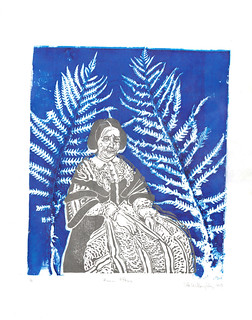
Anna Atkins with ferns
This is a portrait of English botanist and photographer Anna Atkins (1799-1871), née Children. It combines both a hand-carved lino block portrait in dark silver ink, and a screenprint of the silhouette of fern leaves in cobalt blue ink, mimicking the cyanotypes she was known for. It is printed by hand on lovely Japanese kozo (or mulberry) paper, 11" x 14" (28 cm x 35.6 cm). (c) Ele Willoughby, 2015

Anna Atkins (1799-1871), née Children, was an English botanist and photographer. She is the first person to have illustrated a book using photographs, Photographs of British Algae: Cyanotype Impressions in October 1843. Note that: not the first woman, the first person. She lived at a time when it was possible to be a self-trained scientist, especially if you were middle or upper class and received an education and the financial freedom to devote your time to pursue your subject. (The Mary Annings of the world, who managed to make a name for themselves in science despite her class, religions and complete lack of financial ressources, are rare indeed). She was raised and instructed by her father, a naturalist, and her social circle included those who were developing (no pun intended) the latest, brand new photographic technology. So, she was at the right place at the right time. But that doesn't take away from the fact that she had the knowledge, skill, insight and ability to immediately see the utility of the method for descriptive science and to document a specific field of sub-field of botany, with her collection of the algae (seaweeds) of Britain. I think this should be understood as equivalent to a modern-day scientist keeping abreast of other fields of study and rapidly mastering a new high-tech tool to apply it to her field. Even William Henry Fox Talbot, who who invented the salted paper and calotype processes, precursors to modern photographic methods, was not able to publish The Pencil of Nature the first commercially printed photographic book, until eight months after she produced Photographs of British Algae: Cyanotype Impressions.

Her mother died when she was still an infant, but she was close with her naturalist father and received a much more scientific education than was common for women in her time. Her 250 detailed engravings of shells were used to illustrate her father's translation of Lamarck's 'Genera of Shells'. This translation was important to the nomenclature of shells, because her illustration allowed readers to properly identify Lamarck's genera. She married John Pelly Atkins in 1825 and devoted herself to botany and collecting specimen, including for Kew Gardens. In 1839, she became a member of the Botanical Society of the British Isles, one of the few scientific organizations open to women. She became interested in algae, after William Henry Harvey published A Manual of the British marine Algae in 1841.

Through her father, she was friends with both William Henry Fox Talbot and Sir John Herschel, who (amongst other things) invented the cyanotype photographic process in 1842. Within a single year of its invention, she self-published the first known book of illustrated with cyanotype photographs and was likely one of the two first women to make a photograph. She recorded her seaweed specimen for posterity by making photograms by placing the unmounted dried-algae original directly on the cyanotype paper. Atkins self-published her photograms in the first installment of Photographs of British Algae: Cyanotype Impressions in October 1843, and two further volumes in the next decade. She collaborated with Anne Dixon (1799–1864) to produce further books of cyanotypes on ferns and flowering plants and also published other non-scientific or photographic books. In 1865, she donated her collections to the British Museum.

I've shown her based on an early photographic portrait, along with some fern leaves which I've worked with directly, much how she illustrated her own specimen.

Have a look at her cyanotypes and a video of one of the surviving copies of her book.


Tuesday, October 14, 2014

Ada Lovelace Day 2014: The hard-earned fame of Marie Skłodowska-Curie

Ada Lovelace, 3rd edition
Ada, Countess Lovelace, 3rd edition linocut by Ele Willoughby
Today is the 6th annual international day of blogging to celebrate the achievements of women in technology, science and math, Ada Lovelace Day 2014 (ALD14). I'm sure you'll all recall, Ada, brilliant proto-software engineer, daughter of absentee father, the mad, bad, and dangerous to know, Lord Byron, she was able to describe and conceptualize software for Charles Babbage's computing engine, before the concepts of software, hardware, or even Babbage's own machine existed! She foresaw that computers would be useful for more than mere number-crunching. For this she is rightly recognized as visionary - at least by those of us who know who she was. She figured out how to compute Bernouilli numbers with a Babbage analytical engine. Tragically, she died at only 36. Today, in Ada's name, people around the world are blogging.


This year I'm participating in an entire group art show celebrating Ada Lovelace Day. The Art.Science.Gallery show Go Ahead and Do It: Portraits of Women in STEM culminates today! I will share all of my portraits of women in science (and links to where I tell their stories) below.


Marie Curie linocut glows in the dark
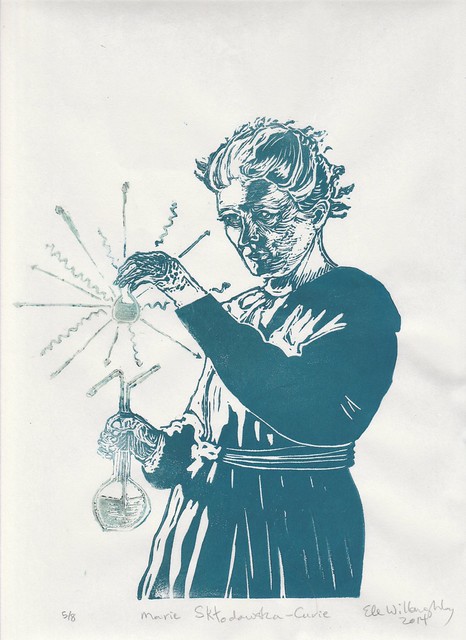
Marie Skłodowska-Curie, linocut with glow-in-the-dark ink by Ele Willoughby, 2014

In previous years, I've specifically avoided writing about Marie Curie because she is often the one historical figure people can name. I don't like to do the obvious thing and particularly want to highlight the under appreciated heroines of science. However the result is that her truly remarkable achievements haven't been celebrated here, just because of her fame. So, with a collection of portraits and stories written on the less well known, today I'll write about the well-known and why she in fact deserves her fame.

Marie SkÅ‚odowska-Curie (7 November 1867 – 4 July 1934), Polish-born, naturalized-French physicist and chemist, as the first woman to win a Nobel prize, the only woman to ever win TWO Nobel prizes, and the only person ever to win in two different sciences: physics and chemistry! She was also the first female professor at the University of Paris, and in 1995 became the first woman to be entombed on her own merits in the Panthéon in Paris. Born Maria Salomea SkÅ‚odowska in Warsaw, she studied secretly at the Floating University there before moving to Paris where she earned higher scientific degrees, met her PhD supervisor and future husband Pierre.

She was one of the pioneers who helped explain radioactivity, a term she coined. She was the one who first developed a means of isolating radioacitve isotopes and discovered not one, but two new elements: polonium (named for her native country) and radium. She also pioneered radioactive medicine, proposing the treatment of tumors with radioactivity. She founded medical research centres, the Curie Institutes in Paris and Warsaw which are still active today. She created the first field radiology centres during World War I. Each one of these achievements alone would warrant being memorialized in the annals of science and medicine; she did all of these things. She died in 1934 from aplastic anemia brought on by exposure to radiation, including carrying test tubes of radium in her pockets during research and her World War I service in her mobile X-ray units.

Her pioneering work explaining radioactivity earned her the 1903 Nobel Prize in Physics with her husband Pierre Curie and with physicist Henri Becquerel. At first, the Committee intended to honour only Pierre and Becquerel, but Swedish mathematician Magnus Gösta Mittag-Leffler, an advocate of women in science, alerted Pierre to the situation. (You may recall that it was the same man who helped Sofia Kovalevski secure a University position in Stockholm and that she collaborated on works of literature and had what was called a "romantic friendship" with his sister Duchess Anne-Charlotte Edgren-Leffler).  After Pierre's complaint, Marie's name was added to the nomination. The 1911 Nobel Prize in Chemistry was awarded to her "in recognition of her services to the advancement of chemistry by the discovery of the elements radium and polonium, by the isolation of radium and the study of the nature and compounds of this remarkable element."

Her life and legacy are truly extraordinary!

MarieCurie_glow
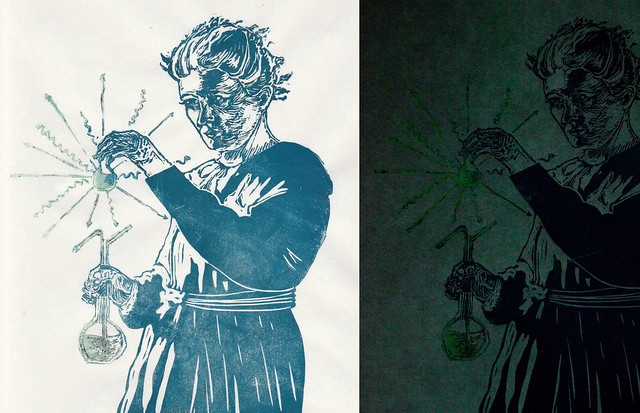
Marie Skłodowska-Curie, linocut with glow-in-the-dark ink show in the light and dark by Ele Willoughby, 2014

Not only was her work original and providing revolutionary insight on the theoretical side at the time, but the sheer heroic dedication and labour involved in her experimental work cannot be overstated. Having recognized that pitchblende ore must contain multiple elements which were giving off radiation, she and Pierre were able to show in 1898 that two new elements Polonium and Radium were needed to explain their observations. They then sought to actually isolate these elements. From a ton of pitchblende, she separated one-tenth of a gram of radium chloride in 1902. In 1910 Marie Curie isolated pure radium metal - a full 12 years after she and Pierre published their preliminary evidence for its existence. This involved working in a shed, meticulously separating the radioactive material from the inert and then dividing the radioactive material into its various sources for many years - all the while raising their young daughter when not at the lab.

Both of the elements she discovered are radioactive, meaning that they spontaneously give off radiation. All of the isotopes of polonium emit alpha particles, but Polonium-210 will emit a blue glow which is caused by excitation of surrounding air. Radium emits alpha, beta and gamma particles - that is 2 protons and 2 neutrons, electrons as well as x-rays. Thus, I've shown her sample surrounded by the symbols of these particles: the straight and wiggly lined arrows for the massive particles and high-energy light photons or gamma rays respectively, and made the sample with glow-in-the-dark ink. While the materials she discovered and worked with would have glowed due to radioactivity, never fear... these prints glow due to phosphorescence - a different process which is not dangerous. The ink will absorb UV light (for instance, from sunlight) and re-emit it in the dark.

The linocut is printed on Japanese kozo paper 9.25" by 12.5" (23.5 cm by 32 cm) in an edition of eight.

You will soon find links to my previous Ada Lovelace Day posts and other short bios and portraits of heroines of science in my next post.

Tuesday, October 15, 2013

Mary Anning, Great Fossil Hunter & Paleontology Pioneer for Ada Lovelace Day

AdaLovelaceIIToday is the fifth annual international day of blogging to celebrate the achievements of women in technology, science and math, Ada Lovelace Day 2013 (ALD13). I'm sure you'll all recall, Ada, brilliant proto-software engineer, daughter of absentee father, the mad, bad, and dangerous to know, Lord Byron, she was able to describe and conceptualize software for Charles Babbage's computing engine, before the concepts of software, hardware, or even Babbage's own machine existed! She foresaw that computers would be useful for more than mere number-crunching. For this she is rightly recognized as visionary - at least by those of us who know who she was. She figured out how to compute Bernouilli numbers with a Babbage analytical engine. Tragically, she died at only 36. Today, in Ada's name, people around the world are blogging 

I've been thinking for a while about whom I would like to portray, in a new print, and write about for Ada Lovelace Day. Emmy Noether has been on my 'to do' list for a while.  When I was taught Noether's Theorem, which related symmetries to conservation laws, I was absolutely flabbergasted. It's one of the most profound ideas in physics (and hence a pretty fundamental aspect of the universe as we know it). It's downright astounding that she isn't a household name (and remember, we do know the names of many male theoreticians even if an understanding of their work is uncommon). I experienced one of those - perhaps transcendental - flashes of insight where I suddenly 'saw' how the theorem was true. I think those moments actual explain why many people choose to be scientists; there's nothing like it. I don't know that I can explain it fully and I'm not sure I can explain the beauty of Noether's Theorem without spontaneously trying to teach anyone willing to listen a term of classical mechanics. I definitely do not know how to convey its meaning in a portrait... though as you can see from my portrait of Lady Ada Lovelace that I am willing to carve actual equations (in reverse, no less!) to show what a person accomplished, but the fact is that even if you do not understand the computation of Bernouilli numbers the meaning of the print is conveyed; Ada showed how the calculations could be done mechanically, on Charles Babbage's wondrous computing engine. To really let anyone understand Noether's tremendous accomplishment, I would need to make Noether's Theorem transparent... though I'm sure most artists would not feel constrained by this requirement. As I've yet to figure out how to do so, I wanted to select someone's whose achievements were more accessible and obvious to understand.
Mary Anning


Mary Anning (21 May 1799 – 9 March 1847) was the wrong class, the wrong sex and even the wrong religious denomination to gain the education, opportunity to work and communicate her results or to garner any respect as a pioneering paleontologist. Further, during her lifetime most people in Britain and elsewhere thought the Earth was a mere few thousand years old, based on a very literal interpretation of the Bible and found the idea of extinction did not fit in with the story of creation. Yet, her fossil discoveries, meticulous collection, documentation and independent work to fully understand the anatomy of the amazing Jurassic creatures she encountered in famed Blue Lias cliffs of Lyme Regis, Dorset, England, were so undeniable that she gained the recognition, admiration and respect of the paleontologists of the day. Others working in the field at the time were almost uniformly male, upper class and Anglican - most of them in fact were clergymen; while Dissenters like Anning were banned from university, the army and several professions. It's hard to fathom today the way that the contributions of working class people could be blatantly ignored or appropriated by their so-called 'betters'. During her lifetime she was barred from even attending meetings of the Geological Society of London (let alone applying for membership) because of her sex and many wealthy "paleontologists" published claims of discovery based on having purchased fossils from Anning and other working class fossil hunters (neglecting to mention Anning's name or contribution). Nonetheless, many contemporary geologists and paleontologists became so impressed with her knowledge that they would visit her to consult on the anatomy and classification of fossil finds as well as collaborate on what we would today call field studies, including her friend Henry De la Beche, William Buckland (who acknowledged her role in recognizing the significance of coprolite to the Geological Society), Richard Owen,  Thomas Hawkins (whom she chastised for 'enhancing' his fossil skeletons by mixing finds before this unscientific habit resulted in scandal), Roderick Murchison, the famed Swiss palaeontologist Louis Agassiz (who thanked her in his book Studies of Fossil Fish, and named two species in her honour). She corresponded with the foremost geologists of her day, Charles Lyell, and Adam Sedgwick who taught Darwin. 

MaryAnningDetail Her family was poor and her parents struggled with adequately support their 10 children (only two of whom survived infancy and childhood). Mary's formal education only included reading and writing which she was taught by the local Congregationalist school. Her father was a cabinet maker (who tragically died young) who like other locals supplemented his income by selling 'curios' to tourists, which were mainly ammonite fossils called 'snake stones' at the time. I've shown two of these spiral, fossil shells of these extinct cephalopods in my print. Mary made her living by selling fossils from a small roadside stand and ultimately a small store she set up in her home. She made her first significant find, the first ichthyosaur skeleton to be correctly identified, with her brother Joseph when she was only 12 years old. I've shown Mary Anning standing in front of the Blue Lias cliffs in front of an ichthyosaur skeleton, like the one she painstakingly excavated. She discovered and excavated the the first two plesiosaur skeletons ever found and the first pterosaur skeleton located outside Germany as well as many important fossil fish. I've also taken the artistic license to show a plesiosaurus fossil above her, based on one she herself found. The cliffs I've illustrated are so packed with fossils, not to underplay the work of finding these fossils, but to try and illustrate the some of the huge scope of her finds. She also worked on invertebrates. Her research showed that belemnite fossils contained fossilised ink sacs like those of modern cephalopods. She was also the first to recognize that coprolites, known as bezoar stones at the time, were fossilised... well, animal droppings (feces). While this sounds distinctly unglamorous, the study of coprolites pioneered by Anning and Buckland were vital to understanding ancient ecosystems. Her friend Henry De la Beche painted the first widely circulated representation of a prehistoric (deep time) scene, based on her finds, and he sold prints to benefit her financially.

Despite her limited formal education she read the scientific literature of the day, copying technical anatomical diagrams and made her own dissections of animals to make comparative studies with her fossil finds. Despite the many barriers to her, she did succeed in having her 1839 letter to the editor Magazine of Natural History published, which corrected an erroneous claim about the classification of extinct sharks.

Gathering fossils along the cliffs, especially following storms when new fossils could be found due to the recent erosion and during the winter months was dangerous work. The tides could come in quickly and the cliffs were not always stable. She narrowly escaped being crushed in a landslide which claimed the life of her faithful dog Tray.

MaryAnning - a detailThough she resented the way her own work was ignored or appropriated by others, she did become increasingly well-known, as her life advanced and posthumously. She struggled financially for most of her life, and she did receive help from colleagues who held her in high esteem. Nine years before her death she was given an annuity, raised by members of the British Association for the Advancement of Science and the Geological Society of London.  After she was diagnosed with cancer, in 1846 the Geological Society raised money from its members to help with her expenses and the council of the newly created Dorset County Museum made her an honorary member. When she died, Henry De la Beche wrote and read her eulogy at a Geological Society meeting beginning,
"I cannot close this notice of our losses by death without advertising to that of one, who though not placed among even the easier classes of society, but one who had to earn her daily bread by her labour, yet contributed by her talents and untiring researches in no small degree to our knowledge of the great Enalio-Saurians, and other forms of organic life entombed in the vicinity of Lyme Regis ..."
Members of the Society commissioned stained glass windows in her parish church in her memory. Charles Dickens wrote of her in 1865 that "[t]he carpenter's daughter has won a name for herself, and has deserved to win it." 


She has since been recognized for her scientific contributions by the Royal Society, paleontologists, geologists, historians of science and even in some popular culture. It is often repeated that she is the subject of the well-known tongue-twister
She sells seashells on the seashore
The shells she sells are seashells, I'm sure
So if she sells seashells on the seashore
Then I'm sure she sells seashore shells.
but there is no solid evidence to support this; in fact, this is likely metafolklore, a folktale about a tongue twister. She appears in in The French Lieutenant's Woman (1969) by John Fowles, and she is the subject of the historical novels Remarkable Creatures (2009) by Tracy Chevalier and Curiosity (2010) by Joan Thomas.

This post contains much information from the remarkably thorough wikipedia entry on Mary Anning, the Natural History Museaum biography of Mary Anning (which calls her "the greatest fossil hunter ever known") and though it was a novel and takes some license with personal relationships for the sake of an engaging story, the very enjoyable 'Curiosity' (2010) by Joan Thomas (which I reviewed here). Edited August 26, 2023 to correct myth about tongue twister.

Tuesday, October 16, 2012

Lise Meitner for Ada Lovelace Day!

AdaLovelaceIIToday is the fourth annual international day of blogging to celebrate the achievements of women in technology, science and math, Ada Lovelace Day 2012 (ALD12). I'm sure you'll all recall, Ada, brilliant proto-software engineer, daughter of absentee father, the mad, bad, and dangerous to know, Lord Byron, she was able to describe and conceptualize software for Charles Babbage's computing engine, before the concepts of software, hardware, or even Babbage's own machine existed! She foresaw that computers would be useful for more than mere number-crunching. For this she is rightly recognized as visionary - at least by those of us who know who she was. She figured out how to compute Bernouilli numbers with a Babbage analytical engine. Tragically, she died at only 36. Today, in Ada's name, people around the world are blogging about women in science and technology, whose accomplishments have all too often gone unrecognized or unacknowledged.

I made a new edition of my 'Ada, Countess Lovelace' print for the occassion. The print is in blue, indigo and dark silver water-based block printing ink on cream coloured Japanese kozo paper 12.5 inches x 10.5 inches (31.8 cm x 26.7 cm). There are 4 prints in this second edition. The first edition was printed on plum coloured paper.


This year, I would like to tell you about Lise Meitner. I made her portrait along with her explanation of nuclear fission. She was the first person to provide a theoretical explanation for nuclear fission and was an integral member of the experimental team as well, though her gender and her heritage interfered with her being properly acknowledged in late 30s Germany. Meitner is shown in dark silver ink with a neutron flying from her brow towards a uranium nucleus, and the ensuing chain reaction is shown in red. The print is in an edition of 6 printed on white Japanese kozo (or mulberry) paper, 12.3 inches by 12.5 inches (31.2 cm by 31.8 cm).

Lise Meitner

Lise Meitner (7 November 1878 – 27 October 1968) was a world-class physicist who collaborated with chemists Otto Hahn and Fritz Straßmann1 in the 1930s in Berlin. The team was investigating whether there were any stable elements beyond uranium, on the periodic table. They discovered that by bombarding the nucleus of uranium-235 with neutrons that they actually triggered it to fission, or break, into two nuclei of roughly half the size and some free neutrons! Hahn's chemistry allowed the startling discovery and identification of barium, but no explanation of the mechanism involved; Meitner's physics provided the explaination of how fission could be possible and its implications. Otto Hahn was awarded the 1945 Nobel prize for chemistry. Though Meitner won many accolades, the Nobel committee neglected her contribution, in one of the most blattant and eggregious instances of their overlooking women's scientific acheivements.

Hahn and Meitner's research was disrupted by WWII. Meitner was of Jewish heritage. Her Austrian citizenship provided her some protection prior to its annexation, when she had to make a daring escape via the Netherlands to a new home in Sweden, in 1938. Despite their seperation, Meitner and Hahn continued to work together, planning the experiments which lead to the discovery of fission at a meeting in Copehagen. Hahn and Straßmann performed the experiments and Hahn realized that the presence of barium could only make sense if the nuclei had split, but he needed Meitner's help to understand how this could be. Meitner was able to apply the latest physics, the liquid-drop model of the nucleus (as shown in my print), to explain how the absorption of an extra neutron could produce an unstable nucleus which split into two large pieces, the daughter nuclei, and more free neutrons. Most importantly she saw that the combined mass of the neutron and uranium-235 was larger than the products and that the 'missing mass' would all be transformed into vast amounts energy according to Einstein's famous equation E = mc². She also saw how the newly produced high-energy neutrons would in turn strike other uranium nuclei, leading to a chain reaction. She worked with her nephew, physicist Otto Frisch to develop this theory. In Germany in 1939, Hahn could not publish jointly with Meitner. Hahn and Straßmann submitted the team's results (that bombarding uranium with neutrons produced barium) for publication in 1938. Meitner and Frisch interpreted these results correctly as nuclear fission in Nature in 1939.

The physics community recognized that the huge energies produced by these fission chain reactions could be used to produce a bomb, and further, that expertise existed in Nazi Germany. Physicists on the Allied side, lead by Leó Szilárd, Edward Teller, and Eugene Wigner immediately worked to persuade Albert Einstein2 (whose fame would receive attention) to bring this danger to the attention of F.D. Roosevelt, which ultimately lead to the Manhattan Project and the development of the atomic bomb. Meitner herself refused to be involved in weapons research or the Los Alamos project and declared, "I will have nothing to do with a bomb!"3 She never returned to Germany or her Austrian homeland, even after the war, making a life in Sweden and retiring to England. Her nephew Otto Frisch composed the inscription on her headstone. It reads "Lise Meitner: a physicist who never lost her humanity."

Apart from her role in discovering and explaining nucleur fission, Meitner had many great acheivements. She was the only second woman to be granted a doctoral degree in physics by the University of Vienna, where she studied with the great Ludwig Boltzmann.4 She moved to Berlin and worked for Max Planck5 (who had previously refused to admit women) before beginning her 30-year long collaboration with Otto Hahn. Together with Hahn in 1917, she discovered the first long-lived isotope of the element protactinium, for which she was awarded the Leibniz Medal by the Berlin Academy of Sciences. That year, Meitner was given her own physics section at the Kaiser Wilhelm Institute for Chemistry. (It's worth noting that she and Hahn were relegated to a basement lab because women had not been allowed in the building, and that she had to go to another building to find a woman's washroom). In 1926, Meitner became the first woman in Germany to assume a post of full professor in physics, at the University of Berlin. She was praised by Albert Einstein as the "German Marie Curie". She visited the US in 1946, where she was hailed as a heroine and received the honour of the "Woman of the Year" by the National Press Club, many honorary doctorates and lectured at Princeton, Harvard and other US universities. She received the Max Planck Medal of the German Physics Society in 1949. Meitner was nominated to receive the Nobel prize three times. In 1966 Hahn, Fritz Straßmann and Meitner together were awarded the Enrico Fermi Award. In 1997, the element 109 was named meitnerium in her honour. Today the Hahn-Meitner Institut in Berlin, craters on the Moon and on Venus, and a main-belt asteroid are all named in her honour.

(This post was made with information from Lise Meitner's wikipedia entry and Sime's biography. Lise Meitner: A Life in Physics by Ruth Sime is one of the best biographies I have ever read. I recommend it highly to anyone interested.)


1 Straßmann, incidentally, was hired by Hahn and Meitner at a time he could not be hired elsewhere in Germany. He had resigned from the Society of German Chemists when it became part of a Nazi-controlled public corporation and was blacklisted. Hahn and Meitner were able to make a position for him at half pay. He and his wife hid a Jewish friend in their apartment, during the war, at great personal risk to their family.

2 The irony is that Einstein had been a dedicated pacificist throughout his life. At the onset of WWI, Meitner had not been able to see his point of view. Her experience as a nurse handling X-ray equipment during WWI changed her attitudes about war. (Contrast this with Hahn's WWI work developing chemical warfare under Fritz Haber, and we return once again to the question of the scientist's ethical obligations. Haber, incidentally, died in exile in 1938, because of his own Jewish heritage). Einstein saw the Nazi threat as such that it warranted pursuing an Allied fission bomb to avoid being devastated by a Germany weapon. He, of course, later denounced using the bomb as a weapon and campaigned against further development of nuclear weapons.

3 Ruth Lewin Sime, Lise Meitner: A Life in Physics (University of California Press, 1996), 305

4 Sime's biography made me a huge fan of Ludwig Boltzmann. He was a talented and kind man. He fought for his wife's right to study mathematics in the 1870s. He was a great teacher and dedicated mentor to his students, including Meitner. Tragically, he suffered from bipolar disorder and took his own life.

5 Planck's own wartime experience is quite the story. He worked hard to shield his employees at the KWG from open conflict with the Nazi regime, though he thought Hahn's suggestion of a public proclamation by scientists, against the treatment of their Jewish colleagues, would be futile. He helped secretly employ Jewish scientists and the blacklisted Straßmann. He held a memorial meeting for Fritz Haber in 1935. He was accused of being "a white jew" by Johannes Stark (Nobel Laureate and Nazi) for continuing to teach Einstein's theories. His own son Erwin, was implicated in the attempt made on Hitler's life in the July 20 plot, and was killed by the Gestapo. Though this and other personal tragedies made the end of his life very difficult, he survived to see a the Nazis defeated and lived to 1947.


Friday, October 7, 2011

Ada Lovelace Day

Ada, Countess Lovelace

Today is Ada Lovelace Day! Today, people around the world are celebrating their heroines in engineering, science, technology and math. Somehow, it crept up on me, and I would like you to consider my (lenghty) post on Chien-Shiung Wu and the Violation of Parity as my contribution for this year. I posted it an hour early... but Madame Wu is a great choice.

About the image: This is a lino block print of Countess, Lady Ada Lovelace (1815-1852), who published the first computer program.* She worked together with Charles Babbage, the inventor of the Difference Engine and the Analytical Engine (the first - analogue! - computers), correcting his notes on how to calculate Bernoulli Numbers with the Analytical Engine. More importantly, she (a great communicator, daughter of mad, bad and dangerous to know Lord Byron) was able to understand and explain the workings of the analytical engine and the potential of computing machines. Her comments seem visionary to the modern reader. Babbage called her the Enchantress of Numbers and the Princess of Parallelograms.

The print is in gold, purple and turquoise water-based block printing ink on mauve Japanese gampi paper 15.25 inches x 10.5 inches.