Showing posts with label history of physics. Show all posts

Thursday, January 27, 2022

Poincaré, Cubism, Non-Euclidian Geometry and Special Relativity

Cubist Poincaré, linocut, 8" x 8" by Ele Willoughby, 2022


This is a hand-printed lino block portrait in the Cubist style of mathematician Henri Poincaré. It’s one of a variable edition printed on Japanese kozo (or mulberry paper), 8” x 8” or (20.3 cm x 20.3 cm). The latest prompt for #printersolstice is Cubism.

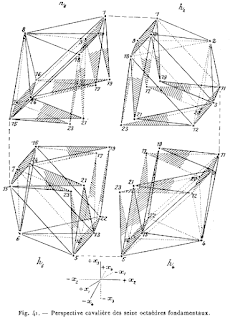
Jouffret diagram
Diagram from Jouffret's 'Traité élémentaire de géométrie à quatre dimensions'


This print is about how movements in art can be connected with contemporary math and physics (and other sciences). Specifically, the way Cubism breaks from a single favoured perspective or absolute frame of reference and attempts to break down subjects into geometrical shapes from multiple points of view can be tied to advancements in non-Euclidian geometry in mathematics, special relativity (published by Einstein in 1905) and the revolution in early 20th century physics. Picasso and his circle were specifically introduced to the mathematics of the fourth dimension and Non-Euclidian geometry by his actuary and enthusiastic amateur mathematician friend Maurice Princet, who gave him the book 'Traité élémentaire de géométrie à quatre dimensions' (Elementary Treatise on the Geometry of Four Dimensions) by Esprit Jouffret, a popularization of Henri Poincaré's 'La Science et l'Hypothèse' (Science and Hypothesis). Jouffret's book includes many diagrams of four dimensional objects like hypercubes projected on the 2D surface of a page. Princet also spoke to Picasso about the work of polymath Henri Poincaré. Picasso realized that this approach to 4D geometry captured the how he wanted to depict two points of view simultaneously and art historians can trace the influence of this geometry in his earliest Cubist paintings. So I have made a Cubist style portrait of mathematician, physicist, engineer and philosopher of science Henri Poincaré (1854-1912).

Henri Poincaré 
(photograph published in 1913, via Wikipedia)


Pointcaré was called "The Last Universalist" since he excelled in such a wide range of mathematics including pure and applied math, mathematical physics and celestial mechanics. Chaos theory and the idea that deterministic systems can have sensitive dependance on initial conditions (colloquially known as the butterfly effect) seemed to explode on the scene with increasing applications in the 1980s but in fact some foundations were laid a century earlier by Poincaré. He was the first person to discover a deterministic system which exhibits chaos in the three-body problem (or how a system of  3 masses behave over under Newton's Law of Universal Gravitation). The three circular shapes in the background allude to the 3-body problem and the spiral is a hint at the chaos in the trajectories. He is considered a founder of the study of topology (how geometric properties are preserved under deformations) and stressed the importance of the invariance of physical laws under various transformations. Special relativity tells us that light speed is the universal speed limit, and that space and time are not absolute. As things approach this speed limit they experience length contraction and time dilation. We use Lorentz transformations to compare length and duration in differing frames of reference. It was Poincaré who wrote the Lorentz transformations in their modern form. He discovered the Lorentz transformations for velocity and the invariance of Maxwell's equations (for electricity, magnetism and light), which was vital part of special relativity. He published a short paper in 1905 which Einstein did not see until after he had published his own independent and revolutionary paper on special relativity. Poincaré also proposed gravitational waves, travelling at light speed from masses. It's hard to over-state his importance to 20th century math and physics.

Pablo Picasso, Portrait of Ambroise Vollard, spring of 1910 (Pushkin Museum, Moscow)

Poincaré himself worked quite intuitively and wrote, "It is only through science and art that civilization is of value."

One of the ways in which Special relativity is strange is that we discovered the problem of simultaneity. If there is no absolute frame of reference, there is no simultaneity; observers in different inertial frames of reference (that is going different speeds*) will not agree on the sequence of events or even whether two things happen at the same time. This problem of simultaneity, it can be argued, is exactly what interested Picasso, when he chose to paint two different points of view on the same canvas. This is the argument made by Miller, author of 'Einstein, Picasso: Space, Time and the Beauty That Causes Havoc' makes. Leonard Schlain, in 'Art & Physics' makes the case that Picasso in painting all sides of an object simultaneously as if he was seeing space as all here in the everlasting now, was depicting what a viewer would see astride a beam of light at the universal speed limit when time has reached its maximum dilation to the present (and only the present). 

Earlier art historians, and in fact Einstein when asked, argued that Cubism wasn't connected to relativity or non-Euclidian geometry but I think each under appreciated the other. The art historians argued the artists had no knowledge of Einstein, or Minkowski (who combined space and time into the 4D spacetime), equations or pure math. Einstein preferred earlier classical painting and argued "This new artistic 'language' has nothing in common with the Theory of Relativity" but then, he felt contemporary art and music had both degenerated. If we are less literal, I think the connection between the two movements is quite clear. There is no absolute frame of reference and both art and physics were revolutionized by this realization.

Schlain makes a further argument connecting Cubism with relativity but noting that colours also change with speed, as length contracts (including the wavelengths or colours we would observe), and colours would be merge as what is in front and behind become one. He argues we would be left with neutrals at the speed of light: white (of white light), black (of its absence),  and muddy tones of mixed colours brown and grey. These are precisely the colours Picasso and Braque used in their early Cubist paintings, and the colours of my palette for my portrait of Poincaré.


*without acceleration and/or far from large masses, so we can ignore general relativity

References

William B. Ashworth, Jr., Scientist of the Day - Esprit Jouffret, Linda Hall Library blog, March 15, 2021.

Arthur I. Miller, Henri Poincaré the unlikely like between Einstein and Picasso, The Guardian, July 17, 2021

Did Picasso know about Einstein?, Physics World, November 1, 2002

Leonard Schlain, Art & Physics, Quill William Morrow, New York, 1991

Henri Poincaré, Wikipedia, accessed January, 2022

Tuesday, March 16, 2021

Mathematician Sophie Germain


Linocut 'Sophie Germain' by Ele Willoughby, 2021

French mathematician, physicist and philosopher Marie-Sophie Germain (1776 – 1831), known as Sophie, taught herself mathematics using books in her father's library and by corresponding with leading mathematicians of her day, including Lagrange, Legendre and Gauss, initially using the pseudonym Monsieur LeBlanc since she knew it was unlikely her contemporaries would take a woman in math seriously. She later wrote to Gauss, the leading mathematician of her day that she used the pseudonym "fearing the ridicule attached to a female scientist." Her work on elasticity theory won her the grand prize from the Paris Academy of Sciences. Her trailblazing work on Fermat's Last Theorem set out a strategy and framework for mathematicians pursuing the problem for hundreds of years. She was denied a formal mathematics education or professional standing due to her sex, but Gauss argued she deserved an honourary degree (though it was never granted).


She was born to a bourgeois family; her father is usually described as a wealthy silk merchant who was elected to the États-Généraux (later the Constitutional Assembly), as a representative of the bourgeoisie. By the time she was 13, the Bastille fell, and she remained indoors for safety during those tumultuous times, her father's library her only source of entertainment. She was fascinated reading about Archimedes' death at Roman soldiers' hands during the siege of Siracusa, unable to tear himself away from mathematics. It piqued her interest and she devoured the mathematics books she found, even teaching herself Latin and Greek in order to read Sir Isaac Newton and Leonard Euler's works. Her parents disapproved this sudden interest in a subject deemed inappropriate for a woman and they denied her warm clothes or a fire to study at night. She simply wrapped herself in quilts and studied by candlelight, when it was so cold her ink froze, eventually winning over her mother's support. Sophie was lucky in that she was not forced to marry and her family was wealthy enough to support her throughout her life, and though mostly excluded from formal education and the society of mathematicians, she was able to pursue her self-study.


The École Polytechnique opened - to men only - in 1794, but lecture notes were made available on request. Students were requested to send solutions to faculty and Sophie began submitting notes to Joseph Louis Lagrange under the name of a former student who had died young, Monsieur Antoine-Auguste Le Blanc. Lagrange recognized "Le Blanc's" ability and requested a meeting, so her rouse was up. Luckily, Lagrange was not opposed to a woman studying mathematics and agreed to mentor her. In 1798, Adrien-Marie Legendre published Essai sur la théorie des nombres and Sophie became interested in number theory and began corresponding with Legendre. Impressed, he included some of her work in the supplement to the second edition of his book, praising it as très ingénieuse ("very ingenious"). Then Gauss published his magnum opus Disquisitiones Arithmeticae. She worked through it for three years before writing him, again as M. Le Blanc, to discuss his book and tell him about her work on Fermat's Last Theorem, a famous grand problem of number theory. Unfortunately, she had made a weak assumption in one of her proofs, and Gauss did not reply to this first letter.


Mathematician Pierre de Fermat famously scrawled his eponymous last theorem in the margin of a book around 1637, without supplying any proof, noting simply that the proof was too long to fit. After 354 years of effort by countless mathematicians, Andrew Wiles was finally able to prove the theorem correct in 1995. The theorem states that no three positive integers x, y, and z satisfy the equation xp + yp = zp for any integer value of p greater than 2. Sophie was working on this problem and making real in-roads.


During the Napoleonic wars, France occupied the German town of Braunschweig, where Gauss lived, and Sophie feared he might suffer the same fate as Archimedes. She wrote family friend General Pernety pleading for him to ensure Gauss' safety. Soldiers were dispatched and found the confused Gauss perfectly safe. Gauss, of course, did not know that Sophie Germain was none other than M. Le Blanc. She decided to reveal her identity and he replied,


How can I describe my astonishment and admiration on seeing my esteemed correspondent M. Le Blanc metamorphosed into this celebrated person ... when a woman, because of her sex, our customs and prejudices, encounters infinitely more obstacles than men in familiarising herself with [number theory's] knotty problems, yet overcomes these fetters and penetrates that which is most hidden, she doubtless has the noblest courage, extraordinary talent, and superior genius.


They became friends and Gauss truly respected her ability, though he was not a reliable correspondent and generally did not review her work (and she would have really benefited from such feedback, lacking mentorship in number theory, and having gaps in her knowledge since she was self-taught). 


She became interested in other problems. German physicist and musician Ernst Chladni had published his experiments on vibrating plates (following the trailblazing work of Robert Hooke). He used a violin bow to vibrate a metal plate covered in sand, so that the sand would concentrate on nodal lines marking divisions between regions that moved in opposing directions. His drawings of the patterns produced are known as Chladni figures (like those shown in lavender in my print). Germain was able to attend his demonstration in Paris. The Paris Academy of Sciences launched a contest to develop the mathematics explaining the vibration of an elastic surface and comparing this to experimental data like Chladni's, with a reward of 3,000 francs. Lagrange pointed out that a new branch of analysis would be required and scared off all would-be contestants with the exception of Sophie and Denis Poisson. But Poisson was elected to the Academy, thus became a judge, leaving only Sophie. She began, mentored by Legendre, but her submission was deemed insufficient, though she provided some ingenious results, which allowed Lagrange to derive an equation, correct under certain conditions. Lagrange died within two years, and Sophie lost a mentor. The Academy decided to extend the contest and Sophie persisted. After initially helping, Legendre withdrew his support. Sophie submitted another attempt anonymously, but it had several errors (of the sort she would have been taught to avoid had she been allowed to study math at a university). She consulted Poisson, and he had access to all her notes as a judge. He then published his own work on elasticity without acknowledging any of her work or their conversations on the subject. At that point in 1816, she published under her own name, "Recherches sur la théorie des surfaces élastiques" partially so what Poisson had done would be clear, and to point out the errors in his work. They extended the contest again partially in response to the breach of confidentiality by Poisson and she persisted with her efforts. She won the gold medal and became the first woman to win a prize from the Paris Academy of Sciences but did not attend the prize ceremony. The Academy was not entirely satisfied; she had the correct differential equation, but having used an incorrect equation by Euler she had incorrect boundary conditions. Even as a prize winner, she was still denied entry to academy meetings as a woman for several years until she made friends with Joseph Fourier, a secretary of the Academy, who got tickets on her behalf. She published her prize-winning essay in 1821, at her own expense as the Academy had neglected to do so, complete with her notes on errors she had made. In 1826, she submitted a revised version of her work; the Academy considered it trivial but they did not want to reject her as they would a man and professional colleague. They both denied her access and were patronizing in their misguided attempt at kindness. She published this essay on the advise of mathematician Augustin-Louis Cauchy. Her nephew later made sure she had a final publication on elasticity, publishing "Mémoire sur la courbure des surfaces" posthumously on her behalf in 1831.


In 1815, the Academy offered an award for a solution to Fermat's Last Theorem, rekindling her first love of number theory. She wrote Gauss with her strategy for a general proof and the significant in-roads towards a proof she had made, but Gauss never replied. She produced what is now known as Sophie Germain's Theorem. To show that Fermat's Last Theorem holds, you can divide the powers p into numbers which are not divisors of x, y or z, or powers p which are a divisor of at least one of x, y or z. She proposed her theorem:


Let p be an odd prime. If there exists an auxiliary prime P = 2Np + 1 (N is any positive integer not divisible by 3) such that:

  1. if xp + yp + zp ≡ 0 (mod P), then P divides xyz, and
  2. p is not a p-th power residue (mod P).

and she used this result to show that Fermat's Last Theorem holds true for all odd primes p < 100. Her method was later used to show it holds true for all p < 1700. Her theorem is known from a footnote in Legendre's treatise on number theory, where he used it to prove Fermat's Last Theorem for p = 5. The text in my print is from one of her on unpublished manuscripts:

Remarque sur l'impossibilité de satisfaire en nombres entiers a l'équation xp + yp = zp. L'impossibilité de cette équation serait hors de doute si on pouvais démontrer la théorème suivant: Pour toute autre valeur de p que p = 2, il y a toujours un infinité de nombres premiers de la forme Np + 1 pour lequels on ne peut trouver deux residus 1ièmes puissances  dont la différence soit l'unité.


(My gloss: "Remarks on the impossibility of any whole numbers satisfying xp + yp = zp . The impossibility of this equation can be shown to be without doubt if we can demonstrate the following theorem: For all p > 2, there are an infinite series of primes of the form Np + 1 for which we cannot find two residues of the first power separated by 1"). She goes on to note that if there's any numbers which do satisfy Fermat's equation for p > 5 it must be numbers "whose size frightens the imagination", around 40 digits long.  


She also pursued philosophy and psychology on her own. Her nephew had two of her works published posthumously: Pensées diverses, a history of science and math with her commentary and Considérations générales sur l'état des sciences et des lettres, aux différentes époques de leur culture in which she argued there no difference between the sciences and the humanities and gained the praise of philosopher August Comte. 


She continued working despite pain after her diagnosis of breast cancer in 1829. She died in 1831, listed only as a property owner, not a mathematician on her death certificate. She is now recognized for her brilliance and originality, but her progress was often sadly hampered by the lack of instruction and the way her peers treated her as a novelty, and avoided proper constructive criticism. She wrote, “These facts are my domain and it is to me alone that they remain hidden. That’s the privilege of the ladies: they get compliments and no real benefits.” Several scholars argue that a contemporary man with similar skills and interest would have had his abilities embraced and talents nurtured. Sophie Germain was able to achieve what she did through both her tremendous talent and extraordinary persistence. Along with her theorem, subsequent discoveries in number theory have been named in her honour, as well as a street in Paris and the Sophie Germain Prize in mathematics offered by the same Academy which had snubbed her.


References

Sophie Germain, Wikipedia, accessed March 2021

Sophie Germain’s Theorem, Wikipedia, accessed March 2021

Ernst Chladni, Wikipedia, accessed March 2021

Ernst Chladni, Entdeckungen über die Theorie des Klanges, 1787, via Chladni Figures (1787) on Public Domain Review

Cristina P. Tanzi, Sophie Germain's Early Contribution to the Elasticity Theory, MRS Bulletin , Volume 24 , Issue 11 , November 1999 , pp. 70 - 71 DOI: https://doi.org/10.1557/S0883769400053549

Alexanderson, G.. “About the cover: Sophie Germain and a problem in number theory.” Bulletin of the American Mathematical Society 49 (2012): 327-331.

Richard Baguley, Sophie Germain: The Mathematics Of Elasticity, Hackaday.com, March 20, 2018

Evelyn Lamb, Thank You, Sophie, and I'm Sorry, Scientific American Blog, April 1, 2017.

Maria Popova, How the French Mathematician Sophie Germain Paved the Way for Women in Science and Endeavored to Save Gauss’s Life, Brainpickings, org, February, 2017.

Reinhard Laubenbacher and David Pengelley,  “Voici ce que j’ai trouvé:” Sophie Germain’s grand plan to prove Fermat’s Last Theorem, Historia Mathematica Volume 37, Issue 4, November 2010, Pages 641-692

Wednesday, June 6, 2018

Mathematician Emmy Noether, Symmetries and Conservation Laws

Emmy Noether, linocut, 11" x 14", Ele Willoughby, 2018
Emmy Noether (1882-1935, pronounced NER-ter) has long been on my "to do" list of scientist portraits. Noether's Theorem is one of the most fundamental and profound theories in physics and I think it's impossible to overstate its importance. In some ways it's astonishing that Noether's Theorem wasn't discovered until one century ago in 1918 and in some ways its true import wasn't clear until much later. The theorem is so powerful that I struggled with how I could depict it visually. It can be written in many different ways. I could have reproduced her actual equations as her paper is widely available in the original German and in English translation. But, my goal with my art is to communicate science, and even writing a single equation cuts the potential audience. I hope that expressing ideas visually through geometry is more accessible to more people. So, in my portrait, I chose to depict a young Emmy in front of a blackboard with a more simple formulation of her theorem and three specific applications of it, shown schematically, using pictures and geometry. In simple terms, Noether's theorem shows us that any symmetry of a system (say, a given problem in physics, like a ball rolling or a molecule or a solar system or the universe itself) implies a conservation law.

The three examples I give are probably the best known, but just give a hint of the power of this theorem. If you do an experiment and then move three steps to the right and repeat it, you usually expect the same results. In general, a lot of things will have this translational symmetry. Noether's Theorem shows that if you get the same result in two reference frames which are shifted from one another, your system conserves momentum (p with an arrow, as a vector quantity). Thus, we have conservation of momentum in any inertial frame of reference. That means that any place where we don't have to worry about any significant differences from acceleration or gravity, we can solve physics problems by simply knowing that the total momentum never changes. In my print I show a set of x, y, z axes moved (translated) to get a new set of axes x', y' and z' and then the quantity p. Similarly, if your system doesn't care if you rotate it or how it's oriented in space, the conserved quantity is angular momentum (L with an arrow, as a vector quantity); hence in my print, I show a set of x, y, z axes rotated x', y' and z' along with conserved quantity L. Your system itself doesn't need to be symmetric. A lumpy asteroid conserves angular momentum every bit as much as a planetary system made of perfect spheres. If it's irrelevant to results whether you do your experiment at 3:00 or 6:25 then your system has a time symmetry and conserves energy (E). This method of using observed symmetries of something and then finding things which are invariant allows us to easily solve all sorts of problems in physics. Further, using observed symmetries of the Universe allows us to know which things are invariant, know more about the nature of reality and assess any new theories by checking whether they also produce the same conserved quantities.*

Here's a nice video which talks about Noether's Thereom.


Her male colleagues Pavel Alexandrov, Albert Einstein, Jean Dieudonné, Hermann Weyl, and Norbert Wiener described Noether as the most important woman in the history of mathematics - a compliment which betrays the biases of the times in comparing her only to those of the same sex. She was quite simply, one of the most important mathematicians period, and her impact on physics was tremendous. (My portrait betrays my own biases, focusing on the physics of Noether's Theorem, rather than her contributions to mathematics... but there you are. I'm a physicist by training, not a mathematician).

Born in Erlangen, Germany, Emmy Noether initially planned to teach girls English and French, rather than follow in her father's footsteps and become a professor of mathematics. But ultimately, she choose to study mathematics at the University of Erlangen, where he was a lecturer. Pursuing mathematics was unconventional for a woman; the university had recently declared that mixed-sex education would "overthrow all academic order" and as one of 2 female students (out of 986) she was only able to audit classes at the discretion of professors. She nonetheless managed to pass the graduation exam in 1903 and was granted a degree. She spent the winter semester at the University of Göttingen attending lectures from astronomer Karl Schwarzschild and mathematicians Hermann Minkowski, Otto Blumenthal, Felix Klein, and David Hilbert, before returning to Erlanger. She completed a dissertation supervised by Paul Gordan, On Complete Systems of Invariants for Ternary Biquadratic Forms (1907) using the "computational" approach to invariants, later superseded by Hilbert's more abstract and general approach. She later referred to this well-received thesis and the first few similar papers as "crap". She continued to work at the university for 7 years, but as a woman she was excluded from an academic position and in fact forced to worked without pay.

In 1915 she was recruited to come to the renown University of Göttingen and work with famed mathematicians David Hilbert and Felix Klein. However, some philologists and historians in the philosophical department protested that a woman must not become a Privatdozent, an additional post-doctoral rank required in Germany and certain other European nations to act as a university professor. Famously, a faculty member protested "What will our soldiers think when they return to the university and find that they are required to learn at the feet of a woman?" but Hilbert defended her indignantly, with one of my favourite lines in response to such entrenched academic sexism: "I do not see that the sex of the candidate is an argument against her admission as privatdozent. After all, we are a university, not a bath house." There she still faced hurdles and had to rely on her family to support her financially, as she was unpaid and could only lecture under Hilbert's name until 1919  despite already having published her eponymous Noether's Theorem in 1918! After Einstein published his theory of general relativity in 1915 and Noether responded by applying her invariance work to some of its complexities and this eventually lead her to prove her famous theorem. As Einstein wrote when he read her paper, "Yesterday I received from Miss Noether a very interesting paper on invariants. I'm impressed that such things can be understood in such a general way. The old guard at Göttingen should take some lessons from Miss Noether! She seems to know her stuff."

The end of WWI and German Revolution of 1918-1919 lead to social change and increased rights for women. Her habilitation was approved and she obtained the rank of Privatdozent in 1919. Three years later she was promoted to an untenured professor (nicht beamteter ausserordentlicher Professor) but her work remained unpaid until the next year when she was finally granted a special position (Lehrbeauftragte für Algebra).
 
Until 1919 she focused on theories of algebraic invariants and number fields. While her incredible contribution to physics had already occurred in 1918, mathematicians remember her for her central role in the 20th century revolution in mathematics, the development of abstract algebra, and her prolific work including Ring Theory from 1920 to 1926, as well as Noetherian rings, Noether groups, Noether equations, Noether modules and more. Her revolutionary 1921 paper Theory of Ideals in Ring Domains is considered a classic and objects which satisfy the ascending chain condition are named Noetherian, in her honour. In the final stage of her career, she focused on noncommutative algebras and hypercomplex numbers and united the representation theory of groups with the theory of modules and ideals. She was a leader in the strong University of Göttingen math department until 1933. Her colleague Dutch mathematician B. L. van der Waerden made her work the foundation of the second volume of his influential 1931 textbook, Moderne Algebra; it was typical of her to allow students and colleagues to receive credit for her ideas. She supervised more than a dozen doctoral students. She was known for her patient guidance but insistence on accuracy. van der Waerden wrote that she was, "Completely unegotistical and free of vanity, she never claimed anything for herself, but promoted the works of her students above all." She learned to live frugally, having gone so long without a salary, and took no concern about her manners, housework or appearance. She used her lecturers as a time for spontaneous discussions of the latest mathematics with students and a place to explore ideas (many of which would become major publications of those students). She spent the winter of 1928–29 at Moscow State University, working with P. S. Alexandrov. She was interested in and supportive of the Russian Revolution and her political opinions got her evicted from her lodging back in Germany when students there complained of living with "a Marxist-leaning Jewess". In 1932, she won the received the Ackermann–Teubner Memorial prize for her contributions to mathematics, which came with 500 Reichsmarks and she gave the plenary address at the 1932 International Congress of Mathematicians in Zürich, a sign of her international stature in the field. Colleagues complained that she was however never elected to the Göttingen Gesellschaft der Wissenschaften (academy of sciences) or promoted to full professor. Within a year Nazi Germany moved to dismiss her and all Jewish academics from university positions. The German Student Association, aided by one of Noether's own former students, a privatdozent named Werner Weber, led the attack on Jews at the University of Göttingen. She merely laughed when students showed up dressed as Hilter's brownshirts. Dedicated to her students, she invited them to her home to discuss math and their plans for the future. Herman Weyl wrote "Emmy Noether—her courage, her frankness, her unconcern about her own fate, her conciliatory spirit—was in the midst of all the hatred and meanness, despair and sorrow surrounding us, a moral solace." Emmy Noether was able to find a position at Bryn Mawr College in Pennsylvania in 1933, where she finally gained the appreciation she deserved. In 1934 she lectured at the Institute for Advanced Study in Princeton, but remarked that she was not welcome at the "men's university, where nothing female is admitted." Tragically, she died 4 days after surgery to remove an ovarian cyst in 1935 when she was only 53.

Noether's theorem remains fundamental to physics, and has been especially vital to particle physics in the decades since her death. Her originality in mathematics was beyond compare and in Weyl's words she "changed the face of algebra by her work."

References
Emmy Noether, wikipedia article access June 6, 2018

Noether E (1918). "Invariante Variationsprobleme". Nachr. D. König. Gesellsch. D. Wiss. Zu Göttingen, Math-phys. Klasse. 1918: 235–257.

M. A. Tavel's English translation of Noether's Theorems (1918)

Matthew R. Francis, Mathematician to know: Emmy Noether, Symmetry Magazine, June 18, 2015.

Natalie Angier, The Mighty Mathematician You’ve Never Heard Of, The New York Times, March 26, 2012

*Now, if you're interested in the equation itself here's one good online explation (if say, you have most of an undergraduate degree in physics or more). A more intuitive a bit more straightforward explanation is here. The original paper is here and can be found in translation here. 


Monday, April 23, 2018

Beatrice "Trixie" Worsley - One of the World's First Computer Science Doctorates

Trixie Worsley, linocut 11" x 14" by Ele Willoughby, 2018

Trixie Worsley earned one of the very first doctorate in computer science, supervised by Douglas Hartree and Alan Turing at Cambridge. Amongst the first computer scientists in Canada, she was certainly the first woman in the field here. She focused on writing software, development of computer libraries, scientific computation and was co-author of the first compiler Transcode (vital to physicists) as well as teaching in the new field of computer science. Her work provides insight into the history of the nascent field of computer science. She published her computational insights and solutions for problems in physics, biology and computer science.

Beatrice Helen Worsley (1921-1972), a quiet and accommodating girl known as Trixie, was born in Queretaro, Mexico, to English parents who had moved to Mexico so her father could work in her mother's family's textile mill. This mill had been destroyed by rebels in 1917, and Trixie's future parents had had to move again so her father could instead work for Rio Grande group’s CIMSA mills. Trixie's mother home-schooled her and her older brother, and the family remained cut off from the local community for safety during this turbulent time in Mexico's history. In 1929, the family moved to Toronto, mainly for the sake of the children's education. Trixie attended Brown public school for a few years before going to the private Bishop Strachan School, where as the top student of her day, she excelled in the university track classes. She graduated with honours in 1939, winning awards for math and science and the Governor General's Award for the highest grades in the school. She entered Trinity College at the University of Toronto with both a general proficiency entrance award and the Burnside Scholarship in Science. Getting top marks in most of her classes she won more scholarships and transferred to Math and Physics in 1940, specializing in applied math. She first saw computers during a summer job in the actuarial department of the Manufacturers Life Insurance Company in Toronto in 1942.

As soon as she completed her bachelor's in mathematics at the University of Toronto in 1944, she enlisted in the Women’s Royal Canadian Naval Service, known as the Wrens. As a researcher at the Naval Research Establishment at Her Majesty’s Canadian Ship Establishment Stradacona, in Halifax, NS, she focused on harbour defence. Worsley was one of 6 Wrens amongst 50 scientists, officers and support staff, who were responsible for things like degaussing ships to limit their magnetic signature and vulnerability to German magnetic mines, torpedo guidance and researching different techniques for harbour defence. Most of this group left the service within a year of the end of the war to pursue further education, with the special opportunities offered to veterans. A small number including Worsley, the only remaining Wren, stayed on. The newly promoted Lieutenant Worsley began researching the badly understood electrochemistry of hull corrosion in 1945, performing experiments at sea. She set the Wrens' record for time at sea, at 150 days, including during the rough mid-winter months. Her endurance and knowledge earned her the respect of the crews, even doing what she called a man's job. She demobilized in 1946 to pursue further education.

She went to MIT for a master's in math and physics with Henry Wallman, at the Radiation Laboratory, where she was exposed to computers and wrote a thesis called Mathematical Survey of Computing Devices with an Appendix on Error Analysis of Differential Analyzers. There were only really a handful of computers out there at the time, in universities, industry and national labs and she surveyed the literature on all of them as well as those planned, and began to be an expert on this new technology and to wish for a future in the field.

Returning to Canada in 1947, where there were not yet any available jobs in computers, she worked at the National Research Council (NRC) in Ottawa as an aerodynamics research officer in the mechanical engineering division, but it didn't hold her interest. She managed to negotiate a move to the new University of Toronto Computation Centre - the only existing Canadian computer R&D program - as one of two project assistants in 1948 (hired for $200 month). She and her colleagues worked on tabulating results for Atomic Energy Canada (AEC) in Chalk River. Worsley used Meccano to build her own differential analyzer with small improvements on the design published by Douglas Hartree and Arthur Porter in 1935. This was a cheap device, one of about 15 ever built worldwide, that was accurate enough to solve many scientific problems. Worsley and the other project assistant were sent to Cambridge to learn about EDSAC at the Cambridge Mathematical Laboratory in 1949. Worsley co-wrote the first program to run on EDSAC and her report on the machine's first run was published in the proceedings of a meeting on high-speed computing at Cambridge that June. She didn't return to Canada because she started her doctorate at Newnham College, with Douglas Hartree as supervisor (with Alan Turing and Maurice Wilkes). She returned to Canada before completing her dissertation but math professor Byron A. Griffith agreed to supervisor her till she completed her work. Hartree approved her thesis, Serial Programming for Real and Idealized Digital Calculating Machines, and she was awarded a PhD in 1952 and then published her first scientific paper. Hers is amongst the first doctorates awarded involving modern computers.

The FERUT computer from the Univerisyt of Toronto Archives
Meanwhile, the ambitious (and expensive) design and construction project of Canada’s first computer, the University of Toronto Electronic Computer Mark I (UTEC) was underway, aiming to produce a nationally-shared university, government and military resource. Plagued by mechanical problems and tube failure, the head of the AEC argued that funding should be withdrawn and moved to purchasing a completed system, the Ferranti Mark I in 1952. Worsley herself named the machine FERUT for “Ferranti computer at the University of Toronto,” and operated the new machine, creating software for everything from problems in atomic physics to the St. Lawrence Seaway calculations. With her colleague Gottlieb she taught courses on its use, but it was notoriously difficult and almost all their students quit. Worsley then worked with physics professor J.N. Patterson Hume, to write a compiler called Transcode, to make higher-order programming possible - a much easier method, if slower to execute. Allowing users to program in a language, rather than machine code, and enter numbers in decimal, rather than binary, hugely simplifier their task and had a huge impact on computing in Canada. It allowed dozens of research groups nationwide to use FERUT to solve a wide-array of scientific problems. Transcode was an immediate success and hundreds of people learned it before the FERUT was replaced with an IBM 650 in 1958. Despite her education, publications and teaching track-record, Worsley was repeatedly passed over for promotion and received less recognition than her (male) peers. She was only promoted from Computation Centre mathematician to assistant professor of physics in 1960. Worsley published more papers than any of the other staff of the Computation Centre in the 1960s as her career veered towards teaching. She was promoted to associate professor of physics and computer science when U of T started a graduate department of computer science in 1965.

She left U of T in 1965 to join Queen's University Computing Centre in Kingston, Ontario, likely influenced by her slow career advancement and treatment as a woman researcher at U of T. It caught her colleagues by surprise as she was moving to a University without a computer science program, only an outdated IBM 1620 and would be computing advisor to the Computing Centre with teaching duties, but not a professor. But, she was lured there to start the new Computing Centre and start anew. A new department of Computing and Information Science was created in 1968 complete with master's program thanks largely to Worsley's efforts and she was promoted to associate professor. In 1971 she took a sabbatical at the Department of Applied Analysis and Computer Science at the University of Waterloo to study assembler coding and computer architecture, but she had a fatal heart attack at age 50 on May 8, 1972.

After her untimely death, Worsley left her entire estate to Cambridge University to set up the Lundgren Fund, in honour of Helge Lundgren, for doctoral math or science students with preference to those in computer science "whose research has been interrupted by national service or personal misfortune." Scott M. Campbell who wrote the great biography of Worsley for the IEEE has been unable to identify this Helge Lundgren, though he suspects this might be tied to whatever it was that drew Worsley suddenly back to Canada before she had finished her doctorate.

Her report on the first run of the EDSAC was included in Brian Randell's classic 1973 book, The Origins of Digital Computers, leading to posthumous fame in the history of computer science. The Canadian Association of Computer Science / Association d'Informatique Canadienne (CACS/AIC) honoured her with a lifetime achievement award in 2015, alongside her former colleagues Hume and Gottlieb. A second Canadian woman supervised by Douglas Hartree at Cambridge, professor emerita of Vanderbilt University Charlotte Froese Fischer established a U of T computer science graduate scholarship in Worsley’s name, for doctoral candidates who have taken an active role in promoting women in the field of computer science. Froese Fischer met Worsley when they both worked in the Computing Centre and remembers her insights, wry humour and "way of expressing herself in a few memorable words.”

I was surprised how much of Trixie's career I could relate to directly. I've spent much more than 150 days doing research at sea, but never (in the Northern Hemisphere) later than a fairly miserable, snowy October. I have a pretty good sense of what it would have been like on the North Atlantic in the mid-winter. Her work as a WREN was on electrochemistry of hull corrosion. As someone who has done marine electromagnetics, I know this is still an active research topic for my naval colleagues. Her doctoral thesis included a great variety of problems, but one, the calculation of second-order corrections to the value of gravity from pendulum measurements at sea is something I know about as my own doctorate involved adapting a gravimeter to use at sea. I've shown Trixie based on a photo of her seated in front of the FERUT, and other images of the machine. I was influenced by my former colleague at U of T Physics, Gordon West's descriptions of the first computers they used and peering directly into the memory of the machine themselves through its output oscilloscopes. MIT makes her master's thesis available, so I looked it up but ended up opting to try and allude to her career as a programmer (rather than a hardware researcher) by reproducing the structure of a flow chart from one of her papers about computation methods in atomic physics.

References
Nina Haikara, 'Honouring Canada's first female computer scientist: U of T's Trixie Worsley,' U of T news, May 26, 2015

Scott M. Campbell, "Beatrice Helen Worsley: Canada's Female Computer Pioneer," IEEE Annals of the History of Computing, volume 25, no. 4 (Oct-Dec 2003), p.51--62.

Beatrice H. Worsley, 'The Self-Consistent Field with Exchange for Neon by FERUT Program,' Can. J. Physics, Vol. 36, 1958

Beatrice Worsley, The Canadian Encyclopedia, accessed April 20, 1018

Smillie, Keith (2002). "Beatrice (Trixie) Worsley". The Computer and Me - A Restrospective Look at Some Computers and Languages.

Beatrice H. (Trixie) Worsley | CS-CAN | INFO-CAN, accessed April 20, 2018

Monday, April 9, 2018

Harriet Brooks, Nuclear Physicist

Harriet Brooks, linocut 9.25" x 12.5" by Ele Willoughby, 2018
When physicists first stumbled upon the phenomenon of radioactivity and shockingly found themselves becoming modern-day alchemists, at the turn of the last century, a promising young Canadian woman made fundamental contributions to our understanding of the nascent field of nuclear physics. Ernest Rutherford (later Lord Rutherford the Nobel laureate) recruited Harriet Brooks (1876 - 1933) while he was working at McGill University in Montreal. Rutherford, now considered one of the giants of early 20th century physics, was a frank New Zealander, known for his dry humour who famously described all of science as either physics or "stamp collecting". I do not imagine he was generous with his compliments, but he stated that Brooks was second only to Marie Curie in her capacity for and understanding of radioactivity. An excellent research physicist, Rutherford was clearly a dedicated and thoughtful supervisor who knew talent when her saw it.

Born July 2, 1876, in Exeter, Ontario, Harriet was one of nine children. Her family was not wealthy and after her father's flour mill burned down and was not covered by insurance, occasionally food was a bit scarce. Only she and her sister Elizabeth, who both had an aptitude for mathematics, attended university. Harriet entered McGill in 1894, only 6 years after the university had admitted its first female student. She graduated in 1898 with a B.A. in mathematics and natural science just as Rutherford arrived from England. He took her on as his first graduate student. He was careful not to assign her a problem in the new and technically difficult field of radioactivity right away, because he felt it was important that young researchers have some appreciated and acknowledged success at the beginning of their carreers, or they might become mistakenly disappointed in their abilities. So after publishing her results in 1899 in the Transactions of the Canadian section of the Royal Society, Harriet completed her master's degree in 1901 on the "Damping of Electrical Oscillations," before embarking on radioactivity research. As a promising researcher, she was appointed a non-resident mathematics tutor for the new women's college Royal Victorian College at McGill in 1899.

Apparatus and schematics of their thorium emanations research, Cabinet B of the Rutherford Museum at McGill

Assigned to on the puzzle of the thorium "emanation" she discovered some of the earliest evidence of transmutation! At that time, physicists knew that some elements gave off alpha particles (which we now know are helium nuclei, two protons and two neutrons bound together), beta particles (which we now know are electrons) and gamma rays, but these "emanations" were different. They knew it might be a radioactive gas, vapour or even a fine powder, but she concluded that it must be a gas of lower atomic weight than thorium - something chemists of the day believed impossible. She co-authored the paper with Rutherford, "The New Gas from Radium" in 1901. This new gas was Radon. She went on to work on measuring the atomic mass of this new gas. Assigning the discovering of a new element to a given individual, especially at this heady time, is tricky, though history is often told much more simply. Some argue that Friedrich Ernst Dorn discovered the element, as he published that Radium compounds emanate a radioactive gas he named Radium Emanation (Ra Em) in 1900. This however, is merely an observation of the existence of a specific isotope of Radon. Rutherford and Brooks themselves credited the Curies for first observing the "emanation".  Today, many credit Rutherford with the "true" discovery of Radon as an element (i.e. a "New Gas"), though he himself was always careful to reference Brooks' work. Between his sole-authored Nature paper of 1901, and his towering reputation, Brooks' role in this discovery was been largely forgotten for decades and only recently, has her role been rediscovered.* While the complete story is messy, a strong case can be made that Harriet Brooks discovered Radon, a new element with a lower atomic mass. It is incontestable that she was amongst the first in the world to observe any form of the element and to attempt to measure its atomic mass.

This 2015 issue of the Canadian Journal of Physics had the cover caption:  Harriet Brooks, pioneering Canadian nuclear physicist, discovered radon in 1901. Her Ph.D. supervisor, Ernest Rutherford, compared her to Marie Curie. On the faculty of Barnard College, she was forced to resign when she became engaged, as marriage was forbidden for female faculty, a great loss to physics (photo courtesy of Wm. Notman & Son; II-123880, McCord Museum).
Brooks proceeded to pursue a doctorate at the famous woman's college Bryn Mawr. She won the President's European Fellowship to go spend 1902-1903 in Cambridge working with (future Nobel laureate) J.J. Thomson. Thomson lacked Rutherford's dedication to guiding young researchers and largely left her on her own. She, like many, especially women, before or since, suffered from impostor syndrome and described herself as "a terrible bungler in research work" in a letter to Rutherford. She wildly underestimated her own skills and accomplishments and was hindered by Thomson's erroneous belief at the the time that radioactivity was a chemical process.** Nontheless, Brooks she made the first measurement of the half-life of Radon (her value: 1 minute, versus the modern value of 55 seconds) while working in Thomson's lab.

Instead of returning to Bryn Mawr to complete her doctorate, she went back to McGill to work with Rutherford for a year. Her biographers Marelene Rayner-Canham and Geoff Rayner-Canham suggest this may have due to her loss of confidence. While back at McGill, she noticed what she called the 'volatility' of radioactive substances, and how a non-radioactive plate placed in a radioactive container would become radioactive. She was seeing the first evidence of her discovery of atomic recoil. When the radioactive element emitted an alpha particle in one direction, the daughter nuclei would be propelled in the opposite direction - sometimes with such force that they became embedded in the plate (which hence becomes radioative). This method was later used by Otto Hahn and Lise Meitner to separate daugther nuclei and identify new elements. Hahn (who alone was granted the Nobel for the discover of nuclear fission he and Meitner made)*** claimed to have discovered atomic recoil, but Rutherford wrote to him to point out it was in fact Brooks. During this time she also charted the decays of Thorium, Radium, and Actinium and discovered not only did radioactive elements transmutate into new elements, but that these products in turn decayed, laying the groundwork for the discovery of nuclear decay series. She published her results in 1904.

One of the important examples of a nuclear decay series showing how various Uranium isotopes can transmutate in a series of reaction (i.e. to Thorium to Radium to Radon...)


In 1904, she became a physics tutor at Columbia's women's college Barnard College. She met physics professor Bergen Davis, fell in love and they became engaged in 1906. The dean Laura Gill demanded her resignation, insisting she couldn't be both a physicist and a wife. Brooks protested, writing, "I think also it is a duty I owe to my profession and to my sex to show that a woman has a right to the practice of her profession and cannot be condemned to abandon it merely because she marries." The head of physics Margaret Maltby defended Brooks and her tremendous skills as a teacher and experimentalist, but the dean insisted she had to choose. Brooks ultimately broke off the engagement, and then nonetheless resigned due to the stress. She then took a step away from the scientific life.

In 1906 she spent her summer with the Fabian socialists at Summerbrook, the utopian commune established by Prestonia Mann Martin in the Adirondacks. She fell in with Marxist writer Maxim Gorky, his (then mistress, eventual second wife) Maria Andreyeva and their entourage and ended up, after a visit to Montreal, travelling with the couple by ship from New York to Naples and Capri! Eventually she seems to have bored of this and went to work with Marie Curie in Paris. Curie offered her a position for another year, but Rutherford, who was returning to England to work in Manchester offered her a fellowship. She accepted, but then suddenly withdrew. While in Montreal she had become reaquainted with her engineering tutor Frank Pitcher. He had been writing her ever since insisting that she should marry him as he could provide a stable future. She had been encouraged by her friends Mrs. Mary Rutherford (Ernest's wife) and Prestonia Martin (who both harboured strong traditional ideas about marriage) and she had ultimately gave in and accepted his proposal. He promptly took off on a mountain climbing tour of Europe, insisted on a religious ceremony despite her wishes and left her to return to Montreal and plan the wedding.

They had three children, but tragically lost one to spinal meningitis in childhood and a second to suicide while a student at McGill. Brooks, now Mrs. Frank Pitcher, never returned to research but took on the vocation of upper middle-class wife and mother until her premature death of leukimia at age 56, likely due to her exposure to Radon. She lived a quiet life after her remarkable 6 year science career, gardening and corresponding with those who had known her when she had been young and free. The social pressures and mores of the time, robbed physics of one of its bright lights.

Schematic electron shell diagram for Radon

I put a lot of thought into how to portray her. There is only a single, easily found, clear photo of her during her scientific career - her graduation photo. Showing her with a schematic diagram of Radon, like the photoillustration used by the Canadian Journal of Physics, seems an obvious choice. I considered that, and also, showing Thorium decaying to Radium to Radon, to allude to her discovery of Radon and chains of transmutations. However while these diagrams of atom are very graphic and make for an interesting image, they're misleading in a few ways. First, by showing the electron shells, we focus on chemistry and what's beyond the nucleus (and neither were what Brooks and colleagues were studying). Secondly, neither the nucleus nor electrons had been discovered during her time, so this is anarchronistic. I thought of showing nuclei undergoing alpha decay, and the daughters likewise decaying (more like my portrait of Lise Meitner), but this too whould be anachronistic; prior to 1906, no one had any idea there were protons and neutrons. So, I specifically showed what she discovered - atomic recoil - and depicted it simply, as it way understood at the time. I show Radium (just as a particle) spontaneously give off an alpha particle in one direction and emitting Radon in the other (what we now call the daughter nuclei). I chose this specific reaction to also reference her discovery of Radon itself. I considered showing the actual apparatus she used to investigate "Thorium emanations" since it's quite amazing that McGill has preserved these and posted photos online, but on its own it doesn't tell much of the story (unless you are already well-versed in the early history of research on radioactivity). I thought about showing our modern understanding of radioactive decay series (like the Uranium series above) but that also would have been anarchronistic. To allude to her third discovery, that these transmutations can occur in chains of reactions, at the bottom I have included a diagram that Rutherford published in 1905, labelled as the team at McGill then understood it: Radium gives off  an alpha particle and produces the "Emanation" (now Radon) which in turn gives off an alpha particle to produce "Radium A" (now Polonium), and a series of further transmutations by giving off alpha or beta or gamma particles and producing subsequent daughter nuclei, which at the time were simply labelled "Radium B" through "Radium F".  Her discoveries and work in collaboration with Rutherford, Thomson, Curie and others helped form the foundation for the entire field of nuclear physics and I hope my portrait can help bring her some of the attention she deserves as an important pioneer of the field.

* Chemists and biographers Marelene Rayner-Canham and Geoff Rayner-Canham point out the Matthew Effect (named by historian of science Robert Merton) where discoveries are often misattributed to a nearby more famous scientist. Consider the famous 'Rutherford Gold Foil Experiment', for instance, which was actually performed by his graduate students Geiger and Marsden, but by that time he had received the Nobel in chemistry "for his investigations into the disintegration of the elements, and the chemistry of radioactive substances." Historian of science Margaret Rossiter notes this Matthew Effect most commonly targets women and proposes the term Matilda Effect for the erasure of women from memory and the history of science.

Brooks could be poster child for the Matilda Effect.

** Famously pompous Thomson also disbelieved geological evidence for the age of the Earth, because thermal physics suggested the Earth might have cooled within a few thousand years (more in line with the Bible)... unless there was some other source of heat. There was: radioactivity. Remember, in fairness, at this time, neither the nucleus not the electron had been discovered. You may recall being taught Thomson's "raisin bun" model of the atom.

*** Unlike Pierre Curie, who threated to refuse the Nobel when he discovered that only he and Becquerel (and not Marie Curie) were to be credited with discovery of radioactivity, Otto Hahn did not insist that Meitner be included in his Nobel win (nor for that matter did he stand up for their assistant Fritz Straßmann). We now know that Meitner was nominated for a Nobel prize 47 times! 

It was mathematician Gösta Mittag-Leffler who alerted Pierre. An early ally to women in science, Gösta Mittag-Leffler also helped mathematician Sofia Kovalevski secure a position as a privat-docent at Stockholm University in Sweden in 1884. Kovalevski developed an intimate "romantic friendship" with his sister, actress, novelist, and playwright Duchess Anne-Charlotte Edgren-Leffler, with whom she lived collaborated on works of literature, for the remainder of her too short life.

References

"The Unstable Nucleus and its uses" American Institute of Physics exhibit on Marie Curie and the Science of Radioactivity - Radioactivity, accessed March 28, 2018

Emanations from Thorium and Radium Rutherford Museum at McGill, acessed March 28, 2018

Marelene Rayner-Canham and Geoff Rayner-Canham, "HARRIET BROOKS(1876-1933): CANADA'S FIRST WOMAN PHYSICIST" LA PHYSIQUE AU CANADA, 2005 - forms.cap.ca

Marelene F. Rayner-Canham and Geoffrey W. Rayner-Canham, comment on RUTHERFORD, THE “TRUE DISCOVERER OF RADON”, Bull. Hist. Chem., VOLUME 29, Number 2 (2004)

Elizabeth Shearly, Harriet Brooks, pioneering Canadian nuclear physicist, The Canadian Science Publishing blog, accessed March 28, 2018

John Geddes, Why Harriet Brooks Fits the Bill, Macleans, March 6, 2016

Ingrid Birker, Remembering Harriet Brooks: Canada’s first female nuclear physicist, McGill Reporter, March 8, 2011

"Harriet Brooks (1876-1933): Radioactivity" virtualmuseum.ca, accessed March 28, 2018

Brooks, Harriet (1876–1933) Women in World History: A Biographical Encyclopedia
COPYRIGHT 2002 Gale Research Inc.

Dale DeBakcsy, Wither: The Many Triumphs and Long Fall of Nuclear Physicist Harriet Brooks. (Women in Science 71), August 24, 2016

Harriet Brooks (Mrs. Frank Pitcher), Obituary, Nature 131, 865 (17 June 1933), doi:10.1038/131865a0

Friday, March 2, 2018

Wilhelm Röntgen reveals his own skeleton


First layer of my Wilhelm Röntgen linocut portrait

Wilhelm Röntgen, thermochromic linocut by Ele Willoughby
Been working on some more Röntgen prints! Wilhelm Röntgen (or Roentgen, without the umlaut), 1845-1923, the German physicist who discovered x-rays, earned the Nobel Prize for physics in 1901. I've depicted him at work, studying this mysterious, newly discovered, invisible form of light, based on a photograph of him in his lab, using a Crookes tube to produce x-rays. The form of the print mimics the nature of his discovery - much as x-rays reveal the skeleton within, the thermochromic ink in which Wilhelm Röntgen is printed dispears when heated to reveal his skeleton below!

Wilhelm Röntgen discovered X-rays using the Crookes tube in 1895. A Crookes tube is an early experimental electrical discharge tube, invented by English physicist William Crookes and others around 1869-1875, in which cathode rays, streams of electrons, were discovered. Despite his efforts to block the light from the tube with cardboard, during his experiments, he noticed that the invisible cathode rays (electrons) caused a fluorescent effect on a small cardboard screen painted with barium platinocyanide when it was placed close to the aluminium window in the tube. Some sort of light was passing through the opaque cardboard and Röntgen speculated that a new kind of ray might be responsible. He called these unknown rays 'x-rays'. We now know that x-rays can be produced when electrons strike a metal target, through a process called Bremsstrahlung (or 'the braking of radiation'). During further tests of the interaction of these rays with metals, he saw the image of his own ghostly skeleton on the barium platinocyanide screen. Within two weeks he had taken the first x-ray photograph: an image of his wife Anna Bertha's hand, inventing the entire field of radiology and medical imaging!

Thermochromic ink changes colour with temperature. If you heat the print above about 30°C ( 86 F) Röntgen will go colourless and disappear, to reveal his skeleton. By using, for instance, a hair dryer, it's possible to see Röntgen's skeleton. It's a metaphor for x-rays!