Showing posts with label canada. Show all posts

Thursday, November 20, 2025

Folktale Week Illustrations: Night and La Chasse-galerie

La Chasse-galerie, linocut, 11" x 14" by Ele Willoughby, 2025

I look forward to it every year! It's time for Folktale Week. Hosts post their 7 prompts for artists and/or writers to create illustrations or tell stories on these themes inspired by folktales, folklore, fables, myth and fairytales! There’s always a lot of magic submissions and it’s open to all. Most of the action is on Instagram (see @folktaleweek for more information) but you can find artists and writers sharing on other socials too. I am going to post my new illustrations here, starting with Day 1: Night.

I wanted to once again make sure I included some Canadian folklore. So for the Day 1 prompt Night I knew what to illustrate!

This hand-carved, hand-printed 11” x 14” lino block print on lovely Japanese paper illustrates the famous French Canadian folktale of the Chasse-galerie, or the Flying Canoe. The tale tells of some hardworking voyageurs in their timber camp, who miss their sweethearts back home, 100 leagues or 500 km away. After a night of heavy drinking on New Year’s Eve they decide they need to visit, despite being required to work the next day. The only way to make it there are back in time is to run the Chasse-Galerie; that is, they have to make a pact with the Devil so their canoe can fly through the air and speed them home and back in time. The Devil demands that if they mention God or touch the cross of any church steeple during their voyage they will forfeit their souls. The voyageurs swear off any more rum to keep their heads clear and they paddle as they speed through the air to the New Year’s Eve festivities where they dance and celebrate with their sweethearts. Eventually they notice it’s getting late and they rush back to the canoe, but their navigator is drunk. Their course back is dangerous and erratic. The navigator narrowly misses church steeples and begins swearing and blaspheming. The men are terrified they will loose their souls so the gag the navigator and elect a new navigator, but the first one tries to resume and they crash into a pine tree. Several versions exist of their various fates, either outwitting the Devil or doomed to fly the canoe through hell and reappearing in the sky each New Year’s Eve.

The popular folktale is believed to a a syncretism between a French version of the Wild Hunt folklore where a man named M. Galerie is chased by the devil all night and local Indigenous tales of a flying canoe. I love how you can trace a sort of family tree of folktales and find familial connections between stories. For me this print is another in my ongoing collection of slightly sinister Yuletide folklore.

Tuesday, October 14, 2025

Aeronautical Engineer and Queen of the Hurricanes, Elsie MacGill for Ada Lovelace Day

Elsie MacGill, linocut print, 9.25" x 12.5" on Japanese paper by Ele Willoughby, 2025


It is once again Ada Lovelace Day, the 16th annual international day of blogging to celebrate the 

Ada Lovelace, 3rd edition
Ada, Countess Lovelace, 3rd edition linocut by Ele Willoughby 

achievements of women in technology, science and math, Ada Lovelace Day 2025 (ALD25). I'm sure you'll all recall, Ada, brilliant proto-software engineer, daughter of absentee father, the mad, bad, and dangerous to know, Lord Byron, she was able to describe and conceptualize software for Charles Babbage's computing engine, before the concepts of software, hardware, or even Babbage's own machine existed! She foresaw that computers would be useful for more than mere number-crunching. For this she is rightly recognized as visionary - at least by those of us who know who she was. She figured out how to compute Bernouilli numbers with a Babbage analytical engine. Tragically, she died at only 36. Today, in Ada's name, people around the world are blogging.

 
You can find my previous Ada Lovelace Day posts here.

I am working on a new woman in STEM portrait for ALD25 and an upcoming #Spacetober print, but sometimes life gets in the way. We had a family emergency this week, so I am quite behind. But I want to share what I can, so read on to find my yearly - if a bit shortened - biography of aeronautical engineer Elsie MacGill (March 27, 1905 – November 4, 1980). Elizabeth Muriel "Elsie" Gregory MacGill was born in Vancouver, in 1905, and became the first woman aeronautical engineer and professional aircraft designer in North America, and likely the world. She was the first and, usually, only woman through her education at four different universities and engineering departments. She collaborated on many of Canada's famous and innovative bush planes and aircraft components, was entirely responsible for Canada's Maple Leaf Trainer II, a military flight trainer aircraft, and most famously, as chief aeronautical engineer at Canadian Car and Foundry (CC&F) in Fort William, Ontario (now Thunder Bay), she oversaw the manufacturing of 1,451 Hawker Hurricane fighter aircraft during WWII for the Royal Canadian Air Force (RCAF) and the British Royal Air Force (RAF), as well as 835 Curtiss Helldivers for the US Navy, becoming known as "The Queen of the Hurricanes." Her work helped make Canada a powerhouse of aircraft manufacturing. Later, she served as a Commissioner of the Royal Commission on the Status of Women in Canada, which published their report in 1970. Elsie came by her aptitude for social justice and blazing her own trail honestly. Her mother Helen MacGill was a suffragette like her mother before her, a journalist, a judge and a leader in Canada's women's movement. Her father James Henry MacGill, was a prominent Vancouver lawyer, part-time journalist, and Anglican deacon and supporter of women's suffrage. Elsie grew up with two older step-brothers and an older sister. Early home-schooling including drawing lessons with renown Canadian artist Emily Carr and swimming lessons with prominent lifeguard Joe Fortes. Then she attended King George Secondary, associated with McGill University, before entering UBC Applied Science, but the dean asked her to leave after one term. She moved on to the University of Toronto, where, she wrote, "My presence in the University of Toronto's engineering classes in 1923 certainly turned a few heads." She spent her summers working in machine shops, where she gained practical hands on skills to go with the classroom theory, and where she was exposed to aeronautical engineering. When Elsie graduated from the University of Toronto in 1927, she was the first woman electrical engineer in Canada. She got a junior job with Austin Aircraft Company in Pontiac, Michigan and began part-time graduate studies, then enrolling full-time at the University of Michigan. Two years later, she graduated from the University of Michigan, as the first woman with a master's in aeronautical engineering, anywhere. Just prior to completing her master's she fell ill with polio and found herself paralyzed from the waist down. She spent much of the subsequent three years in bed or relying on a wheelchair, told she would never walk again. She nevertheless fought to regain her mobility and taught herself to walk again using two canes. She treated her disability as a mere inconvenience. She continued to pursue her doctorate from MIT from 1932-1934, supplementing her income with writing magazine articles about aircraft and flying. At MIT she was finally not the lone woman, as a contemporary of aeronautical engineer and technical writer, M. Elsa Gardner. Upon graduating she returned to Canada, taking a job as assistant aeronautical engineer at Fairfield Aircraft in Longueuil, Quebec. There, she worked on the Fairchild Super 71(the first aircraft designed and built in Canada featuring a metal fuselage), the Fairchild 82 (a bush plane), and the Fairchild Sekani(twin-engined transport aircraft) and presented her paper, "Simplified Performance Calculations for Aeroplanes", to the Royal Aeronautical Society in Ottawa, on March 22, 1938, which was later published in The Engineering Journal. She took part in the CBC's six-part series 
The Engineer in War Time in a segment called "Aircraft Engineering in Wartime Canada."  In 1938 she was also first woman elected to corporate membership in the Engineering Institute of Canada (EIC).

In 1942, she was hired as Chief Aeronautical Engineer at Canadian Car and Foundry (CanCar, or CC&F), where she designed a training aircraft, and oversaw its production: the Maple Leaf Trainer II. It did not end up being used by Commonwealth forces, but Mexico purchased ten of them because of their excellent high-altitude performance. Then, the company was selected to manufacture Hawker Hurricanes for the RAF. She became responsible for increasing the workforce from 500 to 4,500 mainly women workers and the tooling of 25,000 precision parts which had to be interchangeable with the British made Hawker Hurricanes, and streamline the mass production of these aeroplanes. This involved designing the manufacturing tools and adaptations to the plane, including de-icing controls and landing skis, for use during Canadian winters. She wrote and presented a paper about the experience, "Factors Affecting Mass Production of Aeroplanes", later published in The Engineering Journal. It won the Gzowski Medal from the Engineering Institute of Canada in 1941. The work made her famous and she even appeared in a comic book biography in an issue of True Comics in 1942, using her nickname, "Queen of the Hurricanes”.

Seeking a job to replace the Hurricanes, CC&F in 1943, they were awarded a contract from the US Navy for the SB2C Helldiver. Production did not go smoothly; MacGill and CC&F were foiled by repeated changes in specifications making mass production all but impossible. The US Navy, frustrated with delays fired MacGill and line production manager Bill Soulsby, rather than figure out the source of the problem. Soulsby and MacGill got married two weeks later.

The couple moved to Toronto and set up a consulting firm. MacGill wrote the International Air Worthiness regulations for the design and production of commercial aircraft, as a Technical Advisor to the International Civil Aviation Organization (ICAO). These regulations, with their updates, are still important to safety of commercial aircraft.  She became the first woman to chair a U.N. committee, in 1947 as chairman of the United Nations Stress Analysis Committee. MacGill presented her paper "The Initiative in Airliner Design", to the Society of Women Engineers (SWE) and subsequently published it in The Engineering Journal. The next year the SWE awarded her their annual Achievement Award. 

While recovering from a broken leg, in 1953, she sorted through her mother's papers. This in turn lead to writing her biography, My Mother, the Judge: A Biography of Judge Helen Gregory MacGill, which she published in 1955.

She followed her mother's example and worked on women's issues, serving as national president of the Canadian Federation of Business and Professional Women’s Clubs from 1962 to 1964. Prime Minister Lester Pearson appointed her to the Royal Commission on the Status of Women in Canada and she is a co-author of their 1970 report. She filed a "Separate Statement" so she could voice her opinions which differed from the majority on the commission, including her belief that abortion should be removed from the entirety of the Criminal Code. Abortion had become legal in 1969, through the Criminal Law Amendment Act, but only if a 3-doctor committee determined that the pregnancy posed a danger to the parent's health. In 1988, the Supreme Court agreed with MacGill, striking down the remaining Criminal Code provisions restricting abortion as unconstitutional; abortion is healthcare. MacGill was also a member of the Ontario Status of Women Committee, an affiliate of the National Action Committee on the Status of Women. This work along with her engineering career earned her the Order of Canada in 1971. She wrote, "I have received many engineering awards, but I hope I will also be remembered as an advocate for the rights of women and children."

She was granted honorary doctorates in law from the University of Toronto in 1973, and in science from the University of Windsor in 1976. The Ninety-Nines: International Organization of Women Pilots, awarded her the Amelia Earhart Medal in 1975. In 1977 she received the Queen's Silver Jubilee Medal. In 1979, the Ontario Association of Professional Engineers presented her with their gold medal. She was inducted in the Canadian Aviation Hall of Fame in 1983 and she was a a founding inductee in the Canadian Science and Engineering Hall of Fame in 1992. She has been honoured with a stamp, a commemorative loonie dollar coin, schools and cadet squadrons have been named in her honour and she was a subject of a Heritage Minute for her work during WWII.

References
Bourgeois-Doyle, Dick. QUEEN OF THE HURRICANES — The Elsie MacGill Story, Vintage Wings of Canada, accessed October, 2025

Queen of the Hurricanes Engineer Elsie MacGill, Canadians At Arms, accessed October, 2025

Elsie MacGill, Wikipedia, accessed October, 2025

Schiedel, Bonnie. Soaring High - Elsie MacGill was the world’s first female aeronautical engineer. Canada's History, February-March, 2025.

Tuesday, August 29, 2023

Water is Life: Interconnection

 Local non-profit Water Docs Film Festival asked me if I would share their #ARTivist challenge for science art about issues of water and climate change. I shared some existing work which fit their themes and I wanted to create new work for the final theme: "Water is Life: Interconnection." 

At first I was a bit stumped. It's such a big topic. Water is central to all life on Earth. How can I represent that centrality, all life, the water cycle in one image? I think this is an instance where less is more. When I was in New Brunswick, I made a point to take a number of photos of lake water, as a reference for future art. I put this to work, creating a cyanotype with a negative of one of my photos and the theme itself as text, "WATER IS LIFE".


Water Is Life, cyanotype, 11" x 14" by Ele Willoughby, 2023

Then, as I was thinking about the inescapable this summer: the way so much of this country is and has been literally on fire, I began to conceive of this as one half of a diptych. All 13 provinces and territories have seen forest fires in this, the worst forest fire season we have ever experienced. So far 150,504 km squared, or as much as 4% of the forested area of Canada, a huge country with much greater proportion forested areas than most countries. This is an area larger than the entire country of Greece. This is about 5 times the average yearly area affected by forest fires and much of the continent has been bathed in smoke through the summer. 

Climate change causes warmer and drier weather and has radically increased the risk of forest fire. We can expect extreme weather events with increased frequency and severity. Many regions have been left praying for rain.

I made this linocut to express the flip side of "water is life"; "No water no life." I used my lino block centered on the Arctic, including much of Canada, and painted it with flames, then printed the text on top.

No Water No Life, linocut, 11" x 14", by Ele Willoughby, 2023


So, as a diptych:

Water diptych, cyanotype and linocut by Ele Willoughby, 2023


Monday, April 9, 2018

Harriet Brooks, Nuclear Physicist

Harriet Brooks, linocut 9.25" x 12.5" by Ele Willoughby, 2018
When physicists first stumbled upon the phenomenon of radioactivity and shockingly found themselves becoming modern-day alchemists, at the turn of the last century, a promising young Canadian woman made fundamental contributions to our understanding of the nascent field of nuclear physics. Ernest Rutherford (later Lord Rutherford the Nobel laureate) recruited Harriet Brooks (1876 - 1933) while he was working at McGill University in Montreal. Rutherford, now considered one of the giants of early 20th century physics, was a frank New Zealander, known for his dry humour who famously described all of science as either physics or "stamp collecting". I do not imagine he was generous with his compliments, but he stated that Brooks was second only to Marie Curie in her capacity for and understanding of radioactivity. An excellent research physicist, Rutherford was clearly a dedicated and thoughtful supervisor who knew talent when her saw it.

Born July 2, 1876, in Exeter, Ontario, Harriet was one of nine children. Her family was not wealthy and after her father's flour mill burned down and was not covered by insurance, occasionally food was a bit scarce. Only she and her sister Elizabeth, who both had an aptitude for mathematics, attended university. Harriet entered McGill in 1894, only 6 years after the university had admitted its first female student. She graduated in 1898 with a B.A. in mathematics and natural science just as Rutherford arrived from England. He took her on as his first graduate student. He was careful not to assign her a problem in the new and technically difficult field of radioactivity right away, because he felt it was important that young researchers have some appreciated and acknowledged success at the beginning of their carreers, or they might become mistakenly disappointed in their abilities. So after publishing her results in 1899 in the Transactions of the Canadian section of the Royal Society, Harriet completed her master's degree in 1901 on the "Damping of Electrical Oscillations," before embarking on radioactivity research. As a promising researcher, she was appointed a non-resident mathematics tutor for the new women's college Royal Victorian College at McGill in 1899.

Apparatus and schematics of their thorium emanations research, Cabinet B of the Rutherford Museum at McGill

Assigned to on the puzzle of the thorium "emanation" she discovered some of the earliest evidence of transmutation! At that time, physicists knew that some elements gave off alpha particles (which we now know are helium nuclei, two protons and two neutrons bound together), beta particles (which we now know are electrons) and gamma rays, but these "emanations" were different. They knew it might be a radioactive gas, vapour or even a fine powder, but she concluded that it must be a gas of lower atomic weight than thorium - something chemists of the day believed impossible. She co-authored the paper with Rutherford, "The New Gas from Radium" in 1901. This new gas was Radon. She went on to work on measuring the atomic mass of this new gas. Assigning the discovering of a new element to a given individual, especially at this heady time, is tricky, though history is often told much more simply. Some argue that Friedrich Ernst Dorn discovered the element, as he published that Radium compounds emanate a radioactive gas he named Radium Emanation (Ra Em) in 1900. This however, is merely an observation of the existence of a specific isotope of Radon. Rutherford and Brooks themselves credited the Curies for first observing the "emanation".  Today, many credit Rutherford with the "true" discovery of Radon as an element (i.e. a "New Gas"), though he himself was always careful to reference Brooks' work. Between his sole-authored Nature paper of 1901, and his towering reputation, Brooks' role in this discovery was been largely forgotten for decades and only recently, has her role been rediscovered.* While the complete story is messy, a strong case can be made that Harriet Brooks discovered Radon, a new element with a lower atomic mass. It is incontestable that she was amongst the first in the world to observe any form of the element and to attempt to measure its atomic mass.

This 2015 issue of the Canadian Journal of Physics had the cover caption:  Harriet Brooks, pioneering Canadian nuclear physicist, discovered radon in 1901. Her Ph.D. supervisor, Ernest Rutherford, compared her to Marie Curie. On the faculty of Barnard College, she was forced to resign when she became engaged, as marriage was forbidden for female faculty, a great loss to physics (photo courtesy of Wm. Notman & Son; II-123880, McCord Museum).
Brooks proceeded to pursue a doctorate at the famous woman's college Bryn Mawr. She won the President's European Fellowship to go spend 1902-1903 in Cambridge working with (future Nobel laureate) J.J. Thomson. Thomson lacked Rutherford's dedication to guiding young researchers and largely left her on her own. She, like many, especially women, before or since, suffered from impostor syndrome and described herself as "a terrible bungler in research work" in a letter to Rutherford. She wildly underestimated her own skills and accomplishments and was hindered by Thomson's erroneous belief at the the time that radioactivity was a chemical process.** Nontheless, Brooks she made the first measurement of the half-life of Radon (her value: 1 minute, versus the modern value of 55 seconds) while working in Thomson's lab.

Instead of returning to Bryn Mawr to complete her doctorate, she went back to McGill to work with Rutherford for a year. Her biographers Marelene Rayner-Canham and Geoff Rayner-Canham suggest this may have due to her loss of confidence. While back at McGill, she noticed what she called the 'volatility' of radioactive substances, and how a non-radioactive plate placed in a radioactive container would become radioactive. She was seeing the first evidence of her discovery of atomic recoil. When the radioactive element emitted an alpha particle in one direction, the daughter nuclei would be propelled in the opposite direction - sometimes with such force that they became embedded in the plate (which hence becomes radioative). This method was later used by Otto Hahn and Lise Meitner to separate daugther nuclei and identify new elements. Hahn (who alone was granted the Nobel for the discover of nuclear fission he and Meitner made)*** claimed to have discovered atomic recoil, but Rutherford wrote to him to point out it was in fact Brooks. During this time she also charted the decays of Thorium, Radium, and Actinium and discovered not only did radioactive elements transmutate into new elements, but that these products in turn decayed, laying the groundwork for the discovery of nuclear decay series. She published her results in 1904.

One of the important examples of a nuclear decay series showing how various Uranium isotopes can transmutate in a series of reaction (i.e. to Thorium to Radium to Radon...)


In 1904, she became a physics tutor at Columbia's women's college Barnard College. She met physics professor Bergen Davis, fell in love and they became engaged in 1906. The dean Laura Gill demanded her resignation, insisting she couldn't be both a physicist and a wife. Brooks protested, writing, "I think also it is a duty I owe to my profession and to my sex to show that a woman has a right to the practice of her profession and cannot be condemned to abandon it merely because she marries." The head of physics Margaret Maltby defended Brooks and her tremendous skills as a teacher and experimentalist, but the dean insisted she had to choose. Brooks ultimately broke off the engagement, and then nonetheless resigned due to the stress. She then took a step away from the scientific life.

In 1906 she spent her summer with the Fabian socialists at Summerbrook, the utopian commune established by Prestonia Mann Martin in the Adirondacks. She fell in with Marxist writer Maxim Gorky, his (then mistress, eventual second wife) Maria Andreyeva and their entourage and ended up, after a visit to Montreal, travelling with the couple by ship from New York to Naples and Capri! Eventually she seems to have bored of this and went to work with Marie Curie in Paris. Curie offered her a position for another year, but Rutherford, who was returning to England to work in Manchester offered her a fellowship. She accepted, but then suddenly withdrew. While in Montreal she had become reaquainted with her engineering tutor Frank Pitcher. He had been writing her ever since insisting that she should marry him as he could provide a stable future. She had been encouraged by her friends Mrs. Mary Rutherford (Ernest's wife) and Prestonia Martin (who both harboured strong traditional ideas about marriage) and she had ultimately gave in and accepted his proposal. He promptly took off on a mountain climbing tour of Europe, insisted on a religious ceremony despite her wishes and left her to return to Montreal and plan the wedding.

They had three children, but tragically lost one to spinal meningitis in childhood and a second to suicide while a student at McGill. Brooks, now Mrs. Frank Pitcher, never returned to research but took on the vocation of upper middle-class wife and mother until her premature death of leukimia at age 56, likely due to her exposure to Radon. She lived a quiet life after her remarkable 6 year science career, gardening and corresponding with those who had known her when she had been young and free. The social pressures and mores of the time, robbed physics of one of its bright lights.

Schematic electron shell diagram for Radon

I put a lot of thought into how to portray her. There is only a single, easily found, clear photo of her during her scientific career - her graduation photo. Showing her with a schematic diagram of Radon, like the photoillustration used by the Canadian Journal of Physics, seems an obvious choice. I considered that, and also, showing Thorium decaying to Radium to Radon, to allude to her discovery of Radon and chains of transmutations. However while these diagrams of atom are very graphic and make for an interesting image, they're misleading in a few ways. First, by showing the electron shells, we focus on chemistry and what's beyond the nucleus (and neither were what Brooks and colleagues were studying). Secondly, neither the nucleus nor electrons had been discovered during her time, so this is anarchronistic. I thought of showing nuclei undergoing alpha decay, and the daughters likewise decaying (more like my portrait of Lise Meitner), but this too whould be anachronistic; prior to 1906, no one had any idea there were protons and neutrons. So, I specifically showed what she discovered - atomic recoil - and depicted it simply, as it way understood at the time. I show Radium (just as a particle) spontaneously give off an alpha particle in one direction and emitting Radon in the other (what we now call the daughter nuclei). I chose this specific reaction to also reference her discovery of Radon itself. I considered showing the actual apparatus she used to investigate "Thorium emanations" since it's quite amazing that McGill has preserved these and posted photos online, but on its own it doesn't tell much of the story (unless you are already well-versed in the early history of research on radioactivity). I thought about showing our modern understanding of radioactive decay series (like the Uranium series above) but that also would have been anarchronistic. To allude to her third discovery, that these transmutations can occur in chains of reactions, at the bottom I have included a diagram that Rutherford published in 1905, labelled as the team at McGill then understood it: Radium gives off  an alpha particle and produces the "Emanation" (now Radon) which in turn gives off an alpha particle to produce "Radium A" (now Polonium), and a series of further transmutations by giving off alpha or beta or gamma particles and producing subsequent daughter nuclei, which at the time were simply labelled "Radium B" through "Radium F".  Her discoveries and work in collaboration with Rutherford, Thomson, Curie and others helped form the foundation for the entire field of nuclear physics and I hope my portrait can help bring her some of the attention she deserves as an important pioneer of the field.

* Chemists and biographers Marelene Rayner-Canham and Geoff Rayner-Canham point out the Matthew Effect (named by historian of science Robert Merton) where discoveries are often misattributed to a nearby more famous scientist. Consider the famous 'Rutherford Gold Foil Experiment', for instance, which was actually performed by his graduate students Geiger and Marsden, but by that time he had received the Nobel in chemistry "for his investigations into the disintegration of the elements, and the chemistry of radioactive substances." Historian of science Margaret Rossiter notes this Matthew Effect most commonly targets women and proposes the term Matilda Effect for the erasure of women from memory and the history of science.

Brooks could be poster child for the Matilda Effect.

** Famously pompous Thomson also disbelieved geological evidence for the age of the Earth, because thermal physics suggested the Earth might have cooled within a few thousand years (more in line with the Bible)... unless there was some other source of heat. There was: radioactivity. Remember, in fairness, at this time, neither the nucleus not the electron had been discovered. You may recall being taught Thomson's "raisin bun" model of the atom.

*** Unlike Pierre Curie, who threated to refuse the Nobel when he discovered that only he and Becquerel (and not Marie Curie) were to be credited with discovery of radioactivity, Otto Hahn did not insist that Meitner be included in his Nobel win (nor for that matter did he stand up for their assistant Fritz Straßmann). We now know that Meitner was nominated for a Nobel prize 47 times! 

It was mathematician Gösta Mittag-Leffler who alerted Pierre. An early ally to women in science, Gösta Mittag-Leffler also helped mathematician Sofia Kovalevski secure a position as a privat-docent at Stockholm University in Sweden in 1884. Kovalevski developed an intimate "romantic friendship" with his sister, actress, novelist, and playwright Duchess Anne-Charlotte Edgren-Leffler, with whom she lived collaborated on works of literature, for the remainder of her too short life.

References

"The Unstable Nucleus and its uses" American Institute of Physics exhibit on Marie Curie and the Science of Radioactivity - Radioactivity, accessed March 28, 2018

Emanations from Thorium and Radium Rutherford Museum at McGill, acessed March 28, 2018

Marelene Rayner-Canham and Geoff Rayner-Canham, "HARRIET BROOKS(1876-1933): CANADA'S FIRST WOMAN PHYSICIST" LA PHYSIQUE AU CANADA, 2005 - forms.cap.ca

Marelene F. Rayner-Canham and Geoffrey W. Rayner-Canham, comment on RUTHERFORD, THE “TRUE DISCOVERER OF RADON”, Bull. Hist. Chem., VOLUME 29, Number 2 (2004)

Elizabeth Shearly, Harriet Brooks, pioneering Canadian nuclear physicist, The Canadian Science Publishing blog, accessed March 28, 2018

John Geddes, Why Harriet Brooks Fits the Bill, Macleans, March 6, 2016

Ingrid Birker, Remembering Harriet Brooks: Canada’s first female nuclear physicist, McGill Reporter, March 8, 2011

"Harriet Brooks (1876-1933): Radioactivity" virtualmuseum.ca, accessed March 28, 2018

Brooks, Harriet (1876–1933) Women in World History: A Biographical Encyclopedia
COPYRIGHT 2002 Gale Research Inc.

Dale DeBakcsy, Wither: The Many Triumphs and Long Fall of Nuclear Physicist Harriet Brooks. (Women in Science 71), August 24, 2016

Harriet Brooks (Mrs. Frank Pitcher), Obituary, Nature 131, 865 (17 June 1933), doi:10.1038/131865a0

Thursday, February 5, 2015

Etsy Team Captains Summit


I spent Monday and Tuesday at the Etsy Summit here in Toronto. Along with some of my fellow team captains and leaders from across the country, Etsy staff and guests, we've been planning the (anxiously awaited) follow-up to our amazing Etsy: Made in Canada show! It was such an astonishing success, we're going to try to make it a yearly event. Saturday, September 26th, the Toronto Etsy Street Team and 416Hustlers are planning to do it again, at MaRS. There will also be many more simultaneous shows from coast to coast to coast!

Besides meeting like-minded makers, sellers and leaders, we had a chance to really learn from everyone else's experience. We started with a bit of fun. The icebreaker challenged each table of participants to represent Canada using a bag of random craft items and items our peers had brought with them from their various home. Our diorama was the only one with an actual electrical circuit.... how could I resist? We had a PEI potato, wire, pliers and tape. In case you can't tell the first photo is supposed to be Celine (as wonder woman with balloons) and Cirque de Soleil acrobats (and former Olympians) preforming on a stage. It's a conceptual piece. Other hilarious and creative contributions included everything from maps of provinces, woodland and winter scenes, jewellery from artifacts, Niagara Falls, to wearable hats!


Some of the highlights included talks from our peers. The tireless powerhouse from WEST (the Winnipeg Etsy Street Team), Ruth Schulz Smith shared her Event Management expertise and enthusiasm. It's no coincidence she won the only award, having been nominated by her peers. Jessika Hepburn, one of the Halifax leaders and creator of Oh My Handmade! gave an amazing talk about community building and working with partners big and small. I don't want to sound corny, but it was really inspiring. One of my neighbours said she felt her mind so teeming with ideas that she couldn't sleep. As a group, we are consciously coming from the vantage of the handmade movement; we all want to grow our small businesses, but we are also fostering an economy that values the artists, designers, the handmade, the local, the eco-friendly, the repurposed or vintage treasures over the mass produced.  All of the captains and leaders volunteer their time for their teams, and are working to make things easier for all of these handmakers and vintage sellers to run their businesses and maybe even make a life from what they love. Maybe it isn't surprising that they had such interesting things to say about community, partnerships and creative businesses working to improve their corners of the world.
Ruth with rapt audience

Jessika talks about getting involved
We also heard from Etsy. We had some fun PR role playing with the lovely Etsy PR folks as well as their publicists. There was a great talk from their guest colleague Moishe Lettvin, an engineering manager for Seller Growth. He started his talk with images of his mother's pysanky (Ukrainian style) eggs to explain how he'd grown up surrounded by handmade items. While his creative outlet is writing code, he explained that finding a job at Etsy, after Microsoft and Google, felt like coming home. I enjoyed a peek at the technical stuff about the back end of Etsy, but it was also great to hear his enthusiasm for the things we do, and making it easier to run our businesses. Lastly, we got a chance to ask some questions about what the future may hold! I think people left reinvigorated, full of new ideas and happy, which is wonderful.

Friday, May 30, 2014

Yesterday, in history

quebec 518 I meant to post his yesterday, but I ran out of time.

In the early morning fog of 29 May 1914, the ocean liner RMS Empress of Ireland was steaming down the St. Lawrence on its return trip to England, just offshore Rimouski, Quebec, when it collided with the Norwegian collier SS Storstad, or more precisely, when the Storstad collided with her (though there is evidence to suggest both Captains made errors of judgement). Both Captains should have known to maintain their headings due to the dense fog - both, it seems did not. Of the 1,477 persons on board the ship, 1,012 died, making this the largest of any Canadian maritime accident in peacetime, and second only to the the sinking of the Titanic at the time - though now something largely forgotten by most Canadians. The Storstad did not sink.

quebec 517The immense lost of life was not a failure to provide lifeboats or a design failure like the Titanic, but a combination of where she was struck, a failure to close watertight doors and the fact that so many pothole windows were left open to try and air out staterooms, despite maritime regulations requiring them to be shut once the vessel left port. The ship went down rapidly.

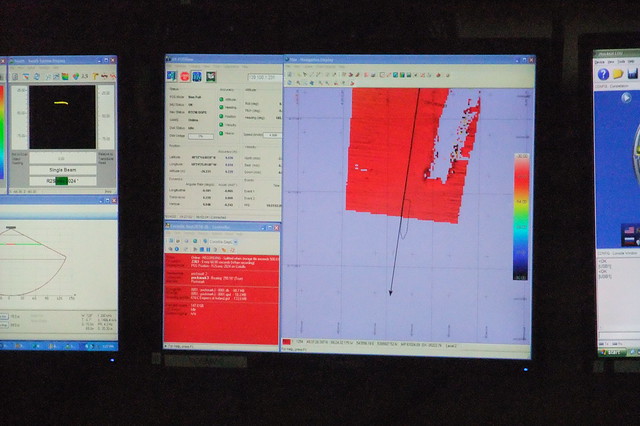
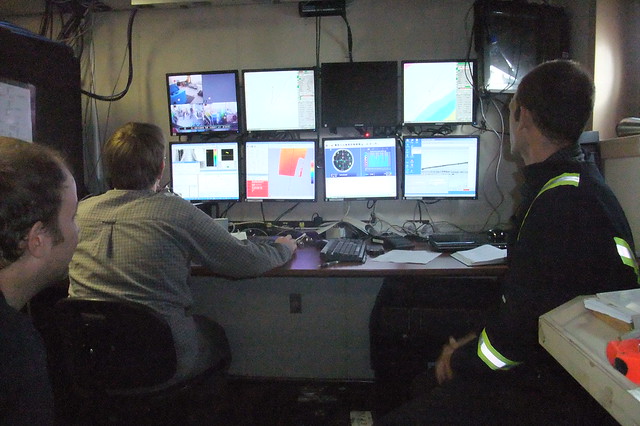
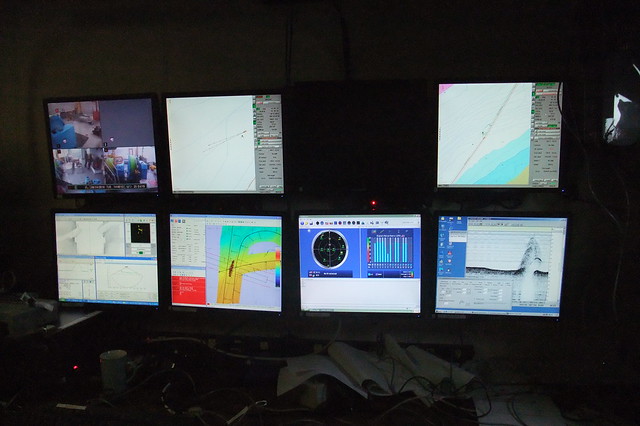
quebec 526While doing fieldwork sailing to and from Rimouski in 2010, we allowed another research group some shiptime to test their multibeam bathymetric system. The RMS Empress of Ireland make a logical target in just 40 m of water. Seeing the undisturbed wreck apear on the screens in the lab was really a fascinating experience.

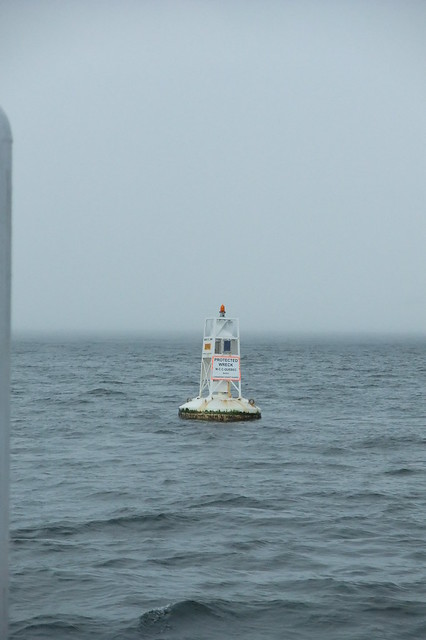
On the surface, there was nothing to see but river and fog, and the one buoy to warn of a shallow obstruction. Below, clear as day on all our screens were bright reflections on the depth sounder and multibeam screens, indicating hard surfaces. It was so unusual to see straight lines, and in fact, the clear outline of a ship, despite the near century of sediment build up, decay, and any incursion of life. Most of what we see has the organic, smooth lines of naturally formed and eroded geology. Even when we do see human-made objects (like our own equipment), it's never so large that you can read its very shape. It was haunting to see the clear outline of the Empress, silently lying on the seabed.

quebec 529 The St. Lawrence is deceptive. In French, we have the word Fleuve to better describe this mighty river which drains into the sea. We do say 'seaway' in English... but river is insufficient. While sometimes calm, the waters are brakish, the tides surprisingly large and the currents stronger than you would imagine for a protected river. I certainly made sure my porthole window was shut. But, a cruise liner is filled with passengers with little to no experience of being at sea. In the dense fog as we surveyed, it was easy to imagine the chaos, especially in the early morning dark. Many passengers may not even have awoken. The story of the sinking, and subsequent inquiry makes for some dramatic and in fact scandalous reading.

The crew of our vessel viewed the ship somewhat solemnly, not so much because they felt the connection to events of a century previous, but because more recently, the wreck itself had claimed more lives. In only 40 m of water, skilled scuba divers can explore it. But in cold water with low visibility, it is a dangerous dive. In 2009, the year before our survey, six divers had died.

Sunday, April 13, 2014

Territories

NWT
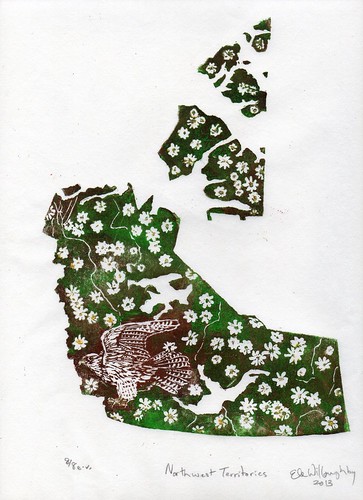
Northwest Territories by minouette

I got a really interesting message from a customer this week. After purchasing my Northwest Territories and Nunavut linocuts, he let me know why. The Collège André Malraux de Granville in France has created an 'artothèque' (great word no? like a bibliothèque or library, except for art) on the theme of territories. They've gathered art from 13 artists from France, Algeria, Canada and Ukraine. My prints will be representing Canada!

I love that my prints are making their way in to some institutional collections and the idea of international artists representing what 'territories' mean to them is fascinating. I'd love to see what else they've purchased.

Nunavut
Nunavut by minouette

Thursday, February 13, 2014

Koi

KoiOrange

I printed my koi block on this lovely, handmade, deep orange kozo paper I found, with a deckle edge.

I also made a new print of a JRT (Jack Russel Terrier, for those who aren't into dogs). Since it's based on a custom order, I'm going to keep it under wraps for a little while. It seems unlikely, but I would hate to spoil the surprise, should the gift recipient see the image before he receives his gift.

I've been doing some research and making notes on planned future prints.

Other than that, Gabriel has been keeping me pretty busy. His grandmother popped by unannounced today during Canada's men's hockey game, which she watched with her grandson on her knee. She's a raving tennis fan, so during the second period when she was unsure if the puck had gone in she asked whether Canada had in fact scored. Then she said, "So, it's 2-love Canada? Er.. well... in my language?"

Wednesday, July 17, 2013

Alex Colville


Iconic Canadian painter Alex Colville died yesterday. He was 92. His unmistakeable work includes the 1954 work Horse and Train above (and he was a war painter for Canada in WWII). Beautiful, realistic painting with a aura of dark surrealism, depicting a lot of this country. I went to one of his shows many years ago and met him. I was so impressed that one of the most famous artists in this country would stand around talking with me and my friends for so long. It was clear that we were far too young (and lacking in funds) to be the sorts that came to an opening to purchase art, but he was a kind and genuine person, happy to speak with young people who were enthusiastic about art.


Wednesday, July 10, 2013

Canada: 10 provinces, 3 territories and their symbols

Canada 
A couple of people asked whether I could print my series of province and territory linocuts on one giant pieace of paper. I was thinking that a book might be a better format. You see, the provinces are not at all printed to scale (and may even have some variations in projection). I made this decision consciously. You see, the smallest province PEI is 5,660 km2 whereas Nunavut, the largest of either province or territory is  2,038,722 km2- that is a bit more than 360 times as large. So, unless I was making art for a very very large space indeed, and could make prints in tens of square metres, I would never be able to acheive enough detail in the smaller provinces. However, it is possible to digitally place all the images side by side, and with a little Photoshop magic, you can see all of Canada. The pieces don't match perfectly; but, between inprecision in my carving, and variations from map to map (of scale, resolutions and maybe even projection) it's a pretty good fit.

Sunday, March 24, 2013

NWT

NWT

The symbols of the Northwest Territories, its territorial symbols the gyrfalcon and mountain avens flowers cover the hand-carved linocut map of NWT. The block was inked 'à la poupée' (with different colours, gray-brown, green and yellow, in different areas) and printed by hand on lovely Japanese kozo (or mulberry) paper. Each print is 23.5 cm by 31.8 cm (9.25" by 12.5"). The print is one of a variable edition of eight.

NWT is one of three Canadian territories, sandwiched between the Yukon to the west, and Nunavut to the east. Its waters currently include the Earth's North Magnetic Pole. Bodies of water shown include Great Bear Lake, the largest lake entirely within Canada, and Great Slave Lake, the deepest body of water in North America at 614 m, as well as the mighty Mackenzie River. In Inuktitut, the Northwest Territories are referred to as ᓄᓇᑦᓯᐊᖅ (Nunatsiaq), "beautiful land". (I love other alphabets and syllabaries).

The Gyrfalcon, also spelled gerfalcon (Falco rusticolus) is the largest of the falcon species and are found throughout the tundra, including all the Canadian Arctic Archipelago. This beautiful bird of prey has been an official symbol of NWT since 1990. The mountain avens (Dryas octopetala, common names include white dryas, and white dryad) is an arctic-alpine flowering plant which grows on a small prostrate evergreen subshrub forming large colonies. It grows abundantly in the eastern and central Arctic, as well as in parts of the Mackenzie River.

I've had the great priviledge of having seen much of this country and having travelled from coast to coast. (I am still hoping to visit the third coast). I have yet to visit any of the territories, despite my best efforts. Some of my research, in my day job as a scientist, relates to the Mackenzie Delta. I've spent many hours looking at maps of this region and one day, I hope to see it in person.

I've now completed all 3 territories and 10 provinces, which I wanted to do before the OOAK. I might make a Canada print too... but not before the show.

Friday, March 22, 2013

PEI

PEI

The symbols of Prince Edward Island, its provincial bird, the blue jay and its tree, the red oak cover the hand-carved map of PEI in this linocut. The block was inked 'à la poupée' (with different colours, reds, blues and black, in different areas) and printed by hand on lovely Japanese kozo (or mulberry) paper. Each print is 23.5 cm by 31.8 cm (9.25" by 12.5"). The print is one of a variable edition of eight.

So, I've only got NWT to go! RJH, like a good Maritimer advocated for PEI to be printed before Nunavut, but I was really concerned about how to fit an animal into the small shape of the province... and no, increasing the scale of the island wasn't the answer, since the relative scales matter. But, in the end, it wasn't too hard... the real trick was conceiving of how much of each the blue jay and the red oak were needed in order to be recognized. Luckily, oaks are perhaps most easily recognized by their leaves. I could have gone for a less contrasting colour scheme, but perhaps inspired by the name 'red oak' I portrayed the tree in autumn.

Thursday, March 21, 2013

Nunavut, rock ptarmigan and purple saxifrage

Nunavut

The symbols of Nunavut, its territorial symbols the rock ptarmigan and purple saxifrage flowers cover the hand-carved map of Nunavut in this linocut. The block was inked 'à la poupée' (with different colours, lavendar, beige, black and red, in different areas) and printed by hand on lovely Japanese kozo (or mulberry) paper. Each print is 23.5 cm by 31.8 cm (9.25" by 12.5"). The print is one of an edition of seven.

Canada's most recent territory, Nunavut (from the Inuktitut : ᓄᓇᕗᑦ ˈnunavut, for 'our land') which separated officially from the Northwest Territories on April 1, 1999 (though the actual boundaries had been established in 1993), includes all the islands in Hudson's Bay not specifically claimed by Ontario or Quebec, so I've included the boundary of Hudson's Bay and James Bay.

How wonderful are the words 'ptarmigan' and 'saxifrage'? I mean how many 'pt...' words do you know? I can think of pterodactyl and Ptah (the Egyptian god). Saxifrage apparently comes from the rock-breaking nature of this tundra and alpin-dweller, but I think it just sounds cool. Also, who could resist the male rock ptarmigan's extravagent scarlet eyelashes eye combs?

Friday, March 15, 2013

Thursday, March 14, 2013

Newfoundland and Labrador linocut

Newfoundland and Labrador

The symbols of Newfoundland and Labrador, its provincial bird the Atlantic puffin and flower the purple pitcher plant cover the hand-carved map of The Rock (and Labrador). The block was inked 'à la poupée' (with different colours, black, orange, lime and burgundy, in different areas) and printed by hand on lovely Japanese kozo (or mulberry) paper. Each print is 23.5 cm by 31.8 cm (9.25" by 12.5"). The print is one of a variable edition of eight.

This linocut was no mean feat! I notice the remaining provinces and territories all have coastlines and islands. I pointed out the challenge of carving the irregular shape of Newfoundland and Labrador to my family. My brother "helpfully" pointed out that there were two rectilinear sections of the border of Labrador... but I'd like to see him cave fractal coastlines, in reverse.

My previous puffin linocut has proven popular. A couple of customers have shared their inspiration for buying the print, and each of them wrote of travelling to the coasts of England and Wales. It's funny for me, since I associate the puffin so strongly with Newfoundland (where, apparently 95% of North American Atlantic puffics come to bred).

I also notice that Newfoundland and Labrador is the only province to have selected a carnivorous plant as its floral emblem.

Thursday, February 28, 2013

Quebec

Quebechotel So yesterday, I arrived at my hotel (nice big room, in a strange triangular shape, with exposed brick walls) at around 3:30. After making sure I could find the institute, I wandered the city for a couple of hours. I don't think I've ever been here in winter - just summer and fall. It was actually much warmer than I expected (3oC, but by the water there was a bitter wind). Climbing all the hills made me feel out of shape. It was interesting to see areas of town which overflow with tourists in the summer, empty after about 5 pm. Carnivale is over, so, it's past the winter tourist blitz too. In fact, my friend arrived early at the restaurant and before I could reply to her text, she had found me (since there were so few people around). I had a lovely dinner with my friends and their 5 year old son. It's wonderful to have friends in various cities (especially when one can arrange to meet on short notice). Coincidentally, I knew two of the scientists at the defense today too.

pigeon graflizardgrafitti
hills and wallsabove rampartsseawardiceChateau Frontenaccannons and slidered white blue roofs
lower citylower city
In August, one could barely walk along these streets. It's funny to see them empty.

Today was pretty exhausting; thinking in French, at a high, technical level, all day is really tiring. Not only that, but the scientists spoke different sorts of French (from France, Quebec, Switzerland). They were all very nice and complimented me on my French, but it was sort of funny as people tried to work out how bilingual I am. I was so tired afterwards, that I decided to come to the airport early. It wasn't obvious what I could do with an hour or an hour and a half, with all my bags, and wearing a suit (so I didn't want to tramp through the snow). Then, I left my hat in the cab, but I was able to retrieve it, but finding my cab in line at arrivals. (Luckily for me, this is not a large airport). Also: thumbs up for free wifi at the airport! So I can blog quietly, until they assign my flight a gate.