Showing posts with label Folklore. Show all posts

Thursday, November 20, 2025

Folktale Week Illustrations: Echo and the Yama orabi

Yama orabi, 8" x 10" linocut by Ele Willoughby, 2025
Yama orabi The Echo, 8" x 10" linocut by Ele Willoughby, 2025

I look forward to it every year! It's time for Folktale Week. Hosts post their 7 prompts for artists and/or writers to create illustrations or tell stories on these themes inspired by folktales, folklore, fables, myth and fairytales! There’s always a lot of magic submissions and it’s open to all. Most of the action is on Instagram (see @folktaleweek for more information) but you can find artists and writers sharing on other socials too. I am going to post my new illustrations here. And now Day 2: Echo.

Seeking less well-known folklore about echoes I found this Japanese echo yōkai. 

This hand-carved and hand-printed lino block print illustrates the mythical Yama orabi (山おらび) or “mountain shouter,” a small, tree-dwelling, birdlike yōkai or spirit who shouts replies, mimicking people’s voices and repeating their words creating an echo. They resemble small birds but have very large heads and sharp, pointy teeth. Any hiker in the mountains who is foolish enough to engage in a shouting match with the Yama orabi will soon die unless they can break the curse by ringing a cracked bell.

Folktale Week Illustrations: Night and La Chasse-galerie

La Chasse-galerie, linocut, 11" x 14" by Ele Willoughby, 2025

I look forward to it every year! It's time for Folktale Week. Hosts post their 7 prompts for artists and/or writers to create illustrations or tell stories on these themes inspired by folktales, folklore, fables, myth and fairytales! There’s always a lot of magic submissions and it’s open to all. Most of the action is on Instagram (see @folktaleweek for more information) but you can find artists and writers sharing on other socials too. I am going to post my new illustrations here, starting with Day 1: Night.

I wanted to once again make sure I included some Canadian folklore. So for the Day 1 prompt Night I knew what to illustrate!

This hand-carved, hand-printed 11” x 14” lino block print on lovely Japanese paper illustrates the famous French Canadian folktale of the Chasse-galerie, or the Flying Canoe. The tale tells of some hardworking voyageurs in their timber camp, who miss their sweethearts back home, 100 leagues or 500 km away. After a night of heavy drinking on New Year’s Eve they decide they need to visit, despite being required to work the next day. The only way to make it there are back in time is to run the Chasse-Galerie; that is, they have to make a pact with the Devil so their canoe can fly through the air and speed them home and back in time. The Devil demands that if they mention God or touch the cross of any church steeple during their voyage they will forfeit their souls. The voyageurs swear off any more rum to keep their heads clear and they paddle as they speed through the air to the New Year’s Eve festivities where they dance and celebrate with their sweethearts. Eventually they notice it’s getting late and they rush back to the canoe, but their navigator is drunk. Their course back is dangerous and erratic. The navigator narrowly misses church steeples and begins swearing and blaspheming. The men are terrified they will loose their souls so the gag the navigator and elect a new navigator, but the first one tries to resume and they crash into a pine tree. Several versions exist of their various fates, either outwitting the Devil or doomed to fly the canoe through hell and reappearing in the sky each New Year’s Eve.

The popular folktale is believed to a a syncretism between a French version of the Wild Hunt folklore where a man named M. Galerie is chased by the devil all night and local Indigenous tales of a flying canoe. I love how you can trace a sort of family tree of folktales and find familial connections between stories. For me this print is another in my ongoing collection of slightly sinister Yuletide folklore.

Friday, April 28, 2023

Some May Day Folk Traditions in Print

I've always been fascinated with May Day traditions, as a May Day baby myself. There are what have been called the "Green Root" (pagan) and "Red Root" (labour) traditions celebrated on the first of May. I've been participating in #FolkloreSunday on Twitter, learning more folklore and using my own artwork to illustrate my own posts. This year seemed like the one to illustrate some of the many "Green Root" traditions of May Day and May Eve like Beltane and Walpurgisnacht.

Jack-in-the-green, linocut, 8" x 10" by Ele Willoughby, 2023

When I participated in #FolkloreWeek last fall, one of the prompts was "tree" and this was the first time I learned about the Jack-Of-The-Green (or Jack O' the Green). I loved the mysterious yet absurd images of walking and dancing men covered in conical wooden or wicker frames covered in foliage, sometimes with a crown of flowers, like a wayward dancing bush leading a procession of characters like the Lord and Lady and a jester, rollicking through the streets. Jack-in-the-green has been part of May Day processions in England since the 1770s. There's a lot of debate about where the tradition came from. Some suspect it arose out of the garlands and floral wreathes worn by milkmaids on May Day, enlarged by the Chimney Sweep guilds (as they celebrated Chimney Sweeper's Day the same day). Others tie it to similar wild men foliage folk figures in continental Europe, pre-Christian fertility figures and the concept of the Green Man. More recent scholarship disputes this connection with the Green Man - but while perhaps not historical the revived 20th century version of the tradition connects the concepts. (You can find more here and here). I have made a Jack-in-the-Green linocut. 


Bonfire, monoprint, 11" x 14" by Ele Willoughby. Hand painted onto a gel plate and printed on water colour paper.
 

Beltane ("lucky fire") is the Gaelic May Day festival held on 1 May, or about midway between the spring equinox and summer solstice (in the Northern hemisphere) has traditionally marked the start of summer. It's tied with mythology and was viewed as a time when fairies were strong and offerings were needed to appease the aos sí. It was one of the most important festivals and there are many traditions. I decided to just illustrate one: the lighting of bonfires. People and livestock often had to move through the smoke, or jump over fires or walk between two fires to guard against sickness and witchcraft. 


Walpurgisnacht, monoprint by Ele Willoughby, 7.75" x 9.875", 2023. Hand painted onto a gel plate and printed on water colour paper.

Bonfires and protection against witchcraft brings us to a May Eve tradition: Walpurgisnacht and Hexennacht (Walpurgis night and Witches' Night as celebrated in Germany). May Eve is the feast day of Saint Walpurga in celebration of her canonization May 1, 870. But folklorists tie it to a more ancient celebration of a moon festival for Walpurga, another name for the Norse goddess Freya of love and beauty who also represented women's magic, sexuality, and independence as well as war and death in battle. She had a magical cloak of falcon feathers and gold necklace, trusty sacred boar friend and a chariot pulled by two cats (cats!). The May Pole can likewise be linked to Yggdrasil, the world tree. Saint Walpurga, amongst other things, apparent fought off witches, so in various European countries, people continue to light bonfires on Saint Walpurga's Eve in order to ward off evil spirits and witches. But in some places people celebrate "Witches' Night", when revelers dress as witches and demons, set off fireworks, dance and play loud music, to drive the witches and winter spirits away. In the Harz mountains the tradition goes back over 1,000 years ago, when people celebrated the arrival of spring  making offerings to the god Wodan (or the Norse god Odin).

These are but a few of the many traditions of this time.


Wednesday, February 1, 2023

Jack Frost, astronomers Kepler and Lepaute and bees in snail shells

 I haven't kept up with posting all my recent prints, so today, we're playing catchup! I've been doing #printerSolstice so I have managed to make a print weekly tie to their prompts. This year the prompts are elements of art and design: value, form, line, balance, texture and upcoming are space, shape, contrast, proportion, unity, pattern and variety. I'm trying to interpret these prompts in light on my ongoing series of prints of various sorts. The first one, value (or the lightness and darkness of colours), I applied to another slightly sinister winter folktale: Jack Frost and made a print in tints and shades of cobalt blue.


Jack Frost, linocut on cardstock, 5" x 7" by Ele Willoughby, 2022

For form, I thought of Kepler and how he arrived at his laws from thinking about music and then the Platonic Solids!

Johannes Kepler, linocut by Ele Willoughby, 2023
Johannes Kepler, linocut, 11" x 14" on Japanese kozo paper, by Ele Willoughby 2023

This is my linocut of mathematician and astronomer Johannes Kepler (1571-1630). We remember him for his role in the Scientific Revolution, and his three laws of planetary motion in particular. His laws modified Copernicus’ heliocentric model; he replaced the circular orbits with elliptical ones & described velocities of planets. Today we know them as:

1) Planetary orbits are ellipses with the Sun as one of the foci (top magenta ellipse)

2) A line from Sun to planet sweeps out equal areas in equal time periods (middle ellipse)

3) The square of the planet’s orbital period (or year) is proportional to the cube of the semi-major axis (shown as the horizontal arrow in the bottom ellipse).

But, I find it fascinating- & important to note- that he came to these laws exploring mystical ideas about music, geometry and congruence with physical phenomena. Sometimes we tell simple, but misleading stories about scientific progress. 

First he argued that the spacing of the 6 known planets from the Sun were related to the 5 Platonic solids, each encased in a sphere and nested one inside another. He had to order them selectively: octahedron, icosahedron, dodecahedron, tetrahedron and cube. He then related the size of the spheres to the  orbital periods of the planets (Mercury, Venus, Earth, Mars, Jupiter and Saturn). But this formula was not precise enough…. But we can see this as the seed of his 3rd law. The gold shapes are the nested Platonic solids from his Mysterium Cosmographicum. 

He also took the medieval idea of the “music of the spheres” literally and translated planetary angular speed as measured from the Sun as musical notes and finds that the minimum and maximum speeds of neighbouring planets approximate harmonies. Though unrelated to our modern ideas about our solar system these explorations of geometry and music ultimately lead to his correct models, which in turn were a significant steps towards Newton’s Law of Universal Gravitation.

Next came line, and I made it about the line traced by an eclipse:

Nicole-Reine Lepaute, linocut by Ele Willoughby, 2023
Nicole-Reine Lepaute, linocut, 11" x 14" on Japanese kozo paper, by Ele Willoughby, 2023

This is my linocut portrait of Nicole-Reine Lepaute, née Étable de la Brière, (5 January 1723 – 6 December 1788). She was a French astronomer, mathematician and human computer. My print celebrates how she calculated the path of the solar eclipse of 1764. She also worked with Alexis Clairaut and Jérôme Lalande to much more precisely calculate the date of the return of Halley’s Comet. This is no mean feat when you realize this was essentially solving the notorious three-body by hand (as the gravitational pull of Jupiter and Saturn affect its orbit around the sun). They worked in parallel, calculating for 6 months straight, barely stopping to eat! She also produced astronomical almanacs from 1759 to 1783 and was also a member of the Scientific Académie de Béziers.

Some of the historic women of science whose names and achievements were recorded, are known to us because of their wealth and privilege. Though Nicole-Reine Lepaute was born in Luxembourg Palace, she was not an aristocrat; she was the sixth of nine children of the valet of the duchess de Barry and her sister. A bright child, she was self-taught and devoured all the books in the library. Her later friend and long-time collaborator, astronomer Jérôme Lalande wrote that she had "too much spirit not to be curious." 

She married the royal clockmaker Jean-André Lepaute, in the Luxembourg Palace, in 1764. She became responsible for the household accounts but her marriage also allowed her to pursue her interest in mathematics and astronomy. She applied her skills to document, observe and calculate the workings of all her husband's inventions. The Académie des Sciences sent Lalande to inspect her husband's new type of pendulum clock. The three worked on the theory of clockmaking and added to her husband's "Traité d'horlogerie," which he had published in 1755. Though she was not included as a co-author, Lalande was nothing but praise for her, writing, "Madame Lepaute computed for this book a table of numbers of oscillations for pendulums of different lengths, or the lengths for each given number of vibrations, from that of 18 lignes, that does 18000 vibrations per hour, up to that of 3000 leagues"

Though Newton's Law of Universal Gravitation, published in 1687, allowed astronomers to calculate planetary orbits around the sun, to do so they considered only the two bodies: the mass and position of a single planet and the sun. The truth is more complex, because all masses exert gravity, and as soon as we introduce even a third mass there is no general closed-form solution and some systems are even chaotic. The first problem studied was the Sun-Earth-Moon 3-body problem, which Newton could not solve and succeeding generations continued to pursue. Early physicists became so frustrated that they began to doubt Newton's Law of Universal Gravitation. Renown mathematician Leonard Euler even wrongly argued against the inverse square law. Being able to accurately predict the Moon's orbit had huge implications for navigation and determination of longitude at sea. Competing polymaths Jean le Rond d'Alembert and Alexis Clairaut each presented their analyses of the problem to the Académie Royale des Sciences in 1747. Clairaut had found a brilliant approximate solution to the 3-body problem for which he received the 1750 prize of the St Petersburg Academy for his essay "Théorie de la lune". 

In 1757, Lalande decided he improve on the predictions of a different 3-body problem: the return of Halley's Comet, last seen in 1682. Because the gravitational pull of Jupiter and Saturn cannot be neglected, Halley himself was only able to calculate that the comet would return "around the end of the year 1758 or the beginning of the next." He enlisted the help of Clairaut and Lepaute.  The divided up the calculations required and worked in parallel for more than 6 months, barely even stopping to eat! They were in a race to make their prediction before the comet itself arrived. By November 1758 they gave a two-month window for comet's perihelion (closed point to the sun) of the 15th of March to the 15th of May, centered around the 13th of April 1759.  They missed the comet's arrival, the 13th of March, 1759 by only a couple of days. Sour grapes Jean d'Alembert griped that their work was "more laborious than deep". In fact, their heroic efforts were a huge technical feat and ten-fold improvement on Haley's vague two-year window. Their error was only due to employing the less-than-accurate accepted masses for Jupiter and Saturn. Notorious ladies' man Clairaut unfortunately removed any mention of Lepaute from his 1760, "Théorie du mouvement des comètes", alledgedly to please another woman, whereas in Lalande's "Théorie des Comètes" he insists they could never have made the calculations without her. 

Lepaute went on to collaborate with Lalande and his calculations for decades. In 1759 Lalande became the director of the  Académie des Sciences astronomical almanac Connaissance des Temps (Knowledge of the times) and appointed Lepaute as his assistant. He prepared computing plans and she did the calculations for the almanac. Her work included calculations on a 1762 comet, and a table of parallactic angles, work on the Éphémerides, annual guides for astronomers and navigators, calculating the daily position of Saturn from 1775 to 1784 (for the seventh volume, in 1774). She calculated on her own the daily positions of the Sun, Moon and planets for the eighth volume (in 1784).

In 1762 she calculated the exact time and path of the annular solar eclipse of 1st of April, 1764. Under her own name, she published a map which showed the eclipse's extent over Europe (shown in green in my print), as well as the its successive phases in 15-minutes intervals as would be visible over Paris (shown in blue in my print).

She and her husband were childless but adopted his nephew, Joseph Lepaute Dagelet in 1768 and she trained him as a mathematician and astronomer. He became a professor and was inducted in the French Royal Academy of Sciences in 1785.

Despite how vital, and Lalande's vocal appreciation, her work remained largely unrewarded and unrecognized during her lifetime. She worked as computer for Lalande for 15 years while he was a professor and director of the Paris Observatory. She did became a member of the distinguished Scientific Academy of Béziers in 1761, and calculated the ephemeris of the 1761 transit of Venus for them. Her eyesight after decades of calculation deteriorated to the point that she had to retire in 1783. She spent the end of her life caring for her terminally ill husband. After her death in 1788, Lalande wrote a biography of her contributions which he included in his Astronomical Bibliography. Both an asteroid (7720 Lepaute) and a lunar crater have posthumously been named in her honour.

For Balance, I made my portrait of Zhang Heng (see previous post).

For Texture, I made a print of an Eastern Snail Shell Mason Bee, Osmia conjuncta. 

Eastern Snail Shell Mason Bee, linocut by Ele Willoughby, 2023
Eastern Snail Shell Mason Bee, linocut 8" x 8" on Japanese kozo paper, by Ele Willoughby, 2023

The Packer Lab at York University posted an image of this mason bee, Osmia conduct, and explained that these adorable little blue snail shell nesting bees had now been observed in Canada (southern Ontario) and to be honest, I'm completely obsessed with the idea. I think it's the cutest thing I've ever heard. Apparently, they think these bees have become more common here because there are now so many of the Cepaea snails, introduced from Europe. So, while I couldn't find any images of this bee nesting, I illustrated it with a Cepaea shell. You can find images and video of other Osmia bees nesting in snail shells online. Many thanks to the friendly and helpful Entomology Twitter folks who helped me track down the right type of snail shell and even introduced me to researchers who said they would try to get video of these cuties next field season!

I will miss Science Twitter when it's gone.

References for scientist bios

Johannes Kepler, Wikipedia, accessed January 2023

Nicole-Reine Lepaute, Wikipedia, accessed January 2023

Jérôme Lalande, Wikipedia, accessed January 2023

Alexis Clairaut, Wikipedia, accessed January 20223

Lynn, W. T. (2 January 1911). "Madame Lepaute". The Observatory. 34: 77–78. Bibcode:1911Obs....34...87L. 

Bernardi, Gabriella (21 March 2016). The Unforgetten Sisters: Female Astronomers and Scientists before Catherine Herschel. Springer. pp. 121–127. ISBN 9783319261270.

De La Lande, Jérôme (1803). Bibliographie astronomique avec l'histoire de l'astronomie depuis 1871 jusqu'à 1802 (in French). Paris: Imprimerie de la République. ISBN 978-2329549170. Archived from the original on 4 May 2010. 

Connor, Elisabeth (November 1944). "Mme. LePaute, An Eighteenth Century Computer". Astronomical Society of the Pacific Leaflets. 4 (189): 314–321. Bibcode:1944ASPL....4..314C.

Tuesday, November 29, 2022

Folktale Week Prints

 I have been neglecting the old blog of late! It's been a busy fall, but I thought I would update you on some of the work I have been making. This year, I decided to participate in Folktale Week. There's always so much wonderful art posted. You should check out @FolktaleWeek on Instagram, or the hashtag #FolktaleWeek2022 to see all the art artists worldwide have created. They create a yearly prompt list for a week in November every year. 

Here's the art I created!

FOOL


An illustration of the fairytale ‘The Three Feathers’ for the first prompt for Folktale Week 2022: Fool. Retold by the Brothers Grimm amongst others, the story tells of a King who needs to decide which of his 3 sons should inherit the crown. The youngest, Dummling (or sometimes even Simpleton) is considered quite the fool by his brothers. The King sends the princes on a series of quests. He drops 3 feathers into the air, telling his sons to take their landing site as a direction to follow. The elder two go off but the 3rd feather falls straight down. First they are tasked with finding a carpet of the finest craftsmanship. The older prices assume any rug they find can beat what Dummling can find in the pond at the base of the tower. But Dummling meats a magical talking toad (King of the Frogs or Toads, depending on the version) who provides a wonderous carpet that the King declares the winner. The older princes insist on more trials; 3 more feathers are dropped & once again Dummling brings a beautiful ring from the magical toad while his brothers underestimate him with their simple rings from farther afield. Again the King chooses Dummling’s offing. The older princes protest that he can’t choose Dummling the Fool, so the King agrees to a 3rd quest: most beautiful bride. The older brothers go follow their feathers but Dummling’s feather goes straight down to the pond where the magical toad has a plan: select a toad. Place her in a hollow turnip as a carriage, pulled by 6 mice. These of course magically become a beautiful (and winning) princess in horse-drawn carriage. The brothers insist on acrobatic trials for the 3 brides. The Frog Princess wins; Dummling becomes a just and peaceful king.

The story begs the question about who were truly the fools! The frog princess in mouse-drawn turnip was an irresistible image!

TREE

Linocut print of Little Elder Tree Mother by Ele Willoughby
Linocut print on washi paper 8" x 10" of the Little Elder Tree Mother by Ele Willougby, 2022


For the #FolktaleWeek2022 prompt “tree” I made a linocut print illustrating ‘The Little Elder Tree Mother’ by Hans Christian Andersen.

In the story a little boy has caught a cold and is sick in bed and his mother brings him a pot of elder tree blossom tea. A kindly old man visits and the boy asks him for a story. The man says he has no stories to tell, and that the stories must come to you. When the boy is impatient the man reassures him that there's a story in the teapot. As they look an elder tree grows out of the teapot, full of blossoms. In the tree appears a kindly looking elderly woman whose dress looks like the blossoms and leaves. The old man tells the story of an elderly couple meeting under an elder tree and revisiting their long life together. The boy complains that this was no fairytale, so the old man suggests he ask the elder tree mother. The elder tree mother takes the boy up into the tree and he experiences the entire dream-like story of life and love of the old man's life. Afterwards the boy doesn't know if he was told the story or dreamed it. His mother says he slept while she argued with the old man about whether the tale was a fairytale. When the boy asks where is the elder tree mother, his mother says she is in the teapot, where she'll remain.

The idea of the Elder-mother, a guardian of elder trees, comes from English and Scandinavian folklore, known as the Danish Hyldemoer ("Elder-Mother") and the Lincolnshire namesake Old Lady and Old Girl. You must ask her permission before using the elder and sometimes she is benevolent but sometimes she is a witch. The elder wood in some folklore is able to ward off lightening or evil.

STAR

Linocut with collaged washi, 11" x 14", 'Kolędnicy' by Ele Willoughby, 2022


My linocut embellished with collaged washi paper for the #FolktaleWeek prompt: Star. This is a procession of Kolędnicy, or Kolęda carollers going through the woods to honour the sun at Winter Solstice. The tradition, also known as Koliada or kolędowanie, dates to pre-Christian times but is now become associated with Christmas and usually celebrated Christmas Eve to Epiphany. This print is inspired by Polish festivals but there are different versions of this across a wider region. It is known for instance in Ukrainian ("Коляда", Kolyadá), Belarusian (Каляда, Kalada, Kaliada), Polish (Szczodre Gody kolęda), Bulgarian, Macedonian, Serbo-Croatian (Коледа, Коледе, koleda, kolenda), Lithuanian (Kalėdos, Kalėda), Greek (Koleda, Κόλιντα, Κόλιαντα), Russian (kolyadovanye, Колядования) and Czech, Slovak, Slovene (koleda). Groups of carollers go singing from house to house with a homemade star on a pole held high and in several traditional costumes.

In Polish folklore, the Turoń, which is the black, horned and shaggy animal with a flopping jaw is common at folk events including Kolęda, in times of Carnival and before Lent begins. The name comes from the word tur, meaning aurochs, an extinct ancestor of modern cattle. Carolling with the star on a pole was called “gwiazdory” from the word for star. Other common costumes include forest creatures like the bear and bird here and devil, and other characters (like Death, Angels, Goats, Foxes, Dziad - an old man, Wise Men and modern ones associated with Christmas).

Each print is 9.25" by 12.5" on Japanese washi paper with collaged paper for colours. You can find both the print and sets of cards with this image in minouette.etsy.com.

REBEL

Sun Wukong linocut by Ele Willoughby
Sun Wukong and the Peaches of Immortality, linocut on washi 8" x 10"


For #folktaleweek2022 prompt “rebel” my favourite irrepressible, chaotic hero of folklore: Sun Wukong, the Monkey King himself!

This is a linocut print of the Monkey King, Sun Wukong, hero of Chinese folklore (and throughout Asia) as well as the 16th century novel by Wu Cheng’en, ‘Journey to the West’.

Before embarking on his humorous epic adventure (and ultimately helping to recover Buddhist sutras) this irrepressible was born from a stone, becomes a King of monkeys, acquires immortality through Taoist practices and his staff-like weapon, phoenix-feather cap, and cloud-walking boots (through extorting the Dragon Kings) and wrecks a lot of mayhem. He defies a death sentence and Hell’s attempt to gather his soul by wiping his name (and those of his monkey friends) out of the Book of Life and Death (once again gaining immortality).

In an attempt to make him more manageable the Jade Emperor invites him to Heaven as ‘Protector of the Horses’ but Monkey realizes he’s being patronized and this just means stable boy, so he sets the horses free and declares himself The Great Sage, Heaven’s Equal. Gold Star advises the Jade Emperor accept the title and try to placate Monkey with another job: Guardian of the Heavenly Peach Garden. Peach-loving Monkey accepts. The Queen Mother’s maidens come to fetch peaches for her Royal Banquet for gods and goddesses to which Monkey was not invited and he turns defiant. He not only eats the Peaches of Immortality, he crashes the party and steals and eats Laozi’s Pills of Immortality. And he’s just getting started! Between his guile and martial prowess, whole armies fail to stop the Monkey King. Being cooked in a crucible for 49 days only makes him stronger. Finally Buddha imprisons him for 500 years, until he is given the opportunity to be let out as protection for the monk Tang Sanzang making a pilgrim to India for the Buddhist sutras (the Journey to the West). 

COSTUME

Selkie linocut by Ele Willoughby
The Selkie, linocut on washi, 9.25" x 12.5", by Ele Willoughby


I like the idea of a selkie for the #FolktaleWeek2022 prompt costume because selkie folktales turn the idea of a costume on its head: this is a mythological being (maybe a fairy or elf, depending on whether you’re in Scotland or Iceland) which disguises itself by removing its skin, rather than covering it up.

This is a hard-carved and printed lino block print of a selkie shedding her skin, seated on rocks, surrounded by harbour seals. Each print is made on lovely Japanese washi paper, cream-coloured paper with bark inclusions, 9.25” x 12.5”.

In Celtic, Norse, Faroese and Icelandic mythology, selkies (also spelled silkies, sylkies, selchies) or selkie folk meaning 'seal folk' can change from seal to human form by shedding their skin. The legends tell of seal fairies or elves who choose to come ashore in human form, and sometimes have human families. Like the swan maiden stories, if a human hides the selkie's seal skin, they cannot return to the sea, but if they find their skin, nothing, not love, nor their own human children (with telltale webbed feet, and sometimes a greenish tint and fishy smell) can keep them on land and they will return to the sea. There are stories of men stealing selkie skins (left ashore, for instance when selkies come to dance naked under the moon) and compelling the female selkie to marry them, but she always longs for the sea (and ultimately escapes when she or her offspring finds her skin). One story though tells of a selkie-wife by choice, who loves her fisherman husband and life ashore. But, when he doesn't heed her advice and ventures out in a storm, she is forced to resume her seal form to rescue him, even though she knows she will loose her comfortable human life on land. Male selkies were known as handsome and seductive, who sought out dissatisfied and neglected human women like fishermen's wives. Women could summon their silkie-husbands by shedding seven tears into the sea.

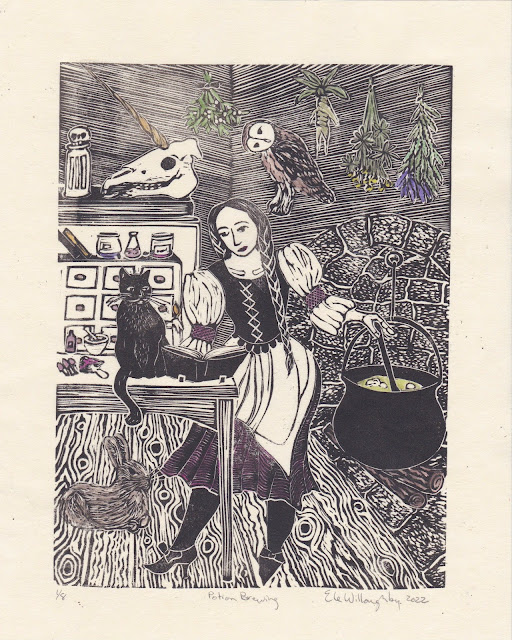
POTION

Potion Brewing linocut by Ele Willoughby
Potion Brewing, linocut on washi 8" x 10" by Ele Willoughby, 2022

For the 
#folktaleweek2022 prompt “potion” I couldn’t find a folktale potion I wanted to illustrate so I imagined a scene with a hedge witch and her familiars as she brews a potion. 

I put some of the research I did to illustrate ‘Death by Shakespeare’ to work. Behind the cat you can spy a Renaissance style medicine cabinet, and the cauldron, jars and bottles are also like some I found of that era. Also the plants and mushrooms used in medicine and poisons or generally seemed to fit the theme and be associated with magic: Amanita, witches cap mushroom, mistletoe, mandrake, vervain, and lady’s mantle. The unicorn skull is for a hint of #magic and the familiars, barn owl, black cat and rabbit all have rich folklore. 

I embellished this print with some hand painted India ink details. 

VICTORY

The Morrigan linocut by Ele Willoughby
The Morrigan, linocut 8" x 10" by Ele Willoughby, 2022


For the final #folktaleweek2022 prompt victory I chose The Morrigan, the tripartite Goddess of Irish mythology. The Morrígan or Mórrígan, also known as Morrígu or as "the three Morrígna" in her form as the three sisters (often Badb, Macha, and Nemain or sometimes Badb, Macha, and Anand). She sometimes appears as an individual, sometimes as three sisters. She was a shape-shifting goddess associated with fate, doom or victory in battle. She incited battle, inspires bravery and can bring victory over the enemies of warriors. She was the wife of The Dagda, the "good god," a father-figure and king, god of agriculture and fertility. She could inspire fear and be a symbol of impending death, often as a crow or raven but she could also be seen as a protector, associated with land, livestock and fertility. She is also the goddess of death and purveyor of prophecy. She sometimes appears in multiple forms within the same story, most commonly a beautiful maiden, a fierce warrior-queen, an old crone or washerwoman washing the blood-stained clothes of the dead, and a raven. The ominous shriek of The Morrigan at battles means she is sometimes associated with banshees.  

It was close to the wire and I finished this print last night, having lost a couple of days I had planned to work with my 8 year old home with a cold. This one might have turned out differently if I had time to linger on decisions but I think it works. There’s something to be said for working intuitively.

It was a challenge to create this week of art but huge thanks to @folktaleweek for organizing this annual event! It’s been a huge treat to see how some many talented artists illustrated these prompts. I loved finding new to me artists and illustrators, checking the hashtag daily, seeing their magical work and learning many myths, legends and folktales. This is a truly international event with posts in my languages and great variety in tales and style of work and I will definitely return to this again next year. If you haven’t already, you should check it out!

Friday, December 3, 2021

Somewhat sinister holiday cards

 I decided to add to my collection of darker yuletide folklore cards, to go with the Yule Cat and made:


linocut Krampus card by Ele Willoughby, 2021

 
The relief print on each card shows Krampus, the scary horned counterpart to Santa of Alpine folklore, complete with birch rods, and naughty child in a basket.  The origins of this character are debated but there are traditional parades called the Krampuslauf or Krampus run, where young men dressed as Krampus and attempt to scare the audience with their antics in many Alpine towns, and  Krampus is featured on holiday greeting cards called Krampuskarten (which often read "Gruss von Krampus" or "Greetings from Krampus"). Krampus is usually hairy, horned, has cloven feet, a lolling long tongue and fangs. The bundle of birch branches or ruten links back to pagan times.

linocut Mari Lwyd card by Ele Willoughby, 2021

This lino block printed card shows Mari Lwyd, a traditional Welsh hobby horse in a field. As part of a wassailing tradition from South Wales, a hobby horse made of a horse skull on a pole, decorated with buttons and ribbons, with sack cloth shrouding the poll and porter is carried through the local area at Christmas time. The men performing with Mari Lwyd at dusk and into the night would request entrance to houses through song, and if admitted must be given food and drink. 

The name Mari Lwyd (pronounced "lood") might come from Holy Mary or grey mare. The source of the tradition is debated but can be linked to various British hooded animal traditions.

linocut Joulupukki, or the Yule Goat, card by Ele Willoughby, 2021

The relief print on each card shows the Yule Goat, Joulupukki of Finland, carrying his parcels, staff with lantern, and bedecked with bells and ribbons in this nighttime scene. Each card is 4.25" by 5.75" (11 cm by 15 cm) and the envelopes are 5.12" x 7.12" (13.5cm x 18.5 cm).

Joulupukki is a Finnish Christmas figure whose name translates as Yule or Christmas Goat. Pukki comes from the Teutonic root "bock", which is a cognate of the English "buck", and means "billy-goat". There is an old tradition of men dressing as a goat at Yule in Finland. These nuuttipukki were evil spirits who would go from house to house demanding gifts and leftovers from the Yule feast. But over time the concept of nuutipukki merged with the idea of Santa Claus and became the benevolent Joulupukki who gave out gifts, rather than claim them, to well-behaved children. But in some areas, nuuttipukki still make visits on Nuutinpäivä, or St. Knut's Day, January 13. 

Yule goats (Julbocken) are common in Nordic countries, as small decorative straw or wicker ornaments decorated with red ribbon or giant ones like the Gävle goat in Sweden, a frequent target of arson. Some argue they are linked to Thor, who rode in a goat-pulled chariot. But others argue it is even more ancient and links to proto-Slavic beliefs where Koliada or Yule honors the god of the fertile sun and the harvest who was represented by a white goat. So Koliada festivals always had a person dressed as a goat, often demanding offerings in the form of presents.

linocut Perchta card by Ele Willoughby, 2021

This linocut card shows Perchta or Berchta (or Bertha in English), a figure from Alpine folklore, who visits during the 12 days of Christmas. Her name may come from "the bright one" or the German word for the feast of the Epiphany and her history is linked to white robbed goddesses like Holda who oversaw spinning and weaving or the goddess Frigg and she emerged from Germanic and Celtic traditions in the Early Middle Ages. She has two forms, both shown in my print: young and beautiful and as white as snow, or an old crone with a long knife and often a beak-like nose. She sometimes has one large, possibly goose foot. Jacob Grimm (of fairy tale fame) thought this indicated she was a shapeshifter or swan maiden. She is associated with birch trees and looked over the forest and wildlife. She was said to visit homes during the 12 days of Christmas and enforce cultural taboos, such as not spinning on holidays. If young people were good (and completed duties like spinning their flax or wool) she would leave a silver coin. But if not, she would slit their bellies open and stuff them with straw or refuse! Between the beautiful and ugly forms of Perchta I include a spindle. In her beautiful form she was known as Grandmother Winter, the bringer of snow

Some legends associate her with the Wild Hunt, and claim she rides through the night sky with her Perchten. 

In contemporary alpine festivals she is accompanied by an entourage, the Perchten, either beautiful and bright Schönperchten who bring luck or ugly Schiachperchten with fangs, tusks and horse tails (resembling Krampus) who are supposed to drive out ghosts and demons. She is viewed as the one who rewards generosity and punishes bad behaviour.