Showing posts with label mythology. Show all posts

Sunday, November 23, 2025

Folktale Week Illustrations: Dawn - The Firebird and the Maiden of Dawn

The Maiden of Dawn and the Firebird, 11" x 14" linocut print by Ele Willoughby, 2025

I look forward to it every year! It's time for Folktale Week. Hosts post their 7 prompts for artists and/or writers to create illustrations or tell stories on these themes inspired by folktales, folklore, fables, myth and fairytales! There’s always a lot of magic submissions and it’s open to all. Most of the action is on Instagram (see @folktaleweek for more information) but you can find artists and writers sharing on other socials too. I am going to post my new illustrations here. And now the final day, Day 7: Dawn.

Here is The Maiden of the Dawn & the Firebird inspired by Edmund Dulac's retelling of a Russian Fairytale.

A Prince is prophesied to fly away on the Firebird on his 15th birthday & marry the Maiden of the Dawn. So the King imprisons him in a luxurious tower prison & holds an elaborate 15th birthday, without him. 

Frustrated, the Prince escapes by the window to the garden, unobserved by the guards enjoying the festival. At the edge of the garden he found a cave, illuminated by a giant bird. In the crystal pool below he saw an image of a beautiful Princess & fell in love. The bird indicated that he should climb aboard & they flew thousands of miles to a beautiful crystal palace at the Home of Dawn with the beautiful Princess asleep in the garden. The prince alighted & failed to wake the Princess. They returned the next night, to no avail but on the 3rd night she awoke at dawn as the Firebird stopped to pluck & give her a feather before leaving the Prince with her. They fell instantly in love & blissfully wandered the garden together. 

But her evil jealous sister enchanted the Prince & his body fell as if dead. The sorrowful Princess kissed his lips, which trembled & she understood her wicked sister must have enchanted him. In desperation she searched the palace then remembered the feather & used it to call the Firebird & fly far west to a cave. There her sister the witch was singing by her cauldron containing the Prince's heart. The Princess rushed forward, overturning the cauldron; the icy brine splashed the witch, killing her. The Princess grasped the frozen heart to her chest & they flew home. 

As they reached their destination, the Princess realized the heart had melted & was gone! Terrified she rushed onward. The Firebird alighted on the roof & the Prince himself came out to greet them. They embraced & she understood that his heart was back where it belonged in his chest, beating against hers. The Firebird's work was done & he flew away, but returned to circle their garden for their wedding, & brought them a feather each anniversary. They ruled as King & Queen of the People of the Dawn for many years & lived joyfully together.

Friday, November 24, 2023

My Folklore Week 2023 Illustrations

Once again I took part in Folktale Week this year! There's fabulous and magical illustrations from artists worldwide; check out #FolktaleWeek2023 on Instagram (plus hashtags for each prompt of the form FolktaleWeek + prompt). The prompts this year were: lost, ink, sea, sleep, underground, illusion, and found. I've decided I can interpret "folktale" loosely to include fairytales, legends, myths and folklore.

For lost, I knew I wanted to make the Minotaur in his labyrinth, with the slightest hint of the first person to avoid getting lost: Theseus with his ball of string.

The Minotaur in his Labyrinth, linocut, 9.25" x 12.5" by Ele Willoughby, 2023
The Minotaur in his Labyrinth, linocut, 9.25" x 12.5" by Ele Willoughby, 2023 

Ink was a real challenge! I had a few ideas but in the end, opted for a Japanese yokai, a sort of supernatural spirit called suzuri no tamashii. Specifically it’s a type of yokai called a tsukumogami, a type of spirit which can arise from an object which is used for 100 years, when it comes alive. 

Suzuri no tamashii, linocut, 9.25" x 12.5", by Ele Willoughby, 2023


The story goes that an ink stone was used to copy the same manuscript over and over again for many generations, about the bloody Genpei War (1180-1185). The 'Akama suzuri,' a top-quality inkstone made specially in Shimonoseki City, began to take on aspects of the story itself. It became possessed by a vengeful spirit of an Ise-Heishi warrior who had been defeated at the Battle of Dannoura, where the Minamoto clan brutally wiped out the entire Taira clan. Phantom sounds like fierce battle, waves on the sea or even a voice narrating "Heike monogatari" (The tale of the Heike) could be heard. Waves rippled on the ink and illusory characters and boats from the story, arose from the ink to wreak havoc on the writing.

As many of the slaughtered Taira soldiers became vengeful spirits or onryō when they died, their grudge-curse infects many ink stones which have been used to repeatedly copy their story.

My print shows an ink stone, ink stick, jar of brushes, and the suzuri no tamashii emerging like two mounted samurai warriors crossing a river from The tale of the Heike. 

Zaratan, linocut, 11" x 14", by Ele Willoughby, 2023

I knew what I wanted to do for sea; I've long wanted to illustrate the Zaratan, a mythical giant sea turtle  that looks like a small island! There's a small campfire on the supposed beach, and a sailing ship from the age of exploration nearby. The sunset sky is in vibrant fuchsia, tangerine and purple.

"There is a story that is told in all lands and throughout all history - the story of sailors who go ashore on an unknown island that later sinks and drowns them, for the island is alive. This imaginary beast-island figures in the first voyage of Sindbad and in the sixth canto of Orlando Furioso (Ch'ella sia usa isoletta ci credemo; "We are all cheated by the floating pile, / And idly take the monster for an isle"); on the Irish legend of St. Brendan and in the Greek bestiary of Alexandria; in the Swedish curate Olaf Magnus' History of the Northern Nations (Rome, 1555) and in the passage in Paradise Lost, Book I, in which the prostrate Satan is compared to a great whale "hap'ly slumbering on the Norway foam."

    -Jorge Luis Borges, The Book of Imaginary Beings (El Libro de Los Seres Imaginarios)

Often depicted as a giant turtle, like the Turtle Island origin myth common to many Indigenous peoples of North America, the Zaratan could in fact be any large marine creature, but I love the idea of a giant turtle.

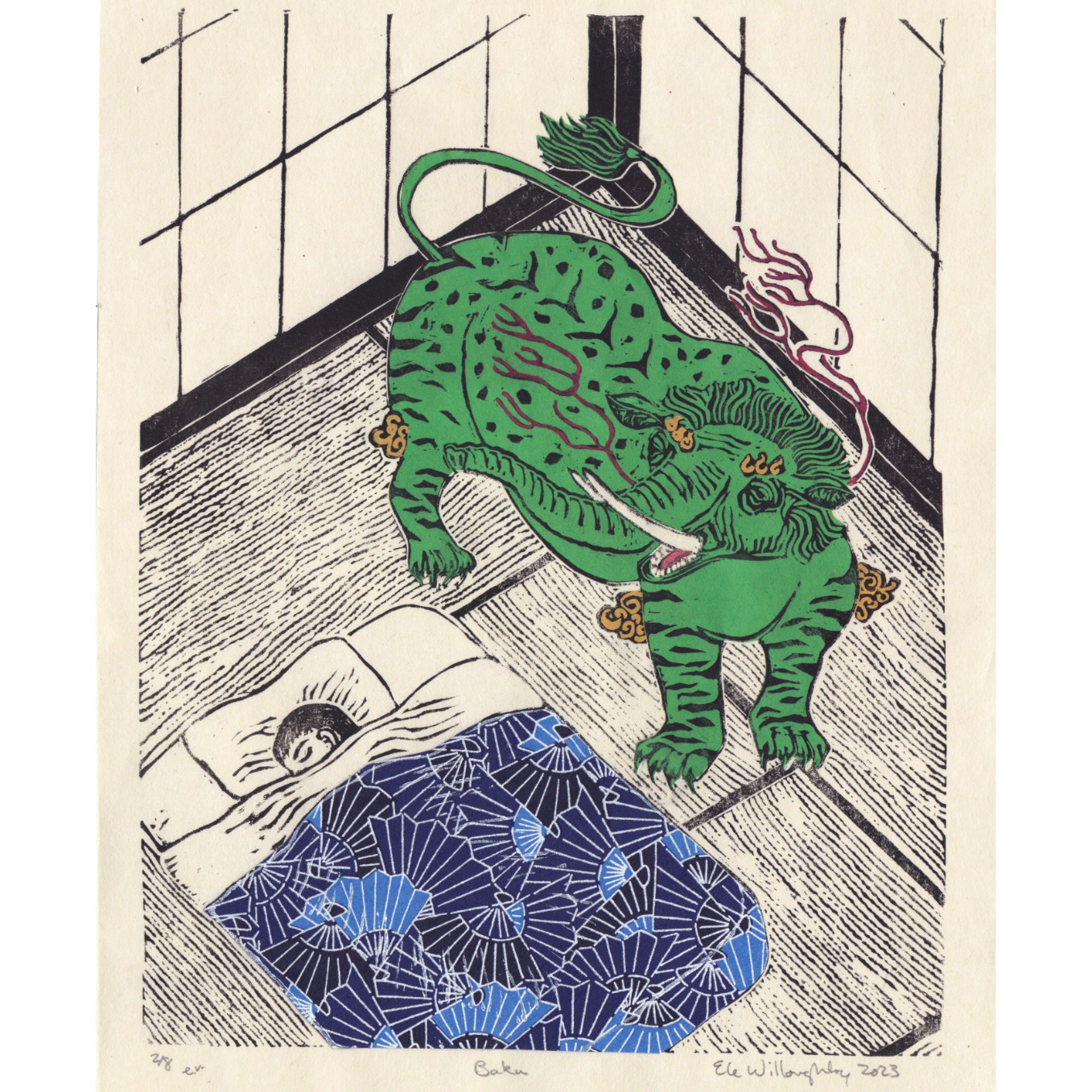
I found another great Japanese yokai for sleep: the Baku. Some stories about sleep are either familiar fairytales or in fact, a bit grim. I like the mythical Japanese chimera because despite its monstrous appearance, it is the beloved eater of nightmares. It was made from leftover parts, with the body of a bear, the claws of a tiger, the tail of a cow, the trunk and tusks of an elephant with the ears and eyes of a rhinoceros! You can call on it if you have bad dreams. A child who awakes from a nightmare will cry, “Baku-san, come eat my dream!” three times and the baku will enter their room to devour the bad dream so they can go back to sleep. They must be careful however, not too call too often, least they get a hungry baku who will also eat their dreams.

Today the word baku can also apply to a real animal, the Malayan tapir, because of its arguable resemblance to the mythical animal.

I thought my blue origami paper would make a great comforter so I made 8 different variations!

Baku, linocut, 9.25" x 12.5" by Ele Willoughby, 2023

The idea I had for underground was the Aos sí, the people of the Sidhe, the Fair Folk of Ireland, who according to legend live beneath mounds in fairy forts underground. I have not yet editioned this print, but I plan to add it to my shop soon! You may know the banshee, or Bean sídhe or woman of the sídhe. In fact the very word Sídhe is the term for earthen mounds like the one in my linocut and the Aos sí are “the people of mounds.” The Sidhe evolved from a mythological people known as the Tuatha De Danaan, powerful, magical semi-divine beings, who feature in many early Irish tales. When the ancestors of the Irish, the Gaels arrived they battled over the Emerald Isle. The way the story was told to me was that neither force could conquer the other and they decided to divide Ireland evenly between them. If you look at Ireland it’s quite an irregular shape and the only way to split it evenly was top and bottom with the Gaels occupying the upper world and the Tuatha De Danaan taking the lower world.

They’re known as the daoine sí or daoine sìth in Scots Gaelic and we get the the idea of fairies from the fair folk, but our inherited Victorian ideas and images of fairies are much gentler, sweeter and cuter than these fierce beings who are benevolent if treated with respect but are known to react cruelly if mistreated. 

The Sidhe, linocut, 11" x 14" by Ele Willoughby, 2023

For illusion, I chose a beautiful French fairytale: La Chatte Blanche, published by Madame d’Aulnoy in 1698.

A king is worried about succession and sends his three sons on quests to determine who will inherit the kingdom (or rather to distract them on that pretence, to avoid being deposed by an impatient prince). First they must find the smallest and most beautiful dog. They each go their own way and the youngest finds a fantastical castle filled with intelligent talking cats. He is quite taken by their beautiful white cat queen who mysteriously wears a locket with a image which looks just like him. He stays a full year and she gives him an acorn for his quest. Returning home he opens the acorn for his father and inside is the tiniest dancing dog. Despite clearly having won the contest, the king starts another: find the finest muslin which can be drawn through the eye of a needle. The princes go out again; the youngest returns to the white cat for another year and she gives him a walnut with nested series of smaller seeds, the tiniest containing magically fine and beautiful muslin. His magical muslin is clearly the winner. The king sets a third task to find the most beautiful princess bride. After a third stay with the cats, the beloved white cat convinces the prince, to his horror, to chop off her head. But when he does the fairy enchantment is broken and she is revealed as a beautiful princess cursed by fairies so that she and those in her kingdom must live as cats unless her forbidden lover’s doppelgänger cuts off her head. It was all an illusion!

She reigned over six kingdoms so after the triple wedding of the three princes, succession is solved as she grants brothers and father each kingdoms to rule and she and her husband the youngest prince rule the remaining three.

La Chatte Blanche, linocut, 9.25" x 12.5", by Ele Willoughby, 2023


I wanted to make sure I included a Canadian folktale this year. So often the folktales we hear are from Europe, but I wanted one from closer to home. I selected the Mermaid of the Magdalenes for the prompt "found." I loved that the found thing as something as prosaic as a tin of sardines, that this is a fairytale about my May Day birthday and about the perils of not preserving marine ecology. I still have to print an edition of this print, but I plan to do so soon.


The Mermaid of the Magdalenes, linocut by Ele Willoughby, 11" x 14", 2023

The rugged east coast Magdalene Islands are all but barren of grass and trees, but the waters are rich in fish and people called it the “Kingdom of Fishes”. Traders could grow rich off the bounty of the sea. Long ago when sardines were first canned they were wildly popular. There was a great slaughter of sardines by greedy traders, who packed them in tiny boxes and shipped them all over the world. The tiny sardines were helpless against the onslaught. They saw their fellow sardines killed and their numbers were dwindling. They cried out for help, calling a meeting of all the fishes. There, they convinced their brethren to stand with them and punish those who fished and ate sardines.

On May Day a ship filled with sardine cans was wrecked on the rocks of the Magdalene Islands, its cargo strewn on shore. The daughter of a fish trader found a tin and was delighted, hoping to eat them. But, she was unable to get the can open sang a song of lament.

“I love sardines when they’re boiled with beans
And mixed with the sands of the sea.
I am dying for some.
Will nobody come and open this box for me?”

A disgusted skate heard her but was too timid to punish her. A merman wanted a land wife but he left her ashore because of his oath to the sardines. Finally the black lobster heard her and remembered his oath. He cunningly offered his help only to trick her and he grasped her with his strong claw and dragged her out to sea.

It’s believed he sold her to the merman. But on the 1st of May you can see her off the coast of the island, her glass in hand, looking longingly at shore as she brushes her hair, each year more and more a fish. The fishermen hear her lonely mournful songs and stay ashore least she drag them out to sea for company. 

 I found this story amongst the Canadian Folktales published by Cyrus MacMillan in 1922.

Tuesday, November 29, 2022

Folktale Week Prints

 I have been neglecting the old blog of late! It's been a busy fall, but I thought I would update you on some of the work I have been making. This year, I decided to participate in Folktale Week. There's always so much wonderful art posted. You should check out @FolktaleWeek on Instagram, or the hashtag #FolktaleWeek2022 to see all the art artists worldwide have created. They create a yearly prompt list for a week in November every year. 

Here's the art I created!

FOOL


An illustration of the fairytale ‘The Three Feathers’ for the first prompt for Folktale Week 2022: Fool. Retold by the Brothers Grimm amongst others, the story tells of a King who needs to decide which of his 3 sons should inherit the crown. The youngest, Dummling (or sometimes even Simpleton) is considered quite the fool by his brothers. The King sends the princes on a series of quests. He drops 3 feathers into the air, telling his sons to take their landing site as a direction to follow. The elder two go off but the 3rd feather falls straight down. First they are tasked with finding a carpet of the finest craftsmanship. The older prices assume any rug they find can beat what Dummling can find in the pond at the base of the tower. But Dummling meats a magical talking toad (King of the Frogs or Toads, depending on the version) who provides a wonderous carpet that the King declares the winner. The older princes insist on more trials; 3 more feathers are dropped & once again Dummling brings a beautiful ring from the magical toad while his brothers underestimate him with their simple rings from farther afield. Again the King chooses Dummling’s offing. The older princes protest that he can’t choose Dummling the Fool, so the King agrees to a 3rd quest: most beautiful bride. The older brothers go follow their feathers but Dummling’s feather goes straight down to the pond where the magical toad has a plan: select a toad. Place her in a hollow turnip as a carriage, pulled by 6 mice. These of course magically become a beautiful (and winning) princess in horse-drawn carriage. The brothers insist on acrobatic trials for the 3 brides. The Frog Princess wins; Dummling becomes a just and peaceful king.

The story begs the question about who were truly the fools! The frog princess in mouse-drawn turnip was an irresistible image!

TREE

Linocut print of Little Elder Tree Mother by Ele Willoughby
Linocut print on washi paper 8" x 10" of the Little Elder Tree Mother by Ele Willougby, 2022


For the #FolktaleWeek2022 prompt “tree” I made a linocut print illustrating ‘The Little Elder Tree Mother’ by Hans Christian Andersen.

In the story a little boy has caught a cold and is sick in bed and his mother brings him a pot of elder tree blossom tea. A kindly old man visits and the boy asks him for a story. The man says he has no stories to tell, and that the stories must come to you. When the boy is impatient the man reassures him that there's a story in the teapot. As they look an elder tree grows out of the teapot, full of blossoms. In the tree appears a kindly looking elderly woman whose dress looks like the blossoms and leaves. The old man tells the story of an elderly couple meeting under an elder tree and revisiting their long life together. The boy complains that this was no fairytale, so the old man suggests he ask the elder tree mother. The elder tree mother takes the boy up into the tree and he experiences the entire dream-like story of life and love of the old man's life. Afterwards the boy doesn't know if he was told the story or dreamed it. His mother says he slept while she argued with the old man about whether the tale was a fairytale. When the boy asks where is the elder tree mother, his mother says she is in the teapot, where she'll remain.

The idea of the Elder-mother, a guardian of elder trees, comes from English and Scandinavian folklore, known as the Danish Hyldemoer ("Elder-Mother") and the Lincolnshire namesake Old Lady and Old Girl. You must ask her permission before using the elder and sometimes she is benevolent but sometimes she is a witch. The elder wood in some folklore is able to ward off lightening or evil.

STAR

Linocut with collaged washi, 11" x 14", 'Kolędnicy' by Ele Willoughby, 2022


My linocut embellished with collaged washi paper for the #FolktaleWeek prompt: Star. This is a procession of Kolędnicy, or Kolęda carollers going through the woods to honour the sun at Winter Solstice. The tradition, also known as Koliada or kolędowanie, dates to pre-Christian times but is now become associated with Christmas and usually celebrated Christmas Eve to Epiphany. This print is inspired by Polish festivals but there are different versions of this across a wider region. It is known for instance in Ukrainian ("Коляда", Kolyadá), Belarusian (Каляда, Kalada, Kaliada), Polish (Szczodre Gody kolęda), Bulgarian, Macedonian, Serbo-Croatian (Коледа, Коледе, koleda, kolenda), Lithuanian (Kalėdos, Kalėda), Greek (Koleda, Κόλιντα, Κόλιαντα), Russian (kolyadovanye, Колядования) and Czech, Slovak, Slovene (koleda). Groups of carollers go singing from house to house with a homemade star on a pole held high and in several traditional costumes.

In Polish folklore, the Turoń, which is the black, horned and shaggy animal with a flopping jaw is common at folk events including Kolęda, in times of Carnival and before Lent begins. The name comes from the word tur, meaning aurochs, an extinct ancestor of modern cattle. Carolling with the star on a pole was called “gwiazdory” from the word for star. Other common costumes include forest creatures like the bear and bird here and devil, and other characters (like Death, Angels, Goats, Foxes, Dziad - an old man, Wise Men and modern ones associated with Christmas).

Each print is 9.25" by 12.5" on Japanese washi paper with collaged paper for colours. You can find both the print and sets of cards with this image in minouette.etsy.com.

REBEL

Sun Wukong linocut by Ele Willoughby
Sun Wukong and the Peaches of Immortality, linocut on washi 8" x 10"


For #folktaleweek2022 prompt “rebel” my favourite irrepressible, chaotic hero of folklore: Sun Wukong, the Monkey King himself!

This is a linocut print of the Monkey King, Sun Wukong, hero of Chinese folklore (and throughout Asia) as well as the 16th century novel by Wu Cheng’en, ‘Journey to the West’.

Before embarking on his humorous epic adventure (and ultimately helping to recover Buddhist sutras) this irrepressible was born from a stone, becomes a King of monkeys, acquires immortality through Taoist practices and his staff-like weapon, phoenix-feather cap, and cloud-walking boots (through extorting the Dragon Kings) and wrecks a lot of mayhem. He defies a death sentence and Hell’s attempt to gather his soul by wiping his name (and those of his monkey friends) out of the Book of Life and Death (once again gaining immortality).

In an attempt to make him more manageable the Jade Emperor invites him to Heaven as ‘Protector of the Horses’ but Monkey realizes he’s being patronized and this just means stable boy, so he sets the horses free and declares himself The Great Sage, Heaven’s Equal. Gold Star advises the Jade Emperor accept the title and try to placate Monkey with another job: Guardian of the Heavenly Peach Garden. Peach-loving Monkey accepts. The Queen Mother’s maidens come to fetch peaches for her Royal Banquet for gods and goddesses to which Monkey was not invited and he turns defiant. He not only eats the Peaches of Immortality, he crashes the party and steals and eats Laozi’s Pills of Immortality. And he’s just getting started! Between his guile and martial prowess, whole armies fail to stop the Monkey King. Being cooked in a crucible for 49 days only makes him stronger. Finally Buddha imprisons him for 500 years, until he is given the opportunity to be let out as protection for the monk Tang Sanzang making a pilgrim to India for the Buddhist sutras (the Journey to the West). 

COSTUME

Selkie linocut by Ele Willoughby
The Selkie, linocut on washi, 9.25" x 12.5", by Ele Willoughby


I like the idea of a selkie for the #FolktaleWeek2022 prompt costume because selkie folktales turn the idea of a costume on its head: this is a mythological being (maybe a fairy or elf, depending on whether you’re in Scotland or Iceland) which disguises itself by removing its skin, rather than covering it up.

This is a hard-carved and printed lino block print of a selkie shedding her skin, seated on rocks, surrounded by harbour seals. Each print is made on lovely Japanese washi paper, cream-coloured paper with bark inclusions, 9.25” x 12.5”.

In Celtic, Norse, Faroese and Icelandic mythology, selkies (also spelled silkies, sylkies, selchies) or selkie folk meaning 'seal folk' can change from seal to human form by shedding their skin. The legends tell of seal fairies or elves who choose to come ashore in human form, and sometimes have human families. Like the swan maiden stories, if a human hides the selkie's seal skin, they cannot return to the sea, but if they find their skin, nothing, not love, nor their own human children (with telltale webbed feet, and sometimes a greenish tint and fishy smell) can keep them on land and they will return to the sea. There are stories of men stealing selkie skins (left ashore, for instance when selkies come to dance naked under the moon) and compelling the female selkie to marry them, but she always longs for the sea (and ultimately escapes when she or her offspring finds her skin). One story though tells of a selkie-wife by choice, who loves her fisherman husband and life ashore. But, when he doesn't heed her advice and ventures out in a storm, she is forced to resume her seal form to rescue him, even though she knows she will loose her comfortable human life on land. Male selkies were known as handsome and seductive, who sought out dissatisfied and neglected human women like fishermen's wives. Women could summon their silkie-husbands by shedding seven tears into the sea.

POTION

Potion Brewing linocut by Ele Willoughby
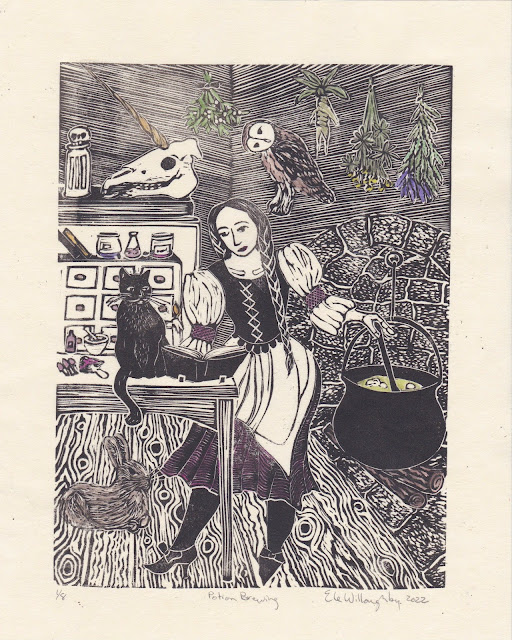
Potion Brewing, linocut on washi 8" x 10" by Ele Willoughby, 2022

For the 
#folktaleweek2022 prompt “potion” I couldn’t find a folktale potion I wanted to illustrate so I imagined a scene with a hedge witch and her familiars as she brews a potion. 

I put some of the research I did to illustrate ‘Death by Shakespeare’ to work. Behind the cat you can spy a Renaissance style medicine cabinet, and the cauldron, jars and bottles are also like some I found of that era. Also the plants and mushrooms used in medicine and poisons or generally seemed to fit the theme and be associated with magic: Amanita, witches cap mushroom, mistletoe, mandrake, vervain, and lady’s mantle. The unicorn skull is for a hint of #magic and the familiars, barn owl, black cat and rabbit all have rich folklore. 

I embellished this print with some hand painted India ink details. 

VICTORY

The Morrigan linocut by Ele Willoughby
The Morrigan, linocut 8" x 10" by Ele Willoughby, 2022


For the final #folktaleweek2022 prompt victory I chose The Morrigan, the tripartite Goddess of Irish mythology. The Morrígan or Mórrígan, also known as Morrígu or as "the three Morrígna" in her form as the three sisters (often Badb, Macha, and Nemain or sometimes Badb, Macha, and Anand). She sometimes appears as an individual, sometimes as three sisters. She was a shape-shifting goddess associated with fate, doom or victory in battle. She incited battle, inspires bravery and can bring victory over the enemies of warriors. She was the wife of The Dagda, the "good god," a father-figure and king, god of agriculture and fertility. She could inspire fear and be a symbol of impending death, often as a crow or raven but she could also be seen as a protector, associated with land, livestock and fertility. She is also the goddess of death and purveyor of prophecy. She sometimes appears in multiple forms within the same story, most commonly a beautiful maiden, a fierce warrior-queen, an old crone or washerwoman washing the blood-stained clothes of the dead, and a raven. The ominous shriek of The Morrigan at battles means she is sometimes associated with banshees.  

It was close to the wire and I finished this print last night, having lost a couple of days I had planned to work with my 8 year old home with a cold. This one might have turned out differently if I had time to linger on decisions but I think it works. There’s something to be said for working intuitively.

It was a challenge to create this week of art but huge thanks to @folktaleweek for organizing this annual event! It’s been a huge treat to see how some many talented artists illustrated these prompts. I loved finding new to me artists and illustrators, checking the hashtag daily, seeing their magical work and learning many myths, legends and folktales. This is a truly international event with posts in my languages and great variety in tales and style of work and I will definitely return to this again next year. If you haven’t already, you should check it out!

Wednesday, January 6, 2016

COSMIC turtles


A graphic cosmic timeline, from the
Big Bang to the present day
(Credit: NASA/WMAP Science Team)
This year, to coincide with PrintAustin, Art.Science.Gallery is hosting COSMIC, a show of prints about "Origin of the Universe. Evolution of the Universe. String Theory. Dark Matter. Dark Energy. Multiverse. Unification of Space + Time. Our Solar System. Cultural Cosmology." I mean, how could I resist? I've been working in every spare moment to produce two brand new prints for the show. (As it happens, most of my astronomy related prints have appeared in previous exhibits there, so I needed new cosmological material).

My first instinct, the first images I imagined were something like the NASA spacetime diagram shown, which is a graphical representation of a lot of the major concepts of cosmology: the Big Bang, Inflation, the formation of galaxies and so forth and even dark energy and our current accelerated expansion... It's a great use of imagery to communicate science, but it's far too literal. It's a diagram, not a piece of art. So I turned to the figurative, imaginative, metaphorical, to avoid the trap of the literal.

Turtles, All the Way Down, 11" x 14" (27.9 cm x 35.6 cm)
linocut with chine-collé by Ele Willoughby, 2016
In some cultures there are origin myths explaining that the (apparently flat) Earth is in fact supported on the back of the World Turtle (occassionally in conjunction with other beasts). In cosmology - or the astrophysics of the origins of our Universe - there is an expression "turtles all the way down" which relates to a well-known anecdote, and metaphor for the problem of infinite regress. There are many versions of the anecdote. It appears, famously, in Stephen Hawking's A Brief History of Time, amongst other sources. The story goes that a physicist, after explaining the origins of our planet, is confronted by a disgruntled audience member who claims this is nonsense. The Earth is, according to him or her, supported by a great turtle. When the physicist asks about what supports the turtle, the answer is a larger turtle, of course. When the physicist persists and asks what supports this next turtle, why, it's "turtles, all the way down!" of, course. The same problem in epistemology is known as the Münchhausen trilemma, after after the story of Baron Munchausen who claimed to have pulled himself and his horse out of the mire by pulling his own hair, in the ultimate example of bootstrapping. (Incidentally, bootstrapping is a favorite tool of physicists, and The Adventures of Baron Munchausen, is one of my favorite films).

A well-known scientist (some say it was Bertrand Russell) once gave a public lecture on astronomy. He described how the earth orbits around the sun and how the sun, in turn, orbits around the center of a vast collection of stars called our galaxy. At the end of the lecture, a little old lady at the back of the room got up and said: 'What you have told us is rubbish. The world is really a flat plate supported on the back of a giant tortoise.' The scientist gave a superior smile before replying, 'What is the tortoise standing on?' 'You're very clever, young man, very clever,' said the old lady. 'But it's turtles all the way down!'
— Hawking, A Brief History of Time, 1988

I've illustrated this expression with a variety of wonderful turtle species using collaged or chine-collé papers to show their various colours. From the top we have an eastern mud turtle (Kinosternon subrubrum), a red-eared slider (Trachemys scripta elegans), a black pond turtle (Geoclemys hamiltonii), a painted batagur (Batagur borneoensis), a Oaxaca mud turtle (Kinosternon oaxacae), a green sea turtle (Chelonia mydas) and the hint of something larger.

Those who've known me a long time will know that I've illustrated this concept before, I love turtles, am obsessed with origin myths and am rather found of zaratans. I am now wondering what, if anything, is the difference between a zaratan and an aspidochelone (incidentally, also encounted by none other than the Baron Munchausen, of course)?

The second piece I've submitted for COSMIC is Noh Spacetime. So it's metaphors all the way down.
Ele Willoughby, 'Noh Spacetime', linocut 12" x 12", 2015

Tuesday, July 16, 2013

Exciting news!

The Stork


This linocut shows how I imagine the great white stork of European folklore, who carries babies to new parents.
The stork is printed in teal ink on Japanese kozo (or mulberry) paper, 32 cm by 17.5 cm or 12.5" by 7". There are 4 prints in the edition.

The ancient stork-the-baby-bringer legend was made popular by Hans Christian Anderson's story called 'The Storks'. The stork is quite stylized, inspired by ancient Chinese art, and not an attempt to accurately portray Ciconia ciconia, the white stork, because - spoiler alert! - storks are not actually where babies come from. (The baby is a little more naturalistic and has very cute toes, if I do say so myself). This print definitely goes in the 'UnNatural History' category, with other mythical creatures.

As some of you know and some may have deduced, I'm printing the baby-carrying stork because I'm thinking about how to decorate a nursery. RJH and I are expecting a baby this winter!* I've been debating when to tell people, but I think it should be clear now, should you happen to see me, that something is afoot**, and am far enough along that risk has decreased a fair bit, so it seems like the right time. I'm doing pretty well. I haven't had morning sickness. My doctor is wonderfully relaxed and says the right things to put people at ease. (She told me half her patients are my age or older. She lets me have one large coffee a day, saying there's been no rigorous study showing any harm. She blamed my swollen feet on the weather, rather than my suspicion it was from eating salty Triskets and sun-dried tomatoes, saying, "The truth is, in this heat and humidity all pregnant women have swollen feet." So, I think she's great.) I confuse sonographers with my technical imaging questions, cause it's fascinating and the physics of ultrasounds is basically the physics of seismology, so I get it. I've had some discomfort from other symptoms. Why does no one every warn you about the leg cramps? It's always "weird food cravings" and never "violently awoken by Charley horse at 4 am". Also, I am thirsty all of the time  which is weird for a girl whose mother called her 'the camel' who was rarely thirsty (or needed to pee). I was keeping a glass of water by my bedside until I realized Minouette thought this was a new, convenient bedtime cat watering station, so now I have a cat-proof bedside water bottle. Sleeping is a bit of a challenge and I'm finding the 'extreme heat alert' weather unpleasant. Me and the cat are hiding in the cool basement right now. Mainly, I feel like I've swallowed a large and unruly water balloon, which is flattening all the things I normally keep in my belly.

bibsbibs

As you might imagine, I've responded by making things! So far, I've made 7 reversible fabric bibs (whales, mermaids, fortune cats, psychedelic blue squirrels, an urban scene, mushrooms, vintage cameras, constellations, flowers, numbers, cupcakes and elephants) and a block printed camera toy (because baby will want to be like Daddy I figure). I'm planning some fabric, block printed alphabet blocks too. I'll make duplicates for my shop, should you want any for your favorite wee one. I have other plans too, of course, but this is a good start.

camera toy
camera toy

* I'm pretty sure if he reads this he'll tell me I've buried the lede, but I'm not a newspaper man and like a little suspense. 

**Though, luckily for me, all the summer clothing is light, and airy and not fitted, so it seems not everyone figures it out on sight.

Friday, January 4, 2013

Aquarius and JRT

Aquarius

The silver stars and silhouette of Aquarius the water bearer are illustrated in this handmade block print. The water flows right down to Piscis Austrinus, the fish. Parts of the constellations of Capricornus, Pisces and Sculptor and the dashed line of the ecliptic are also shown. If you imagined all celestial bodies we see in the night sky as mapped onto a sphere (the Celestial Sphere) around our Earth, the ecliptic would be the line you would draw to map the apparent path of the Sun through the various constellations. The word Aquarius and symbol ♒ appear at the top of the image. The lines linking the constellation appear in silver-on-blue or blue-on-silver as appropriate. There are a couple of bright galaxies or star clusters shown as circles. I printed an edition of eight prints, 9 inches by 7.5 inches (22.9 cm by 19 cm) on lovely, deep blue, handmade, Japanese kozo (or mulberry) paper with silk fibres.

The Babylonians identified this constellation with their god Enki (or Ea). Enki was the deity of crafts (gašam); mischief; water, seawater, lakewater (a, aba, ab), intelligence (gestú, literally "ear") and creation (Nudimmud: nu, likeness, dim mud, make bear). As a marine geophysicist and a maker, this sounds like my sort of myth.

Also today, I printed a second edition of my portrait of Orbit, a.k.a. Lady Giggleswick (after receiving an anxious enquiry from that there would be a seconde édition, non?). Here she is, back by popular demand:

JRT

Sunday, December 16, 2012

Andromeda, Cetus, Perseus and Pegasus

Andromeda3

This is a linocut of the Greek myth of Andromeda. Her mother, Queen Cassiopeia bragged that Andromeda was more beautiful than the Nereids, or sea nymphs, angering Poseidon, god of the sea. He sent Cetus the sea monster to ravage the coast of the kingdom as punishment. The King Cepheus and Queen Cassiopeia were advised by an oracle that they needed to sacrifice their daughter to Cetus to save their land. She was striped bare and chained to a rock by the coast. She proved a very lucky princess, because who should happen by but the hero Perseus, fresh from his successful battle with the snake-headed Gorgon Medusa (whose head was in his sack). You see, Medusa's head turned the living to stone, which made it quite the useful weapon. Further, Pegasus the flying horse was born from the stump of her neck, so really this defeating Medusa was win-win for Perseus. He, of course, fell in love, slayed the monster and married Andromeda.

In the print, the monster Cetus encircles the rock on which Andromeda is chained. Perseus is shown descending on Pegasus, his flying horse, to battle the monster. You can see a couple of snakes peeping from his sack. Some versions of the myth suggest that Perseus was invisible at this moment, since he was wearing Hades's helm (note: Harry Potter was not the first to have a cloak of invisibility), but through the magic of printmaking, Perseus and Pegasus are made visible. (Flying horses are far more interesting when you can see them. Or perhaps, this is moment before he donned the cloak.)

Most of this story is commemorated in the night sky. Cassiopeia, Cepheus, Andromeda, Perseus, Cetus and Pegasus are all constellations.

The print is in a variable edition of 6 on lovely Japanese kozo (or mulberry) paper, 11 inches or 28 cm square. The block was inked 'à la poupée', with different colours applied directly to a single block. The sea is royal blue, the sea monster deep red with yellow eyes, the hair and wings on Perseus' helmet are yellow.

(May replace this with a higher resolution scan once I get Photoshop on my early Christmas gift).

Thursday, December 13, 2012

Persephone

Persephone

This is a linocut of the Greek myth of Persephone. The ancient Greek goddess Persephone, beloved daughter of Demeter was kidnapped by Hades, god of the underworld, and taken to his home where she was tempted with many delicious items. The pomegranate proved the most irresistible and sealed her fate. For the six pomegranate seeds she accepted from Hades, she was required to return every year for six months, where she became Hades' queen. During her absence (autumn and winter) her mother the grain goddess grieves, and the plants whither and die until they are reborn on her return; this explains the seasons.

The print is in a variable edition of 6 on lovely Japanese kozo (or mulberry) paper, 11 inches or 28 cm square. The block was inked 'à la poupée', with different colours applied directly to a single block. Persephone is deep indigo, with red pomegranate, lips and poppy and golden wheat.

I've depicted Persephone with a poppy and wheat crown for symbolic reasons. She was an agrarian goddess, hence the wheat. The poppy was used as an offering for the dead in Greek and Roman myth. It is associated with sleep, including eternal sleep. The bright red colour of the poppy is also a promise of resurrection, much like spring coming with Persephone's yearly return. (Which I discovered when I dressed as Persephone for a Winter Solstice feast and costume party one year).


Friday, December 16, 2011

Reading is sexy XLVIII

(image source) The next two books I read had a theme of dysfunctional sibling relationships, where siblings compete for love with fatal results, also the theme of Eden, the serpent and fall from grace. Just in time for the holidays! (kidding of course)

23. The Game by A.S. Byatt This is a shorter, early novel by Byatt, which tells the story of two adult sisters, Casandra the Oxford don and Medievalist, and Julia, best-selling novelist. As children they had an elaborate, shared, imaginative life and the titular game, inspired by Medieval romances, reminiscent of what the young Brontë sisters made with their mythology of Gondal and the associated maps and stories they created together. The adult sisters are distant, but brought together when their father has a stroke. They grew apart, we learn, as the novel progresses, due to a series of perceived transgressions (Julia writing about their shared game, their mutual and competitive love of the neighbour Simon -now a jungle-dwelling herpetologist with a budding TV career, Cassandra's rather melodramatic denunciation of the family's Quaker faith and conversion to Anglicanism, Julia's sort of self-sabotaging hero-worship for her older sister). Cassandra is a spinster, with a secret obsession still for Simon, who shared her early religious investigations. Julia is married to would-be Quaker saint Thor, and has a teenage daughter Deborah. Julia finds herself on a TV show about art and ideas, through which Simon re-enters their lives. Once again, Byatt has a natural scientist as a character to involve zoology, but also the symbol and mythology of snakes and serpents. I appreciate her consistent argument that science, like art, contributes to culture. Julia, initially intending to repair her relationship with her sister, ends up writing a novel, which is a thinly-veiled story of Cassandra and her relationship with and to Simon, without much thought to consequences. This is a study of family relationships, unrequited love, ideas, the nature of art versus science, writing, mental health, suicide, charity, academia, and responsibility. The characters feel quite real and the story is engaging, though it is perhaps less of a tapestry of ideas than Byatt's later novels.

(Literary gossip being what it is, I read once that this novel started her feud with her sister Margaret Drabble, though, it's also been attributed to writing about a family tea set.)

24. Cain by José Saramago This strange and final parable from the wise old man himself, is a sort of mythical biography of Cain. It begins with his parents, Adam and Eve, and their despotic Old Testament Creator (complete with ample pride and crown) in the Garden of Eden. After their expulsion, and an interesting interlude between Eve and the guarding Cherubim, they land on their feet when taken in by a caravan (because, of course, there are other people), and eventually they make a home and a family. Cain, in frustration with God's petty testing of his faith by only accepting Abel's tributes, kills his brother in jealousy, but argues for God's partial culpability. The story is really of his life after this, as a nomad, through time and space. He serves as skeptical witness to all of the most famous Old Testament stories (from Abraham and Isaac through Sodom and Gomorrah, the Tower of Babel, Moses, Job, various wars and battles ending with Noah). The thesis seems to be that the Old Testament God is cruel and capricious (all that senseless death and destruction, including innocent children destroyed in Sodom and cruel demands of sacrifice), but Cain has a plan for retribution.

As intriguing as all of Saramago's novels, this is a most unusual book.

25. My White Planet by Mark Anthony Jarman At first I thought, that's what you get for choosing books at random off RJH's shelf. He, after all, has King Leopold's Ghost (about the exploitation of the Congo) by his bedside, and The Road (in which *spoiler alert* people are eaten) in the glove compartment of his car. I wondered whether perhaps all his favorite books would be sad. Jarman's first story (and some of the subsequent stories) of a soldier's life in Custer's army is a bit grim. Several stories are informed by the violent North American colonial wars and battles (with allusions to Sitting Bull through Louis Riel). The titular dreamy story about seven isolated men at arctic research station which has fallen out of contact with civilization, who find a shipwrecked girl, is quite creepy. But, he writes crystalline stories like poems. "Make way for my itchy antlers, my spikes of rage, my affection for the slippery slope." I have the idea that Jarman is a writer's writer. He knows how to wield words. His stories are very evocative. I recognized the unnamed Straight of Georgia (and was unsurprised to learn the author lived in Victoria, prior to moving to Fredericton) in the description of a float plane flight in Bad Men Who Love Buzz Lightyear; I recognized Fredericton with its right side and wrong side of the Saint John River in Bear on a Chain. I can see how his simple story of a New Brunswick old timers hockey team, A Nation Plays Chopsticks would charm RJH, with its descriptions of the game, the odd camaraderie, driving moose-ridden highways at night, haunting old arenas, and questioning the drive of the 'civilized' narrator (presumably Jarman) to play a sometimes violent game. I personally enjoyed the sporadic allusions to an interesting array of music (clearly he's an avid listener) - from Bobbie Gentry through the White Stripes, by way of everyone from Otis Blackwell, Neil Young, Stereolab, Godspeed You! Black Emperor, Joy Division, the Tragically Hip, Sid Vicious, Syd Barrett and assorted unexpected allusions. The final two stories are even labeled "Bonus Tracks". Personally, I would read this book for the sheer pleasure of these two sentences: "If Derrida didn't exist we'd have to invent him. And then beat him up at recess," but the book is much richer than that. Read these well-crafted stories and see.

26. Myths To Live By by Joseph Campbell. Guess it's back to the imagery of the Garden and the serpent.

{Series so far: books read, more books read, books read, books read continues, more books read,  Reading is sexy I,  Reading is sexy II,  Reading is sexy III,  IReading is sexy V, Reading is sexy V, Reading is sexy VI, Reading is sexy VII, Reading is sexy VIII, Reading is sexy IX, Reading is sexy Reading is sexy X, Reading is sexy XI, Reading is sexy XII, Reading is sexy XIII, Reading is sexy XIV, Reading is sexy XV, Reading is sexy XVI, Reading is sexy XVII, Reading is sexy XVIII, Reading is sexy XIX, Reading is sexy XX, Reading is sexy XXI, Reading is sexy XXII, Reading is sexy XXIII Reading is sexy XXIV, Reading is sexy XXV, Reading is sexy XXVI, Reading is sexy XXVII, Reading is sexy XXVIII, Reading is sexy XXIX, Reading is sexy XXX, Reading is sexy XXXI, Reading is sexy XXXII, Reading is sexy XXXIII, Reading is sexy XXXIV, Reading is sexy Reading is sexy XXXV, Reading is sexy XXXVI, Reading is sexy XXXVII, Reading is sexy XXXVIII, Reading is sexy XXXIX, Reading is sexy XL, Reading is sexy XLI, Reading is sexy XLII, Reading is sexy XLIII, Reading is sexyXLIV, Reading is sexy XLV, Reading is sexy XLVI, Reading is sexy XLVII}