


I have been neglecting the old blog of late! It's been a busy fall, but I thought I would update you on some of the work I have been making. This year, I decided to participate in Folktale Week. There's always so much wonderful art posted. You should check out @FolktaleWeek on Instagram, or the hashtag #FolktaleWeek2022 to see all the art artists worldwide have created. They create a yearly prompt list for a week in November every year.
Here's the art I created!
FOOL

An illustration of the fairytale ‘The Three Feathers’ for the first prompt for Folktale Week 2022: Fool. Retold by the Brothers Grimm amongst others, the story tells of a King who needs to decide which of his 3 sons should inherit the crown. The youngest, Dummling (or sometimes even Simpleton) is considered quite the fool by his brothers. The King sends the princes on a series of quests. He drops 3 feathers into the air, telling his sons to take their landing site as a direction to follow. The elder two go off but the 3rd feather falls straight down. First they are tasked with finding a carpet of the finest craftsmanship. The older prices assume any rug they find can beat what Dummling can find in the pond at the base of the tower. But Dummling meats a magical talking toad (King of the Frogs or Toads, depending on the version) who provides a wonderous carpet that the King declares the winner. The older princes insist on more trials; 3 more feathers are dropped & once again Dummling brings a beautiful ring from the magical toad while his brothers underestimate him with their simple rings from farther afield. Again the King chooses Dummling’s offing. The older princes protest that he can’t choose Dummling the Fool, so the King agrees to a 3rd quest: most beautiful bride. The older brothers go follow their feathers but Dummling’s feather goes straight down to the pond where the magical toad has a plan: select a toad. Place her in a hollow turnip as a carriage, pulled by 6 mice. These of course magically become a beautiful (and winning) princess in horse-drawn carriage. The brothers insist on acrobatic trials for the 3 brides. The Frog Princess wins; Dummling becomes a just and peaceful king.
The story begs the question about who were truly the fools! The frog princess in mouse-drawn turnip was an irresistible image!
TREE
 |
| Linocut print on washi paper 8" x 10" of the Little Elder Tree Mother by Ele Willougby, 2022 |
For the #FolktaleWeek2022 prompt “tree” I made a linocut print illustrating ‘The Little Elder Tree Mother’ by Hans Christian Andersen.
In the story a little boy has caught a cold and is sick in bed and his mother brings him a pot of elder tree blossom tea. A kindly old man visits and the boy asks him for a story. The man says he has no stories to tell, and that the stories must come to you. When the boy is impatient the man reassures him that there's a story in the teapot. As they look an elder tree grows out of the teapot, full of blossoms. In the tree appears a kindly looking elderly woman whose dress looks like the blossoms and leaves. The old man tells the story of an elderly couple meeting under an elder tree and revisiting their long life together. The boy complains that this was no fairytale, so the old man suggests he ask the elder tree mother. The elder tree mother takes the boy up into the tree and he experiences the entire dream-like story of life and love of the old man's life. Afterwards the boy doesn't know if he was told the story or dreamed it. His mother says he slept while she argued with the old man about whether the tale was a fairytale. When the boy asks where is the elder tree mother, his mother says she is in the teapot, where she'll remain.
The idea of the Elder-mother, a guardian of elder trees, comes from English and Scandinavian folklore, known as the Danish Hyldemoer ("Elder-Mother") and the Lincolnshire namesake Old Lady and Old Girl. You must ask her permission before using the elder and sometimes she is benevolent but sometimes she is a witch. The elder wood in some folklore is able to ward off lightening or evil.
STAR
 |
| Linocut with collaged washi, 11" x 14", 'Kolędnicy' by Ele Willoughby, 2022 |
My linocut embellished with collaged washi paper for the #FolktaleWeek prompt: Star. This is a procession of Kolędnicy, or Kolęda carollers going through the woods to honour the sun at Winter Solstice. The tradition, also known as Koliada or kolędowanie, dates to pre-Christian times but is now become associated with Christmas and usually celebrated Christmas Eve to Epiphany. This print is inspired by Polish festivals but there are different versions of this across a wider region. It is known for instance in Ukrainian ("Коляда", Kolyadá), Belarusian (Каляда, Kalada, Kaliada), Polish (Szczodre Gody kolęda), Bulgarian, Macedonian, Serbo-Croatian (Коледа, Коледе, koleda, kolenda), Lithuanian (Kalėdos, Kalėda), Greek (Koleda, Κόλιντα, Κόλιαντα), Russian (kolyadovanye, Колядования) and Czech, Slovak, Slovene (koleda). Groups of carollers go singing from house to house with a homemade star on a pole held high and in several traditional costumes.
In Polish folklore, the Turoń, which is the black, horned and shaggy animal with a flopping jaw is common at folk events including Kolęda, in times of Carnival and before Lent begins. The name comes from the word tur, meaning aurochs, an extinct ancestor of modern cattle. Carolling with the star on a pole was called “gwiazdory” from the word for star. Other common costumes include forest creatures like the bear and bird here and devil, and other characters (like Death, Angels, Goats, Foxes, Dziad - an old man, Wise Men and modern ones associated with Christmas).
Each print is 9.25" by 12.5" on Japanese washi paper with collaged paper for colours. You can find both the print and sets of cards with this image in minouette.etsy.com.
REBEL
 |
| Sun Wukong and the Peaches of Immortality, linocut on washi 8" x 10" |
For #folktaleweek2022 prompt “rebel” my favourite irrepressible, chaotic hero of folklore: Sun Wukong, the Monkey King himself!
This is a linocut print of the Monkey King, Sun Wukong, hero of Chinese folklore (and throughout Asia) as well as the 16th century novel by Wu Cheng’en, ‘Journey to the West’.
Before embarking on his humorous epic adventure (and ultimately helping to recover Buddhist sutras) this irrepressible was born from a stone, becomes a King of monkeys, acquires immortality through Taoist practices and his staff-like weapon, phoenix-feather cap, and cloud-walking boots (through extorting the Dragon Kings) and wrecks a lot of mayhem. He defies a death sentence and Hell’s attempt to gather his soul by wiping his name (and those of his monkey friends) out of the Book of Life and Death (once again gaining immortality).
In an attempt to make him more manageable the Jade Emperor invites him to Heaven as ‘Protector of the Horses’ but Monkey realizes he’s being patronized and this just means stable boy, so he sets the horses free and declares himself The Great Sage, Heaven’s Equal. Gold Star advises the Jade Emperor accept the title and try to placate Monkey with another job: Guardian of the Heavenly Peach Garden. Peach-loving Monkey accepts. The Queen Mother’s maidens come to fetch peaches for her Royal Banquet for gods and goddesses to which Monkey was not invited and he turns defiant. He not only eats the Peaches of Immortality, he crashes the party and steals and eats Laozi’s Pills of Immortality. And he’s just getting started! Between his guile and martial prowess, whole armies fail to stop the Monkey King. Being cooked in a crucible for 49 days only makes him stronger. Finally Buddha imprisons him for 500 years, until he is given the opportunity to be let out as protection for the monk Tang Sanzang making a pilgrim to India for the Buddhist sutras (the Journey to the West).
COSTUME
 |
| The Selkie, linocut on washi, 9.25" x 12.5", by Ele Willoughby |
I like the idea of a selkie for the #FolktaleWeek2022 prompt costume because selkie folktales turn the idea of a costume on its head: this is a mythological being (maybe a fairy or elf, depending on whether you’re in Scotland or Iceland) which disguises itself by removing its skin, rather than covering it up.
This is a hard-carved and printed lino block print of a selkie shedding her skin, seated on rocks, surrounded by harbour seals. Each print is made on lovely Japanese washi paper, cream-coloured paper with bark inclusions, 9.25” x 12.5”.
In Celtic, Norse, Faroese and Icelandic mythology, selkies (also spelled silkies, sylkies, selchies) or selkie folk meaning 'seal folk' can change from seal to human form by shedding their skin. The legends tell of seal fairies or elves who choose to come ashore in human form, and sometimes have human families. Like the swan maiden stories, if a human hides the selkie's seal skin, they cannot return to the sea, but if they find their skin, nothing, not love, nor their own human children (with telltale webbed feet, and sometimes a greenish tint and fishy smell) can keep them on land and they will return to the sea. There are stories of men stealing selkie skins (left ashore, for instance when selkies come to dance naked under the moon) and compelling the female selkie to marry them, but she always longs for the sea (and ultimately escapes when she or her offspring finds her skin). One story though tells of a selkie-wife by choice, who loves her fisherman husband and life ashore. But, when he doesn't heed her advice and ventures out in a storm, she is forced to resume her seal form to rescue him, even though she knows she will loose her comfortable human life on land. Male selkies were known as handsome and seductive, who sought out dissatisfied and neglected human women like fishermen's wives. Women could summon their silkie-husbands by shedding seven tears into the sea.
POTION
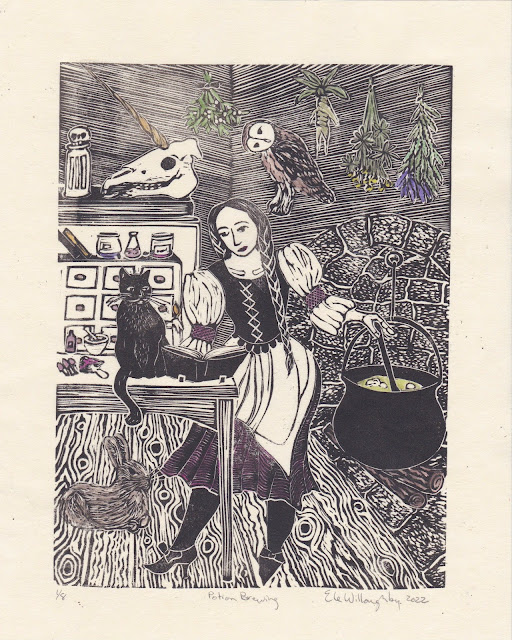 |
| Potion Brewing, linocut on washi 8" x 10" by Ele Willoughby, 2022 |
For the #folktaleweek2022 prompt “potion” I couldn’t find a folktale potion I wanted to illustrate so I imagined a scene with a hedge witch and her familiars as she brews a potion.
I put some of the research I did to illustrate ‘Death by Shakespeare’ to work. Behind the cat you can spy a Renaissance style medicine cabinet, and the cauldron, jars and bottles are also like some I found of that era. Also the plants and mushrooms used in medicine and poisons or generally seemed to fit the theme and be associated with magic: Amanita, witches cap mushroom, mistletoe, mandrake, vervain, and lady’s mantle. The unicorn skull is for a hint of #magic and the familiars, barn owl, black cat and rabbit all have rich folklore.
I embellished this print with some hand painted India ink details.
VICTORY
 |
| The Morrigan, linocut 8" x 10" by Ele Willoughby, 2022 |
For the final #folktaleweek2022 prompt victory I chose The Morrigan, the tripartite Goddess of Irish mythology. The Morrígan or Mórrígan, also known as Morrígu or as "the three Morrígna" in her form as the three sisters (often Badb, Macha, and Nemain or sometimes Badb, Macha, and Anand). She sometimes appears as an individual, sometimes as three sisters. She was a shape-shifting goddess associated with fate, doom or victory in battle. She incited battle, inspires bravery and can bring victory over the enemies of warriors. She was the wife of The Dagda, the "good god," a father-figure and king, god of agriculture and fertility. She could inspire fear and be a symbol of impending death, often as a crow or raven but she could also be seen as a protector, associated with land, livestock and fertility. She is also the goddess of death and purveyor of prophecy. She sometimes appears in multiple forms within the same story, most commonly a beautiful maiden, a fierce warrior-queen, an old crone or washerwoman washing the blood-stained clothes of the dead, and a raven. The ominous shriek of The Morrigan at battles means she is sometimes associated with banshees.
It was close to the wire and I finished this print last night, having lost a couple of days I had planned to work with my 8 year old home with a cold. This one might have turned out differently if I had time to linger on decisions but I think it works. There’s something to be said for working intuitively.
It was a challenge to create this week of art but huge thanks to @folktaleweek for organizing this annual event! It’s been a huge treat to see how some many talented artists illustrated these prompts. I loved finding new to me artists and illustrators, checking the hashtag daily, seeing their magical work and learning many myths, legends and folktales. This is a truly international event with posts in my languages and great variety in tales and style of work and I will definitely return to this again next year. If you haven’t already, you should check it out!


