Showing posts with label mono print. Show all posts

Wednesday, September 10, 2025

New Natural History Prints

Every September I take part in #SciArtSeptember and post art on the daily prompts. You can see my picks and new prints on my socials  (Bluesky or Instagram or Cara). I'm going to share my new prints, including sneak peeks here.

First up, for the prompt islet, I made a mono print on my gel plate using pencil and acrylics. 


Islet monoprint, 11" x 14" by Ele Willoughby, 2015


I was thinking about the tiny islands in the lake in New Brunswick. Islets, too small for human habitation can be a refuge for wildlife.

For the prompt jewel, I made a linocut ebony jewelwing damselfly. The forests of southeastern Canada and the eastern US are home to these metallic blue-green beauties known as ebony jewelwing (Calopteryx maculata) or black-winged damselflies. The males, like the one in my hand-carved and hand-printed linocut are turquoise with elegant black wings. The females are a duller brown with a white spot on their wings. Each print is on handmade khaki green paper with fibre inclusions and a deckle edge. I designed my linocut based on a photo I took in the Rouge National Park. Each print is 8" x 10".

my photo of an ebony jewelwing from earlier this summer 

Ebony Jewelwing, 8" x 10", by Ele Willoughby, 2025

For mimic, I shared the flower fly from my last post. The prompt trawl was also one which needed something new.

Glass Sponge Reef, 11" x 14" by Ele Willoughby, 2025
The Glass Sponge Reef, linocut print, 11" x 14", by Ele Willoughby, 2025

Glass sponges are fragile, brittle, living animals with skeletons made of silica, the same material we use to make glass. Reefs, widespread during the age of dinosaurs, are now quite rare, and in fact, were long believed to have gone extinct 40 million years ago. Then in 1987, scientists discovered 9,000 year glass sponge reefs or bioherms offshore northern British Columbia. All known glass sponge reefs today are found offshore BC, and its neighbours Alaska and Washington state. These important and beautiful biomes filter bacteria out of water, provide habitat for several species like spot prawns, halibut, squat lobsters and the rockfish in my print, store carbon and fertilize the ocean. These reefs in Canadian waters are now in marine protected areas as they can be destroyed, literally shattered, by pawn and crab traps, fishing lines, anchors and bottom trawling. Ocean warming and acidification are also damaging to these unique, vital ecosystems and natural wonders.

My 11" x 14" limited edition linocut print is made in watercolour paper and illustrates different glass sponges and a rock fish at the seafloor. The edition is limited to 8 prints.


Friday, April 28, 2023

Some May Day Folk Traditions in Print

I've always been fascinated with May Day traditions, as a May Day baby myself. There are what have been called the "Green Root" (pagan) and "Red Root" (labour) traditions celebrated on the first of May. I've been participating in #FolkloreSunday on Twitter, learning more folklore and using my own artwork to illustrate my own posts. This year seemed like the one to illustrate some of the many "Green Root" traditions of May Day and May Eve like Beltane and Walpurgisnacht.

Jack-in-the-green, linocut, 8" x 10" by Ele Willoughby, 2023

When I participated in #FolkloreWeek last fall, one of the prompts was "tree" and this was the first time I learned about the Jack-Of-The-Green (or Jack O' the Green). I loved the mysterious yet absurd images of walking and dancing men covered in conical wooden or wicker frames covered in foliage, sometimes with a crown of flowers, like a wayward dancing bush leading a procession of characters like the Lord and Lady and a jester, rollicking through the streets. Jack-in-the-green has been part of May Day processions in England since the 1770s. There's a lot of debate about where the tradition came from. Some suspect it arose out of the garlands and floral wreathes worn by milkmaids on May Day, enlarged by the Chimney Sweep guilds (as they celebrated Chimney Sweeper's Day the same day). Others tie it to similar wild men foliage folk figures in continental Europe, pre-Christian fertility figures and the concept of the Green Man. More recent scholarship disputes this connection with the Green Man - but while perhaps not historical the revived 20th century version of the tradition connects the concepts. (You can find more here and here). I have made a Jack-in-the-Green linocut. 
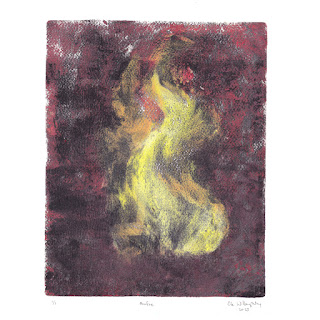
 

Bonfire, monoprint, 11" x 14" by Ele Willoughby. Hand painted onto a gel plate and printed on water colour paper.
 

Beltane ("lucky fire") is the Gaelic May Day festival held on 1 May, or about midway between the spring equinox and summer solstice (in the Northern hemisphere) has traditionally marked the start of summer. It's tied with mythology and was viewed as a time when fairies were strong and offerings were needed to appease the aos sí. It was one of the most important festivals and there are many traditions. I decided to just illustrate one: the lighting of bonfires. People and livestock often had to move through the smoke, or jump over fires or walk between two fires to guard against sickness and witchcraft. 


Walpurgisnacht, monoprint by Ele Willoughby, 7.75" x 9.875", 2023. Hand painted onto a gel plate and printed on water colour paper.

Bonfires and protection against witchcraft brings us to a May Eve tradition: Walpurgisnacht and Hexennacht (Walpurgis night and Witches' Night as celebrated in Germany). May Eve is the feast day of Saint Walpurga in celebration of her canonization May 1, 870. But folklorists tie it to a more ancient celebration of a moon festival for Walpurga, another name for the Norse goddess Freya of love and beauty who also represented women's magic, sexuality, and independence as well as war and death in battle. She had a magical cloak of falcon feathers and gold necklace, trusty sacred boar friend and a chariot pulled by two cats (cats!). The May Pole can likewise be linked to Yggdrasil, the world tree. Saint Walpurga, amongst other things, apparent fought off witches, so in various European countries, people continue to light bonfires on Saint Walpurga's Eve in order to ward off evil spirits and witches. But in some places people celebrate "Witches' Night", when revelers dress as witches and demons, set off fireworks, dance and play loud music, to drive the witches and winter spirits away. In the Harz mountains the tradition goes back over 1,000 years ago, when people celebrated the arrival of spring  making offerings to the god Wodan (or the Norse god Odin).

These are but a few of the many traditions of this time.


Wednesday, April 6, 2022

Movements in Art History Inspired Prints

 I haven't yet posted all the prints I made for #PrinterSolstice so here are some of the others!


Dada inspired linocut with spherical cow, eye, bubbles and text
Dada-inspired linocut by Ele Willoughby
This one of a kind lino block print combines multiple lino blocks in a Dada-inspired original artwork. Dada was a cultural movement post-WWI in response to the horrors of the war which often was satirical or nonsensical, breaking down all previous standards. Combining unrelated elements was common, as was the appearance of text, including of course, the repeated use of the word "Dada". It was a precursor to surrealism.

This print combines my spherical cow print, an eye and a skeleton with the repeated word "Dada" and is unique... but I made a second print with some of the same elements, but a tardigrade, rather than a skeleton.

Dada-inspired linocut by Ele Willoughby


This is a minimalist print inspired by the transit of Venus. Much like a solar eclipse, when our moon's orbit brings it between the Earth and sun, the transit of Venus occurs when the planet Venus passes directly between the sun and us (or any other planet) partially obscuring or occulting the disk of the sun. Venus is much larger than our moon, but much farther away, so it blocks a much smaller portion of the sun, for a much longer period; it typically appears like a small black dot slowly moving in a line across the face of the sun over the course of several hours. These transits are rare, but predictable. The separation between transits is: 121.5 years, 8years, 105.5 years. There have been two this century (in 2004 and 2012) and there will not be another until 2117. Historically such transits have been vital to astronomers in their efforts to gauge the size of our solar system. Astronomers travelled to remote sites across the globe to get multiple simultaneous observations of the event, and improve distance and size estimates using parallax of the various observations. 


The Transit of Venus, linocut by Ele Willoughby, 9" x11", 2022

The design of this print is inspired by Minimalism, an art movement post-WWII which espoused geometrical abstraction, and cutting away extraneous details, and sometimes even colours in favour of monochrome compositions. A hemicircle represents the solar disk and the series of smaller excised circles represent the path of Venus.

Goethe's Theory of Colours, Linocut by Ele Willoughby, 8" x 10", 2022

This print, inspired by the boldly coloured Fauvism paintings, is a hand-printed, limited edition, reduction block print portrait of writer, statesman and polymath Johann Wolfgang von Goethe (1749-1832). While best known for his contributions to German literature, he was pursued natural sciences, studying morphology, did work which presaged evolution, discovered the human intermaxillary bone, performed Galvanic experiments, studied anatomy with Alexander von Humboldt, formulated a theory of plant metamorphosis, gathered the largest private collection of minerals in Europe, and popularized a barometer he built based on Torricelli’s principle. What he considered his most important work was his Theory of Colours (Farbenlehre, 1810). 

Goethe rejected Newton’s description of colour and analytic approach. He wanted to portray rather than explain colour. He was a careful observer and claimed, “The human being himself, to the extent that he makes sound use of his senses, is the most exact physical apparatus that can exist.” He felt colour came from the interplay of light and dark through a turbid medium (like air, dust and moisture). He included aesthetic qualities such as the allegorical, symbolic, and mystic use of colour. His physics were not sound but he was the first to probe human colour perception and his insights inspired the art world (especially J. M. W. Turner) and philosopher Ludwig Wittgenstein to write ‘Remarks on Colour’. 

My portrait is based on contemporary portraits, particularly a painting of Goethe in 1828 by Joseph Karl Stieler.

Horus and Seth, mono print by Ele Willoughby, 8" x 10", 2022

This is a one of a kind mono print about the Ancient Egyptian gods Horus and Seth, representing the struggle between order and chaos. My print is inspired by the Harlem Renaissance paintings of Aaron Douglas in particular, his layers of translucent colours, silhouettes and use of ancient Egyptian (and other African) culture, myth and imagery. 

This print shows Horus battling his uncle Seth. The story of their fight is NSFW as they say, but what I like in particular is that the ancient Egyptians believed both the god Horus, who represented order, amongst other things, and Seth (or Set), who represented chaos were necessary components for life and creativity.

This print was the first one I made with my new gel plate and stencils!

Flamboyant Wormhole, linocut by Ele Willoughby, 

This is a hand-printed Lino block print of an astrophysical wormhole, linking two locations in spacetime, inspired by Op Art. A wormhole, also called an Einstein-Rosen bridge, may exist, linking points in space-time like a sort of tunnel from one space and time to another. We don't know if they actually exist, but they are consistent with General Relativity and have been the subject of a lot of theoretical physics research and sci-fi. Space time is 4D, but if we represent it on the page, we can imagine it like a flat surface and then a wormhole would be a sort of tube from one area to another with a blackhole like a sort of drain leading to a white hole. If such structures exist, they may or may not be traversable, but it's conceivable they could allow time travel or faster than light travel or travel between different universes depending on the location of each end.  

Theia, linocut print by Ele Willoughby, 8" x10", 2022

This 6 colour hand printed linocut print illustrates the formation of the Earth’s Moon in a comic book influenced pop art style. The favoured model of Moon formation is that 4.5 billion years ago, early in the history of our solar system, a Mars-sized astronomical body called Theia crashed into the early proto-Earth. Large amounts of projectiles from this catastrophic collision, both rocks from Theia and the proto-Earth’s own mantle, coalesced under gravity to form this planet’s own satellite: the Moon. The giant-collision theory is supported by moon rock samples gathered during the Apollo missions and lunar asteroids found on Earth; these rocks so similar to the Earth's chemical and isotopic make-up suggest that the Earth and Moon have some shared history and that the Moon was not simply a capture object from elsewhere. But variations in the types and proportions of minerals found in Moon rocks versus here on Earth suggest that there's more to the story and it was not simply formed simultaneously with the Earth. The Moon is rich in minerals formed at high temperatures like we would expect from a massive impact event.

We can thank this catastrophic event, sometimes called 'The Big Splash' for the world as we know it, with stable orbit and climate thanks to having such an unusually large satellite in our Moon.