Showing posts with label art history. Show all posts

Wednesday, April 6, 2022

Movements in Art History Inspired Prints

 I haven't yet posted all the prints I made for #PrinterSolstice so here are some of the others!


Dada inspired linocut with spherical cow, eye, bubbles and text
Dada-inspired linocut by Ele Willoughby
This one of a kind lino block print combines multiple lino blocks in a Dada-inspired original artwork. Dada was a cultural movement post-WWI in response to the horrors of the war which often was satirical or nonsensical, breaking down all previous standards. Combining unrelated elements was common, as was the appearance of text, including of course, the repeated use of the word "Dada". It was a precursor to surrealism.

This print combines my spherical cow print, an eye and a skeleton with the repeated word "Dada" and is unique... but I made a second print with some of the same elements, but a tardigrade, rather than a skeleton.

Dada-inspired linocut by Ele Willoughby


This is a minimalist print inspired by the transit of Venus. Much like a solar eclipse, when our moon's orbit brings it between the Earth and sun, the transit of Venus occurs when the planet Venus passes directly between the sun and us (or any other planet) partially obscuring or occulting the disk of the sun. Venus is much larger than our moon, but much farther away, so it blocks a much smaller portion of the sun, for a much longer period; it typically appears like a small black dot slowly moving in a line across the face of the sun over the course of several hours. These transits are rare, but predictable. The separation between transits is: 121.5 years, 8years, 105.5 years. There have been two this century (in 2004 and 2012) and there will not be another until 2117. Historically such transits have been vital to astronomers in their efforts to gauge the size of our solar system. Astronomers travelled to remote sites across the globe to get multiple simultaneous observations of the event, and improve distance and size estimates using parallax of the various observations. 


The Transit of Venus, linocut by Ele Willoughby, 9" x11", 2022

The design of this print is inspired by Minimalism, an art movement post-WWII which espoused geometrical abstraction, and cutting away extraneous details, and sometimes even colours in favour of monochrome compositions. A hemicircle represents the solar disk and the series of smaller excised circles represent the path of Venus.

Goethe's Theory of Colours, Linocut by Ele Willoughby, 8" x 10", 2022

This print, inspired by the boldly coloured Fauvism paintings, is a hand-printed, limited edition, reduction block print portrait of writer, statesman and polymath Johann Wolfgang von Goethe (1749-1832). While best known for his contributions to German literature, he was pursued natural sciences, studying morphology, did work which presaged evolution, discovered the human intermaxillary bone, performed Galvanic experiments, studied anatomy with Alexander von Humboldt, formulated a theory of plant metamorphosis, gathered the largest private collection of minerals in Europe, and popularized a barometer he built based on Torricelli’s principle. What he considered his most important work was his Theory of Colours (Farbenlehre, 1810). 

Goethe rejected Newton’s description of colour and analytic approach. He wanted to portray rather than explain colour. He was a careful observer and claimed, “The human being himself, to the extent that he makes sound use of his senses, is the most exact physical apparatus that can exist.” He felt colour came from the interplay of light and dark through a turbid medium (like air, dust and moisture). He included aesthetic qualities such as the allegorical, symbolic, and mystic use of colour. His physics were not sound but he was the first to probe human colour perception and his insights inspired the art world (especially J. M. W. Turner) and philosopher Ludwig Wittgenstein to write ‘Remarks on Colour’. 

My portrait is based on contemporary portraits, particularly a painting of Goethe in 1828 by Joseph Karl Stieler.

Horus and Seth, mono print by Ele Willoughby, 8" x 10", 2022

This is a one of a kind mono print about the Ancient Egyptian gods Horus and Seth, representing the struggle between order and chaos. My print is inspired by the Harlem Renaissance paintings of Aaron Douglas in particular, his layers of translucent colours, silhouettes and use of ancient Egyptian (and other African) culture, myth and imagery. 

This print shows Horus battling his uncle Seth. The story of their fight is NSFW as they say, but what I like in particular is that the ancient Egyptians believed both the god Horus, who represented order, amongst other things, and Seth (or Set), who represented chaos were necessary components for life and creativity.

This print was the first one I made with my new gel plate and stencils!

Flamboyant Wormhole, linocut by Ele Willoughby, 

This is a hand-printed Lino block print of an astrophysical wormhole, linking two locations in spacetime, inspired by Op Art. A wormhole, also called an Einstein-Rosen bridge, may exist, linking points in space-time like a sort of tunnel from one space and time to another. We don't know if they actually exist, but they are consistent with General Relativity and have been the subject of a lot of theoretical physics research and sci-fi. Space time is 4D, but if we represent it on the page, we can imagine it like a flat surface and then a wormhole would be a sort of tube from one area to another with a blackhole like a sort of drain leading to a white hole. If such structures exist, they may or may not be traversable, but it's conceivable they could allow time travel or faster than light travel or travel between different universes depending on the location of each end.  

Theia, linocut print by Ele Willoughby, 8" x10", 2022

This 6 colour hand printed linocut print illustrates the formation of the Earth’s Moon in a comic book influenced pop art style. The favoured model of Moon formation is that 4.5 billion years ago, early in the history of our solar system, a Mars-sized astronomical body called Theia crashed into the early proto-Earth. Large amounts of projectiles from this catastrophic collision, both rocks from Theia and the proto-Earth’s own mantle, coalesced under gravity to form this planet’s own satellite: the Moon. The giant-collision theory is supported by moon rock samples gathered during the Apollo missions and lunar asteroids found on Earth; these rocks so similar to the Earth's chemical and isotopic make-up suggest that the Earth and Moon have some shared history and that the Moon was not simply a capture object from elsewhere. But variations in the types and proportions of minerals found in Moon rocks versus here on Earth suggest that there's more to the story and it was not simply formed simultaneously with the Earth. The Moon is rich in minerals formed at high temperatures like we would expect from a massive impact event.

We can thank this catastrophic event, sometimes called 'The Big Splash' for the world as we know it, with stable orbit and climate thanks to having such an unusually large satellite in our Moon.

Wednesday, January 12, 2022

Prints inspired by art history

I am trying to participate in the #PrinterSolstice again this year. They have created a series of prompts for each of 13 weeks starting with the (northern hemisphere) winter solstice. This year the themes are based on 20th century movements in art. It's been challenging to find time; we're once again sheltering at home and schools have gone remote here. Facilitating remote school takes a lot of my time and I cannot print at the same time, though I can plan, draw and carve. 

We started with Abstract Expressionism, which is really outside my wheelhouse, since my prints are representational. But it gave me a chance to work intuitively to create a mono print with scraps of lino.

monoprint by Ele Willoughby, 2022


Next was Art Deco. I looked at a lot of Art Deco artworks. The frequent clamshell motif and the keyhole shape in Art Nouveau works, plus seeing a number of mermaid illustrations reminded me I had long wanted to illustrate the story of Mélusine, the legendary half-fairy ancestor of the House of Lusignan and royals including the Plantagenets, whose lower half became a serpent when she bathed. She marries a nobleman but insists he must never observe her in the bath; of course he does, and she leaves him - so the keyhole shape works just right to tell the story! There are many versions, like most folklore. Sometimes she has two tails, or a fishtail or wings. There are different versions of her name and various stories are found in different regions especially France, Luxembourg and the Low Countries. I first learned of her from Manuel Mujica Láinez’s The Wandering Unicorn, which tells her story through the centuries. Her story also appears in A.S. Byatt’s Possession amongst many other places from operas to video games.

Mélusine linocut, 8" x 10" by Ele Willoughby, 2022


These art history prompts have been a challenge to link to my art practice. I've  been seeking a connection to things like science art. The third prompt was Bauhaus. In looking at Bauhaus paintings I was reminded of nothing so much as Feynman diagrams, and the exuberance action on the quantum scale, so I decided to combine quantum physics with the Bauhaus vocabulary of lines, shapes and colour palette. 

I was thinking more of the paintings of Kandinsky than the regular geometric shapes in Bauhaus design: a welter of black straight, wavy and curly lines, stripes of colour, triangles, circles and concentric rings and washes of pale colour, often on a cream coloured background. 

The Feynman diagrams are a tool of particle and quantum physics to both denote a particle interaction and also can be used to make calculations of probabilities and physical properties. Straight lines denote particles (quarks and leptons like electrons). Wavy lines denote photons. Curly lines are gluons and the dotted line is a Higgs particle. I wanted to include an electron spontaneously giving off a virtual photo and particle-antiparticle pairs, production of a Higgs particle, one diagram of the sort of we see if we smash protons together, and one hilariously named penguin diagram (in this instance producing a gluon).

Feynman Diagram Bauhaus, linocut, variable edition, 8" x 10" by Ele Willoughby, 2022

Looking at all these prints as I try to plan ahead and link them to my art practice and science art I am reminded of Leonard Shlain's book Art and Physics. It should be around here somewhere but I can't find it on my bookshelves. (Aside: this house needs a librarian.) In the book Schlain linked major movements in art with advancements in physics. I am not sure I can agree with his thesis that movements in art presaged new physics (which feels like it violates causality to me) but I greatly enjoyed the book. Others have drawn parallels between art and physics and it's clear that both math and physics were an influence of some of these major modern movements in art. In fact, this has been true for centuries; consider for instance the development of artistic perspective, or the camera obscura. One of the obvious connections is between cubism and the math of the fourth dimension and the physics of relativity. So that is something I'm thinking about for an upcoming print.

Some of the other prompts (colour field, Dadaism, Fauvism, Harlem Renaissance, Minimalism and surrealism) are less obvious for me, but I'm thinking ahead. Op Art is rather clearly related to mathematics. I have a scientific idea for Conceptual art and the seed of an idea for Pop Art. Stay tuned for more!

Tuesday, January 30, 2018

Antoine-Laurent and Marie-Anne Paulze Lavoisier as The Lovers

Antoine et Marie-Anne Paulze Lavoisier, linocut with collaged washi,
2018 by Ele Willoughby
All too often history of science, or the history of science as retold by scientists, neglects to mention women. One of the things I want to do with my series of prints about the history of science is put those excluded back into the story. Sometimes, the missing women are hiding in plain sight! Invited to create a piece inspired by the Lovers tarot card, I thought of French scientists Antoine Lavoisier (26 August 1743 – 8 May 1794) and his wife Marie-Anne Paulze Lavoisier (20 January 1758 – 10 February 1836). Lavoisier is often referred to as the 'father' of modern chemistry, without any reference to his wife. Though many will be familiar with a image of the two, doing chemistry together. Their close friend, famed neo-Classical painter Jacques Louis David painted his Portrait of Anoine-Laurent Lavoisier and his wife in 1788. He also trained Marie-Anne Paulze in drawing and engraving, allowing her to accurately illustrate their experiements. And she most definitely appears in her own drawings and engravings documenting their work.

I hope considering them as a true (and loving team) is a more modern day interpretation of love and their history, as well as a more complete and accurate look at the development of chemistry. The couple, working closely together, modernized and quantified chemistry and the scientific method, recognized and named oxygen and hydrogen, explained the role that oxygen plays in combustion, helped modernize chemical nomenclature and discovered that mass is conserved in chemical reactions. While this has traditionally been described simply as Lavoisier's work modern scholarship points out that Paulze translated all his contemporaries, like Joseph Priestley and Henry Cavendish's manuscripts from English or Latin to French, took notes of all observations, illustrated all experimental set-ups, edited his reports and worked so closely with him we can't easily separate their roles. Perhaps most importantly, her translation of Richard Kirwan's 'Essay on Phlogiston and the Constitution of Acids' with her own footnotes pointing out all the errors in chemistry, convinced her husband to perform their own experiments, which ultimately disproved the popular but incorrect ideas about "phlogiston" (the supposed fire-like element released by substances during combustion) championed by George Stahl, and lead to the discovery of oxygen. Attributing everything to him alone is clearly not the full picture.


David - Portrait of Monsieur Lavoisier and His Wife.jpg
Portrait of Anoine-Laurent Lavoisier and his wifeBy Jacques-Louis David - Metropolitan Museum of Art, online database:
entry 436106 (accession number: 1977.10), Public Domain, Link

While clearly a devoted couple, their history as lovers is a bit complicated, especially looking back with modern eyes. They married in 1771, when Lavoisier was about 28 and Paulze was merely 13! Child marriage is a horrifying prospect and remains a scourge today, but Lavoisier was in fact recruited by Marie-Anne's father Jacques Paulze to rescue her. Both men gained most of their income from the Ferme Générale (the General Farm), a private consortium which paid the Crown for the priviledge of gathering certain taxes. A powerful nobel and member of the consortium, the 50-year-old Count d'Amerval made a formal proposal of marriage to the 13 year old Marie-Anne Paulze, who considered him "a fool, an unfeeling rustic, and an ogre". Wishing to protect her from such a fate, Paulze asked his friend Lavoisier to marry her instead. He agreed, and the couple settled down at the Arsenal in Paris, where he was able to further pursue his growing interest in chemistry and build a state-of-the-art lab. Marie-Anne became interested in these scientific pursuits and soon joined him in the lab. She received formal training in the field from his friends and colleagues Jean Baptiste Michel Bucquet and Philippe Gingembre, and the couple spent most of their time in the lab. Marie-Anne also famously hosted scientific salons with luminaries of the day.

Work Lavoisier undertook to help fund their research, including his role with the Ferme Générale and the tobacco commission, tragically lead to his execution during the French Revolution. She fought to defend his legacy after he was executed. She organized and arranged for the publication of his Mémoires de chimie, including a preface she wrote attacking the revolutionairies she blamed for her husband's death. The book was published by her former lover P.S. du Pont; the idea that the successful marriage and partnership of the Lavoisiers could survive a 10 year affair (1781-1791) with du Pont is quite foreign to modern eyes, but there was little controversy when French nobles of the time took a lover. In fact, when Lavoisier died, her entrusted his wife to his friend du Pont's care. Due to the upheaval of the times, du Pont was unable to repay the money he borrowed from her for his printing venture, and she pursued her financial claim against him and his son for years. The du Ponts moved to the United States, prospered*, repaid their dept and finally published Lavoisier's memoirs of chemistry.

This engraving by Mme Lavoisier shows one of their experiments in human respiration. She is clearly the one recording their data and documenting the experimental set-up on the right.
This drawing by Mme Lavoisier shows one of their experiments in human respiration. She is clearly the one recording their data and documenting the experimental set-up on the right.


Mme Lavoisier kept his name for the rest of her life, even during her short-lived second marriage to physicist Sir Benjamin Thomson, Count Rumford. She dumped Rumford as soon as she realized that he did not intend for her to work alongside him in the lab, or respect her Independence as she was accustomed. One of the best physicists of the day who revolutionized our understanding of heat, Thomson fled the U.S., abandoning his first wife after supporting the British side during the American Revolution. He was knighted by George III and made a count after moving to Bavaria, by the Holy Roman Empire. After the death of his estranged wife, he was attracted to the wealthy widow Paulze-Lavoisier, who travelled in the best scientific circles, and saw her wealth as a means of funding his research. Despite a four-year courtship, they soon found they were a bad match. They married in 1805 and separated in 1809.**

I draw on a variety of the aspects of historical tarot cards in my print. I've included the word "L'Amoureux" in French, for this French couple. I chose them, not only as a loving historical scientific couple, but because the card is associated with flames and the element of air. The Lavoisiers studied air and were the ones who really showed that air was not an element (in the modern chemical sense) by isolating various constituent gases like oxygen, and debunking the earlier phlogiston theory. I have specifically shown them with their famous phlogiston experiment apparatus. Further, not only did they recognize the role that oxygen played in combustion, Lavoisier and his friend Pierre-Simon Laplace also recognized that the process of respiration was in fact a slow, controlled combustion - hence the image of the lungs with flames (which is also an allusion to the flaming heart symbol and iconography).

The prints are 7.5" x 12.5" with an image area of 5" x 8.3". Each are printed on Japanese kozo paper, with collaged pink lungs and patterned vest.

As a printmaker, documenting the history of science with relief prints, I love that Marie-Anne Paulze Lavoisier also documented science with relief prints.

* His son Éleuthère, trained by Lavoisier as a chemist, opened a gun-powder manufacturing plant which ultimately became one of the biggest and most successful US companies, DuPont.

**One famous story about the ill-fated Rumford-Lavoisier marriage: annoyed that she had invited many guests without seeking his permission he locked their gate and removed the key. So, she spoke with her guests through the gate and then poured boiling water on his prized flowers. (see 'Women in Chemistry: Their Changing Roles from Alchemical Times to the Mid-Twentieth Century' by Marlene and Geoffrey Rayner-Canham).

NEVER COME BETWEEN A SCIENTIFIC LADY AND HER SALON.

Monday, October 26, 2015

Maria Sibylla Merian, Entomologist, Scientific Illustrator, Explorer of Gardens and the New World

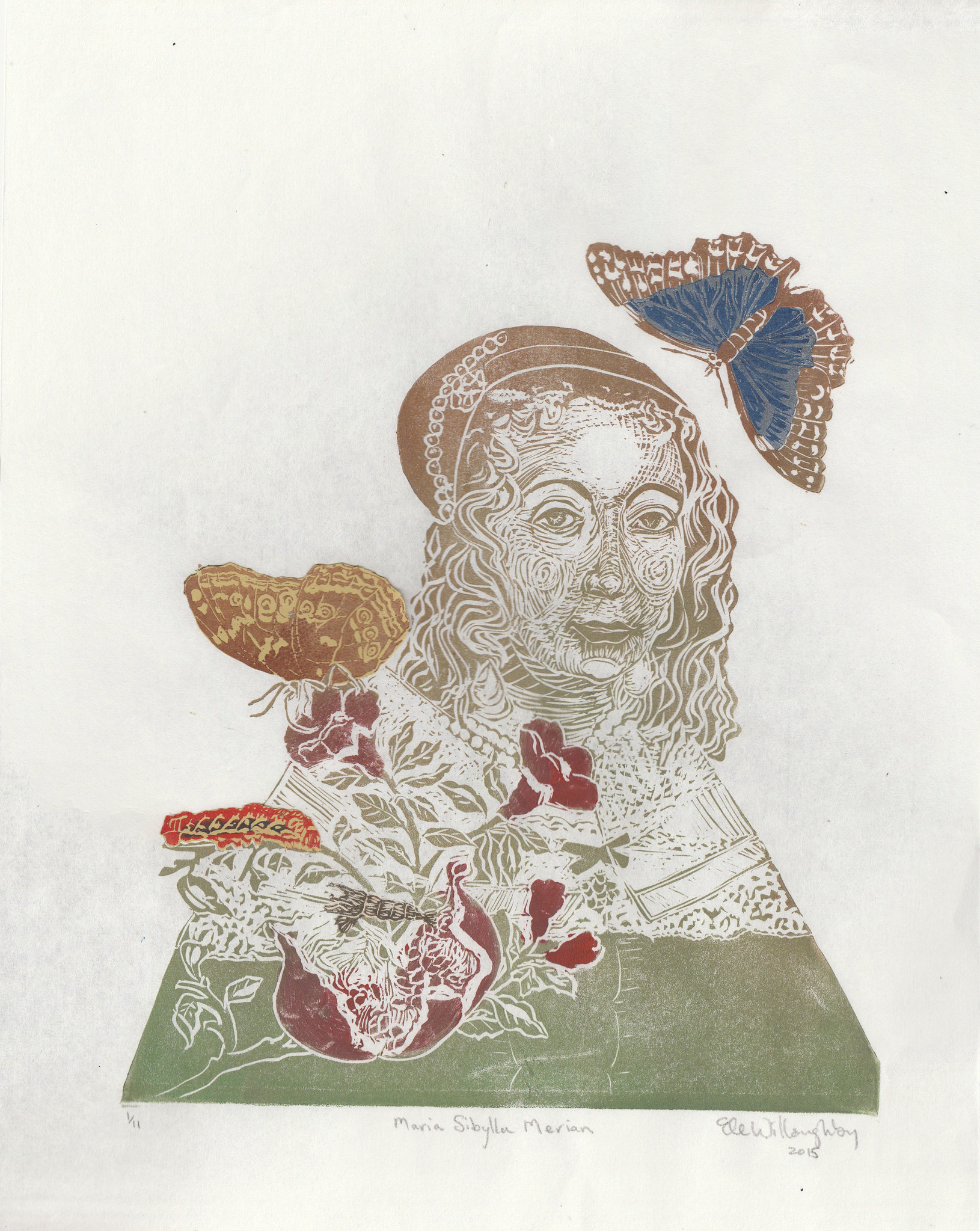
Maria Sibylla Merian
Linocut portrait 'Maria Sibylla Merian' by Ele Willoughby, 2015

This is a linocut portrait of Maria Sibylla Merian (1647-1717), leading entomologist of her day, traveller and scientific illustrator. She is shown complete with pomegranate branch and the life cycle of a morpho butterfly from caterpillar, to chrysalis in its cocoon to butterfly, inspired by her famous work 'Metamorphosis insectorum Surinamensium' - a process she carefully documented and explained. Each print is 11" by 14" (27.9 cm by 35.6 cm), on white Japanese kozo paper with collaged or "chine-collé" hand printed Japanese papers in beige, umber for the cocoon, caterpillar and two views of the butterfly in umber and blue.

The German-born naturalist came from a Swiss family who founded one of one of Europe's largest publishing houses in the 17th century. This allowed her early access to many books on natural history. After she lost her father at age three, and her mother remarried still life painter Jacob Marrel. Her step-father and his students trained her as an artist. She began painting insects and plants by 13. She wrote, "I spent my time investigating insects. At the beginning, I started with silk worms in my home town of Frankfurt. I realized that other caterpillars produced beautiful butterflies or moths, and that silkworms did the same. This led me to collect all the caterpillars I could find in order to see how they changed".

She married her step-father's apprentice Johann Andreas Graff, they had a daughter Johanna Helena, and moved to his home city of Nurenburg. She was able to contribute to the family income by painting, creating embroidery designs, and teaching drawing lessons to unmarried daughters of wealthy families, something which also allowed her access to the finest gardens where she continued collecting and documenting. She published her first book of natural illustrations, titled Neues Blumenbuch, in 1675 at age 28. In 1679, she first published her insect research in a two-volume, illustrated book focusing on insect metamorphosis. She moved twice to be with her mother after her step-father's death, then to join her half-brother at a Labadist religious community. She also split with her husband. After her mother's death, she moved to Amsterdam in 1691 and divorced her husband in 1692.

In Amsterdam, she was able to observe some of the collections of insects which had been brought back from Suriname. She became curious whether the life cycles of the exotic butterflies and other insects mirrored those Europe species she knew well. She was able to secure the city of Amsterdam's permission and and travel grant to travel to Suriname in South America, along with her younger daughter Dorothea Maria. She further funded her travels by selling 255 paintings. She planned a five year mission to study insects, making her perhaps the first person to plan a proper scientific expedition!

She travelled throughout the colony sketching insects and plants. She criticized the Dutch planters treatment of indigenous people and black slaves (though she relied upon amerindian slaves in her residence and her excursions, and brought a young amerindian woman named Indianin back with her to Holland). She used local native names for the plants and described local uses. Malaria likely cut her expedition short and forced her return to the Dutch Republic in 1701. She sold her collected specimen and in 1705 she published Metamorphosis Insectorum Surinamensium about the insects of Suriname.

She suffered a stroke in 1715 which left her partially paralysed and died a pauper in 1717. Her daughter Dorothea published Erucarum Ortus Alimentum et Paradoxa Metamorphosis, a collection of her mother's work, posthumously. Both Dorothea and Johanna followed their mother's lead and became botanical illustrators.

Modern scholars now appreciate her pioneering scientific work as well as the beauty of her scientific illustrations. During her life time insects were still reviled and people still put credence in the Aristotelian idea that they were spontaneously generated or "born of mud". She meanwhile detailed the life cycle of 186 species and explained the poorly-understood or even unknown process of metamorphosis. Science was conducted in Latin and her publications were in the vernacular, making them more popular with high society than contemporary scientists. Despite her knowledge and original research contributions she was not really recognized as a scientist in her day (though Carl Linnæus (1707-1778), father of taxonomy, did cite her in his Systema Naturæ of 1753). It was very unusual for a woman in her day to pursue science, let alone travel the world in its pursuit. She was able to do so because she began her studies with the accessible - animals she could find in her own backyard, and become the leading expert on metamorphosis. During her great expedition, she also noted their habitats, feeding habits and uses to indigenous people. Her classification of butterflies and moths are still relevant today. She detailed plants, frogs, snakes, spiders, iguanas, and tropical beetles and was the first European to describe both army ants and leaf cutter ants as well as their effect on other organisms.

Her work had a strong influence on future scientific illustration. Her work shows great accuracy and she was the first to illustrate the complete life cycle of insects. In her time, funding her expedition and her unladylike devotion to insects was ridiculed, but she is remembered as one of the best insect and flower illustrators of all time. Her daughters and student Rachel Ruysch (1664-1750) all went on to be renown botanical illustrators.

Shortly after her death, Peter the Great saw and purchased a large number of her works in Amsterdam. Her portrait was printed on the 500 DM note before Germany converted to the euro. Her portrait has also appeared on a 0.40 DM stamp and two American 32 cent stamps. Many schools, place names, a scientific research vessel and a crater on Venus have been named in her honour.

One last tidbit (or two) for you history of science buffs: Dorothea's daughter, Maria Sibylla Merian's granddaughter married mathematician Leonhard Euler (1707-1783). Maria Sibylla Merian was also first cousin to Jacob Christoph Le Blon (1667-1741), painter and engraver who invented the four colour printing process (using an RYBK color model similar to the modern CMYK system).

Friday, August 16, 2013

Beautiful Bugs

There's a really interesting post up on the Etsy blog, by Abbey Nova about gorgeous handmade insects. This is right up my alley, having recently had my bee biodiversity show, and also, since I've been thinking about how best to supply a certain museum shop with prints to accompagny their planned entomology show (more on that soon!). Also, I've long been a fan of Elsita who makes magical illustrations, paper cut art and sculptures and writes some lovely blogs too. Her paper bee is featured in the main photo illustrating the article. Nova notes that human-insect relations are often strained, at best, but she puts these lovely bugs into the context of the history of the still-life painting and some of the fascinating ancient symbolic associations we've harboured about insects. Some of these were new to me: ancient Spanish rock paintings of spiders are linked to the moon and fertility; I knew the butterfly could symbolize the soul and bees industriousness, but did not know that the fly and dragonfly in the 16th and 17th century Dutch still-life tradition could symbolize the devil or spiritual temptation. She includes a wonderful selection of insect-themed art and I'm flattered to see my bumblebee linocut amongst them. Check out the post and the art. There are some amazing finds. Fellow Mad Scientist of Etsy Sasha of whatnomints even made a beautiful cockroach on her hand-embroidered flour-sack tea towel.