Showing posts with label chemistry. Show all posts

Tuesday, February 3, 2026

Agnes Pockels Find Wonder While Washing Dishes and Invents Surface Science

Agnes Pockels, linocut, 11" x 14" on Japanese paper, by Ele Willoughby, 2026

The seventh prompt for #PrinterSolstice2026 is division, and I have decided to focus on the dividing line or interface, and the self-taught scientist who pioneered surface science. 

When Agnes Pockels (1862-1935) was 18, she did not get the chance to go to university and study physics like her brother Friedrich, who became a professor of theoretical physics and discovered the Pockels effect studying optics and electromagnetism. She took her "passionate interest for natural science" to those household chores she was allowed to pursue, and applied her analytic mind and careful observation to what she saw even in greasy dishwater. She became fascinated with how soap behaves on the surface of the water, and especially in the effect of impurities. She began performing experiments as an amateur chemist. In so doing, she pioneered the entire field of surface science describing physical properties of liquids and solids at interfaces, gained international recognition, published a series of peer-reviewed papers and earned an honorary doctoral degree from Braunschweig University, Germany. Performing kitchen-table research, she developed a surface film balance technique to study soap and surfactants at the air-liquid interfaces and defined the Pockels point, the minimum area a single molecule can occupy in a monomolecular film.

Agnes Pockels' first paper 'Surface Tension' published in Nature
Agnes Pockels' first paper 'Surface Tension'
published in Nature in 1891, complete
with Lord Rayleigh's introduction.


Born in Venice in 1862, when it was part of the Kingdom of Lombardy-Venetia, Agnes' father Theodor served in the Austrian army. Malaria was an ever-present risk in the region and struck the family. When Theodor fell ill in 1871, he retired and moved the family, his wife Alwine, daughter Agnes and son Friedrich, to Brunswick, in the newly formed German Empire. Agnes was interested in science, and attended the Municipal High School for Girls. Though she would have loved to pursue higher education in science, and especially in physics, women were not admitted to German universities (with a very few notable exceptions). So, she studied science at home, while caring for her parents for three decades, as expected for an unmarried daughter. When her younger brother Friedrich went to study physics at the University of Göttingen, he would share his textbooks with her. Later, he would supply her with research in the academic literature to help her pursue her own self-taught studies. When the universities finally began admitting women, Agnes followed her father's wishes and refrained from attending so she could continue keep house and to care for her sick parents.

She began experiments when she was 18, and by age 20 in 1882, she had devised a slide through for making quantitative measurements of soapy water and other materials. Her water-filled through was 70 cm long, 5 cm wide and 2 cm deep and she laid a metal strip (about 1.5 cm wide) on the water, across the width of the through, so she could divide the surface into two parts. A lengthwise ruler along the through allowed her to precisely measure the surface area of both sides as the strip was moved along the length of the through. Building on the plate method of Ludwig Wilhelmy, she devised a simple but clever means of measuring surface tension in either area with a ceramic button (6 mm in diameter) placed on the surface. She would raise the button with an apothecary's balance or weighing scale to measure the force required to lift it from the water. She could then compare the force required to lift her button from pure water, or water with various added substances and impurities. Using her through, she investigated surface forces of monomolecular films, emulsions, solutions and the effect of impurities on physical properties and she came to understand surfactancy, the property of a chemical compound to decrease surface tension at an interface between different materials (at least one of which is a fluid).  She found that small amounts of impurities could have a large impact on surface tension. 

Agnes Pockels in 1885

Her through influenced future experimentalists in colloidal and surface science who employ the modern Langmuir-Blodgett through, an improved apparatus based on her work, still in use today. When Irving Langmuir won the 1932 Nobel Prize in Chemistry for his work in the surface chemistry of oil films, he was building on the 18 year old autodidact Agnes Pockels' experiments with a button and thin tray, performed in her kitchen (not that he bothered to mention this in his Nobel lecture). Her sister-in law, Elisabeth Pockels wrote, "every day, millions of housewives were unhappy to see greasy dish water and just wanted to get rid of it, but it inspired this very person to make observations and finally also work on scientific treatises." She made her meticulous investigations for a full decade without any communication or collaboration with the world of academic science. She had tried writing to physicists at the University of Göttingen about her work but received no reply. Then in 1890, her brother sent her a paper on surface phenomena by renown physicist Lord Rayleigh.  With her brother's encouragement, she wrote Rayleigh a modest, 12 page letter, including all her results. She explained that she had been unable to publish her results in any scientific journal and she gave him her permission to use her results if they were at all useful. Rayleigh did not speak German, but luckily, his wife Evelyn could translate the letter for him. He instantly recognized the importance of Agnes' work and to his credit he sent them to Nature, putting the weight of his reputation behind supporting the work of an unknown amateur, writing, "I shall be obliged if you can find space for the accompanying translation of an interesting letter which I have received from a German lady, who with very homely appliances has arrived at valuable results regarding the behaviour of contaminated water surfaces. The earlier part of Miss Pickles' letter covers nearly the same ground as some of my own recent work, and the main harmonises with it. The later sections seem to me very suggestive, raising if they do not fully answer, many important questions. I hope soon to find opportunity for repeating some of Miss Pockels' experiments." Nature published Ages' letter with Rayleigh's cover letter. This paper, 'Surface Tension' is considered a landmark in the history of surface chemistry.

Seeing her research published encouraged her to continue her experiments, and her correspondence with Rayleigh. She wrote to him about the paramount importance of cleanliness in these experiments and her recognition of how contamination had hampered her previous efforts. Even dust could hinder reproducibility. To study monolayer films, she developed a procedure for the deposition of the compound of interest as a solution in benzene on the surface of the water in her trough and she was able to measure layer thickness at 13Å (an Angstrom is a billionth of a metre, roughly the size of a single atom). She published her second paper, with Rayleigh's help, in Nature in 1892. She went on to study forces on monomolecular films, the calming effect various oils can have on water, various liquids and their adhesion on glass and the surface tension of emulsions and solutions, other surface phenomena like capillary and contact angles, publishing her results in scientific journals including Nature, Wissenschaftliche Rundschau, Annalen der Physik, and Science.  She was invited to give public lectures by German universities.  She published subjects beyond surface science, including her translation of Georg Howard Darwin's 'The Tides and Kindred Phenomena in the Solar System' and a philosophy paper in Annalen der Naturaphilosophie. 

German scientists finally took notice. At the Physikalische Institut of Techniche Hochschile Brauschweig (the Physical Institute of the Technical University Brauschweig), crystal physicist Woldemar Voigt (1850-1919) offered her lab facilities, so over the next decade, she squeezed in further research there around her responsibilities at home. 

Soaps are surfactants made of molecules which have a "water loving" hydrophilic head and a water-repelling hydrophobic tail which is insoluble in water and tends to sit on its surface. Using her sliding through, Agnes found the tiny addition of surfactants had a small impact on surface tension until the slider passed a certain point, where tension would suddenly increase. She plotted surface tension versus slider position, showing the compression isotherm. She realized that the point the compression isotherm abruptly changed was when the continuous film of surfactant was a single molecule thick. With further experimentation she found that the threshold point is the same for a variety of surfactants. Knowing the volume of surfactant soap and the surface area covered by the film, she was able to calculate the surface area of the water occupied by a single molecule to be 20 square Angstroms, now known as the Pockels Point.

Early in the new century, in 1902, her parents' worsening health interrupted her work at the university and she became their full-time carer. Her father died in 1906, her brother died in 1913 and her mother died in 1914. She herself was in quite poor health and she needed to have a stay in a sanitarium. Then during the first world war, she lost contact with the scientific community. Germany was isolated and she was unable to access the foreign scientific literature. Her health and eyesight deteriorated. She had invested wisely and was more financially insulated than other Germans from the post-war financial chaos. She felt the responsibility to protect those around her from the threat of hunger and homelessness and she stopped carrying out her experiments. She published the last of her 14 papers, reviewing her classic work, in 1926. She spent her later years travelling in Europe and as the devoted Auntie Agnes to her brother's children. She finally received public recognition for her work, winning the Laura R. Leonard Prize of the Colloid Society in 1931. In 1932, Techniche Hochschile Brauschweig granted her an honorary doctorate in engineering. She was the first woman to receive such an award. Legendary German colloid chemist Wolfgang Ostwald published her biography on her 70th birthday in 1832. Her sister-in-law Elisabeth Pockels also wrote a biography of Agnes, focusing on her personal life. Since 1993 the university has granted the Agnes Pockels Medal to people who have made outstanding contributions to the development of the university, promoting research and teaching, particularly by women. In 2002 Techniche Hochschile Brauschweig established the Agnes Pockels Laboratory to foster chemical education and aid chemistry teachers, focusing on children under 10, especially girls.

Despite her limited access to education Agnes Pockels found wonder in a mundane tub of dishwater, and launched an entirely new field of science.

References

Agnes Pockels, Wikipedia, accessed January, 2026

DeBakcsy, Dale. How a Kitchen Experiment Spawned a New Science: The Surface Physics of Agnes Pockels. The Women in Science Archive. October 16, 2023.

Derrick, M. Elizabeth. Agnes Pockels, 1862-1935, Journal of Chemical Education, vol. 59, no, 12, pp. 1030-1031, December 1982

Gratzer, Walter (ed.). A Beside Nature - Genius and Eccentricity in Science 1869-1953. W.H. Freeman and Company, New York. pp. 88. 1999.

Kruse, Andrea and Sonja M. Schwarzl. "Zum Beispiel Agnes Pockels," Nachrichten aus der Chemie, 06, 2002, translated as "Who was Agnes Pockels - Agnes Pockels - Housewife and Chemist", Braunschweig Technical University, accessed January, 2026.

RAYLEIGH Surface Tension. Nature 43, 437–439 (1891). https://doi.org/10.1038/043437c0

Wednesday, March 5, 2025

Master Geng: Chinese Alchemist Geng Xiansheng, 'Refining Snow' or Using Mercury to Extract Silver from Snow

Geng Xiansheng, linocut 9.25" x 12.5" by Ele Willoughby, 2025

Mercury is the final prompt for #printerSolstice2425, which again made me think of alchemy. It is an element the alchemists favoured and felt was fundamental in their efforts to transmute base metals into precious metals, both in western and Chinese alchemy (from whence the more familiar western alchemy emerged). Chinese alchemy (煉丹術 liàndānshù), a name which literally means a method for refining cinnabar, or mercury sulphide (HgS) focused on longevity (and alignment with Tao) . It can be divided into the esoteric "inner alchemy" and "external alchemy" focused on making elixirs. 

The earliest recorded woman in Chinese alchemy was Fang (Chinese: 方), who lived roughly the first century BCE and is credited with a method for turning mercury into silver. So little is known about her, and what little that is known is so tragic, that I opted for another woman alchemist associated with "turning" mercury into silver, ten centuries later.  

This is my hand-printed linocut portrait of a woman alchemist known as Master Geng who flourished some time before the year 975 (Chinese: 耿先生; pinyin: Gěng Xiānshēng; Wade–Giles: Kêng Hsien-shêng). According to legend, this daughter of a scholar named Geng Qian (sometimes spelled Keng Chhien),  was known from adolescence for her intelligence, curiosity and skill in alchemy. She appears in the writing of alchemist Wu Shu, in his book Chiang Huai I Jen Lu (or Records of Twenty-five Strange Magician-Technicians between the Yangtze and Huai River) written in 975. An expert in what was called "the art of the yellow and the white" (that is, alchemy), she distilled perfumes and was also known as a talented poet and magician. Her fame grew to the point that the Emperor Xuanzong (circa 846-859) invited her to the palace, where rather than being counted amongst the palace women, she was honoured as a scholar and given the title Master, as in teacher. She was eloquent, spoke with confidence and known for wearing green robes and for her skills in performing alchemical transformations in the Imperial Court. In particular, she was known for using mercury for "creating" silver. One story tells that she could even transform snow into silver. The Emperor wished to test her skills and noted that all her transformations employed fire  and enquired whether she could perform a transformation without it. 

"She answered, 'Let me try. It might be.' So the Emperor took some mercury and enveloped it in several layers of beaten bark-cloth, closing it with the [Imperial] seal; this she placed forthwith in her bosom. After a long time there suddenly came a sound like the tearing of a piece of silk. The Teacher [Geng Xiansheng] smiled and said: 'Your Majesty did not believe in my methods, but now you will see for yourself. Ought you not to trust me ever hereafter?' Then she handed the packet back to the Emperor who saw that the seal was unbroken and upon opening it found that the mercury had all turned to silver."

Song Dynasty scroll painting "Master Geng of the Southern Tang Dynasty refining snow'"

Modern chemists speculate that she might in fact have been using a legitimate chemical process which uses mercury to extract silver from ore. Likewise, her distilling of perfumes could have employed early prohibitive form of the Soxhlet process to continuously extract camphor into alcohol. Thus while alchemy differs from modern chemistry in aims and understanding, she would have been using some methods which we can recognize as scientific and can be seen as part of history of chemistry.

In her personal life she was known for her love of wine and romantic liaisons. 

My portrait is inspired by Song Dynasty paintings including one scroll painting called 'Master Geng of the Southern Tang Dynasty refining snow' and illustrations of alchemists and their tools like the large three-legged ting furnace in which medicines were prepared.


Detail Song Dynasty scroll painting "Master Geng of the Southern Tang Dynasty refining snow'"
Detail of Song Dynasty scroll painting "Master Geng of the Southern Tang Dynasty refining snow'"

References
Chinese alchemy, Wikipedia, accessed March, 2025
Fitzgerald, C.P. The Horizon History of China, American Publishing Co., Inc., New York, 1969.
Gordon, Robin L. Chinese Women Alchemists, Women Alchemists 2.0 website, accessed March, 2025.
Master Geng, Wikipedia, accessed March, 2025
Maxwell-Stuart, P. G. (2012-03-01). The Chemical Choir: A History of Alchemy. A&C Black. p. 13. ISBN 9781441132970.
Rayner-Canham, Marelene F.; Rayner-Canham, Marelene; Rayner-Canham, Geoffrey (2001). Women in Chemistry: Their Changing Roles from Alchemical Times to the Mid-twentieth Century. Chemical Heritage Foundation. pp. 4–5. ISBN 9780941901277.
Xin, Yang, Barnhart, Richard M., Chongzheng, Nie, Cahill, James, Shaojun, Lang and Hung, Wu. Three Thousand Years of Chinese Painting, Yale University Press, 1997


Wednesday, February 19, 2025

Marie Meudrac, where the transition from alchemy to chemistry meets medicine, cooking and cosmetics: chemistry by a woman for women

Marie Meurdrac, linocut, 9.25" x 12.5" by Ele Willoughby, 2025

This is my hand-printed linocut portrait of Marie Meurdrac (c. 1610-1680), one of the first chemistry textbook authors and the first woman to publish a book on early chemistry. Working right at the transition between alchemy and chemistry, in 1666 she published 'La Chymie charitable & facile, en faveur des dames' (Charitable and easy chemistry for ladies). I selected her for the #printerSolstice2425 prompt sodium, as for her, salt, "the father of generation" was the first of the 3 elements, salt, sulphur and mercury, from which all materials were made. 

We do not know a great deal about her life for certain. Born to a land-owning family, in Mandres-les-Roses, now a suburb of Paris, to Vincent Meurdrac or Meurdrat, a notary, and Elisabeth Dove.  Her younger sister Catherine, became the author and memoirist with the nom de plume Madame de la Guette.  She married a military man. Her sister recorded his name as Monsieur de Vibrac, captain du château de Grosbois, where she moved after her marriage. He was commander of Charles de Valois, Duke of Angoulême (illegitimate son of Charles IX of France)'s guard unit. However the Abbot Sanson recorded that she married Guillaume de Brisset; but this discrepancy might be explained if Guillaume de Brisset succeeded his father Monsieur de Vibrac to both the fiefdom of Vibrac and the captaincy.  In any account, living there, she became good friends with Countess de Guiche. She taught herself chemistry following the works and experiments of her contemporaries and reading books on chemistry and alchemy. She had her own lab where she tested all her remedies and recipes. She dared to write a handbook of practical chemistry, which helped popularize the subject throughout Europe, at a time when the very idea of scholarly women was ridiculed in France. The  woman question ("la querelle des femmes")- or rather the question of whether women should be educated at all was widely debated. The book is dedicated to the countess; Meurdrac had access to a high temperature furnace which required permission of the king which she might have got thanks to the countess. 

Chemistry had long been practiced by women in cooking in the kitchen, in making household remedies and cosmetics, but as sciences became formalized it became a man's world. Meurdrac had been keeping notes of all her experiments so as not to forget her results when she realized she had enough for a book as complete or more so than other available chemistry handbooks. The word “chymie” comes from 16th century Swiss doctor Paracelsus, and following in his tradition, she believed that matter is made of various quantities of 3 elements: salt, mercury, and sulphur, but unlike previous alchemist authors (including those she cites like Raymond Lull and Basil Valentine) her writing is clear and unpretentious rather than obscure. She wants to expose what alchemists would keep a secret for the select few. She omits the astrological conditions so come in alchemical recipes. 


The Preface from Marie Meurdrac's  'La Chymie charitable & facile, en faveur des dames' complete with her argument "les Esprits n'ont point de sexe"


She wrote about her uncertainty in daring to publish as a woman, concerned that it might be above her station and knowing that men scorn the products of women's minds but concludes that but minds "have no sex and that if the minds of women were cultivated like those of men, and that if as much time and energy were used to instruct the minds of the former, they would equal those of the latter.” Her words, "les Esprits n'ont point de sexe" appear in my print, as in her book. Knowing that bourgeois or even aristocratic women were denied formal scientific education in universities, she wanted to provide accessible chemistry, botany, pharmacology, medicine, as well as in cosmetics knowledge and hands-on training to women. As women could not legally practice medicine, providing free healing services and lessons was a sort of loophole for her, hence the word "charitable" in her title.  She covered items such as lab techniques, properties of medicines, and cosmetics. She also had a table of weights and 106 alchemical symbols that were used in medicine at the time. The jars behind are marked with these symbols. She presents ingredients as "principles" rather than materials, in the manor of the alchemists and describes methods used both by alchemists and early chemists such as distillation, sublimation, rectification, calcination, cohobation and so forth, with specific vessels and fires to be used. She includes recipes which could be found in contemporary chemistry texts such as for Flowers of Bezoin, or Salt of Saturn. Following Paracelsus she writes about plants in medicine, as they believed them superior to other matter, created prior to animals according to Genesis and having survived the great flood. She was wary of using metals in medicine, viewing such treatment as more aggressive. She brought her knowledge to a wide audience, empowering women to make their own remedies and cosmetics safely, for instance, correctly warning of the dangers of using poisonous mercury sublimate to whiten skin as was done at the time. 

She is surrounded with books, tools, supplies and plants she would have used including scales, glassware, tongs, and a furnace, inspired by the frontispiece in one of the several editions of her book. The plants are rosemary, which she describes as a universal antidote to all sorts of illnesses, and tansy, used to facilitate childbirth. The book was popular for more than 50 years, with five editions in France, six in Germany, and one in Italy. She encouraged her readers to follow her lead and use their skills to freely treat the poor. Recognizing the cost of materials and tools she offers her readers some more accessible alternative suggestions and offers advice on finding the more rare ingredients. She even offers to answer readers' questions or even make demonstrations in person. Writing about chemistry for women, when it was claimed by men for men, was transgressive, and she defends her ability to do so with her strong feminist argument. She made hands-on training in chemistry, botany, pharmacology, and medicine, as well as in cosmetics accessible to generations of women. 

References

Bulletin du bibliophile, Volume 24, Techner, 1859. pp. 252-253


Fiendstein, Sandy. Experience, Authority and Alchemy of Language: Margaret Cavendish and Marie Meurdrac Respond to the Art. Early Modern Women, Volume 15, Number 2, Spring 2021, pp. 133-142 (Article) Published by Arizona Center for Medieval and Renaissance Studies. DOI: https://doi.org/10.1353/emw.2021.0028

Fiendstein, Sandy. La Chymie for Women: Engaging Chemistry's Bodies. Early Modern Women: An Interdisciplinary Journal, vol 4, 2009, pp. 223-234.

Findlay, Sam. 'Mind has no sex': The story of Marie Meurdrac, First Lady of Chemistry, ARC Centre of Excellence for Electromaterials Science, March 10, 2015.

Gordon, Robin L. 2015. Marie Meurdrac. Women Alchemists: Stories and  Reflections on their Place in History, Psyche and Science. accessed, February, 2025

Marie Meudrac - La chymie pour les femmes, YouTube video by Sur les épaules des géantes, February 3, 2021

Marie Meudrac, Wikipedia, accessed February 2025 (both English and French versions)

Meurdrac, Marie.  La chymie charitable & facile, en faveur des dames : 1666, Paris, CNRS, (réimpr. présentée et annotée par Jean Jacques) (1re éd. 1666), 249 p. (ISBN 2-271-05726-4).

Rayner-Canham, Marelene F.; Rayner-Canham, Marelene; Rayner-Canham, Geoffrey (2001). Women in Chemistry: Their Changing Roles from Alchemical Times to the Mid-twentieth Century. Chemical Heritage Foundation. pp. 4–5. ISBN 9780941901277.


Friday, January 24, 2025

Claudine Picardet: chemist, mineralogist, and scientific translator at the chemical revolution

Claudine Picardet, linocut print, 9.25" x 12.5" by Ele Willoughby, 2025

For the PrinterSolstice prompt oxygen I made a portrait of a woman who was right there in the thick of things when the element oxygen was becoming understood. This is my hand-printed linocut portrait of Claudine Picardet (née Poullet, later Guyton de Morveau, 1735-1820). She was at the centre of things, making experiments in chemistry, mineralogy, recording meteorologic data and perhaps most importantly, translating the latest science from Swedish, English, German, Italian and possibly Latin to French in the height of the chemical revolution.

Claudine Poullet was the eldest daughter of a royal notary, François Poulet de Champlevey, and she married barrister and member of the Académie royale des sciences, arts, et belles-lettres de Dijon, Claude Picardet in 1755. His membership in the Académie was Claudine’s entry into the high society scientific bourgeoisie. She attended lectures and demonstrations and became involved as a scientist, translator and host of her own salon. When she began her career she signed her translations and annotated textbooks as "Mme P*** de Dijon.” The couple had a son died at 19 in 1776. Her husband died in 1796, and she moved to Paris where she married her longtime scientific collaborator and friend Louis-Bernard Guyton de Morveau, deputy of the Council of five hundred and director and chemistry professor at the École Polytechnic. She continued her work and hosting scientific salons in Paris, where she was known as the Baroness Guyton-Morveau during Napoleon’s reign. 

Her extensive translation work was part of the Bureau de traduction de Dijon headed by Guyton de Morveau, which required her to maintain extensive contacts abroad, be conversant with the latest science, be polylingual and even to perform laboratory experiments and examinations of mineralogical specimens to confirm the results in texts she translated. She produced books, papers and manuscripts circulated amongst French scientists. The other half dozen members were all male academics; none were as prolific, or translated from as many languages nor published in the Annales de Chimie, like her. Established by Guyton de Morveau, Antoine Lavoisier, Claude Louis Berthollet in 1789, the Annales de Chimie paid translators as authors. She appears to eventually directed the team of translators. Claude-Nicolas Amanton wrote a misogynistic obituary crediting her work to her second husband, but this is contradicted by the evidence. She also was a prominent contributor, including works like her translation of John Hill’s Spatogenesia: the Origin and Nature of Spar; its Qualities and Uses (1772) to Jean-André Mongez’s Journal de physique.

She published the first translated volume of the chemical essays of Swedish chemist Carl Wilhelm Scheele, who was one of the discoverers of oxygen, from Swedish and German into French, collected as Mémoires de chymie de M. C. W. Scheele; She was the person who brought Scheele’s work to oxygen to the attention of scientists in France. She translated Abraham Gottlob Werner’s 1774 mineralogy textbook into French, expanding and annotating the original to the degree that her Traité des caractères extérieurs des fossiles, traduit de l'allemand de M. A. G. Werner, 1790 is considered a new edition of the book. She likely contributed substantially tho the translation of Torbern Olaf Bergman’s six-volume Opuscula physica et chemica (Latin, 1779–1790), usually attributed to Guyton de Morveau. She also translated Richard Kirwan’s papers and may have contributed to Marie-Anne Paulze Lavoisier’s 1787 translation of his Essay on Phlogiston. Along with all the works in chemistry and mineralogy, she translated some meteorology and astronomy like "Observationes astron. annis 1781, 82, 83 institutæ in observatorio regio Havniensi" (1784), reporting the astronomical observations of the longitude of the Mars knot, made in December 1783 by Thomas Bugge. She attended Guyton de Morveau’s chemistry lectures and studied the mineral collection of the Dijon Academy. She even invented some French scientific terms to capture Werner’s neologisms. 


From 1786 to 1787, Guyton de Morveau, Antoine Lavoisier, Claude-Louis Bethollet and Antoine-François Fourcroy met almost daily while they worked to modernize chemical nomenclature, creating the definitive names still used in inorganic chemistry today and writing “Méthode de nomenclature chimique.” This included rules like simple substances should have simple names like hydrogen and oxygen and compounds should have compound names designating their parts, like sodium chloride. A 19th century painting of the authors notably includes both Claudine Picardet, holding a book to indicate her roll as translator and Mme Lavoisier. They were integrated in this work and deserve to be remembered for their roles.


Together with her second husband, Claudine Picardet established Dijon internationally as a scientific centre. Her translation work occurred at a vital moment in the chemical revolution, and she was recognized for the importance of her work during her day; we should remember her today.

References

Antonelli, Francesca. Madame Lavoisier and the Others: Women in Marie-Anne Paulze-Lavoisier’s Network (1771-1836). Notes Rec. (2023) 77, 283–302 doi:10.1098/rsnr.2021.0074 Published online 13 July 2022 

Ashworth Jr., William B., Scientist of the Day - Claudine Picardet, Linda Hall Library, August 7, 2018

Claudine Picardet, Wikipedia, accessed January, 2025

Kahr, Bart. Gender and the Library of Mineralogy. Crystals 2022, 12(3), 333; https://doi.org/10.3390/cryst12030333

La femme savante de Dijon - Claudine Picardet - Mini bio 42, posted by Sur les épaules de géantes, YouTube video, watched January, 2025


Dorothy Crowfoot Hodgkin, chemist, crystallographer, Nobel laureate, mother, arthritis patient, peace and disarmament activist

Dorothy Crowfoot Hodgkin, linocut print, 11" x 14", by Ele Willoughby, 2025

The next prompt for PrinterSolstice is cobalt, an element animals including humans require for their metabolism, in the form of vitamin B12. So I made the portrait of English chemist and x-ray crystallographer Dorothy Mary Crowfoot Hodgkin (née Crowfoot, 1910-1994) won the Nobel Prize in chemistry for her models of biomolecules like penicillin, vitamin B12 and insulin, which were essential to structural biology.

The eldest of four daughters of English parents who were in the colonial administration of North Africa and the Middle East, and later, archeologists, Dorothy was born in Cairo, Egypt. The family escaped the heat of the summers by returning to England. When Dorothy was 4, her mother left her and her sisters Joan (2) and Elizabeth (7 months) with her Crowfoot grandparents near Worthing and returned to her husband and life in Egypt. The girls grew up with grandparents in England with parental support from afar. Dorothy became interested in chemistry as early as 4 and interested in crystals by age 10; "captured for life by chemistry and crystals," she later wrote. Her mother, a proficient botanist, encouraged her interests. She found a dark rock when visiting her parents in north Africa and asked a family friend, soil scientist A.F. Joseph if she could analyse it; he gave her a surveyor's box of reagents and minerals to encourage her.  She and her sisters would use a portable mineral kit to analyse pebbles they found in the stream.  During WWI, Dorothy lost four uncles on her mother's side influencing her to become an ardent supporter of the League of Nation and later a peace and disarmament activist. Her parents moved to Sudan where her father was in charge of eduction and archeology until 1926. In 1921, she entered Sir John Leman Grammar School, one of two girls allowed to study chemistry rather than domestic science usually assigned to girls.  She had one extended trip to spend time with her parents in Khartoum when she was 13.  A distant cousin who was a chemist, Charles Harrington (later Sir Charles) recommended D.S. Parsons' 'Fundamentals of Biochemistry' to her at age 14. She set up a a small lab in her attic, using chemicals she got from the local pharmacist. On her 16th birthday her mother gave her W.H. Bragg's 'Concerning the Nature of Things' about x-ray crystallography, which used the scatter pattern of x-rays through crystals at different angles, recorded on photographic plates to image crystals and use mathematics to then deduce their structure from these patterns. As Latin, required for entry to Oxford, was not on her school curriculum, the headmaster personally tutored her so she was able to pass the entrance exam. 

Post-WWI her parents eventually returned to their habit of summering in England to spend time with their children and escape the heat while working abroad. After retiring from the Sudan Civil Service in 1926, her father took job as Director of the British School of Archeology in Jerusalem and her parents lived there until 1935.

Dorothy joined her parents at the archeological site Jerash (present day Jordan) and documented patterns of mosaics of several 5th to 6th century Byzantine era churches, taking a year to finish her drawing just as she entered Oxford to study chemistry. There she also performed chemical analyses of glass tesserae from these sites. Her precise and meticulous drawings are now housed at Yale. She so enjoyed field archeology she considered switching her field of study. Her attention to detail in documenting patterns would later serve her well as a chemist. She graduated Oxford with a first class degree in chemistry in 1932.

She entered the PhD programme at Cambridge later that year studying with John Desmond Bernal and became interested in the use of x-ray crystallography to study the structure of proteins. She worked with Bernal on the first application of the method to image a biomolecule, pepsin. Previously, the method had only been used for inorganic crystals. Bernal believed in equal opportunities for women in chemistry and helped make x-ray crystallography one of the few fields with significant representation from women scientists. He followed in the example of William Bragg himself, who had 11 women amongst his 18 students. In 1933 she was awarded a research fellowship at Somerville College and returned to Oxford in 1934  to teach with her own lab equipment. She missed the day Bernal made the first photo of an x-ray of a protein crystal for health reasons. She was only 24 when she began experiencing pain in her hand which was diagnosed as chronic rheumatoid arthritis. She went to a clinic in Bruton for thermal baths and gold treatments before returning to work. The disease caused her hands to swell and become distorted; she had to add a special lever to the allow her to continue to use the main switch on the x-ray equipment. The disease is progressive and caused increasingly debilitating pain, problems and deformities in her hands and feet. She was appointed the college's first fellow and tutor in chemistry in 1936, a roll she held until 1977. She earned her PhD in 1937 on the x-ray crystallography and chemistry of sterols. In 1945 with C.H. Carlisle, she published the first structure of a steroid, chloresterol iodide. From 1941 through 45, she worked with colleagues including Barbara Low, on solving the structure of penicillin. She made her calculations manually with a set of specially printed paper strips and with her team plotted 108,00 points in the molecule to make two-dimensional contours of electron densities. With help from her sister, she drew the contour sheets on perspex so these 2D slices could be stacked to visualize the molecule in three dimensions. Only then could she make the traditional ball and stick model (like I have shown in my portrait); she surrounded hers with 2D contour plots of electron density. Country to scientific opinion, they found that penicillin contained a β-lactam ring. She was doing all this intense work while Thomas was teaching in Newcastle; she had to send him a telegram to alert him the arrival of their second child was imminent. The research was characterized as a wartime secret. She sent Thomas a postcard, 'Think we really have found out something for certain about P. Am extremely cheerful.' They completed the work on VE day in 1945. She became a Fellow of the Royal Society in 1947. They published their penicillin results in 1949; she bowed to social pressure at this point and added Hodgkin to her name, though she had up to this point published as Dorothy Crowfoot.

In 1948, Merck discovered vitamin B12, one of the most complex vitamins then known, and Hodgkin created some new crystals. Merck only published its refractive indices. When she realized it contained cobalt, she knew the almost completely unknown structure could be established with x-ray crystallography, but its size and largely unidentified atomic components would make it a challenge. Since the crystals were pleochroic, that is, they displayed different colours at different angles, she deduced the presence of a ring structure, confirmed by x-ray crystallography. Her 1954 published study was described by Nobel Laureate Lawrence Bragg as being as significant as "breaking the sound barrier." She published the final structure in 1955 and 56. 

In 1953, she, Sydney Brenner, Jack Dunitz, Leslie Orgel, and Beryl Oughton (later Rimmer), were the first people to drive from Oxford to Cambridge in two cars to see the model of the double helix of DNA built by James Watson and Francis Crick, informed by x-ray crystallography by Maurice Wilkins and Rosalind Franklin and their student Gosling. 

In 1957 the Royal Society awarded her the Royal Medal and she became a reader at Oxford, gaining a full, modern laboratory in 1958. She was appointed the Royal Society's Wolfs Research Professor in 1960 through 1970 which provided salary, research expenses and assistance and she was a fellow of Wolfson College, Oxford from 1977 to 1983. 

Insulin, illustrated by Dorothy Crowfoot Hodgkin
Insulin, illustrated by Dorothy Crowfoot Hodgkin. This drawing was presented to crystallographer Dr. Helen Megan who was organizing the Festival Pattern Group in Britain in 1951. Hodgkin refused a fee or to copyright an image found in nature. Megaw organized an exhibit of the wonders of scientific patterns applied in design as part of the Festival of Britain. I decided life is too short to try and make a relief print of a molecule this complex!

One of her most important and celebrated studies was the longest lasting. She first received a sample of insulin in 1934. The size and complexity of the molecule was too great to explore with x-ray crystallography at that time, but the importance of the hormone captured her imagination. She had paused this research to work on the structure of penicillin, which contains 17 atoms, and vitamin B12, which contains 181 atoms, but returned to it later. By 1969, 35 years later, she was finally able to work with an international team of young scientists to reveal the structure of insulin. Insulin contains 788 atoms! It's hard to overstate the size of the task and the sheer number of calculations involved. This work was instrumental in our ability to mass-produce insulin and treat diabetes and also to allow scientists to alter the structure of the molecule to create even better drug options. She remained active in collaborating on insulin production and drug development to better treat diabetes. 

Sample of insulin wallpaper design made for the Festival of Britain
Sample of insulin wallpaper design made for the Festival of Britain. This simplified and stylized insulin design inspired the blouse she's wearing in my portrait.

Soft-spoken and gentle but determined and hardworking, Hodgkin inspired her students, whom she encouraged to address her simply as Dorothy. Her most famous student moved on from chemistry to politics; conservative UK PM Margaret Thatcher (née Roberts), hung Hodgkin's portrait in her office, out of respect for her former tutor, the livelong Labour supporter, sometime Communist Party of Britain member and pacifist Hodgkin. Hodgkin's politics were greatly influenced by her mentor Bernal, an open and vocal communist and supporter of the Soviet regime until it invaded Hungary in 1956. She always called him "Sage" and they briefly had a relationship (unconventionally, Bernal had an open marriage) before she met Thomas Hodgkin. Thomas was teaching adult education classes in northern English mining and industrial communities, after resigning from the Colonial Office. Intermittently a member of the Communist Party, he later wrote several works on African politics and history and lectured at Balliol College, Oxford. The two married in 1937 and had three children, Luke (1938-2020), Elizabeth (1941), and Toby (1946). Thomas spent a much time in west Africa, supporting and chronicling emerging postcolonial states. A lifelong advocate for peace, Dorothy campaigned against nuclear arms and the Vietnam war. Because of Dorothy's political activities and her husband's communist party membership she was banned from entering the US in 1953, and subsequently not allowed in without CIA waiver. 

She was in Ghana, where her husband was an advisor to president in 1964 when she learned she had been awarded the Nobel Prize for Chemistry her work on the structure of biomolecules. She served as President of the International Union of Crystallography, an organization she helped found, from 1972 to 1975 and worked to foster international collaboration. She worked to include Chinese and Soviet scientists through the Cold War. In 1976 she won the prestigious Copley Medal, the first woman to do so (the second wasn't until Jocelyn Bell Burnell in 2021). Concerned about social inequities and preventing war and in 1976 she became the longest-serving president of the international Pugwash Conference on Science and World Affairs, which brings scientists and public figures to work together to reduce the risk of armed conflict and seek solutions to global security threats. She stepped down in 1988 after the signing of the Intermediate-Range Nuclear Forces Treaty ban on short and long-range nuclear weapons. She accepted the Lenin Peace Prize from the Soviet government in 1987 for her peace and disarmament work. Fellow chemist, peace activist and Nobel laureate Linus Pauling had recommended her for the award.

In later years she spent a great deal of time in a wheelchair because of the progress of the rheumatoid arthritis, but she was able to remain an active scientist. She skipped the 1987 Congress of the International Union of Crystallography in Australia, but attended the 1993 Congress in Beijing. She died by stroke in 1994 in her husband's village of Ilmington. 

The Royal Society now awards the Dorothy Hodgkin Award in her honour to outstanding early career scientists requiring flexible work due to caring or health reasons. The Council offices in Hackney, university buildings at the universities of York, Bristol and Keele and the science block at her old school Sir John Leman High School are named in her honour. Oxford International Women's Festival presents the annual Dorothy Hodgkin Memorial Lecture in her honour.

Her work helped in the rapid production of penicillin, considered a miracle drug at the time, mapping vitamin B12 helped the fight against pernicious anemia and her structure of insulin greatly improved our ability to treat diabetes. She left her mark on science and society both.

References,

All or Nothing,  Back From the Dead exhibit website from The Museum of the History of Science, 2021

Alman, Margaret. Art in the Atoms: Chemist Dorothy Crowfoot Hodgkin, blog post, February 3, 2010.

Cole, Rupert. Happy Birthday Dorothy Hodgkin. Science Museum blog. May 11, 2018

Dorothy Crowfoot Hodgkin, Nobel Prize website, accessed January, 2025

Dorothy Hodgkin, Wikipedia, accessed January, 2024

Hodgkin, Dorothy Mary Crowfoot, Jennifer Kamper, June Lindsey, Maureen F. Mackay, Jenny Pickworth, John H. Robertson, Clara Brink Shoemaker, J. G. White, R. J. Prosen and Kenneth N. Trueblood. “The structure of vitamin B12. I. An outline of the crystallographic investigation of vitamin B12.” Proceedings of the Royal Society of London. Series A. Mathematical and Physical Sciences 242 (1957): 228 - 263.


Thursday, September 14, 2023

Mary the Jewess The Mother of Alchemy


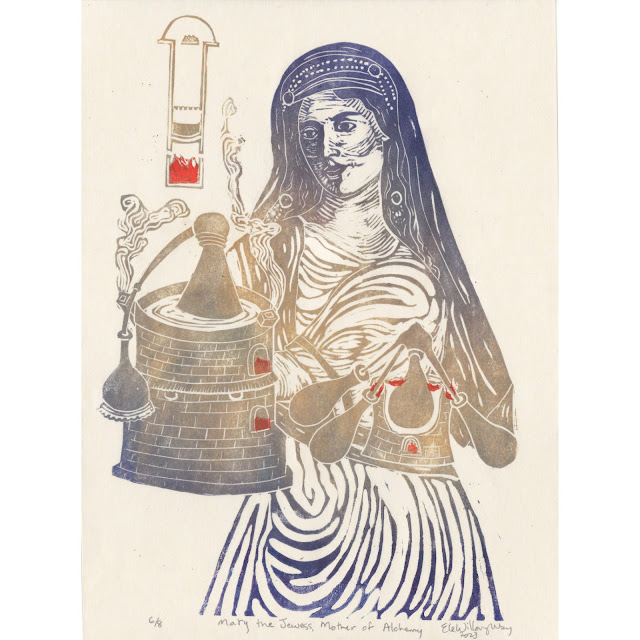
Mary the Jewess, Mother of Alchemy, linocut 11" x 14" by Ele Willoughby, 2023


This is my hand-printed linocut portrait of the earliest recorded alchemist: Mary the Jewess (also known as Maria Hebraea, or Miriam, or Maria Prophetissa). The ancient alchemist Zosimos of Panopolis (who lived in Hellenistic Egypt around 300 CE), cites her research and innovations and calls her "the divine Maria". He even states that she opened an academy for studying alchemy, and taught, "the inner, concealed nature of the metals could be discerned by a complex alchemical process that was revealed to her by God himself and that was to be transmitted only to the Jewish people." She must have predated him, in the early centuries of the common era, and several scholars suspect she lived in Alexandria, Egyptian in the first century. Zosimos relates that she wrote a treatise called "On Furnaces and Apparatuses" and she invented, or at least described ovens, apparatuses for cooking and distilling, and other alchemical experimentation, made of metal, clay, and glass with joints sealed using fat, wax, starch paste, and fatty clay. She favored glass vessels which allowed one to observe reactions without disturbing them and provided some protection fro poisonous materials like mercury, sulfurous and arsenic compounds. Amongst inventions attributed to her are the bain-marie (named in her honour, essentially a double boiler, still used in cooking and chemistry today), the kerotakis (which allowed one to heat items while collecting vapors) and the tribikos (a kind of alembic with three arms that was used to obtain substances purified by distillation, still used in chemistry labs today). The kerotakis was an extractor for vapors which had a metallic palette supported inside to hold samples on which the vapors would act. When working properly it made an airtight seal and we get the term "hermetically sealed" from its use in the "hermetic arts" (that is, in alchemy). It played a role in alchemy and the advent of chemistry up to the late19th century when German chemist Franz von Soxhlet produced the modern, modified kerotakis, known as the Soxhlet extractor in 1879, which is used to this day. I've included these three devices in my portrait. Her name also comes down to us in the term "Mary's Black" for the iron(II) sulfide coating on metal after using the kerotakis. She appears in the writings of other alchemists in the Greek tradition, like Olympiodorus the Younger (c. 495 – 570)  and Christianos in the 7th century, and in the writings of early Arab authors. Arab writer al-Habīb (dates unknown) must have had access to a now lost Hellenistic treatise by or about Mary. The tenth century Arab author Ibn Umail quotes Mary's books with information not found in other sources, suggesting he possessed her actual writings.

Sadly we know very little about Mary's life, but some of her books are quoted by others, and she casts quite the long shadow across centuries of alchemy. Like other alchemists, her words about her explorations of substances are quite mystical and hard to understand. Her axiom, known as the 'Axiom of Maria': "One becomes two, two becomes three, and by means of the third and fourth achieves unity; thus two are but one," was quoted by many alchemists who followed her; C.G. Jung called it a leitmotiv which runs seventeen centuries of alchemy. It's enigmatic and unscientific to the modern reader, but during her life, philosophers in the Mediterranean held an Aristotelian view of mater. She was expressing the idea that all materials were one. Aristotelians believed that mater was composed of four elements (air, fire, earth, and water), with four qualities in opposing pairs (hot/cold and wet/dry). It was commonly believed that by appropriately adjusting the proportions of the four elements by adjusting the balance of the qualities, a material could be transformed into any other. Alchemists in Egypt believed that a base metal like lead could be transmuted into gold with four steps: 1) melanosis, or blackening, to kill the base metal; 2) leukosis, or whitening the metal (using arsenic compounds); 3) xanthosis, or yellowing silver into gold (which might involve sulfur); and 4) iosis, or making the metal violet, which was purported to make it transformable into other metals. Much of their exploration involved producing these colour changes in metals.

Alchemists disguised their works to avoid accusations of witchcraft or sorcery or to keep their research findings secret from most people, so it is hard for us to interpret. Her interests were broader that we tend to assume for alchemists; she was interested in more than attempting to transmute lead into gold or producing the Philosopher's Stone and the Elixir of Life. Alchemy was more a religious view of life for her. She spoke of joining metals of different sexes, or the death of metals - things which do not fit with our modern scientific knowledge. Nonetheless some people credit her with discovering hydrochloric acid. She is credited with inventing the silver sulfide process, still used in metalworking today. She is believed to have discovered caput mortum, a dark purple dye. Though alchemists' understanding of materials was not scientific, the methodologies and apparatus developed definitely involved scientific thinking and form the foundation of what was to become chemistry. Mary's "On Furnaces and Apparatuses" contains the first description of a still. The instruments attributed to her, and her innovations for sealing apparatus were well-designed and played a role in chemistry and cooking for many many centuries or even persist today. And that is truly extraordinary!

My colour scheme is influenced by the deep purple of caput mortum. In Arab texts she was called "Daughter of Plato" - a term used in Western alchemy for white sulfur, so I also use a yellow-gold colour in my portrait. There's a portrait of her in German physician and alchemist Michael Maier's book 'Symbola Aurea Mensae Duodecim Nationum,' but since it was published in 1617, I don't think it actually provides any insight to her appearance or clothing. I was more influenced in imagining what she would have looked like by researching the clothing of Hellenistic Jews of the first to third century of the common era and the frescos of the Dura-Europos synagogue built in Syria in 244 CE. I made this print for the #SciArtSeptember prompt: alchemy.

References 

Cohen, Stephen Michael. "Maria the Jewess." Shalvi/Hyman Encyclopedia of Jewish Women. 25 June 2021. Jewish Women's Archive. (Viewed on September 14, 2023) <https://jwa.org/encyclopedia/article/maria-jewess>.

Hendrickson, Kristin. Maria the Prophetess: Mother of Alchemy, lecture given at Arizona Center of Medieval and Renaissance Studies, Tempe, Arizona, as part of the ACMRS Fearless Females series program, on September 20, 2013, https://www.medievalists.net/2015/07/maria-the-prophetess-mother-of-alchemy/

Lewis, Jone Johnson. "Mary the Jewess, First Known Alchemist." ThoughtCo, Aug. 25, 2020, thoughtco.com/mary-the-jewess-biography-3530346.

Mary the Jewess, Wikipedia, accessed September, 2023

Patai, Raphael. The Jewish Alchemists: A History Source Book. New Jersey: Princeton University Press. pp. 60–91. ISBN 978-0-691-00642-0. 1995

Sacks, Harold. Mary the Jewess and the Origins of Chemistry, SciHi Blog, May 8, 2020. http://scihi.org/mary-the-jewess-origins-chemistry/

van der Horst, P.W. (2002). Maria Alchemista, the First Female Jewish Author. In: Berger, S., Brocke, M., Zwiep, I. (eds) Zutot 2001. Zutot: Perspectives on Jewish Culture, vol 1. Springer, Dordrecht. https://doi.org/10.1007/978-94-017-3730-2_6

Friday, June 30, 2023

Cyanotype Experiments

Wet cyanotype with lemon slices
In this wet cyanotype the lemon slices are acting as both the translucent object to be imaged and a source of water and acid which affects the photochemistry. By Ele Willoughby, 2023, on watercolour paper 11" x 14"

I have been experimenting with cyanotypes. A cyanotype is an early photographic method, first used in 1842, which produces a cyan blue print used today for monochromatic art or blueprints. It is made using a slow-reacting, photographic printing formulation sensitive to a limited near ultraviolet and blue light spectrum, the range 300nm to 400nm known as UVA radiation. Two chemicals are mixed: potassium ferricyanide and ferric ammonium citrate, and coated on a surface. I usually use watercolour paper and then water to develop and fix the image. Along with some straightforward botanical images, I have objects with interesting silhouettes like lace, notions and tools. I have also been combining these with images of my own linocuts on acetate. I have been experimenting with wet cyanotype, where you begin the developing right away by applying some water while exposing the surface, as well as messing with the chemistry with things like vinegar, lemon juice, salt, and spices. I have also tried adding things which themselves are light sensitive, like lilac dye, paprika and curry powder. The results always somewhat to completely unpredictable, especially since I have been using the sun as my source of UVA radiation. This week I started toning some of my cyanotypes by bleaching with washing soda which allows tannins to bond to iron in the emulsion so images can be tinted. You can use different sources of tannins but I started with things in my kitchen: green tea and coffee. I've also embellished some with my linocut prints. Here's a taste!


Cyanotype fern by Ele Willoughby
Cyanotype fern, 9" x 12", Cyanotype spots by Ele WilloughbyEle Willoughby, 2023

Cyanotype in spots, 11" x 14" by Ele Willoughby, 2023

Cyanotype with teacup pattern lace, wild geraniums and lemon balm, toned with green team 11" x 14" by Ele Willoughby, 2023

Octopus cyanotype, toned with green tea, 11" x 14" by Ele Willoughby, 2023

Wildflowers and grasses cyanotype with linocut moths, 8" x 10.25", by Ele Willoughby, 2023