Showing posts with label multimedia. Show all posts

Friday, August 18, 2023

Multimedia with Kites


Linocut kites on cyanotype sky with collaged washi, Ele Willoughby, 11" x 14", 2023

Linocut kites on cyanotype sky with collaged washi, Ele Willoughby, 11" x 14", 2023

Linocut kites on cyanotype sky with collaged washi, Ele Willoughby, 11" x 14", 2023
Linocut kites on cyanotype sky with collaged washi and embroidery thread, Ele Willoughby, 11" x 14", 2023

Linocut kites on cyanotype sky with collaged washi, Ele Willoughby, 11" x 14", 2023

Linocut kites on cyanotype sky with collaged washi, Ele Willoughby, 11" x 14", 2023
Linocut kites on cyanotype sky with collaged washi, Ele Willoughby, 11" x 14", 2023 

kites, linocut by Ele Willoughby, 2023
Linocut kites with collaged washi, Ele Willoughby, 11" x 14", 2023

This is one of a series, each unique, of my hand made cyanotypes on watercolour paper (14" x 11") with an image of a cloud-filled sky overprinted with my linocut print of several kites, and wind-socks each collaged with beautiful Japanese washi papers. I made one without cyanotype and on one I hand-sewed embroidery thread for all the strings. The carp-shaped Koinobori wind socks (also known as satsuki-nobori) are flown in Japan to celebrate Tango no sekku, or Children's Day each May 5.

Friday, June 30, 2023

Cyanotype Experiments

Wet cyanotype with lemon slices
In this wet cyanotype the lemon slices are acting as both the translucent object to be imaged and a source of water and acid which affects the photochemistry. By Ele Willoughby, 2023, on watercolour paper 11" x 14"

I have been experimenting with cyanotypes. A cyanotype is an early photographic method, first used in 1842, which produces a cyan blue print used today for monochromatic art or blueprints. It is made using a slow-reacting, photographic printing formulation sensitive to a limited near ultraviolet and blue light spectrum, the range 300nm to 400nm known as UVA radiation. Two chemicals are mixed: potassium ferricyanide and ferric ammonium citrate, and coated on a surface. I usually use watercolour paper and then water to develop and fix the image. Along with some straightforward botanical images, I have objects with interesting silhouettes like lace, notions and tools. I have also been combining these with images of my own linocuts on acetate. I have been experimenting with wet cyanotype, where you begin the developing right away by applying some water while exposing the surface, as well as messing with the chemistry with things like vinegar, lemon juice, salt, and spices. I have also tried adding things which themselves are light sensitive, like lilac dye, paprika and curry powder. The results always somewhat to completely unpredictable, especially since I have been using the sun as my source of UVA radiation. This week I started toning some of my cyanotypes by bleaching with washing soda which allows tannins to bond to iron in the emulsion so images can be tinted. You can use different sources of tannins but I started with things in my kitchen: green tea and coffee. I've also embellished some with my linocut prints. Here's a taste!


Cyanotype fern by Ele Willoughby
Cyanotype fern, 9" x 12", Cyanotype spots by Ele WilloughbyEle Willoughby, 2023

Cyanotype in spots, 11" x 14" by Ele Willoughby, 2023

Cyanotype with teacup pattern lace, wild geraniums and lemon balm, toned with green team 11" x 14" by Ele Willoughby, 2023

Octopus cyanotype, toned with green tea, 11" x 14" by Ele Willoughby, 2023

Wildflowers and grasses cyanotype with linocut moths, 8" x 10.25", by Ele Willoughby, 2023


Thursday, July 7, 2022

Rusty patched bumblebee, In The Landscape and These Are a Few Of Our Favourite Bees


View through viewing portal into Ele Willoughby's rusty patched bumblebee lambe lambe box

In the Landscape, multimedia by Ele Willoughby and Sarah Peebles, linocut, painting, video projection, branch, wire, DNA bar codes, sound

Top of Ele Willoughby's rusty patched bumblebee lambe lambe box with view through skylight, paper flowers, twig chair, dandelion stem woven table, hand bound tiny book with linocut bee

Shot of Ele Willoughby's rusty patched bumblebee wooden lambe lambe box on legs, short table with other artifacts and bumblebee specimen

Some photos of my pieces in our art show, These are a Few of Our Favourite Bees, with my diorama like lambe lambe theatre box for a rusty patched bumblebee, and rusty patched bumblebee print along with the In the Landscape multimedia collaboration with Sarah Peebles.


Come see the show at the Campbell House Museum until July 16! Hear our artist talks this evening at the Canadian Music Centre, 20 St Joseph St, at 7:30 pm. Or you can watch the webcast here!

Wednesday, June 8, 2022

These are a Few of Our Favourite Bees


So I haven't been posting much recently, but I've been busily preparing for this collective art show about bees. If you're in Toronto, I hope you'll come check it out!


Exhibition
Campbell House Museum  
June 22 - July 16, 2022 

160 Queen Street W.

Opening event 
Campbell House,
Saturday July 2,  
2 – 4 p.m.

Artists' Talk & Webcast
The Canadian Music Centre, 
 
20 St. Joseph Street Toronto 
Thursday, July 7
7:30 – 9 p.m.
(doors open 7 pm)

Co-presented by Art-Sci Salon & The Canadian Music Centre

These are a Few of Our Favourite Bees investigates wild, native bees and their ecology through playful dioramas, video, audio, relief print and poetry. Inspired by lambe lambe – South American miniature puppet stages for a single viewer – four distinct dioramas convey surreal yet enlightening worlds where bees lounge in cozy environs, animals watch educational films and ethereal sounds animate bowls of berries (having been pollinated by their diverse bee visitors). Displays reminiscent of natural history museums invite close inspection, revealing minutiae of these tiny, diverse animals, our native bees. From thumb-sized to extremely tiny, fuzzy to hairless, black, yellow, red or emerald green, each native bee tells a story while her actions create the fruits of pollination, reflecting the perpetual dance of animals, plants and planet. With a special appearance by Toronto's official bee, the jewelled green sweat bee, Agapostemon virescens!

These are a Few of Our Favourite Bees Collective are:

Sarah Peebles, Ele Willoughby, Rob Cruickshank & Stephen Humphrey
The Works

These are a Few of Our Favourite Bees

Sarah Peebles, Ele Willoughby, Rob Cruickshank & Stephen Humphrey
Single-viewer box theatres, dioramas, sculpture, textile art, macro video, audio transducers, poetry, insect specimens, relief print, objects, electronics, colour-coded DNA barcodes.

Bees represented: rusty-patched bumble bee (Bombus affinis); jewelled green sweat bee (Agapostemon virescens); masked sweat bee (Hylaeus annulatus); leafcutter bee (Megachile relativa)

In the Landscape

Ele Willoughby & Sarah Peebles
paper, relief print, video projection, audio, audio cable, mixed media  

 Bee specimens & bee barcodes generously provided by Laurence Packer – Packer Lab, York University; Scott MacIvor – BUGS Lab, U-T Scarborough; Sam Droege – USGS; Barcode of Life Data Systems; Antonia Guidotti, Department of Natural History, Royal Ontario Museum

Tuesday, July 6, 2021

Wiwaxia Hat


Wiwaxia hat on black

Me in Wiwaxia Hat
Wiwaxia Hat on Black from Front


Wiwaxia, a scaly spiny invertebrate were common inhabitants of the Cambrian & early Ordovician seas. No one is quite sure if they were scaly worms or mollusks, but I was quite sure if you scaled up (no pun intended!) their 5 cm long bodies they would make quite a fabulous hat. One of the fun things about contemplating ancient fossil is that colour is rarely preserved so no one can disprove my (admittedly quite unlikely) idea that the scales has multifarious patterns. So this piece is really wearable multimedia textile art. It works sculpture or hat.

When I make art to tell stories about science I am often literal and direct to communicate clearly. If I make art for or about me, it’s much more metaphorical. Though depicting an extinct animal might easily be #SciArt, this is more about my feelings of experiencing lockdown. I can’t quite explain why I felt like “f— it, I’m making a wiwaxia hat” is how I felt, but it was. This was work I could actually do while wrangling my child for remote school, when very few other things were possible. Each scale and spine is block printed and hand sewn.
 
Carving, while working at the same table as a busy 7 year old was tricky. I felt like I said, "Don't shake the table" incessantly. Printing while supervising school would not work at all. But, I could cut and sew by hand,  hand-printed scales and spines I prepared the previous evening (after my son's bedtime).

Compare this work with my print on the same subject:

Wiwaxia linocut by Ele Willoughby
Wiwaxia linocut by Ele Willoughby, 11" x 14" on translucent washi with bark inclusions and collaged assorted washi scales and spines.

Thanks to my husband Roger Hallett for the photos!


Sunday, December 30, 2018

Looking back at my art and science 2019

Antoine et Marie-Anne Paulze Lavoisier,
linocut with collaged washi,
2018 by Ele Willoughby
This year started with the end of our tenure running the Toronto Etsy Street Team gallery. Though this meant a great deal less time curating shows, I did make a move to show my art more in gallery shows, and sell through galleries and shops and less selling in person. Early in the year, I decided I would not participate in the One of a Kind Christmas Show. Selling art in person is tough to do; it's hard on your body to stand for long hours, fine art can be a harder sell than handmade goods which serve more than just an aesthetic purpose, and retailing anything can be gruelling - perhaps more so if it is your own creation. But, I am quite pleased that I did participate in a large number of artshows, a sold art in a variety of cities this year.

The first show for me this year was The Tarot Lovers: Works of Heart exhibition, which showed (and sold) at the Wellington County Museum and Archives. Curated by Shelley Carter, this show is one in a series she has organized with themes based on Tarot cards. I enjoyed the challenge of mixing those concepts with my ongoing works about the history of science, as an excuse to highlight the loving partnership of Antoine Lavoisier (26 August 1743 – 8 May 1794) and his wife Marie-Anne Paulze Lavoisier (20 January 1758 – 10 February 1836). Lavoisier is often referred to as the 'father' of modern chemistry, without any reference to his wife, and yet, as their official illustrator, she shows herself participating in his experiments and her skills as technical scientific translator allowed him to be up-to-date with chemistry across the Channel.

The next exhibit for which I submitted work was also an exchange of multiples: The Matchbook Project Cabinet of Curiosities.
 The works, along with my previously exhibited 'Imaginary Menagerie' prints were exhibited at Balzac's upstairs gallery for the Curious Fauna show in the fall, and I got my very own wunderkammer of beautiful and very varied artist-made matchboxes on the theme of cabinets of curiosities. This delightful project was curated and created by Hearyung Kim and Natalie Draz (whom I know from PROOF Studio Gallery).

In March I took part in Graven Feather's 'What the Fukushini' exhibit, submitting a version of my pink fairy armadillo linocut with collaged washi papers. This show, in partnership with The Paper Place, had artists make works on or with a specific washi paper. There was a great and delightful variety of works.


 Pink fairy armadillo, 11" x 13", 
multimedia by Ele Willoughby, 2018 (sold)


The most significant creation of new work for an exhibit was my five new portraits of Canadian women in STEM which were part of Curiosty Collider's show Interstitial: Science Innovations by Canadian Women, along with two other artists, this June in Vancouver! Interstitial was curated by Larissa Blokhuis, who makes gorgeous natural history inspired works, mainly in glass. I had previously made Ursula Franklin's portrait for the Phylo Project from Dave Ng and the Advanced Molecular Biology Laboratory (the science education facility within the Michael Smith Laboratories, UBC): a trading card game about Women in Science and Engineering! I added geologist Alice Wilson, physicist Harriet Brooks, computer scientist Trixie Worsley, medical researcher and biochemist Maud Menten and geneticist and Down syndrome expert Irene Ayako Uchida. Of these new five, I had only previously known Menten, despite having worked at the Geological Survey of Canada (like Wilson), being an alumni of U of T where Worsley had taught physics and computing and being a physicist by training (like Brooks). I was very glad to become involved with a great science/art organization and take part in this exhibit. Some artwork sold and many others in these editions have since - and it caused me to do some research specically on the history of Canadian women in STEM. This was revealing in and of itself, and I also gained some useful insights into how to find great stories about underappreciated women scientists.


Redbud and the Bees, 18" x 24",
linocut with collaged washi papers by Ele Willoughby, 2018
I made 'Redbud and the Bees' for  Creature Conserve  a non-profit outreach organization which brings artists and scientists together to "foster sustained and informed support for animal conservation," and their show Urban Wildlife: Learning to Co-exist. I remembered the urbanredbud citizen science project here in Toronto. Local U of T doctoral candidate Charlotte de Keyzer is working with the public to gather data on flowering times of Eastern redbud trees (Cercis canadensis) and their pollinators using bee nest boxes and traps. She made the suggestion of highlighting how the redbuds are moving into Toronto due to climate change and gardiners, and though popular with our local bees, they also attract a less popular new species the Eastern carpenter bee, who drill holes in wood to build nests. (Because the world is very small, it turns out de Keyser is the sister-in-law of my friend Laura Watt who you may know from Cubits). This show was curated by Creature Conserve founder, artist and scientist Lucy Spelman. It has been shown at the Rhode Island School of Design (RISD) in July, and ArtProv Gallery in Rhode Island in September. This year, the exhibit will travel to other galleries in the US. Stay tuned for more details and chances to see these works!

This August, the Ontario Science Centre (OSC) staged an exhibit called 'Quantum' about the history of quatum mechanics. My friends at The Maker Bean (where you can now find my art, at both their Bloor and Dufferin and OSC locations) asked if I had an artwork about quatum mechanics. Indeed I do! So my portraits of physicists Bohr, Meitner, Roentgen, Wu and Curie, as well as Schroedinger's Cat, have all been on display at the OSC since then!

Me, at sea and two of my space-related prints:
my portraits of astronaut Mae Jemison and
Space Race engineer and mathematician Mary Golda Ross
This October, I was invited to give a talk as part of Science Literacy Week about my experience being an astronaut candidate for the Canadian Space Agency. Since astronauts are both scientists and science communicators, I took this as an opportunity to talk about both my research and sciart, together for the first time. I spoke at an event called "Space Mythbusters" at Gerstein Library along with a couple of other scientists. I told them what the astronaut selection process was really like and a bit about the mission that Canadian astronaut David Saint-Jacques has now begun, onboard the International Space Station. I also gave a version of this talk to a Boy Scout troup and am planning to do so at a couple of Toronto Public Libraries in 2019. Jesse Hildebrand spearheads Science Literacy Week, and he invited me to submit a proposal for Story Collider, a science-themed storyteller series and podcast. He hosts the Toronto series along with Misha Gajewski. So, I'm going to be doing that too, very early in the new year! Catch me on January 14th.

Eastern carpenter bee multimedia (sold)
Once again, I participated in Graven Feather's In the Round Show, this year hosted at PROOF Studio Gallery in the Distillery. I made a couple of round multimedia works based on my new bee and redbud lino blocks and one on the pink fairy armadillo. Like other years, I also participated in and helped organize the Toronto Etsy Street Team shows, including the Summer Market (or, this year, our first Etsy: Made in Canada Spring Show), Etsy: Made in Canada in September and our TEST Christmas Market, less than a week ago.  I also participated in Peggy Muddles' Scienterrific Pop-up at Tosca Terran's new Co:Lab space - in the same gallery where we had our year-long TEST Gallery pop-up! Likewise, I participated in Graven Feather's Holiday Market too. I was very pleased to also send off a selection of women scientist prints to Anthology boutique in Madison, Wisconsin.


Santiago Ramón y Cajal, linocut, 12" x 12" by Ele Willoughby, 2018
As well as all these shows and works created with specific shows in mind, I also added to my on-going collection of scientist portraits with neuroscientist and artist in his own right, Santiago Ramón y Cajal (1852 - 1934), 17th century scientist and scifi author Margaret Cavendish, ancient Egyptian court physician Merit Ptah (arguably the earliest recorded woman in science), pharmaceutical chemist Alice Ball (who made the first effective treatment for leprosy), mathematician and Space Race engineer Mary Golda Ross, and mathematician Emmy Noether. All of these involved research and writing on my part too. I also managed to complete my long-awaited chair reuphostery personal project, with involved printmaking, patchwork, applique and embroidery.

On a personal front, we managed to also sneak in trips to Sault Ste Marie for my family reunion and out to New Brunswick to see my husband's family. Amazingly, our - now five year old son - has been raised to be a good little traveller, and we managed to do this by car! My husband has some new, hard-won job security. Our son started French immersion in senior kindergarter this year. All of this is good.

When I looked back I see that in fact, a lot happened this year, and while it sort of feels sometimes that I have never accomplished enough, I have done rather a lot. I know that this year will bring more art shows, already in the planning and several more speaking engagements. I have several collections I am continuing to build and I would like to do more varied multimedia work. It isn't always straightforward to navigate a path as self-employed modern day Renaissance woman, but I think (I hope) that I'm on the right patch to carve out my own place at the intersection of art and science.

Monday, March 19, 2018

Pink Fairy Armadillo - What the Fukunushi?

Pink fairy armadillo, 11" x 13", multimedia by Ele Willoughby, 2018

I'm taking part in Graven Feather's collaboration with the Japanese Paper Place, the 'What the Fukunishi?' exhibit from March 21 through April 1 at 906 Queen St West, Toronto

Exhibition hours: Thursday, Friday, Saturday 12-6pm & Sunday 12-4pm. Inspired by their description of these rose and pale yellow fukunishi papers as being "an excellent support material for a huge variety of medias and techniques" I decided to mix it up. This piece combines linocut, collage and colour pencil to show the adorable sand swimmer, the pink fairy armadillo, a tiny armoured mammal, also known as a pichiciego or Chlamyphorus truncatus, who lives in desserts or xerix scrublands of central Argentina. These uncommon tiny armadillos are only 90–115 mm (3.5–4.5 in) long, subterranean and nocturnal. They are rarely seen and their numbers are declining, due to farming, hunting and predation from domestic pets. Sadly they do not survive long in captivity. Its giant forepaws allow it to dig its burrow and explain it's nickname, the "sand-swimmer". 
 
You can also find a series of prints in my shop of just the animal itself.
 
Pink Fairy Armadillo I, linocut and collage on washi paper, 12" x 8", Ele Willoughby, 2018
 

Thursday, February 8, 2018

The Matchbook Project Cabinet of Curiosities


I am really pleased to be invited to take part in the The Matchbook Project, especially since the theme this year is Cabinet of Curiosities. This is a group travelling exhibit/artist exchange where all the participating artists make 10 tiny boxes (3" x 2" x 1") and their contents. You can see images of previous works in this project here or follow the #inventoryofmemorymatchbox hashtag on Instagram. Artists may decide to have similar matchbox covers and differing contents, but I decided to make similar contents and different covers.


I returned to the idea of the two-headed turtle, for something which is both an example of natural history and something extraordinary which might fit in your wonderkammer. I carved two matching lino blocks for the turtle from above with the top of its shell and the turtle from below with the bottom of its shell and printed these on Japanese cardstock. Then I printed the shell itself on many different washi papers so I cold collage each section of the shell seperately.

I made the matchboxes themselves from Japanese cardstock in assorted colours, textures and sometimes with inclusions like gold and silver foil or silk fibres. Then I made assorted tiny pillows on which the polycephaly (two-headed turtle) specimen could rest. These were made in red silk or patterned cotton with a Japanese motif or botanical drawings (which fit with the cabinet of curiosity theme).
 
I collaged each of the boxes with all the bits of prints and proofs I've been saving so long: turtles on assorted washi, insect wings on delicate tissue, crystals on irridescent paper, beetles on washi, bees, radiolarians, fossils, mushrooms, butterflies and tiny vintage tarot cards from a beautiful sheet of paper I bought in Amsterdam many years ago.
  

I had so much fun making these I think I'll make more. I'm planning to list a mystery box in my shop, so that you can purchase one and have the contents be a surprise!

Monday, July 24, 2017

Washi Wednesday at the Japanese Paper Place

Unicorn amongst umbrellas detail, one of my linocuts on washi
and other papers
This Wednesday, July 26 from 1:00 pm to 5:00, I will be demonstrating my process of making linocuts with hand-printed, collaged Japanese washi papers at the Japanese Paper Place. This 'Washi Wenesday' is a free demo - one held the last Wednesday of every month - and you can drop in and see me work, see examples from portfolio and chat about printmaking and paper! Stop in (103 The East Mall Unit 1, Etobicoke, M8Z 5X9) and say hello!

The Japanese Paper Place has the most amazing warehouse of Japanese papers, both handmade and machine made. They supply the Paper Place on Queen West, as well as working directly with artists and selling papers online. I'm looking forward to doing a demo because I find teaching in any way is always instructive, and allows me to think about my own process. Also, it's a chance to seek the perfect paper for ideas in my head!

Sunday, May 31, 2015

Bee Homes - linocut bees interactive audiovisual multimedia piece

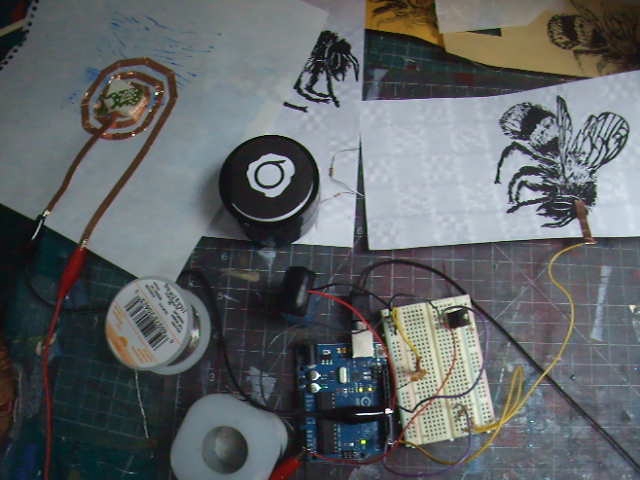
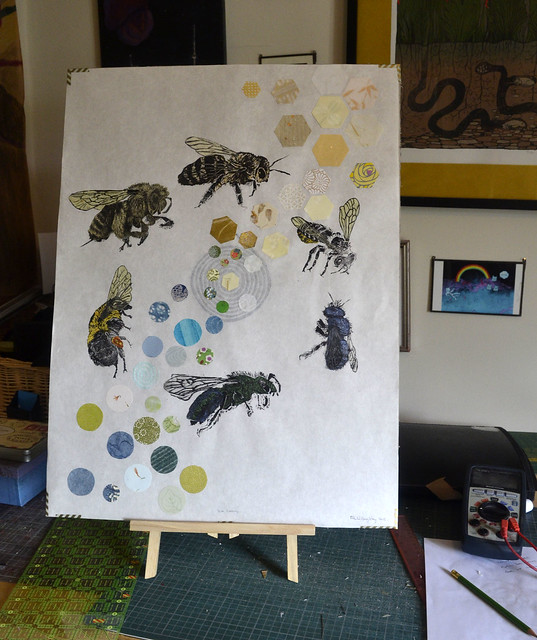
For a long time, I've had some version of this in my head. This week I finally managed to complete my multi-bee interactive audiovisual multimedia piece... just in time for the Bees (& the Birds) show at Graven Feather. You may recall that a few years ago, I made a linocut bee in electrically conductive in (specifically Bare Paint, which I mixed with some block printing extender to get a better viscosity for making a linocut). I combined this with an Arduino microcontroller so the bee itself could act as a capacitative sensor. In simplest terms a capacitor is made of two electrically conductive - usually metal - plates with a gap between them. The gap can be nothing but air, or a variety of electrolytes.  If there was a wire between the plates, charge would flow freely. Because of the gap, charge builds up on one plate a dissipates at a certain rate to the other. The rate at which this happens depends on the capacitance, which in turn depends on things like the physical properties of the plates, electrolyte and the size of the gap. So, a capacitative sensor takes advantage of the latter to sense proximity, or, measure capacitance to tell you the gap between two "plates". In my case the "plates" are bees printed in electrically conductive paint and my hand. This is the principle behind the theremin (though, they are of course, a great deal more sophisticated, but the idea is the same)*. Here's an example of an earlier prototype from 2012:

buzzing bumblebee print prototype

So, I can use my linocut on paper connected to an Arduino microcontroller as a sensor, and use the Arduino then to trigger a audio response when someone approaches the linocut. A very simple speaker can be made from a current-carrying wire in a spiral, affixed to a membrane, next to a strong magnet.** So, above I made a speaker with a piece of paper, copper tape as wire and a magnet. The next step was to carve a spiral lino block and block print a speaker on paper with electrically conductive paint, which I did. Thus an actual print, a sheet of paper, becomes both sensor and speaker. I had planned to then make a piece which had multiple bees as multiple sensors which would trigger different reponses. I created the artwork in time for my show about bees in 2013.

TheBees
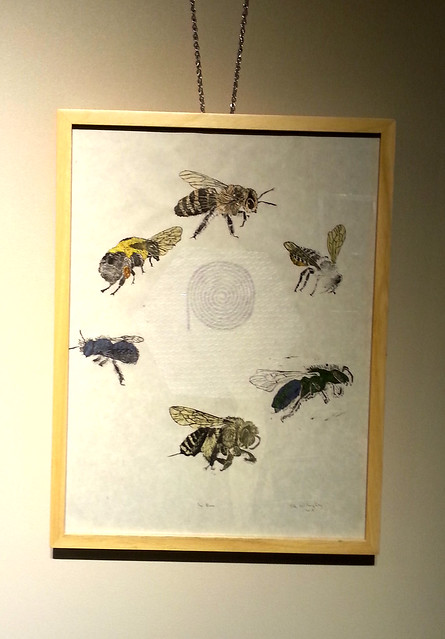
The Bees, Ele Willoughby, linocut on various Japanese washi, 18" x 24", 2013.
I had planned to add sound to this piece, but didn't have the opportunity.

I had two issues. First, my prototype used only an Arduino. I was able to play back sound by keeping the recording length quite short and the sampling rate low. There's only so much on-board RAM. I could make multiple sensors each play the same recording, but I simply ran out of memory using only an Arduino.

Secondly, I got pregnant and chose to put electronics aside for a while. I couldn't find any reliable medical guidance about soldering electronics while pregnant or in the proximity of babies (as if there aren't in fact large numbers of engineers, scientists, artists and hobbiests who are women of child-bearing age, ahem!), but jewellers were warned to avoid lead solder, and I opted to err on the side of caution. Lead and developping nervous systems struck me as a bad combination.

So, now that my son is one and a half, I've had an opportunity to return to the idea. The obvious way to add more sound to a project is the off-the-shelf solution of adding a Wave Shield to the Arduino. This is a second circuit board which plugs into the first to let you control and play files from an SD card to a speaker. (Bare Paint has recently released their own microcontroller, the Touch board based on the Arduino, but specifically with their applications for their paint, such as capacitative sensors, in mind. This might have been an easier way to go... but I had an Arduino, so I chose to add a Wave Shield).

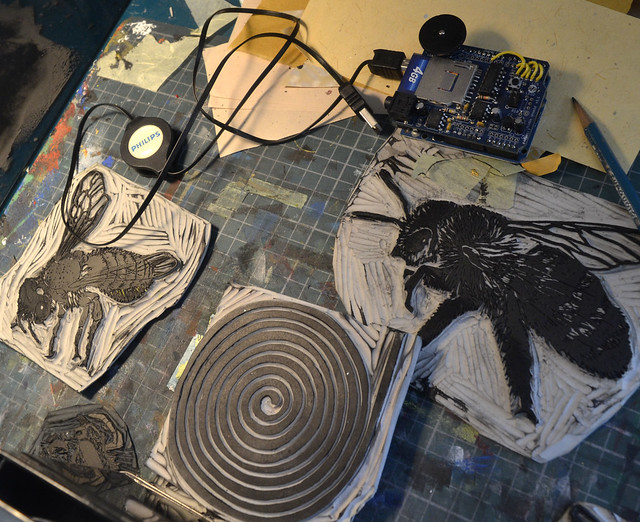
beeblocks
My bee lino blocks and spiral lino speaker block, along with the Arduino and Wave Shield. You can talk to the Arduino via serial port. I combined the open source code wavehc_play6.pde (which plays different 6 audio files when 6 different buttons are pushed) with ArduCapSenseBlinky.ino which employs a collection of capacitative sensors to trigger a collection of LEDs to flash.
beeconductive
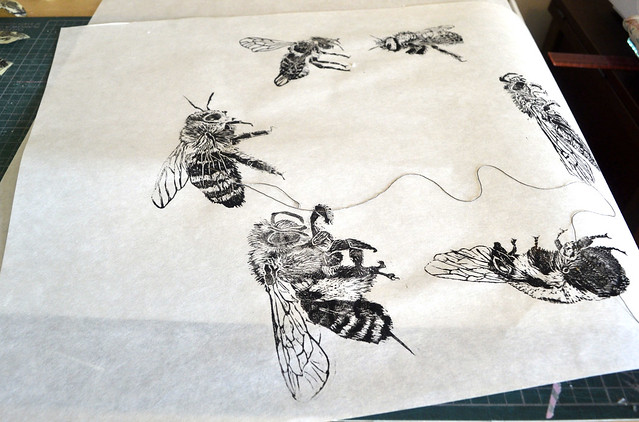
To make an electrical connection from my 6 bees (honeybee, bumblebee, leafcutter bee, long-horned bee, blue orchard mason bee and sweat bee), which I block printed in Bare Paint with block printing extender on Japanese kozo paper, I sewed through the paper with electrically conductive thread. I wanted the speaker, magnet and electronics to be behind the sheet, so I needed to pass through it. 
beeEisel
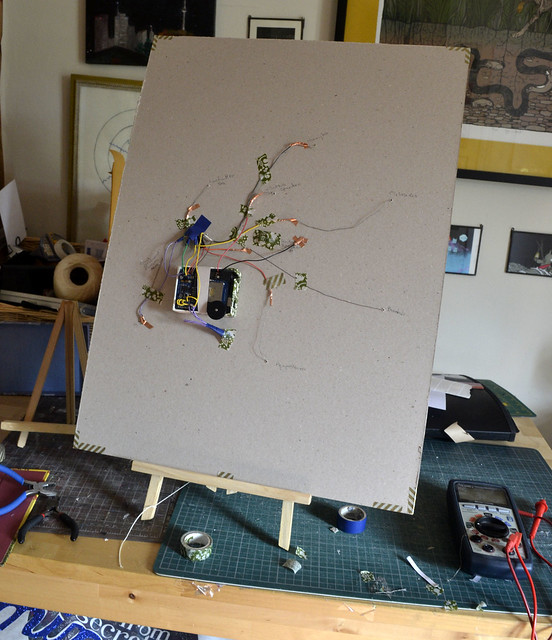
I also printed each bee block on a variety of Japanese washi papers, to get the colour and texture of the bees and wings. This also hides the stitching/electrical connections. The story I'm telling with the piece is about how bees live here. We all know the honeybee, with its hexagonal cells in its hives, but it's not native to North America. Most of our native bees live in holes and burrows. They also come in a wide range of colours. So the other collaged, handmade papers, represent how the bees live, from the hexagons with the honey bee at the top in yellows, to the circles in blues and greens at the bottom. In this shot you can also see the spiral speaker printed on the reverse. The sheet is on kozo paper which is very strong, but not at all stiff. So I backed it with book board to have something on which to mount the electronics. My trusty multimeter is there so I can check that each bee does have good connectivity through to the digital I/O pin on the Arduino.
beeElectronics
This is what's hiding behind the piece. I affixed a small box to hold the Arduino. There are six DIO pins at the top of the Wave Shield board connected to wires in purple, green, yellow, orange, red and brown. These in turn are connected using copper tape to each of the 6 conductive threads coming from the 6 bees. The threads from either end of the speak spiral are likewise connected to the speaker output and ground.
I made a short recording for each bee. I tried to find audio recordings of each different species. Back in 2012, Sarah Peebles directed me to some of her audio recordings on Reasonating Bodies. I also simply searched YouTube for videos of each type of bee. I combined these (using Audacity... which is pretty awesome freeware for simple sound applications) with my spoken words about the bees and save these as .WAV files which can be played by the Arduino Wave Shield. So I was able to say how though the honeybee might be our idea of the canonical bee, our "default" bee, it is in fact not native to North America, and many of out native bees are quite different; many are solitary, producing neither hives nor honey, and coming in all sorts of colours. You can see and hear my piece at the Graven Feather show the Bees (& the Birds), which runs June 4 through 27. I'll post a video of the piece in action later. You can find each of my bees prints separately here (and learn a little bit about each species too).

*In fact, this is how the gravimeter I used for my doctorate worked too. Picture a mass suspended on a spring such that the spring force upward is balanced by gravity downward. Should the force of gravity change as you move the sensor (due to a large buried mass below, for instance) the mass on a spring will no longer be in equilibrium. The sensor was the most extraordinary, delicate, tiny, spun quartz spring terminated with a tiny piece of quartz coated in gold between capacitative plates. When the mass moved, an electrical restoring force was applied to the plates which returned the sensor to equilibrium. This restoring force could tell you the change in gravity, or, in my case acceleration (since I kept the gravimeter still, it was the seafloor which moved up and down).

**A good source of strong magnets: old hard drives