Showing posts with label bumblebee. Show all posts

Monday, July 6, 2026

Cyanotype and Sun Prints


I've been making more cyanotype experiments, combining them with linocut and other types of sun prints and playing with shapes. 


Tree of Heaven and Fern Cyanotype with Sun Print, by Ele Willoughby, 2026


Bumblebee cyanotype, 11" x 14" by Ele Willoughby, 2026


Cat cyanotype with Virginia creeper cyanotype, by Ele Willoughby, 2026


Foxtail Barley cyanotype, 5" x 8" by Ele Willoughby, 
2026


Alliums and Dandelions Cyanotype, 11" x 14" by Ele Willoughby, 2026


Skeleton, Fern and Wild Carrot Cyanotype, 11"  x 14" by Ele Willoughby, 2026

Lily pads cyanotype and sun print, 11" x 14" by Ele Willoughby, 2026


Sunday, May 31, 2015

Bee Homes - linocut bees interactive audiovisual multimedia piece

For a long time, I've had some version of this in my head. This week I finally managed to complete my multi-bee interactive audiovisual multimedia piece... just in time for the Bees (& the Birds) show at Graven Feather. You may recall that a few years ago, I made a linocut bee in electrically conductive in (specifically Bare Paint, which I mixed with some block printing extender to get a better viscosity for making a linocut). I combined this with an Arduino microcontroller so the bee itself could act as a capacitative sensor. In simplest terms a capacitor is made of two electrically conductive - usually metal - plates with a gap between them. The gap can be nothing but air, or a variety of electrolytes.  If there was a wire between the plates, charge would flow freely. Because of the gap, charge builds up on one plate a dissipates at a certain rate to the other. The rate at which this happens depends on the capacitance, which in turn depends on things like the physical properties of the plates, electrolyte and the size of the gap. So, a capacitative sensor takes advantage of the latter to sense proximity, or, measure capacitance to tell you the gap between two "plates". In my case the "plates" are bees printed in electrically conductive paint and my hand. This is the principle behind the theremin (though, they are of course, a great deal more sophisticated, but the idea is the same)*. Here's an example of an earlier prototype from 2012:
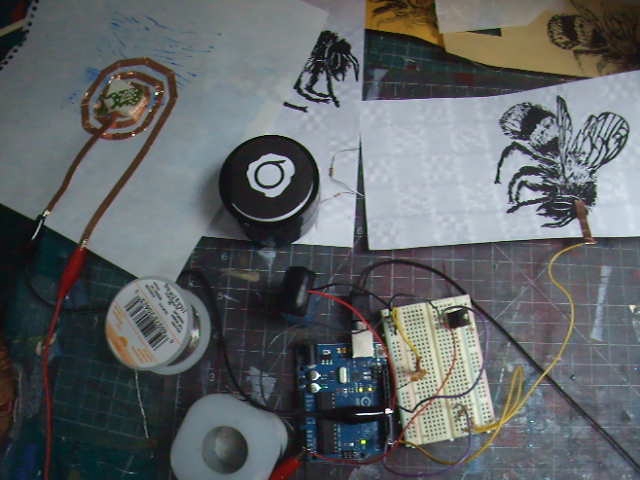
buzzing bumblebee print prototype

So, I can use my linocut on paper connected to an Arduino microcontroller as a sensor, and use the Arduino then to trigger a audio response when someone approaches the linocut. A very simple speaker can be made from a current-carrying wire in a spiral, affixed to a membrane, next to a strong magnet.** So, above I made a speaker with a piece of paper, copper tape as wire and a magnet. The next step was to carve a spiral lino block and block print a speaker on paper with electrically conductive paint, which I did. Thus an actual print, a sheet of paper, becomes both sensor and speaker. I had planned to then make a piece which had multiple bees as multiple sensors which would trigger different reponses. I created the artwork in time for my show about bees in 2013.
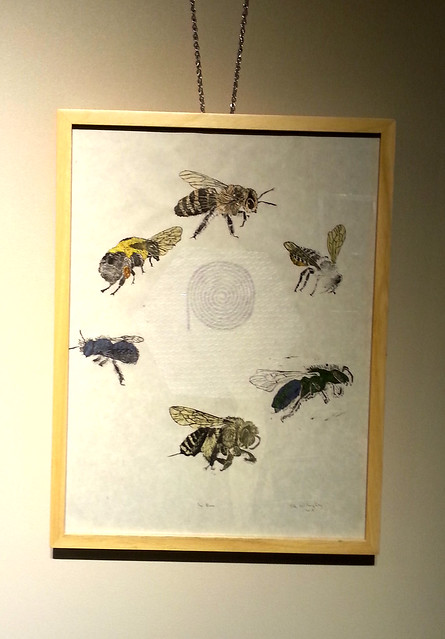
TheBees
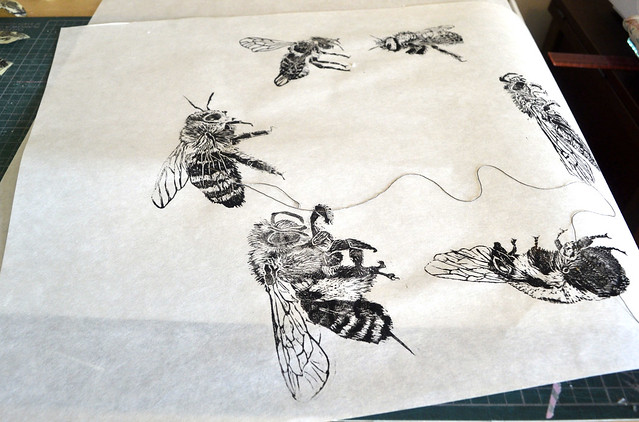
The Bees, Ele Willoughby, linocut on various Japanese washi, 18" x 24", 2013.
I had planned to add sound to this piece, but didn't have the opportunity.

I had two issues. First, my prototype used only an Arduino. I was able to play back sound by keeping the recording length quite short and the sampling rate low. There's only so much on-board RAM. I could make multiple sensors each play the same recording, but I simply ran out of memory using only an Arduino.

Secondly, I got pregnant and chose to put electronics aside for a while. I couldn't find any reliable medical guidance about soldering electronics while pregnant or in the proximity of babies (as if there aren't in fact large numbers of engineers, scientists, artists and hobbiests who are women of child-bearing age, ahem!), but jewellers were warned to avoid lead solder, and I opted to err on the side of caution. Lead and developping nervous systems struck me as a bad combination.

So, now that my son is one and a half, I've had an opportunity to return to the idea. The obvious way to add more sound to a project is the off-the-shelf solution of adding a Wave Shield to the Arduino. This is a second circuit board which plugs into the first to let you control and play files from an SD card to a speaker. (Bare Paint has recently released their own microcontroller, the Touch board based on the Arduino, but specifically with their applications for their paint, such as capacitative sensors, in mind. This might have been an easier way to go... but I had an Arduino, so I chose to add a Wave Shield).
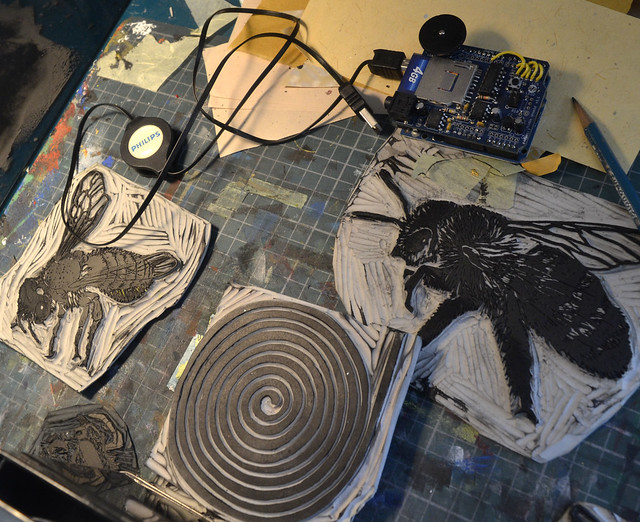
beeblocks
My bee lino blocks and spiral lino speaker block, along with the Arduino and Wave Shield. You can talk to the Arduino via serial port. I combined the open source code wavehc_play6.pde (which plays different 6 audio files when 6 different buttons are pushed) with ArduCapSenseBlinky.ino which employs a collection of capacitative sensors to trigger a collection of LEDs to flash.
beeconductive
To make an electrical connection from my 6 bees (honeybee, bumblebee, leafcutter bee, long-horned bee, blue orchard mason bee and sweat bee), which I block printed in Bare Paint with block printing extender on Japanese kozo paper, I sewed through the paper with electrically conductive thread. I wanted the speaker, magnet and electronics to be behind the sheet, so I needed to pass through it. 
beeEisel
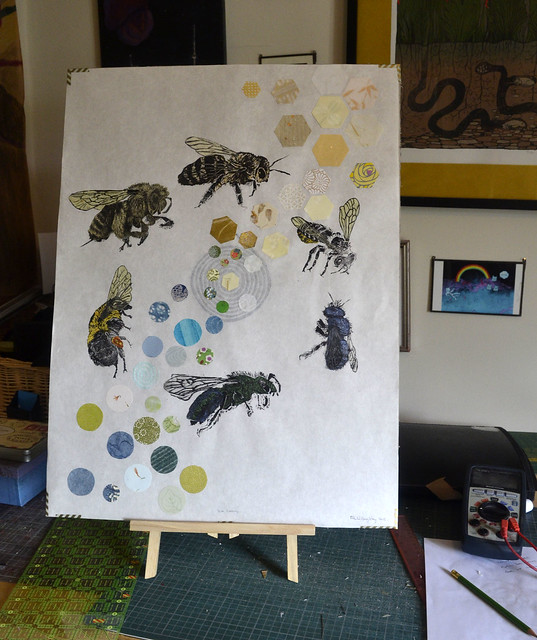
I also printed each bee block on a variety of Japanese washi papers, to get the colour and texture of the bees and wings. This also hides the stitching/electrical connections. The story I'm telling with the piece is about how bees live here. We all know the honeybee, with its hexagonal cells in its hives, but it's not native to North America. Most of our native bees live in holes and burrows. They also come in a wide range of colours. So the other collaged, handmade papers, represent how the bees live, from the hexagons with the honey bee at the top in yellows, to the circles in blues and greens at the bottom. In this shot you can also see the spiral speaker printed on the reverse. The sheet is on kozo paper which is very strong, but not at all stiff. So I backed it with book board to have something on which to mount the electronics. My trusty multimeter is there so I can check that each bee does have good connectivity through to the digital I/O pin on the Arduino.
beeElectronics
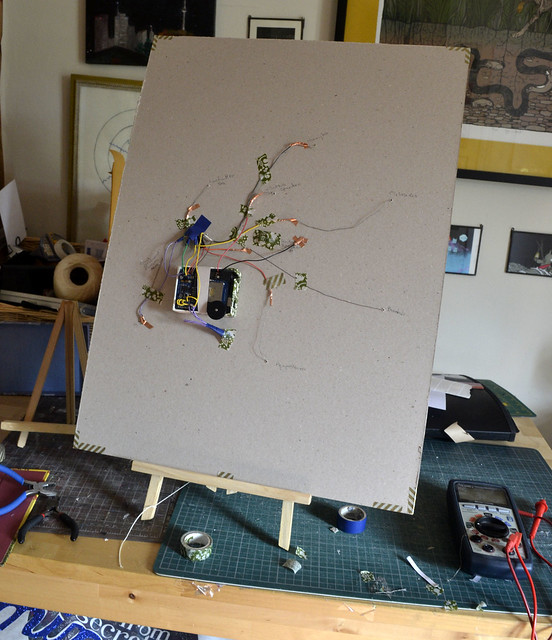
This is what's hiding behind the piece. I affixed a small box to hold the Arduino. There are six DIO pins at the top of the Wave Shield board connected to wires in purple, green, yellow, orange, red and brown. These in turn are connected using copper tape to each of the 6 conductive threads coming from the 6 bees. The threads from either end of the speak spiral are likewise connected to the speaker output and ground.
I made a short recording for each bee. I tried to find audio recordings of each different species. Back in 2012, Sarah Peebles directed me to some of her audio recordings on Reasonating Bodies. I also simply searched YouTube for videos of each type of bee. I combined these (using Audacity... which is pretty awesome freeware for simple sound applications) with my spoken words about the bees and save these as .WAV files which can be played by the Arduino Wave Shield. So I was able to say how though the honeybee might be our idea of the canonical bee, our "default" bee, it is in fact not native to North America, and many of out native bees are quite different; many are solitary, producing neither hives nor honey, and coming in all sorts of colours. You can see and hear my piece at the Graven Feather show the Bees (& the Birds), which runs June 4 through 27. I'll post a video of the piece in action later. You can find each of my bees prints separately here (and learn a little bit about each species too).

*In fact, this is how the gravimeter I used for my doctorate worked too. Picture a mass suspended on a spring such that the spring force upward is balanced by gravity downward. Should the force of gravity change as you move the sensor (due to a large buried mass below, for instance) the mass on a spring will no longer be in equilibrium. The sensor was the most extraordinary, delicate, tiny, spun quartz spring terminated with a tiny piece of quartz coated in gold between capacitative plates. When the mass moved, an electrical restoring force was applied to the plates which returned the sensor to equilibrium. This restoring force could tell you the change in gravity, or, in my case acceleration (since I kept the gravimeter still, it was the seafloor which moved up and down).

**A good source of strong magnets: old hard drives

Friday, July 19, 2013

It's Better With Bees

Bee biodiversity exhibit

If you missed the It's Better With Bees exhibit (March 30 to July 1, at the Ball's Falls Conservation Centre in Jordan, Ontario), here are a few photos. The exhibit was about bee biodiversity. Along with my prints - which were apparently a useful teaching tool for schoolkids - there was a bee audio box and bee trading cards by Sarah Peebles (check out Reasonating Bodies for more of Sarah's work, lots of resources and a wealth of information on bees), various beekeeping artifacts and a large collection of specimens of different species. I really enjoyed getting so see the exotic bees up close.

The Bees
Detail of The Bees
Detail of The Bees
Bee biodiversity exhibit with The Bees

You can find all of my available bee prints here, or at the gift shop at the Ball's Fall's Conservation Centre. It's a lovely spot, not too far from Hamilton, and only an hour from Toronto or Buffalo - a great place for a picnic. The large print showing all six bees around a hexagon (with lovely Japanese washi tissue paper with a honeycomb pattern) has sold, but I have more multi-bee works in mind! I wanted to comment on the fact that we always think about the honeybee, which is actually a bit atypical and a European import. Our native pollinators are often solitary bees, who live in the ground or simple nests (rather than hives), do not make honey, and can be very unexpected irridescent colours.


Tuesday, April 2, 2013

for the bees

TheBees If you're in the Toronto-Hamilton-Buffalo area this spring, I'd like to suggest making a day trip to the lovely Ball's Falls Conservation Area. Until Canada Day (July 1), along with the beautiful scenery and heritage areas, they will be hosting an exhibit about the biodiversity of bees, including artwork and 7 of my prints. The exhibit also has the wonderful multimedia sound and visual art of installation artist and composer Sarah Pebbles. Her "Audio Bee Booth for Ball's Falls" allows you to not only see, and learn about our beautiful pollinators (and their alarming decline), but to hear them too. There are many artifacts, and scientific photos curtesy of York University, also included. I set up my art early, so I myself have yet to see it all. Check out Resonating Bodies for more of Sarah's work on bees, and my set of images of bees here.

Sunday, October 28, 2012

Local Bumblebee

I've been planning a series of six local bees (both native bees, and common transplanted bees) and chose a bumblebee. I recently discovered that I had previously (and inadvetently) selected a common European bumblebee (lacking peer review of the science behind my art) and decided I would make another bumble protrait, this time of ­the Common Eastern Bumblebee, or Bombus Impatiens.

Bombus Impatiens

If you live in eastern North America you may recognize this guy. It is yellow on its upper thorax, with a black spot in the centre of its back, and is black on the lower abdomen. I wanted to capture the round, fuzzy bee in flight and show how unexpected proportions of the bee make it appear as round and cuddly as an insect could be. Bumblebees are social insects that are characterized by black and yellow body hairs, often in bands. This hair comes in soft (long, branched setae) pile, that covers their entire body, making them appear and feel fuzzy. Like their relatives the honey bees, bumblebees feed on nectar and gather pollen to feed their young. This one has orange pollen on its fuzzy leg.

Friday, March 30, 2012

Prototyping the Bumblebee


This is another project in progress. I love the idea of paper computing or paper electronics. I'm planning a print (Ă  la Italian-speaking polar bear) which interacts with the viewer by making sound when approached. So I want the print itself to act as a (capacitative) sensor and a speaker. I've been sourcing electrically conductive paints and inks and even tried to make my own with graphite and block printing medium. I settled on Bare Paint which seemed the most user-friendly (though it is only available in black, I suspect because it's full of graphite). It's slightly tempermental as a block printing medium, but only slightly - which is great news as they never claimed it could do this. They have examples using it as a screenprinting medium, but usually screenprinting ink is less viscous. This 'paint' is quite thick and viscous so I'm really pleasantly surprised at how it performs in a block print. (They also produce an electrically conductive body paint so you can be a circuit and have blinkie LEDs shining on your skin, or your body can be a MIDI interface, if you so desire.) They even have a tutorial for how to make a capacitative sensor, which I followed. I combined their Arduino code (basically the CapSense library with slight tweaks) with some advice from Lady Ada's tutorial on using switches with Arduinos and Leah Buechley's Simple Arduino Audio Samples tutorial and the tutorial for paper speakers from the Kit-of-No-Parts by Hannah Perner-Wilson. There's no point in re-inventing the wheel, people. You'll have to turn your volume up to hear the buzzing, but it's there*. I believe the weird noise at the beginning, is because the start of the sample is being triggered repeatedly; I should be able to write better code to avoid that and go straight to the buzzing bumblebee.

As you can see, it worked in my demo, but it isn't yet very robust. Sometimes if I restart the Arduino it gets caught in a loop, constantly re-triggering the start of the sound sample. I plan to work on the code, and maybe play with the resistance accross the two pins to sense and receive the varying capacitance, and maybe add a small capacitor for stability. The other issue at the moment is power. I seem to be going through 9V batteries at an untenable rate**, so I hope to be able to switch to rechargeable AA batteries (and lowering the voltage, because no one want to deal with 6 batteries). Alternatively, I might get a 9V adaptor to power both the Arduino and the FET which switches the speaker on. That might be the way to go for the final product. Eventually, I'd like this to work with some very small parts; just the chip from the Arduino***, the FET, some resistors, maybe a capacitor, minimal wires or conductive thread or copper tape, a magnet, and power. I also need to find out if there is any difficulty having the sensor printed on one side of the sheet and the speaker on the other; after all, two conductors with paper sandwiched in between is by definition a capacitor so I wonder if I need any shielding or anything.

Also, I trained it to play the Ode to Joy (badly, from a musical perspective) employing the Tone function which outputs square waves at the frequency of notes. Now, don't you want to see what you could make your art do?

Note: If you're just here for pretty pictures and such and cannot make heads or tails of my descriptions of software or hardware, feel free to ask. I hope the above is comprehensible. If it isn't, feel free to let me know.

*thanks again Synap for the sound sample
**why don't they mark Amp-hours on these things?
***I think I'll have to use an ATMega chip, because the ATTiny only has 2K of memory and I don't think I can write a program and store 3 seconds of sound data in that little space.

Tuesday, February 14, 2012

Break out the cinnamon hearts...

wouldyou701

I hope you have a good Valentine's Day - the annual celebration of eating a frightening number of cinnamon hearts. This is a holiday I enjoyed as a child; my mother always had a heart-shaped box full of cinnamon hearts and other goodies for my brothers and I. As an adult, it seems to me like Valentine's Day has become a way to pressure couples to spend money, and to make singles feel abnormal. So I'm all for reclaiming Valentine's Day. Love is a good thing; endulge yourself (the person you should remember to love), and remember all your loved ones (friends, family, pets, whomever). If you do get to spend your day with a sweetheart, have fun, and don't let anyone tell you what symbols are necessary to show that your love is true. There's more to love than romantic love, and there's more than one way to express any sort of love. Do whatever you want to do.

I like to make (slightly irreverent) Valentines myself. I am very happy to have received a beautiful bouquet this morning. I think I was as impressed that he managed to surprise me; I have no idea where he could have hidden the flowers. RJH said Minouette helped (by agreeing not to eat said flowers). I love my little family.

Friday, January 13, 2012

Bumblebee on the front page

bumblebee 003

Last night, my bumblebee mini linocut was on Etsy's front page! It's a great little treasury:

frontpage-bee

How much do I love that badger? The lightbox got me thinking. Most of the artists were on my favorites list before I saw the treasury.

Tuesday, January 25, 2011

Bumblebee Best of 2010!

bumblebee 001

Craftster Best of 2010 Winner I'm a Craftster Best of 2010 Winner! My bumblebee linocut was awarded one of the 'Best of 2010' awards from craftster in the "Other Image Reproduction Techniques: Completed Projects" category! I don't spend as much time on the site as I once did, but craftster is a great site, and being a member really helped me hone my skills and learn how to create things and send them off into the unknown. I'm very flattered they've awarded me a 'best of' once again! The funny thing is that I created the bee with a view to entering it in a printmaking competition (for prints with a print area no larger than 10 cm, or 4 inches, squared) - but I never submitted it. Perhaps this is my cue to submit more art to competitions. Hmmmm....

Sunday, March 21, 2010

Entomology Pillow

Watch minouette compulsively avoid grocery shopping by wasting time on the internet. I hate grocery shopping. It's a problem. Anyhow, here's a new pillow:

entomology pillow
entomology reverse
butterfly detailentomology pillow beeentomology pillow monarchentomology fabric

This one of a kind pillow features three original, hand-pulled block prints on fabric, of some of the loveliest insects: butterflies and a bumblebee. The front is a patchwork of a contemporary faux-bois print in deep blue, with a butterfly on a grass green cotton, a bumblebee on a delicate pin-striped umber and sunny yellow, and a monarch butterfly on a vintage floral. The reverse combines a rustic, hand-woven Nepalese fabric with a contemporary print like a scientific illustration of butterflies, moths, ladybugs (ladybirds) and bees.

I like the idea of combining vintage and rustic fabrics with contemporary fabrics, and embellishing things through printmaking to make something new.

The Mad Scientists of Etsy challenge for March is entomology. Natural history is still hot. When I was an undergrad studying physics, people would invariably ask, "Why would you want to do that?!" assuming, erroneously that their own tastes were universal and I was some sort of masochist. I always thought about the entomologists, because, while I know intellectually, they must derive pleasure from it, and probably think bugs are cool, I feel that the fear of creepy-crawlies is primordial. Though, it's the helminthologists I really worry about. If there's ever a helmintology challenge, I think I'll sit that one out.

Thursday, March 11, 2010

Bumblebee

I posted a new bumblebee chine collé linocut in my shop
bumblebee 001

This is a first edition lino block print of a bumblebee on Japanese kozo (mulberry) paper with yellow washi chine collé (collaged fine Japanese paper). The term chine collé is from the French for "papier-chine collé" or glued Chinese paper (though fine Japanese is more likely); it's a way to get a different colour or texture in a relief print. The bee itself fits with 10 cm (4 inches) square and the sheet is 20 cm (7.9 inches) square. The print is one of only 12.

bumblebee 008

For the month of March, the Mad Scientists of Etsy are celebrating entomology! Even though, butterflies are the new pirates, I thought I would make a bee, and since Reynardin encourages me to carve fur, I went for the fuzzy bumblebee.

Actually, this is sort of Step 1. I am planning an entomology pillow (yes, really). Also, I have this New Year's resolution to submit prints to print shows and contests, and there is a mini-print show in Ottawa, I'm considering. Prints must be 10 cm by 10 cm (and can be on sheets up to 20 cm by 20 cm). My other option would be, the Hand-Held Harpy. Or to make something else, pronto.

Hand-Held Harpy Linocut