Showing posts with label fern. Show all posts

Monday, July 6, 2026

Cyanotype and Sun Prints


I've been making more cyanotype experiments, combining them with linocut and other types of sun prints and playing with shapes. 


Tree of Heaven and Fern Cyanotype with Sun Print, by Ele Willoughby, 2026


Bumblebee cyanotype, 11" x 14" by Ele Willoughby, 2026


Cat cyanotype with Virginia creeper cyanotype, by Ele Willoughby, 2026


Foxtail Barley cyanotype, 5" x 8" by Ele Willoughby, 
2026


Alliums and Dandelions Cyanotype, 11" x 14" by Ele Willoughby, 2026


Skeleton, Fern and Wild Carrot Cyanotype, 11"  x 14" by Ele Willoughby, 2026

Lily pads cyanotype and sun print, 11" x 14" by Ele Willoughby, 2026


Tuesday, June 9, 2026

Bluegrass and Cyanotypes


Bluegrass Cyanotype
Bluegrass Cyanotype, 11" x 14" by Ele Willoughby, 2026

I was walking by the local high school with my son and noticed the long grass and became curious about it. I like to use the iNaturalist app to identify species I don't know and so I learned this was smooth meadow grass, also known as Kentucky bluegrass. When I realized that, I knew instantly I had to made a cyanotype, combining the grass and the music. As well as the grass itself, I've imaged an excerpt of the sheet music for Bill Monroe's Blue Grass Stomp.

I took the opportunity to make some other botanical cyanotypes with plants from my garden or cut flowers.

Fern cyanotype, 11" x 14" by Ele Willoughby, 2026

Wild Geranium Cyanotype, by Ele Willoughby, 2026

Virginia creeper cyanotype, 11" x 14" by Ele Willoughby, 2026


Gerbera Daisies Cyanotype, 8.5" x 11" by Ele Willoughby, 2026


Lilies of the valley cyanotype, 11" x 14" by Ele Willoughby


Friday, September 12, 2025

Making Cyanotypes in the Sun

I've been taking advantage of the late summer sunshine to make some cyanotypes with some of the specimen I gathered and put in my flower press while in New Brunswick and some "volunteers" from my garden.


Proso millet cyanotype, 11" x 14" by Ele Willoughby

Proso millet cyanotype, 11" x 14" by Ele Willoughby

Wild Carrot and Other Wildflowers cyanotype, 11" x 14" by Ele Willoughby


Wild Flowers and Wild Carrot cyanotype, 11" x 14" by Ele Willoughby
Wild Carrot and Other Wildflowers cyanotype, 11" x 14" by Ele Willoughby

Two Ferns Cyanotype,  on handmade paper with a deckle edge, about 7.25" x 9.75"
by Ele Willoughby, 2025

Fern Leaf Cyanotype, on handmade paper with a deckle edge, about 7.25" x 9.75" 
by Ele Willoughby, 2025


Found Monarch Butterfly Wings, Wildflower and Leaves Cyanotype, on handmade paper with a deckle edge, about 7.25" x 9.75" by Ele Willoughby, 2025

Thursday, March 7, 2024

Triadic Colours, CYMK, Primary Colours, and Warm Colours and My Printer Solstice Prints


Ochre Sea Stars, linocut by Ele Willoughby on 8" x 8" washi paper

For the #PrinterSolstice prompt triadic colours, I choose the secondary colours orange, purple and green, which are three equidistant on the colour wheel. I was looking forward to #InsertAnInvert2024 and needing an intertidal creature.

My lino block print of two Pisaster ochraceus, generally known as the purple sea star, ochre sea star, or ochre starfish, on a bed of kelp, is hand-printed on 8" x 8" (20 cm x 20 cm) delicate white Japanese paper with bark inclusions. A common sea star, or starfish of the Pacific, it is a keystone species considered an indicator of health in the intertidal zone. Most of these starfish are purple but they can also come in orange (as shown), or ochre, yellow and brown.

These were amongst my favorite finds on the beaches of Vancouver Island.


A collection of small gel prints made with cyan, magenta, yellow and black ink, cut paper stencils, lino blocks and plant materials

For the #PrinterSolstice prompt CMYK I spent a morning experimenting with my gel plate, using paper stencils, lino blocks and plant materials and my process cyan, magenta, yellow and black inks.

For the #PrinterSolstice prompt primary colours, I thought I would play with adding yellow and red to a cyanotype (which are in tones of blue of course). I decided to return to my idea of contrasting a fractal Sierpiński triangle and the naturally occurring fractal shape of a fern leaf. The Sierpiński triangle (also called the Sierpiński gasket or Sierpiński sieve) is a fractal equilateral triangle, subdivided recursively into smaller equilateral triangles. It's a self-similar sets—that is, it is a mathematically generated pattern that is reproducible at any magnification or reduction named after the Polish mathematician Wacław Sierpiński. This was a decorative pattern many centuries before Sierpiński. I made a cyanotype of a fern leaf and used a gel plate to add a red circle. I lino block printed the yellow Sierpiński triangle.
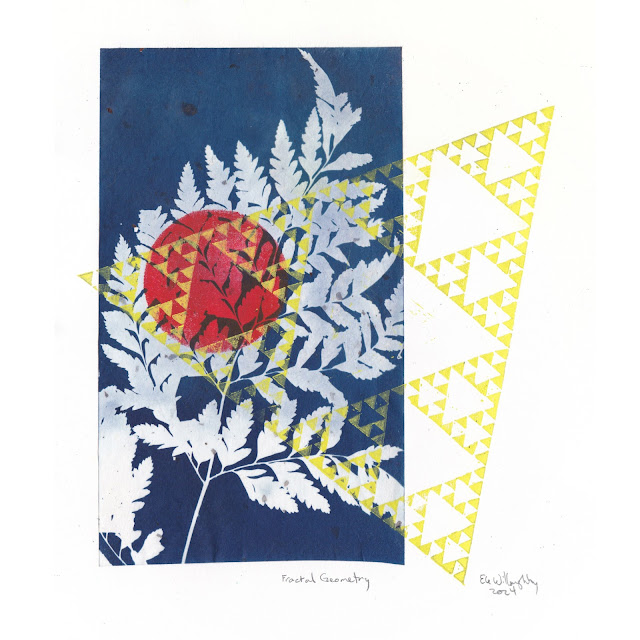
Fractal Geometry, cyanotype with gel print and linocut, 9" x11" by Ele Willoughby, 2024
 

And for the final prompt warm colours, I looked ahead once again to prompts for #InsertAnInvert2024 and decided I needed to make a true crab.

Frog crab, linocut print on washi paper, 8" x 8", by Ele Willoughby, 2024

 My hand-printed red frog crab (Ranina ranina), also known as a spanner crab or Huỳnh Đế crab, is hand-printed on Japanese kozo (or mulberry) paper 8" x 8" (20.3 cm x 20.3 cm) square. This crab is found in tropical and sub-tropical waters offshore Australia, the Philippines, Vietnam, the east coast of Africa, through the Indian ocean to  the Pacific offshore Japan and Hawai'i. It is the sole known member of its genus and it is fished for its meat. The 5.9" (15 cm) crabs live in 10 to 100 m (33–328 ft) or water, where they bury themselves in the sand during the day and hunt bottom-dwelling fish. Known as "frog crabs", on account of their elongated carapace and frog-like appearance. Their claws are modified into tools for digging, and the body is a rounded shape that is easy to bury in sand. Unlike most other true crabs, the abdomens of raninids are not curled under the cephalothorax, so they are a little unusual looking.

Ranina ranina is a regional specialty in some regions of the Philippines where it is known as curacha. It is generally eaten steamed as halabos, or cooked in coconut milk as ginataan. In Vietnam the species is named as "Huỳnh Đế crab", literally means "emperor crab" as it has been a favorite high-ranked cuisine of historical Vietnamese monarchs hailed "monarch of all the crab".


Tuesday, June 15, 2010

Fractal Geometry II on the Front Page

'Fractal Geometry II' on the front page

One of the leaf prints + lino prints of a fern leaf and Sierpiński Triangle just made it to the Etsy Front Page (in the bottom right corner) - much to my surprise.

I made that for an MSOE challenge on fractal geometry last September. I debated relisting it, and thought I should do something with the Sierpiński Triangle block. When I visited Etsy the funny thing is that with the new aspect ratio, at first I only saw the top row or so, and thought to myself, 'oh, are triangles still the thing?' and then I scrolled down and actually clapped my hands when pleasantly surprised.

Friday, September 25, 2009

fractal geometry

You were dying to know why I've been hunting ferns, right?

For the month of September, 2009, the MSOE challenge is 'Fractal Geometry'. Fractals are self-similar: their parts mimic (more-or-less) the whole. Some of the exotic species within this mathematical family have precise familiar shapes, like the simplest rectilinear object you could imagine, the triangle. Others have organic lines like coast lines or plants. The fern is a stereotypical example; oblong leaves with branch off of veins which in turn branch off of other veins, in a self-similar manner.

In this mono print, I am comparing and contrasting the aspect of self-similarity, by combining a block printed Sierpiński Triangle (the holes in which could in theory continue ad infinitum, but being human, there is a practical limit to what can be carved) and a printed fern leaf.

Fractal geometry I

Then, I did it again:
Fractal geometry II
Fractal geometry III - detail
Fractal geometry IV - detail