Showing posts with label butterflies are the new pirates. Show all posts

Wednesday, March 29, 2023

Love and Butterflies: Victorian Lepidopterist, Scientific Illustrator and Diarist


Margaret Fountaine linocut, 11" x14" by Ele Willoughby, 2023

Margaret Elizabeth Fountaine (1862-1940)'s posthumous books featured the somewhat salacious bits of her diaries of her "wild and fearless life," but she was a also trailblazing Victorian lepidopterist, who published in many papers in The Entomologist's Record and Journal of Variations, and was an expert on tropical butterflies, discovering, documenting, breeding and gathering specimen in 60 countries on 6 continents, a talented scientific illustrator, who gathered a collection of 22,000 (bequeathed to the Norwich Castle Museum). She became the only female fellow in the Royal Entomological Society in 1898. She gave scientific lectures internationality on things like "the sagacity of caterpillars." She was the most famous woman lepidopterist of the late 19th and early 20th centuries.
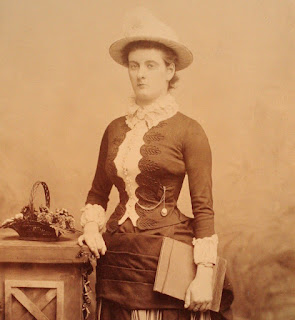

Margaret Fountaine
Margaret Fountaine wore many hats 


The eldest daughter of seven children born to a family of modest means of clergyman John Fountaine
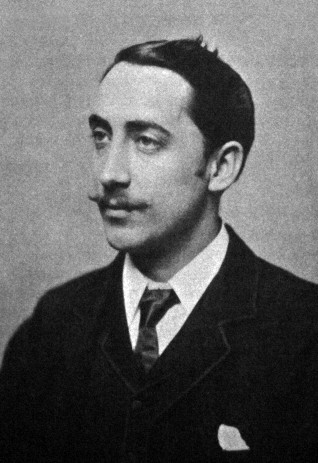
Septimus Hewson,
swindler & object of her affection

and his wife (also a clergyman's daughter) Mary Isabella Lee, Margaret was born in Norwich.  The family moved to Eaton Grange, Norwich, when her father died. The next year, at 15, Margaret began keeping a diary, a habit she kept up until her death in 1940. Teenage Margaret spent her time in nature, or gossiping with siblings about her crushes. She had already developed her interest in natural history, and her habit of falling for men she saw but didn't know... and recording her anguished feelings in her diary. She spent seven years yearning after an Irish chorister, Septimus Hewson, at her local church, pretending she was painting interior scenes of the church as an excuse to essentially stalk him. She wrote angrily in her diary if she spotted him talking to other women, though she herself had never dared speak to him. Sadly for Margaret, Septimus was a drunk and a swindler who thrown out of Norwich in disgrace. So Margaret claimed she was visiting some respectable ladies in Dublin, but snuck away to follow Septimus to Limerick and profess her love. He apparently reciprocated and she considered herself engaged. She returned home and wrote to him of her joy that her years secretly pinning after him would end with their marriage. After weeks of silence his own relatives wrote to her that she would be best to forget him; he had betrayed everyone he knew and squandered all his money on booze. She found herself nearing 30, a spinster by Victorian standards, with no prospects and no plan. But the death of a wealthy uncle when she was 27 had giving her and her sister the freedom to make choices that few of her contemporaries could enjoy. 
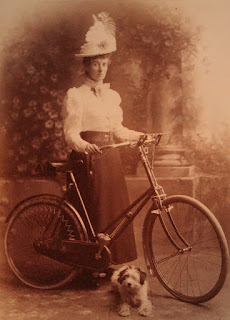
Margaret Fountaine with bike
Margaret Fountaine 
with bicycle and fabulous hat   

Her first move was to leave, and escape her painful memories of unrequited love. So she headed to the continent with her sister, touring France and Switzerland by bicycle, where she found a way to dull her pain by encouraging a series of men's affections and then scorning them She wrote, "it was the pleasure of inflicting that pain that my soul was craving for. I could do it - I had the power. I had learnt it now at last." She became more serious in her butterfly collecting, using Latin rather than common names. She settled in Milan, encouraged by a teacher who told her she could have a career in opera. The workload, training, lifestyle and uncertainty of success were not for her but she kept up her studies until 1895 when she met Henry John Elwes,  Fellow of the Royal Society, vice-president of the Horticultural Society and a passionate butterfly collector, at his UK estate. Butterfly collecting was not uncommon for Victorian ladies, but Margaret did not do things by half-measures.  Margaret realized this could be her life's purpose. Unlike hobbyists Margaret sought out not just to gather, but to document and breed species and to travel anywhere, no matter how inhospitable, to do so, tracking elusive species through European mountains, African deserts, South American jungles, Indian plains, Australia and islands of the South Pacific.  
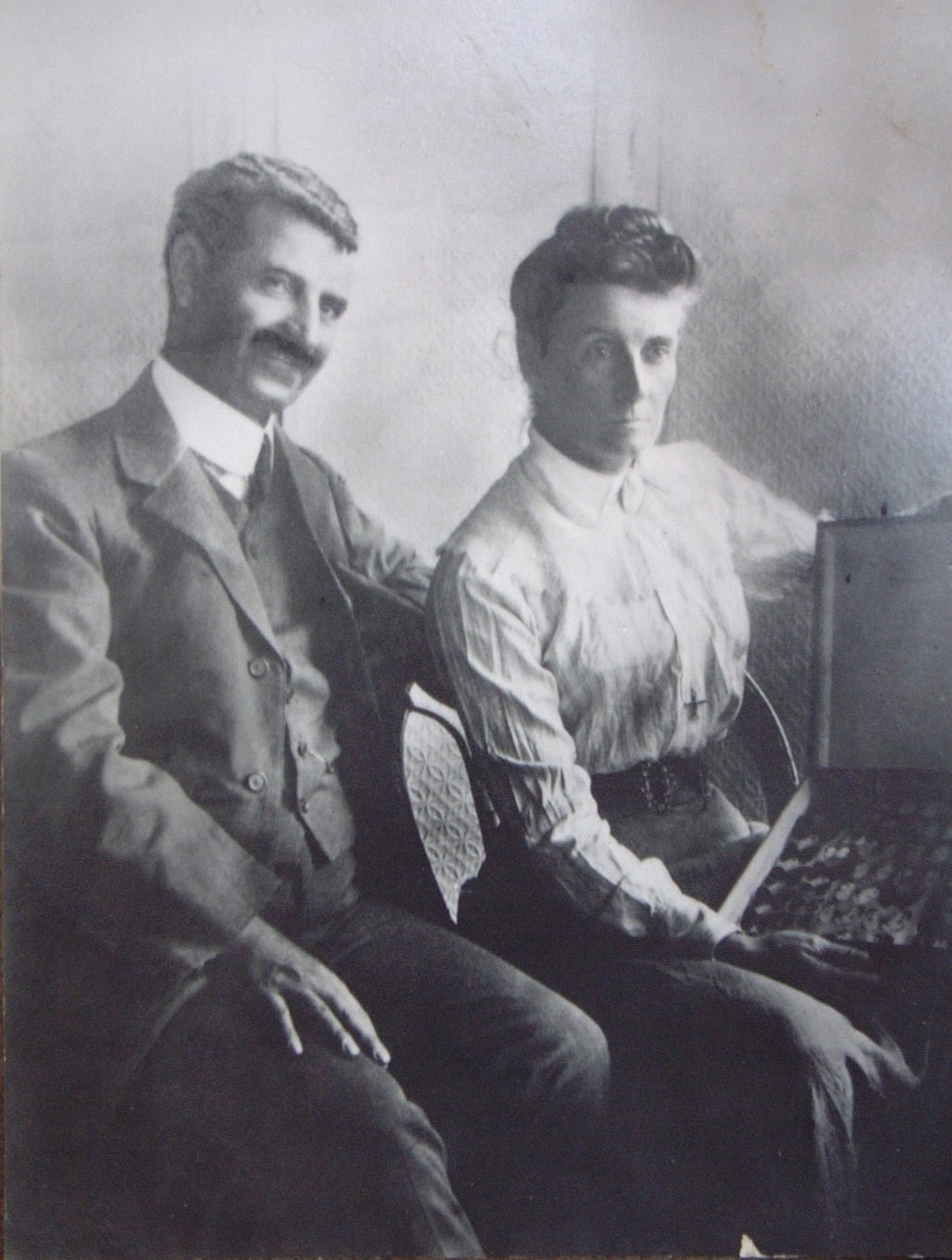
Margaret and Kalil, around 1912

Much of this work, for better or worse, was done in partnership with a dragoman (a sort of local fixer/interpreter and guide) Khalil Neimy, 15 years her junior, which
we know because she noted his help (when many peers did not bother) whom she met in Damascus. Though secretly married, he declared his love for her, and they spent many years of a tumultuous relationship together, travelling the world and collecting butterflies, and, in while South America, she developed means of rearing butterflies. She shared her knowledge freely with fellow collectors and entomologists, and though not dedicated to writing up her scientific results, her reputation was such that she was invited to join the prestigious Linnean Society in 1912. 
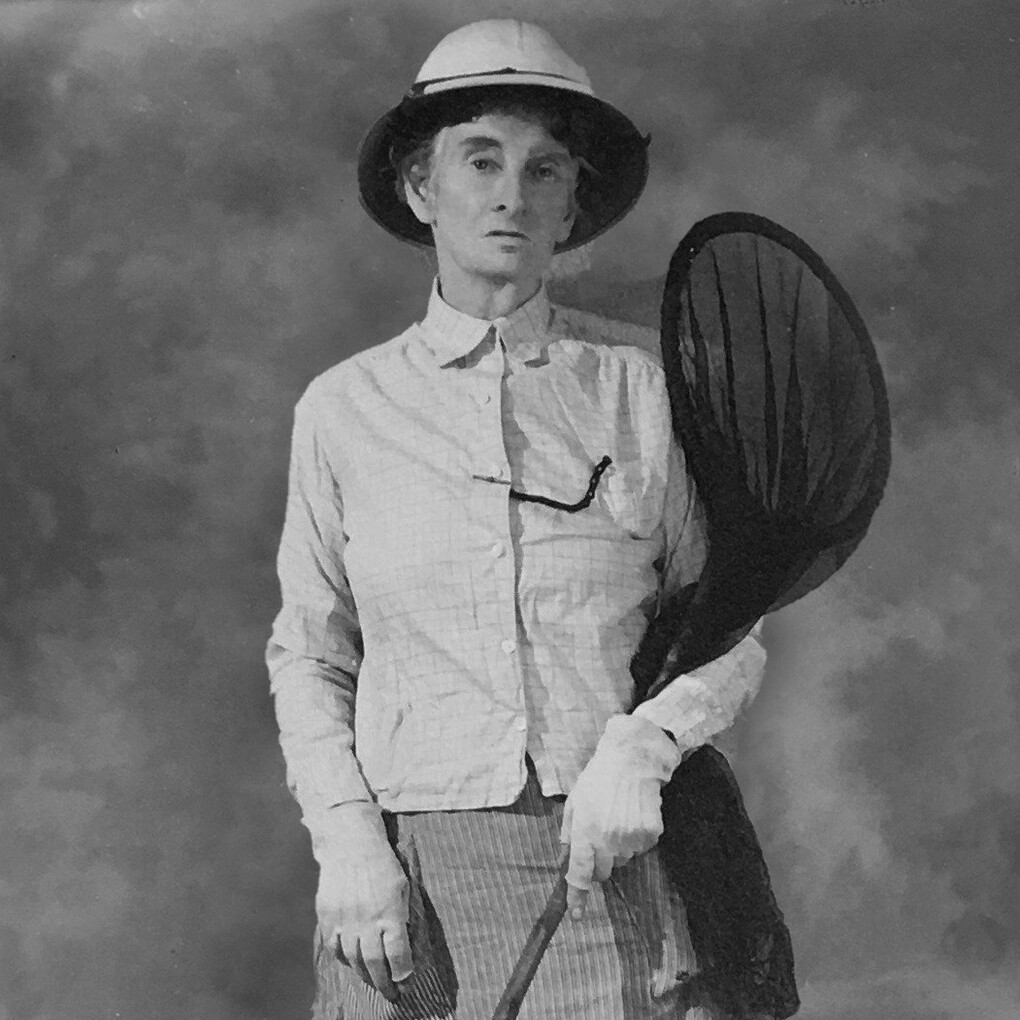
Margaret with her butterfly net
WWI hit her income as her investments plummeted in value, and for the first time she needed to earn money. She worked first as a simple cataloguer for a private collection in California and then, with her reputation for being able to find species no one else could, she started to receive collection commissions. This allowed her to continue to finance her travels and expeditions. Neimy confessed he was secretly married and was slow to get a divorce so they could marry. Also, as an Ottoman citizen, if they did marry, she would automatically become an Ottoman citizen, which she did not want. He struggled to get UK citizenship, seemingly forgetting that he also had US citizenship. But he died in 1928, and then Margaret discovered she was still seeing his wife, and fathering children while pursuing her. His loss, along with her sister's death and other family woes left her with less enjoyment of her life. But, she began to receive professional recognition and find herself the star of entomological gatherings, as she continued her fieldwork into her seventies. She died butterfly net in hand in the jungle, likely of a heart attack, discovered by a local monk. 

References

Dale DeBakcsy, Love and Butterflies The Adventures of Victorian Lepidopterist Margaret Fountaine, Women You Should Know, January 15, 2020

David Waterhouse, A Love of Butterflies - The Fountaine-Neimy Collection, Norwich Castle Museum and Art Museum, July 2, 2021

Florien Duijsens, Podcast # 27: Margaret Fountaine, Dead Ladies Show, November 19, 2019

The captivating life of a leading lepidopterist, KL Magazine, accessed March, 2023

Margaret Fountaine, Norfolk Women in History, accessed March, 2023

Margaret Fountaine, Wikipedia, accessed March, 2023

Monday, October 26, 2015

Maria Sibylla Merian, Entomologist, Scientific Illustrator, Explorer of Gardens and the New World

Maria Sibylla Merian
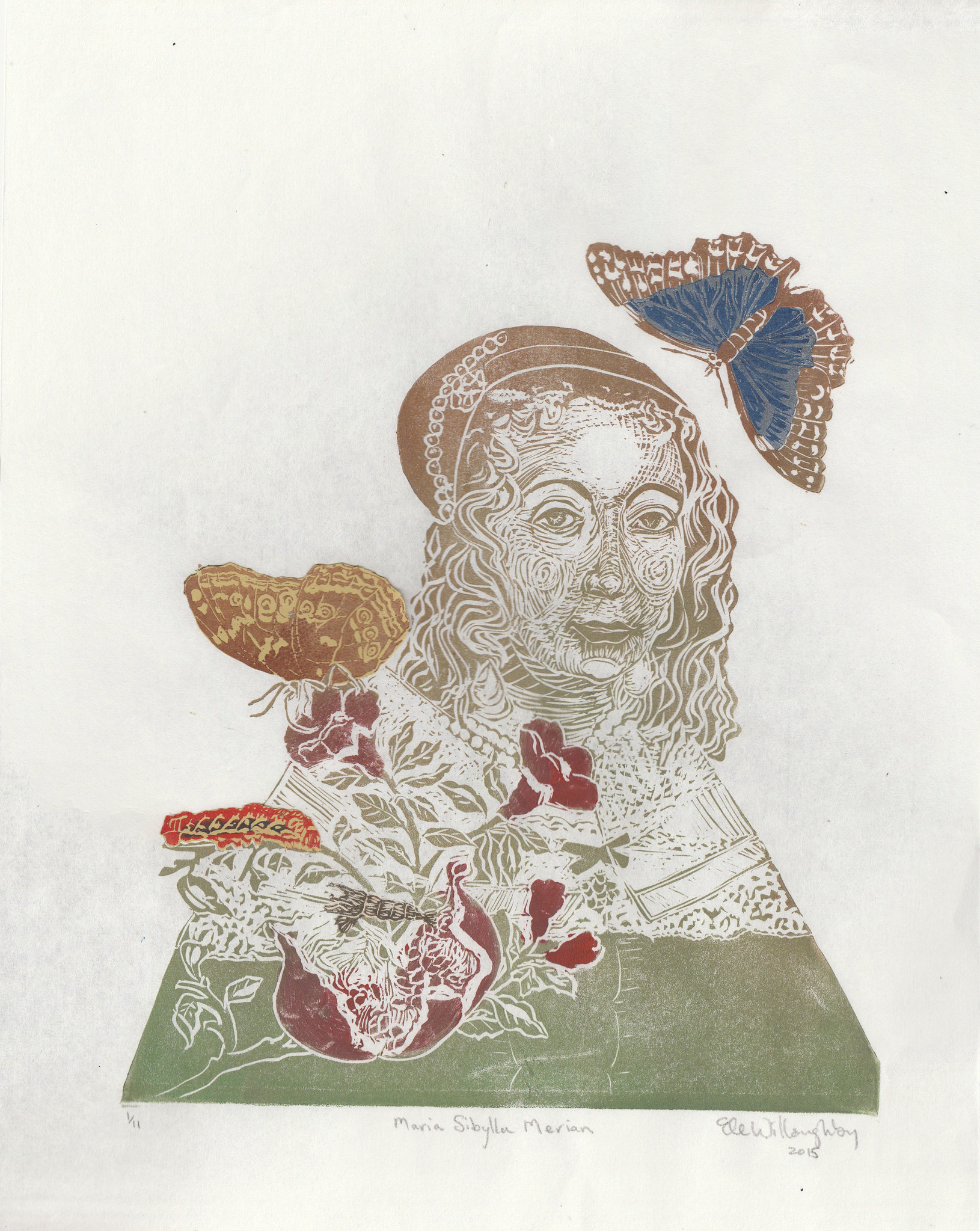
Linocut portrait 'Maria Sibylla Merian' by Ele Willoughby, 2015

This is a linocut portrait of Maria Sibylla Merian (1647-1717), leading entomologist of her day, traveller and scientific illustrator. She is shown complete with pomegranate branch and the life cycle of a morpho butterfly from caterpillar, to chrysalis in its cocoon to butterfly, inspired by her famous work 'Metamorphosis insectorum Surinamensium' - a process she carefully documented and explained. Each print is 11" by 14" (27.9 cm by 35.6 cm), on white Japanese kozo paper with collaged or "chine-collé" hand printed Japanese papers in beige, umber for the cocoon, caterpillar and two views of the butterfly in umber and blue.

The German-born naturalist came from a Swiss family who founded one of one of Europe's largest publishing houses in the 17th century. This allowed her early access to many books on natural history. After she lost her father at age three, and her mother remarried still life painter Jacob Marrel. Her step-father and his students trained her as an artist. She began painting insects and plants by 13. She wrote, "I spent my time investigating insects. At the beginning, I started with silk worms in my home town of Frankfurt. I realized that other caterpillars produced beautiful butterflies or moths, and that silkworms did the same. This led me to collect all the caterpillars I could find in order to see how they changed".

She married her step-father's apprentice Johann Andreas Graff, they had a daughter Johanna Helena, and moved to his home city of Nurenburg. She was able to contribute to the family income by painting, creating embroidery designs, and teaching drawing lessons to unmarried daughters of wealthy families, something which also allowed her access to the finest gardens where she continued collecting and documenting. She published her first book of natural illustrations, titled Neues Blumenbuch, in 1675 at age 28. In 1679, she first published her insect research in a two-volume, illustrated book focusing on insect metamorphosis. She moved twice to be with her mother after her step-father's death, then to join her half-brother at a Labadist religious community. She also split with her husband. After her mother's death, she moved to Amsterdam in 1691 and divorced her husband in 1692.

In Amsterdam, she was able to observe some of the collections of insects which had been brought back from Suriname. She became curious whether the life cycles of the exotic butterflies and other insects mirrored those Europe species she knew well. She was able to secure the city of Amsterdam's permission and and travel grant to travel to Suriname in South America, along with her younger daughter Dorothea Maria. She further funded her travels by selling 255 paintings. She planned a five year mission to study insects, making her perhaps the first person to plan a proper scientific expedition!

She travelled throughout the colony sketching insects and plants. She criticized the Dutch planters treatment of indigenous people and black slaves (though she relied upon amerindian slaves in her residence and her excursions, and brought a young amerindian woman named Indianin back with her to Holland). She used local native names for the plants and described local uses. Malaria likely cut her expedition short and forced her return to the Dutch Republic in 1701. She sold her collected specimen and in 1705 she published Metamorphosis Insectorum Surinamensium about the insects of Suriname.

She suffered a stroke in 1715 which left her partially paralysed and died a pauper in 1717. Her daughter Dorothea published Erucarum Ortus Alimentum et Paradoxa Metamorphosis, a collection of her mother's work, posthumously. Both Dorothea and Johanna followed their mother's lead and became botanical illustrators.

Modern scholars now appreciate her pioneering scientific work as well as the beauty of her scientific illustrations. During her life time insects were still reviled and people still put credence in the Aristotelian idea that they were spontaneously generated or "born of mud". She meanwhile detailed the life cycle of 186 species and explained the poorly-understood or even unknown process of metamorphosis. Science was conducted in Latin and her publications were in the vernacular, making them more popular with high society than contemporary scientists. Despite her knowledge and original research contributions she was not really recognized as a scientist in her day (though Carl Linnæus (1707-1778), father of taxonomy, did cite her in his Systema Naturæ of 1753). It was very unusual for a woman in her day to pursue science, let alone travel the world in its pursuit. She was able to do so because she began her studies with the accessible - animals she could find in her own backyard, and become the leading expert on metamorphosis. During her great expedition, she also noted their habitats, feeding habits and uses to indigenous people. Her classification of butterflies and moths are still relevant today. She detailed plants, frogs, snakes, spiders, iguanas, and tropical beetles and was the first European to describe both army ants and leaf cutter ants as well as their effect on other organisms.

Her work had a strong influence on future scientific illustration. Her work shows great accuracy and she was the first to illustrate the complete life cycle of insects. In her time, funding her expedition and her unladylike devotion to insects was ridiculed, but she is remembered as one of the best insect and flower illustrators of all time. Her daughters and student Rachel Ruysch (1664-1750) all went on to be renown botanical illustrators.

Shortly after her death, Peter the Great saw and purchased a large number of her works in Amsterdam. Her portrait was printed on the 500 DM note before Germany converted to the euro. Her portrait has also appeared on a 0.40 DM stamp and two American 32 cent stamps. Many schools, place names, a scientific research vessel and a crater on Venus have been named in her honour.

One last tidbit (or two) for you history of science buffs: Dorothea's daughter, Maria Sibylla Merian's granddaughter married mathematician Leonhard Euler (1707-1783). Maria Sibylla Merian was also first cousin to Jacob Christoph Le Blon (1667-1741), painter and engraver who invented the four colour printing process (using an RYBK color model similar to the modern CMYK system).

Saturday, June 21, 2014

Pollinators

bees

In the US, the Pollinator Partnership is celebrating National Pollinators Week, so I thought I would share some bees and butterflies. You've probably heard about the plight of the bees and the declining populations of pollinators in general. Pollinators are vital to our ecosystem and even if we are to be purely self-centred, our own food supply. I made these prints for a show on the biodiversity of bees. As I've mentioned before, there are some great resources for fostering our own local native bees on Resonating Bodies as well links to Sarah Peebles' sound and installation bee art.

I've noticed that my flower garden is attracting bees daily and I'm looking forward to luring more! I got the Bee Friendly Garden Seed Set from TEST member, printmaker and organic farmer Laura of cubits at our Spring Marketplace.


In other news, I lent some artwork to a science outreach program, planning an event on a vital topic... more on that later. Also, much to my surprise, I'm working on some logos for a cafe in Saudi Arabia.  Some sort of theme this week...

Happy summer solstice (or winter, if you happen to be south of the equator)!

Wednesday, June 11, 2014

June so far

Swallowtail and lilac It's been a busy week for us so far. On Saturday, it was the TEST 5th Annual Spring Marketplace. RJH dropped me off at the show and then took the baby for some men's only time. There were all sorts of garage sales on the Danforth, so they wandered around and got some loot. Our neighbour found a free second-hand ExerSaucer (it's a little baby gym, in which he can stand, supported... something my sister-in-law likes to jokingly call the 'circle of neglect' because it keeps babies occupied long enough to try and do something) which she kindly hauled home for little Mr. Monkeytoes.

Sunday was our first wedding anniversary. Though it was a bit cool and overcast, we all went to Ward's Island. We showed the baby where we were married and had a lovely picnic. It was a great day!

Since then, RJH has been spending his week of vacation busily working on replacing the horrid insulbrick on the back of the house. He went and bought some cedar shingles (from the maritimes of course). There were some discoveries: the wood beneath my studio window was completely rotted, and has now been replaced. Dad came by yesterday to help stain the shingles - on both sides- before installing them. We have a rain warning today, so RJH is staining shingles in the garage. He hopes to be able to complete this project by the end of the week.

On Monday, I sent off a large package of prints, and a couple of handprinted pillows, to Ambergris Gallery, on Block Island (also known as New Shoreham), Rhode Island. They're hosting a show called 'From the Depths' this summer, so my sea creatures will be exhibited by the oceanside!

I did get to take a bit of a walk with the baby Monday too. We spotted that lovely swallowtail butterfly on a large lilac while we were out.

We just finished our Spring show, but our Toronto Etsy Street Team never sleeps. We're already working on preparing for the fall show. Etsy: Made in Canada Day will be September 27, at MaRS, at College and University streets, here in Toronto. There will be simultaneous shows in at least 30 other Canadian towns and cities and we're planning on a national promotion campaign. Our own show will be a big one: we're thinking of hosting 100 vendors!

Biggest news personally on the artistic front: I'm going to be selling at the One of a Kind Christmas show this year! I'm going to have a 5' by 10' booth from December 2 to December 7. This is a huge show. I did their spring show last year, but wasn't up for either the Christmas or spring show since. Little Mr. Monkeytoes was born during the Christmas show last year, and was too small and in need of too much attention during the 2014 Spring show, but he'll be one (one!) by December, so I'll be able to get some help with the childcare. In the meanwhile, I have to plan and build my booth and gather a lot of stock. There are tens of thousands of visitors, so I'll need a lot of items. This is a big investment too, but I think it will definitely be worth it. Wish me luck! I'll let you know how my preparations are going.

Right, nose back to the grindstone. ;)

Thursday, August 1, 2013

New Monograms

FforFrog004
aardvark005
BforBear001

I've been making more monograms with the aim of producing a set of soft blocks with every letter of the alphabet included. In the meanwhile, I'm printing on a variety of papers of different colours, textures and patterns.

Thursday, August 16, 2012

It's Not the Moths Pillow

anti-moths broadside pillow

This one of a kind, handmade pillow features an image of my 'Moths' linocut, printed on a cotton silk blend fabric with a soft sheen. The reverse of the pillow is pin-striped greys and browns with irridescent threads and a beige and turquoise butterfly print cotton. The pillow is about 14.5" by 12" (37 cm by 31 cm). You might recall my explanation of my broadside:
I got no quarrel with the insects. Just because they have six legs and an exoskeleton is no reason to revile 'em. The beasties of the Lepidoptera order are beautiful and multifarious. We take their cousins the butterflies as symbols of the soul. I've personally long maintained that butterflies are the new pirates, with their ever-increasing popularity. I understand that insects will share my habitat - and even my home - as they, after all, were here first. We may even compete for the same resources in our shared environment. It's just the expensive tastes of the moths... they've crossed the line. It's not like I even own very many cashmere items, and the little #$@& went after them all.
So, I had the broadsides printed onto fabric, to make lovely cushions. Surely, the moths are now quaking in their boots. All 6 of them.

reverse of moths pillow

Wednesday, June 6, 2012

A Kaleidoscope of Butterflies

kaleidoscope-b1

A collection of butterflies, like those in this linocut, is called 'a kaleidoscope'. Isn't that perfect? I think it suggests a flutter of colourful, symmetric, beauties. This is the fifth in a series of the weird and wonderful terms of venery (collective nouns for animals) prints.

This lino block print is printed in black ink on Japanese kozo (or mulberry) paper 12.5 inches by 12 inches, or 31.7 cm by 30.5 cm in dimension, in an edition of twelve. Each butterfly involves 'chine collé' (collaged, delicate, Japanese paper) for their glorious colour. They are arrayed with a three-fold symmetry, like images in a toy kaleidoscope. There are three each of the orange Isabella's Longwings (Nymphalidae Eueides isabella), three yellow Eastern tiger swallowtails (Papilio glaucus), and three blue Red-Spotted Purples (Limenitis arthemis astyanax).

For this series, I'm designing the typography to match the subjects. The word 'kaleidoscope' has clean, simple, and where possible circular or linear lines, like images in the toy itself. The word 'Butterflies' starts with a butterfly 'B', and encorporates one butterfly in its midst and wing shapes in the 'f' and 'l' and even a tiny butterfly in the dot on the 'i'.

As you might imagine, I do love butterflies, and, like moths, they have figured previously in my prints. Butterflies are quite amazing creatures and its not surprising that they are an important symbol to many cultures. I think they are growing in popularity, and like to say, "Butterflies are the new pirates," but I'm not sure anyone believes me. This print was rather complex to design, carve and print, but I think it's worth it.

You might recall my feelings about moths.

kaleidoscope738

There is a butterfly in the middle of the word 'Butterflies' because butterflies tend to land in the middle of things. That's my story... it's definetly not a clever fix. It's not like I started thinking to myself I could make butterfly shapes for the 'B' and the calligraphic 'f', but then thought butterflies have two sets of wings, requiring 4 loops, so subconciously decided that there needed to be a second 'f'... because that would be illogical, and my spelling can't possibly be that bad... no, that never happened.

Monday, November 14, 2011

Reading is sexy XLVII

(image by Mladen Penev)
Goodness. From reading this blog, you would think that I have given up on the pastime of reading. I haven't posted a thing since August. Usually, I aim for 50 and hit about 40 books in a year. This year, I'm nowhere near that. Though, on the other hand, I've read a couple of epic books, which probably should count for at least three normal books (and in fact, one of them does, in the original Japanese). The trouble though, with not posting promptly, is that it is less fresh in my mind. In fact, I might omit an entire book! Ah well...

17. Too much happiness by Alice Munro. This is an excellent collection of short stories and the titular novella. (It won the 2009 Man Booker International Prize). I sought it out because I am interested in Sophie Kovaleskaya (there are various spellings and means of transliterating from Cyrillic characters, Со́фья Васи́льевна Ковале́вская) the nineteenth century master of mathematics and literature, and first female university professor in Northern Europe. Like the other (fictional) characters in these stories, her real life and marriage was complex, and she sought love in the wrong places. The stories have stayed with me; the people seem real, with faults and virtues, interacting in ways they don't foresee any more than the reader would. Several stories are overshadowed by violence, or the threat thereof. The collection is capped with the novella based on the facts of Kovaleskaya's turbulent life (her nursery wallpapered with her father's old calculus notes, her introduction to nihilism, her initially sham marriage as a means to escape Russia and pursue a higher eduction, her fight to study mathematics and her relationship with her thesis supervisor Karl Weierstrass, her return to Russia, the birth of her daughter, the complexity and end of her marriage, her writing, her life and professorship in Sweden, her lover, her premature death) and her ironic last words, 'Too much happiness.' Beautifully crafted and plotted stories.

18. The Crying of Lot 49 by Thomas Pynchon. I managed to read another Pynchon novel, but this early one is a mere 126 pages. Though, he packs those pages with more life, conspiracy, insanity, radio DJs, dead millionaires, secret codes, illegal underground mail systems, engineer bars complete with Lissajous figures on an oscilloscope for a sign, dive motels, psychiatrists doling out LSD to housewives, skeletons, a teenage band called the Paranoids, clues in bloody Jacobean Revenge Plays, stamp collecting, and one sex scene of more slapstick hilarity than can be imagined without reading the book. Oedipa Maas gets more than she bargained for when she agrees to be the executor of her former lover's estate.

19. Travels in the Scriptorium by Paul Auster. Well, if I can read one book with a complicated relationship to reality as we know it, why not two? Mr. Blank, an old man, awakes each day in a simple room: door, window, bed, desk and chair, but no memory or understanding of where he is or why he's there. He doesn't know if he is being imprisoned or is free to leave. A couple of people visit him, and he is given some clues to understand his fate. This odd, post-modern yet grounded, novel feels like one of the parables of José Saramago. It is a game between the author and the reader and the characters, but it is not only a game. It will be more rewarding if you read the New York Trilogy first.

20. The Woodcut Artist's Handbook by George A. Walker This was a thorough and enjoyable resource on 'everything you wanted to know about relief printing'. I've had it for some time and am glad I finally read it. Though intended to serve as a textbook or reference for printmaking students, it is very readable - especially since it includes a large collection of illustrations of relief prints from many artists, most of whom are also quoted describing their own techniques and preferences.* In terms of woodcut, he focuses on Western methods of engraving and woodblock printing, which is useful to me, in that I've only studied Japanese moku hanga methods. Though, that would be the one criticism; to be truly comprehensive, the book might have included more on Japanese and Chinese approaches to relief prints.

21. ghost by Alan Lightman. I've read a few of physicist-turned-novelist Alan Lightman's books and articles. I really enjoyed Einstein's Dreams, which was genuinely new and innovative. I have found some of his writing less to my taste. I wasn't sure what I was getting into with ghost. As it turns out, it's compelling and subtle novel about a man struggling to cope with something that defies characterization. David was always smart, but did not finish law school. He finds himself, divorced from a wife he adored and mystified how he lost his job at the bank. He takes a job at a mortuary, temporarily he thinks, because he needs a salary. There, in the resting room, he sees something. That is where his problems begin. How does he process what he's seen? What should he say or not say to the people in his life (his girlfriend, the people in his apartment building, his colleagues, and ultimately, the press and scientists who become embroiled in the story). This is a very earnest character-driven story, and the relationships between the characters are quite something. It's also a meditation on knowledge, the bounds of knowledge and superstition.

22. 1Q84 by Haruki Murakami I am a huge fan of Muraki; I've read every book which has appeared in translation: novels, short stories, non-fiction, even anthologies he's edited and a book about him by Jay Rubin (one of his main two translators into English).

1Q84 did not disappoint me; this is the hard-boiled, fantastic, supernatural Japan full of high and low culture (from ad slogans, to under-appreciated jazz clarinettists, to fashion, to cooking and to Proust and Chekov) like only he can write. The title is a play on words. In Japanese, 9 is kyu, and the title alludes to Orwell's 1984 and the setting, a strange version of 1984 Japan, where our heroine Aomame (literally her family name means 'green peas') finds more and more things are not what they were. She begins the novel stuck in traffic on an elevated expressway, to the sounds of Janáček's Sinfonietta, and her cabbie informs her that she could only make her meeting if she takes the unusual move of abandoning the cab, and climbing down the emergency staircase (in her designer suit and heels). He warns however, that things may change, and that there is only one reality. Not really remarking on his words, she takes the staircase to her important meeting, and finds herself in a different version of 1984, which she dubs 1Q84. The police have new uniforms and guns, since breakfast. She was somehow unaware of a big news story: a shootout between a militant faction of an organic-farm-cum-religious cult Sakigake and the police. Most damning, the moon now has a new smaller, greenish companion moon. Aomame's story is interwoven with that of Tengo Kawana, mathematics cram school teacher and budding novelist. Tengo is convinced to take part in a shady scheme to act as ghostwriter, for a strange 17 year old girl Fuka-Eri's stranger story 'Air Chrysalis'. As the novel unfolds we learn of the bond between Tengo and Aomame, though separated for 20 years, they fell in love at 10, before either really knew what that meant. Though Tengo excels in school and sports, he has an unhappy boyhood with his undemonstrative, demanding father who drags him door to door while he collects fees for the national NHK TV broadcaster. Aomame is likewise dragged door-to-door in the hopes of using guilt to get better treatment, by her mother, a devout follower of the Society of Witnesses. They intuitively recognize their akinness as children they spend the rest of the novel increasing seeking each other out.

This is a dark novel for Murakami. Though previous novels included occasional graphic violence or the terrors of war, this novel focuses more attention on domestic and sexual violence and abuse. Aomame goes from fitness and self-defense instructor to becoming involved in vigilante assassinations. There are a series of suicides, and several murders in this novel. Murakami is also investigating the nature of the religious cult in this fiction (after his extensive non-fiction investigation of members of the Aum Shinrikyo cult following their notorious sarin gas attack on the Tokyo subway system in 1995). Fuka-Eri, it turns out, based her 'Air Chrysalis' on her childhood experiences in the Sakigake compound. This being a Murakami novel, involves a dead, blind goat, the Little People and an air chrysalis, doppelgangers/alter egos and running away. Soon in Aomame's parallel story, she too finds herself embroiled with Sakigake. The 925-page novel (published as 3 books in Japanese) drags the reader into the 1Q84 otherworld. It is compelling, exciting, moving, disturbing, sad and hopeful. I couldn't put it down.**

I certainly recommend this novel; it is quite amazing. However, if you haven't previously read Murakami, start with A Hard-Boiled Wonderland at the End of the World or A Wild Sheep-Chase. I do think a caveat is necessary; this is a darker and more violent novel than his others. It also features various depictions of sex and sexuality (though the violence is mercifully 'off-stage'). It isn't a book for young people. I read three articles in The New York Times about it. One was a wide-eyed sort of interview, marveling at the inventiveness, strangeness and scope of the novel. The other was a mixed review, which criticized the moral ambivalence (after all, sexual abuse isn't a metaphor) but conceded that this book made the reviewer think much more than most. I think in some ways the lack of moralism is a strength because it forces the reader to grapple with hard questions (what is the solution to domestic violence, is vigilante justice warranted, what can and cannot be allowed as part of religion, what is evil). So I enjoyed the novel more than she, but her criticism seems just. The third article is a poor review, but someone with little patience for loose ends is perhaps reading the wrong novelist. I think this book is amazing, but I do recognize that it won't appeal to all.

{Series so far: books read, more books read, books read, books read continues, more books read, I, II, III, IV, V, VI, VII, VIII, IX, X, XI, XII, XIII, XIV, XV, XVI, XVII, XVIII,XIX, XX, XXI, XXII, XXIII XXIV, XXV, XXVI, XXVII, XXVIII, XXIX, XXX, XXXI, XXXII, XXXIII, XXXIV, XXXV, XXXVI, XXXVII, XXXVIII, XXXIX, XL,XLI, XLII, XLIII,
XLIV, XLV, XLVI}

*Because the world is very small, amongst the artists is 's father.
**If you wondered where I was last week, my world was coping with an ear infection and 1Q84.

Tuesday, November 8, 2011

Io, myth and moon

Io-stitched2

In this three colour (2 screen) screenprint, I combined Io, both the nympth (in cow-form) of Ancient Greek myth, and Io the large, volcanous moon of Jupiter. I'm interested in exploring the role of myth and imagination in science, and specifically here, how astronomical naming has been traditionally based on mythology. To make this screenprint, I combined my pencil drawings of cow/nymph Io and cloud with a NASA photograph of Io, which I manipulated. The screenprint is one of an edition of 10, printed in yellow (with a hint of lime), magenta and purple, on white paper, 28 cm (11 inches) square.

The story of Io is a funny one; she is one of many nymphs who caught the roving eye of notorious womanizer Zeus. As told by Ovid, in 'Metamorphoses', Io rejected Zeus' nighttime advances until the oracles lead her father to drive her into the fields. There, Zeus covered her with clouds to try and hide her from his justly jealous wife Hera, who nonetheless decuded there was something suspicious going on. Zeus then upped the ante and turned himself into a cloud and Io into a beautiful, white heifer. Hera, used to such nonsense, was not fooled and demanded the white heifer as a gift, which Zeus could not refuse. Needless to say, Hera kept this cow far from her unfaithful spouse. So, I made Io a lovely beribboned, heifer with garlands of flowers, resting on a fluffy (if lascivious) cloud.

The story goes on with more shenanigans, including Hera sending a gadfly to harass poor Io, which apparently has something (etymologically at least) to do with the oestrous cycle... but I didn't want to tell the revenge part of the tale, and no one wants to think about menses, though a relentless, vengeful, stinging gadfly does make some sense to me. Anyhow...

Io-small

Io, the Jovian satellite - or moon, is the innermost of the four Galilean moons which Galileo first observed and identified (January 8, 1610 ) in orbit around Jupiter.* Galileo knew the importance of a good patron and he named them the 'Medician stars'. Io and her sister Jovian moons were important to the history of science. Their observation made it clear to Galileo that it was not possible that everything circled the earth if these moons circle Jupiter and thus, Copernicus must be right. We now know that this lovely moon is the most geologically active place in our solar system, with its more than 400 volcanoes fueled by tidal heating, as it is violently pulled in multiple directions by the strong gravity of Jupiter and the other moons. It has been beautifully photographed by a series of satelittes sent from Earth.

The Mad Scientists of Etsy challenge for this month is 'metamorphosis'. I thought I would make something related to science but with a less expected connection to the theme of 'metamorphosis'. Rather than natural, biological metamorphosis**, this print brings the mythological, metamorphosed Io (of Ovid's 'Metamorphoses') and the moon Io unexpectedly together.

*The IAU Gazetteer of Planetary Nomenclature points out that Simon Marius may even have observed Io days prior, but he neither published nor necessarily realized what he saw. Nonetheless, he named the Jovian moons. (He believed in Tycho Brahe's system, which was mid-way between helio- and geo-centric, with planets circling the sun, which in turn circles the Earth. At the risk of putting a footnote on my footnote, I'll point out that this in not as illogical as it sounds, because Tycho was an excellent experimentalist and couldn't justify a heliocentric model with his data... because he couldn't observe stellar parallax. So, he was wrong, not because he avoided new ideas, but because he was conscientious and the data for parallax was not acheivable with the technology of the time. Go team Tycho! Never underestimate an honest experimentalist.).

**Butterflies may be the new pirates, but I just don't like larvae.

Thursday, October 13, 2011

Winged Walrus

I wanted to make a linocut which would qualify for a mini-print competition. The printed area must only be 10 cm by 10 cm (3.9 inches to 3.9 inches) on a 18 cm by 18 cm (7.1 inches by 7.1 inches) sheet. So, I returned to an idea I've played with before: the winged walrus.

Winged Walrus

The walrus is printed on Japanese kozo (or mulberry) paper with collaged or chine collé wings pale yellow Japanese tama paper (a lightweight watermark tissue). There are 15 prints in this first edition.

I like the idea of a massive walrus supported by delicate butterfly wings. Here are some of the ways I've interpreted this before:

Walter, the winged walrusWilt, winged walrus, topwingedwalrus

Tuesday, September 27, 2011

Scrappy Strip Quilts

Elle's Scrappy String Quilt

I really like the photos posted by The Workroom's flickr stream. You can see most of the other quilts made in their classes if you follow this link.

Elle's Scrappy String Quilt

Monday, September 26, 2011

Scrappy Strip Quilt - and butterflies, dinosaurs, fractals and more

scrappy strip quilt

I finished my quilt. I was torn on whether I wanted to block print the fabric or not... but I'm glad I did. Here's the reverse:

Reverse of scrappy strip quilt

I made this quilt with stripes of fabric scraps from my stash, including vintage thrifted fabrics and contemporary prints. I block printed the sashing with my own carved monarch butterfly lino block. The reverse is a patchwork with the green sashing fabric, rectangles of the fabrics used on the front and a series of my block prints on fabric including a dinosaur, jellyfish, bees, butterflies, Russian nesting dolls, a fractal triangle, a quail, a rhino, and a blue whale. The quilting is done in a couple of variegated threads, by machine. The quilt is 39 inches by 57 inches (1 m by 146 cm), maybe the size of a child's bed.


Pretty nifty what one can do with scraps, imagination and patience, no?

Tuesday, May 10, 2011

more moths

moths3

So I completed another moth broadside (and listed all 3). Perhaps I should paper my walls with these and dare the little $^#* to eat them.

Tuesday, December 14, 2010

Samiya the cat pillow

Also, there will be more cats!

minouette 031

Meet Samiya:
minouette 030minouette 036

I'm glad to use that crazy vintage fabric, which looks like some sort of acid-fueled labyrinth. I think it works. I also embroidered Samiya's eyes. I've been thinking about embroidery of late.

Don't forget: butterflies are the new pirates.

Sunday, March 21, 2010

Entomology Pillow

Watch minouette compulsively avoid grocery shopping by wasting time on the internet. I hate grocery shopping. It's a problem. Anyhow, here's a new pillow:

entomology pillow
entomology reverse
butterfly detailentomology pillow beeentomology pillow monarchentomology fabric

This one of a kind pillow features three original, hand-pulled block prints on fabric, of some of the loveliest insects: butterflies and a bumblebee. The front is a patchwork of a contemporary faux-bois print in deep blue, with a butterfly on a grass green cotton, a bumblebee on a delicate pin-striped umber and sunny yellow, and a monarch butterfly on a vintage floral. The reverse combines a rustic, hand-woven Nepalese fabric with a contemporary print like a scientific illustration of butterflies, moths, ladybugs (ladybirds) and bees.

I like the idea of combining vintage and rustic fabrics with contemporary fabrics, and embellishing things through printmaking to make something new.

The Mad Scientists of Etsy challenge for March is entomology. Natural history is still hot. When I was an undergrad studying physics, people would invariably ask, "Why would you want to do that?!" assuming, erroneously that their own tastes were universal and I was some sort of masochist. I always thought about the entomologists, because, while I know intellectually, they must derive pleasure from it, and probably think bugs are cool, I feel that the fear of creepy-crawlies is primordial. Though, it's the helminthologists I really worry about. If there's ever a helmintology challenge, I think I'll sit that one out.

Thursday, March 11, 2010

Bumblebee

I posted a new bumblebee chine collé linocut in my shop
bumblebee 001

This is a first edition lino block print of a bumblebee on Japanese kozo (mulberry) paper with yellow washi chine collé (collaged fine Japanese paper). The term chine collé is from the French for "papier-chine collé" or glued Chinese paper (though fine Japanese is more likely); it's a way to get a different colour or texture in a relief print. The bee itself fits with 10 cm (4 inches) square and the sheet is 20 cm (7.9 inches) square. The print is one of only 12.

bumblebee 008

For the month of March, the Mad Scientists of Etsy are celebrating entomology! Even though, butterflies are the new pirates, I thought I would make a bee, and since Reynardin encourages me to carve fur, I went for the fuzzy bumblebee.

Actually, this is sort of Step 1. I am planning an entomology pillow (yes, really). Also, I have this New Year's resolution to submit prints to print shows and contests, and there is a mini-print show in Ottawa, I'm considering. Prints must be 10 cm by 10 cm (and can be on sheets up to 20 cm by 20 cm). My other option would be, the Hand-Held Harpy. Or to make something else, pronto.

Hand-Held Harpy Linocut

Monday, March 1, 2010

seahorse & jellyfish/butterflies, blossoms and feathers

It's my mother's birthday on Wednesday, but since we had planned to go to the OB's (post hockey game) we just ended up celebrating yesterday. She asked me, yesterday for a silk scarf to go with a new gray dress. I said I would choose red, but she mentioned salmon (as a colour). Here is what I came up with. I had some striped greyish silk. I printed it with the jellyfish and seahorse blocks in salmony pink.
seahorse and jellyfish

I had some hand-woven Thai floral silk (oh, the wonders of the Sidney Thrift Store!), which I embellished with butterflies, blossoms and feathers in black, and tints of salmon, peach, orange and pink. Honestly, it's less busy than that sounds:

butterfly side of scarf

I painstakingly sewed the two rectangles together. Silk can be tough and finnicky to deal with.
butterfly end of scarf
blossom, butterfly, feathers
butterflies, feathers
blossom, butterfly, feathers

I actually wear a lot of silk scarves* but have never previously attempted to make one.

*Ok, actually, it's a running joke: how many scarves does have on her person at any give time. But they are the solution to style + unpredictable weather: 40 million French women can't be wrong. I have um, several.