Showing posts with label moth. Show all posts

Monday, September 21, 2026

Brains and Buckmoths

A couple more new prints I made for #SciArtSeptember are 'Amygdala' and 'Bogbean Buckmoth' which I made for the almond (shape) and silk prompts respectively. Did you know that amygdala literally means almond-shaped? I did not, but it inspired my print. 

Amygdala, cyanotype print by Ele Willoughby, 2026
Amygdala, 8" x10" cyanotype print, by Ele Willoughby, 2026

This one of a kind cyanotype on water colour paper has an image of an open source brain MRI with the amygdala highlighted in gold. The amygdala is a paired nuclear complex in the cerebral hemispheres of our brains (and those of other vertebrates). Part of the limbic system, the amygdala has a primary role in the processing of memory, decision-making, and emotional responses (including fear, anxiety, and aggression) but also plays a role in things like social communication and understanding. 

The Bogbean Buckmoth is an endangered giant silk moth, here in Ontario.

Bogbean Buckmoth, 8" x 8" linocut by Ele Willoughby, 2026

This is a hand-printed lino block print of the endangered Bogbean Buckmoth (Hemileuca sp.). It is printed by hand in dark brown, black and rusty-orange in on lovely Japanese washi (or mulberry) paper, 8" x 8".

A day flying silk moth and the only buckmoth (Hemileuca) in eastern Canada, the Bogbean Buckmoth is very distinct with its black and white wings with eyespots and its black body with both white and rusty orange markings on the thorax and abdomen. It is a medium-sized moth with forewing lengths of 26–32 mm for males and 32–36 mm for females. Bogbean Buckmoth populations are known only from eastern Ontario and New York; it is listed as endangered in both jurisdictions. It only lives in open, chalky, low shrub fens containing large amounts of bogbean, an emergent wetland flowering plant which is the primary food of its larvae along with bog cranberry. Though the adults can fly for several kilometres they rarely leave the region around their home in the fens, increasing their isolation.

The Bogbean Buckmoth has a one-year life cycle. These moths spend the winter as eggs and emerge as larvae (black with reddish-orange branched spines along the back) the next spring, becoming adults in mid- to late September.

Here in Ontario they are threatened by habitat loss and changes like water level fluctuations, land development, pesticide use and climate change and its impact on wetlands. Also, its preferred food, the bogbean, is threatened by invasive plants, especially the European Common Reed and Narrow-leaved Cattail.

Wednesday, September 9, 2026

Pollinators by moonlight and in the garden

Still enjoying playing with cyanotype combined with linocut. Here are a couple of recent ones where I combined a moon cyanotype with varies plants and linocuts of insects.

Moon, moths and lanternfly
Moon, moths and lanternfly. 11" x 14" cyanotype and linocut by Ele Willoughby, 2026


Moon and Plants Cyanotype With Linocut Butterfly and Moths
Moon, plants, moths and butterfly 11" x 14" cyanotype and linocut by Ele Willoughby, 2026


September is a busy #scicomm month with the Mineral Cup (which you can catch on bluesky or mastodon) and SciArtSeptember. If you've been following along, some of my art that I am sharing daily will be familiar. I also made a brand new linocut for the prompt ruby: a male ruby-throated hummingbird with Canada columbine. 

Ruby-throated hummingbird, 8" x 8" linocut by Ele Willoughby, 2026


Friday, September 15, 2023

New Natural History Prints for SciArtSeptember


Cochineal, linocut 8" x 8" by Ele Willoughby, 2023


For the SciArtSeptember prompt carmine, a bright red pigment derived from carminic acid, traditionally harvested from cochineal, a sessile parasite on Opuntia cacti in South America, north through to Mexico and the southwest US, I made this linocut. The cochineal are laboriously collected by brushing them off the pads of prickly pear cacti. The insect makes carminic acid to deter predators but it’s precisely what attracts people, who dry them out, extract the acid and mix it with aluminum or calcium salts to make carmine dye.

The dye was important historically for textiles (prior to the invention of synthetic dyes in the 19th century). Aztec and Maya peoples were using it as early as the second century BCE. It was used in Peru from the Middle Horizon period (600-1000 CE). Moctezuma II demanded yearly tributes of cochineal dye by the 15th century. Aztecs used it in manuscripts. Colonial powers exploited the dye in the 16th century. It produced in places controlled by Spain and Portugal. It was the second most valuable export after silver. The British began using it to dye their red coats and were frustrated by the Mexican monopoly on trade. There have been various disastrous attempts to export the insects and dye production to places like Australia.

Today, in an effort to avoid synthetic dyes, cochineal is used in food and cosmetics and it may be in your lipstick.


Hummingbird Clearwing, linocut, 8" x 8" by Ele Willoughby, 2023


This is a hand-printed lino block print of the charming Hummingbird Clearwing moth (Hermaris thysbe) seeking pollen from cherry blossoms. The olive-headed burgundy moth has transparent wings (though colour can be variable). It beats its wings rapidly to hover above flowers, like a hummingbird, meaning it is often confused with a hummingbird or bee. It has a 5 cm wingspan. Its bulky abdomen has lead to its adorable nickname "the flying shrimp." The caterpillar likes to feed on cherry amongst other things and as a moth, it feeds on a wide range of flowers, with a preference for pink and purple, so I chose to illustrate it with cherry blossoms.

Its range covers most of North America. It is a migratory species which is common here in Ontario, and in the eastern US.

Its scientific name Hermaris thysbe is likely a reference to Thisbe, half of a pair of ill-fated lovers in Ovid's Metamorphoses and her blood-stained scarf. It's a reference to the moth's reddish-brown colour. 


Talon, tinted drypoint print by Ele Willoughby, 2023


For the #SciArtSeptember prompt talon, I tried drypoint using an aluminum pop can! I cut it open with strong kitchen scissors and incised a drawing of a harpy eagle talon with an exacto knife. I used some small leftover rectangles of mat board to get black relief printing ink into the lines and wiped away the excess with junkmail on newsprint - so the entire process was done using what would otherwise be garbage. I printed it using my small etching press, and tinted the talon by hand with gouache.

Friday, September 4, 2020

More Animal Prints and Imaginary Friends of Science

I haven't kept up with my own prints during this weird time, so today I'm going to share a bunch of recent prints!


Pair of Adélie Penguins linocut by Ele Willoughby
Adélie Penguins linocut by Ele Willoughby

Orca linocut by Ele Willoughby

Black Bear linocut by Ele Willoughby

Beaver linocut by Ele Willoughby

Moose linocut by Ele Willoughby
Moose linocut by Ele Willoughby  

Yeti crab linocut by Ele Willoughby

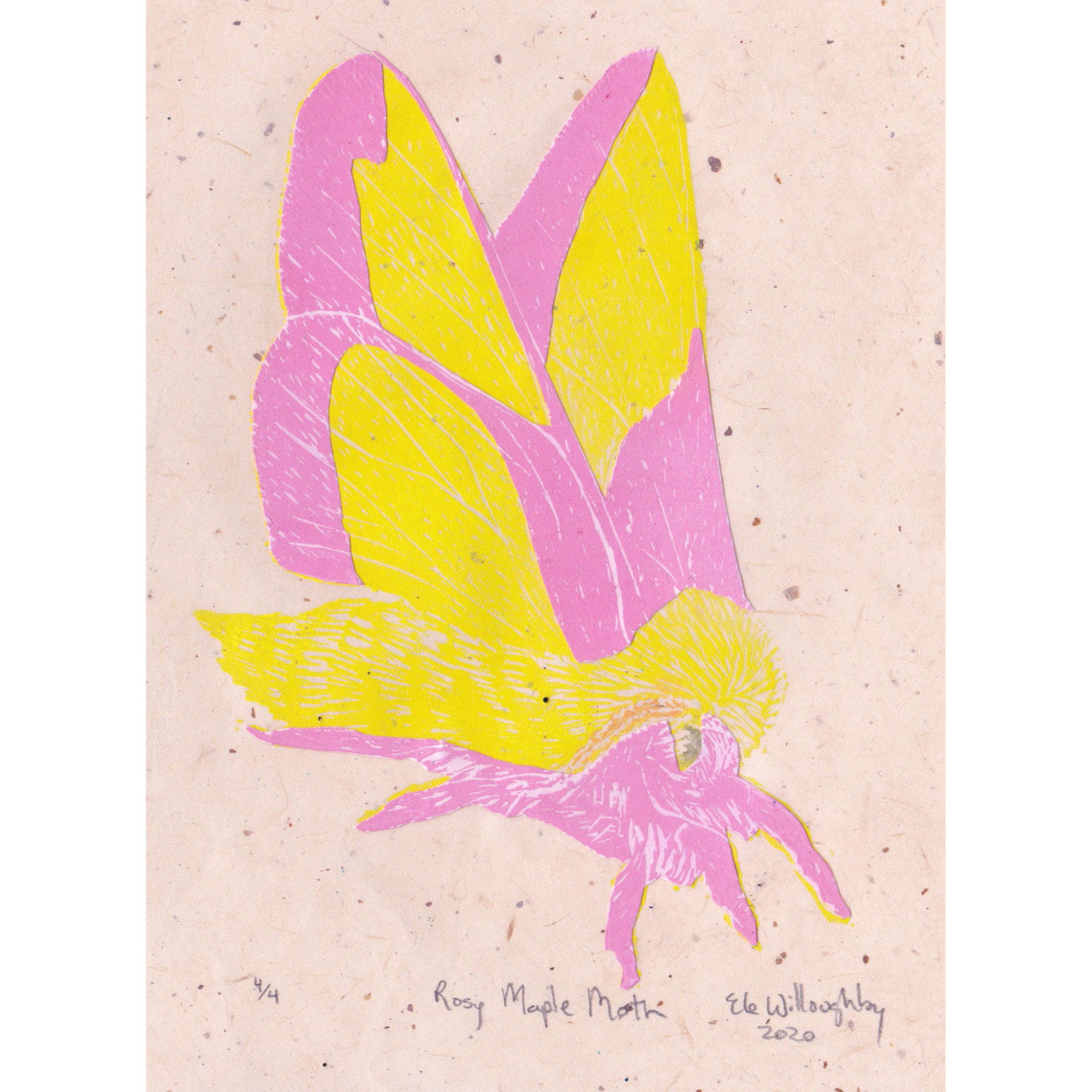
Rosy Maple Moth linocut by Ele Willoughby


Occam's Razor linocut by Ele Willoughby

That last one probably needs some explantions. This print "Occam's Razor" is about the Law of Economy or Parsimony postulated by Scholastic philosopher William of Ockham (1287–1347), "pluralitas non est ponenda sine necessitate" or entities should not be needlessly multiplied. More simply this law, or really, rule of thumb is that the simplest explanation is usually right. The print should Ockham himself, inspired by an image of him from a stained glass window in Surrey, the proverbial razor and many unlikely things (aliens, ghosts, cryptozoological creatures) it would cut away.

 This is my most recent "Imaginary Friend" of science, along with demons (Maxwell's, Descartes' and Laplace's), Schroedinger's cat, and the Spherical Cow. If you have another charismatic thought-experiment/imaginary friend of science to suggest, please let me know!

Friday, November 1, 2019

Rear Admiral and Mathematician Grace Hopper Teaching Computers Something Like English

Grace Hopper, linocut on 11" x 14" Japanese kozo paper, 2019, by Ele Willoughby
The first modern computers were loud, room-sized monsters, essentially a collection of relays (electrical switches) patched together with electrical cords. Each "switch" could be one (1) or off (0) and could represent data (an input value) or an action applied to these data.  To talk to the computer, to tell it to do anything with these values, you needed to speak in machine code, in the natural language of the computer itself of zeroes and ones - and each machine had its one structure and associated code. The story of how these giant computing machines went from a rare, complex tool available only research scientists at a few select university or government labs to ubiquitous, multipurpose portable tools we carry with us everywhere and use daily, depends in part on the idea we could, and should, develop machine-independent programming languages and that these could be based on English. This revolutionary idea was popularized by American computer scientist and US Navy rear admiral Grace Brewster Murray Hopper (née Murray December 9, 1906 – January 1, 1992).

Born in on the Upper West Side of New York City, the eldest of three children, she was the sort of curious child who dismantled alarm clocks to discover how they work; she was seven when she was caught, having already taken seven clocks apart, and her mother limited her future exploration to working with a single clock. Her father owned an insurance business. She took after her mother, herself a mathematician. She was admitted to Vassar College at 17 and completed a Bachelor's degree in math and physics. By 1930, she had completed her Master's at Yale and married New York University comparative literature professor Vincent Foster Hopper (1906–1976). She began teaching at Vassar in 1931. By 1934, she completed her PhD on "New Types of Irreducibility Criteria" under the supervision of Øystein Ore at Yale. Unusually for a mathematics professor, she insisted her students write well; her first assignment would be an essay on her favourite formula. She felt studying mathematics without the ability to communicate math was pointless. Her own ability to translate real world problems into mathematics and math into English would serve her well throughout her career.

She became bored with an unexciting marriage and found teaching math less fulfilling than she hoped. When the US entered WWII she was on partial leave from Vassar, spending a year studying finite difference methods for solving partial differential equations with Richard Courant at New York University. She saw a way to change her life. At age 34, Hopper tried to enlist in the Navy, but was rejected. She was deemed too old, and a petite woman, her weight to height ratio was too low; further her job as a mathematician and professor at Vassar was considered valuable to the war effort.
Though Vassar promoted her to associate professor in 1941 she obtained a leave of absence. She persisted with her goal and got a special exemption for being 15 pounds (6.8 kg) below the Navy minimum weight of 120 pounds (54 kg) and volunteered for the the United States Navy Reserve women's branch (WAVES) in 1943. By 1945, she had divorced her husband, but chose to retain her husband's family name.

After graduating top of her class at the Naval Reserve Midshipman's School at Smith College in Massachusetts, she was assigned to the Bureau of Ships Computation Project at Harvard University as a lieutenant, junior grade. Howard H. Aiken, physicist and computing trailblazer, who had been a professor was now leading a team there as a commander in the Navy. His team was working on programming the giant IBM Automatic Sequence Controlled Calculator (ASCC), an electromechanical computer known as the Mark I. Hopper said she had to learn the languages of the different scientists and engineers whose problems they were running on the machine, the languages of the managers, and of the programmers, and her facility with these different modes of communication was why Aiken assigned her to write the first computer programming manual. Despite her doubt about writing a book, she produced a 561-page volume starting with a history of computing machines from Charles Babbage to the present. Like her forebearer Ada Lovelace, she saw the potential of a computer controlled by separate punch tape instructions (what we now know as software) rather than the need to reconfigure the machine hardware itself. Aiken had originally bristled at the thought of a woman on the team, but soon made Hopper primary programmer and his top deputy. She became known as irreverent, brilliant, sharp-tonged but a good collaborator. Together, Aiken and Hopper co-authored three papers on the Mark I. After the war, she requested to transfer to the regular Navy, but her request was declined due to her age. She opted nonetheless to remain at Harvard as Navy reserve research fellow under a Navy contract, until 1949, despite the offer of a full professorship at Vassar.

While working on the Mark I, Hopper perfected the use of the subroutine, the way programmers use a specific chunk of code to perform a specific task again and again, such as taking the sinusoid or logarithm of a value. This a concept Ada Lovelace wrote about in her Notes on the Analytical Engine.  She began thinking about the way to take her library of subroutines and enable its use on any machine, if her source code could be translated to machine code (which is machine-specific) by using a compiler.

Famously, while working on the Mark II, she and her colleagues had to do some literal "debugging" when a dead moth was discovered in a relay. The term "bug" already existed in engineering, but the process of systematical detecting and removing problems in computer programs came to be known as debugging partially because of this specific wayward moth and Hopper delighted to telling the story of the actual bug. It was dutifully recorded by taping its corpse labelled "First actual case of bug being found," in the log book dated September 9, 1947.

The Harvard Mark I, II and III, were reliable machines based on electromechanical relays, but these were slow. Hopper's work had help make these machines the most easily programmed but she recognized that the new electronic devices using vacuum tubes were so much faster, that easy of programming and reliability were not enough. Also, it became clear that she would not be promoted or granted tenure at Harvard. She left her post to join the Eckert–Mauchly Computer Corporation where she worked on the development of UNIVAC I, the first general purpose electronic digital computer design, made for business. When the company was taken over by Remington Rand in 1950, she was appointed UNIVAC director of Automatic Programming Development. She became convinced that since people were far better at writing English than in symbols, that they ought to be able to write programs in English and that the computer themselves should translate this into machine code. It took her three years to convince others. She wrote her first paper on compilers (now known as link-loaders, the tool computers use to translate English-like computer programs into machine code) and had developed a functional link-loader the A-0 in 1952, all while her peers thought computers could only do arithmetic. As a mathematics professor she realized only, "[v]ery few people are really symbol manipulators. If they are they become professional mathematicians, not data processors. It's much easier for most people to write an English statement than it is to use symbols. So I decided data processors ought to be able to write their programs in English, and the computers would translate them into machine code. That was the beginning of COBOL, a computer language for data processors. I could say 'Subtract income tax from pay' instead of trying to write that in octal code or using all kinds of symbols." Promoted to the company's first director of automatic programming, her department released some of the first compiler-based programming languages, including MATH-MATIC and FLOW-MATIC. In 1959, she was a technical consultant to the Conference on Data Systems Languages (CODASYL) where she and colleagues defined the new language COBOL (an acronym for COmmon Business-Oriented Language), extending on FLOW-MATIC and IBM's language COMTRAN. COBOL became a major computer language in data processing and even persists today as legacy code.

She sadly retired from the Navy Reserve at age 60, as required in 1967, at the rank of commander but was recalled to active duty in 1968 and served as the director of the Navy Programming Languages Group in the Navy's Office of Information Systems Planning. She retired again in 1971, but was again recalled in 1972. She became a captain in 1973. During the 70s she argued for the move away from giant centralized computers to networks of small, distributed machines. She worked on standards for computer systems, components and programming languages like FORTRAN and COBOL. In 1983 she was promoted to commodore and remained on active duty several years beyond mandatory retirement by special approval of Congress. In 1985 the rank commodore was renamed rear admiral making her one of few women to achieve that rank. She final retired in 1986 as the the oldest active-duty commissioned officer in the United States Navy at age 79. She then worked as a senior consultant to Digital Equipment Corporation (DEC) until her death at age 85 in 1992, lecturing on the history of computers in full dress uniform. By the end of her life she was a very well-recognized figure, earning more than 40 honourary degrees, many awards and had many things named in her honour. She became the first woman to win the National Medal of Technology, the highest technology award in the US. At the ceremony she said, “If you ask me what accomplishment I’m most proud of, the answer would be all the young people I’ve trained over the years; that’s more important than writing the first compiler.” After her death, the Navy commissioned the U.S.S. Hopper, a guided missile destroyer, and in 2016 Hopper was posthumously received the Presidential Medal of Freedom.

In my portrait I've shown her as she was in WWII in front of the Harvard Mark I, with a little nod to the famous "first" computer bug. I am the sort of nerd who actually looks up the actual moth recorded and then put some thought into species that may have fit the size and colour of the moth found at Harvard.

References
Gilbert, Lynn (1981). Women of Wisdom: Grace Murray Hopper. Lynn Gilbert, Inc.
Software Bug, Wikipedia, accessed October 2019 
Grace Hopper, Wikipedia, accessed October 2019 
COBOL, Wikipedia, accessed October 2019   
Harvard Mark I,  Wikipedia, accessed October 2019   
Walter Isaacson, Grace Hopper, computing pioneer, The Harvard Gazette, December 3, 2014
Grace Murray Hopper (1906-1992): A legacy of innovation and service, Yale News, February 10, 2017

Thursday, August 16, 2012

It's Not the Moths Pillow

anti-moths broadside pillow

This one of a kind, handmade pillow features an image of my 'Moths' linocut, printed on a cotton silk blend fabric with a soft sheen. The reverse of the pillow is pin-striped greys and browns with irridescent threads and a beige and turquoise butterfly print cotton. The pillow is about 14.5" by 12" (37 cm by 31 cm). You might recall my explanation of my broadside:
I got no quarrel with the insects. Just because they have six legs and an exoskeleton is no reason to revile 'em. The beasties of the Lepidoptera order are beautiful and multifarious. We take their cousins the butterflies as symbols of the soul. I've personally long maintained that butterflies are the new pirates, with their ever-increasing popularity. I understand that insects will share my habitat - and even my home - as they, after all, were here first. We may even compete for the same resources in our shared environment. It's just the expensive tastes of the moths... they've crossed the line. It's not like I even own very many cashmere items, and the little #$@& went after them all.
So, I had the broadsides printed onto fabric, to make lovely cushions. Surely, the moths are now quaking in their boots. All 6 of them.

reverse of moths pillow

Tuesday, May 10, 2011

more moths

moths3

So I completed another moth broadside (and listed all 3). Perhaps I should paper my walls with these and dare the little $^#* to eat them.

Saturday, May 7, 2011

Don't get me wrong....

moths2

I got no quarrel with the insects. Just because they have six legs and an exoskeleton is no reason to revile 'em. The beasties of the Lepidoptera order are beautiful and multifarious. We take their cousins the butterflies as symbols of the soul. I've personally long maintained that butterflies are the new pirates, with their ever-increasing popularity. I understand that insects will share my habitat - and even my home - as they, after all, were here first. We may even compete for the same resources in our shared environment. It's just the expensive tastes of the moths... they've crossed the line. It's not like I even own very many cashmere items, and the little bastards went after them all.

So, I'm printing broadsides. As RJH said, "Because there's nothing a moth hates more than a strongly-worded pamflet."

moths1

Linocut, (inked à la poupée), 12.5 inches wide by 14 inches, on Japanese cream-coloured kozo (or mulberry paper). The first image shows one with various washi chine collé.

Apparently, it's International Print Day so it's apt that I finished this today.