Showing posts with label women in technology. Show all posts

Tuesday, October 14, 2025

Aeronautical Engineer and Queen of the Hurricanes, Elsie MacGill for Ada Lovelace Day

Elsie MacGill, linocut print, 9.25" x 12.5" on Japanese paper by Ele Willoughby, 2025


It is once again Ada Lovelace Day, the 16th annual international day of blogging to celebrate the 

Ada Lovelace, 3rd edition
Ada, Countess Lovelace, 3rd edition linocut by Ele Willoughby 

achievements of women in technology, science and math, Ada Lovelace Day 2025 (ALD25). I'm sure you'll all recall, Ada, brilliant proto-software engineer, daughter of absentee father, the mad, bad, and dangerous to know, Lord Byron, she was able to describe and conceptualize software for Charles Babbage's computing engine, before the concepts of software, hardware, or even Babbage's own machine existed! She foresaw that computers would be useful for more than mere number-crunching. For this she is rightly recognized as visionary - at least by those of us who know who she was. She figured out how to compute Bernouilli numbers with a Babbage analytical engine. Tragically, she died at only 36. Today, in Ada's name, people around the world are blogging.

 
You can find my previous Ada Lovelace Day posts here.

I am working on a new woman in STEM portrait for ALD25 and an upcoming #Spacetober print, but sometimes life gets in the way. We had a family emergency this week, so I am quite behind. But I want to share what I can, so read on to find my yearly - if a bit shortened - biography of aeronautical engineer Elsie MacGill (March 27, 1905 – November 4, 1980). Elizabeth Muriel "Elsie" Gregory MacGill was born in Vancouver, in 1905, and became the first woman aeronautical engineer and professional aircraft designer in North America, and likely the world. She was the first and, usually, only woman through her education at four different universities and engineering departments. She collaborated on many of Canada's famous and innovative bush planes and aircraft components, was entirely responsible for Canada's Maple Leaf Trainer II, a military flight trainer aircraft, and most famously, as chief aeronautical engineer at Canadian Car and Foundry (CC&F) in Fort William, Ontario (now Thunder Bay), she oversaw the manufacturing of 1,451 Hawker Hurricane fighter aircraft during WWII for the Royal Canadian Air Force (RCAF) and the British Royal Air Force (RAF), as well as 835 Curtiss Helldivers for the US Navy, becoming known as "The Queen of the Hurricanes." Her work helped make Canada a powerhouse of aircraft manufacturing. Later, she served as a Commissioner of the Royal Commission on the Status of Women in Canada, which published their report in 1970. Elsie came by her aptitude for social justice and blazing her own trail honestly. Her mother Helen MacGill was a suffragette like her mother before her, a journalist, a judge and a leader in Canada's women's movement. Her father James Henry MacGill, was a prominent Vancouver lawyer, part-time journalist, and Anglican deacon and supporter of women's suffrage. Elsie grew up with two older step-brothers and an older sister. Early home-schooling including drawing lessons with renown Canadian artist Emily Carr and swimming lessons with prominent lifeguard Joe Fortes. Then she attended King George Secondary, associated with McGill University, before entering UBC Applied Science, but the dean asked her to leave after one term. She moved on to the University of Toronto, where, she wrote, "My presence in the University of Toronto's engineering classes in 1923 certainly turned a few heads." She spent her summers working in machine shops, where she gained practical hands on skills to go with the classroom theory, and where she was exposed to aeronautical engineering. When Elsie graduated from the University of Toronto in 1927, she was the first woman electrical engineer in Canada. She got a junior job with Austin Aircraft Company in Pontiac, Michigan and began part-time graduate studies, then enrolling full-time at the University of Michigan. Two years later, she graduated from the University of Michigan, as the first woman with a master's in aeronautical engineering, anywhere. Just prior to completing her master's she fell ill with polio and found herself paralyzed from the waist down. She spent much of the subsequent three years in bed or relying on a wheelchair, told she would never walk again. She nevertheless fought to regain her mobility and taught herself to walk again using two canes. She treated her disability as a mere inconvenience. She continued to pursue her doctorate from MIT from 1932-1934, supplementing her income with writing magazine articles about aircraft and flying. At MIT she was finally not the lone woman, as a contemporary of aeronautical engineer and technical writer, M. Elsa Gardner. Upon graduating she returned to Canada, taking a job as assistant aeronautical engineer at Fairfield Aircraft in Longueuil, Quebec. There, she worked on the Fairchild Super 71(the first aircraft designed and built in Canada featuring a metal fuselage), the Fairchild 82 (a bush plane), and the Fairchild Sekani(twin-engined transport aircraft) and presented her paper, "Simplified Performance Calculations for Aeroplanes", to the Royal Aeronautical Society in Ottawa, on March 22, 1938, which was later published in The Engineering Journal. She took part in the CBC's six-part series 
The Engineer in War Time in a segment called "Aircraft Engineering in Wartime Canada."  In 1938 she was also first woman elected to corporate membership in the Engineering Institute of Canada (EIC).

In 1942, she was hired as Chief Aeronautical Engineer at Canadian Car and Foundry (CanCar, or CC&F), where she designed a training aircraft, and oversaw its production: the Maple Leaf Trainer II. It did not end up being used by Commonwealth forces, but Mexico purchased ten of them because of their excellent high-altitude performance. Then, the company was selected to manufacture Hawker Hurricanes for the RAF. She became responsible for increasing the workforce from 500 to 4,500 mainly women workers and the tooling of 25,000 precision parts which had to be interchangeable with the British made Hawker Hurricanes, and streamline the mass production of these aeroplanes. This involved designing the manufacturing tools and adaptations to the plane, including de-icing controls and landing skis, for use during Canadian winters. She wrote and presented a paper about the experience, "Factors Affecting Mass Production of Aeroplanes", later published in The Engineering Journal. It won the Gzowski Medal from the Engineering Institute of Canada in 1941. The work made her famous and she even appeared in a comic book biography in an issue of True Comics in 1942, using her nickname, "Queen of the Hurricanes”.

Seeking a job to replace the Hurricanes, CC&F in 1943, they were awarded a contract from the US Navy for the SB2C Helldiver. Production did not go smoothly; MacGill and CC&F were foiled by repeated changes in specifications making mass production all but impossible. The US Navy, frustrated with delays fired MacGill and line production manager Bill Soulsby, rather than figure out the source of the problem. Soulsby and MacGill got married two weeks later.

The couple moved to Toronto and set up a consulting firm. MacGill wrote the International Air Worthiness regulations for the design and production of commercial aircraft, as a Technical Advisor to the International Civil Aviation Organization (ICAO). These regulations, with their updates, are still important to safety of commercial aircraft.  She became the first woman to chair a U.N. committee, in 1947 as chairman of the United Nations Stress Analysis Committee. MacGill presented her paper "The Initiative in Airliner Design", to the Society of Women Engineers (SWE) and subsequently published it in The Engineering Journal. The next year the SWE awarded her their annual Achievement Award. 

While recovering from a broken leg, in 1953, she sorted through her mother's papers. This in turn lead to writing her biography, My Mother, the Judge: A Biography of Judge Helen Gregory MacGill, which she published in 1955.

She followed her mother's example and worked on women's issues, serving as national president of the Canadian Federation of Business and Professional Women’s Clubs from 1962 to 1964. Prime Minister Lester Pearson appointed her to the Royal Commission on the Status of Women in Canada and she is a co-author of their 1970 report. She filed a "Separate Statement" so she could voice her opinions which differed from the majority on the commission, including her belief that abortion should be removed from the entirety of the Criminal Code. Abortion had become legal in 1969, through the Criminal Law Amendment Act, but only if a 3-doctor committee determined that the pregnancy posed a danger to the parent's health. In 1988, the Supreme Court agreed with MacGill, striking down the remaining Criminal Code provisions restricting abortion as unconstitutional; abortion is healthcare. MacGill was also a member of the Ontario Status of Women Committee, an affiliate of the National Action Committee on the Status of Women. This work along with her engineering career earned her the Order of Canada in 1971. She wrote, "I have received many engineering awards, but I hope I will also be remembered as an advocate for the rights of women and children."

She was granted honorary doctorates in law from the University of Toronto in 1973, and in science from the University of Windsor in 1976. The Ninety-Nines: International Organization of Women Pilots, awarded her the Amelia Earhart Medal in 1975. In 1977 she received the Queen's Silver Jubilee Medal. In 1979, the Ontario Association of Professional Engineers presented her with their gold medal. She was inducted in the Canadian Aviation Hall of Fame in 1983 and she was a a founding inductee in the Canadian Science and Engineering Hall of Fame in 1992. She has been honoured with a stamp, a commemorative loonie dollar coin, schools and cadet squadrons have been named in her honour and she was a subject of a Heritage Minute for her work during WWII.

References
Bourgeois-Doyle, Dick. QUEEN OF THE HURRICANES — The Elsie MacGill Story, Vintage Wings of Canada, accessed October, 2025

Queen of the Hurricanes Engineer Elsie MacGill, Canadians At Arms, accessed October, 2025

Elsie MacGill, Wikipedia, accessed October, 2025

Schiedel, Bonnie. Soaring High - Elsie MacGill was the world’s first female aeronautical engineer. Canada's History, February-March, 2025.

Friday, February 19, 2021

Hertha Ayrton, Mathematician, Physicst, Engineer and Inventor


Hertha Ayrton, linocut by Ele Willoughby
Hertha Ayrton, linocut, 9.25" x 12.5" by Ele Willoughby, 2021.


This is my linocut portrait of British engineer, mathematician, physicist & inventor Hertha Ayrton (1854-1923). She is remembered for her research on the electric arc lamp, on ripple marks in sand & water, and her inventions including of mathematical line dividers which allowed artists, architects & engineers to enlarge or diminish drawings. I’ve shown her with a diagram of the dividers from her 1st of 26 patents, one of her diagrams about the origin & growth of ripple marks & one of her diagrams of an electric arc lamp (a subject on which she literally wrote the textbook).⁠
⁠
Born Phoebe Sarah Marks in Portsea, Hampshire, she was the third of eight children of a Polish Jewish immigrant watchmaker father & seamstress mother. After her father’s death when she was 7 in 1851, the family was left penniless and her mother returned to work as a seamstress. Sarah, as she was then known, had to care for her younger siblings. When she was 9, her maternal aunt Marion Hartog, who ran a school in north-west London with her husband Alphonse Hartog, invited her to join their household and attend their school. Though a hardship to her family, her mother recognized her potential and supported the move to London and the opportunities for her daughter. Her cousins introduced her to math and science. In her family, she was known as a fiery and occassionally crude character. By 16, she was living independantly, employed as a governess.

Her friend Ottilie Blind nicknamed her Hertha after the poem by Algernon Swinburne. They coached each other to prepare for the Cambridge entrance exam. Blind introduced Hertha to her mentor feminist, suffragette and founder of Girton College (the first residential college for women in England), Barbara Bodichon, after who she would later name her daughter. Her extended family and the suffrage community helped her get a higher education; author George Eliot* (a friend whom she met through Bodichon) wrote in support her application to Girton College, at Cambridge. She did not win a scholarship and would not have been able to afford tuition but she was supported with loans and donations from the suffrage community. While there studying math, she founded the fire brigade, led the choral society, and with fellow student and mathematician Charlotte Scott, formed a mathematics club. She also developed her first patented invention, the line divider and developed and built a sphygmomanometer (for measuring a person's pulse) while still an undergraduate. She passed the famous Mathematical Tripos in 1880, but Cambridge wouldn’t grant women degrees. She was able to take and pass a University of London equivalency exam, and they granted her a BSc in 1881.⁠
⁠
She earned an income teaching embroidery and math. She ran a club for working girls and looked after her invalid sister. By 1884 she had her first patent for a line divider; she also sought a US patent for it in 1885. Lady Goldsmid and Barbara Bodichon provided the funding she needed to seek these patents. The invention was well-received and got good reviews in the scientific press. She presented a paper on her invention to the Physical Society in 1885 and the device was manufactured in six sizes by a scientific instrument maker. Supporters encouraged her to become an entreprenneur and inventor but she wanted to pursue a scientific career.

She began evening classes on electricity with Professor Will Ayrton, trailblazer in engineering education at Finsbury Technical College. She was one of 3 women among 121 students. He was a widower with a young daughter, and a supporter of women's education and fight for voting rights. They married in 1885 and began collaborating on physics experiments and she was able to work from the lab in their home. A year later, they had a daughter, Barbara Bidochon Ayrton. From 1888 she taught practical and domestic electricity to women. Between this, domestic chores and raising her young daughter she had little time for research.

When her mentor Bodichon died in 1891, she left Ayrton enough money to support her mother and hire a housekeeper. Will supported her research but was also careful to not always collaborate with her, so that her work would be recognized as independant from his. He once told a friend “you and I are able people, but Hertha is a genius.” She began her own studies of the electric arc, solving the pressing problem of why they would flicker and hiss. She showed this was a result of oxygen coming into contact with carbon rods used to create the arcs. She patented a number of improvements to arc lights and published 12 articles on her advances. She was the first woman to deliver a paper to the Institution of Electrical Engineers (IEE), which was more progressive than other institutions and always allowed women to attend meetings. She was also able to present three papers to the British Association for the Advancement of Science (BAAS, now the British Science Association) in 1895, 1896 and 1898. She was elected a member of the IEE, recognized a professional qualification, in 1899; she was the sole female full member of the institution until 1958. Her cousin Marcus Hartog used her 1900 lecture at the International Electrical Congress in Paris to argue that the British Association for the Advancement of Science shouls allow women on their committees. Denied the right to present her paper to the Royal Society due to her sex, renown engineer John Perry (and Will's former colleague) presented it on her behalf in 1901. After she published her textbook The Electric Arc, Perry proposed her as Fellow of the Royal Society but they rejected this (as she was married, and hence had no independant legal standing). But in 1904, she became the first woman to present her own paper ‘The Motion of Ripples in Sand and Wave’ to the Royal Society. By 1906 she was the first woman to win the Hughes Medal, for her work on ripples and the electric arc.⁠
⁠
In Paris in 1903 she met Marie Curie and they became close friends, both physicists who collaborated with their physicist husbands and dedicated to social causes, and concerned about the role of women in society. They visited whenever Ayrton was in France. Ayrton vocally defended Marie, when Pierre died and the British press identified him (rather than Marie) as the discovered of radium, writing ‘Errors are notoriously hard to kill, but an error that ascribes to a man what was actually the work of a woman has more lives than a cat.’ Then in 1911, Marie won the Nobel for chemistry but endured a scandal in when her affair with married physicist Paul Langevin. Ayrton defended her again, and Marie and her daughters took refuge with the Ayrtons in England for two months. She was deeply involved in the women’s suffrage movement, marched in many marches (and recruited her friend Marie Curie to the cause).⁠
⁠
After poisoned gas was used as a weapon during WWI, she put her expertise in fluid dynamics to work trying to develop a means of removing gas from the trenches. She also invented a fan and despite initial resistance from the War Office was able to demonstrate its effectiveness in protecting soldiers from poison gas and she herself organized production of her first manually operated fans in 1916. By 1917 she had developed a new, mechanically operated fan, more resistant to high winds, and she again fought War Office bureaucracy and organized the production of 104,000 sent to the Western Front.⁠ Her research on fans was later used to improve ventilation in mines and sewers. She continued to study vortices until she died. She left much of her estate to the IEE.

*Apparently, the character Mirah, in George Eliot's novel Daniel Deronda, is based on Hertha. You might recall that George Eliot was also friends with another mathematician I've portrayed, Sofia Kovalevski. The sentence "In short, woman was a problem which, since Mr. Brooke's mind felt blank before it, could hardly be less complicated than the revolutions of an irregular solid," from Eliot's Middlemarch, is undoubtedly due to her friendship with Kovalevski. I like to imagine George Eliot was quietly a math groupie. 

 References 

Elizabeth Bruton, The life and material culture of Hertha Marks Ayrton (1854–1923): suffragette, physicist, mathematician and inventor, Science Museum Group Journal, Autumn 2018, Issue 10 Article DOI: http://dx.doi.org/10.15180/181002

Ayrton, Hertha. “The origin and growth of ripple-mark.” Proceedings of the Royal Society of London. Series A, Containing Papers of a Mathematical and Physical Character 84, no. 571 (1910): 285-310.

Kim Martini, The origin of ripples and other fantastic fluid experiments by Hertha Marks Ayrton, Deep Sea News, April 28, 2016.

Hertha Ayrton, Wikipedia, accessed February, 2021.

Joan Meiners, Meet Hertha Ayrton, the mathematician who cleared WW1 trenches of poisonous gas, Massive Sci, June 5, 2020.

Archives Biographies: Hertha Ayrton, The Institute of Engineering Technology, accessed February, 2021

Friday, November 1, 2019

Rear Admiral and Mathematician Grace Hopper Teaching Computers Something Like English

Grace Hopper, linocut on 11" x 14" Japanese kozo paper, 2019, by Ele Willoughby
The first modern computers were loud, room-sized monsters, essentially a collection of relays (electrical switches) patched together with electrical cords. Each "switch" could be one (1) or off (0) and could represent data (an input value) or an action applied to these data.  To talk to the computer, to tell it to do anything with these values, you needed to speak in machine code, in the natural language of the computer itself of zeroes and ones - and each machine had its one structure and associated code. The story of how these giant computing machines went from a rare, complex tool available only research scientists at a few select university or government labs to ubiquitous, multipurpose portable tools we carry with us everywhere and use daily, depends in part on the idea we could, and should, develop machine-independent programming languages and that these could be based on English. This revolutionary idea was popularized by American computer scientist and US Navy rear admiral Grace Brewster Murray Hopper (née Murray December 9, 1906 – January 1, 1992).

Born in on the Upper West Side of New York City, the eldest of three children, she was the sort of curious child who dismantled alarm clocks to discover how they work; she was seven when she was caught, having already taken seven clocks apart, and her mother limited her future exploration to working with a single clock. Her father owned an insurance business. She took after her mother, herself a mathematician. She was admitted to Vassar College at 17 and completed a Bachelor's degree in math and physics. By 1930, she had completed her Master's at Yale and married New York University comparative literature professor Vincent Foster Hopper (1906–1976). She began teaching at Vassar in 1931. By 1934, she completed her PhD on "New Types of Irreducibility Criteria" under the supervision of Øystein Ore at Yale. Unusually for a mathematics professor, she insisted her students write well; her first assignment would be an essay on her favourite formula. She felt studying mathematics without the ability to communicate math was pointless. Her own ability to translate real world problems into mathematics and math into English would serve her well throughout her career.

She became bored with an unexciting marriage and found teaching math less fulfilling than she hoped. When the US entered WWII she was on partial leave from Vassar, spending a year studying finite difference methods for solving partial differential equations with Richard Courant at New York University. She saw a way to change her life. At age 34, Hopper tried to enlist in the Navy, but was rejected. She was deemed too old, and a petite woman, her weight to height ratio was too low; further her job as a mathematician and professor at Vassar was considered valuable to the war effort.
Though Vassar promoted her to associate professor in 1941 she obtained a leave of absence. She persisted with her goal and got a special exemption for being 15 pounds (6.8 kg) below the Navy minimum weight of 120 pounds (54 kg) and volunteered for the the United States Navy Reserve women's branch (WAVES) in 1943. By 1945, she had divorced her husband, but chose to retain her husband's family name.

After graduating top of her class at the Naval Reserve Midshipman's School at Smith College in Massachusetts, she was assigned to the Bureau of Ships Computation Project at Harvard University as a lieutenant, junior grade. Howard H. Aiken, physicist and computing trailblazer, who had been a professor was now leading a team there as a commander in the Navy. His team was working on programming the giant IBM Automatic Sequence Controlled Calculator (ASCC), an electromechanical computer known as the Mark I. Hopper said she had to learn the languages of the different scientists and engineers whose problems they were running on the machine, the languages of the managers, and of the programmers, and her facility with these different modes of communication was why Aiken assigned her to write the first computer programming manual. Despite her doubt about writing a book, she produced a 561-page volume starting with a history of computing machines from Charles Babbage to the present. Like her forebearer Ada Lovelace, she saw the potential of a computer controlled by separate punch tape instructions (what we now know as software) rather than the need to reconfigure the machine hardware itself. Aiken had originally bristled at the thought of a woman on the team, but soon made Hopper primary programmer and his top deputy. She became known as irreverent, brilliant, sharp-tonged but a good collaborator. Together, Aiken and Hopper co-authored three papers on the Mark I. After the war, she requested to transfer to the regular Navy, but her request was declined due to her age. She opted nonetheless to remain at Harvard as Navy reserve research fellow under a Navy contract, until 1949, despite the offer of a full professorship at Vassar.

While working on the Mark I, Hopper perfected the use of the subroutine, the way programmers use a specific chunk of code to perform a specific task again and again, such as taking the sinusoid or logarithm of a value. This a concept Ada Lovelace wrote about in her Notes on the Analytical Engine.  She began thinking about the way to take her library of subroutines and enable its use on any machine, if her source code could be translated to machine code (which is machine-specific) by using a compiler.

Famously, while working on the Mark II, she and her colleagues had to do some literal "debugging" when a dead moth was discovered in a relay. The term "bug" already existed in engineering, but the process of systematical detecting and removing problems in computer programs came to be known as debugging partially because of this specific wayward moth and Hopper delighted to telling the story of the actual bug. It was dutifully recorded by taping its corpse labelled "First actual case of bug being found," in the log book dated September 9, 1947.

The Harvard Mark I, II and III, were reliable machines based on electromechanical relays, but these were slow. Hopper's work had help make these machines the most easily programmed but she recognized that the new electronic devices using vacuum tubes were so much faster, that easy of programming and reliability were not enough. Also, it became clear that she would not be promoted or granted tenure at Harvard. She left her post to join the Eckert–Mauchly Computer Corporation where she worked on the development of UNIVAC I, the first general purpose electronic digital computer design, made for business. When the company was taken over by Remington Rand in 1950, she was appointed UNIVAC director of Automatic Programming Development. She became convinced that since people were far better at writing English than in symbols, that they ought to be able to write programs in English and that the computer themselves should translate this into machine code. It took her three years to convince others. She wrote her first paper on compilers (now known as link-loaders, the tool computers use to translate English-like computer programs into machine code) and had developed a functional link-loader the A-0 in 1952, all while her peers thought computers could only do arithmetic. As a mathematics professor she realized only, "[v]ery few people are really symbol manipulators. If they are they become professional mathematicians, not data processors. It's much easier for most people to write an English statement than it is to use symbols. So I decided data processors ought to be able to write their programs in English, and the computers would translate them into machine code. That was the beginning of COBOL, a computer language for data processors. I could say 'Subtract income tax from pay' instead of trying to write that in octal code or using all kinds of symbols." Promoted to the company's first director of automatic programming, her department released some of the first compiler-based programming languages, including MATH-MATIC and FLOW-MATIC. In 1959, she was a technical consultant to the Conference on Data Systems Languages (CODASYL) where she and colleagues defined the new language COBOL (an acronym for COmmon Business-Oriented Language), extending on FLOW-MATIC and IBM's language COMTRAN. COBOL became a major computer language in data processing and even persists today as legacy code.

She sadly retired from the Navy Reserve at age 60, as required in 1967, at the rank of commander but was recalled to active duty in 1968 and served as the director of the Navy Programming Languages Group in the Navy's Office of Information Systems Planning. She retired again in 1971, but was again recalled in 1972. She became a captain in 1973. During the 70s she argued for the move away from giant centralized computers to networks of small, distributed machines. She worked on standards for computer systems, components and programming languages like FORTRAN and COBOL. In 1983 she was promoted to commodore and remained on active duty several years beyond mandatory retirement by special approval of Congress. In 1985 the rank commodore was renamed rear admiral making her one of few women to achieve that rank. She final retired in 1986 as the the oldest active-duty commissioned officer in the United States Navy at age 79. She then worked as a senior consultant to Digital Equipment Corporation (DEC) until her death at age 85 in 1992, lecturing on the history of computers in full dress uniform. By the end of her life she was a very well-recognized figure, earning more than 40 honourary degrees, many awards and had many things named in her honour. She became the first woman to win the National Medal of Technology, the highest technology award in the US. At the ceremony she said, “If you ask me what accomplishment I’m most proud of, the answer would be all the young people I’ve trained over the years; that’s more important than writing the first compiler.” After her death, the Navy commissioned the U.S.S. Hopper, a guided missile destroyer, and in 2016 Hopper was posthumously received the Presidential Medal of Freedom.

In my portrait I've shown her as she was in WWII in front of the Harvard Mark I, with a little nod to the famous "first" computer bug. I am the sort of nerd who actually looks up the actual moth recorded and then put some thought into species that may have fit the size and colour of the moth found at Harvard.

References
Gilbert, Lynn (1981). Women of Wisdom: Grace Murray Hopper. Lynn Gilbert, Inc.
Software Bug, Wikipedia, accessed October 2019 
Grace Hopper, Wikipedia, accessed October 2019 
COBOL, Wikipedia, accessed October 2019   
Harvard Mark I,  Wikipedia, accessed October 2019   
Walter Isaacson, Grace Hopper, computing pioneer, The Harvard Gazette, December 3, 2014
Grace Murray Hopper (1906-1992): A legacy of innovation and service, Yale News, February 10, 2017

Tuesday, October 9, 2018

On-going Series of Women in STEM for Ada Lovelace Day Throughout History

The earliest recorded woman in science was a woman of colour and one of the earliest known person in STEM at all. Merit Ptah ("beloved of [the god] Ptah") lived circa 2700 BCE and was chief physician of the pharoah's court, implying not only that she was recognized as a doctor, who attended the pharoah, but that she trained and supervised other doctors, during the Second or Third Dynasty of Ancient Egypt.
Merit Ptah, Chief Physician, linocut by Ele Willoughby, 11" x 14", 2018

Hypatia, the first recorded female mathematician lived in the 3rd century AD in Alexandria, Egypt, which was part of the Roman Empire. She was born at some time between about 350 and 370 and died in 415 C.E. She was the head of the Platonist school, where she taught philosophy, astronomy and mathematics. She believed in empiricism and natural law. She was the last librarian of the famed Library of Alexandria in the Museum of Alexandria, largest and most significant library of the ancient world. She was the daughter of a famous mathematician, Theon Alexandricus (ca. 335–405), with whom she worked and published edited versions of Classical texts in mathematics. She also pursued her education in Athens and Italy before returning to Alexandria and becoming the head of the Platonist school. It is known that she wrote commentaries on 13-volume Arithmetica by Diophantus, the Conics of Apollonius, and edited Ptolemy's Almagest and on Euclid's Elements. She charted heavenly bodies. She built and instructed her pupils in the design and use of the astrolabe, and likely made improvements to it.
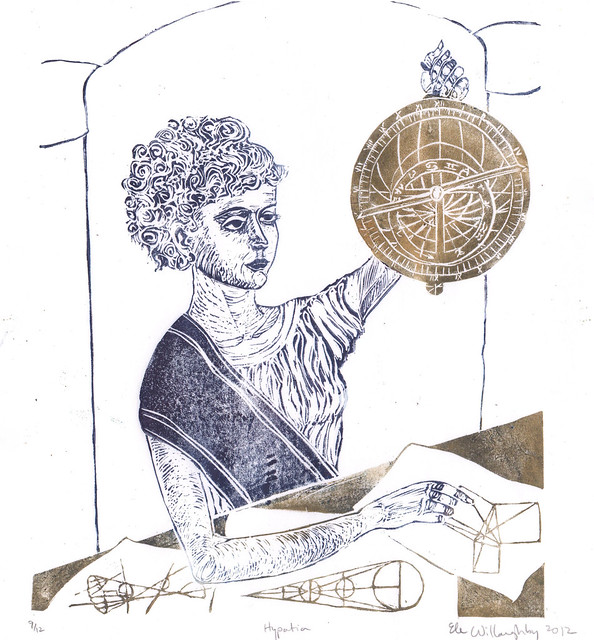

Hypatia3
Hypatia, linocut 12" x 12" by Ele Willoughby, 2012


Margaret Lucas Cavendish, Duchess of Newcastle-upon-Tyne (1623 – 1673), 17th-century English aristocrat, philosopher, poet, scientist, fiction-writer, and playwright shown with her imaginary world from her strange science fiction novel 'The Blazing World' which she appended to her scientific treatise 'Observations upon Experimental Philosophy'.

Margaret Cavendish and the Blazing World linocut 11" x 14", 2018, by Ele Willoughby

Maria Sibylla Merian (1647-1717), was the leading entomologist of her day, traveller and scientific illustrator. She is shown complete with pomegranate branch and the life cycle of a morpho butterfly from caterpillar, to chrysalis in its cocoon to butterfly, inspired by her famous work 'Metamorphosis insectorum Surinamensium' - a process she discovered then carefully documented and explained.


Maria Sibylla Merian, 11" x 14" linocut by Ele Willoughby, 2015
German-born Caroline Herschel (1750 – 1848), while overshadowed by her brother William (who discovered Uranus, amongst his other astronomical accomplishments), was a real pioneer as a woman in astronomy and made her own important contributions. In fact, she became the first salaried female scientist, when King George III hired her to assist her brother, at a time when there were few professional scientists anywhere. Hers was a real life sort of scientific Cinderella story; deemed unmarriageable, since a childhood bout of typhus stunted her growth, her mother thought she should train to be a servant but William managed to rescue his younger sister from their mother's clutches, under the pretext that she might have the voice to be a solo singer in Handel's oratorios, as she too was a natural musician. Of course, he also wanted a woman to manage his bachelor household. Meanwhile, he developed a real passion for astronomy and soon, so did his sister. She discovered 11 nebulae (2 of which turned out to be galaxies) which were previously unknown! She also found 8 or 9 comets, as well as making and sharing observations of comets discovered by others. She worked to complete and publish her brother's star charts after his death.
Caroline Herschel
Caroline Herschel, linocut by Ele Willoughby, 2014

Marie-Anne Paulze Lavoisier (1758 – 1836) was the wife of Antoine Lavoisier, who is often referred to as the 'father' of modern chemistry, without any reference to his wife. Marie-Anne became interested in her husband's scientific pursuits and soon joined him in the lab. She received formal training in the field from his friends and colleagues Jean Baptiste Michel Bucquet and Philippe Gingembre. Marie-Anne also famously hosted scientific salons with luminaries of the day and was taught. Jacques Louis David painted his Portrait of Anoine-Laurent Lavoisier and his wife in 1788. He also trained Marie-Anne Paulze in drawing and engraving, allowing her to accurately illustrate their experiements. And she most definitely appears in her own drawings and engravings documenting their work.
 

Antoine et Marie-Anne Paulze Lavoisier, linocut with collaged washi,
2018 by Ele Willoughby

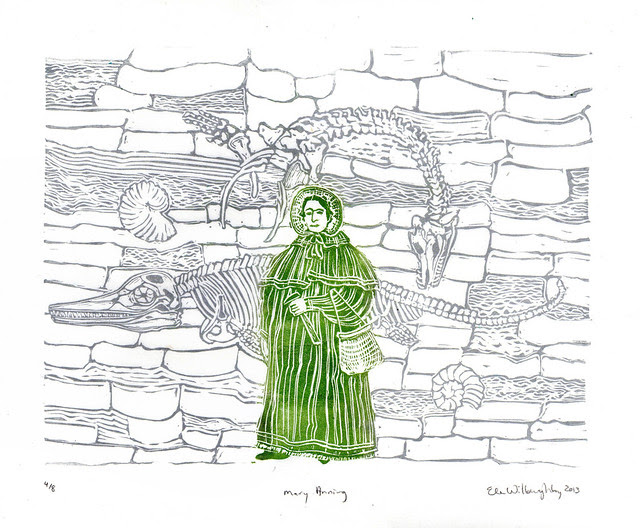
Mary Anning (1799 – 1847) was the wrong class, the wrong sex and even the wrong religious denomination to gain the education, opportunity to work and communicate her results or to garner any respect as a pioneering paleontologist. Further, during her lifetime most people in Britain and elsewhere thought the Earth was a mere few thousand years old, based on a very literal interpretation of the Bible and found the idea of extinction did not fit in with the story of creation. Yet, her fossil discoveries, meticulous collection, documentation and independent work to fully understand the anatomy of the amazing Jurassic creatures she encountered in famed Blue Lias cliffs of Lyme Regis, Dorset, England, were so undeniable that she gained the recognition, admiration and respect of the paleontologists of the day. She made her first significant find, the first ichthyosaur skeleton to be correctly identified, with her brother Joseph when she was only 12 years old. Her research showed that belemnite fossils contained fossilised ink sacs like those of modern cephalopods. She was also the first to recognize that coprolites, known as bezoar stones at the time, were fossilised... well, animal droppings (feces). While this sounds distinctly unglamorous, the study of coprolites pioneered by Anning and Buckland were vital to understanding ancient ecosystems. Her friend Henry De la Beche painted the first widely circulated representation of a prehistoric (deep time) scene, based on her finds, and he sold prints to benefit her financially.
Mary Anning
Mary Anning, linocut by Ele Willoughby


Anna Atkins (1799-1871), née Children, was an English botanist and photographer. She is the first person to have illustrated a book using photographs, Photographs of British Algae: Cyanotype Impressions in October 1843. Note that: not the first woman, the first person. She lived at a time when it was possible to be a self-trained scientist, especially if you were middle or upper class and received an education and the financial freedom to devote your time to pursue your subject. She was raised and instructed by her father, a naturalist, and her social circle included those who were developing (no pun intended) the latest, brand new photographic technology. So, she was at the right place at the right time. But that doesn't take away from the fact that she had the knowledge, skill, insight and ability to immediately see the utility of the method for descriptive science and to document a specific field of sub-field of botany, with her collection of the algae (seaweeds) of Britain. I think this should be understood as equivalent to a modern-day scientist keeping abreast of other fields of study and rapidly mastering a new high-tech tool to apply it to her field. Even William Henry Fox Talbot, who who invented the salted paper and calotype processes, precursors to modern photographic methods, was not able to publish The Pencil of Nature the first commercially printed photographic book, until eight months after she produced Photographs of British Algae: Cyanotype Impressions. 

This is a portrait of English botanist and photographer Anna Atkins (1799-1871), née Children. It combines both a hand-carved lino block portrait in dark silver ink, and a screenprint of the silhouette of fern leaves in cobalt blue ink, mimicking the cyanotypes she was known for. It is printed by hand on lovely Japanese kozo (or mulberry) paper, 11" x 14" (28 cm x 35.6 cm). (c) Ele Willoughby, 2015

Today is named in honour of Countess, Lady Ada Lovelace (1815-1852), who published the first computer program. She worked together with Charles Babbage, the inventor of the Difference Engine and the Analytical Engine (the first - analogue! - computers), correcting his notes on how to calculate Bernoulli Numbers with the Analytical Engine. More importantly, she (a great communicator, daughter of mad, bad and dangerous to know poet Lord Byron) was able to understand and explain the workings of the analytical engine and the potential of computing machines. Her comments seem visionary to the modern reader. Babbage called her the Enchantress of Numbers.

Ada Lovelace linocut by Ele Willoughby

Founder of modern nursing, social reformer, statistician, data visualization innovator and writer Florence Nightingale (1820 – 1910) earned the nickname "The Lady with the Lamp" during the Crimean War, from a phrase used by The Times, describing her as a “ministering angel” making her solitary rounds of the hospital at night with “a little lamp in her hand”. Behind Nightingale is her own ‘Diagram of Causes of Mortality in the Army in the East’ plotted as a polar area diagram – though not her own statistical and data visualization innovation, sometimes called a Nightingale Rose Diagram. It illustrates the causes of death in the military hospital she managed during the Crimean War. When she researched the causes of mortality, looking back at the data, she saw clearly that the lack of hygiene was a far greater risk to soldiers’ lives than being wounded. Her statistics and clear data visualization saved lives.


Florence Nightingale portrait
Florence Nightingale (1820 – 1910), nursing, statistics and data visualization pioneer, linocut by Ele Willoughby

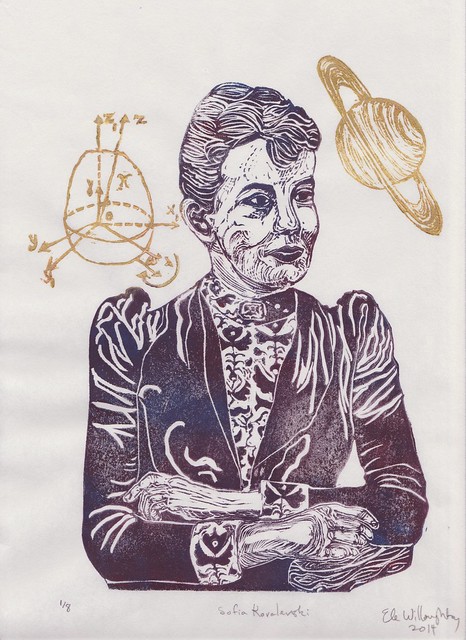
Great Russian mathematician and writer, Sofia Vasilyevna Kovalevski (1850-1891), is also known as Sofie or Sonya, her last name has been transliterated from the Cyrillic Со́фья Васи́льевна Ковале́вска in a variety of ways, including Kovalevskaya and Kowalevski. Sofia's contributions to analysis, differential equations and mechanics include the Cauchy-Kovalevski theorem and the famed Kovalevski top (well, famed in certain circles, no pun intended).  We now know there are only three fully integrable cases of rigid body motion and her solution ranks with those of mathematical luminaries Euler and Lagrange. She was the first woman appointed to a full professorship in Northern Europe or to serve as editor of a major scientific journal. She is also remembered for her contributions to Russian literature. All of this despite living when women were still barred from attending university. Her accomplishments were tremendous in her short but astonishing life.
Sofia Kovalevski linocut
Sofia Kovalevski, linocut by Ele Willoughby, 2014

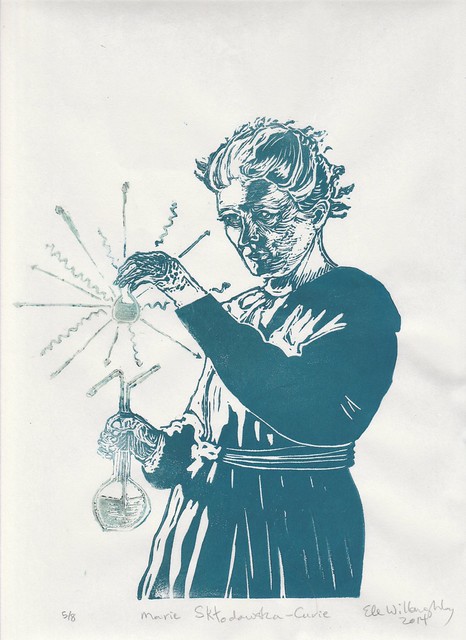
My portrait of Marie Skłodowska-Curie (1867 – 1934) shows the famous Polish-born, naturalized-French physicist and chemist at work in her lab. The contents of her lab glassware appropriately glow-in-the-dark! She was one of the pioneers who helped explain radioactivity, a term she coined. She was the one who first developed a means of isolating radioactive isotopes and discovered not one, but two new elements: polonium (named for her native country) and radium. She also pioneered radioactive medicine, proposing the treatment of tumors with radioactivity. She founded medical research centres, the Curie Institutes in Paris and Warsaw which are still active today. She created the first field radiology centres during World War I. Marie Curie was the first woman to win a Nobel prize, the only woman to ever win TWO Nobel prizes, and the only person ever to win in two different sciences: physics and chemistry!

Marie Curie linocut glows in the dark
Marie Skłodowska-Curie (1867 – 1934), physicist, chemist, double Nobel Laureate
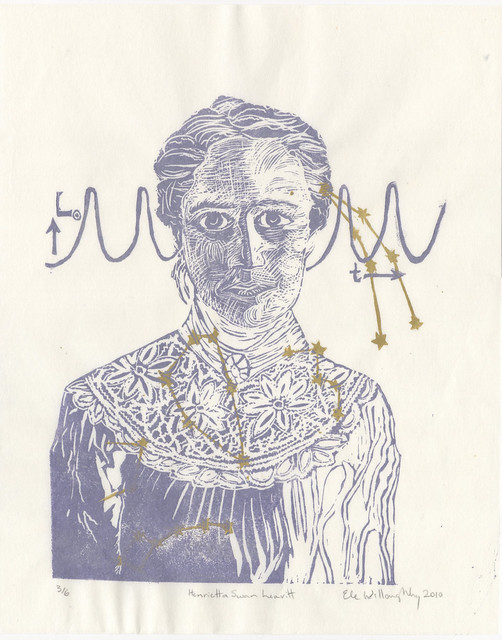
Henrietta Swan Leavitt (1868- 1921) was an American astronomer. In her day, women scientists were regularly hired to do menial chores. She was hired to count images on photographic plates as a "computer". In studying these plates, in 1908 she was able to deduce a ground-breaking theory, which allowed Hubble's later insight about the age and expansion of the universe. Her period-luminosity relation for Cepheid variable stars radically changed modern astronomy, an accomplishment for which she received little recognition during her lifetime.
Henrietta Swan Leavitt
Henrietta Swan Leavitt (1868 – 1921), astronomer whose work set the scale of our Universe

Canadian medical researcher Maud Menten (1870-1960) has been called the "grandmother of biochemistry" and "a radical feminist 1920s flapper," and a "petite dynamo." Not only was she an author of Michaelis-Menten equation for enzyme kinetics (like the plot in indigo in my portrait), she invented the azo-dye coupling for alkaline phosphatase, the first example of enzyme histochemistry,  still used in histochemistry imaging of tissues today (which inspired the histology background of the portrait), and she also performed the first electrophoretic separation of blood haemoglobin in 1944!

Maud Menten, linocut 9.25" x 12.5" by Ele Willoughby, 2018
Physicist Harriet Brooks (1876 - 1933) shows her and her discovery of atomic recoil. Brooks also discovered Radon and measured its atomic mass and half-life. Her graduate supervisor and future Nobel laureate Ernest Rutherford also credited her with first recognizing that radioactive elements could undergo chains of transmutations into a series of new elements. He stated that she was second only to Marie Curie in her capacity for and ability as a radioactivity researcher. During her extraordinary 6 year career in physics she worked with 3 Nobel laureates (Rutherford, Thomson and Curie) and made these fundamental contributions to the new field of nuclear physics!

Harriet Brooks, linocut 9.25" x 12.5" by Ele Willoughby, 2018

Physicist Lise Meitner (1878 – 1968) was the first person to provide a theoretical explanation for nuclear fission and was an integral member of the experimental team as well (she collaborated with ollaborated with chemists Otto Hahn and Fritz Straßmann), though her gender and her heritage interfered with her being properly acknowledged in late 30s Germany. Only Hahn was awarded the Nobel for this work. She received the Max Planck Medal of the German Physics Society in 1949. Meitner was nominated to receive the Nobel prize three times. In 1966 Hahn, Fritz Straßmann and Meitner together were awarded the Enrico Fermi Award. In 1997, the element 109 was named meitnerium in her honour. Today the Hahn-Meitner Institut in Berlin, craters on the Moon and on Venus, and a main-belt asteroid are all named in her honour.
Lise Meitner
Lise Meitner (1878 – 1968) and Nuclear Fission, linocut by Ele Willoughby
Geologist and paleontologist Alice Wilson (1881-1964) mapped the entire Ottawa-St Larence Valley region by herself, since she was barred from doing fieldwork with men, was the first female Canadian geologist, despite ill-health and a frail constitution. Her research interests focused on fossil invertebrates from the Paleozoic era (252–541 million years ago) from across Canada, and from the Ordovician era (444–485 million years ago) in her own backyard in Ontario and Quebec as well as Ordovician fauna from the Rockies and Arctic. She studied stratigraphy in Ontario and Quebec. Over the course of 50 years, she became an authority on fossils and rocks of the Ottawa - St. Lawrence Valley, as a direct response to the sexist limitations placed upon her.

Alice Wilson, linocut on collaged washi papers, 11" x 14" by Ele Willoughby, 2018


Emmy Noether (1882-1935) was one of the greatest 20th century mathematicians and Noether's Theorem is one of the most fundamental and profound theories in physics.
Emmy Noether, linocut, 11" x 14", Ele Willoughby, 2018


Inge Lehmann (1888-1993) was a pioneer woman in science, a brilliant seismologist and lived to be 104. In 1936 she wrote an earth-shattering paper, with an astonishingly succinct title: P' in which she laid out her arguments supporting her discovery of the inner core of the earth. She later also discovered a discontinuity in the mantle (confusingly called the Lehmann discontinuity). When she received the Bowie medal in 1971 (she was the first woman to receive the highest honour of the American Geophysical Union), her citation noted that the "Lehmann discontinuity was discovered through exacting scrutiny of seismic records by a master of a black art for which no amount of computerization is likely to be a complete substitute..."

Inge Lehmann, linocut on Japanese washi, 8" x 8" by Ele Willoughby
Alice Augusta Ball (1892 - 1916) was a chemist who discovered the first effective treatment for leprosy (or Hansen's disease) a disfiguring disease which has afflicted people for millenia. Physician Dr. Harry T. Hollmann of the Kalihi Hospital in Hawai'i and acting director of the Kalihi leprosy clinic, was unsatisfied with using chaulmoogra oil in its natural form to treat leprosy patients and wanted to isolate the active ingredients. He recruited the graduate student Ball to help. Within a year, she was able to do what chemists and pharmacologists had been unable to do for centuries. She not only isolated the active ingredients but convert them to a form which could be circulated in the body. My print shows how she formed the ethyl ester of chaulmoogric acid (the acid plus alcohol produces the ethyl ester with water).
Alice Ball, 11" x 14", linocut by Ele Willoughby, 2018, shows the chemist, branches of the chaulmoogra tree and
how she formed the ethyl ester of chaulmoogric acid (the acid plus alcohol produces the ethyl ester with water)
Mary Golda Ross (1908-2008) was a mathematician, aeronautical engineer, philanthropist and Cherokee “hidden figure” of the space race. Lockheed Martin hired her as mathematician in 1942, troubleshooting the P-38 Lighting fighter plane (as shown). She knew already that her interest was in interplanetary flight, but didn’t mention it in 1942 for fear that her credibility would be questioned, but she was indeed farsighted. After the war Lockheed Martin sent her to UCLA to study engineering and celestial mechanics. She was one of the 40 engineers selected to start Skunk Works, their Advanced Development Program, an in-house top-secret think tank. She was the only woman and only Indigenous person and much of her work there remains classified! It included preliminary design concepts for interplanetary travel, crewed and uncrewed space flights and the earliest plans for orbiting satellites. She worked on the Agena rocket, so important to the Apollo moon mission (shown) and was an author of the NASA Flight Handbook Vol. III about flight to Mars and Venus.
Mary Golda Ross, linocut handprinted on Japanese kozo paper, 11" x 14", 2018 by Ele Willoughby

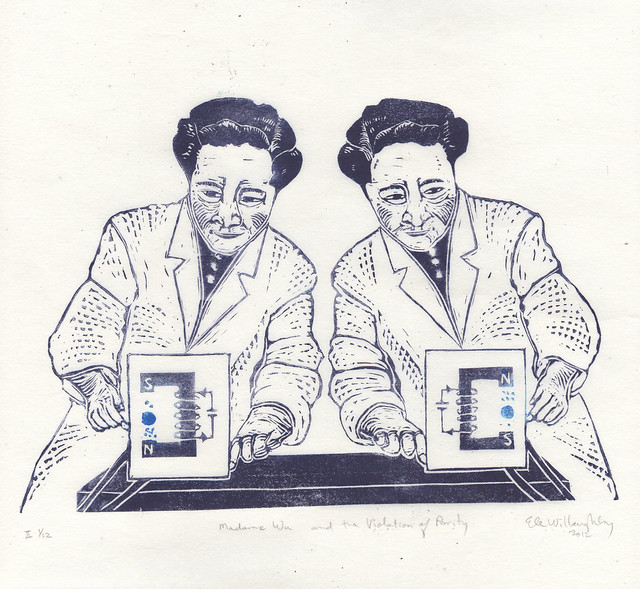
Physicist Chien-Shiung Wu (1912-1997, Chinese-born American physicist, whose nicknames included the “First Lady of Physics”, “Chinese Marie Curie,” and “Madame Wu”) came up with a truly beautiful experiment to test whether the weak force conserves parity. For their theoretical work on the question of parity in the physics of subatomic particles, Lee and Yang were quickly awarded the Nobel Prize for Physics in 1957; the Nobel committee neglected to include Wu.
Mme Wu
Chien-Shiung Wu (1912-1997) and the Violation of Parity, linocut by Ele Willoughby

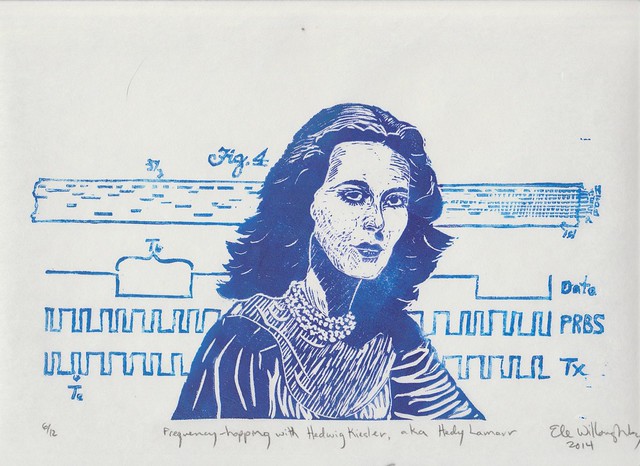
Hedy Lamarr (1914 –  2000), best known as a star of Hollywood's Golden Age was born Hedwig Keisler, escaped Austria during WWII and her arms-dealer husband and put her inside knowledge to work for the Allied forces.  She knew that torpedoes were guided by radio signals, of a single frequency, which were vulnerable to interference or "jamming". She had the idea that if multiple frequencies were employed, like a radio station which varied its channel unpredictably, it would not be possible for the enemy to find and interfere with the signal. This way the signal could be encoded across a broad spectrum. She met her neighbour, the avant-guard musician and composer George Antheil at a party. Together they developed Hedy's frequency-hopping idea, encorporating George's technology for synchronizing pianolas, and on the 11th of August, 1942, US Patent Number 2,292,387 for the "Secret Communications System." Lamarr's and Antheil's frequency-hopping idea serves as a basis for modern spread-spectrum communication technology, such as Bluetooth, COFDM (used in Wi-Fi network connections), CDMA (used in some cordless and wireless telephones) and 4G LTE communications. You are probably using a device right now which relies on these ideas.
Hedy Lamarr linocut
Frequency-hopping with Hedwig Keisler, aka Hedy Lamarr (1914-2000), linocut by Ele Willoughby

Irene Ayako Uchida (1917-2013) was a geneticist and cytologist who discovered the risk posed to future offspring due to abdominal x-rays on their pregnant mothers. She was a world expert in Down syndrome, President of the American Society of Human Genetics, served on the Science Council of Canada, received honourary degrees from McMaster and Western universities, was named Woman of the Century 1867-1967 by the National Council of Jewish Women, in Manitoba, an Officer of the Order of Canada, had a lifelong love of language and grammar, and a wry sense of humour.

Irene Ayako Uchida, Linocut, 9.25" x 12.5", 2018 by Ele Willoughby
My linocut portrait of Canadian geneticist Irene Ayako Uchida (1917-2013) is hand printed on 9.25" x 12.5" Japanese kozo (or mulberry) paper. Uchida is shown surrounded by chromosones, with anomalies (shown with pink arrows) due to radiation exposure, based on one of her research papers. A strand of DNA is hidden in the image (as her watchband).


American geologist and oceanographic cartographer Marie Tharp (1920-2006), made pioneering, thorough and complete ocean floor maps made with her partner in science Bruce Heezen which revealed the Mid-Atlantic Ridge. The mid-ocean ridge itself, based on their 1957 physiographic map, is illustrated behind her, along with the sort of echo sounder or precision depth recorder tracks she used, in front of her.  This work was integral to the Plate Tectonics revolution in earth science.

Marie Tharp and the Mid-Atlantic Ridge Linocut
Marie Tharp and the Mid-Atlantic Ridge,
9" x 12" linocut on Japanese paper, by Ele Willoughby, 2015

Beatrice "Trixie" Helen Worsley (1921-1972) is believed to have earned the very first doctorate in computer science, supervised by Douglas Hartree and Alan Turing at Cambridge, set the WWII Wrens' record for time at sea, at 150 days, and was the first female computer scientist in Canada.

Trixie Worsley, linocut 11" x 14" by Ele Willoughby, 2018

Ursula Franklin (1921 – 2016) represented not only excellence in science and engineering, but she was a great, perhaps even visionary, thinker on the very role of technology in our society, as well as a fearless and tireless advocate for women in STEM, peace and social justice. Her research interests and achievements were clearly guided by her principles, including gathering evidence of the harmful health effects of radiation from atmospheric testing of nuclear weapons to or her work on the political and societal impacts of support of the technologies and their use. She was also a pioneer in archeometry: the application of material science to archeology.

Ursula Franklin, linocut, 11" x 14" by Ele Willoughby, 2016

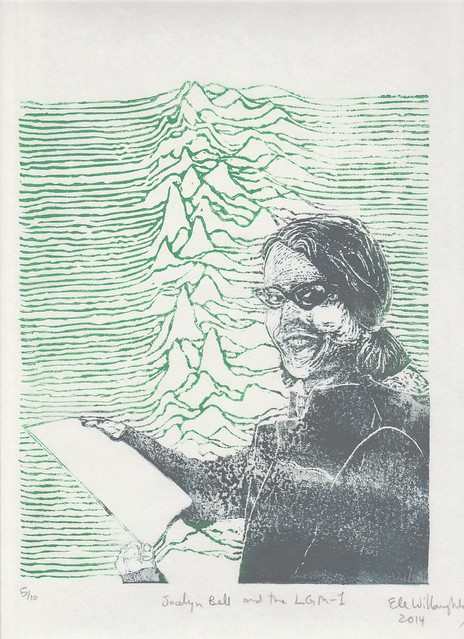
Astrophysicist Jocelyn Bell Burnell (born 1943) was just a graduate student in 1967 when she discovered the first radio pulsar (or pulsating star), a highly magnetized, rotating neutron star that emits a beam of electromagnetic radiation. This radiation (light in the radio frequency band) can only be observed when the star is point towards us; so, like the light from a distant lighthouse, it appears to pulse at a precise frequency. The 1968 paper announcing this discovery in Nature has five authors, lead by Hewish, followed by Jocelyn Bell. In 1974, Hewish won the Nobel Prize for this discovery, along with fellow radioastronomer Martin Ryle). Jocelyn Bell was not included as it was assumed that the "senior man" was responsible for the work. Jocelyn Bell Burnell has gone one to a very distinguished career in astrophysics. She became the first female president of the Institude of Physics and of the Royal Society of Edinburg. She helped set up the Athena Swan programme to support UK women in science. In 2018 she was awarded the $3 million Breakthrough Prize in Fundamental Physics for her discovery of pulsars and lifetime of leadership in science. She is donating the award money to the Institute of Physics for PhD scolarships for underrepresented people including women, ethnic minorities and refugee students in physics!
Jocelyn Bell and the LGM-1
Jocelyn Bell (Burnell) (born 1943) and the LGM-1, astrophysicist who discovered pulsars, linocut by Ele Willoughby

Mae Carol Jemison (born October 17, 1956) is a physician who became the first African American woman to travel in space when she went into orbit aboard the Space Shuttle Endeavour for NASA, on September 12, 1992. She also has a B.S. in chemical engineering, served in the Peace Corps, is a dancer and choreographer, formed and runs her own company researching the application of technology to daily life, and even appeared on Star Trek: The Next Generation.
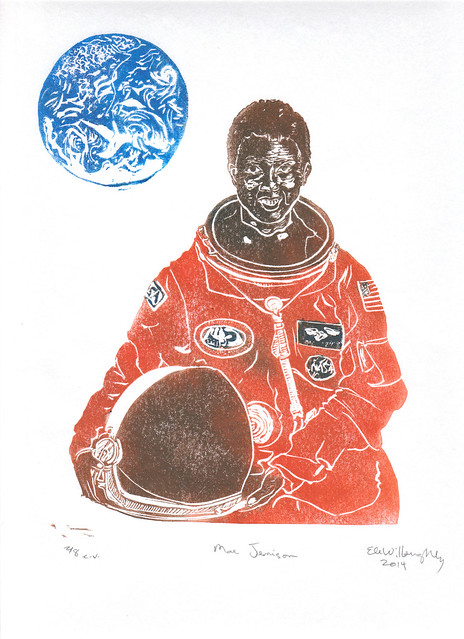


Mae Jemison linocut
Mae Jemison, linocut on Japanese kozo paper, 9.25" by 12.5" (23.5 cm by 32 cm) in an edition of eight by Ele Willoughby, 2014