Showing posts with label wunderkammer. Show all posts

Thursday, February 8, 2018

The Matchbook Project Cabinet of Curiosities


I am really pleased to be invited to take part in the The Matchbook Project, especially since the theme this year is Cabinet of Curiosities. This is a group travelling exhibit/artist exchange where all the participating artists make 10 tiny boxes (3" x 2" x 1") and their contents. You can see images of previous works in this project here or follow the #inventoryofmemorymatchbox hashtag on Instagram. Artists may decide to have similar matchbox covers and differing contents, but I decided to make similar contents and different covers.


I returned to the idea of the two-headed turtle, for something which is both an example of natural history and something extraordinary which might fit in your wonderkammer. I carved two matching lino blocks for the turtle from above with the top of its shell and the turtle from below with the bottom of its shell and printed these on Japanese cardstock. Then I printed the shell itself on many different washi papers so I cold collage each section of the shell seperately.

I made the matchboxes themselves from Japanese cardstock in assorted colours, textures and sometimes with inclusions like gold and silver foil or silk fibres. Then I made assorted tiny pillows on which the polycephaly (two-headed turtle) specimen could rest. These were made in red silk or patterned cotton with a Japanese motif or botanical drawings (which fit with the cabinet of curiosity theme).
 
I collaged each of the boxes with all the bits of prints and proofs I've been saving so long: turtles on assorted washi, insect wings on delicate tissue, crystals on irridescent paper, beetles on washi, bees, radiolarians, fossils, mushrooms, butterflies and tiny vintage tarot cards from a beautiful sheet of paper I bought in Amsterdam many years ago.
  

I had so much fun making these I think I'll make more. I'm planning to list a mystery box in my shop, so that you can purchase one and have the contents be a surprise!

Tuesday, January 9, 2018

Looking back at 2017: science, art and life

Wunderkammer, interactive multimedia: linocut, collage, wooden box, electronics, sound files, 2017 by Ele Willoughby
With the new year, like many, I often like to look back. I find sometimes you don't see things accumulate or note acheivements. So, briefly, on a personal front, 2017 was a very interesting year. It was challenging, but over all, I'm quite proud. On one hand it's funny to start off talking about the acheivement of being in the running for a job I didn't get, but astronaut is no ordinary job. I was proud that I even had the guts to submit my application in the summer of 2016 for the Canadian Space Agency's job search. Each step of the year-long search, as I continued to advance I was a strange mixture of astonished yet confident that after all, it was something I could learn to do if selected. So I was very proud to be  one of the top 72 people selected from 3772 initial applicants, who were invited to the Astronaut Recruitment Assessment Centre! It was a unique experience; 3 and half days of gruelling mental, psychological and physical assessment, along with a very impressive and fascinating cohort of fellow applicants (only a third of whom were women). I've had so many questions and comments from people since this experience that I didn't expect. People I just met told me they were proud. Parents told me that they followed my progress with their kids, or asked me advice about how to encourage the next generation of potential astronauts. I wouldn't have imagined that even making it that far in their job search could impact people, but I'm humbled that it did and thank you all for your kindness, encouragement and support.

Another new experience this year was running an art gallery! I'm so glad that Emma talked me into taking on the Toronto Etsy Street Team Gallery, because truth is, I think I would have shied away from the financial risk. But it was a great experience and I'm proud of what we pulled off. I curated my first show, Wunderkammer, with a wonderful collection - a cabinet of curiosity in fact, of science art from some favourite and new-to-me artists. I went on to curate and organize shows about Canada, help foster Rebecca Vaughan curate and participate in Love Your Body, curate and participate in a Mesozoic themed the Dinovember show. I was also really pleased to take part in Tosca Terran's UnNatural History show at the gallery, where I showed my entire unnatural print collection.

2017 also some some great collaborations. WWEST's Phylo Women in STEM trading cards came out this spring. Definitely my favourite commission of 2016, was making and submitting five of my portraits of women. I have previously submitted some art for UBC's Dave Ng's earlier project to use trading cards as a natural historian's version of Pokemon. This latest set brings attention to women in science and technology, throughout history, and the hurdles facing women and under-represented groups. He told me he had seen my blog post about the death of physicist, material scientist and archeometry pioneer Ursula Franklin and it encouraged him to include her, as a great scientist, role model and Canadian. As you can see (above), I've also illustrated marine geologist Marie Tharp, physicist Lise Meitner, seismologist Inge Lehmann and proto-computer scientist Ada Lovelace. The sets are available from Phylo and you are even free to download and print your own! 

Because life is odd, the day after I learned that I did not advance to the top 32 astronaut candidates, Anthropologie approached me about collaborating on tee shirts. They loved my 'terms of venery' series of group nouns for animals.  They licensed two of my existing prints, 'An Ostentation of Peacocks' and 'A Kaleidoscope of Butterflies' and commissioned a third work. They wanted my portrait of my beloved, late, great Minouette the cat, but wanted it to fit in the venery series. While a group of cats is often known as a clowder, I remembered that it can also be called a glaring, and I thought that was a perfect combination for her fierce "Stop carving lino and feed me now!" look. I was very excited to work with one of my favourite clothing stores and it was a lovely experience to work with them. I was gratified that they wanted artwork that I had made simply because I wanted to.

 2017 also saw my home, studio and peculiar combination of jobs and interests as the subject of this Toronto Star article. I participated in another Bees (& the Birds) show. I did all the Toronto Etsy Street Team craft shows: the Midsummer Market, Etsy Made in Canada (where I enjoyed playing second fiddle for the first time) and the Christmas Maket. I sold at the One of a Kind Christmas show once again. I had artwork selected for the Leftovers VI Silent Auction, in Boise, Idaho, and 'Life as we knew it' and 'LUNAR' art shows at Art.Science.Gallery in Austin, Texas.

On the home front, our son turned four at the end of November, which means that he was able to start kindergarten in September. This is a big shift and I'm still getting used to it. He's now at school 6 hours a day, which frees me up to have much more freedom and control of my time and schedule and he loves it and is flourishing!

I love most of all that this list is very mixed: art, science, family life, and I'm keeping people guessing. When I was young I thought I had to choose, but I think in 2017 I did a good job of not choosing and being as much of a Renaissance woman as I can. I'm rather enjoying not having to define myself one way. This year once again promises new things and I'm looking forward to seeing what it brings.


Tuesday, October 17, 2017

UnNatural History


My linocut imaginary menagerie: Snowflake beetles, Chrysanthemum snake, Elusive Cactibou, Iceberg Squid, Batbearoo, Hammerhead Hedgehorse, Duck-billed Deer, Winged Walrus, Mandriltee and Aeolian Jellyfish

 Last Friday, the 13th, was the Opening for 'UnNatural History', curated by Tosca TerĂ¡n at the Toronto Etsy Street Team Gallery. There were costumes, Tarot readings, and prizes along with a fascinating show of art from 14 artists from Canada, the US, Iceland and Hungary. Works include painting, printmaking, multimedia, photography, bookbinding and sculpture and explore real and imaginary life forms and landscapes.

 This month and for the first two days of November, there gallerywill also host a series of workshops, from creating with thermoplastic, to bat skeleton articulation to decorating sugar skills to celebrate Dia de los Muertos. Find out more on the blog and come see the show while you can!
Paintings by Kristen D'Aquila
Photographs of marine plants and animals in multimedia light boxes by Holly McClellan

Sculptures with detail of one of the sculptures, and what lurks inside, by Lavinia Hanachiuc

Photographic sculptures of landscapes by Mar Hester
Hand-stitched, collaged animal illustrations by Judith Pudden


Multimedia by Kest Schwartzman, including cicadas, butterflies and a bat in metal masks and costumes
Kest Schwartzman

Kest Schwartzman

painting by Rosemary Stehlik
Photos by Wilder Duncan and Ralph Smith. Wilder, who is teaching the bat skeleton articulation workshop and does rogue taxidermy, arranges the bones he works with, in paterns like mandalas or geometric shapes and collaborated with still life photographer Smith

Pati Tozer's miniature etchings and hand-bound book, between Schwartzman's cicadas and D'Aquila's paintings

wundercabinet of beaded specimen by Cynthia Winders
Tosca TerĂ¡n, glass sculptures with wool, moss and lichen, shaped like plankton
Images are 'Ambient Plague' by Elaine Whittaker about microbes around us. Bone sculptures by Tosca TerĂ¡n, and figurines by Kathryn Bell

Tuesday, March 7, 2017

News and plans: WUNDERKAMMER, #SciArt Tweetstorm and more


If you've been following me for long, you'll know that I'm obsessed with Cabinets of Curiosity and in fact, I view my growing portfolio of prints about natural history as a sort of wunderkammer. So, when we decided to take the plunge and sub-lease the gallery for 2017, it was obvious that I would want to curate not just a #SciArt show, but a Cabinet of Curiosity show. I'm really excited to announce this show and there are so many team members who would be a perfect fit, I'm already curating in my head. I'm looking forward to seeing applications even! I've opened the application to all local artists, so you don't need to be a team member to apply. There are a lot of amazing artists inspired by science in this city. Apply!

This week has been the now annual Twitter #SciArt tweetstorm, so I've been busily sharing my art and art of others all week. You need to go check out the hashtag today, if you haven't been following.

Also, we plan to revisit Christine's Bees (& the Birds) show about pollinators this year.  We are of course going to celebrate Canada's 150th birthday with a Canada themed show opening Canada Day. Jen, who is also an ambassador for the Body Image Movement, is curating a Love Your Body show about positive body image. We thought a Halloween show would be fun, and I'm also going to enjoy curating a dinosaur Dinovember show in November, of course!

A huge congratulations to the remaining 32 candidates to become the next two Canadian Space Agency astronauts! I had the pleasure of meeting several of them with my batch of fellow candidates at the Astronaut Assessment Center, and will be cheering them on as the competition continues.

http://www.asc-csa.gc.ca/eng/astronauts/recruitment/map.asp# While I'm no longer in the running, it's been quite the experience to make it this far. I was proud of myself for completing the application! 3072 people applied, but about twice that number began but did not complete the lengthy and involved process. I was very glad to have the opportunity to have a glimpse at what the life of an astronaut is all about as well as to meet so many of these accomplished Canadians!

Thanks very much to my friends and family who cheered me on and helped free up my time so I could participate in the process as long as I did. I really appreciate all your support and encouragement. It meant a lot!

Tuesday, March 8, 2016

SciArt, women and wunderkammers

my linocut portraits of women in STEM, left to right, top to bottom:
Hypatia, Skłodowska-Curie, Nightingale, Atkins, Leavitt, Jemison, Merian and Lamarr


my linocut portraits of women in STEM, left to right, top to bottom:
Anning, Wu, Lovelace, Lehmann, Kovalevski, Tharp, Bell (Burnell), Meitner, Herschel

I'm sharing my women in STEM portraits for International Women's Day today. We're fresh off the second annual #SciArt tweetstorm, which is rapidly becoming a fabulous institution on Twitter. For the second year, the first week of March has been a celebration of the place where art and science intersect - everything from technical drawings and data visualizations to comics to fine art in all media to textiles and fashion and basically, whatever you can imagine. It's a great way to find like-minded creators and share your work, brought to us by the great team at the Symbiartic blog on Scientific American.

Like other participants I'm really thankful for this opportunity to connect with a greater audiance. This just blows my mind. I've shared my leaf prints before and usually get great feedback, a few favorites and retweets, but during the tweetstorm this was the response:


Though my friend @faunalia likes to think I'm some sort of craft celebrity, I'm not remotely famous and 107 retweets and 130 favorites are astronomical numbers for me! The tweetstorm brought my art to the eyes of chemists and plant scientists. It really has the power to help bring people together and forge a SciArt community.

Some SciArt from TEST teammates: The Vexed Muddler,
Slashpile Designs, nanopod, The Chemist Tree, Honey Thistle,
HOPSCOTCH, Tanya Harrison Photo and Wild Whimsy Woolies
During February, the Toronto Etsy Street Team did a daily #WeBeTEST Instagram challenge, and that too was great for community building. On Valentine's we shared some love of our teammates work and amongst other things, I wrote about other science-artists on the team. I've long been a fan of the otherworldly jewellery and sculpture metal and glasswork of Tosca from nanopod. You can see that Haeckel is a influence to her too, along with myth and some of the more astounding natural history. You can find radiolarians, jellyfish and other biomorphic forms in her work. She's decided to add a some retail to her studio and teaching space Nanotopia (322 Harbord St, at Grace). She's invited Honey Thistle and Never Wares and I to also sell a cabinet of curiosity of items, along with her works, minerals, fossils, bones, taxidermy and other strange ephemera! So I brought her some small prints of weird (real and imaginary) creatures as well as some stuffed animals (extant and extinct) today. Next week, two women from Brooklyn's Morbid Anatomy Museum and Evolution store will be in town and teaching Entomology 101 and Jackalope and Squirrel taxidermy mounts at Nanotopia. The retail space is planned to coincide with their visit March 11 -13. If you're in the neighbourhood you should go check it out! To be honest, this is pretty well my definition of cool and it was all I could do not to squeal with delight and act like I'm a professional grown-up doing something normal and every day, because how cool is that?

This is a photo I took of the window of Evolution, NYC, June 18, 2011
The Morbid Anatomy blog, by the way,  is somewhere you could loose hours of your life if you too are inspired by the intersection of art and science, or love magpie&whiskeyjack but wish it were more gothic.

Tosca said she would like more stuffed things and I think I really must make tardigrades. By the way, I printed a linocut tardigrade last week. If you don't know, these mighty microscopic creatures of 0.5 mm (0.02") maximum in length are found in environments from mountaintops to the deep sea, from tropical rain forests to the Antarctic, and can survive conditions leathal to most other animals including: temperature ranges from near absolute zero 1 K (−458 °F; −272 °C) to about 420 K (300 °F; 150 °C); roughly six times the pressures found in the deepest oceanic trenches on Earth; ionizing radiation at dosages hundreds of times what would kill a mere human; the vaccuum of space. That's right; these animals have been to outer space and lived to tell the tale (or, at least lived and had someone tell the tale). The can go without food for 30 years, dehydrate, and then just rehydrate and go about their lives.
Tardigrade, linocut 8.5" x 11" on Japanese paper, Ele Willoughby, 2016

Tardigrades have short, plump legs and are prevalent in mosses and lichens and feed on plant cells, algae, and small invertebrates, hence their second nickname in case "water bear" isn't cute enough for you: the moss piglet. Tardigrades have been around at least 530 million years to the Cambrian. Don't you think it would make a cuddly plushie?

When you're done catching up on the #SciArt hashtag on Twitter, be sure to look up #5womenartists - another great one for this #WomensHistoryMonth. It occurs to me that all the work I'm writing about here today are all by women artists, and if you like what I do, you'll love their work too.


Sunday, July 6, 2014

Dictionary of imaginary mini print creatures

I used to regularly blog what I was reading, but fell out of the habit last year. Something about the heat of the summer, and feeling so pregnant, and then, having the baby in the winter. I did read last year... less than in some years... but I read and failed to document it. It's no longer fresh in my mind, but I have been meaning to try and catch up.

This year, when I get a moment, I'm usually feeding the baby and so I don't have two hands and have found trying to read a book awkward. So I've been reading copious amounts of non-fiction on my phone, rather than books. The one book I read when I have some quiet and two hands to gently hold it is the Codex Seraphinianius, written and illustrated by Italian architect Luigi Serafini from 1976 to 1978. It's a visual encyclopedia, of a foreign, paradoxical yet familiar, world, complete with its own language and obscure meanings. I've written about it and alluded to it previous to ever seeing a copy in person, a few times, in fact. An original first edition will run you about $5000, but a new edition came out last year, for a much more conceivable $200 for a large, beautiful, hardcover book. It comes complete with a new preface by the author, which I enjoyed. He describes how he made the book - the physical process - without destroying the beauty of the unknown why or what it really is about. He basically writes (and I should perhaps post a spoiler alert for the purist), I don't know, I was somehow compelled, maybe that weird stray cat 'dictated' the Codex to me? RJH gave it to me for Christmas. Wanting to get back into writing reviews of what I read (in the most generous sense of the word), I've been thinking about how one could review a mysterious tome, all alien illustrations and imagined alphabet or syllabary and language.

It occurred to me the best way would be something like this.

1. Codex Seraphinianius, written and illustrated Luigi Serafini.
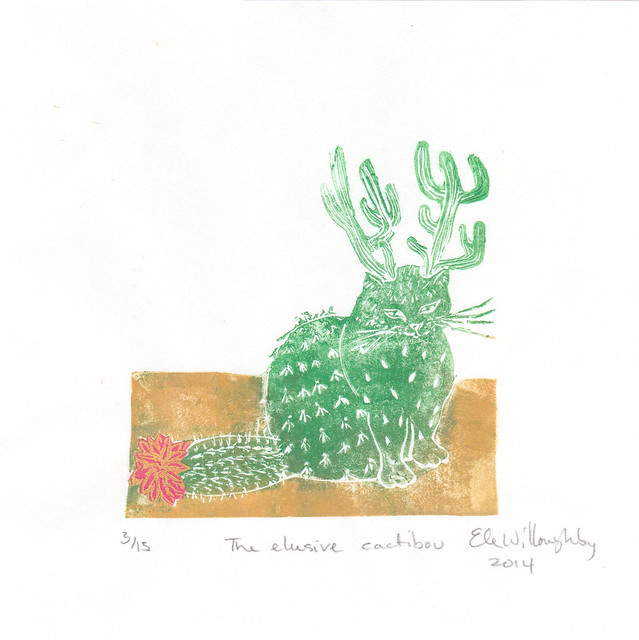
The elusive cactibou linocut

I mean, it's sort of obvious in hindsight, no? What can one say to the Codex, but to reply in kind with an illustration of a bizarre, unknown creature, which nonetheless seems to be built of familiar parts (say, a cat, cacti and caribou antlers) and its own internal logic? No sooner had this idea had entered my mind than it grew into a series of mini print illustrations of fantastical creatures, beginning with my previous mini print, the winged walrus.
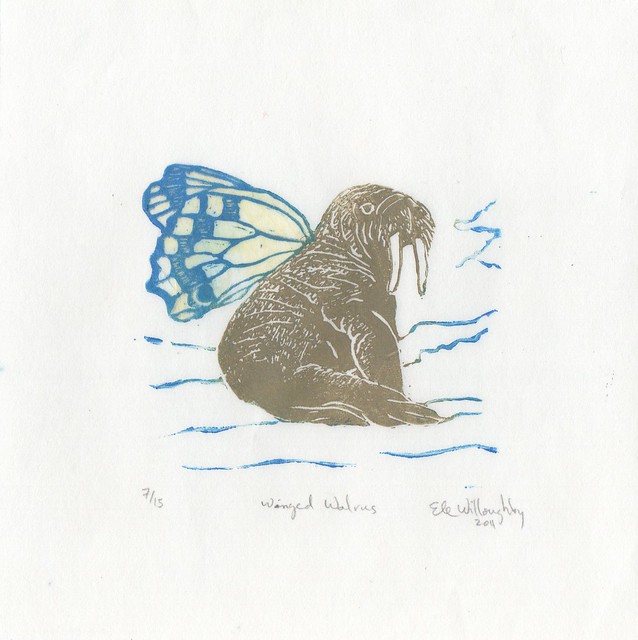
Winged Walrus

And before long, I needed to make a print of the Batbearoo (neither bat, nor bear, but a flying marsupial).
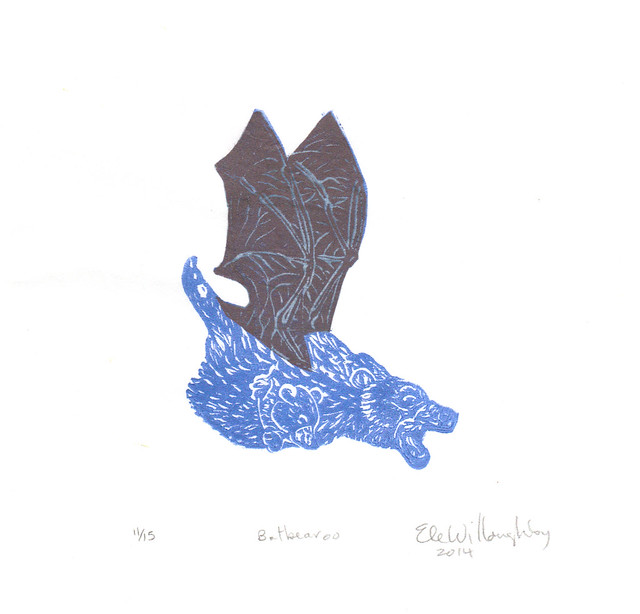
Batbearoo linocut
http://vennarecci.free.fr/Rhinogrades/
 Anatomie Et Biologie Des Rhinogrades — Un Nouvel Ordre De Mammifères, Masson, France (1962) is the most wonderful sort of fictional science (rather than traditional science fiction). The original was published in German as Bau und Leben der Rhinogradentia in 1957. There exists an English translation by Leigh Chadwick in 1967 called The Snouters: Form and Life of the Rhinogrades, but I've only found my French edition. StĂ¼mpke created an entire new (imaginary) order of mammals, the rhinogrades (or "snouters") whose most remarkable characteristic was the nasorium, an organ derived from the ancestral species' nose, which had variously evolved to fulfill every conceivable function, notably including locomotion. It's written much like a regular scientific treatise, complete with footnotes, references, Latin species information and a straight face. He never actually says anything to suggest that this order of mammals, or their home the Hi-Yi-Yi Pacific Islands are anything other than real. As I explain here, this 'scientific' text is truly magical, and I even cried at the end. It is understandably a great favorite amongst zoologists.
I was reminded of a couple of my other favorites. Harald StĂ¼mpke's

The other favorite is "The Book of Imaginary Beings" by Jorge Luis Borges with (poor forgotten) Margarita Guerrero (who is often omitted from the author list), which I did review here. It's another sort of imaginary encyclopedia of sorts, though written in human languages (Spanish, and readily available in English translation). It's a miscellany of the marvellous, written in Borges' typical magical scholarly fashion.

It's possible I have also been influenced by reading my tiny son Mercer Mayer's Little Monster's Bedtime Book several times. It's a lovely little illustrated storybook of 15 poems about monsters he invented - and, importantly, defined and described, published when I was but a wee little thing myself.

It occurred to me that there is in fact an entire proud tradition of these sorts of scholarly or scientific treatises on the not quite real, masquerading as fact. You might consider the 15th century Voynich manuscript, to which the Codex is often compared. It too is written in an unknown script, appears to be a sort of illustrated encyclopedia, or possibly nonsense. It has long intrigued scholars. Just last year, an article on a new study, published in the journal PLoS One, argued that the manuscript has a real, decipherable message (as reported by the BBC here). A large portion of the what I think of as 'proto-science', both intentionally (usually to confuse competitors, if one was say an alchemist) or unintentionally fall into this category. During the classical advent of history, Herodotus and Pliny for instance, did not really distinguish between "I can attest that this is factual" and "some guy told me this half-baked story over beers". Or, at least, it's fair to say they compiled their works in the absence of modern methods to try and establish the veracity of natural history of any sort.

So my next project is clear. These works have given me so much pleasure, I need to write my own fictional zoological text, featuring the likes of the winged walrus, batbearoo and cactibou! I plan a collection of mini prints, along with pseudo-zoological descriptions of these rare (and you know, possibly imaginary) creatures. After all, I think of much of my work as a sort of wunderkammer, and a true cabinet of curiosity is not just group of specimen of natural history both real and imaginary, but a proper collection, of ordered, organized and described things, in its own proto(pseudo)-scientific fashion.