Showing posts with label animal. Show all posts

Sunday, July 6, 2014

Dictionary of imaginary mini print creatures

I used to regularly blog what I was reading, but fell out of the habit last year. Something about the heat of the summer, and feeling so pregnant, and then, having the baby in the winter. I did read last year... less than in some years... but I read and failed to document it. It's no longer fresh in my mind, but I have been meaning to try and catch up.

This year, when I get a moment, I'm usually feeding the baby and so I don't have two hands and have found trying to read a book awkward. So I've been reading copious amounts of non-fiction on my phone, rather than books. The one book I read when I have some quiet and two hands to gently hold it is the Codex Seraphinianius, written and illustrated by Italian architect Luigi Serafini from 1976 to 1978. It's a visual encyclopedia, of a foreign, paradoxical yet familiar, world, complete with its own language and obscure meanings. I've written about it and alluded to it previous to ever seeing a copy in person, a few times, in fact. An original first edition will run you about $5000, but a new edition came out last year, for a much more conceivable $200 for a large, beautiful, hardcover book. It comes complete with a new preface by the author, which I enjoyed. He describes how he made the book - the physical process - without destroying the beauty of the unknown why or what it really is about. He basically writes (and I should perhaps post a spoiler alert for the purist), I don't know, I was somehow compelled, maybe that weird stray cat 'dictated' the Codex to me? RJH gave it to me for Christmas. Wanting to get back into writing reviews of what I read (in the most generous sense of the word), I've been thinking about how one could review a mysterious tome, all alien illustrations and imagined alphabet or syllabary and language.

It occurred to me the best way would be something like this.

1. Codex Seraphinianius, written and illustrated Luigi Serafini.
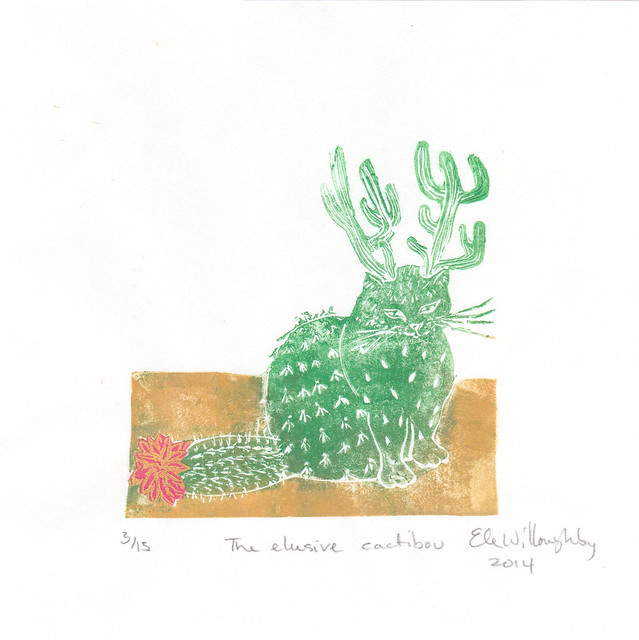
The elusive cactibou linocut

I mean, it's sort of obvious in hindsight, no? What can one say to the Codex, but to reply in kind with an illustration of a bizarre, unknown creature, which nonetheless seems to be built of familiar parts (say, a cat, cacti and caribou antlers) and its own internal logic? No sooner had this idea had entered my mind than it grew into a series of mini print illustrations of fantastical creatures, beginning with my previous mini print, the winged walrus.
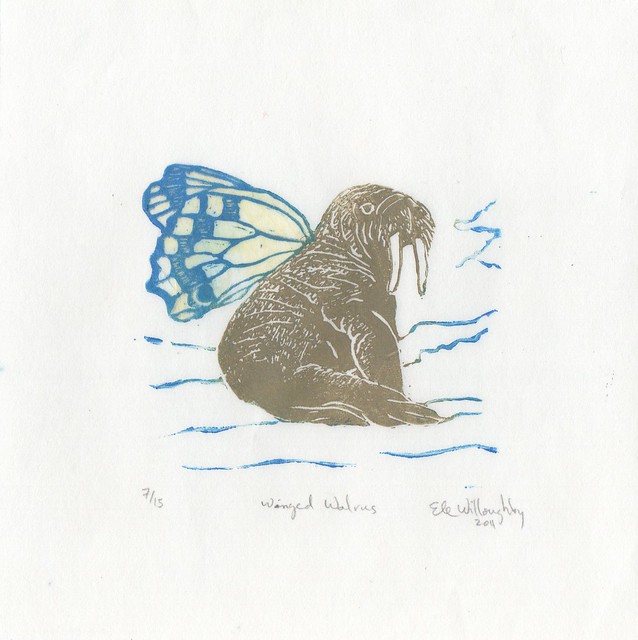
Winged Walrus

And before long, I needed to make a print of the Batbearoo (neither bat, nor bear, but a flying marsupial).
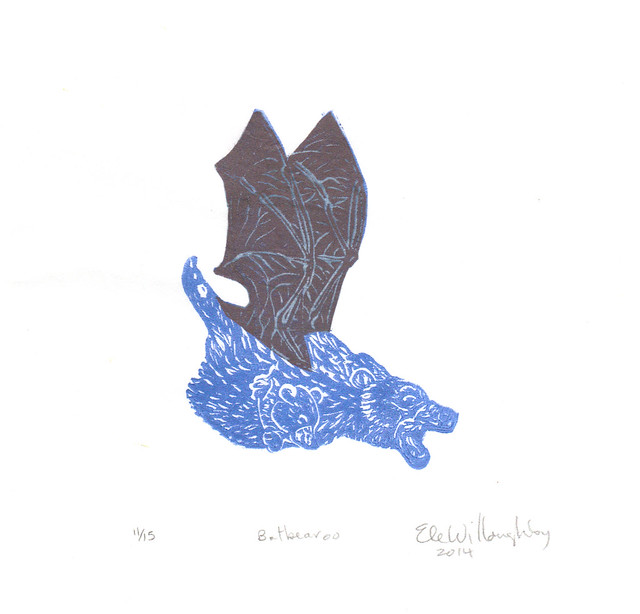
Batbearoo linocut
http://vennarecci.free.fr/Rhinogrades/
 Anatomie Et Biologie Des Rhinogrades — Un Nouvel Ordre De Mammifères, Masson, France (1962) is the most wonderful sort of fictional science (rather than traditional science fiction). The original was published in German as Bau und Leben der Rhinogradentia in 1957. There exists an English translation by Leigh Chadwick in 1967 called The Snouters: Form and Life of the Rhinogrades, but I've only found my French edition. Stümpke created an entire new (imaginary) order of mammals, the rhinogrades (or "snouters") whose most remarkable characteristic was the nasorium, an organ derived from the ancestral species' nose, which had variously evolved to fulfill every conceivable function, notably including locomotion. It's written much like a regular scientific treatise, complete with footnotes, references, Latin species information and a straight face. He never actually says anything to suggest that this order of mammals, or their home the Hi-Yi-Yi Pacific Islands are anything other than real. As I explain here, this 'scientific' text is truly magical, and I even cried at the end. It is understandably a great favorite amongst zoologists.
I was reminded of a couple of my other favorites. Harald Stümpke's

The other favorite is "The Book of Imaginary Beings" by Jorge Luis Borges with (poor forgotten) Margarita Guerrero (who is often omitted from the author list), which I did review here. It's another sort of imaginary encyclopedia of sorts, though written in human languages (Spanish, and readily available in English translation). It's a miscellany of the marvellous, written in Borges' typical magical scholarly fashion.

It's possible I have also been influenced by reading my tiny son Mercer Mayer's Little Monster's Bedtime Book several times. It's a lovely little illustrated storybook of 15 poems about monsters he invented - and, importantly, defined and described, published when I was but a wee little thing myself.

It occurred to me that there is in fact an entire proud tradition of these sorts of scholarly or scientific treatises on the not quite real, masquerading as fact. You might consider the 15th century Voynich manuscript, to which the Codex is often compared. It too is written in an unknown script, appears to be a sort of illustrated encyclopedia, or possibly nonsense. It has long intrigued scholars. Just last year, an article on a new study, published in the journal PLoS One, argued that the manuscript has a real, decipherable message (as reported by the BBC here). A large portion of the what I think of as 'proto-science', both intentionally (usually to confuse competitors, if one was say an alchemist) or unintentionally fall into this category. During the classical advent of history, Herodotus and Pliny for instance, did not really distinguish between "I can attest that this is factual" and "some guy told me this half-baked story over beers". Or, at least, it's fair to say they compiled their works in the absence of modern methods to try and establish the veracity of natural history of any sort.

So my next project is clear. These works have given me so much pleasure, I need to write my own fictional zoological text, featuring the likes of the winged walrus, batbearoo and cactibou! I plan a collection of mini prints, along with pseudo-zoological descriptions of these rare (and you know, possibly imaginary) creatures. After all, I think of much of my work as a sort of wunderkammer, and a true cabinet of curiosity is not just group of specimen of natural history both real and imaginary, but a proper collection, of ordered, organized and described things, in its own proto(pseudo)-scientific fashion.

Sunday, November 3, 2013

Zed, new and improved

ZZebra2

Honestly, I was so keen to finish the alphabet, I didn't even notice I failed to reverse the 'Z' prior to carving my zebra, until it was politely pointed out to me. RJH says now that my backwards Z for Zebra can be a 'collector's item' when I'm famous, hahaha. Anyhow, I was able to carefully re-jig the block and insert a new piece of lino to produce a new edition with the same zebra and a correct Z.

The instinct to draw letters in the right orientation is so strong that I really find it remarkably easy to forget to reverse them for block prints.

While I had assembled my quilt, I hadn't actually quilted it (or sewn the layers together) yet... so I was able to replace the reversed-z quilt block with a normal z quilt block.

Saturday, September 7, 2013

g for giraffe

gForGiraffe001 G is for Giraffe of course!

This 'g' monogram linocut features an elegant giraffe. It's standing on the tail and peeking through the loop of the 'g'. This is an open edition print in brown ink on Japanese paper, known as washi. It is available in a variety of colours! Each sheet is 14.8 cm or 5⅞ inches square.

gForGiraffe005gForGiraffe002gForGiraffe003gForGiraffe004

Wednesday, July 10, 2013

Canada: 10 provinces, 3 territories and their symbols

Canada 
A couple of people asked whether I could print my series of province and territory linocuts on one giant pieace of paper. I was thinking that a book might be a better format. You see, the provinces are not at all printed to scale (and may even have some variations in projection). I made this decision consciously. You see, the smallest province PEI is 5,660 km2 whereas Nunavut, the largest of either province or territory is  2,038,722 km2- that is a bit more than 360 times as large. So, unless I was making art for a very very large space indeed, and could make prints in tens of square metres, I would never be able to acheive enough detail in the smaller provinces. However, it is possible to digitally place all the images side by side, and with a little Photoshop magic, you can see all of Canada. The pieces don't match perfectly; but, between inprecision in my carving, and variations from map to map (of scale, resolutions and maybe even projection) it's a pretty good fit.

Thursday, October 18, 2012

L is for Lynx

L is for Lynx leafy

This 'L' monogram linocut features a lynx. This is an open edition print on Japanese kozo washi (or mulberry paper), Thai and other interesting papers. It is available in a variety of colours and some prints! Each sheet is 5.5 inches by 8 inches, or 14 cm by 21.6 cm.

The lynx can be one of four types of wildcat. This one is a Eurasian lynx native to European and Siberian forests. I've been a fan of the lynx since childhood. I recall writing a report on the subject in grade 4. In fact, I might have found said project in my mother's storage locker earlier this month (not to say I'm a complete pack-rat... but, this might have happened).

L is for Lynx obonaiL is for Lynx spot on khakiL is for Lynx yellowL is for Lynx spots

Also, a little aside. Some of you, like me, are fans of printmaking and appreciate the work involved in making a hand pulled print. Etsy recently reorganized its front page in an effort to facilitate browsing. The trouble is that Printmaking, formerly an obvious category, is now stuck in a subsection of Art labelled 'Prints and Posters'. Unfortunately, many people use the word 'print' to signify a reproduction. There's nothing wrong with reproductions - I have some giclée and archival prints which I enjoy. But they are entirely different from original artworks made labouriously by hand by printmakers, like relief prints, etchings, sérigraphs, lithographs, collographs, woodcuts, engravings and more. If you are an Etsy user, please add your two cents worth here. It's important that they hear that this is not a move which serves artists or art buyers. It might be particularly meaningful for them to receive feedback from buyers.

Friday, July 20, 2012

Otter O & Unicorn U

OtterO804OtterO805 OtterO806OtterO807 OtterO809Unicorn U Unicorn UUnicorn U Unicorn UUnicorn U

O is for otter and U is for unicorn. Each is an open edition print on Japanese kozo washi (or mulberry paper). It is available in a variety of colours! Each sheet is 14.8 cm or 5⅞ inches square.

Wednesday, June 20, 2012

A Tower of Giraffes

giraffes001

Well, I still have no functioning laptop of my own, but RJH has been kind enough to create a profile for me on his laptop and I'm getting better at using it.*

This linocut shows a tower of giraffes. The collective noun for a group of giraffes is a "tower" of course. The first thing you might notice about a giraffe is its towering neck, and a collection of giraffes tower over most things. The typography I designed for the words represents their meaning; "tower" mimics the shape of a tower complete with a turret-shaped 't' and the delicate, tall, thin letters of 'Giraffes' mimic the animals, right down to the horns-like ossicones on the dot of the 'i'. In fact, the crenellations (the battlement, or cut-out bits of the parapet) of the turret-t also echo the shape of the ossicones.**

These linoleum block printed giraffes are printed in brown ink with black and orange words on Japanese kozo, or mulberry paper. Each print is 9.25" by 12.5" or 23.5 cm by 31.7 cm in dimension. There are 8 prints in the edition.

giraffes detail

I love how each giraffe has such personality! The one in the middle looks a bit goofy; the one on the right is a snob; the one on the left wonders what it did to get saddled with the other two. Am I right?

I also love the weird and wonderful terms of venery - the collective nouns for groups of animals (and other things). Some are evocative, some strange and obscure. This is the sixth in a series of such prints.

Do you have any idea how hard it is for me to carve "Giraffes", backwards, when it is so hot I think my brain might be slightly melted, without getting confused about which consonants to double? Let's face it, I might like words, but my spelling is atrocious. In fact, I wanted to put two t's in atrocious, but my spell-checker won't let me. RJH says double consonants are my kryptonite. Reynardin gleefully remembers my high school "writting" folder. I may know where you can get yourself a "Girraffes" print to go with your "Butterfflies". *head desk* I have a new motto (which has two t's - I checked): spell twice, carve once.

*I've used all sorts of machines (PC, UNIX, LiNUX, various Apple, and a few more or less handmade approximations of these), and like most physicists I know, I'm a PC person, not a Mac person. There is no reason for a Mac to give me trouble if I can program a data logger in machine code, and yet, I find them anti-intuitive, to the great amusement of several friends. First of all, I had to learn all the shortcuts (without using CTRL) and then I had to ask about right-clicking when there is no right-hand mouse button at all and generally I find it hard to tell what it's up to. I want to know what a machine is doing, and I'm not very patient... but I'm getting better. Plus, I like my bilingual keyboard. It was a pain to try and list this print in French without any é on the keyboard.

**I managed to use crenellations and ossicones in a single sentence. In fact, I just did it again. Think the sesquipedalian police will get me?

Wednesday, February 1, 2012

Animal Pillows

dodopillow6
ikuko the giraffe
ikuko giraffe reverse
cat
cat, reverse

RJH is kind enough to let me play use his camera, so I've been photographing and relisting all my block printed pillows. He must really love me, cause I don't think (between you, me and the lamp-post) that I could let him borrow the gravitymeter -the differential pressure gauge maybe; that thing is damn near indestructible. Luckily, he would have little to no use for either, and the photogs view cameras as tools to be used which must not be fragile.

p.s. If you would like a new internet habit (hahaha) you can find minouette on Pinterest. Leave a link if you've got one too.

Thursday, December 29, 2011

That's totally a skunk

skunk detail A determined skunk marches through the snow in this lino block print in black on white Japanese kozo (or mulberry) paper. Each print is 12.5 inches by 8 inches (or 31.8 cm by 20.3 cm). There are 8 prints in the edition.

While most famous for their malodorous defense mechanism, the black and white striped skunk is actually rather cute. So, I'm adding it to my collection of black and white block printed animals.

skunk marching through the snow

This is an actually conversation I had, inspired by my "discarded proofs of prints as wrapping paper" scheme.

R: Oh, did I tell you I love your narwhals print?
M: You mean the pygmy right whale and the two seals?
R: Yes, and this is a great badger.
M: Dude, that's totally a skunk.


These things can be important to know. Those in Europe may not truly appreciate the pungent consequences of mistaking a skunk for a badger (though, I don't suggest messing with a badger either)*. N's cats like to taunt the local skunk, so they are not allowed out if the skunk has been seen. Unfortunately, one summer night they closed only the screen door. The vengeful skunk sprayed their house. N's teenage children were sent home from school the next day, because they stank, merely from being in the same building. Can you imagine being a teenager sent home from school for stinking?! Skunks are quite common here, even in the city. When I was small, we had one who lived below the back porch.

I've been translating all my Etsy listings into French, for days. It's funny to note that while in school I learned that a skunk was a moufette but in Québec it's often called la bête puante (or the stinking beast)! Apparently in the US a skunk is sometimes called a polecate, which I don't understand.

*I can hear the stinking badger jokes now.