Showing posts with label history. Show all posts

Thursday, February 25, 2021

Freedom of the Press, Blood, Sweat and Tears, Creative Blocks and Animal Prints

 I have been working away, when I could, while we've been trying to do remote school for the first couple months of the year. I actually managed to keep up with the Printer Solstice prompt and made a new print a week. Now that schools have reopened here, I have a chance to share some of my latest prints. 


Freedom of the Press, linocut by Ele Willoughby, 2021

I wasn't quite sure where to go with the theme "freedom of the press". I went with a winged Gutenberg press, thinking of the initial freedom it represented after its invention. (By the way, it's often presented as the first press, moveable type and paper were invented in China). I made a several different prints with this block, rather than a single edition.

The next theme was Blood, Sweat and Tears:

Blood, Sweat and Tears, linocut by Ele Willoughby, 2021

This "Blood, Sweat and Tears" lino block print is about how we as people reflect our origines in the ocean. Printed from 8 hand-carved blocks it shows blood cells racing through an artery, a cross-section of our skin with a sweat gland, an eye with a tear and a section of ocean seawater.

There's a well-known quotation from Isak Dinesen (the pen-name of Karen Blixen);

“‘Why, yes,’ he said, ‘I know of a cure for everything: salt water.’

‘Salt water?’ I asked him.

‘Yes,’ he said, ‘in one way or the other. Sweat, or tears, or the salt sea.’"

This oft-given advice that hardwork, releasing your emotions or visiting the sea is the answer to any problem plays on the fact that sweat and tears are just salty water. But, in fact, we ourselves are predominently water, and we preserve the salinity of the environment of our earliest ancestors, from even before the first lobe-finned fish decided to seek refuge on land, in the Devonian (about 360 million years ago).

Next up was Creative Blocks. I opted for carving a collection of kid's wooden building blocks and then printing them on assorted beautiful patterned papers (both Japanese washi and European papers), so that some of them were "creative". I have made a whole series of these prints, each unique.

Creative Blocks, series of linocuts by Ele Willoughby, 20201

The next prompt was Animal Prints. So much of what I do is animal prints I wasn't sure what to do. It occurred to me that choosing insects might be a less common choice. Then I discovered that a group of moths is called an eclipse and I knew I had to add to my terms of venery series for groups of animals.

An Eclipse of Moths, linocut by Ele Willoughby 2021


This hand-printed lino block print shows five of the noctural moths of Ontario in front of the moon at a lunar eclipse. The five moths are: the gorgeous green Luna moth (Actias luna), the yellow and purplish-pink Imperial moth (Eacles imperialis), the Five-spotted Hawk Moth in brown with orange spots (Manduca quinquemaculata), the red-orange, black and cream Virgin Tiger Moth (Apantesis virgo), and the black and white White Underwing (Catocala relicta).

I designed the typefaces to suggest the meaning of the words. "Eclipse" is full of crescent moon shapes. "Moths" is written in moth shapes.

Thursday, July 2, 2020

Death by Shakespeare Illustrations

My linocut chapter illustration for Chapter 1 of ‘Death by Shakespeare’ by Kathryn Harkup
In early March, like everyone else I guess, my attention was taken by current events and the impending pandemic. Sure enough, once schools closed as the lock-down set in, I found I had little time and less energy. Blogging is one of the things I neglected. I managed to keep posting art to Instagram and made a point to post women in science daily for Women's History Month, trying to avoid the all-too-common physicist's mistake of playing arm-chair epidemiologist (and assuming if you've mastered numerical modelling that you know what to do) or since I share a lot of science communication, I wanted to avoid talking about Covid-19, because I have no pertinent expertise (being a scientist doesn't qualify you to talk about all subjects and this one in particular needed I think, fewer self-appointed experts muddying the waters). Also, since "doomscrolling" is now a recognized fixation of people, I wanted to break up people's mounting tension with art. So I have been sharing a lot of art and making art when not amateur homeschooling our son... but not much else. Today, I'm playing catch up.
My linocut chapter illustration for Chapters 2, 3 and 4 of ‘Death by Shakespeare’ by Kathryn Harkup


I neglected to share this here, though I am excited to be able to share. Last fall I made the chapter illustrations for ‘Death by Shakespeare’ by Kathryn Harkup! I just got my copies in the mail right before the lock-down. Such a fun project researching, planning and carving linocut chapter headings for 11 chapters about how Shakespeare offed his characters (see handy pie chart here). The illustrations are supposed to be reminiscent of the engravings you would see in old books, and set the scene for each chapter. I made the linocuts at 4 times the scale that they appear to get the details I wanted. I spent October reading about Shakespeare, his plays and life, poisons, weapons, Renaissance medicine and various awful corporal and capital punishment techniques. And the language of flowers.


My linocut chapter illustration for Chapters 5, 6 and 7 of ‘Death by Shakespeare’ by Kathryn Harkup

The first chapter was fairly straightforward, about the bard himself. So in conversation with author and publisher I choose plume, inkwell, drama masks and the spear from Shakespeare’s coat of arms.
The 2nd chapter is about Shakespeare’s world. Since he wrote “all the world’s a stage” and literally named his theatre The Globe, I thought of illustrating the Globe and its neighbourhood. The 3rd chapter is about medicine and what could be treated in Shakepear's day. My first thought was William Harvey who discovered the circulation of blood in Shakespeare’s day, but we opted for some more general images of contemporary medicine (rather than referencing specific experiments of Harvey which aren’t mentioned in the text). The urology flask was used as a sign for a doctor, as testing urine was a vital diagnostic tool. I was able to find a lot of reference prints for Renaissance surgical tools. Medicinal plants included the poppy and mandrake root - a fun thing to research! In the centre is a specific allusion to Shakespeare’s ‘Pericles’ where a medical chest was thrown overboard. I researched antique medical chests and first imagined it viewed through a round porthole window. Then I decided I had better check if 16th century vessels had round porthole windows and wasn’t able to find any hard evidence that they did. So I went for some nautical looking rope to frame that part of the image instead to avoid any anachronism.⠀

My linocut chapter illustration for Chapters 8, 9 and 10 of ‘Death by Shakespeare’ by Kathryn Harkup
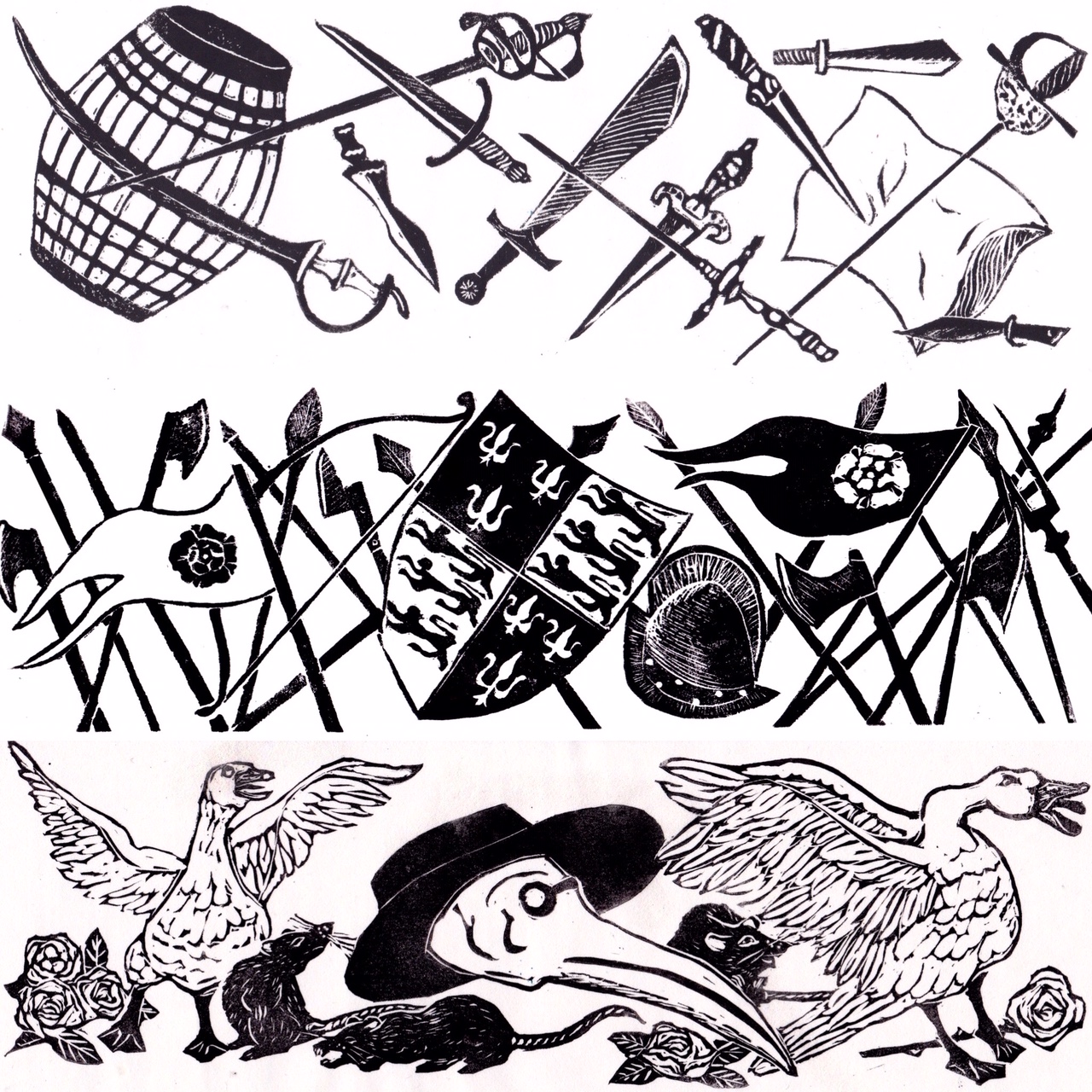
Chapter 4 was a little grim for me, to be honest, spending a few days thinking about execution. This print includes heads on spikes, noose, executioner’s mask, block and axe, as well as a Gibbet. If you aren’t familiar, don’t look them up. There’s a lot of murder in Shakespeare and most of them, in fact most deaths in the plays, are stabbings. So for Chapter 5 I researched Renaissance weapons, knives, swords and daggers. We’ve also got Clarence in the butt of malmsey and Desdemona with the pillow. A butt is a specific type of barrel or even a unit of volume of the time and I now know a bunch of barrel and cask facts! Chapter 6 is the “dogs of war.” When I was younger I read all the history plays and I have a great illustrated collection of the plays. They cover centuries of history so there were variations in arms and armour over that time but the majority of stories of war in Shakespeare are about England and the War of the Roses, so I wanted to include the lions and fleur de lys shield and the white and red roses of Lancaster and York. The phrase “the dogs of war” made me think of an inexorable march so I wanted spears, pikes, halberds and pennants to suggest advancing armies. Chapter 7 is “A Plague O’both Your Houses” about disease. The plague itself and a plague doctor’s mask were clearly needed! Rats, suspected plague carriers also make an appearance. I looked into the history of plague doctor masks which varied in different times and places. The other imagery is more subtle: roses are geese were associated with syphillis! I keep thinking about the Untitled Goose Game and giggling to myself. I wanted the geese to be aggressive looking.⠀The plague mask feels more topical now than I could ever imagine.

Poison was my favourite chapter to illustrate for ‘Death by Shakespeare’ - bottles, pots, and vials of fluids and powder. Renaissance apothecary jars are delightfully imperfect. Cleopatra’s venomous asp also makes an appearance as well as poisonous plants and mushroom known and used at the time: aconite, hellbane, deadly nightshade, yew and fly agaric. Chapter 9 is about Shakespeare’s characters who take their own lives, so we wanted to treat this sensitively and symbolically, so we have Ophelia’s flowers. There is a long tradition of the language of flowers and Ophelia herself specifies what several mean. She mentions rosemary, pansies, fennel, violets, columbines and daisies.⠀Chapter 10 is about the effects grief and broken-heartedness . A conceptual chapter is a bit less obvious but what came to mind was memento mori, symbolic reminders of our mortality which have long played a part of art history. The symbolism runs deep, but I tried to incorporate and stick to symbols common in Shakespeare’s day. The skull is common of course- and famously used precisely as a reminder of our mortality in Hamlet. The hourglass and candle (which could be snuffed out) represent our finite lifetimes. The live flowers contrast with the skull but wilting flowers again suggest our lives are finite. Butterflies are also common and can be a symbol of the soul. I enjoyed carving this one.

My linocut chapter illustration for Chapter 11, how it appeared in the book and the cover (cover art not by me) of ‘Death by Shakespeare’ by Kathryn Harkup

The strange misfit Shakespearean deaths chapter includes “Exit, pursued by a bear,” baked in a pie, an ounce of flesh, lightening and um, severed hands. I worried about getting the bear species right. There are a lot of poorly identified bears on the internet, let me tell you. ⠀
This is the first time I have done all the illustrations for a book, something I've long wanted to do and it was a real treat to have a fascinating and rich topic like this.

Friday, May 30, 2014

Yesterday, in history

quebec 518 I meant to post his yesterday, but I ran out of time.

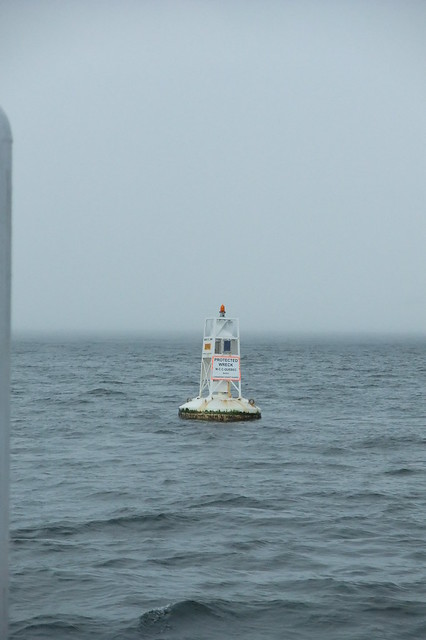
In the early morning fog of 29 May 1914, the ocean liner RMS Empress of Ireland was steaming down the St. Lawrence on its return trip to England, just offshore Rimouski, Quebec, when it collided with the Norwegian collier SS Storstad, or more precisely, when the Storstad collided with her (though there is evidence to suggest both Captains made errors of judgement). Both Captains should have known to maintain their headings due to the dense fog - both, it seems did not. Of the 1,477 persons on board the ship, 1,012 died, making this the largest of any Canadian maritime accident in peacetime, and second only to the the sinking of the Titanic at the time - though now something largely forgotten by most Canadians. The Storstad did not sink.

quebec 517The immense lost of life was not a failure to provide lifeboats or a design failure like the Titanic, but a combination of where she was struck, a failure to close watertight doors and the fact that so many pothole windows were left open to try and air out staterooms, despite maritime regulations requiring them to be shut once the vessel left port. The ship went down rapidly.

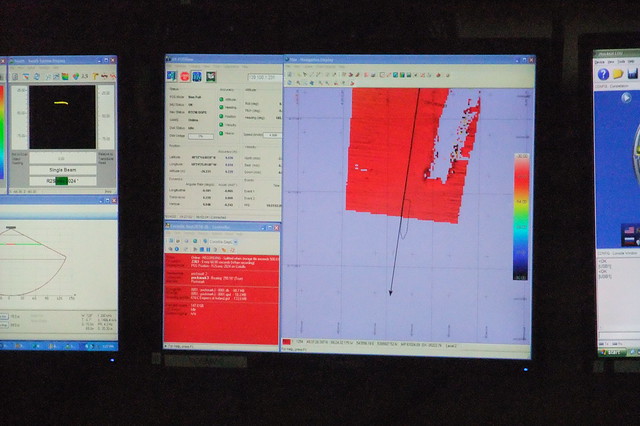
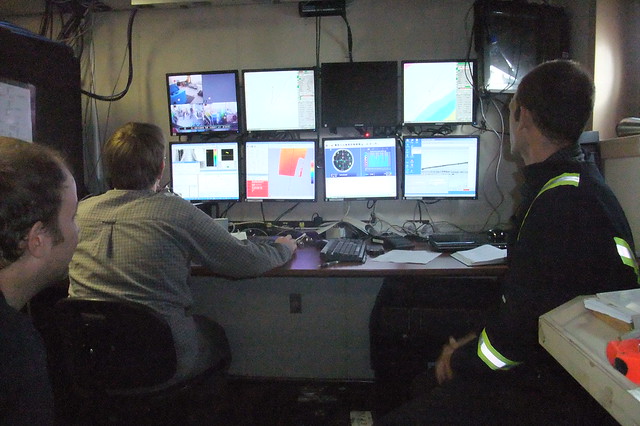
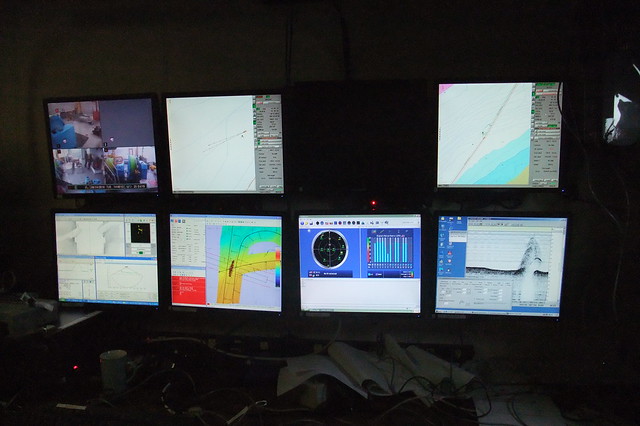
quebec 526While doing fieldwork sailing to and from Rimouski in 2010, we allowed another research group some shiptime to test their multibeam bathymetric system. The RMS Empress of Ireland make a logical target in just 40 m of water. Seeing the undisturbed wreck apear on the screens in the lab was really a fascinating experience.

On the surface, there was nothing to see but river and fog, and the one buoy to warn of a shallow obstruction. Below, clear as day on all our screens were bright reflections on the depth sounder and multibeam screens, indicating hard surfaces. It was so unusual to see straight lines, and in fact, the clear outline of a ship, despite the near century of sediment build up, decay, and any incursion of life. Most of what we see has the organic, smooth lines of naturally formed and eroded geology. Even when we do see human-made objects (like our own equipment), it's never so large that you can read its very shape. It was haunting to see the clear outline of the Empress, silently lying on the seabed.

quebec 529 The St. Lawrence is deceptive. In French, we have the word Fleuve to better describe this mighty river which drains into the sea. We do say 'seaway' in English... but river is insufficient. While sometimes calm, the waters are brakish, the tides surprisingly large and the currents stronger than you would imagine for a protected river. I certainly made sure my porthole window was shut. But, a cruise liner is filled with passengers with little to no experience of being at sea. In the dense fog as we surveyed, it was easy to imagine the chaos, especially in the early morning dark. Many passengers may not even have awoken. The story of the sinking, and subsequent inquiry makes for some dramatic and in fact scandalous reading.

The crew of our vessel viewed the ship somewhat solemnly, not so much because they felt the connection to events of a century previous, but because more recently, the wreck itself had claimed more lives. In only 40 m of water, skilled scuba divers can explore it. But in cold water with low visibility, it is a dangerous dive. In 2009, the year before our survey, six divers had died.

Wednesday, October 17, 2012

Darwin on Galapagos

Darwin on Galapagos

I made a 2nd edition of my 'Darwin on Galapagos' block print on pale gray Japanese washi paper. Each sheet is 10.5 inches (26.7 cm) tall and 7 inches (17.8 cm) wide. This is one of the 2nd edition of 3.

"The inhabitants believe that these animals are absolutely deaf; certainly they do not overhear a person walking closely behind them. I was always amused, when overtaking one of these great monsters as it was quietly pacing along, to see how suddenly, the instant I passed, it would draw in its head and legs, and uttering a deep hiss fall to the ground with a heavy sound, as if struck dead. I frequently got on their backs, and then, upon giving a few raps on the hinder part of the shell, they would rise up and walk away; but I found it very difficult to keep my balance."
-Charles Darwin, 1835, Galapagos Islands

Monday, August 6, 2012

Reading is sexy LI

(image credit: Chris Silas Neal)
12. The Sea - A Cultural History by John Mack This was an very interesting book, though somehow it didn't quite keep me engaged. I would recommend this book as an interesting read, perhaps in small doses, along with some other reading. In fairness, I think I am not well disposed to reading uncorrected page proofs (like this one). I do get caught in details.* The one thing I would have preferred in fact would be more. Some of the things which interest me, like (obviously) marine science**, exploration, map making, the depths, shipwrecks, and women at sea, naval architecture and piracy are given short shrift. I think this book could easily have grown into a much larger project. As it is, it's more of an anthropological, sociological and English literature history (with a touch of art history) of the sea than a full cultural history of the sea - which is a fascinating thing, but not a complete thing. I did particularly appreciate the careful study of cultural differences in navigation. In the west (particularly the Mediterranean) we historically focus on a tradition of 'coasting' (travelling from port to port, largely within sight of shore) and we give a lot of credit to explorers' "discoveries" (of inhabited, clearly already discovered places). Too often we learn western history as world history, so the details on Ibn M jid and 15th century navigation in the Arab world were refreshing. I appreciated the contrast between (southern) European methods with the tradition of navigation in the Arab world (which largely involved knowing the monsoonal weather patterns and latitudes of all ports, finding the requisite latitude and going straight across a line of latitude). This in turn can be contrasted with the Polynesian navigation tradition, which was more about relative headings maintained with reference to astronomical cues in the presence of currents, wind and waves. In an oceanic world dotted with small islands, the sea is viewed as connecting, rather than separating people. I also enjoyed learning of societies like the Sea Gypsies of Malaya, who, as near as possible, live on the ocean.
(image: by

 *Like most people who go to sea, I admire Captain Cook and thus was stumped when I read about his contributions to "geography and hydrology". Hydrology? Cook did many things, but nothing like the work of hydrologists I know (who study the action of water in geology). Eventually I concluded that this was a typo and hydrography was intended - something more obviously paired with geography, after all. But, I wasted a lot of time puzzling over this. Also, when the Nootka people of BC are described as living on an island west of "Victoria Island" it really annoys me; there is no "Victoria" island. I know it's confusing that Vancouver is on mainland and Victoria is on Vancouver Island, but since the Nootka were mentioned when discussing Captain Vancouver, you think it might have occurred to someone. It's the largest Pacific island east of New Zealand, so it's sort of hard to miss. I don't think most people would be irked by such details (unless they happen to have lived on Vancouver Island and done marine geophysical research off Nootka Island).

**SCIENCE IS PART OF CULTURE.

{Series so far: books read, more books read, books read, books read continues, more books read, I, II, III, IV, V, VI, VII, VIII, IX, X, XI, XII, XIII, XIV, XV, XVI, XVII, XVIII,XIX, XX, XXI, XXII, XXIII XXIV, XXV, XXVI, XXVII, XXVIII, XXIX, XXX, XXXI, XXXII, XXXIII, XXXIV, XXXV, XXXVI, XXXVII, XXXVIII, XXXIX, XL,XLI, XLII, XLIII,XLIV, XLV, XLVI, XLVII, XLVIII, XLIX, L}

Tuesday, July 31, 2012

Alan Turing and the Enigma

Turing853

This is a linocut portrait of Alan Turing (1912-1954). It is printed in indigo and orange by hand on lovely Japanese kozo (or mulberry paper), 9.25" by 12.5" (23.5 cm by 32 cm) in an edition of eight.

This year we celebrate the centenary anniversary of Alan Mathison Turing, OBE, FRS (23 June 1912 – 7 June 1954), British mathematician, cryptanalyst, computer scientist, prophet and hero. He is someone I've long thought to portray, but I have been stumped. My scientists are shown with images of something quintessential to their science, or the reason they are famous (or should be), but Turing had so many accomplishments, it wasn't obvious what to portray or how. You might recall his portrayal in Neal Stephenson's 'Cryptonomicon'. I was introduced to him many year ago by Douglas Hofstadter's 'Gödel, Escher, Bach'1. You may also be familiar with the Turing Test or at least its portrayal in Blade Runner. Turing foresaw not only that machines might quite likely develop the capacity to think (after all, our brains are only made of matter, and complex systems of neurons, which either fire or not, much like an electronic switch), but that we needed an objective, double-blind test to determine whether something/someone was able to think, as early as 1950, when most people were only dimly aware of the existence of any sort of computer. But Turing quite literally defined what we now mean by computation itself (with his concept of Turing Machines) back in 1936. During the WWII he worked as a codebreaker and invented the device which was finally able to crack the notorious German cryptographic Enigma machine (in its more complex later incarnation)! His work undoubtedly saved many lives, and today we recognize him as a genius and a hero. In my print, I've included a simplified diagram of the mechanism behind the Enigma with its rotors or scramblers which acted as monoalphabetic substitution ciphers, literally scrambling letters at each turn. During, his all too short life, he also made important contributions to mathematical biology and explaining morphogenesis (the biological process that causes an organism to develop its shape) and the existence of Fibonacci numbers in biology. To indicate this later work, I've made the pattern of his tie look like the sort of Turing pattern produced by reaction–diffusion systems. This work presaged much later work in chaos theory.

Tragically, he lived in a time even more biased and bigoted than our own. Rather than recognizing the magnitude of his contributions to society during his lifetime, he was prosecuted for his homosexuality (still illegal in Britain in 1952) and forced to undergo chemical castration. He died two years later, after eating a cyanide-poisoned apple (determined by the coroner to be a suicide). It is truly abominable they way he was treated; while we can't address the past injustice we can remember, recognize and celebrate his remarkable achievements today.

There are many serious looking photos of Turing. I chose one of him smiling as inspiration for this portrait. He clearly enjoyed his work, and had a sense of humour (evident in the silly names he gave mathematical techniques he discovered)2, so I chose to remember him laughing.  

1I cannot recommend this book strongly enough. Read it. Immediately, if not sooner.
2 i.e. Banburismus and Turingery

Thursday, August 25, 2011

Reading is sexy XLVI

(image source, could easily be a representation of a certain character)

You would be forgiven for assuming that I had given up reading, based on this blog, as I haven't posted anything about books since May! I have been reading, though not at my usual rate, what with all the travelling and so forth. Also, to be honest, Mason & Dixon almost did me in. It's one of those, excellent-but-a-real-slog kind of books. You might recall, when it was last mentioned, I'd read 200 pages, a mere quarter of the book. I wrote:

12. Mason and Dixon by Thomas Pynchon In which Mr. Pynchon's wild, Unfettered, Profound, tightly woven (and Sporadically, giving the Appearance, of Unhinged) Mind takes on the Lives of two Eighteenth Century English Astronomers, Servants of the Royal Society, now Best Rem'mbred for their Survey of of the Boundary of Pennsylvania and Maryland.... Though the language is suited to the protagonist's era (complete with unfathomable capitalization rules) and the narrative winding and non-linear, I'm 200 pages in and it's addictive. Only 600 more to go...

While less raucous than Gravity's Rainbow, it had level of detail and critical eye for history I've come to expect - both mentioning figures from the history of science like Bouguer, someone I would only expect geophysicists to know (and then, really, only those of us who work with potential fields methods, and I don't even expect anyone reading this to know what 'potential fields methods' means), and forcing me to reconsider my thoughts on General Wolfe. Dixon is identified as 'Geordie', and Wolfe's actions in Northern England, what today we would call union-busting, like his actions in Scotland (covered in the next novel I read) go beyond pragmatic into mercenary, despite the heroic image presented in Canadian history books. It does present an epic story just prior to and after the American Revolution (both George Washington and Benjamin Franklin appear as characters), but it is unflinching in detailing the violence including massacres of native people and the slave trade and its brutality, and the plight of women. Both Mason and Dixon are reminded of their time in South Africa, and are repulsed, the Quaker Dixon in particular. It wouldn't be Pynchon without the delightfully absurd Learnèd English Dog (L.E.D.), a chatty terrier, snooty pirates, the ghost of Mason's wife, sentient clocks (and Harrison's clock, of Longitude fame), a lovesick duck automaton chasing the object of her desire, a French master-chef through the woods, Jesuit plots and prostitute-nuns, a Chinese Jesuit Feng shui practitioner, serious coffee abuse, flying over leylines and a variety of magic accomplished through the magnetic and telluric fields of the earth, and the mysterious power of their surveyed line itself. It is epic, serious, absurd, and a touching tale of friendship between our odd couple, Mason and Dixon.

The excerpt is from PRINTERESTING, who were particularly amused by the "Print causes Civil Unrest". Perhaps that's my problem, I am both a printmaker and a coffee-drinker at sea.

13. No Great Mischief by Alistair MacLeod This is a novel of great beauty. I read it because RJH said it was one of his favorites; I am embarrassed to say I didn't know MacLeod (an amazing Canadian author) previously. The title brings us back to General Wolfe; it is a quotation from one of his letters arguing that Scottish Highlanders lead his troops into battle at the Plains of Abraham because, "they are hardy, intrepid, accustomed to a rough country, and no great mischief if they fall." It tells the story of the MacDonald family, through the eyes of Alexander MacDonald, now an orthodontist in Toronto. He recalls his childhood on Cape Breton Island, where he and his twin sister were raised by their grandparents, after a terrible accident on the ice, when his parents and brother were crossing to their lighthouse. It is also the story of his elder brothers, who grew up, half-wild in their ancestor and clan patriarch Calum Ruadh's home, and grow to be men who are expert miners, sent around the world, but longing for Cape Breton. It is the story of his grandparents, of the Island, of the entire mythic history of Clan Donald, of the Scots and their relationship with the French. Its characters are of such fullness and humanity that it is hard not to think this is a memoir, our narrator really knows and loves these people. Even the dog and horse worked their way into my heart. It's a love story about Cape Breton itself, but it also ties their exile to many who have to leave home, like the Mexican and Caribbean seasonal fruit pickers in Ontario, and it makes the story universal. It is about Home. Read it.

14. The Man That Corrupted Hadleyburg by Mark Twain. A dark and amusing little satire about pride, honesty, and small town politics.

15. Sugar & Other Stories by A.S. Byatt.
Byatt's first collection of stories has a recurring theme of death and how the surviving cope. There are some ghosts; both children and parents haunt this collection. There is injustice. There is suicide, accidental death and one, possible, future homicide. It's a dark little collection, not as sweet as the name implies.

16. Women Who Run With the Wolves: Myths and Stories of the Wild Woman Archetype by Clarissa Pinkola Estés.
Pinkola Estés is a Jungian analyst and storyteller. In this book about women's psychology, she approaches issues through the lens of fairytales and archetypes, employing stories and characters like Bluebeard, Baba Yaga, the Red Shoes and the Inuit Sealskin to provide insight. Each tale is interpreted as symbolic of a single female psyche; both Bluebeard and his bride, as well as her sisters are all aspects of a single mind. We have our own inner predators, but our own healers too. It's a style that is a bit foreign to me (I tend towards the literal and when in doubt, rely upon my logic and rational abilities) but I do love a good fairytale, and am certain there is both insight and sound advice within.

{Series so far: books read, more books read, books read, books read continues, more books read, I, II, III, IV, V, VI, VII, VIII, IX, X, XI, XII, XIII, XIV, XV, XVI, XVII, XVIII,XIX, XX, XXI, XXII, XXIII XXIV, XXV, XXVI, XXVII, XXVIII, XXIX, XXX, XXXI, XXXII, XXXIII, XXXIV, XXXV, XXXVI, XXXVII, XXXVIII, XXXIX, XL,XLI, XLII, XLIII,
XLIV,
XLV}

Friday, August 12, 2011

The Brick Works

Which reminds me, I never did tell you about our trip to the Brick Works. I've been wanting to check it out. We went the last Sunday in July, for the antique market. I wanted to see the graffiti in the old brick works themselves. It also has its own example of an urban marsh too. RJH thought it was a bit contrived, and the brick works a little too tamed, but I really enjoyed it. I think it's a great idea, reclaiming industrial space as art, event and nature space. I love, of course, that the graffiti is not only left, but featured. They have a farmer's market on Saturdays too. I also enjoyed the historical photos of the great Toronto fire of 1904. I can only imagine how hot it must have been in there with all the kilns firing, day and night, to rebuild the city core.

Brickworks
BrickworksBrickworksBrickworks
Brickworks
Brickworks
Brickworks
Brickworks
Brickworks foxBrickworks owl & beaverBrickworks jay
Turtle at the Brickworks
Heron at the Brickworks

We saw snapping and painted turtles, and watched the great blue heron at length. The marsh was full of bees, butterflies, dragonflies and moths too. Another oasis within the city.

Sunday, May 29, 2011

Ottawa

We drove to Ottawa Friday morning, and back last night.

flame, Parliament and tourists

This photo isn't about Parliament, or the stance of the photographer up front... it's about the sartorial choices of the man in the turquoise hoodie, wearing plaid shorts *over* his pants.

unicorn is not okay

I really don't know what to think about the unicorn at Parliament, but I like it.

gargoyle I hadn't been inside Parliament since I was 12, and we decided to do the touristy thing and poke around. An enthusiastic guide (who, in a very Canadian fashion, had a distinct Mexican accent) invited us to take the 45 minutes tour. We declined, but he came back and said that actually, people didn't general know this, but it was possible to avoid the tour but simply go up the Peace Tower and see the Memorial Chamber. So, we decided to do this. Despite, some hassle with security (who were fascinated with my travel chop sticks), we got in and up the Tower after only a short wait. It was really worth it. The view is wonderful and the Memorial Chamber was actually quite moving.

Parliamentary library roofview from Peace Towermuseum from Peace Tower
gargoyle dragon
faces

The downtown core really does seem to empty out by 6 pm. We headed toward Byward Market to try and find dinner. We chose a place because I was amused that it was in the building which originally housed the Geological Survey of Canada.

Saturday, RJH played several hockey games (for the Heart & Stroke foundation) and I went to the Museum of Civilization, since I had yet to do so. It's across the river in Gatineau, with a great view of Parliament. Though this child appears to be fleeing, the museum is great. I enjoyed their Japanese exhibit, which rooted contemporary Japanese design in its traditions - for instance tracing robots to eighteenth century automatons, or manga to ukiyo-e woodblock prints. Since I've spent time in Japan, and visited the Tokyo Edo Museum and the National Museum, I wasn't sure I would be impressed, but it was really well curated. Also, I got to pet Paro the Japanese robot baby seal. It was creepy. I also enjoyed the amazing array of masks in their permanent collection, and even the straightforward Canadian history.

child flees museum
Museum of Civilization Reid SculptureReid creatureBill Reid sculpture
Museum of Civilization
Museum of Civilization ceiling
in Museum 'How Charming'Museum of Civilization pressmailbox cat