Showing posts with label history of medicine. Show all posts

Thursday, February 26, 2026

Rosalyn Sussman Yalow

Rosalyn Sussman Yalow, linocut print, 9.25" 12.5" by Ele Willoughby, 2026


For the 10th #PrinterSolstice2526 prompt 'fraction' I made the portrait of the woman who taught us how to measure the fraction, or concentration of many things, like antigens like hormones to drugs to within our blood, and to diagnose and monitor related diseases, medical physicist and Nobel laureate Rosalyn Sussman Yalow. 

Rosalyn Yalow (née Sussman, 1921-2011) was born to a Jewish family in the Bronx during the Great Depression and attended Walton High School. Her parents had not had the opportunity to attend high school, but valued education and encouraged their children, Rosalyn and Alexander, to read books from the local library. Like Esther Lederberg, she got the opportunity for higher education at the all-female Hunter College, tuition-free. Her mother hoped she would become a teacher but Rosalyn opted to study physics.  She read Eve Curie's biography of her mother, double-Nobel laureate Marie Skłodowska-Curie, and Rosalyn got excited about nuclear physics. A lecture by Enrico Fermi in 1939, on nuclear fission, newly discovered by Lise Meitner, Otto Hahn and Fritz Strassman, captured her imagination. So, she became Hunter College's first physics major and even graduated early with honours. Money was tight, and opportunities for graduate school for a young Jewish woman were few, so she got herself a secretary to a biochemist at Columbia University, Dr. Rudolf Schoenheimer (who developed a technique of isotope labelling of biomolecules). She thought eventually she might go to graduate school at Columbia. She graduated Hunter College in 1941 She did not think that as a woman, she could get financial support for graduate school as she found a second secretary job. Columbia immunologist Dr. Michael Heidelberger hired her on condition that she study stenography. When the US joined WWII, suddenly there was more opportunity for women. Many male physics grad students were drafted or being sent to do secret wartime research and universities decided was better to admit women students, as men were otherwise occupied, than to have to close their doors. She was offered a teaching assistant position in the college of engineering at the University of Illinois Urbana-Champaign, where she was the first woman since 1917 and the only woman among 400 members. There were no women's washrooms, a real inconvenience when working late in the lab. She took extra undergraduate courses in physics to fill in gaps in her education. She was ambitious, and assertive and felt disapproval, particularly from other women, for not taking up teaching, the socially acceptable role for a woman at the time. She married fellow physics student, Aaron Yalow, the son of a rabbi in 1943. She learned how to build her own equipment and measure and work with radioactive substances.  She earned her PhD in 1945, then took further tuition-free physics back home in New York, under government auspices at New York University. 

Aaron knew he was not marrying a housewife, and supported her pursuing her career in physics, but he did not, on the other hand, help around the house. She valued the traditional roles of wife and mother. Her parents had not kept a kosher home, but she did for Aaron and later, their two children, Benjamin and Alanna. If Rosalyn had to travel, she would prepare his meals in advance, for him to warm up. Rather than the more modern ideas of work-life balance, Rosalyn's solution was simply to stint on sleep. Like many in her generation she was a bit wary of feminism and feminist organizations, placing a high priority on the role of wife and mother. She worried feminism lead women to eschew traditional duties. Conversely she advocated for more women in science and served as a loyal and dedicated role-model and mentor to younger women. She wrote, "The world cannot afford the loss of the talents of half its people if we are to solve the many problems which beset us." But, she did not want women in science to be treated differently from men so she disapproved of organizations for women in science. She recognized that WWII had created opportunities for women, but suggested that if the numbers of women decreased post-war, perhaps they were simply not interested. Nonetheless, she devoted her retirement years to advocating for better-quality child care and science education, aware that these could both make a significant positive impact on women's participation in science.

After grad school, Rosalyn got a job as an assistant electrical engineer at the Federal Telecomminations Laboratory, where she was the only woman. In 1946 she returned to Hunter College, where she taught physics. In 1947, Aaron introduced her to Columbia University medical physics Edith Quimby, who used radioactive isotopes. She asked to volunteer in Quimby's lab, anxious to get back into research; Quimby instead introduced her to influential medical physicist Gioacchino Failla. Failla immediately called the VA Hospital in the Bronx and got her a part-time job as a researcher there, to set up their Radioisotope Services. She set up a lab in an old janitor's closet, often building her own equipment, as the field was so new. She split her time between working in the lab and as a physics lecturer until 1950, because she wanted to keep mentoring students. One especially promising student had caught her attention: Mildred Spiewak (later the "Queen of Carbon Science" Dresselhaus), whom she persuaded to apply to graduate school for physics, rather than teacher's college. Rosalyn remained an active mentor to Millie through her career. 


Rosalyn Yalow with her research partner Solomon Berson, when she won the 1961 Ely Lilly Award of the American Diabetes Association. (via here)


The Veterans Association wanted to institute a research program on the medical uses of radioactivity, and by 1950, Yalow had equipped a radioisotope lab at the Bronx VA Hospital and she left teaching for research. There she met her longtime collaborator, physician Solomon Berson. He had already accepted a job with the VA Hospital in Bedford, Massachusetts, but after interviewing Rosalyn, they hit it off famously, and he changed his plans. Each happily married to someone else, they became "work spouses," an inseparable, complementary pair, in the lab for 22 years, using radioactive isotopes to study the human body. Sol taught Rosalyn immunology and Rosalyn taught Sol about radioactivity.

She wrote, "The only difference between men and women in science is that women have the babies. This makes it more difficult for women in science but, ... it is merely another challenge to overcome." The VA policy was that once women employees reached their fifth month of pregnancy, they had to leave, so, when expecting her children, she ignored the policy and deliberately neglected to inform the VA.

Rosalyn and Sol were interested in what happens to the insulin diabetics injected to allow them metabolize sugars. Rosalyn had a personal reason for her interest in addition to their scientific reasons; Aaron was diabetic. So they labelled insulin by adding a radioactive isotope of iodine, so they could follow the insulin in patients' bodies by the location of the radiation. Was the insulin being broken down by the body and passed through urine? To their surprise, diabetics who had been injecting insulin for some time, were retaining the insulin longer than health patients (themselves included amongst their healthy subjects). The insulin was being produced by cattle, and it was quite similar, but not identical to human insulin. They realized that the diabetics' bodies were detecting a foreign substance and producing an immune response to the cattle insulin, which was why it was processed more slowly and remaining in their bodies, but it also meant it was becoming less effective. These patients needed human insulin, and thus we now produce insulin which is identical to that naturally produced in healthy humans. 

They realized they could flip their method around to measure the insulin in blood. If they mixed a patient's blood with a mixture of radioactively tagged insulin and natural antibodies the antibodies would then pair with the tagged or patient insulin. Since the antibodies prefer the nonradioactive version of the insulin (or any other hormone they wanted to measure in this way), gradually, they separate from their radioactive partners and pair with the natural hormone. Then, they could separate all the hormone-antibody pairs (whether radioactive or not) and measure the radioactivity of the mixture. The difference between the radioactivity of the mixture from the original sample of tagged samples is a measure, or assay, of the amount of hormone in the blood sample naturally. Suddenly, rather than 100 cubic centimetres of blood, a diabetic patient's insulin level could be measured with a tiny blood sample. They proved that type 2 diabetes was caused by the body's inefficient use of insulin, rather than lack of insulin. Better yet, this method could be used with virtually anything which produced an immune response and did not require the patient to be exposed to any radioactivity. Yalow and Berson had developed the radioimmunoassay by 1960. Their methodology can be applied to measure minute quantities of hundred of substance, like hormones, vitamins, viruses, drugs and enzymes, and diagnostic hormone-related conditions and diseases, revolutionizing diabetes treatment. Their published many papers and trained many young scientists in their tight-knit "Mom and Pop" lab, by then grown much larger than the old janitor's closet.

Recognizing both its huge commercial potential and potential for improving or saving lives, Yalow and Berson refused to patent the method. Yalow was appointed a research professor in the department of medicine at Mount Sinai Hospital. Yalow won a Fullbright fellowship to go to Portugal, and the 1961 Ely Lilly Award of the American Diabetes Association.  In 1921, she won the Gairdner Foundation International Award for biomedical scientists advancing humanity and the American College of Physicians award. In 1972, she won the annual William S. Middleton Award for Excellence in Research, the highest honour of the Biomedical Laboratory Research and Development Service for outstanding biomedical science pertaining to the healthcare of veterans. She also won the Koch Award of the Endocrine Society. Tragically, also that year, Sol died at 54. Yalow named her lab for him and became the Solomon Berson Distinguished Professor at Large and became known at the "Mother of Endocrinology." Rosalyn knew that the Nobel Committee did not grant posthumous awards and would not generally award surviving researchers of joint research if one of the researchers had died. She knew she would have to prove herself on her own, and not simply as the "Mom" or their "Mom and Pop Lab." 

In 1975, Yalow and Berson (posthumously) were awarded the American Medical Association Scientific Achievement Award. In 1976 she became the first woman or nuclear physicist to receive the Albert Lasker Award for Basic Medical Research. In 1977, Rosalyn Yalow received the Nobel Prize in Physiology or Medicine for her role in developing the radioimmunoassay technique (along with Roger Guillemin and Andrew V. Schally, for their work on hormone production in the brain). She won the 1977 Golden Plate Award of the American Academy of Achievement. In 1978 she was elected Fellow of the American Academy of Arts and Sciences. She won the A. Cressy Morrison Award of the New York Academy of Sciences in 1986 and the National Medal of Science in 1988. She continued conducting research at her VA lab until she retired in 1991. She was inducted into the National Women's Hall of Fame in 1993. She died in the Bronx in 2011 at 89.


References

Berson, Solomon A., Rosalyn S. Yalow, Arthur Bauman, Marcus A. Rothschild, and Katharina Newly, Insulin-I'13 Metabolism in Human Subjects: Demonstration of Insulin Binding Globulin in the Circulation of Insulin Treated Subjects, The Journal of Clinical Investigation, February 1, 1956. 

Harrod, Jordan. Meet Nobel Prize winner Rosalyn Sussman Yalow, who let doctors see into your blood. Massive Science. May 12, 2019.

Rosalyn Sussman Yalow, Wikipedia, accessed February, 2026

Gellene, Denise. Rosalyn S. Yalow, Nobel Medical Physicist, Dies at 89. New York Times. June 1, 2011

Rosalyn Yalow. NobelPrize.org. Nobel Prize Outreach 2026. accessed February 2026.

Rosalyn Yalow and Solomon Berson, Science History Institute Museum & Library, accessed February, 2026.

The Nobel Prize in Physiology or Medicine 1977. NobelPrize.org. Nobel Prize Outreach 2026. accessed February 2026.


https://department.va.gov/history/featured-stories/dr-rosalyn-yalow/

https://www.acs.org/education/whatischemistry/women-scientists/rosalyn-sussman-yalow.html

Wednesday, January 8, 2025

Sophie Brahe, Horticulturalist, Astronomer, Chemist, Genealogist and Sister to Tycho

Sophie Brahe, linocut 11" x 14" by Ele Willoughby, 2025

Born in either 1556 or 1559,  the 12th child (9 survived infancy) of Otte Brahe, advisor to the Danish king Frederick II, and Beate Bille Brahe, leader of Queen Sophie’s royal household, in Knudstrup Castle, Sophie Brahe was a horticulturalist, astronomer, chemist, and genealogist. At least a decade her senior and adopted and raised by his uncle Jørgen Thygesen Brahe, Sophie did not grow up with brother, the famous astronomer Tycho but the two became close when she reached adolescence. They found they were alike, sharing a determination to pursue science despite their family’s attitude this was an unsuitable activity for an aristocrat. Eventually they also shared a determination to each marry for love without regard for financial concerns or familial approval. They married a commoner and penniless noble respectively. 

Sophie married Otto Thott in 1579 and they two had a son, Tage Thott in 1580, but Otto died in 1588. As a widow, Sophie was responsible for maintaining and running the estate (now known as Trolleholm Castle in Eriksholme) until her son came of age. She studied chemistry, medicine and horticulture, growing medicinal plants and an exceptional garden. Following the theories of Paracelsus, she produced medicines to treat the poor, but as a woman, she could not formally study medicine.  


She became a regular visitor to her brother’s astronomical and alchemical laboratory, first at Herrevad Abbey and then later at Uranienborg, on the island of Hven. Tycho trained her in horticulture and chemistry but initially discouraged astronomy, but she pursued it on her own. She taught herself with textbooks in German and texts she had translated at her own expense from Latin. Even if he initially thought she might have the skills and education to pursue astronomy, he realized she could help him with his observations. With time he realized she had the skills she needed, to the point that he eventually, when he was often absent from 1588 to 1597, he started to delegate his duties to her, getting her to calculate the astrological charts which were the bread and butter of Renaissance astronomers. 

Specifically she made observations for Tycho on 11 November 1572, which led to the discovery of the supernova that is now called SN 1572, as well as a lunar eclipse in 1573 while still a girl. Tycho published De nova stella, or On the New Star about the supernova; the stars in my portrait are based on De nova stella and SN 1572 is the large star above Sophie’s head. The discovery of supernova was important to the ongoing revolution in astronomy as an observable change in the sky seemed counter to the prevailing geocentric model of the universe. Sophie was instrumental to Tycho’s meticulous observations of planetary orbits. Tycho developed instrumentation that allowed the most precision observations ever made prior to the invention of the telescope; Sophie, along with some other assistants, used these to make measurements. The incredible dataset proved invaluable to Kepler and lead to his laws of planetary motion, an important precursor to Newton’s law of universal gravitation. 

While at Uranienborg, she met Tycho’s friend, the alchemist Erik Lange. Lange's sister was married to another Brahe brother, so they had a family connection as well. Tycho trusted Erik to the extent that he made him the executor of his children's estate. Sophie returned to visit Erik over a dozen times and the two became engaged in 1590. Lange’s passion for alchemy had bankrupted him; he was obsessed with trying to produce gold from base metals. Sophie stood by him and financially supported his efforts after he used up his own fortune. Their wedding was delayed for years when Lange had to flee to Germany to avoid his creditors. The 600-line epic poem “Urani Titani” was published in 1594, as the love letters between Sophie as Urania, the muse of astronomy and Erik as a titan, studying alchemy abroad, written from Sophie’s point of view. The printer thought she was the author, but Tycho later claimed it. It seems likely he was either author, or at minimum translator and interpreter of Sophie’s thoughts, as Sophie was not fluent in Latin and Tycho was more likely to have known of its unusual poetic form. The poem denounces the futile search for the philosophers’ stone and promotes instead allegiance to Phoebus, god of healing. This shows the closeness of the two siblings, his respect for her as an astronomer, and that they likely both doubted that alchemy could produce gold. Nonetheless, Sophie was devoted to Erik and supported his research. 

She was able to visit Lange in Hamburg in 1599 but the two were not able to wed until 1602 in Eckernförde, where the couple lived in extreme poverty. Sophie complained to her sister that she had to wear stockings with holes in them to her own wedding and the groom needed to return his wedding clothes to the pawn broker after the wedding. She also complained of the family’s objections to her pursuit of science and their failure to pay money she was owed. She was often allow as he fled due to his debts. Even jewellery and clothes her sisters gave her out of pity were hawked to support his alchemical research. Erik had moved to Prague by 1608, where he died in 1613.

After Erik’s death, she regained enough wealth to fund repairs to the church at Ivetofta near where Frederick II had previously granted her the nearby manor of Årup. She nonetheless moved to Zealand and settled in Helsingør in 1616 where he son Tyge Thott had become a State Councillor. There she pursued her studies of horticulture and healing plants, teaching her servant all she knew of botany and healing. Despite any disdain she felt about the social norms of the aristocracy, she produced a genealogy of the Brahe family in 1600 and by 1626 she published a 900 page genealogy of 60 Danish noble families, still considered a major source for the history Danish nobility. Even in her 80s she was receiving visitors who came to see her famous gardens. She died in 1643 and is buried in the village of Torrlösa in the Thott family chapel, which is now part of Sweden.

References

Alenius, Marianne, The Honey-Sweet Delicacies of the Muses,  The History of Nordic Women's Literature,  July 27, 2011

Murray, Caroline, Sister of the more famous Tycho, Professor Hedgehog’s Journal,  September 10, 2018

Neill, Crystal, Sophie Brahe: Tycho’s Urania, on Before Newton: Explorations of pre-modern science, medicine and technology blog, accessed January, 2025

Sophie Brahe, Wikipedia, accessed January, 2025.

Tycho Brahe, Wikipedia, accessed January, 2025.

Wentrup, Curt. Chemistry, Medicine and Gold-Making: Tycho Brahe, Helwig Dieterich, Otto Tachenius, and Johan Glauber, Chem Plus Chem, Volume 88, Issue 1, 24 November 2022 https://doi.org/10.1002/cplu.202200289

Sophie Ottesdatter Brahe, www.skbl.se/sv/artikel/SophieBrahe, Svenskt kvinnobiografiskt lexikon (article by Sara Griberg), retrieved 2025-01-07.

Hoyrup, Else. Sophie Brahe, on Grandma Got STEM blog, July 22, 2013, accessed January, 2025.

Rönneus, Maria Yrsa, Urania Titani: Sofie Brahe, guest post on Samantha Wilcoxson Blog, March 29, 2024, accessed January 2025.

Tuesday, October 10, 2023

Hildegard von Bingen, Medieval Medicine and Natural History for Ada Lovelace Day


Hildegard von Bingen, linocut, 11" x 14" by Ele Willoughby, 2023


Ada Lovelace, 3rd edition
Ada, Countess Lovelace, 3rd edition linocut by Ele Willoughby
It is once again Ada Lovelace Day, the 15th annual international day of blogging to celebrate the achievements of women in technology, science and math, Ada Lovelace Day 2023 (ALD23). I'm sure you'll all recall, Ada, brilliant proto-software engineer, daughter of absentee father, the mad, bad, and dangerous to know, Lord Byron, she was able to describe and conceptualize software for Charles Babbage's computing engine, before the concepts of software, hardware, or even Babbage's own machine existed! She foresaw that computers would be useful for more than mere number-crunching. For this she is rightly recognized as visionary - at least by those of us who know who she was. She figured out how to compute Bernouilli numbers with a Babbage analytical engine. Tragically, she died at only 36. Today, in Ada's name, people around the world are blogging.

 
You can find my previous Ada Lovelace Day posts here.

Despite some biased ideas about the Medieval period, which we inherited from Enlightenment scholars, the Dark Ages were only "dark" in the sense that there is a dearth of documentation. All too often, people have the idea that this was a stagnant period in the pursuit of knowledge after the end of the Classical period. Many documents of the time have simply been lost, so we don't have a lot of information about many individuals and their specific advancements in scientific thought. But the sheer fame and productivity of Hildegard von Bingen (1098-1179) is an exception. Her writings preserve not only her own knowledge and theories but much of the nature of institutional medicine and folk healing of her day (which she deftly combined). While she might be best remembered today as a composer of seventy Gregorian chants and musical dramas and as a Catholic saint, author of biblical commentaries, three books on her visions and two biographies, she is also recognized as the progenitor of natural history in German-speaking lands and author of medical and natural history texts. She even invented her own script and language!

Likely born the tenth child in her rural Rhineland family, her religious parents raised her intending for her to be a tithe to the church, and she entered the double-monastery at Disibodenberg at 14. Her well-respected magistra Jutta (1092-1136) became her mentor and teacher, and it is believed Hildegard was assigned to the infirmary. There she would have been responsible for, in particular, for but likely not limited to, the health of the women at the monastery and adjoining community. She would also have had access to the books and knowledge of her male counterpart, who was responsible in particular for the health of the men. After Jutta's death, Hildegard was elected magistra and she lead the Disibodenberg nuns until 1148, when at age 50, inspired by a vision, she moved them all to a new monastery at Rupertsberg at Bingen. She immediately began writing her text books. Physica describes elements, mammals, reptiles, fish, birds, trees, metals, and precious stones and medicinal uses of 293 plants (230 herbaceous plants and 63 trees). Causae et curae was written presumably to ensure that her replacement in the infirmary had all the knowledge she would need. It describes 47 diseases along with causes, symptoms and treatments and goes on to document 300 plants used to treat diseases. It reads both like a Medieval first aid manual and technical scientific writing of her day. She lived in the new monastery until her death at 81. People traveled to Rupertsberg to receive healing from Hildegard and her order. She was a prodigious correspondent and has been called a Medieval "Dear Abby" because of her letters to such luminaries as King Henry II of England, King Louis VII of France, the Holy Roman Emperor Frederic I Barbarossa, the Byzantine Empress Agnes of France, Bernard of Clairvaux, four popes and others. She was invited to preach at nearby cathedrals including at Cologne, Mainz and Worms. By the time she reached 80, she was so respected and renown that she could defy the pope and it was the pope who had to back down. Commanded to excommunicate a man in her community, she simply declined to do so.

Outside of Salerno, those practicing medicine in her day were not university educated, but either working in monasteries and infirmaries or were folk healers using herbal folklore. Hildegard's contemporary woman in medicine Trota of Salerno is a notable exception, as she was formally educated at the medical school in Salerno. The rise of universities and formal medical schools actually lead to greater exclusion of women from medical practice; universities usually excluded women. 

Hildegard developed a holistic understanding of medicine and was systematic and scientific in her approach within her Christian worldview. She is believed to have access to ancient Greco-Roman medical sources, typically available and shared between monasteries, including the works of Hippocrates, Galen and Pendanius Dioscoride. The Classical humoural theory was central to medicine until the 17th century. It related humours, or the vital bodily fluids, namely, according to Hipocrates, the blood, phlegm, yellow bile, and black bile to human health and behaviour. Blood was considered hot and wet, yellow bile hot and dry, black bile cold and dry and phlegm cold and wet; these properties were used to try and diagnose how these humours might be unbalanced and causing disease. She likely also had access to texts by pioneering Arab and Persian physicians, and was abreast of some of the contemporary advancements from the Salerno school of medicine. Her medical philosophy is influenced by St. Augustine, Isidore Hispalensis, Bernard Sylvestris of Tours, and perhaps Boethius. She would have been trained in nursing, diagnosis, prognosis, pharmacy and treatment by her monk colleague in the infirmary at Disibodenberg. She herself wrote about how the infirmarian was responsible for the infirmary garden and the "spices and medicinally active herbs," thus, she became expert at gardening and botany too. In addition to Latin terms, Hildegard includes German names for plants she could not name in Latin, so scholars believe she also incorporated knowledge from the folk herbalist, magical and medical tradition. Some instructions even prescribed charms and incantations. Importantly, she synthesized these disparate sources of knowledge. Along with the humoural theory, she believed that everything on Earth was made by God for man, so there's very little which could not be used in medicine to counter a humoural imbalance. For instance, she prescribed a poultice of quince, deemed "dry" to treat the "dampness" of an ulcer. Her writings actually allow an unusual insight into "wise woman" healing practices, as it was rare for other women to be literate in Latin. She wrote that she was told to ‘write down that which you see and hear’ in a vision, and thus recorded her visions. But she takes the same approach with medicine, writing down observations and supplementing her observations with knowledge from books rather than simply relying on their authority. This strategy hints at the beginnings of the scientific method.

Her philosophy of medicine was deeply influenced by her experience in the garden and she gives a special focus on "viriditas" or the greening power of plants, expanding on Galen and Hippocrates' four humors, connecting plants to human health, and viewing this greening force as also vital within the human body. She ties viriditas directly to fertility and vigor and describes it as a humour that can dry up. She approaches medicine the way a gardener nurtures a garden. Her approach in all things was quite holistic and she believed spiritual health complemented physical health. She begins her text Causae et curae with the creation of the cosmos and connects the human person as microcosm to the sacred macrocosm of the cosmos. Her work documents causes of disease, sexuality, psychology, physiology, diagnosis, treatments and prognosis. Illness, she wrote, was a result of falling into disharmony with creation and could be treated with rest, herbal cures, steam baths, a proper diet, and achieving spiritual peace. Her goal was to heal body, spirit and mind; in the 12th century healers commonly viewed health as involving all of these things. 

She discussed sexuality openly and women's reproductive health. She described female orgasm, nocturnal ejaculation, coitus as therapy, conception, birth, complications in childbirth, gynecological diseases, menstruation (including botanical emmenagogues or menstruation stimulators), abortifacients (substances which can induce an abortion including sarum, white hellebore, feverfew, tansy, oleaster, and farn) and menopause. Medieval Christian healers would not hesitate to proscribe abortifacients to save a mother's life if it were at risk. She wrote about determining an embryo's sex and noted that children need affection for their psychological development, writing “The strength of the male seed determines the sex of the embryo, while the love of one parent to the other determines the moral qualities of the child.” She is likely the first woman to write about skin diseases and treatments including leprosy, scabies, lice, insect bites, burns and conditions now believed to be erysipela, paronychia, contact allergies, rosacea, and rhinophyma. Hers is the first description of a peeling for rosacea, a method still used; she used plants that promote blistering on the skin, which would then rapidly heal. She recommended skin treatments with plants which we now can confirm have anti-inflammatory and antibacterial properties. She recommended a balanced diet including cutting back on food high in fats and cholesterol and that salt should be taken in moderation to avoid hypertension. She writes about kidney and liver ailments and treatments; in her day, uroscopy and examining urine was considered a doctor or healer's most reliable tool. She herself suffered migraines and she wrote about headaches and remedies. She precisely described toothache and even how nerves run from the brain to gums and the need for dental hygiene. She addresses depression, anxiety and schizophrenia. A modern study investigated whether her correct herbal remedies were mere lucky strikes - that is whether herbal remedies she reports which are still supported by modern science are just a result of chance. They found this could not be the case. Though most of her claims are not correct, she is correct far too often for it to be by mere chance. Further, she does not repeat all claims in ancient sources, suggesting she was independent in her thinking. Most of her remedies are ingredients from the kitchen or garden but she also recommends the use of minerals including gold for arthritis, emerald for heart pain, jasper for hay fever or for cardiac arrhythmia, gold topaz for loss of vision, sulfur ointment for scabies and blue sapphire for eye inflammation; most of these play no role in modern medicine, though gold is still used for arthritis and sulfur is still used for skin treatments for people and domestic animals. While all her writings and worldview were firmly planted within her faith, she did not presume sin was the primary cause for disease; bad humours, bad lifestyle or the weather were more often suspected. She makes pragmatic practical suggestions rather than trying to treat illness with prayer, penitence or pilgramage.

She invented her own alternate alphabet or secret code with symbols for each letter and applied it to her own Lingua ignota (Unknown Language), which consisted of 1000 invented words for a list of nouns. Scholars are divided on her intentions; was this a secret language to increase solidarity within nuns in her order, or was this intended for anyone? Modern conlangers (aficionados of constructed languages) view her as a Medieval precursor.  

She formed a deep friendship and love for her assistant Richardis von Stade, who worked beside her on her major work Scivias. When Ricardis was elected abbess of a monastery at Bassum, far from Rupertsberg in 1151, Hildegard was bereft. She wrote to Richardis' mother, to the Archbishop of Bremen and even to the pope, trying to get them to intervene, to no avail. She wrote letters of her grief to Ricardis, writing "Now, let all who have grief like mine mourn with me, all who, in the love of God, have had such great love in their hearts and minds for a person- as I had for you- but who was snatched away from them in an instant, as you were from me." Tragically, Richardis died the next year. 

My portrait includes some of her prescribed treatments which we can now confirm do have medical benefits (or at least effects). Clockwise from the top, she is surrounded: by tansy (Tanacetum vulgare) which has antibacterial and toxic contents; common comfrey (Symphytum officinale) is sometimes used on the skin to treat wounds and reduce inflammation from sprains and broken bones, it roots and leaves contain allantoin, a substance that helps new skin cells grow, along with other substances that reduce inflammation and keep skin healthy; mandrake (species in the genus Mandragora, either Mandragora officinarum or Mandragora autumnalis) which contain hallucinogenic tropane alkaloids which are poisonous; sulfur she prescribed for skin ailments does indeed act as a fungicide; lemon balm (Melissa officinalis) which has been shown to have some calming effects, some antibacterial properties and positive effects on indigestion; and quince (Cydonia oblonga), which is understudied, but there is some early evidence that it may help prevent stomach ulcers (which would actually coincide with her advice). 

Above and below Hildegard is the alphabet along with her own alternate alphabet Litterae ignotae which she used for her own Lingua ignota (Unknown Language). The scroll in her hand also shows medieval musical notation to represent her compositions. 

Her map of the universe from her book Scivias in illustrated on her habit. She correctly viewed the Earth as spherical, and then in the typical Medieval worldview, she posits a series of concentric celestial spheres, influencing events on Earth. Other Medieval thinkers describe a spherical universe. The shape of Hildegard's map of the universe is unique; some describe it as oval, or egg-shaped others, more directly, as vulva-shaped. In the centre of her diagram is the Earth, as as you move upward, you see the moon, then the inner planets Mercury and Venus (which look like stars), then beyond the ring there is the Sun (the large flower-like shape) and outer planets Mars, Jupiter and Saturn (the three outermost star shapes). Recall, the further planets are not visible to the naked eye. She wrongly assumes the antipodes are uninhabitable, without a more modern understating of the cause of the seasons. Seasonal variations in the heavens and seasons on Earth were attributed to winds.

While you could not call a Medieval woman a feminist, she did believe that men and women were equal before God, and rejected the prevailing Aristotelian idea that women were inferior inversions of men, with opposite but inferior relationships with humors and elements. She wrote, rather that, that women had different but not opposite or inferior relationships to the elements. To her, men and women were complimentary aspects of the divine.

Hildegard entered the monastery an uneducated child and grew to be a renown, respected thinker and healer, with a tremendous output in music, theology, natural history and medicine, who has been recognized as a saint. Her writings on medicine and reputation as a healer were used as arguments by early feminists that women should be admitted to medical schools. Her music has seen a resurgence of interest. Her impact and influence can still be felt today. 


* Offering the tenth child as a tithe to the church was a common practice, and many scholars believe Hildegard was the tenth child in her family, but we lack surviving documentation of 9 older siblings, so we can't state this with complete certainty.

Sources

Brady, Erika. Healing Logics: Culture and Medicine in Modern Health Belief Systems. 1 ed. Utah State University Press, 2001. Project MUSE muse.jhu.edu/book/9398. 
 
Campbell, Olivia, Abortion remedies from a Medieval Catholic nun (!), JSTOR Daily, October 13, 2021.
 
Janega, Eleanor, Going Medieval blog, posts tagged 'Hildegard of Bingen,' accessed October, 2023.

Hay, K.A., "Hildegard's Medicine: A Systematic Science of Medieval Europe." Proceedings of the 17th Annual History of Medicine Days, March 7th and 8th, 2008, Heath Science Centre, Calgary, AB. http://hdl.handle.net/1880/47483 Downloaded from PRISM Repository, University of Calgary

Hildegard of Bingen, Wikipedia, accessed October, 2023

Johnston, Sophie., Hildegard of Bingen, Bluestocking Online Journal of Women's History, January 1, 2008.

Lockett, Charles J., Was Hildegard von Bingen the First Medieval Scientist? Medieval Blog, July 18, 2022

The Medieval Garden Enclosed, posts tagged 'Hildegard of Bingen', The Metropolitan Museum of Art blog, accessed October, 2023.

Mount Sinai Health Library, accessed October, 2023.

Sharratt, Mary, "Hildegard the Healer," on Feminism and Religion, May 13, 2015.

Singer, Charles. 'The Scientific Views and Visions of Saint Hildegard (1098-1180)', in Studies in the History and Method of Science, edited by Charles Singer, Oxford at the Claredon Press, 1917.

Stefanidis, Ioannis, Theodoros Eleftheriadis, Maria Efthymiadi, Maria Kalientzidou, and Elias Valiakos, Remedies for Kidney Ailments in Physica by Hildegard von Bingen (1098-1179), Volume: 21 Issue: 6 June 2023 - Supplement - 2, Pages: 53 - 56, June 2023.

Sweet, Victoria, 'Hildegard of Bingen and the Greening of Medieval Medicine', Bulletin of the History of Medicine , Fall 1999, Vol. 73, No. 3 (Fall 1999), pp. 381-403 Published by: The Johns Hopkins University Press, Stable URL: https://www.jstor.org/stable/44445287

Ramos-e-Silva, Marcia., Saint Hildegard von Bingen (1098-1179): “the light of her people and of her time”. International Journal of Dermatology 1999; 38(4):315-320.

Uehleke, Bernhard, Werner Hopfenmueller, Rainer Stange and Reinhard Saller, Are the Correct Herbal Claims by Hildegard von Bingen Only Lucky Strikes? A New Statistical Approach. Complementary Medicine Research Forschende Komplementärmedizin / Research in Complementary Medicine (2012) 19 (4): 187–190. https://doi.org/10.1159/000341548 Published Online: 01 April 2012


Wednesday, April 7, 2021

Biochemist Marie Maynard Daly

Marie Maynard Daly linocut
Marie Maynard Daly, linocut 9.25" x 12.5" by Ele Willoughby, 2021
 

This is a hand-carved and hand-printed linocut portrait of trailblazing American biochemist Marie Maynard Daly (1921-2003). Daly, the first Black woman to earn a doctorate in chemistry in the US, made important research contributions to our understanding of the biochemistry of the cell nucleus and cardiovascular issues. Her interest in the nuclear proteins within cells lead to important contributions to our knowledge of the chemistry of histones and protein synthesis. She published original research establishing that  "no bases other than adenine, guanine, thymine, and cytosine were present in appreciable amounts" in DNA - research which was cited when Watson and Crick accepted the Nobel Prize for the structure of DNA. She did some of the earliest work on the relationship between diet and cardiovascular health. She was the first to show how cholesterol could clog arteries and that hypertension lead to atherosclerosis; these were invaluable discoveries in our understanding of heart attacks and work to lower the risk of heart attacks. She also did early work linking smoking and hypertension. Later she made studies of the uptake of creatine by muscle cells, which is important to understanding the recycling systems of muscles. She did this at a time when there where tremendous barriers due to race and gender discrimination in fields of research where women and minorities are still underrepresented.

Born April 16, 1921, in Queens, NY, she was the eldest of three and had twin younger brothers. Her father Ivan Daly was an immigrant from the British West Indies who had come to the US on a scholarship to Cornell to pursue his own dream of a career in chemistry, but when he and his family were unable to cover the tuition and board, he had to drop out of school. He supported his family as a postal worker, and passed on his love of science to his children. Her mother Helen Page Daly was a homemaker, avid reader and fellow lover of science, who also fostered her children's education. Marie's grandparents had a library with many biographies of scientists. Marie recalled being fascinated as a child by Paul DeKruip’s Microbe Hunters, with its stories of scientists like van Leeuwenhoek, Pasteur and Koch and being encouraged in her interests by parents and teachers alike. After attending an all-girls high school in Manhattan, she won a scholarship to Queens College.  She could remain close to home, and save money living at home. She graduated magna cum laude with a BSc in chemistry in 1942, in the top 2.5% of students, a Queens College Scholar and inducted into the Phi Beta Kappa and Sigma Xi honor societies.

She got lab and teaching assistant jobs at Queens College to support herself as she continued on, studying for her Master's at New York University, and afterwards. As WWII raged, and employment opportunities for a Black woman in chemistry were uncertain, she decided her best bet was to continue her education, and she began doctoral studies in biochemistry at Columbia under Dr. Mary Letitia Caldwell, Columbia's first female chemistry professor, a well-known expert in enzymes and nutritional chemistry. She graduated only three years after enrolling, in 1947, with her thesis "A Study of the Products Formed by the Action of Pancreatic Amylase on Corn Starch," unaware that she had become the first Black woman to earn a chemistry PhD, at a time when only 2% of Black women had college degrees. She was the first Black person to earn a doctorate from Columbia.

She wanted to work with biochemist Dr. Alfred Ezra Mirsky (one of the first to isolate mammal messenger RNA) but he told her she would need to provide her own funding. So she worked as a physical science instructor at Howard University for a year and began studying protein structure, until able to secure funding for a seven-year post-doctoral fellowship from the American Cancer Society. She moved to the Rockefeller Institute of Medicine in New York City, for the next seven years,  where she worked with distinguished scientists and was the only Black scientist there. With Mirsky, she worked on protein synthesis and the metabolism of cellular nuclei, critical and foundational research for developing ideas on the structure of DNA. 

She became  a biochemist associate for the College of Physicians and Surgeons at Columbia, and at the Albert Einstein College of Medicine in1955. There, she taught and continued her research on cancer and nucleic acids while she collaborated with Dr. Quentin Deming at Goldwater Memorial Hospital, on the causes of heart attacks. Her research about arterial walls looked at the effects of aging, hypertension, atherosclerosis (or the build up of fat in arteries), sugar and cholesterol. They showed that hypertension was a precursor to atherosclerosis and were the first to link cholesterol and clogged arteries. In studies of hypertensive rats, she showed the link between  high cholesterol and heart attacks. This was the foundation of work to prevent heart attacks. She studied the link between smoking and lung disease and how kidneys affect metabolism. She was a researcher for the American Heart Association from 1958 to 1963, working particularly on stroke research. Columbia made her an assistant professor of biochemistry from 1960-1961. She married Vincent Clark in 1961 (and retained her name professionally).

She and Deming both moved to Albert Einstein College of Medicine at Yeshiva University where she became an assistant professor of biochemistry and medicine (then associate professor from 1971). While there, she started and helped run the Martin Luther King Jr. - Robert F. Kennedy program to help prepare Black students for admission and worked to recruit Black and Puerto Rican students. She also did important work on understanding the uptake of creatine in muscles, including the temperature and ion conditions at which it could be best absorbed. She was a dedicated mentor. She participated in a conference with 30 other minority women in STEM, hosted by the American Association for the Advancement of Science which resulted in in a report called The Double Bind: The Price of Being a Minority Woman in Science (Malcom, Hall, & Brown, 1976).

She was also a cancer scientist with the Heath Research Council of New York from 1962 through 1972. She served on the board of governors of the New York Academy of Science. She was also active in student recruitment and in professional societies and the NAACP and National Association of Negro Business and Professional Women. She was a Fellow of the American Association for the Advancement of Science.

After retirement in 1986, she donated money to Queens College to create scolarships from Black students in physics and chemistry, in honour of her father. She served on the Commision for Science and Technology for New York City for three years, before moving with her husband Vincent Clark to their East Hampton summer home and then to Sarasota, Florida. In 1999, the National Technical Association recognized Daly as one of the top 50 women in STEM. She was devoted to playing the flute, gardening and her dogs; when her cancer made flute playing difficult, she learned the guitar. She died in 2003, at the age of 82, in New York City.

References

Daly, Marie Maynard. Encyclopedia.com, accessed April, 2021. 

Galen Scott, Black History Month - Marie Daly, The Researchers Gateway, March 7 2019

Marie M. Daly PhD Memorial Celebration, Einstein University, 2021

Victoria Corless, Pioneers in Science: Marie Daly, Advanced Science News, August 27, 2020 

Marie Maynard Daly, Wikipedia, accessed April, 2021.

Jalen Borne, Hidden Figures Beyond: The First Black PhD in Chemistry, Marie Maynard Daly, Charged Magazine, April 3, 2020

Dale DeBlakcsy, Marie Maynard Daly (1921-2003), America's First Black Woman Chemist, Women You Should Know, February 28, 2018

Daniel Tyrell, #BlackCardioInHistory: Dr. Marie Maynard Daly, blackincardio.com, October 20, 2020.

Marie Maynard Daly, Science History Institute, November 9, 2018

Roopati Chaudhary, Marie Maynard Daly, Sci-illustrate, July 14, 2020.

Tuesday, October 13, 2020

Peseshet, Actual Earliest Named Woman in Science or Medicine, Ancient Egyptian Overseer of the Female Physicians


Linocut of Peseshet
Peseshet, Overseer of Physicians, linocut, 11" x 14" by Ele Willoughby, 2020

Ada Lovelace, 3rd edition
Ada, Countess Lovelace, 3rd edition linocut by Ele Willoughby


It is once again Ada Lovelace Day, the 12th annual international day of blogging to celebrate the achievements of women in technology, science and math, Ada Lovelace Day 2019 (ALD19). I'm sure you'll all recall, Ada, brilliant proto-software engineer, daughter of absentee father, the mad, bad, and dangerous to know, Lord Byron, she was able to describe and conceptualize software for Charles Babbage's computing engine, before the concepts of software, hardware, or even Babbage's own machine existed! She foresaw that computers would be useful for more than mere number-crunching. For this she is rightly recognized as visionary - at least by those of us who know who she was. She figured out how to compute Bernouilli numbers with a Babbage analytical engine. Tragically, she died at only 36. Today, in Ada's name, people around the world are blogging.

You can find my previous Ada Lovelace Day posts here. 

One of the things that has become very clear, participating in a dozen years of Ada Lovelace events, is not only that there has long been a large collection of under-recognized women in the history of science and technology, who need to be written back into the story, but that there is a large appetite for these stories. Representation matters. Women in STEM and girls who love science and technology are seeking evidence of precedence (of foremothers in science). So much so, that scientists and amateur historians are themselves seeking out stories and evidence of women trailblazers. Thus, when Canadian feminist medical doctor Kate Campbell Hurd-Mead (1867 – 1941), likely made an innocent error, misinterpreting a report and conflating two people, she accidentally started the paper trail for an non-existent ancient woman in medicine: Merit Ptah, reputedly the earliest recorded woman in medicine and subject of one of my portraits. Hurd-Mead confused the Overseer of Healer Woman that did exist, Peseshet (5th Dynasty, 2465-2323 BCE), with a name, tomb location and date for someone a bit earlier, giving this conflation of people "Merit Ptah" priority. Thus "Merit Ptah" became a bit of a feminist hero, and for instance, The International Astronomical Union even named the impact crater Merit Ptah on Venus after her. While "Merit Ptah" was not what she appeared, the idea that women have played a role in science and medicine since ancient times is quite true. Specifically, there is hard evidence both that medicine in ancient Egypt was was quite advanced for the ancient world, and admired by people from contemporary civilizations and that women participated in this work. Physicians, even in the Old Kingdom of Ancient Egypt, while also often a sort of priest whose roll involved their religious beliefs and sympathetic magic, and quite different from our modern understanding of the role, did practise some things we would still recognize as science-based medicine. Specifically, we know Peseshet lived and worked as the Overseer of Women Physicians from a specifical inscription on her son's tomb.
 
Depiction of the Stela of the lady Peseshet from John F. Nunn, Acient Egyptian Medicine,
University of Oklahoma Press, 2002
 
The word for doctor is swnw (or swnwt for a woman; the suffix -t makes a word feminin, the way -e can make the feminine form of a French word) and is sometimes simplified as just the arrow symbol, indicating that doctors were initially the arrow-pullers, the people who treated those injured in battle. The name Peseshet is shown with the arrow hieroglyph in three separate places in the tomb of her son Akhet-hotep, a royal official and overseer of priests, who lived during the 5th Dynasty around 2400 BCE, and had an elaborate tomb build in the necropolis at Saqqara. Compassion for the suffering was an important moral consideration as they believed they would be judged on their morality through life when they reached the afterlife. Curing a patient would increase a doctor's standing but failing to do so was not viewed as a moral failing. They had no concept of the germ theory of disease, but luckily cleanliness was demanded of the priestly class and Egyptians in general bathed and purified their bodies often, and shaved their body hair as a means to fend off disease. Both surgery and prosthetics were part of ancient Egyptian medicine. There is a beautiful relief from the Temple of Kom Ombo showing surgical instruments, but this was made thousands of years after Peseshet's time. The oldest surgical tools discovered are from the 6th Dynasty. The mummification and ritual autopsy of human and animal corpses meant that ancient Egyptians had an extensive understanding of anatomy and generally managed to correctly infer the roles of major organs (though famously not the brain). They did prescribe medicines (which helps document their treatments and ancient pharmaceuticals). They are known to have used 160 distinct plant products for their medicinal uses.Some of the other earliest doctors recorded were moreorless contemporaries of Peseshet. Polymath Imhotep (late 27th century BCE) was ultimately deified and the Greeks identified him with their own god of medicine, Asklepios, so it is assumed he was a physician, though there is little hard evidence of this. Hesy-Ra (3rd Dynasty, 2687-2649 BCE) lived roughly the same time and is identified as both official and dentist. The fact that there were dentists at this time gives us a hint that there were already different medical specialists. Others include ophthalmologist, gastroenterologist, and proctologist; midwives were separate from doctors and were all female.  I think this indicates enough overlap with our own ideas about science and medicine to legitimately recognize Peseshet as an ancient trailblazer and woman in STEM.
 
I think this animation is a bit speculative, as the inscription above are all the specifics about Peseshet's life, but it does help bring to life how the Ancient Egyptian doctors did do things we expect doctors to do, such as dispense medicines, study anatomy, keep records, study and teach existing medical knowledge, but also involved their religious beliefs and sympathetic magic.
I made this new portrait of Peseshet, adapting my previous portrait of "Merit Ptah". The hieroglyphs indicate who she is (in fuschia) and her role. I have taken some artistic license and hope that this is reasonably accurate. Luckily for me, ancient Egyptians were not hung up on careful spelling and were pretty flexible in their use of hieroglyphics, so I hope that my combination gleaned from different sources is reasonably accurate. The rest of the hieroglyphs read "wer swnwt per aa" where "wer" means chief and I believe can be indicated by the swallow, "swnwt" is the feminine form of doctor, indicated by the arrow, pot and half-circle (for the feminine -t suffix), and "per aa" means great house or palace (the sort of rectangle with a opening is house and the last irregular shape indicated great).
 
References
 
Jakub Kwiecinski, 'Merit Ptah, “The First Woman Physician”: Crafting of a Feminist History with an Ancient Egyptian Setting,' Journal of the History of Medicine and Allied Sciences, Volume 75, Issue 1, January 2020, Pages 83–106, https://doi.org/10.1093/jhmas/jrz058
Published: 22 November 2019 
 
Michelle Star, 'The Story of That Famous Female Physician From Ancient Egypt Is Actually Wrong, ' Science Alert, 17 DECEMBER 2019
 
John F. Nunn, Acient Egyptian Medicine, University of Oklahoma Press, 2002  
 
Merit Ptah, wikipedia entry accessed March, 2018 and October 2020
 
Méryt-Ptah (médecin dans l'Égypte antique), wikipedia entry accessed March, 2018
 
27th-century BC women,  wikipedia entry accessed March, 201827th-century BC women, 
 
Ancient Egyptian Clothing,  wikipedia entry accessed March, 2018
 
Ancient Egyptian Costume History, Decoration and Coloring,  Costume and fashion history. Traditional Historical clothes, accessed March 2018
 
Tom Tierney, Ancient Egyptian Fashions, Mineola, N.Y.: Dover. p. 2. ISBN 9780486408064.
 
Ancient Egyptian Medicine, wikipedia entry accessed March 2018
 
Ancient Egyptian Medicine, from Ancient Egypt Online, accessed March, 2018
 
Aleksandrovna, J.O and Lvovna, M.G, The Social status of physicians in Ancient Egypt. Istoriya meditsiny (History of Medicine), 2015. Vol 2, No. 1, pp. 55-71.
 
Histoire de la médecine en Egypte ancienne, website accessed March, 2018
 
John F. Nunn, Ancient Egyptian Medicine, University of Oklahoma Press, 2002
 
Bruno Halioua, and Bernard Ziskind, Medicine in the Days of the Pharaohs, London Belknap Press of Harvard University Press 2005. ISBN: 0674017021 9780674017023
 
H.W. Jansen, A History of Art, 3rd Edition, Harry N. Abrams, 1986 

Thursday, July 2, 2020

Death by Shakespeare Illustrations

My linocut chapter illustration for Chapter 1 of ‘Death by Shakespeare’ by Kathryn Harkup
In early March, like everyone else I guess, my attention was taken by current events and the impending pandemic. Sure enough, once schools closed as the lock-down set in, I found I had little time and less energy. Blogging is one of the things I neglected. I managed to keep posting art to Instagram and made a point to post women in science daily for Women's History Month, trying to avoid the all-too-common physicist's mistake of playing arm-chair epidemiologist (and assuming if you've mastered numerical modelling that you know what to do) or since I share a lot of science communication, I wanted to avoid talking about Covid-19, because I have no pertinent expertise (being a scientist doesn't qualify you to talk about all subjects and this one in particular needed I think, fewer self-appointed experts muddying the waters). Also, since "doomscrolling" is now a recognized fixation of people, I wanted to break up people's mounting tension with art. So I have been sharing a lot of art and making art when not amateur homeschooling our son... but not much else. Today, I'm playing catch up.
My linocut chapter illustration for Chapters 2, 3 and 4 of ‘Death by Shakespeare’ by Kathryn Harkup


I neglected to share this here, though I am excited to be able to share. Last fall I made the chapter illustrations for ‘Death by Shakespeare’ by Kathryn Harkup! I just got my copies in the mail right before the lock-down. Such a fun project researching, planning and carving linocut chapter headings for 11 chapters about how Shakespeare offed his characters (see handy pie chart here). The illustrations are supposed to be reminiscent of the engravings you would see in old books, and set the scene for each chapter. I made the linocuts at 4 times the scale that they appear to get the details I wanted. I spent October reading about Shakespeare, his plays and life, poisons, weapons, Renaissance medicine and various awful corporal and capital punishment techniques. And the language of flowers.


My linocut chapter illustration for Chapters 5, 6 and 7 of ‘Death by Shakespeare’ by Kathryn Harkup

The first chapter was fairly straightforward, about the bard himself. So in conversation with author and publisher I choose plume, inkwell, drama masks and the spear from Shakespeare’s coat of arms.
The 2nd chapter is about Shakespeare’s world. Since he wrote “all the world’s a stage” and literally named his theatre The Globe, I thought of illustrating the Globe and its neighbourhood. The 3rd chapter is about medicine and what could be treated in Shakepear's day. My first thought was William Harvey who discovered the circulation of blood in Shakespeare’s day, but we opted for some more general images of contemporary medicine (rather than referencing specific experiments of Harvey which aren’t mentioned in the text). The urology flask was used as a sign for a doctor, as testing urine was a vital diagnostic tool. I was able to find a lot of reference prints for Renaissance surgical tools. Medicinal plants included the poppy and mandrake root - a fun thing to research! In the centre is a specific allusion to Shakespeare’s ‘Pericles’ where a medical chest was thrown overboard. I researched antique medical chests and first imagined it viewed through a round porthole window. Then I decided I had better check if 16th century vessels had round porthole windows and wasn’t able to find any hard evidence that they did. So I went for some nautical looking rope to frame that part of the image instead to avoid any anachronism.⠀

My linocut chapter illustration for Chapters 8, 9 and 10 of ‘Death by Shakespeare’ by Kathryn Harkup
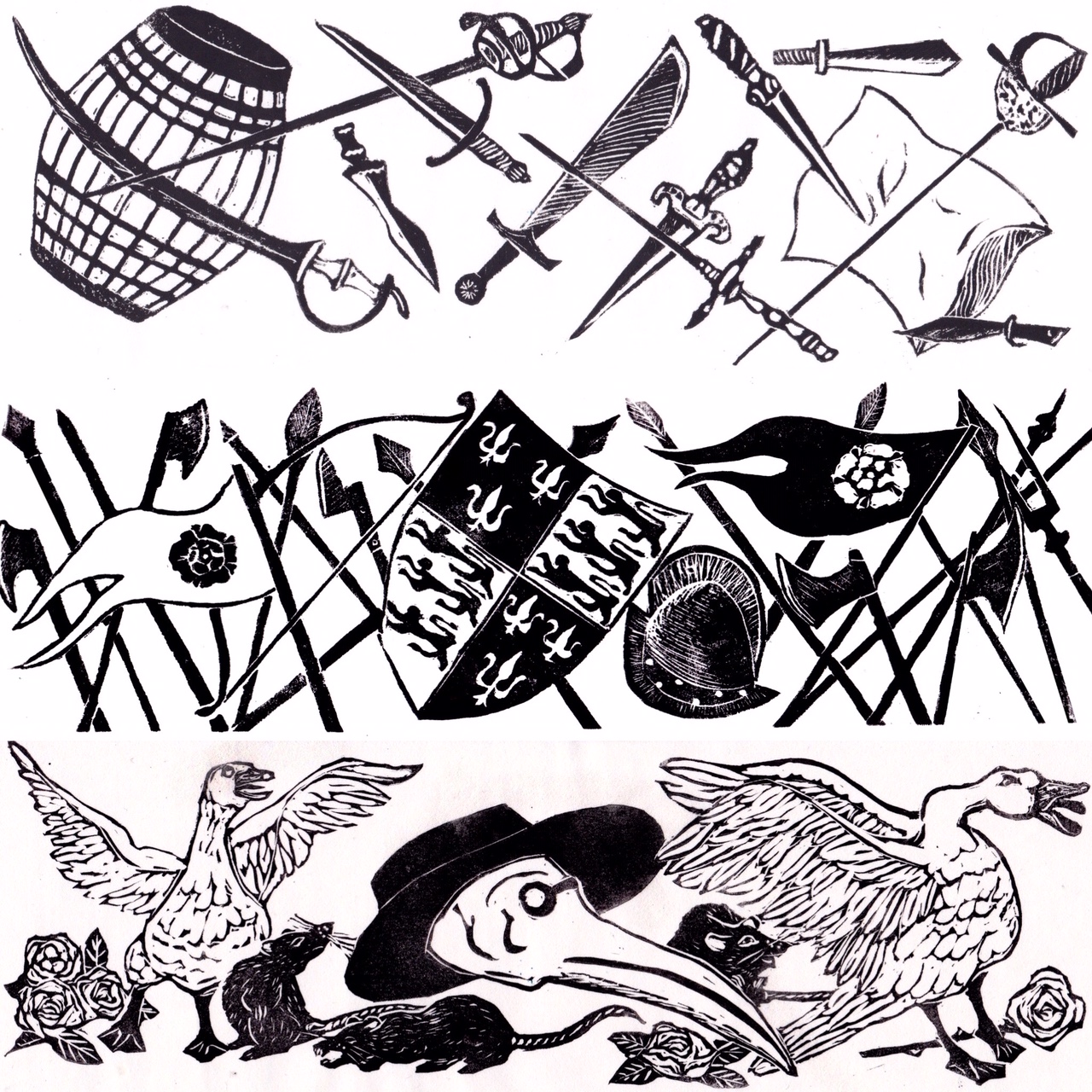
Chapter 4 was a little grim for me, to be honest, spending a few days thinking about execution. This print includes heads on spikes, noose, executioner’s mask, block and axe, as well as a Gibbet. If you aren’t familiar, don’t look them up. There’s a lot of murder in Shakespeare and most of them, in fact most deaths in the plays, are stabbings. So for Chapter 5 I researched Renaissance weapons, knives, swords and daggers. We’ve also got Clarence in the butt of malmsey and Desdemona with the pillow. A butt is a specific type of barrel or even a unit of volume of the time and I now know a bunch of barrel and cask facts! Chapter 6 is the “dogs of war.” When I was younger I read all the history plays and I have a great illustrated collection of the plays. They cover centuries of history so there were variations in arms and armour over that time but the majority of stories of war in Shakespeare are about England and the War of the Roses, so I wanted to include the lions and fleur de lys shield and the white and red roses of Lancaster and York. The phrase “the dogs of war” made me think of an inexorable march so I wanted spears, pikes, halberds and pennants to suggest advancing armies. Chapter 7 is “A Plague O’both Your Houses” about disease. The plague itself and a plague doctor’s mask were clearly needed! Rats, suspected plague carriers also make an appearance. I looked into the history of plague doctor masks which varied in different times and places. The other imagery is more subtle: roses are geese were associated with syphillis! I keep thinking about the Untitled Goose Game and giggling to myself. I wanted the geese to be aggressive looking.⠀The plague mask feels more topical now than I could ever imagine.

Poison was my favourite chapter to illustrate for ‘Death by Shakespeare’ - bottles, pots, and vials of fluids and powder. Renaissance apothecary jars are delightfully imperfect. Cleopatra’s venomous asp also makes an appearance as well as poisonous plants and mushroom known and used at the time: aconite, hellbane, deadly nightshade, yew and fly agaric. Chapter 9 is about Shakespeare’s characters who take their own lives, so we wanted to treat this sensitively and symbolically, so we have Ophelia’s flowers. There is a long tradition of the language of flowers and Ophelia herself specifies what several mean. She mentions rosemary, pansies, fennel, violets, columbines and daisies.⠀Chapter 10 is about the effects grief and broken-heartedness . A conceptual chapter is a bit less obvious but what came to mind was memento mori, symbolic reminders of our mortality which have long played a part of art history. The symbolism runs deep, but I tried to incorporate and stick to symbols common in Shakespeare’s day. The skull is common of course- and famously used precisely as a reminder of our mortality in Hamlet. The hourglass and candle (which could be snuffed out) represent our finite lifetimes. The live flowers contrast with the skull but wilting flowers again suggest our lives are finite. Butterflies are also common and can be a symbol of the soul. I enjoyed carving this one.

My linocut chapter illustration for Chapter 11, how it appeared in the book and the cover (cover art not by me) of ‘Death by Shakespeare’ by Kathryn Harkup

The strange misfit Shakespearean deaths chapter includes “Exit, pursued by a bear,” baked in a pie, an ounce of flesh, lightening and um, severed hands. I worried about getting the bear species right. There are a lot of poorly identified bears on the internet, let me tell you. ⠀
This is the first time I have done all the illustrations for a book, something I've long wanted to do and it was a real treat to have a fascinating and rich topic like this.