|
| My linocut chapter illustration for Chapter 1 of ‘Death by Shakespeare’ by Kathryn Harkup |
In early March, like everyone else I guess, my attention was taken by current events and the impending pandemic. Sure enough, once schools closed as the lock-down set in, I found I had little time and less energy. Blogging is one of the things I neglected. I managed to keep posting art to
Instagram and made a point to post women in science daily for Women's History Month, trying to avoid the all-too-common physicist's mistake of playing arm-chair epidemiologist (and assuming if you've mastered numerical modelling that you know what to do) or since I share a lot of science communication, I wanted to avoid talking about Covid-19, because I have no pertinent expertise (being a scientist doesn't qualify you to talk about all subjects and this one in particular needed I think, fewer self-appointed experts muddying the waters). Also, since "doomscrolling" is now a recognized fixation of people, I wanted to break up people's mounting tension with art. So I have been sharing a lot of art and making art when not amateur homeschooling our son... but not much else. Today, I'm playing catch up.
 |
| My linocut chapter illustration for Chapters 2, 3 and 4 of ‘Death by Shakespeare’ by Kathryn Harkup |
I neglected to share this here, though I am excited to be able to share.
Last fall I made the chapter
illustrations for ‘Death by Shakespeare’ by Kathryn Harkup! I just got
my copies in the mail right before the lock-down. Such a fun project researching, planning and
carving linocut chapter headings for 11 chapters about how Shakespeare offed his characters (see handy pie chart here). The illustrations are supposed to be reminiscent
of the engravings you would see in old books, and set the scene for each
chapter. I made the linocuts at 4 times the scale that they appear to
get the details I wanted. I spent October reading about Shakespeare, his
plays and life, poisons, weapons, Renaissance medicine and various awful corporal and capital punishment techniques. And the language of flowers.
 |
| My linocut chapter illustration for Chapters 5, 6 and 7 of ‘Death by Shakespeare’ by Kathryn Harkup |
The
first chapter was fairly straightforward, about the bard himself. So in
conversation with author and publisher I choose plume, inkwell, drama
masks and the spear from Shakespeare’s coat of arms.
The
2nd chapter is about Shakespeare’s world.
Since he wrote “all the world’s a stage” and literally named his theatre
The Globe, I thought of illustrating the Globe and its neighbourhood. The 3rd chapter is about medicine and what could be treated in Shakepear's
day. My first thought was William Harvey who discovered the circulation
of blood in Shakespeare’s day, but we opted for some more general
images of contemporary medicine (rather than referencing specific experiments of Harvey which aren’t mentioned in the text). The urology
flask was used as a sign for a doctor, as testing urine was a vital
diagnostic tool. I was able to find a lot of reference prints for Renaissance surgical tools. Medicinal plants included the poppy and mandrake
root - a fun thing to research! In the centre is a specific allusion to
Shakespeare’s ‘Pericles’ where a medical chest was thrown overboard. I
researched antique medical chests and first imagined it viewed through a
round porthole window. Then I decided I had better check if 16th
century vessels had round porthole windows and wasn’t able to find any
hard evidence that they did. So I went for some nautical looking rope to
frame that part of the image instead to avoid any anachronism.⠀
 |
| My linocut chapter illustration for Chapters 8, 9 and 10 of ‘Death by Shakespeare’ by Kathryn Harkup |
Chapter 4 was a little grim for
me, to be honest, spending a few days thinking about execution. This
print includes heads on spikes, noose, executioner’s mask, block and
axe, as well as a Gibbet. If you aren’t familiar, don’t look them up. There’s a lot of murder in Shakespeare and most of them,
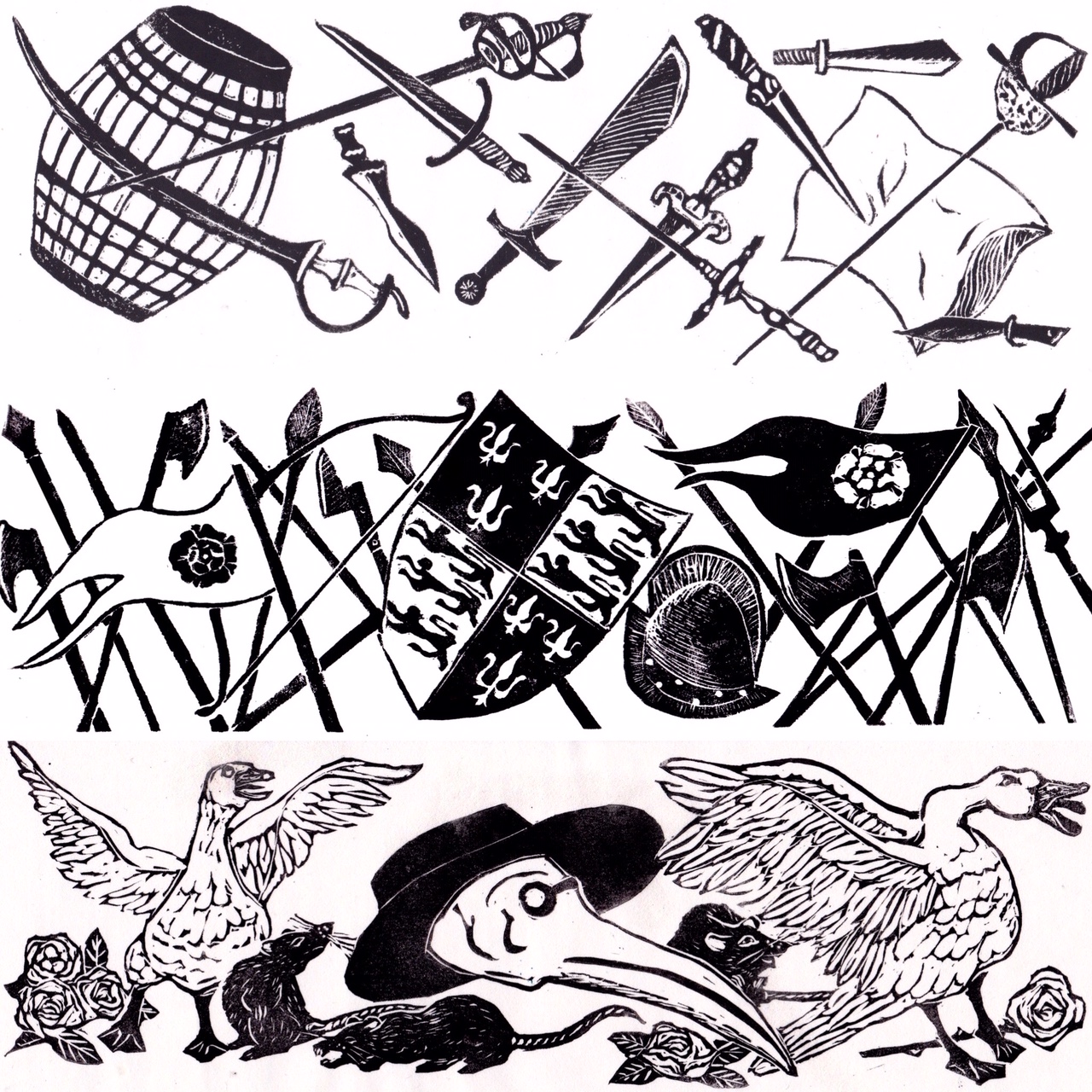
in fact most deaths in the plays, are stabbings. So for Chapter 5 I researched
Renaissance weapons, knives, swords and daggers. We’ve
also got Clarence in the butt of malmsey and Desdemona with the pillow. A
butt is a specific type of barrel or even a unit of volume of the time
and I now know a bunch of barrel and cask facts! Chapter 6 is the “dogs of war.” When I was younger I read
all the history plays and I have a great illustrated collection of the
plays. They cover centuries of history so there were variations in arms
and armour over that time but the majority of stories of war in
Shakespeare are about England and the War of the Roses, so I wanted to
include the lions and fleur de lys shield and the white and red roses of
Lancaster and York. The phrase “the dogs of war” made me think of an
inexorable march so I wanted spears, pikes, halberds and pennants to
suggest advancing armies. Chapter 7 is “A Plague O’both Your Houses” about disease.
The plague itself and a plague doctor’s mask were clearly needed! Rats,
suspected plague carriers also make an appearance. I looked into the
history of plague doctor masks which varied in different times and
places. The other imagery is more subtle: roses are geese were
associated with syphillis! I keep thinking about the Untitled Goose Game
and giggling to myself. I wanted the geese to be aggressive
looking.⠀The plague mask feels more topical now than I could ever imagine.
Poison was my favourite chapter to illustrate for ‘Death
by Shakespeare’ - bottles, pots, and vials of fluids and powder.
Renaissance apothecary jars are delightfully imperfect. Cleopatra’s
venomous asp also makes an appearance as well as poisonous plants and
mushroom known and used at the time: aconite, hellbane, deadly
nightshade, yew and fly agaric. Chapter 9 is about Shakespeare’s characters who take
their own lives, so we wanted to treat this sensitively and
symbolically, so we have Ophelia’s flowers. There is a long tradition of
the language of flowers and Ophelia herself specifies what several
mean. She mentions rosemary, pansies, fennel, violets, columbines and
daisies.⠀Chapter 10 is about the effects grief and
broken-heartedness . A conceptual chapter is a bit less obvious but what
came to mind was memento mori, symbolic reminders of our mortality
which have long played a part of art history. The symbolism runs deep,
but I tried to incorporate and stick to symbols common in Shakespeare’s
day. The skull is common of course- and famously used precisely as a
reminder of our mortality in Hamlet. The hourglass and candle (which
could be snuffed out) represent our finite lifetimes. The live flowers
contrast with the skull but wilting flowers again suggest our lives are
finite. Butterflies are also common and can be a symbol of the soul. I
enjoyed carving this one.
 |
| My linocut chapter illustration for Chapter 11, how it appeared in the book and the cover (cover art not by me) of ‘Death by Shakespeare’ by Kathryn Harkup |
The
strange misfit Shakespearean deaths chapter includes “Exit, pursued by a
bear,” baked in a pie, an ounce of flesh, lightening and um, severed
hands. I worried about getting the bear species right. There are a lot of poorly identified bears on the internet, let me tell you. ⠀
This is the first time I have done all the illustrations for a book, something I've long wanted to do and it was a real treat to have a fascinating and rich topic like this.