Showing posts with label botany. Show all posts

Friday, June 26, 2026

Barbara McClintock asking the maize plant to solve specific problems

Barbara McClintock, linocut print, 11" x 14" by Ele Willoughby, 2026

I first read about Barbara McClintock years ago in 'Nobel Prize Women in Science' by Sharon Bertsch McGrayne. McClintock was one of the women portrayed who did actually win the award, rather than the several who should arguably have been included in various wins. Much more recently, I read 'The Exceptions: Nancy Hopkins, MIT and the Fight for Women in Science', by Kate Zernike. When I was an undergraduate and then graduate student in physics at University of Toronto, and served on the Gender Issues Committee, biologist Nancy Hopkins famously showed systemic discrimination against women faculty at MIT with hard data, gathered systematically, if surreptitiously, by literally measuring lab floor space. Her victory was all our victory, because she used the tools of science to convince scientists. Further, she and collaborators showed academics worldwide a strong, convincing, simple and effective strategy for showing discrimination was occurring. For instance, in 2002, the University of Toronto settled a class action suit from retired female faculty, acknowledging gender barriers and pay discrimination. The book is well-written, but I found it a bit hard to read. Barriers and discrimination Hopkins experienced in the 60s onwards, felt all too familiar for my experiences decades later. Further, as a physics student, one of a grand total of 2 women specialists as a undergrad, and as an obvious minority as a grad student, with a grand total of 0 then 1 female faculty, it was pretty undeniable that something was wrong and needed fixing. It took Hopkins, wary of feminism like many of her generation, a very long time to recognize she was facing discrimination and harassment. I found it rather hard to read about naive young Nancy who took so long to question things.

Rosalin Franklin, linocut, 11" x 14" by Ele Willoughby
Roaslind Franklin, linocut, 11" x 14", by Ele Willoughby 2020

One of Hopkins' role models, somewhat hidden in the background was Barbara McClintock, who tried resolutely to recruit her. Young Nancy was a bit wary of McClintock whom she viewed as a bit of a square peg, maybe sidelined from the cutting edge of genetics unlike her undergraduate mentor Nobel laureate James Watson. She was both right and quite wrong, as it turned out. Outsider McClintock would go on to win the 1983 Nobel Prize in Physiology or Medicine. It was funny to read about Watson's role as champion and mentor in Nancy's life, knowing him more as a bit of a villain, not so much in Rosalind Franklin's life (as he is often portrayed with imprecision and hindsight), but as a villain in the story of what was and was not remembered about Franklin posthumously until more recently. Also, he has become increasingly notorious for ugly racist and sexist biases about people. Nancy was important to a lot of us women in science in the early 2000s, well beyond biology, for the way she spearheaded the survey of lab space offered women versus men faculty at MIT and gathered hard data of systemic biases. When Nancy was the first person to read Jim Watson's 'Selfish Gene', it did not occur to her that maybe the portrayal of Franklin as uptight harridan might not be the whole story or to wonder why this was the first time she had heard of her. When Watson told Nancy that McClintock was "difficult" she believed him. When McClintock showed Nancy a letter in which she had been described as the best person in the field and that it was a shame that she (McClintock) couldn't be hired because she was a woman, Nancy assumed the problem and McClintock's science both were a thing of the past. But what did come through to me in reading this book was how, all the while, Barbara McClintock was doing her own thing, quietly revolutionary on her own terms. Barbara was there supporting fellow women in science and understood the dynamics of gender in the scientific workplace before Nancy. 

Barbara McClintock (1902-1992) was a cytologist and geneticist who studied maize genetics from graduate school through retirement. She had been named Eleanor when she was born the third of four children to British immigrant in Connecticut, Thomas Henry McClintock, a homeopathic physician, and his upper-middle-class, Mayflower-descendent Boston wife, housewife, artist and poet, Sara Handy McClintock. When she was young, her parents decided that Eleanor was too delicate and feminine and did not suit their solitary, active, independent child, so they renamed her Barbara. To help save money while her father established his medical practice, and relive her mother of caring for both a toddler Barbara and her new infant younger brother, Barbara was sent to live with an aunt and uncle in Brooklyn from the age of three until she began school. She was close with her father but had a difficult relationship with her mother from a young age.

From her uncle she learned to repair machinery and love nature. Her father raised her as a boy, giving her boxing gloves at age four. When a neighbour who disapproved of the athletic child who didn't play like a girl and tried to teach her "womanly" things, her mother told her to mind her own business. She played sports with the boys, but felt they merely tolerated her as a girl. When Barbara found a teacher "emotionally ugly" her parents let her stay home from school. She grew up with a sense of freedom.

Her family moved to Brooklyn in 1908, where Barbara completed high school in 1919, and discovered her love of science. She wanted to continue to Cornell's College of Agriculture but her mother did not want to allow it. She worried Barbara would become unmarriageable, a not uncommon attitude at the time. Mrs. McClintock had convinced Barbara's older sister to reject a scholarship to Vassar. Her father returned from France where he was serving in the army medical corps just in time to intercede on Barbara's behalf, and she managed to register just before the deadline. 

Barbara thrived at college, participating in student government and joining a sorority (though she later broke her sorority pledge). Her friend circle were avant-guard, and most of her women friends were Jewish at a time when there was a large social gap between Jews and Gentiles at Cornell. She studied Yiddish, and when she found her friends were not welcome in sororities she rejected her own bid. She took up jazz music, playing tenor banjo in a group until the late hours began to interfere with her work. A 1921 field course taught by C.B. Hutchinson first peaked her interest in genetics, a brand new field of study. Hutchinson had been impressed and telephoned to invite her take the new graduate course in genetics the next year. She would later say, "Obviously, this telephone call cast the die for my future. I remained with genetics thereafter." She got her undergraduate degree in 1923, her MSc in 1925 and PhD in 1927, all officially in botany, though her graduate work focused on the cytogenetics of maize. Though just a petite younger woman grad student in pants and a man's shirt working with men in the fields and the lab, she was instrumental in assembling a group of plant breeders and cytologists working on maize cytogenetics, including her champion Marcus Rhoades, future Nobel laureate George Beadle and Harriet Creighton, and this group was supported by department head Rollins A. Emerson (who had rediscovered the laws of inheritance established by Mendel). The group remained close friends and allies through their careers. She worked as research assistant to botanists Lowell Fitz Randolph and Lester W. Sharp. She focused on ways to visualize and characterize maize chromosomes (packages of DNA carrying its genetic material). She was the first to show the 10 maize chromosomes using a staining method she developed using carmine looking at cells from the microspore rather than the root tip, effectively scooping her own supervisor who had been working for years on more effective way to image the maize chromosomes. She studied the morphology of chromosomes and was actually able to link chromosome groups to inherited traits.

Every visit home, her mother tried to convince her not to go back, afraid she would become a professor rather than a housewife. Barbara decided she was too independent for emotional relationships, that she was a "dominant person" who would make a man miserable. She broke up with her beau and remained single for the rest of her life. Zernike writes that she "nurtured a vision of herself as gender-free - feeling at home neither as a girl nor a boy - and once complained of her body as 'a nuisance'."*

She was the first to describe the cross-shaped interaction of the set of maternal and paternal chromosomes that pair up (called homologous chromosomes) during meiosis (cell division of germ cells). Together with Harriet Creighton in the 1930s, studying meiosis in corn cells and examining the gene positions on the chromosomes, she discovered that new combinations of nucleotides that make up DNA in offspring were related to the event of crossing. This proved inter-chromosomal genetic recombination, previously only a hypothesis. They published in 1931, only a few months before Curt Stern published the same observation for fruit flies. This landmark paper made her reputation. They went on to observe how the recombination was linked with new offspring traits. McClintock's chromosomal map was consistent with the linkage map published by her supervisor Hutchinson in 1921, and made a basis of her work with Creighton. They also showed that crossing-over occurs in sister chromatids (which occur when chromosomes are copied by DNA and tied together by a centromere). 

Her success and the importance of her publications lead to receiving several National Research Council post-doctoral fellowships and she continued her research at Cornell, the University of Missouri and the California Institute of Technology, driving her model A Ford across the country. She was the first woman postdoc at Caltech, which required the board of trustees' approval. After a visit to the faculty club on her first day, unlike every other visiting scholar, she was never welcomed again. Warren Weaver of the Rockefeller Foundation deemed her "more boy than girl." It was very hard to find a permanent position during the Great Depression. In Missouri in 1931 and 1932, Stadler introduced her using x-rays as a mutagen; greatly increasing the rate of mutation above background levels was a very useful tool in genetic studies. She found ring chromosomes (where the ends of a single radiation-damaged chromosome fuse), which were first reported by Mikhail Sergeevich Navashin, in x-ray-mutagenized maize. She correctly inferred that normally, undamaged chromosomes must have a structure on the chromosome tip to ensure stability, eventually identified as telomeres. She showed that the loss of ring-chromosomes at meiosis caused variegation in subsequent maize generations due to chromosomal deletion. On chromosome 6, she demonstrated the presence of the nucleolus organizer region needed for the assembly of the nucleolus (the largest structure in the cell nucleus). She found that cells can be damaged during non-homologous recombination (the repair of double-strand breaks in DNA) and published this in 1933. 

She earned a Guggenheim Foundation Fellowship which allowed her to work in Germany with Richard B. Goldschmidt director of the Kaiser Wilhelm Institute for six months, but she left due to mounting political tensions there. Emerson hired her as an assistant in his Department of Plant Breeding at Cornell for three years and her work there lead to an offer of an assistant professorship from Lewis Stadler at the Department of Botany at the University of Missouri in 1936. There she continued her work on the effect of x-rays on maize cytogenetics. She found breakage and fusion in irradiated maize chromosomes and found spontaneous breakage in endosperm cells from some plants. She made a key cytogenetic discovery of a breakage-rejoining-bridge cycle. During mitosis (cell splitting) the broken chromatids were rejoined after chromosome replication. In anaphase (when replicated chromosomes are split), the broken chromosomes formed a bridge which was broken when the chromatids moved toward cell poles. These broken ends rejoined in the interphase (just prior to) the next mitosis, causing massive mutations which she could observe as variegation of the endosperm. In 1938 she published a cytogenetic analysis on the centromere, describing its organization, function and ability to divide. While her research was going well, and she was gaining recognition (she was elected vice-president of the Genetics Society of America in 1939) she was not happy at Missouri. She felt her "maverick" ways did not fit with what was expected of a "lady scientist." Whether it was wearing pants, allowing her students to work in the field after hours or simply climbing the fence when she forgot her key, she did not fit. When another woman named Barbara McClintock announced her engagement in the newspaper, she was hauled into her boss' office and told she would be fired if she married. She was excluded from faculty meetings, not told of advertised professorships elsewhere and convinced she would never be get tenure, so she decided to leave. She learned that if Stadler, who had hired her, moved to the University of California, her job would be in jeopardy. She took a leave of absence in 1941 and accepted a visiting professor at Columbia, where Rhoades was now teaching. Rhoades also offered to share his research field at Cold Spring Harbor Laboratory, a research institution funded by the Carnegie Institution of Washington on Long Island. She loved working the lab and said, "I was just so interested in what I was doing I could hardly wait to get up in the morning and get at it." In December, acting director Drosophila expert Milislav Demerec of the Carnegie Institution of Washington's Department of Genetics at Cold Spring Harbor offered her a temporary position there and then, when made Director he offered her a permanent position. She wavered at first but accepted and became a permanent member of staff in 1942. She had found the right fit, somewhere everyone wore jeans, teaching was not required and there were no restrictions on research.

Esther Lederberg, linocut print, 11" x 14" by Ele Willoughby, 2026
Esther Lederberg, linocut print, 11" x 14" by Ele Willoughby, 2026. Esther Lederberg also worked at Cold Spring Harbor and published on N. crassa in the early 40s.

There she used the breakage-rejoining-bridge cycle to map new genes. In 1944 she was elected to the National Academy of Sciences, only the third woman to be elected. George Beadle invited her to visit Stanford and work on the bread mold Neurospora crassa. He had used N. crassa to demonstrate the one gene one enzyme relationship and within two months McClintock had described its number of chromosomes (or karyotype) and its entire life cycle.  Beadle said, "Barbara, in two months at Stanford, did more to clean up the cytology of Neurospora than all other cytological geneticist had done in all previous time on all forms of mold." In 1945 she was elected president of the Genetics Society of America. All of this she achieved before her Nobel award winning work.

Summer grad students at Cold Spring Harbor would play baseball in the evening, next to Barbara's cornfields. One of them, James Watson, said the ball went all too often into her fields and she would "get pretty mad... like your mother". Little did he know at the time that her cornfields would tell a much more complex story of the operation of genes than could be found in the structure of DNA alone. McClintock could be prickly and Watson also called her "the Katharine Hepburn of science."

She began her systematic study of mosaicism in maize in the summer of 1944 investigating the mechanisms of colour patterns and unstable inheritance. She had noted that colour patterns were too unstable over the generations to be explained by simple mutations. She discovered two dominant genetic loci she called Dissociation (Ds) because it could cause a dissociation (or break) and Activator (Ac) which was like a sort of switch. She found that corn colours, dominant or recessive were turned on or off by Ds. Strikingly, Ds could change position, or transpose, within the chromosomes, disrupting the colour gene. In a few cells it can jump again. The jumping is random, so multicoloured corn is common. She found that Ac terminated the transposition of Ds; the amount of jumping around done by Ds is determined by the numbers of copies of Ac in the cell. Ds had other varying effects on neighbouring genes, like making normally stable mutations unstable, if Ac was present. Then in 1948 she made the unexpected observation that both Ds and Ac could change position, or transpose, on the chromosome. Hence they are now known as transposons. 

By carefully controlling crosses, and observing the colouration patterns in generations of crops and careful microscopic analysis, she was able to describe the relationship between Ds and Ac. She saw that Ac controls how Ds jumps from chromosomes 9, and that when it does the chromosome breaks. Ds which suppresses the aleurone protein colour gene prior to transposition, and releases it when it jumps, resulting in pigment synthesis in cells. The Ds jumps are random, and may happen in some cells and not in others, so colour mosaicism is common in maize. The size of coloured spots depends on the stage of development at dissociation. She called Ds and Ac "controlling units" or "controlling elements" to distinguish them from genes and hypothesized that this gene regulation could explain how multicellular life with a single genome can produce cells of  different functions. Thus the genome was not simply a static set of instructions - dogma at the time. In 1950, she published "The origin and behaviour of mutable loci in maize" in the Proceedings of the National Academy of Sciences and presented a paper of the same name the next year at the annual Cold Spring Harbor symposium. These described this research, the instability due to Ac, or both Ds and Ac in four genes and how those genes can unpredictably revert to the wild phenotype. She also explained there were "families" of transposons which did not interact with each other. She described her colleagues' response to this work as "puzzlement, even hostility," and said, "They thought I was crazy, absolutely mad," but she persisted with her research and published a subsequent paper in Genetics in 1953 about her statistical data and lectured on the work through the 50s. She found another element she called Suppressor-mutator (Spm) for which some versions could transpose on their own and some could not but which, when present, fully rather than partially suppressed mutant genes. McClintock worried she would alienate her colleagues if she continued to publish on controlling elements, so after 1953, she stopped. She felt the need to wait until the field was ready for conceptual change. When she presented her observation that maize did not follow Mendelian distributions where colours would be dictated strictly by copies of dominant or recessive genes, geneticist Sewal Wright suggested she (like other women) simply did not understand the underlying mathematics. During a visit, McClintock threw Joshua Lederberg and colleagues out of her lab for arrogance. He later declared, "By God, that woman is either crazy or a genius." According to McGrayne, a leading molecular biologist described her as "just an old bag who'd been hanging around Cold Spring Harbor for years." McClintock had no patience for arrogance. Barbara did not feel the need to keep defending her work. She said, "If you know you are on the right track, if you have this inner knowledge, then nobody can turn you off... no matter what they say." While McClintock thought her colleagues deemed her mad, she was respected. It might be more accurate to say her colleagues struggled to understand her work. Geneticist Alfred H. Sturtevant said in 1951, "I didn't understand one word she said, but if she says it is so, it must be so!"

She got a grant in 1957 from the National Academy of Sciences to research Central and South American indigenous maize strains so she could investigate the evolution of maize through chromosomal changes. In South America, she could work on a larger scale. In 1959 she was elected a fellow of the American Academy of Arts and Sciences. Through extensive work in the 60s and 70s looking at chromosomal, morphological and evolutionary characteristics of maize strains she and her colleagues published The Chromosomal Constitution of Races of Maize, an influential publication for cytogenetics, paleobotany, ethnobotany and evolutionary biology. She had officially retired in 1967, becoming a Distinguished Service Member of the Carnegie Institution of Washington, which allowed her to continue working with grad students as an emeritus scientist at Cold Spring Harbor. She also received the Kimber Genetics Awards.

In 1961, French geneticists François Jacob and Jacques Monod described genetic regulation of the lac operon and McClintock wrote an article for American Naturalist comparing this to her work on controlling elements in maize. She had effectively discovered genetic regulation though biology was slow to recognize this. When her colleagues finally saw transposons in bacteria, yeast and bacteriophages in the late 60s and early 70s, they had the tools to investigate the molecular basis for transposition, and her discoveries began to receive the credit they deserved. Today, mutant plants are generated using the Ac/Ds mechanism, to characterize gene function. We now know that transposons make up the majority, in fact, 85% of the maize genome and a significant portion of our own. McClintock did not get everything right but she had made a huge leap forward, years before anyone else. 

When the Carnegie Institute of Genetics closed in the early 70s, her corn field was removed to become a library parking lot. McClintock continued working and collaborating with colleagues Ben and Frances Burr at Brookhaven National Laboratory, where she  replanted her seeds and with Nina Federoff at the Carnegie Institute of Embryology in Baltimore. 

In 1970 she received the National Medal of Science. She was the first woman to do so. In 1973 Cold Spring Harbor named a building in her honour. The awards kept coming: the Louis and Bert Freedman Foundation Award (1978), the Lewis S. Rosensteil Award (1978), she received the first MacArthur Foundation Grant, the Albert Lasker Award for Basic Medical Research, the Wolf Prize in Medicine, the Thomas Hunt Morgan Medal from the Genetics Society of America, the Louisa Gross Horwitz Prize from Columbia University, and in 1983 the Nobel Prize for Physiology or Medicine for discovering "mobile genetic elements," 30 years after her discovery. She was the first woman to win the prize solo. When alerted of her win by a 6:00 phone call from the New York Times the morning it was announced, post-doc Grey Freyer found her collecting walnuts and congratulated her. "For what?" she asked. "You won the Nobel Prize!" he told her. "That's nice," she said. The administrative director got her to issue a press release, in which she wrote that it seemed unfair "to reward a person for having so much pleasure, over the years, asking the maize plant to solve specific problems and then watching its responses." When the reporters showed up, they found her again out collecting walnuts in dungarees and shirt. Colleague escorted her to the press conference but she was wearing a Groucho mask as a disguise. She told reporters "I've had a very, very, satisfying and interesting life."

Barbara McClintock in the Groucho mask

That year physicist, feminist and historian of science Evelyn Fox Keller published 'A Feeling for the Organism', a biography which brought McClintock's story to the public. In 1986 she was inducted in the National Women's Hall of Fame. In 1987, The Discovery and Characterization of Transposable Elements: The Collected Papers of Barbara McClintock was published. In 1989 she was elected a Foreign Member of the Royal Society. In 1993 she received the Benjamin Franklin Medal for Distinguished Achievement in the Sciences of the American Philosophical Society. She received 14 honorary doctorates and an Honorary Doctor of Humane Letters. She remained active in the Cold Spring Harbor community, giving talks on mobile genetic elements and the history of genetics for junior scientists for the rest of her life, playing tennis, collecting black walnuts for baking for colleagues. She would place the walnuts in her driveway and roll her Honda Accord over them, to crack them open to make brownies! Known for her lengthy and thorough answers to student questions, she had brownies at the ready when they looked tuckered out. Jim Watson hosted a large party with many of her colleagues for her 90th birthday. She died of natural cause at 90 years of age in 1992. Her colleagues remembered her brilliance, intensity, scientific focus, devoted mentorship, quick wit and sense of fun. Steven Jay Gould wrote, "Her discovery of transposable elements in maize - so-called jumping genes - first presented in the early 1950s before her field had any language to express such a heterodox idea, was, in retrospect, the beginning of modern molecular genetics." Posthumously, in 2005 the USPS issued a Barbara McClintock stamp, the McClintock Prize was named in her honour in 2013, and in 2024 the plant Stellaria mcclintockiae was named in her honour.


References

    Chomet, P., and R. Martienssen. Barbara McClintock's Final Years as Nobelist and Mentor: A Memoir. Cell, 170, pp. 1049-1054. September 7, 2017.

    Barbara McClintock. NobelPrize.org, Nobel Prize Outreach 2026. January 25, 2026.

    Barbara McClintock, Wikipedia, accessed June, 2026.

    Barbara McClintock's World, Weed to Wonder, Cold Spring Harbor Laboratory, accessed June, 2026.

    Kim, Taeah. The Life of Barbara McClintock and her Jumping Gene. AMI Webinar Online Salon, 2020.

    Krueger, Brian. Barbara McClintock discovered a little thing called the transposable element in 1950. omicly.com, May 5, 2024. 

    Madrigal, Alexis. What was Barbara McClintock's "mysticism"?  Oakland garden club. September 2, 2023.

    McGrayne, Sharon Bertsch. Nobel Prize Women in Science. Birch Lane Press, New York. 1993.

    Pearse, Yewande. Meet Barbara McClintock, who used corn to decipher 'jumping genes,' Massive Science, May 11, 2018.

    Zernike, Kate. The Exceptions: Nancy Hopkins, MIT and the Fight for Women in Science. Scribner, New York, 2023.


    Tuesday, October 10, 2023

    Hildegard von Bingen, Medieval Medicine and Natural History for Ada Lovelace Day


    Hildegard von Bingen, linocut, 11" x 14" by Ele Willoughby, 2023
    Hildegard von Bingen, linocut, 11" x 14" by Ele Willoughby, 2023


    Ada Lovelace, 3rd edition
    Ada, Countess Lovelace, 3rd edition linocut by Ele Willoughby
    It is once again Ada Lovelace Day, the 15th annual international day of blogging to celebrate the achievements of women in technology, science and math, Ada Lovelace Day 2023 (ALD23). I'm sure you'll all recall, Ada, brilliant proto-software engineer, daughter of absentee father, the mad, bad, and dangerous to know, Lord Byron, she was able to describe and conceptualize software for Charles Babbage's computing engine, before the concepts of software, hardware, or even Babbage's own machine existed! She foresaw that computers would be useful for more than mere number-crunching. For this she is rightly recognized as visionary - at least by those of us who know who she was. She figured out how to compute Bernouilli numbers with a Babbage analytical engine. Tragically, she died at only 36. Today, in Ada's name, people around the world are blogging.

     
    You can find my previous Ada Lovelace Day posts here.

    Despite some biased ideas about the Medieval period, which we inherited from Enlightenment scholars, the Dark Ages were only "dark" in the sense that there is a dearth of documentation. All too often, people have the idea that this was a stagnant period in the pursuit of knowledge after the end of the Classical period. Many documents of the time have simply been lost, so we don't have a lot of information about many individuals and their specific advancements in scientific thought. But the sheer fame and productivity of Hildegard von Bingen (1098-1179) is an exception. Her writings preserve not only her own knowledge and theories but much of the nature of institutional medicine and folk healing of her day (which she deftly combined). While she might be best remembered today as a composer of seventy Gregorian chants and musical dramas and as a Catholic saint, author of biblical commentaries, three books on her visions and two biographies, she is also recognized as the progenitor of natural history in German-speaking lands and author of medical and natural history texts. She even invented her own script and language!

    Likely born the tenth child in her rural Rhineland family, her religious parents raised her intending for her to be a tithe to the church, and she entered the double-monastery at Disibodenberg at 14. Her well-respected magistra Jutta (1092-1136) became her mentor and teacher, and it is believed Hildegard was assigned to the infirmary. There she would have been responsible for, in particular, for but likely not limited to, the health of the women at the monastery and adjoining community. She would also have had access to the books and knowledge of her male counterpart, who was responsible in particular for the health of the men. After Jutta's death, Hildegard was elected magistra and she lead the Disibodenberg nuns until 1148, when at age 50, inspired by a vision, she moved them all to a new monastery at Rupertsberg at Bingen. She immediately began writing her text books. Physica describes elements, mammals, reptiles, fish, birds, trees, metals, and precious stones and medicinal uses of 293 plants (230 herbaceous plants and 63 trees). Causae et curae was written presumably to ensure that her replacement in the infirmary had all the knowledge she would need. It describes 47 diseases along with causes, symptoms and treatments and goes on to document 300 plants used to treat diseases. It reads both like a Medieval first aid manual and technical scientific writing of her day. She lived in the new monastery until her death at 81. People traveled to Rupertsberg to receive healing from Hildegard and her order. She was a prodigious correspondent and has been called a Medieval "Dear Abby" because of her letters to such luminaries as King Henry II of England, King Louis VII of France, the Holy Roman Emperor Frederic I Barbarossa, the Byzantine Empress Agnes of France, Bernard of Clairvaux, four popes and others. She was invited to preach at nearby cathedrals including at Cologne, Mainz and Worms. By the time she reached 80, she was so respected and renown that she could defy the pope and it was the pope who had to back down. Commanded to excommunicate a man in her community, she simply declined to do so.

    Outside of Salerno, those practicing medicine in her day were not university educated, but either working in monasteries and infirmaries or were folk healers using herbal folklore. Hildegard's contemporary woman in medicine Trota of Salerno is a notable exception, as she was formally educated at the medical school in Salerno. The rise of universities and formal medical schools actually lead to greater exclusion of women from medical practice; universities usually excluded women. 

    Hildegard developed a holistic understanding of medicine and was systematic and scientific in her approach within her Christian worldview. She is believed to have access to ancient Greco-Roman medical sources, typically available and shared between monasteries, including the works of Hippocrates, Galen and Pendanius Dioscoride. The Classical humoural theory was central to medicine until the 17th century. It related humours, or the vital bodily fluids, namely, according to Hipocrates, the blood, phlegm, yellow bile, and black bile to human health and behaviour. Blood was considered hot and wet, yellow bile hot and dry, black bile cold and dry and phlegm cold and wet; these properties were used to try and diagnose how these humours might be unbalanced and causing disease. She likely also had access to texts by pioneering Arab and Persian physicians, and was abreast of some of the contemporary advancements from the Salerno school of medicine. Her medical philosophy is influenced by St. Augustine, Isidore Hispalensis, Bernard Sylvestris of Tours, and perhaps Boethius. She would have been trained in nursing, diagnosis, prognosis, pharmacy and treatment by her monk colleague in the infirmary at Disibodenberg. She herself wrote about how the infirmarian was responsible for the infirmary garden and the "spices and medicinally active herbs," thus, she became expert at gardening and botany too. In addition to Latin terms, Hildegard includes German names for plants she could not name in Latin, so scholars believe she also incorporated knowledge from the folk herbalist, magical and medical tradition. Some instructions even prescribed charms and incantations. Importantly, she synthesized these disparate sources of knowledge. Along with the humoural theory, she believed that everything on Earth was made by God for man, so there's very little which could not be used in medicine to counter a humoural imbalance. For instance, she prescribed a poultice of quince, deemed "dry" to treat the "dampness" of an ulcer. Her writings actually allow an unusual insight into "wise woman" healing practices, as it was rare for other women to be literate in Latin. She wrote that she was told to ‘write down that which you see and hear’ in a vision, and thus recorded her visions. But she takes the same approach with medicine, writing down observations and supplementing her observations with knowledge from books rather than simply relying on their authority. This strategy hints at the beginnings of the scientific method.

    Her philosophy of medicine was deeply influenced by her experience in the garden and she gives a special focus on "viriditas" or the greening power of plants, expanding on Galen and Hippocrates' four humors, connecting plants to human health, and viewing this greening force as also vital within the human body. She ties viriditas directly to fertility and vigor and describes it as a humour that can dry up. She approaches medicine the way a gardener nurtures a garden. Her approach in all things was quite holistic and she believed spiritual health complemented physical health. She begins her text Causae et curae with the creation of the cosmos and connects the human person as microcosm to the sacred macrocosm of the cosmos. Her work documents causes of disease, sexuality, psychology, physiology, diagnosis, treatments and prognosis. Illness, she wrote, was a result of falling into disharmony with creation and could be treated with rest, herbal cures, steam baths, a proper diet, and achieving spiritual peace. Her goal was to heal body, spirit and mind; in the 12th century healers commonly viewed health as involving all of these things. 

    She discussed sexuality openly and women's reproductive health. She described female orgasm, nocturnal ejaculation, coitus as therapy, conception, birth, complications in childbirth, gynecological diseases, menstruation (including botanical emmenagogues or menstruation stimulators), abortifacients (substances which can induce an abortion including sarum, white hellebore, feverfew, tansy, oleaster, and farn) and menopause. Medieval Christian healers would not hesitate to proscribe abortifacients to save a mother's life if it were at risk. She wrote about determining an embryo's sex and noted that children need affection for their psychological development, writing “The strength of the male seed determines the sex of the embryo, while the love of one parent to the other determines the moral qualities of the child.” She is likely the first woman to write about skin diseases and treatments including leprosy, scabies, lice, insect bites, burns and conditions now believed to be erysipela, paronychia, contact allergies, rosacea, and rhinophyma. Hers is the first description of a peeling for rosacea, a method still used; she used plants that promote blistering on the skin, which would then rapidly heal. She recommended skin treatments with plants which we now can confirm have anti-inflammatory and antibacterial properties. She recommended a balanced diet including cutting back on food high in fats and cholesterol and that salt should be taken in moderation to avoid hypertension. She writes about kidney and liver ailments and treatments; in her day, uroscopy and examining urine was considered a doctor or healer's most reliable tool. She herself suffered migraines and she wrote about headaches and remedies. She precisely described toothache and even how nerves run from the brain to gums and the need for dental hygiene. She addresses depression, anxiety and schizophrenia. A modern study investigated whether her correct herbal remedies were mere lucky strikes - that is whether herbal remedies she reports which are still supported by modern science are just a result of chance. They found this could not be the case. Though most of her claims are not correct, she is correct far too often for it to be by mere chance. Further, she does not repeat all claims in ancient sources, suggesting she was independent in her thinking. Most of her remedies are ingredients from the kitchen or garden but she also recommends the use of minerals including gold for arthritis, emerald for heart pain, jasper for hay fever or for cardiac arrhythmia, gold topaz for loss of vision, sulfur ointment for scabies and blue sapphire for eye inflammation; most of these play no role in modern medicine, though gold is still used for arthritis and sulfur is still used for skin treatments for people and domestic animals. While all her writings and worldview were firmly planted within her faith, she did not presume sin was the primary cause for disease; bad humours, bad lifestyle or the weather were more often suspected. She makes pragmatic practical suggestions rather than trying to treat illness with prayer, penitence or pilgramage.

    She invented her own alternate alphabet or secret code with symbols for each letter and applied it to her own Lingua ignota (Unknown Language), which consisted of 1000 invented words for a list of nouns. Scholars are divided on her intentions; was this a secret language to increase solidarity within nuns in her order, or was this intended for anyone? Modern conlangers (aficionados of constructed languages) view her as a Medieval precursor.  

    She formed a deep friendship and love for her assistant Richardis von Stade, who worked beside her on her major work Scivias. When Ricardis was elected abbess of a monastery at Bassum, far from Rupertsberg in 1151, Hildegard was bereft. She wrote to Richardis' mother, to the Archbishop of Bremen and even to the pope, trying to get them to intervene, to no avail. She wrote letters of her grief to Ricardis, writing "Now, let all who have grief like mine mourn with me, all who, in the love of God, have had such great love in their hearts and minds for a person- as I had for you- but who was snatched away from them in an instant, as you were from me." Tragically, Richardis died the next year. 

    My portrait includes some of her prescribed treatments which we can now confirm do have medical benefits (or at least effects). Clockwise from the top, she is surrounded: by tansy (Tanacetum vulgare) which has antibacterial and toxic contents; common comfrey (Symphytum officinale) is sometimes used on the skin to treat wounds and reduce inflammation from sprains and broken bones, it roots and leaves contain allantoin, a substance that helps new skin cells grow, along with other substances that reduce inflammation and keep skin healthy; mandrake (species in the genus Mandragora, either Mandragora officinarum or Mandragora autumnalis) which contain hallucinogenic tropane alkaloids which are poisonous; sulfur she prescribed for skin ailments does indeed act as a fungicide; lemon balm (Melissa officinalis) which has been shown to have some calming effects, some antibacterial properties and positive effects on indigestion; and quince (Cydonia oblonga), which is understudied, but there is some early evidence that it may help prevent stomach ulcers (which would actually coincide with her advice). 

    Above and below Hildegard is the alphabet along with her own alternate alphabet Litterae ignotae which she used for her own Lingua ignota (Unknown Language). The scroll in her hand also shows medieval musical notation to represent her compositions. 

    Her map of the universe from her book Scivias in illustrated on her habit. She correctly viewed the Earth as spherical, and then in the typical Medieval worldview, she posits a series of concentric celestial spheres, influencing events on Earth. Other Medieval thinkers describe a spherical universe. The shape of Hildegard's map of the universe is unique; some describe it as oval, or egg-shaped others, more directly, as vulva-shaped. In the centre of her diagram is the Earth, as as you move upward, you see the moon, then the inner planets Mercury and Venus (which look like stars), then beyond the ring there is the Sun (the large flower-like shape) and outer planets Mars, Jupiter and Saturn (the three outermost star shapes). Recall, the further planets are not visible to the naked eye. She wrongly assumes the antipodes are uninhabitable, without a more modern understating of the cause of the seasons. Seasonal variations in the heavens and seasons on Earth were attributed to winds.

    While you could not call a Medieval woman a feminist, she did believe that men and women were equal before God, and rejected the prevailing Aristotelian idea that women were inferior inversions of men, with opposite but inferior relationships with humors and elements. She wrote, rather that, that women had different but not opposite or inferior relationships to the elements. To her, men and women were complimentary aspects of the divine.

    Hildegard entered the monastery an uneducated child and grew to be a renown, respected thinker and healer, with a tremendous output in music, theology, natural history and medicine, who has been recognized as a saint. Her writings on medicine and reputation as a healer were used as arguments by early feminists that women should be admitted to medical schools. Her music has seen a resurgence of interest. Her impact and influence can still be felt today. 


    * Offering the tenth child as a tithe to the church was a common practice, and many scholars believe Hildegard was the tenth child in her family, but we lack surviving documentation of 9 older siblings, so we can't state this with complete certainty.

    Sources

    Brady, Erika. Healing Logics: Culture and Medicine in Modern Health Belief Systems. 1 ed. Utah State University Press, 2001. Project MUSE muse.jhu.edu/book/9398. 
     
    Campbell, Olivia, Abortion remedies from a Medieval Catholic nun (!), JSTOR Daily, October 13, 2021.
     
    Janega, Eleanor, Going Medieval blog, posts tagged 'Hildegard of Bingen,' accessed October, 2023.

    Hay, K.A., "Hildegard's Medicine: A Systematic Science of Medieval Europe." Proceedings of the 17th Annual History of Medicine Days, March 7th and 8th, 2008, Heath Science Centre, Calgary, AB. http://hdl.handle.net/1880/47483 Downloaded from PRISM Repository, University of Calgary

    Hildegard of Bingen, Wikipedia, accessed October, 2023

    Johnston, Sophie., Hildegard of Bingen, Bluestocking Online Journal of Women's History, January 1, 2008.

    Lockett, Charles J., Was Hildegard von Bingen the First Medieval Scientist? Medieval Blog, July 18, 2022

    The Medieval Garden Enclosed, posts tagged 'Hildegard of Bingen', The Metropolitan Museum of Art blog, accessed October, 2023.

    Mount Sinai Health Library, accessed October, 2023.

    Sharratt, Mary, "Hildegard the Healer," on Feminism and Religion, May 13, 2015.

    Singer, Charles. 'The Scientific Views and Visions of Saint Hildegard (1098-1180)', in Studies in the History and Method of Science, edited by Charles Singer, Oxford at the Claredon Press, 1917.

    Stefanidis, Ioannis, Theodoros Eleftheriadis, Maria Efthymiadi, Maria Kalientzidou, and Elias Valiakos, Remedies for Kidney Ailments in Physica by Hildegard von Bingen (1098-1179), Volume: 21 Issue: 6 June 2023 - Supplement - 2, Pages: 53 - 56, June 2023.

    Sweet, Victoria, 'Hildegard of Bingen and the Greening of Medieval Medicine', Bulletin of the History of Medicine , Fall 1999, Vol. 73, No. 3 (Fall 1999), pp. 381-403 Published by: The Johns Hopkins University Press, Stable URL: https://www.jstor.org/stable/44445287

    Ramos-e-Silva, Marcia., Saint Hildegard von Bingen (1098-1179): “the light of her people and of her time”. International Journal of Dermatology 1999; 38(4):315-320.

    Uehleke, Bernhard, Werner Hopfenmueller, Rainer Stange and Reinhard Saller, Are the Correct Herbal Claims by Hildegard von Bingen Only Lucky Strikes? A New Statistical Approach. Complementary Medicine Research Forschende Komplementärmedizin / Research in Complementary Medicine (2012) 19 (4): 187–190. https://doi.org/10.1159/000341548 Published Online: 01 April 2012


    Tuesday, May 11, 2021

    Botanist E.K.Janaki Ammal

    E.K. Janaki Ammal
    E.K. Janaki Ammal, linocut by Ele Willoughby, 9.25" x 12.5", 2021

    Botanist Janaki Ammal (4 November 1897 – 7 February 1984), a trailblazer for women in science in India, worked on genetic crosses, breeding sweeter sugarcane varieties which could thrive in India, was an expert in cytogenetics and phytogeography and coauthor of the influential Chromosomal Atlas of Plants. The first woman in India to earn a doctorate and the first woman in the US to earn a doctorate in botany, she became an environmental activist and wrote about the importance of incorporating indigenous knowledge when working toward sustainable development. Her name lives on in the names of plants like the Magnolia kobus Janaki Ammal and the eggplant (known as brinjal or brengal in India) Janaki Brengal, and the recently developed delicate yellow rose named in her honour.

    One of 13 siblings born to Dewan Bahadur E. K. Krishnan, a sub-judge in Madras Presidency who wrote books about local birds, and his second wife Devi Krishnan, in a blended family of 19 with 6 children from his first marriage, Janaki grew up in a home with many books on nature and wildlife. She was nonetheless born into the Thiyya caste, which was considered backwards, and this later affected her treatment as a scientist. She went to a missionary school in Tellichery before studying for her botany degree at Queen Mary College in Madras (now Chennai) and graduating with an Honours degree from Presidency College in 1921, where she developed a love of cytogenetics. She took a job teaching Women’s Christian College. Granted a prestigious Barbour Scholarship at the University of Michigan, she was able to avoid a marriage to a cousin, having watched so many sisters have arranged marriages, and come to the US for graduate school. Her niece recounted that she was detained at Ellis Island until she was mistaken for an Indian princess dressed in her traditional silks, with long dark hair, and she told her niece, “I did not deny it.” After her masters in 1925, she returned to teaching at the WCC, and then complete her doctorate as a Barbour Fellow in 1931, becoming the first woman in the US to earn a doctorate in botany. As a plant cytologist she focused on hybridization on plants, producing interspecific and intergeneric hybrids. Her thesis "Chromosome Studies in Nicandra Physaloides" saw her produce a triploid eggplant cross known as "Janaki Brengal."

    She returned to India as a professor of botany at the Maharaja's College of Science, Trivandrum, from 1932 - 1934 before spending five years at the Imperial Sugar Cane Institute, Coimbatore along with Charles Alfred Barber, as a geneticist working to develop a sweeter sugarcane hybrid which could thrive in India and reduce their dependence on imports from Indonesia and grow more food domestically. She worked on the cytogenetics of Saccharum spontaneum, the sugarcane species grown in India, as well as developing hybrids with related grass species like zea, sorghum, and bamboo. She was elected Fellow of the Indian Academy of Sciences in 1935. Her cross-breeding research, using a labour intense process called polyploidy, provided the means for consistent results in hardy sugarcane with higher sucrose content. Her work on hybrid plants which could survive the tropical climate was important to India's recovery from famines (including the 1943 Bengal famine that claimed nearly 3 million lives).

    Frustrated by discrimination she faced due to her sex, single status and her class, she moved to England in 1940 where she worked as Assistant Cytologist at the John Innes Horticultural Institution in London, throughout the Blitz, until 1945. For company, she smuggled a palm squirrel named Kapok in the folds of her sari, into the UK and it lived at the John Innes Horticultural Institution for many years! She met and worked with many celebrated geneticists (and eugenicists) there. She had been invited to work with famous geneticist Cyril Dean Darlington, and together wrote the monumental Chromosome Atlas of Cultivated Plants, which remains an important botany text on economic plants today. They took a different approach; rather than mapping the occurrence of plants of different classifications, their atlas recorded the chromosome numbers of 100,000 plants to show evolutionary patterns of botanical groups. She also published chromosonal counts, ploidy and on the origin and evolution of numerous garden species including grasses, Rhododendron and Nerines. S.D. Darlington and the renown J.B.S. Haldane (who coined the term ‘genetics’) remained friends and mentors throughout her career.

    Then she worked as a cytologist at the Royal Horticultural Society at Wisley from 1945 to 1951; she was their first salaried female staff member. She researched the effects of the medication colchicine on woody plants like magnolia. When applied in water to the growing tip of young seedlings once their seed leaves had fully expanded it caused a doubling of chromosomes in cells, giving them heavier leaves, variable flowers with often thicker tepals which make them more durable. She planted many magnolia shrubs which still bloom every spring and a variety (with white petals and purple stamens) has been named Magnolia kobus Janaki Ammal after her.

    After a chance meeting on a plane, none other than Prime Minister Jawaharlal Nehru lured her back to India post-Independence by personally requesting she return in 1951 to be Officer on Special Duty then later Director General of the Botanical Survey of India, which had been a colonial institution set up by Kew Gardens in 1890 to gather specimen (and export them to England). She found the colonialist European-biased tradition continued and she worked to have house Indian plant specimens in India. She wrote, “The plants collected in India during the last thirty years have been chiefly by foreign botanists and often sponsored by institutions outside India. They are now found in various gardens and herbaria in Europe, so that modern research on the flora of India can be conducted more intensely outside India than within this country.” She worked to document indigenous knowledge of plants and their cultural role. She argued that the way Chinese and Malayan flora mixed with Indian plants in north-east India led to natural hybridisation and resulted in great biodiversity. In 1956 the University of Michigan gave her an honorary LL.D. Nobel laureate C. V. Raman founded the Indian National Academy of Sciences and selected her as fellow in its first year in 1957.  She worked the rest of her career as a government scientist in various roles within India such as at Central Botanical Laboratory at Allahabad, as officer on special duty at the Regional Research Laboratory in Jammu, and at the Bhabha Atomic Research Centre at Trombay before settling in Madras in 1970 as Emeritus Scientist at the Centre for Advanced Study in Botany, University of Madras. She lived and worked in their Field Laboratory at Maduravoyal near Madras for the rest of her life and made her own garden of medicinal plants. She was the first woman scientist to have the prestigious Padma Shri conferred on her by the Government of India in 1977. During her retirement years, she focused on researching and publishing on medicinal plants and ethnobotany, travelling the country and interacting with remote tribes and making tremendous contributions to research on Northeast and Himilayan flora.

    Her focus shifted to protecting the environment and biodiversity for the future. The push for food cultivation was leaving to massive deforestation, including 25 million acres claimed by the government under the Grow More Food Campaign. She used her renown as a leading scientist to defend the rainforest in Kerala with the Save Silent Valley campaign when the government planned to flood 8.3 square kilometres for a hydroelectric project. At 80 years old she used all her prestige to protect this pristine rainforest and all the biodiversity it contains, as well as putting her expertise to work mounting a chromosonal survey of all the plants it contains. The campaign was successful and the area became instead a national park, after her death at age 87 in 1984.  

    Born under British rule, to a caste deemed backwards, when only 1% of Indian women were literate, and less than 1000 advanced beyond 10th grade, Janaki Ammal rose to prominence as a scientist. She spent years working in scientific institutions which were otherwise white male enclaves. She lead an ascetic life of Ghandian simplicity, always dressed simply in saris, wishing to be remembered for her scientific work at the cutting edge of cytogenetics and cytogeography.  She was a trailblazer for applying indigenous knowledge in environmentalism. Her name lives on in plant varieties, and the Ministry of Environment and Forestry of the Government of India National Award of Taxonomy, and several scholarships but her work lives on in the great swathes of rainforest she helped preserve, the sweetness of Indian sugarcane hybrids, hardy magnolias still living in England and much more.

    References

    Janaki Ammal, wikipedia, accessed April, 2021 

    Sharanya Dutta, Do You Know the Botanist Janaki Ammal, She of the Magnolia Kobus fame?, The Wire, October 21, 2016

    Archana Nagarajan, Janaki Ammal, Sci-illustrate Stories, July 7, 2019.

    Janaki Ammal Edvaleth Kakkat, University of Michigan Rackham Graduate School Barbour Scholars Spotlight, accessed May 2021.

    Janaki Ammal, History of Scientific Women on scientificwomen.net, accessed May, 2021.

    Vinita Damodaran, Janaki Ammal - My work is what will survive, PHYTOPIA Science Gallery Bengalaru on sciencegallery.com, accessed May, 2021. 

    Leila McNeill, The Pioneering Female Botanist Who Sweetened a Nation and Saved a Valley, smithsonianmag.com, July 31, 2019.

    Geeta Doctor, Celebrating Janaki Ammal, Botanist and a Passionate Wanderer of Many Worlds, The Wire, July 6, 2016


    Mandeep Matharu, Yvette Harvey & Matthew Biggs. "My Work is What Will Survice". NatSCA blog. April 26, 2019.

    Tuesday, October 13, 2015

    Botanist and Photographic Pioneer Anna Atkins - for Ada Lovelace Day


    Ada Lovelace, 3rd edition
    Ada, Countess Lovelace, 3rd edition linocut by Ele Willoughby
    Today is the 7th annual international day of blogging to celebrate the achievements of women in technology, science and math, Ada Lovelace Day 2015 (ALD15). I'm sure you'll all recall, Ada, brilliant proto-software engineer, daughter of absentee father, the mad, bad, and dangerous to know, Lord Byron, she was able to describe and conceptualize software for Charles Babbage's computing engine, before the concepts of software, hardware, or even Babbage's own machine existed! She foresaw that computers would be useful for more than mere number-crunching. For this she is rightly recognized as visionary - at least by those of us who know who she was. She figured out how to compute Bernouilli numbers with a Babbage analytical engine. Tragically, she died at only 36. Today, in Ada's name, people around the world are blogging.
    You can find my previous Ada Lovelace Day posts here. 
    This year, I thought I'd take the opposite approach from last year. I wrote about Marie Skłodowska-Curie last year, despite her fame and the risk that she was likely the only women in STEM that many people can name. I chose to write about her because it was artificial to avoid her; she really did make incredible discoveries and lived an extraordinary life. This year, I've selected a scientist who is rather new to me, and who was not an icon of science. She was nonetheless a pioneer. I've selected her because she is precisely the sort of scientist we forget - especially if female. What she did was important, and cutting edge in her time, and while it may not have been epochmaking it was the sort of important, incremental, methodical work which represents much of the scientific entreprise, and most of the advance of science throughout history. I believe the concept of the "paradigm shift" might be useful, but it is often dangerously simplistic and leads to a false narrative of a series of great men (almost invariably it is a man who is selected to represent the bringer of the new idea) revolutionizing science. Science, and its history, is more often much more involved, non-linear, over-lapping and interwoven than this type of narrative presents. Lastly, I love that this particular scientist was working at the intersection of art and science.


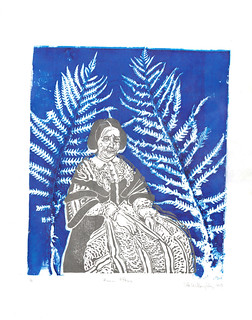
    Anna Atkins with ferns
    This is a portrait of English botanist and photographer Anna Atkins (1799-1871), née Children. It combines both a hand-carved lino block portrait in dark silver ink, and a screenprint of the silhouette of fern leaves in cobalt blue ink, mimicking the cyanotypes she was known for. It is printed by hand on lovely Japanese kozo (or mulberry) paper, 11" x 14" (28 cm x 35.6 cm). (c) Ele Willoughby, 2015

    Anna Atkins (1799-1871), née Children, was an English botanist and photographer. She is the first person to have illustrated a book using photographs, Photographs of British Algae: Cyanotype Impressions in October 1843. Note that: not the first woman, the first person. She lived at a time when it was possible to be a self-trained scientist, especially if you were middle or upper class and received an education and the financial freedom to devote your time to pursue your subject. (The Mary Annings of the world, who managed to make a name for themselves in science despite her class, religions and complete lack of financial ressources, are rare indeed). She was raised and instructed by her father, a naturalist, and her social circle included those who were developing (no pun intended) the latest, brand new photographic technology. So, she was at the right place at the right time. But that doesn't take away from the fact that she had the knowledge, skill, insight and ability to immediately see the utility of the method for descriptive science and to document a specific field of sub-field of botany, with her collection of the algae (seaweeds) of Britain. I think this should be understood as equivalent to a modern-day scientist keeping abreast of other fields of study and rapidly mastering a new high-tech tool to apply it to her field. Even William Henry Fox Talbot, who who invented the salted paper and calotype processes, precursors to modern photographic methods, was not able to publish The Pencil of Nature the first commercially printed photographic book, until eight months after she produced Photographs of British Algae: Cyanotype Impressions.

    Her mother died when she was still an infant, but she was close with her naturalist father and received a much more scientific education than was common for women in her time. Her 250 detailed engravings of shells were used to illustrate her father's translation of Lamarck's 'Genera of Shells'. This translation was important to the nomenclature of shells, because her illustration allowed readers to properly identify Lamarck's genera. She married John Pelly Atkins in 1825 and devoted herself to botany and collecting specimen, including for Kew Gardens. In 1839, she became a member of the Botanical Society of the British Isles, one of the few scientific organizations open to women. She became interested in algae, after William Henry Harvey published A Manual of the British marine Algae in 1841.

    Through her father, she was friends with both William Henry Fox Talbot and Sir John Herschel, who (amongst other things) invented the cyanotype photographic process in 1842. Within a single year of its invention, she self-published the first known book of illustrated with cyanotype photographs and was likely one of the two first women to make a photograph. She recorded her seaweed specimen for posterity by making photograms by placing the unmounted dried-algae original directly on the cyanotype paper. Atkins self-published her photograms in the first installment of Photographs of British Algae: Cyanotype Impressions in October 1843, and two further volumes in the next decade. She collaborated with Anne Dixon (1799–1864) to produce further books of cyanotypes on ferns and flowering plants and also published other non-scientific or photographic books. In 1865, she donated her collections to the British Museum.

    I've shown her based on an early photographic portrait, along with some fern leaves which I've worked with directly, much how she illustrated her own specimen.

    Have a look at her cyanotypes and a video of one of the surviving copies of her book.


    Monday, April 13, 2015

    Gregor Mendel and his Peas

    Gregor Mendel with his pea plants
    Gregor Mendel, 11" x 14" (28 cm x 35.6 cm), 2015 by Ele Willoughby
    This is a linocut portrait of Gregor Mendel (1822-1884), scientist and Augustinian friar who posthumously gained fame for establishing many of the rules of heredity, fundamental to modern genetics.... more than three decades after his death (though even he didn't realize the importance of his crossbreeding studies). By carefully crossbreeeding pea plants and tracing seven characterististics (plant height, pod shape and colour, seed shape and colour, and flower position and colour) he was able to deduce what are now referred to as the laws of Mendelian inheritance. Apparently, pea plants were the most popular of his projects with his colleagues. His mouse experiments were frown upon by his bishop (all those copulating rodents!) and his particularly aggressive Cyprian and Carniolan bees proved an annoyance to his fellow monks and visitors to the abby.

    He coined the terms "recessive" and "dominant" traits. Some of his findings are subtlely alluded to in the layout of the pea flowers, like a Punnett square depicting a cross between two pea plants heterozygous for purple and white blossoms - that is, purple flowers are a dominant characteristic and the first generation of crossbread plants will have all purple flowers, but the recessive white flowers can reappear in subsequent generations. The first edition is a variable run of 8 prints, each 11" by 14" (28 cm by 35.6 cm), on ivory Japanese kozo paper with "chine-collé" white and mauve paper.

    Apart from completing this print this weekend, I unfortunately got to spend most of the beautiful Sunday afternoon inside, in line.  A few weeks ago, I was thinking that I don't get out enough with the baby and still had not used gift certificates I got at Christmas. It's a challenge sometimes to work around his meals and naps and get anywhere on public transit (especially if that means carrying him and his stoller up and down three flights of stairs cause so many stations are still not accessible in 2015!). So, I made a point to go to a certain shop with the intent of replacing my 10 year old, twice-repaired shoes. I found the shop mostly empty of shoes but I did buy myself a dress on sale, and went across the street and bought myself an organic fruit smoothie at the Big Carrot, which I shared with the baby. At the time, I thought I'd done really well. As locals will know, a server has since been diagnosed with Hep A, and thus, like hundreds of other patrons, Gabriel and I got to wait in line to be vaccinated. It's unlikely we've been exposed; we would have had to have been served by the particular person and he or she would have had to had improperly washed hands... but it's not worth risking (and the young can show no symptoms while readily infecting others). Not how I would have liked to have spent the first lovely warm day of the year... though I was kind of impressed that everyone took the public health advice, turned up, and waited patiently. The elderly couple behind us offered to push the stroller and hold out place in line so I could at least let Gabriel run around a little. He's not too rambunctious and people were patient with him, which I appreciated. It helps that he smiles at everyone.