Showing posts with label mathematician. Show all posts

Wednesday, April 15, 2026

Polymath Claude Shannon and Theseus the Electromechanical Mouse in a Maze


Claude Shannon, linocut print, 11" x 14" by Ele Willoughby, 2026

I was recently commissioned to make a portrait of Claude Shannon. It seemed clear that it would need some binary to represent his work, and the math and computer science in particular. I opted to also include Theseus in his maze, which hits on the electrical engineering, and the humour in what he did.

This is my linocut portrait of Claude Elwood Shannon (1916-2001), mathematician, electrical engineer, computer scientist and cryptographer credited with laying the foundations for the Information Age. Each hand-printed linocut on 11" x 14" Japanese kozo (or mulberry paper) shows Shannon in front of binary numbers and with his electromechanical mouse Theseus with its maze. Though partially behind him, the binary numbers represent the standard ASCII code for "CLAUDESHANNON". 

At the University of Michigan, he took two degrees: one in electrical engineering and the second in mathematics, graduating in 1936. His MIT masters thesis is arguably one of the most impactful ever completed. In it, "A Symbolic Analysis of Relay and Switching Circuits", he showed that we can construct any logical numerical relationship through the electrical applications of Boolean algebra. This is now the underlying theoretical basis for   digital computing and digital circuits. He completed his doctorate at MIT in 1940 on mathematical genetics.

During WWII he worked in the field of cryptanalysis for US national defence, doing fundamental work on codebreaking and secure telecommunications, and writing a paper which is considered one of the foundational pieces of modern symmetric-key cryptography.

His 1948 paper "A Mathematical Theory of Communication" laid the foundations for the field of information theory. This paper was important to the invention of the compact disc, the internet, mobile phones and even our understanding of blackholes. He introduced the term "bit," invented the signal-flow graph and co-invented pulse-code modulation and the first wearable computer. 

In 1950, he designed and built a learning machine, with the help of his wife mathematician and research collaborator Betty Shannon. They built an adjustable maze with sensors (an electromechanical relay circuit) which followed the path of an electromechanical mouse whimsically named Theseus. Theseus could search corridors until it found a target (the penny in my portrait). Then, the mouse could be moved to anywhere in the maze. If the location was known, it would go immediately to the target. If the location was unknown, the mouse would search until it found a known position, adding this knowledge to its memory, and proceed from the known position. This way it could eventually find the most direct route. This is the first known artificial learning device.

In 1951 he joined the CIA's  Special Cryptologic Advisory Group. He was a professor at MIT from 1956 to 1978. His work was also foundational for artificial intelligence. He was a co-organizer of the 1956 Dartmouth workshop, considered to be the discipline's founding event. He published papers on the programming of chess computers. His Theseus machine was the first electrical device to learn by trial and error, being one of the first examples of artificial intelligence.

Tuesday, September 21, 2021

Optimizer of compilers, code and parallel computing trailblazer Fran Allen


Frances Allen, linocut 9.25" x 12.5", by Ele Willoughby, 2021
 

This is my linocut portrait of trailblazing American computer scientist Frances Elizabeth Allen (August 4, 1932 – August 4, 2020) who made foundational contributions to optimizing compilers (which translate code written in computer languages to the machine code in ones and zeroes actually used by computers), optimizing programs and parallel computing. This work has made computers and everything they do faster and more efficient. Compiler expert Graydon Hoare told the New York Times that her work is in “every app, every website, every video game or communication system, every government or bank computer, every onboard computer in a car or aircraft.” She was the first woman to become an IBM Fellow, where she worked from 1957 to 2002 and as an emeritus fellow afterwards. She was the first woman to win the prestigious A.M. Turing Award or contributions "of lasting and major technical importance to the computer field". I made this portrait for the #mathyear prompt: Turing Award.

She grew up the eldest of six kids on a farm near Lake Champlain; her mother was a teacher and her father a farmer. She went to elementary school in a one-room schoolhouse before attending a local high school and then the New York State College for Teachers where she graduated with a degree in mathematics in 1954. She worked as a teacher, back at her old high school, before returning to study at the University of Michigan for a MSc in mathematics in 1957.
 
IBM Research was recruiting and Allen needed to pay off student loans so she took the job. They wanted  their employees to learn and use FORTRAN (FORmula TRANslation, the first and newly introduced high-level programming language).  With her teaching experience and some basic computing courses under her belt, she was assigned to teach FORTRAN while simultaneously learning it herself. She said she had to teach these unhappy scientists (who were skeptical that a high-level language could work as well as assembly code) and became enamored with FORTRAN and its possibilities for productivity and performance. As Grace Hopper argued, "It's much easier for most people to write an English statement than it is to use symbols. So I decided data processors ought to be able to write their programs in English, and the computers would translate them into machine code." Her goal became to make those compilers, the translators, more efficient. Allen had intended to return to her first love, teaching high school math, but instead stayed with IBM for 45 years. 

In 1959 Allen managed the compiler-optimization teams for Harvest and Stretch, IBM's first transitorized 100 kW supercomputer. With its 2048 kB of memory the goal was to make it 100 times faster than contemporary machines! While it was not a hit with clients (as it apparently still took 18 hours to produce a 24-hour weather forecast), it impressed the National Security Agency. Allen was then assigned to the Harvest project for code breaking (of messages from the Soviet Union intercepted by American spies) and she spent a year leading an NSA team on classified projects. Harvest was such a success, thanks to Allen's optimization of the compiler, it was used for 14 years despite the pace of technological innovation. She also worked on the Alpha computer language which could run on Stretch and could create new alphabets beyond the system-defined alphabets. She  In '62 she moved from the IBM facility in Poughkeepsie to Yorkton Heights, where she worked on further supercomputer (ACS-1) and language projects (PL/I). She collaborated with John Cocke on a series of fundamental papers about compiler optimization to improve how higher level languages are translated to machine code. The diagrams in the portrait are from their crucial 1971 paper, 'A Catalogue of Optimizing Transformations'. Their work introduced the concept of using such graph-theoretical structures to encode a program content in order to efficiently and automatically understand how its parts function together and find ways to optimize code.

She did a sabbatical at NYU in 1971 and was thence an adjunct professor there, and a sabbatical at Stanford in 1977. From 1980 to 1995 she led IBM's parallel computing team, developing tools which became broadly used in commercial compilers in personal computers, and developing software for their Blue Gene project. She became the first woman IBM Fellow in 1989. In 1995 she was named president of the IBM Academy of Technology, an internal steering group for the company. In this role she focused on mentoring and women in tech. After her retirement in 2002 she remained as an Emeritus Fellow and continued to work on programs encouraging women and girls to work in computing.

She was a fellow of the IEEE, the AAAS, the American Philosophical Society, the Association for Computing Machinery and the Computer History Museum. She was elected to the National Academy of Sciences. In 1997 she won the IEEE Computer Society Charles Babbage Award and was inducted in the Women in Technology Hall of Fame. She won the IEEE Computer Society Computer Pioneer Award in 2004. She won the Association for Women in Computing Augusta Ada Lovelace Award in 2002 and the ABIE Award for Technical Leadership from the Anita Borg Institute in 2004. In 2006, she won the Associating of Computing Machinery A.M. Turing Award,  for contributions "of lasting and major technical importance to the computer field" in recognition of her work with supercomputers.  She was the first woman to win the prestigious award in its 40 year history.

When she wasn't working she enjoyed other challenges and adventures, as an avid runner, mountain climber and participant in expeditions to the to the Artic and on the Chinese/Tibet border. 


In 2022, the IEEE will present the IEEE Frances E. Allen Medal for the first time for innovative work in computing leading to lasting impact on other fields of engineering, technology, or science.

References

Frances Allen, wikipedia, accessed September, 2021

Allen, Frances E.; Cocke, John (1971). Rustin, Randall (ed.). A Catalogue of Optimizing Transformations. Design and Optimization of Compilers. Thomas J. Watson IBM Research Center. Prentice Hall. 

Kim Lyons, Computer scientist Frances Allen, known for her work on compiling, dies at 88, The Verge,

Tuesday, July 27, 2021

Mathematician Karen Uhlenbeck, Bubbles and Bubbling

Karen Keskulla Uhlenbeck, linocut detail, 9.25" x 12.5", variable edition on Japanese kozo paper with chine collé with suminagashi marbling, by Ele Willoughby, 2021


My latest #sciart (or, maybe #mathart) portrait is of mathematician Karen Uhlenbeck. Though a lot of her work is pertinent to physics, this was still a challenge to work out how to tell the story of her mathematics. A founder of modern geometric analysis, she won the 2019 Abel Prize for "her pioneering achievements in geometric partial differential equations, gauge theory, and integrable systems, and for the fundamental impact of her work on analysis, geometry and mathematical physics." Partial differential equations are pretty central to doing physics, and a sort of mathematics I really enjoy, but apart from that, I know what all the words mean in that previous sentence, but things like gauge theory and analysis aren't part of the math I've studied or used in my own research. As we move forward in time, depicting contemporary (or near contemporary) mathematics is increasingly challenging because it's beyond my ken.

I looked up several of her important papers, seeking geometrical diagrams as a way to tell the story of her research pictorially. Though she describes herself as a visual, geometric (and messy!) thinker, I didn't find anything but a lot of algebra (which I would have had to work hard to follow, let alone use to speak to a wide audience, or painstakingly carve in reverse!) But I found an "in" for depicting minimal surfaces and her methods for removing singularities, through Fields Medalist Sir Simon Donaldson's review of her work, including a schematic of "bubbling" and also some of the great science/math communication and articles about her and her work, which were published when she won the Abel Prize.

Born in Clevland to an engineer father Arnold Keskulla and teacher and artist mother Carolyn Windeler Keskulla, her family moved to New Jersey when she was a child. She spent her childhood enjoying nature, playing football and secretly reading science texts, imagining a job where she could avoid people. She started a degree in physics but switched to math at the University of Michigan. In the wake of the Soviet Union's launch of Sputnik the US Congress passed the National Defense Education Act, to encourage more participation in STEM including encouraging women and minorities in those fields. The university added an honours math course in response, which showed her there was more to math than she ever knew and it changed her life. “The structure, elegance and beauty of mathematics struck me immediately, and I lost my heart to it,” she wrote. She switched majors. She chose the Courant Institute of Mathematical Sciences at New York University, for graduate school, avoiding applying to more prestigious schools where she feared the competitive male math culture wouldn't suit her. She married biophysicist Olke C. Uhlenbeck, the son of European intellectuals; his father is well-known physicist George Uhlenbeck. She was quite influenced by her new in-laws. Her parents valued ideas but put an emphasis on earning an income, but her in-laws valued intellectual things and encouraged her pursuit of mathematics. Her husband moved to Harvard and she opted to switch to graduate school at Brandeis University, where she earned her PhD in 1968 with advisor Richard Palais. Palais was exploring the space between analysis (a generalization of calculus) and topology (the study of shapes) and Uhlenbeck enjoyed this in-between world. With Smale, Palais had made advances in the study of harmonic maps, which came out of the calculus of variations and the search for shapes in equilibrium with physical measurements. Uhlenbeck's research built on this.

She found temporary jobs at MIT and Berkeley but was hampered by the classic "two-body problem" for academic spouses (where an couple cannot find two professorships in the same place) and anti-nepotism rules - though she later noted that the institutions which claimed they were precluded from hiring both her and her husband, even in different departments, did not officially have any such anti-nepotism rules on the books. Schools like MIT, Stanford and Princeton which courted her husband, simply declined to hire a woman in math. Her husband generously declined to work at institutions where she could not.

Eventually they both got faculty positions at the University of Illinois at Urbana–Champaign in 1971. But she could not stand life in Urbana, where she was often dismissed as an "academic wife" rather than a professor in her own right. She lacked professional support, did not enjoy teaching, felt undervalued and struggled to find the right research topic for her. But, while there, she met post-doc Jonathan Sacks and they began working whether certain problems converge to harmonic maps; eventually they discovered a sort of "awkward point" or singularity called a bubble where systems cannot converge on a harmonic map. The mathematical concept of a minimal surface minimizes area (or surface tension or energy) the way a soap bubble does in the natural world. They showed there were a finite number of these singularities and that when you rescale a map near them you have "bubbling" as in the diagram in my print. This trick of rescaling was one of her and Sacks' most important contributions.

 She moved to the University of Illinois at Chicago in 1976, separating from her husband. In 1983, she moved to the University of Chicago, where there were other women math professors and peers who took her seriously. She received a Sloan Fellowship and finally knew she could support herself and her research. She learned the value of a professional support network and realized that isolating herself was hurting her and her career. Her work with Sacks was foundational to the development of the new mathematical field of geometrical analysis. This bubbling phenomenon was found in many different sorts of mathematical physics. She took her intuition and techniques honed working on minimal surfaces and began ground-breaking work in gauge theory and the nature of exotic n-spaces, a means of connecting observations at different places that comes up in the quantum mechanical world of fundamental forces, building on the work of mathematical physicists like Weyl, Yang and Mills. With C.H. Taubes, she analyzed Yang-Mills equations in four dimensions; she proved her removable singularities theorem, showing that bubbling cannot occur around isolated points, so if a finite-energy solution exists to the Yang-Mills equations near a point, the solution will extend smoothly to the point. Simon Donaldson's extension of this research won him the prestigious Fields Medal for mathematics in 1986. Uhlenberck won a MacArthur Prize Fellowship or "genius grant" (1983-1988) which made her feel, "obliged to become more ambitious.”

She married mathematician Robert F. Williams, then in 1988, moved to the University of Austin as the Sid W. Richardson Foundation Regents Chairholder and won the Noether Lecture award from the Association for Women in Mathematics. In 1990, she was only the second woman in math to give the plenary lecture at the International Congress of Mathematicians in Kyoto, after none other than mathematical giant Emmy Noether. She founded the Park City Mathematics institute and with Chuu-Lian Terng she co-founded the IAS Women and Mathematics (WAM) program to recruit and retain more women in math, encouraging collaboration and mentorship at all stages of their careers, a complete turn-around from the isolation she sought at the beginning of her career and her avoidance of her fellow women in math because “It was self-evident that you wouldn't get ahead in mathematics if you hung around with women.” Together, they've created a network of nearly 1500 women mathematicians. She realized that one needs role models - not examples of perfection, but people who make errors but pick themselves back up. When asked if she had a role model, she cited beloved chef and TV presenter Julia Child! "She had these fantastic television programs, and she was a real person. She could pick the turkey up off the floor and serve it," Uhlenbeck said. She founded the Distinguished Women in Mathematics Lecture Series at the University of Texas at Austin. Uhlenbeck won the National Medal of Science in 2001 and the 2007 Steele Prize for a Seminal Contribution to Mathematical Research from the American Mathematical Society. Granted yearly by the King of Norway, rather like a math equivalent to the Nobel, the Abel Prize includes a $700,000 award, and recognizes a mathematician’s entire career. Uhlenbeck became the first (and so far only) woman to win the Abel Prize in 2019.  She donated half the funds to organizations encouraging underrepresented (that is, traditionally excluded) minorities in mathematics. She further donated to environmental organizations and the National Academy of Science. She is now an emeritus professor at Austin, as well as a visiting associate at the Institute for Advanced Study and senior research scholar at Princeton University.

Like so many of my subjects, I've found she also loves art and began drawing more than a decade ago, mostly landscapes. She notes, “I discovered the fascinating fact that the problem of scale occurs both in mathematics and in drawing.” In drawing you want to capture the full forest as well as the details of individual plants, just as you want to capture all scales in math. “The hardest part with both is fitting the two scales together. You need the right tools.” Uhlenbeck has provided the world of mathematics and physics with so many of just the right tools.

References

Donaldson, S.. “Karen Uhlenbeck and the Calculus of Variations.” Notices of the American Mathematical Society 66 (2019): 1. DOI:10.1090/noti1806

Sioban Roberts, "In Bubbles, Karen Uhlenbeck Sees a Mathematical Universe," The New York Times, April 8, 2019

Karen Uhlenbeck, Wikipedia, accessed July 2021.

Rachel Crowell, "Karen Uhlenbeck Becomes First Woman To Win Abel Prize For Mathematics," Forbes, March 20, 2019

Dale DeBakcsy, How Mathematical Lone Wolf Karen Uhlenbeck Found Her Pack, Women You Should Know, November 29, 2017.

Karen Uhlenbeck, Karen Uhlenbeck on Being the First Woman to Receive the Abel Prize, remarks made at reception at the Institute for Advanced Study on March 19, 2019.

Karen Uhlenbeck, Coming to grips with success: a profile of Karen Uhlenbeck, Celebratio Mathematica, 1996

Jessica Atlee, Crossing Fields: Karen Uhlenbeck’s pioneering work marries math with physics, Symmetry Magazine, August 15, 2019.

Erica Karreich, Karen Uhlenbeck, Uniter of Geometry and Analysis, Wins Abel Prize, Quanta Magazine, March 19, 2019

Marianne Freiberger, The Abel Prize 2019, Plus magazine, University of Cambridge, March 19, 2019.

Tuesday, March 16, 2021

Mathematician Sophie Germain


Linocut 'Sophie Germain' by Ele Willoughby, 2021

French mathematician, physicist and philosopher Marie-Sophie Germain (1776 – 1831), known as Sophie, taught herself mathematics using books in her father's library and by corresponding with leading mathematicians of her day, including Lagrange, Legendre and Gauss, initially using the pseudonym Monsieur LeBlanc since she knew it was unlikely her contemporaries would take a woman in math seriously. She later wrote to Gauss, the leading mathematician of her day that she used the pseudonym "fearing the ridicule attached to a female scientist." Her work on elasticity theory won her the grand prize from the Paris Academy of Sciences. Her trailblazing work on Fermat's Last Theorem set out a strategy and framework for mathematicians pursuing the problem for hundreds of years. She was denied a formal mathematics education or professional standing due to her sex, but Gauss argued she deserved an honourary degree (though it was never granted).


She was born to a bourgeois family; her father is usually described as a wealthy silk merchant who was elected to the États-Généraux (later the Constitutional Assembly), as a representative of the bourgeoisie. By the time she was 13, the Bastille fell, and she remained indoors for safety during those tumultuous times, her father's library her only source of entertainment. She was fascinated reading about Archimedes' death at Roman soldiers' hands during the siege of Siracusa, unable to tear himself away from mathematics. It piqued her interest and she devoured the mathematics books she found, even teaching herself Latin and Greek in order to read Sir Isaac Newton and Leonard Euler's works. Her parents disapproved this sudden interest in a subject deemed inappropriate for a woman and they denied her warm clothes or a fire to study at night. She simply wrapped herself in quilts and studied by candlelight, when it was so cold her ink froze, eventually winning over her mother's support. Sophie was lucky in that she was not forced to marry and her family was wealthy enough to support her throughout her life, and though mostly excluded from formal education and the society of mathematicians, she was able to pursue her self-study.


The École Polytechnique opened - to men only - in 1794, but lecture notes were made available on request. Students were requested to send solutions to faculty and Sophie began submitting notes to Joseph Louis Lagrange under the name of a former student who had died young, Monsieur Antoine-Auguste Le Blanc. Lagrange recognized "Le Blanc's" ability and requested a meeting, so her rouse was up. Luckily, Lagrange was not opposed to a woman studying mathematics and agreed to mentor her. In 1798, Adrien-Marie Legendre published Essai sur la théorie des nombres and Sophie became interested in number theory and began corresponding with Legendre. Impressed, he included some of her work in the supplement to the second edition of his book, praising it as très ingénieuse ("very ingenious"). Then Gauss published his magnum opus Disquisitiones Arithmeticae. She worked through it for three years before writing him, again as M. Le Blanc, to discuss his book and tell him about her work on Fermat's Last Theorem, a famous grand problem of number theory. Unfortunately, she had made a weak assumption in one of her proofs, and Gauss did not reply to this first letter.


Mathematician Pierre de Fermat famously scrawled his eponymous last theorem in the margin of a book around 1637, without supplying any proof, noting simply that the proof was too long to fit. After 354 years of effort by countless mathematicians, Andrew Wiles was finally able to prove the theorem correct in 1995. The theorem states that no three positive integers x, y, and z satisfy the equation xp + yp = zp for any integer value of p greater than 2. Sophie was working on this problem and making real in-roads.


During the Napoleonic wars, France occupied the German town of Braunschweig, where Gauss lived, and Sophie feared he might suffer the same fate as Archimedes. She wrote family friend General Pernety pleading for him to ensure Gauss' safety. Soldiers were dispatched and found the confused Gauss perfectly safe. Gauss, of course, did not know that Sophie Germain was none other than M. Le Blanc. She decided to reveal her identity and he replied,


How can I describe my astonishment and admiration on seeing my esteemed correspondent M. Le Blanc metamorphosed into this celebrated person ... when a woman, because of her sex, our customs and prejudices, encounters infinitely more obstacles than men in familiarising herself with [number theory's] knotty problems, yet overcomes these fetters and penetrates that which is most hidden, she doubtless has the noblest courage, extraordinary talent, and superior genius.


They became friends and Gauss truly respected her ability, though he was not a reliable correspondent and generally did not review her work (and she would have really benefited from such feedback, lacking mentorship in number theory, and having gaps in her knowledge since she was self-taught). 


She became interested in other problems. German physicist and musician Ernst Chladni had published his experiments on vibrating plates (following the trailblazing work of Robert Hooke). He used a violin bow to vibrate a metal plate covered in sand, so that the sand would concentrate on nodal lines marking divisions between regions that moved in opposing directions. His drawings of the patterns produced are known as Chladni figures (like those shown in lavender in my print). Germain was able to attend his demonstration in Paris. The Paris Academy of Sciences launched a contest to develop the mathematics explaining the vibration of an elastic surface and comparing this to experimental data like Chladni's, with a reward of 3,000 francs. Lagrange pointed out that a new branch of analysis would be required and scared off all would-be contestants with the exception of Sophie and Denis Poisson. But Poisson was elected to the Academy, thus became a judge, leaving only Sophie. She began, mentored by Legendre, but her submission was deemed insufficient, though she provided some ingenious results, which allowed Lagrange to derive an equation, correct under certain conditions. Lagrange died within two years, and Sophie lost a mentor. The Academy decided to extend the contest and Sophie persisted. After initially helping, Legendre withdrew his support. Sophie submitted another attempt anonymously, but it had several errors (of the sort she would have been taught to avoid had she been allowed to study math at a university). She consulted Poisson, and he had access to all her notes as a judge. He then published his own work on elasticity without acknowledging any of her work or their conversations on the subject. At that point in 1816, she published under her own name, "Recherches sur la théorie des surfaces élastiques" partially so what Poisson had done would be clear, and to point out the errors in his work. They extended the contest again partially in response to the breach of confidentiality by Poisson and she persisted with her efforts. She won the gold medal and became the first woman to win a prize from the Paris Academy of Sciences but did not attend the prize ceremony. The Academy was not entirely satisfied; she had the correct differential equation, but having used an incorrect equation by Euler she had incorrect boundary conditions. Even as a prize winner, she was still denied entry to academy meetings as a woman for several years until she made friends with Joseph Fourier, a secretary of the Academy, who got tickets on her behalf. She published her prize-winning essay in 1821, at her own expense as the Academy had neglected to do so, complete with her notes on errors she had made. In 1826, she submitted a revised version of her work; the Academy considered it trivial but they did not want to reject her as they would a man and professional colleague. They both denied her access and were patronizing in their misguided attempt at kindness. She published this essay on the advise of mathematician Augustin-Louis Cauchy. Her nephew later made sure she had a final publication on elasticity, publishing "Mémoire sur la courbure des surfaces" posthumously on her behalf in 1831.


In 1815, the Academy offered an award for a solution to Fermat's Last Theorem, rekindling her first love of number theory. She wrote Gauss with her strategy for a general proof and the significant in-roads towards a proof she had made, but Gauss never replied. She produced what is now known as Sophie Germain's Theorem. To show that Fermat's Last Theorem holds, you can divide the powers p into numbers which are not divisors of x, y or z, or powers p which are a divisor of at least one of x, y or z. She proposed her theorem:


Let p be an odd prime. If there exists an auxiliary prime P = 2Np + 1 (N is any positive integer not divisible by 3) such that:

  1. if xp + yp + zp ≡ 0 (mod P), then P divides xyz, and
  2. p is not a p-th power residue (mod P).

and she used this result to show that Fermat's Last Theorem holds true for all odd primes p < 100. Her method was later used to show it holds true for all p < 1700. Her theorem is known from a footnote in Legendre's treatise on number theory, where he used it to prove Fermat's Last Theorem for p = 5. The text in my print is from one of her on unpublished manuscripts:

Remarque sur l'impossibilité de satisfaire en nombres entiers a l'équation xp + yp = zp. L'impossibilité de cette équation serait hors de doute si on pouvais démontrer la théorème suivant: Pour toute autre valeur de p que p = 2, il y a toujours un infinité de nombres premiers de la forme Np + 1 pour lequels on ne peut trouver deux residus 1ièmes puissances  dont la différence soit l'unité.


(My gloss: "Remarks on the impossibility of any whole numbers satisfying xp + yp = zp . The impossibility of this equation can be shown to be without doubt if we can demonstrate the following theorem: For all p > 2, there are an infinite series of primes of the form Np + 1 for which we cannot find two residues of the first power separated by 1"). She goes on to note that if there's any numbers which do satisfy Fermat's equation for p > 5 it must be numbers "whose size frightens the imagination", around 40 digits long.  


She also pursued philosophy and psychology on her own. Her nephew had two of her works published posthumously: Pensées diverses, a history of science and math with her commentary and Considérations générales sur l'état des sciences et des lettres, aux différentes époques de leur culture in which she argued there no difference between the sciences and the humanities and gained the praise of philosopher August Comte. 


She continued working despite pain after her diagnosis of breast cancer in 1829. She died in 1831, listed only as a property owner, not a mathematician on her death certificate. She is now recognized for her brilliance and originality, but her progress was often sadly hampered by the lack of instruction and the way her peers treated her as a novelty, and avoided proper constructive criticism. She wrote, “These facts are my domain and it is to me alone that they remain hidden. That’s the privilege of the ladies: they get compliments and no real benefits.” Several scholars argue that a contemporary man with similar skills and interest would have had his abilities embraced and talents nurtured. Sophie Germain was able to achieve what she did through both her tremendous talent and extraordinary persistence. Along with her theorem, subsequent discoveries in number theory have been named in her honour, as well as a street in Paris and the Sophie Germain Prize in mathematics offered by the same Academy which had snubbed her.


References

Sophie Germain, Wikipedia, accessed March 2021

Sophie Germain’s Theorem, Wikipedia, accessed March 2021

Ernst Chladni, Wikipedia, accessed March 2021

Ernst Chladni, Entdeckungen über die Theorie des Klanges, 1787, via Chladni Figures (1787) on Public Domain Review

Cristina P. Tanzi, Sophie Germain's Early Contribution to the Elasticity Theory, MRS Bulletin , Volume 24 , Issue 11 , November 1999 , pp. 70 - 71 DOI: https://doi.org/10.1557/S0883769400053549

Alexanderson, G.. “About the cover: Sophie Germain and a problem in number theory.” Bulletin of the American Mathematical Society 49 (2012): 327-331.

Richard Baguley, Sophie Germain: The Mathematics Of Elasticity, Hackaday.com, March 20, 2018

Evelyn Lamb, Thank You, Sophie, and I'm Sorry, Scientific American Blog, April 1, 2017.

Maria Popova, How the French Mathematician Sophie Germain Paved the Way for Women in Science and Endeavored to Save Gauss’s Life, Brainpickings, org, February, 2017.

Reinhard Laubenbacher and David Pengelley,  “Voici ce que j’ai trouvé:” Sophie Germain’s grand plan to prove Fermat’s Last Theorem, Historia Mathematica Volume 37, Issue 4, November 2010, Pages 641-692

Monday, July 6, 2020

Gladys West, mathematician and geodesist who found the Earth's shape for GPS

Gladys West, linocut, 11" x 14" by Ele Willoughby, 2020


Geodesy is the study of the shape of the Earth. The Earth isn’t a ball so much as an oblate spheroid- that means it’s a bit of a flattened oval in cross-section. Further there are bumps and divots, deviations from the reference ellipsoid. Measuring these deviations teaches us about our Earth and oceans, and the orbital dynamics of satellites. This mathematician and geodesist only started to get the recognition she deserves in recent years for the role she played in various satellite programs, including most famously the Global Positioning System (GPS).  

Gladys Mae West (née Brown) was born in 1930 in in Sutherland, Dinwiddie County, in rural Virginia. Her family were farmers in a community of share-croppers; her mother also worked at a tobacco company and her father also worked for the railroad. She decided early on that she needed an education if she didn't want to work in a factory or in the cotton, corn or tobacco fields. She secured a scholarship to Virginia State University, a HBPU (Historically Black Public University) as her high school class valedictorian. A great all-around student, she was unsure what subject to pursue but was encouraged to major in science and math since fewer people had the aptitude to tackle them. She choose the male-dominated field of mathematics, and joined the Alpha Kappa Alpha sorority. She graduated with a Bachelor of Science in Mathematics in 1952 and taught math and science for two years before returning to complete her Masters in Mathematics at VSU in 1955. She taught again briefly before starting her career at the Naval Proving Ground in Dahlgren, Virginia (now the Naval Surface Warfare Center) in the US in 1956. There were only 3 other Black people there, one woman and two men, and she says felt the pressure to always do everything right and set an example. She was hired as a computer programmer in the Naval Surface Warfare Center Dahlgren Division and a project manager for satellite data-processing systems. All the while, she earned a second Master's in public administration from the University of Oklahoma.

She fell in love with one of her two male, Black mathematician colleagues, Ira West. They married, had three children (and now seven grandchildren) and have been together for over 60 years.

In the 1960s, she participated in an award winning study which  proved the regularity of Pluto’s motion relative to Neptune. She then began using satellite altimeter data to model the Earth's shape, particularly the oceans. Her hard work paid off, when her department head recommended her for a commendation 1979 and she became the project manager for the Seasat radar altimetry project, the first remote sensing satellite for the oceans. From the mid 70s through the 80s West developed complex algorithms for an IBM 7030 “Stretch” computer in order to model distortions in the Earth's shape due to gravitational, tidal and other forces. Her calculations produced an extremely accurate geodetic Earth model, or geoid, optimized to determine the sallite orbits of what we now know as the Global Positioning System. She thus played a pivotal role in the development of technology which is so central to our lives, as GPS is embedded in industry, navigation, telecommunications and applications which exceed anything the US Navy could ever have imagined.

In 1986, West also published Data Processing System Specifications for the Geosat Satellite Radar Altimeter, a 51-page technical report for the Naval Surface Weapons Center (NSWC), a guide to increase the accuracy of the estimation of geoid heights and vertical deflection, based on Geosat radio altimetry data.

My portrait features three of the satellites central to her carreer: Seasat, a GPS satellite and GEOS-3, as well as the satellite paths for Geosat based on her own publications.

After 42 years, she retired 1998. She and Ira travelled, but she decided to return to academia and pursue a doctorate. She suffered a stroke which impacted her hearing, vision, balance and mobility, but despite this, she persisted and completed a PhD in Public Administration from Virginia Tech in 2018 at age 88!

Her acheivements only started to receive recognition when a sorority sister from Alpha Kappa Alpha read the brief bio she submitted for an alumni function and pointed out to her that she was a "Hidden Figure" of GPS. Her story started to be covered in the press. She was officially recognised by the Virginia Senate and she was inducted into the United States Air Force Hall of Fame in 2018, one of the highest honors bestowed by Air Force Space Command (AFSPC).

Edited January 19, 2026: Gladys West died January 17, 2026 at age 95, surrounded by her family.

References

Amelia Butterly, '100 Women: Gladys West - the 'hidden figure' of GPS,' BBC.com, May 20, 2018

Air Force Space Command Public Affairs, 'Mathematician inducted into Space and Missiles Pioneers Hall of Fame,' December 07, 2018
 
Cathy Dyson, 'Gladys West's work on GPS 'would impact the world,' January 19, 2018,
The Free Lance Star, Fredericksburg.com. 

Gladys West, wikipedia, accessed July 6, 2020 

West, Gladys B. (June 1986). "Data Processing System Specifications for the Geosat Satellite Radar Altimeter" (PDF). Naval Surface Weapons Center, Report NSWC TR 86-149.

Tuesday, November 12, 2019

Mary Somerville, the Queen of Science

Mary Somerville, linocut print 11" x 14" by Ele Willoughby, 2019
The great mathematician, writer and polymath, Mary Fairfax Somerville (1780-1872) was allowed "to grow up a wild creature," roaming in nature, wading in the sea, watching birds, collecting eggs, starfish, shells, seaweed and flowers or watching whales, with her older brother Sam when he was home from school but otherwise on her own. Second of four surviving children of Vice-Admiral Sir William George Fairfax and his second wife, Margaret Charters, the young Mary Fairfax grew up in the Scottish Borders. Though well-respected and highly ranked, her father's income was quite meagre and her pragmatic mother helped feed the family and supplement income growing vegetables, fruit and keeping cows for milk. Her easygoing if busy mother did teach her to read the Bible and Calvinist catechisms, but she was left largely to her own devices. Though her father was a Tory, she was liberal-minded and felt the French populace justified to revolt; she and her brother also refused sugar in their tea to protest the institution of slavery. She later wrote that she "resented the injustice of the world in denying all those privileges of education to my sex which were so lavishly bestowed on men." Her father returned from sea when she was 10 and declared that running wild wouldn't do and she was sent for a year of tuition at Musselburgh, an expensive boarding school where she learned writing, grammar and some French. When released she "felt like a wild animal escaped from a cage."

After her year of schooling she did spend a lot of time reading, or resentfully working on a sampler, stitching letters and numbers. Her aunt Janet disapproved of her reading and neglecting her poor sewing skills and she was sent to the village school for needlework lessons. The village school master began to visit in the evenings and teacher a bit more including how to use a globe. When she was 13 she was sent to writing school in Edinburgh during the winter months, where she finally learned arithmetic. She taught herself enough Latin to read books in their home. She confessed this to her favourite uncle Dr. Thomas Somerville, the adult in her life who didn't discourage her pursuit of ideas and learning.  He told her women had been scholars even in ancient times and read her Virgil to help her learn more Latin. She went to visit her uncle William Charters, in Edinburgh, where she was sent to dancing school to learn manners and to curtsey. She also met the Lyell family, befriending Charles, who would go on to revolutionize geology.

Mary stumbled upon mathematics unexpectedly. A young woman, whom she met when dragged to a tea party by her mother, invited her to come see her needlework and showed her a ladies' magazine with puzzles. Mary was fascinated by the mathematical puzzles and solutions the magazine published. Her new friend could only tell her these were called algebra. She sought books at home to help her decipher this but she only found a book on navigation. It did not help with algebra, but she was introduced to trigonometry and learned there was more to astronomy than stargazing. She asked her younger brother's tutor to buy her an algebra textbook and Euclid's Elements, and soon she was staying up late to read these after chores. But she ran through too many candles and her parents put a stop to this, fearing for her sanity; they like many contemporaries felt that higher learning was unnatural in a woman. She continued to study in secret.

Nicknamed "the Rose of Jedburgh" among Edinburgh socialites, her expected role was to marry and so she did. She married her distant cousin Samuel Grieg, a commissioner in the Russian navy and London-based Russian consul. They were not a good match. He held a low opinion of the abilities of women and no interest in science. Left largely alone, she began to study French and more mathematics. She was widowed within three years and left with her young toddler son Woronzow, a baby, and a small inheritance. She returned to live her parents, more independent now as a widow.

Laplace's Demon
Laplace's Demon, by Ele Willoughby 2011

She had studied plane and spherical trigonometry, conic sections and James Ferguson's Astronomy. Despite her children and household chores she ambitiously tried to read Newton's Principia.  She met intellectuals like Lord Henry Brougham, and the renown Professor of mathematics and natural history, John Playfair who encouraged her mathematical studies and introduced her to mathematician and astronomer William Wallace. She corresponded with Wallace about her mathematical problems. She made a name for herself when she was awarded a silver medal in 1811 by solving a mathematical problem posed in the mathematical journal of the Military College at Marlow. Wallace suggested she read mathematician Pierre-Simon Laplace on gravity and all physics in the decades since the Principia first appeared in 1687. Finding she understood Laplace's five-volume Mécanique Céleste (Celestial Mechanics) as well as the tutor she hired, her confidence increased, and she expanded her studies to astronomy, chemistry, geography, microscopy, electricity and magnetism, buying a "excellent little library" of math and science books at the age of 33.  She began to see that English mathematics, dominated by Newton, had stagnated and fallen behind their continental colleagues, by not adopting Leibnizian calculus.

Ada, Countess Lovelace, linocut by Ele Willoughby.
Ada is shown with Babbage's diagrams of his Difference Engine
and the equations for Bernouilli Numbers, which she showed
how to calculate mechanically in the world's first
computer program.
She was much luckier in her second marriage in 1812, to another cousin, Dr William Somerville (1771–1860). He was inspector of the Army Medical Board, and the son of her favourite aunt and uncle. Elected a member of the Royal Society, William Somerville socialized with leading intellectuals, scientists and writers of the day and was a devoted supporter of Mary's studies. She returned to reading Laplace and Newton after their honeymoon. The family (including William's illegitimate son who became close with Woronzow) moved to Hanover Square into a government house in Chelsea when William was appointed to the Chelsea Hospital in 1819. Her marriage was a very happy one, though they had a disastrous financial loss (the trusting William acted as guarantor for a relative's loan) and were devastated by the early death of three of Mary's six children; her second son from her first marriage died at nine, her first son with William died as a baby, and their first daughter Margaret died at ten. Woronzow, and their daughters Martha and Mary survived.

Caroline Herschel
Caroline Herschel, linocut by Ele Willoughby, 2014
Wallace introduced the Somervilles to astronomer F. William Herschel who discovered Uranus and worked with his sister Caroline, who discovered many comets and more. He showed them his huge reflecting telescope and his son, mathematician and polymath John Herschel became one of Mary's mentors, though ten years her junior. The Somervilles we popular and met "nothing but kindness" in scientific circles. They met many including philosopher William Wollaston, and physicists Thomas Young and Michael Faraday.  Mary become friends with mathematician Anne Isabella Milbanke, Baroness Wentworth, and mathematics tutor to her daughter, Ada Lovelace. She frequently visited polymath and inventor Charles Babbage, viewed his Calculating-machines and introduced him to Lovelace. She and Lovelace became close friends, discussing mathematics problems over tea. The couple travelled frequently to Europe, and like in London, met with the scientists and intellectuals of the day on their travels. On the continent they met polymath François Arago, physicist Jean-Baptiste Biot, mathematician Siméon Denis Poisson, and Laplace himself.  
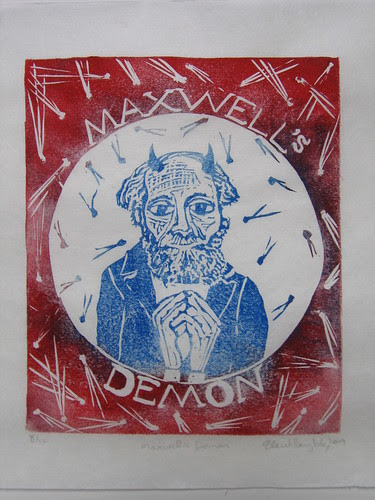
Maxwell's Demon
Maxwell's Demon, linocut
by Ele Willoughby

Mary began experimenting and published her first paper on "The magnetic properties of the violet rays of the solar spectrum", in the Proceedings of the Royal Society in 1826. Her results were praised and reproduced by others but ultimately shown to be incorrect, which crushed her confidence in performing her own experiments. The truth is that finding small errors in experimental design and correcting and improving them is part of the normal process of science. She was the first woman to publish scientific results under her own name. Had she not been a woman and an outsider, she might have realized she had no reason to feel embarrassed. In 1829, Sir David Brewster, inventor of the kaleidoscope, wrote that Mary Somerville was "certainly the most extraordinary woman in Europe - a mathematician of the very first rank with all the gentleness of a woman".

Antoine et Marie-Anne Paulze Lavoisier,
linocut with collaged washi,
2018 by Ele Willoughby
Meanwhile, her acquaintance Lord Brougham asked her to translate Laplace's Mécanique Céleste into English for the Society for the Diffusion of Useful Knowledge.  He even visited her in person to try and persuade her. She agreed on the condition she could work in secret and that it could be more technical than he had intended, for she felt the need to introduce the British public to Leibnizian calculus so they could understand Laplace. This became a labour of love, not just a translation, but an expanded version explaining all the mathematics of gravity and celestial mechanics that Laplace assumed the reader should intuit, and additional pertinent topics, under the title of The Mechanism of the Heavens. It took her three years. Brougham refused to publish it, deeming it too technical for his audience. William was determined her work would not go to waste and he brought the book to their friend geologist Charles Lyell's publisher John Murray. Murray eventually agreed to publish it (after John Herschel reviewed the manuscript and found it virtually flawless) in 1831, when Mary was 50. It sold well, made her famous and became the standard textbook for undergraduates at University of Cambridge until the 1880s. As Mary had been denied access to a university education as a woman this was very gratifying. In France, her book was so well received that Biot wrote to her to say colleagues were pestering him to hurry up his review of the book for the Journal des Savants. The next year when they travelled to Paris they were celebrated and made new scientific friends including physicist André-Marie Ampère and Marie-Anne Paulze Lavoisier Rumford (widow of and assistant to the famous chemist Antoine, and now also widow of the physicist Count Rumford). Mary Somerville was elected an honourary member of the Royal Astronomical Society along with Caroline Herschel. They were first two women admitted in any way, even if only honourary members of the society. She was also elected honorary member of the Royal Irish Academy, of the Bristol Philosophical Institution and the Société de Physique et d'Histoire Naturelle de Genève in 1834 and the British Crown granted her a pension of £200 a year for her contributions to science and literature. The pension was very timely, as the Somervilles' financial problems meant they quietly relied on the extra income she was able to earn (something not deemed appropriate for a middle class woman).

Her next book On the Connexion of the Physical Sciences (1834) was even grander in scope, connecting and summarizing the physical sciences of physics and astronomy with geography and meteorology. This book sold 15,000 copies establishing her reputation as amongst the elite of scientific authors. It was her publisher John Murray's most successful science book until Darwin published The Origin of Species in 1859. The book went through nine editions and she updated it for the rest of her life, even pointing out in the third edition that the challenges in calculating the position of Uranus hinted at the existence of  further possible undiscovered planets. She wrote that perhaps even the mass and orbit of this hypothetical planet could be deduced from observations of Uranus. Somerville's insight inspired British astronomer John Couch Adams who was able to mathematically predict the existence of Neptune in 1846. In his review of Connexion, polymath William Whewell introduced (for the first time in print) a new term he coined three years prior: 'scientist.' Many claim he praised her as the first scientist, but while he praised her text as "masterly" and praised her rare skill at mathematics, he did not apply the work scientist to any individual.

Though she had many male scientist friends and mentors, as a woman she was usually barred from  scientific societies. Her husband presented her papers to the Royal Society on her behalf, as did John Herschel. Their friend Arago presented her results on light and chemistry to the French Academy of Science. Faraday praised her explanations of his work, which was cutting edge research at the time of the publication of Connexion. Throughout her career, she had great instincts and open-mindedness about new ideas. She supported her friend Thomas Young's controversial wave theory of light, a real paradigm shift. Young explained his famous double-slit experiment by building on his French friend Augustin-Jean Fresnel's explanation of the diffraction of light in terms of waves and Christian Huygen's idea of the propagation of wavefronts of light, at a time when Biot and Laplace were still expounding on the particle nature of light. Likewise, she hinted at the revolution to come with the next generation of physicists who showed how seemingly disparate forces could be combined. Mary wrote, "Various circumstances render it more than probable that, like light and heat, [electricity] is a modification or vibration of that subtle ethereal medium, which, in a highly elastic state, pervades all space," which inspired the subsequent investigations by Hans Christian Ørsted (also written Oersted) and Michael Faraday. Mary noted that mariners observe lightening affects compasses. She described American John Henry's electromagnet, able to hold a ton of metal. And she traced the history of electrical and magnetic investigations since Coulomb. Later, the great physicist James Clerk Maxwell who combined the forces of electricity and magnetism in his laws for light, cited Somerville's book On the Connexion of the Physical Sciences for its hints of connections between light and magnetism, electricity and light, colour, electricity and magnetism and heat. He praised her insight and took the time to carefully explain why her experiment using violet light to magnetize a needle had failed. Mary may not have succeeded in establishing the connection between light and magnetism, but in searching for it she was on the vanguard of contemporary research.

In 1848 she published her most popular book,  Physical Geography, which was the first textbook on the subject in English. It went through six editions in her lifetime, was used until the early 20th century and won her the Victoria Gold Medal of the Royal Geographical Society in 1869. Physical Geography was influential, ignoring political divisions and viewing humanity as a part of nature, but a part able to affect its environment, emphasizing interconnectedness and interdependencies. While she was working on this book, she was initially discouraged by German naturalist Alexander von Humboldt’s publication of his first volume of Kosmos (1845), which covered similar subject matter but John Hershel encouraged her to continue and as she wrote, follow  "the noble example of Baron Humboldt, the patriarch of physical geography." She takes her readers through the place of the Earth in the solar system, its structure, features of land and water, formation of mountains, volcanoes, oceans, lakes and rivers, and what impacts temperature, electricity, magnetism and the auroras before turning to the distribution of life. Impressed, Humboldt himself wrote to her, "You alone could provide your literature with an original cosmological work." Her book also precipitated some backlash because her discussion of geology contradicted the biblical estimate of the age of the Earth, but she wrote, "facts are such stubborn things." Four years later, the Somerville family, Mary and William and their daughters Martha and Mary, moved to Italy for health reasons and because the cost of living was lower.

William Somerville died at 89 in 1860 and then her son Woronzow died suddenly, at age 60, in 1865, sending Mary into a deep grieving period. So when Maxwell published his theory of electromagnetism in 1865, Mary was preoccupied with grieving and took little notice of this monumental work she helped presage and inspire. Now in her 80s, she began work on her memoir. Mary had always put her fame and scientific credibility to work to support causes she believed in, including women’s suffrage, arguing that science was too often used for military purposes, the antivivisection movement and drawing attention to the way human activity was causing animal extinctions. A lifelong lover of birds, she had a pet mountain sparrow which would sleep on her arm as she wrote. She noted the decline in "feathered tribes" of Europe who would be "avenged by the insects." In 1866 when philosopher and economist John Stuart Mill organized a massive petition to Parliament to give women the right to vote, he asked Mary Somerville to be the first to sign. She was a member of the General Committee for Woman Suffrage in London, and petitioned London University unsuccessfully to grant degrees to women (noting that in France, Emma Chenu had been granted an MA in mathematics and a Russian lady, likely Sofia Kovalevski, had also taken a degree). She viewed her final book as a mistake. Published at age 88 in 1869, On Molecular and Microscopic Science, a popularization of science book, it was not as well received as her previous works, but was nonetheless sold well. She explained the latest thinking on atoms and molecules and revealed the lifeforms discovered with the microscope. But, she felt her time would have been better used if devoted more purely to mathematics, and began working to catch up on the latest mathematics research and returned to work on her 246-page manuscript on curves and surfaces. She enjoyed her old age and was glad to keep her faculties, work on mathematics and take an interest in current affairs until her own death, expressing only regret that she would not live to see results of scientific expeditions underway or the abolition of the slave trade. She died on November 28, 1872, while working on a mathematical paper on Hamilton's quaternions, approaching her 92nd birthday. Her obituary in The Morning Post read, "Whatever difficulty we might experience in the middle of the nineteenth century in choosing a king of science, there could be no question whatever as to the queen of science." Her daughter Martha edited her autobiography, Personal Recollections, from Early Life to Old Age (1873), and it was published posthumously.

In my portrait, I've shown Somerville with diagrams from her first two books, emphasizing the importance of her impact on astronomy and physics, and highlighting some of the cutting edge science she presented (like connections between electricity and magnetism, and Young's Double Slit Experiment).

References
Mary Somerville, Mechanism of the Heavens, London: John Murray 1831
Mary Somerville, On the Connexion of the Physical Sciences,  London: John Murray 1834 
Mary Somerville, PERSONAL RECOLLECTIONS FROM EARLY LIFE TO OLD AGE OF MARY SOMERVILLE WITH Selections from her Correspondence BY HER DAUGHTER, MARTHA SOMERVILLE.  London: John Murray, 1874

Robyn Arianrhod, Seduced by Logic: Émilie du Châtelet, Mary Somerville and the Newtonian Revolution, OUP, New York, 2012
James Secord, 'Mary Somerville's Vision of Science' Physics Today 71, 1, 46 (2018); doi: 10.1063/PT.3.3817
'Mary Somerville', Britanica, accessed November 2019 
Mary Sommerville, Wikipedia, accessed November 2019