Showing posts with label history of mathematics. Show all posts

Wednesday, February 18, 2026

Alicia Boole Stott Envisions the Fourth Dimension

Alicia Boole Stott, linocut print, 9.25" x 12.5" by Ele Willoughby, 2026


 The 9th prompt for #PrinterSolstice2526 is volume, so I thought I would portray a mathematician. Not satisfied with regular old three dimensional volumes, I made a portrait of Anglo-Irish mathematician Alicia Boole Stott (1860-1940), so let's talk about four and more dimensions.

Alicia Boole Stott (1860-1940), the third of five daughters, came to mathematics honestly. Her father George Boole, like her, was an autodidact mathematician, philosopher and logician, who served as the first professor of mathematics at Queen's College, Cork, in Ireland and developed Boolean logic, which would later prove so essential to computer programming. Likewise, her mother Mary Everest Boole was an autodidact mathematician and educator, who was further tutored by George and who edited his book on algebraic language, Laws of Thought. When she was only four years old, her father died, and facing poverty, Mary returned to England with Alicia's sisters, where she found a job as a librarian at Queen's College, London and worked as a mathematics tutor. Mary developed her own novel ideas about fostering imagination in teaching mathematics and science to children. She believed that physical manipulation of objects like sticks and stones, or stitching curves onto cards could help children form an understanding of mathematical concepts. She integrated fables, history, philosophy and literature and a fanciful writing style into teaching mathematics to appeal to children. Her ideas on education were not the only way Mary was unconventional; she organized discussion groups with Queen's College students with John Hinton a promulgator of polygamy, much to the disapproval of the authorities.  She was a believer in parapsychology and the occult and was the first woman to join the Society of Psychical Research. She wrote about topics which were controversial at the time, like the occult, eastern philosophy, evolution and animal rights, as well as the pedagogy of mathematics, so most of her books were published long after they were written. 

Unlike her sisters, Alicia stayed in Cork with her grandmother and great-uncle, until she was 11, when she rejoined her mother and sisters in London. Alicia had felt repressed and unhappy living in Cork, but the lodgings her mother could afford in London were "poor, dark, dirty and uncomfortable." The five girls had to share a room. Her mother sold George's Royal Society Gold Medal, to buy a harmonium so they could have music at home. Alicia went to the school attached to Queen's College London. Mary brought up her daughters doing things like projecting shapes of things such as hanging pendulums onto paper "to acquaint them with the flow of geometry." Alicia learned mathematics from her mother and the first two books of Euclid. She did not attend university. Mary had to leave her job as librarian and become a secretary for John Hinton. When she was 17, Alicia returned briefly to Cork, where she worked in a children's hospital but soon returned to London. She learned about higher-dimensional spaces from her future brother-in-law, mathematician Charles Howard Hinton (son of John Hinton). Charles had mystical beliefs about the fourth dimension and thought we humans inhabit a 4D space we will eventually perceive. He had crafted 4D models with hundreds of small coloured cubes of wood, each labelled with its own Latin name, which he shared with the Boole sisters. He used his cubes to try and get the sisters to visualize a 4D hypercube, for which he coined the word tesseract. His cubes became a popular, but notoriously difficult approach to grappling with 4D geometry; Alicia was the only one who mastered them, becoming more adept than Hinton himself. Among other books, Hinton went on to write The Fourth Dimension. 

There are analogues to 3D shapes in 4D. Imagine the five Platonic solids: the cube, the tetrahedron (a pyramid with a triangular base so it has 4 equilateral triangle sides), the octahedron (like two pyramids glued together at the square base so it has 8 equilateral triangles as faces), the dodecahedron (with 12 pentagonal faces) and the icosahedron (with 20 equilateral triangle faces). These are 3D shapes bound with regular polygons with the same number of edges at each vertex. If you relax the rule that the faces must all be the same, you get the collection of semiregular polyhedra. Each of the Platonic solids, along with  the  the familiar convex regular polygons (equilateral triangle, square, regular pentagon, regular hexagon and so on) has what is called a 4-polytope, which is an analogue in 4D where faces are replaced with 3D cells of identical Platonic solids. Similarly, there are semiregular polytopes you can define from the semiregular polyhedra. 

Alicia Boole's model next to a diagram in Pieter Schoute's diagram
of the same 3D cross-section of a 4D polytope

Alicia discovered that there are exactly 6 regular convex 4-polytopes. Swiss mathematician Ludwig Schläli had beat her to this discovery, in 1850 before she was born, but he had not published his work. He had submitted his manuscript for publication, but it was rejected as it was too lengthy. It was finally published 6 years after he died. He named these shapes polyscheme, but Alicia introduced her term polytope (based on the German term polytop) as she was unaware of Schläli's work (and her term was the one adopted). American mathematician Washington Irving Stringham rediscovered 6 regular convex 4-polytopes and published his results in 1880, but Alicia was unaware of his paper and working in isolation. In 1884, English theologian and schoolmaster Edwin Abbott Abbott published a satirical novella called Flatland: A Romance of Many Dimensions in which lines and 2D polyhedral characters living on a plane encounter a 3D sphere; as it moves through the plane the sphere appears as cross-sections, a sequence of growing and shrinking circles. Analogously, Alicia was able to visualize 4-polytopes as 3D cross-sections, allowing her to unfold a 4D problem into 3D problems. Simply using Euclidean constructions and synthetic methods (the only tools at her disposal, having never learned analytic geometry) she was able to produce 3D central cross-sections of all 6 regular polytypes in 4D, and make coloured drawings and cardboard models of each. Of these 6, 5 are 4D analogues of the Platonic solids (the hypercube or 8-cell, the hyperoctahedron or 16-cell, the hypertetrahedron or 5-cell, the 120-cell and the 600-cell) and 6th, called the 24-cell, has no 3D analogue.

 From left to right, from top to bottom: Mary Stott, G.I. Taylor, Margaret Taylor, P.H. Schoute, A. Boole Stott [Boole Stott, undated(b)]. (Courtesy of the University of Bristol.)

She contributed to Hinton's 1888 book A New Era of Thought, about higher-dimensional reasoning, writing about sections of 3D solids and part of the preface. (By the time the book came out, Hinton and his wife Mary Ellen Boole Hinton had gone to Japan, following his conviction for bigamy for marrying a second wife under an assumed name. This surprising fact is perhaps less so when we recall he was the son of the radical proponent of polygamy, John Hinton). In 1889, she began secretarial work near Liverpool, working for lawyer and amateur mathematician H. John Falk, who was editing Hinton's book. In 1890 she met actuary Walter Stott, who joined Alicia and Falk on editing a new edition of Hinton's book. The pair married  had two children: Mary in 1891 and Leonard in 1892. According to Coxeter, "for some years she led a life of drudgery, rearing her two children on a very small income." In 1895 Walter told her of Dutch mathematician Pieter Schoute's work on central sections of the regular polytopes and she saw that his drawings matched her 3D models, so she mailed him photographs of her work. Schoute replied, asking to meet and collaborate which they did until he died two decades later. They wrote letters back and forth and some summers Schoute would come to stay with the Stott family in England so they could work together. He eventually convinced her to publish, which she did in two papers published in Amsterdam in 1900 and 1910. In her second paper, she was there first person to enumerate all 45 semi-regular polytopes. They also co-authored papers in 1908 and 1910. In 1907, they presented her models at the annual British Association of the Advancement of Science in Leicester. In 1912 Schoute presented his work on semiregular polytopes to the 5th International Congress of Mathematicians in Cambridge, crediting her with the roots of his proof. She made complete sets of models of 120-cell and 600-cell polytopes and left them with Schoute. When he died in 1913, Alicia took a hiatus from mathematics. The University of Groningen granted her an honorary doctorate in 1914, and exhibited her models. She was invited to the ceremony but not able to attend. When the degree arrived in the mail in a cardboard cylinder, she exclaimed, "This will be a good place to keep sticks of macaroni!" 

In 1930, when Alicia was 70, her nephew, physicist Geoffrey Ingram Taylor introduced her to the now famed British-Canadian mathematician Harold Scott MacDonald Coxeter who was 23 and a graduate student at Cambridge at the time. Despite their age difference they two became good friends. Like Taylor, Coxeter called her Aunt Alice. Coxeter wrote, "The strength and simplicity of her character combined with the diversity of her interests made her an inspiring friend." The two met regularly and began working together on topics in 4D geometry. He invited her to one of his supervisor H.F. Baker's celebrated geometry tea parties, where they presented a joint paper and she brought a set of her models, which she then donated to the department of mathematics. They collaborated on the investigation of a special kind of 4D polytope (Gosset's 4D polytope s{3,4,3}) for which she made models of its sections. Alicia made two more important discoveries about constructions for polyhedra related to the golden section. With Coxeter, she presented a joint paper at the University of Cambridge. When Coxeter moved to Toronto in 1936 to take up a professorship at U of T, Alicia gave him an antique stained-glass Archimedean solid shade and wrote to him, "My dear! I don't know how to write to you - words seem so futile besides so great a separation! But indeed one can rejoice, for your sake, that it happened so... While I have been writing my mind has gone back to the lovely world we have visited together, and which you have made so much your own. I wonder where you will get to in it! How I wish I could follow." They managed to continue their collaboration, despite their separation, until her death in 1940. Coxeter when on to work at U of T for 60 years and become regarded as one of the greatest geometers of the 20th century. Much of what we know about Alicia's life is thanks to Coxeter's reminiscing about his dear Aunt Alice.

My portrait contains her 3D unfolding of part of a hypercube, her colour drawings of some of the 3-principle sections of the 600-cell, her expansion of the octahedron - a truncated octahedron, sections of of the 16-cell.

p.s. I have related Alicia's life to some of her family, including mathematician father George Boole, mathematician, educator and activist mother Mary Everest Boole, brother-in-law mathematician (and bigamist) Charles Hinton, nephew physicist Geoffrey Ingram Taylor (who went on to be knighted and win the gold medal of the Royal Society, like his grandfather). But, I recommend reading Moira Chas' article 'The Extraordinary Case of the Boole Family' to also learn about further surprising and fascinating family. Alicia's sister Mary Ellen, first wife of Charles Hinton, was a poet. Charles Hinton also invented a baseball-pitching machine and wrote mathematical romances. Her sister Margaret (mother of Geoffrey Ingram Taylor) was a painter. Her sister Lucy Everest Boole was a Lecturer in chemistry at the London School of Medicine for Women and the first woman elected a Fellow of the Institute of Chemistry. Her sister Ethel was an activist concerned about the plight of the Russian people under Tsarist rule and travelled to Russian where she visited prisons, smuggled propaganda, composed music and wrote wildly successful novels (one of which was made into a film with music by Shostakovich). She married Polish exile and rare book expert Wilfred Voynich, who bought the famed, mysterious, medieval manuscript in an as-of-yet-undeciphered text illustrated with dreamlike images of strange plants and creatures, known as the Voynich manuscript. Alicia's son Leonard was a medical doctor and pioneer in the treatment of tuberculosis who inked a portable x-ray machine, an artificial pneumothorax apparatus and a system of navigation based on spherical geometry. Alicia's nephew Sebastian Hinton invented the jungle gym (inspired by the bamboo structures his father built while in self-imposed exile in Japan to teach his children about 3- and 4-D shapes). Sebastian married Carmelita Chase who founded the progressive Putney School, a boarding school in Vermont (where Coxeter was invited and considered working). Alicia's grandniblings Howard Everest Hinton became a distinguished entomologist, William Hinton a Marxist writer and Joan Hinton a nuclear physicist involved in the Manhattan Project who was so appalled by the consequences of the atomic bombing of Hiroshima she became a pacifist, gave up physics, moved to China and became a Maoist. Alicia's great-grandniblings include award-winning documentarian Carma Hinton and 2018 Turing Award-winning A.I. researcher Geoffrey Everest Hinton. 


References

Alicia Boole Stott, Wikipedia, accessed February, 2026. 

Boole Stott, Alicia. On Certain Series of Sections of the Regular Four Dimensional Hypersolids. Verhnadelingen Natuurkunde, Eerste Sectie, deel 7, nummer 3 (1900), pp. 1-21. 

Chas, Moira. The Extraordinary Case of the Boole Family. Notices of the American Mathematical Society. DOI: https://dx.doi.org/10.1090/noti1996. December, 2019. 

O'Connor, J.J. and E.F. Robertson, Alicia Boole Stott, MacTutor Archive, University of St Andrews. July 2014.

Polo-Blanco, Irene. Alicia Boole Stott, a geometer in higher dimension. Historia Mathematica. Volume 35, Issue 2. pp. 123-139. May, 2008.

Polo-Blanco, Irene. Alicia Boole Stott's models of sections of polytypes. Lettera Mathematica. Volume 2, pp. 149-154. September 9, 204.

Riddle, Larry. Alicia Boole Stott. Biographies of Women Mathematicians. Agnes Scott College. February 19, 2025


Wednesday, January 28, 2026

Mathematician Olga Ladyzhenskaya, Turbulent History, Fluid Dynamics and Partial Differential Equations

Olga Ladyzhenskaya, linocut print, 11" x 14" by Ele Willoughby, 2026


For the 6th #PrinterSolstice prompt 'expression' I chose Olga Ladyzhenskaya, a mathematician who overcame personal tragedy, faced Soviet totalitarianism and the catastrophic political upheaval of the 20th century to make a huge impact on the math, making important contributions to study of partial differential equations and left a legacy of influence on a school of students and collaborators in this field. She changed the very way partial differential equations are examined and was one of the leading figures to popularize the notion of weak solutions (which satisfy the equations but may not be differentiable) for partial differential equations. Expressions included in my portrait are for the Navier-Stokes equation, quoted directly from her 1958 paper on the subject*. She was known for her courage, kindness and integrity as well as her indelible mark on mathematics.

Born in the wild woods in Kologriv, a small, remote town on northwest of Moscow, Olga Ladyzhenskaya (1922-2004) and her older sisters were taught mathematics by their math teacher father Aleksandr Ivanovich Ladýzhenski. He would formulate a theorem and ask his daughters to prove it, a technique which fostered Olga's mathematical intuition. Olga showed the most promise amongst her sisters and soon she and her father were working on calculus together. His family had descended from nobility, and it was not a good time to be either an intellectual, or descendent from nobility, in the USSR. His uncle, who also lived with the family in Kologriv, was a famous watercolour painter, Gennardy Ladýzhenski. Olga was close with her great-uncle, whom she called "Dedushka" or grandfather, and she carefully preserved his landscape paintings of the River Ounja. Her mother Anna Mikhailovna was originally from a small town in Estonia and was the homemaker. Their home was full of books and the girls were exposed to culture, though they grew up in what felt like the hinterland. Olga had a lifelong love of art and literature. Aleksandr stood up for his students after their parents were arrested by the NKVD (the predecessor of the KGB secret police). In his epic The Gulag Archipelago Solzhenitsyn recounted that a peasant warned Aleksandr Ladýzhenski that he was on a list of enemies of the state, but he refused to hide. Shortly thereafter in 1937 he was arrested and executed, likely in a NKVD torture chamber like many other great teachers, declared an "enemy of the people." It was a great shock to his family. Olga's mother and eldest sister managed to support the family through this terrible time. Her mother made dresses, soap and other craft work to earn an income and survive. Olga's older sisters were expelled from school as daughters of Aleksandr. Her father's status, and the resulting impacts on his family, was not rehabilitated until 1956, when Khrushchev delivered the "Secret Speech" at the 20th Party Congress of the Communist Party which denounced the Stalin's purges and exonerated the teachers who had been killed. This was a speech which also finally allowed a resumption of communication between mathematicians, across the Iron Curtain. Prior to the speech the two groups were working in isolation of each other. Olga had been tackling the some of the most difficult equations of mathematical physics without the benefit of knowing about progress made in the West.

Despite her excellent grades, when Olga graduated from high school two years later, she was not admitted to Leningrad State University, as the daughter of an "enemy of the people." She was allowed to attend Pokrovski Teachers' Training College in Leningrad. Then during the war years, she was forced to leave Leningrad and she taught at an orphanage at Godorets before returning home to teach at the high school in Kologriv, like her father, as well as in her home. She welcomed all students, regardless of their ability to pay. In thanks for her kindness, a student's mother interceded on her behalf and Olga got an opportunity to study mathematics at Moscow State University. She was awarded a Stalin stipend (despite her family history) and ration card so she could survive as a student, but she was often hungry. Sometimes she had to sleep on the auditorium benches, joking that she was learning through osmosis by using her books as a pillow. 

She wrote a thesis supervised by renown mathematician Ivan Georgievich Petrovskiǐ.  She started studying algebra and number theory and her interest in partial differential equations (PDEs) grew. This is the calculus of multivariable functions, a way to determine the rate of change of a function with respect to one of its variables. This is a branch of mathematics which is invaluable to physics, engineering and other fields which use applied mathematics. It is often impossible to find explicit formulas for solutions for partial differential equations so a lot of modern math and science research goes into finding approximate numerical solutions for PDEs. In pure mathematics, there is research into what we can know qualitatively about the nature of solutions of certain important, but impossible to explicitly solve, PDEs: things like whether solutions exist at all, if so, whether are they unique, whether they are differentiable or smooth, whether solutions are regular or stable. 

After she graduated in 1947, she got married to Alekseevich Kiselev, a specialist in number theory and the history of mathematics who lived in Leningrad. Thus she moved to Leningrad for graduate school, where she taught in the physics department. Though they had a loving marriage, it was brief. She and her husband separated because he wanted children whereas she wanted to devote her life to mathematics and felt that children would be an obstacle. She remained single thereafter. 

Her official supervisor for her thesis on linear and quasilinear hyperbolic systems of partial differential equations was Sergei Sobolev, but unofficially she was guided by Vladimir Smirnov and they became friends. Smirnov was in charge of several branches of mathematics, seismology, hydrodynamics and aerodynamics and she was strongly influenced to study mathematical physics. She defended her PhD in 1951. Two years later, 1953 was an important year for Ladyzhenskya; She published her first book, she also defended her "habilitation" dissertation (the highest university degree awarded in some European nations typically 5 to 15 years after a PhD) and Stalin died, thus things slowly began to change in Russia. She went on to publish six monographs (some as long as 700 pages) and more than 250 papers! 

Ladyzhenskaya and Smirnov started the weekly mathematical physics "Smirnov Seminar," in 1947 and she took over the seminar after his death in 1974. She is remembered for asking just the right questions in seminars, which were revealing for teaching. She organized sporadic very popular conferences of differential equations and their applications.  She was known for her work on partial differential equations and especially her work on whether the solutions to regular problems in the calculus of variations are analytic, which is the 19th of famed mathematician David Hilbert's list of 23 (at the time) unsolved problems. In 1954 she joined the Stekov Institute mathematical physics laboratory and would go on to become its head in 1961. 

By the mid-50s she was working on problems in fluid dynamics, a particularly mathematically-challenging field of physics, and the Navier-Stokes equations for the motion of viscous fluids, in particular. These equations would interest her for the rest of her career. These partial differential equations are vital to modelling everything from the weather, to turbulence, to ocean currents, to flow in a pipe, or in blood vessels or around an airplane wing. Despite having been developed in the 19th century and their importance to such a wide array of science and engineering, to this day, there is much we still do not know about these equations. Turbulence may be common in everyday life but the physics and underlying mathematics remain some of the least understood. Physicists are interested in how the smooth laminar flow say in a river, breaks down when it hits an obstacle causing eddies upon eddies in the flow until we are left with turbulence - and whether we can correctly model that turbulence thereafter. In my portrait I show precisely this: laminar flow lines hitting an obstacle, the ensuing eddies and devolution into turbulence. Mathematicians however still have not even been able to show whether smooth solutions even always exist in three dimensions. We do not even know if the equations will allow us to model fluids with any given initial conditions, indefinitely into the future. This is called the Navier-Stokes existence and smoothness problem, deemed one of the seven most important unsolved math problems. The Clay Mathematics Institute is offering a 1 million US dollar Millennium Prize award for a proof or counter-example to the problem. 

In the 1930s, Jean Leray had demonstrated the existence of weak solutions of the Navier-Stokes equations, but it had proved more difficult to show whether solutions were unique, until Olga was able to show both existence and uniqueness. She did this at a time when, as a Soviet mathematician, she was not able to read Leray's work. She was the first to prove the convergence of finite difference methods to solve the Navier-Stokes equations. That means she showed that we can reliably find a solution to the equations of how viscous fluids move by using the very useful trick of approximating derivatives with finite differences. She also analyzed the regularity of solutions under certain conditions for two-dimensional flows. Her resulting monograph of the Navier-Stokes equations ranks amongst the most influential mathematical books ever published. She believed that when flow becomes highly turbulent in 3D systems that the Navier-Stokes equations are insufficient so she present her own modification to the equations at the International Congress of Mathematicians in Moscow in 1966. 

She also analyzed the regularity of other types of partial differential equations, including parabolic equations (Vsevolod A. Solonnikov and her student Nina Ural'tseva) and quasilinear elliptical equations. These two types of equations are invaluable to the physics and engineering of time-dependent and steady-state phenomena, respectively. In the 1960s, these three published a veritable encyclopedia on the subject of the regularity of the solutions of PDEs that remains authoritative today. She published her influential text The Mathematical Theory of Viscous Incompressible Flow in 1961. She dedicated the book to the three people she most respected: her father, Vladimir Ivanovich Smirnov and Jean Leray.  At a time when exchanges between Western and Soviet scientists and mathematicians were virtually non-existent, she extended the results of Ennio De Giorgi, Jurgen Moser and John Nash ( the 1994 Nobel Laureate in Economics). 

Olga Ladyzhenskaya
Olga Ladyzhenskaya

She taught mathematics throughout her career and was recognized as one of the most significant and influential 20th century mathematicians. She nominated for the 1958 Fields Medal. She was president of the St Petersburg Mathematical Society. She was awarded the 1969 State Prize of the USSR and the Chebyshev Prize of the USSR Academy of Science. She was elected a corresponding member of the USSR Academy of Science in 1981, a foreign member of The German Academy of Scientists Leopoldina in 1985, a foreign member of the Academia die Lincei in 1989, a full member of the Russian Academy of Sciences in 1990 and a foreign member of the American Academy of Arts and Science in 2001. In 1989 Communist rule in the USSR ended, and Olga could travel more freely. She won the Great Gold Lomonosov Medal in 2002. Her name is inscribed in marble on a table at the Science Museum of Boston alongside the other most influential 20th century mathematicians. 

She counted amongst her friends dissent writer Aleksandr Solzhenitsyn, famous for raising awareness of repression and the Gulag prison system in Soviet Russia, and poet Anna Akhmatova, who wrote about the Stalinist terror, was twice nominated for the Nobel Prize for literature and dedicated a poem to her. She loved nature and travelling and was a skilled storyteller. She was once on the city council, and was engaged in her community, often risking her own safety and career to aid people opposed to the Soviet regime. She helped many mathematicians in Leningrad obtain apartments, free of charge, for themselves and their families. She cared deeply, was beloved and known to be full of energy and as a person of integrity, courage, faith, and unafraid to express her viewpoint despite a dangerous political climate. Nonetheless she remained a patriotic Russian and encouraged fellow Russian mathematicians to remain in Russia. She was plagued by eye problems and relied on special pencils to work in later years. She loved the sun and with her vision loss found the dark St Petersburg winters a challenge in later life. She was about to make a trip to Florida, and complete a paper on computational hydrodynamics when she died in her sleep in 2004 at the age of 81.

*The text reads "систему уравнений Навье — Стокса" which means 'a system of Navier-Stokes equations' and also "для функций" which means 'for functions' and "при граничных и начальных
условиях" which means 'under boundary and initial conditions'.


References

Dumbaugh, Della, Panagiota Daskalopoulos, Anatoly Vershik, Lev Kapitanski, Nicolai Reshetikhin, Darya Apushkinskaya, and Alecander Nazarov, The Ties That Bind - Olga Ladyzhenskaya and the 2022 ICM in St. Petersburgh. Notices of the American Mathematical Society. DOI: https://dx.doi.org/10.1090/noti2047. March, 20220.

Friedlander, Susan, Peter Lax, Cathleen Morawetz, Louis Nirenberg, Gregory Seregin, Nina Ural'tseva, and Mark Vishik. Olga Alexandrovna Ladyzhenskaya (1922-2004). Notices of the AMS, Volume 51, Number 11, pp. 1321-1331, December, 2004. 

Goudon, Thierry and Irina Sophia Antipolis. Olga Alexandrovna Ladyzhenskaya. Brèves de Maths - Mathématiques de la planète Terre. April 23, 2013.

O'Connor, J.J. and E.F. Robertson, Olga Alexandrovna Ladyzhenskaya. MacTutor. University of St. Andrews, August, 2005.

Olga Ladyzhenskaya. Wikipedia, accessed January, 2026.


Thursday, April 28, 2022

Virginia Ragsdale's Conjecture

Virginia Ragsdale linocut by Ele Willougby
Virginia Ragsdale, linocut, 11" x 14" on cream coloured washi, by Ele Willoughby, 2022


One of the unexpected delights of making a series of portraits of people in STEM is that people are interested in subjects because of their personal relationships. In hindsight, it should have been obvious; I am a scientist and have family and friends! But, it didn't occur to me that these "famous" (in some circle) great scientists would appeal as images of family members, or friends, and it's actually pretty touching when people contact me and tell me they are buying a print because the subject is someone they knew personally. This is a mathematician who was introduced to me by a repeat customer, because this is one of her ancestors. So not only to I get to learn of a new-to-me historic women in STEM, but I have a commission to make her portrait for someone's own personal connection to her.

This is a linocut portrait of mathematician Virginia Ragsdale (1870-1945) who is remembered for the Ragsdale conjecture (shown in the upper two inequalities). I'm always wary of including equations in talking about the history of math and science. What's important is that she proposed a way of approaching a difficult problem that was an inspiration for a lot of other mathematicians. The problem (which remains unsolved!) was included in David Hilbert's famous set of problems, namely, what are the possible arrangements of real algebraic curves embedded in the projective plane? She decided to set an upper bound for certain type of such curves. She proposed that they consider algebraic curve of degree 2k which are all topologically circles (or ovals) where some ovals are nested inside each other; others are not. An oval is defined as even if it is contained an an even number of other ovals of the curve, otherwise the oval is called odd. She conjectured that for an algebraic curve which contains p odd and n even ovals:


 equation.pdf


and

equation.pdf.


It was a very useful insight to consider even and odd ovals separately; the difference p-n is the Euler characteristic of a region bounded by the even and odd ovals. The Ragsdale conjecture, made in her 1906 dissertation, is amongst the earliest and most famous on the topology of real and algebraic curves, which stimulated a lot of 20th century research and was not disproved until 1979. A correct upper bound has yet to be found. I have also included an inequality she posed:


equation.pdf


later proved by Ivan Petrovsky. The diagrams of algebraic curves also appeared in her dissertation "On the Arrangement of the Real Branches of Plane Algebraic Curves," was published by the American Journal of Mathematics in 1906. In it she tackles the 16th of David Hilbert’s famous 23 unsolved problems in mathematics - one of only a few which remain unresolved today. 


Born in Jamestown, North Carolina just after the Civil War, she was class valedictorian at the Salem Academy, where she excelled at math and piano. She was went on to Guilford College where she helped set up a YMCA, and establish an Alumni Association as well and worked to expand college athletics. When she graduated with a B.S. in 1892, she won a scholarship to Bryn Mawr for the woman student with the highest grades, so she continued on, studying for her A.B. degree in physics. She won a fellowship to study in Europe for the class of 1896, which she delayed for a year, working as a physics demonstrator and beginning graduate studies in math. She then spent 1897-98 attending lectures by the renown mathematicians Felix Klein and David Hilbert at the University of Göttingen.


Upon returning the the US, she taught math for three years in Baltimore before another scholarship, awarded by the Baltimore Association for the Promotion of University Education of Women, allowed her to return to Bryn Mawr to complete her doctorate with Charlotte Scott. 


She moved to New York and taught at Dr. Sach’s School for Girls until 1905. She became the head of the Baldwin School in Bryn Mawr from 1906-1911 and worked as Charlotte Scott’s reader from 1908-1910. She accepted a mathematics position which brought her back to North Carolina in 1911 at the Women’s College in Greensboro (now UNC at Greensboro) where she stayed for almost two decades. She was department head from 1926-1928 and left a lasting impact, insisting on investing in a telescope and adding statistics to the curriculum. She held high standards but was known for her patience for students.


She retired to care for her ailing mother and run the family farm in 1928. When her mother died she built a lovely house at the edge of the Guilford College where she gardened, restored furniture and researched her family’s genealogy. Upon her death she left the home to the college and serves now as the home of the college president. 


References

Virginia Ragsdale, On the Arrangement of the Real Branches of Plane Algebraic Curves, American Journal of Mathematics, Volume 28, 1906

Virginia Ragsdale, Wikipedia, accessed April 2022

Ragsdale conjecture, Wikipedia, accessed April 2022

De Loera, Jesús; Wicklin, Frederick J. "Biographies of Women in Mathematics: Virginia Ragsdale". Anges Scott College. Retrieved April, 2022.

Tuesday, July 27, 2021

Mathematician Karen Uhlenbeck, Bubbles and Bubbling

Karen Keskulla Uhlenbeck, linocut detail, 9.25" x 12.5", variable edition on Japanese kozo paper with chine collé with suminagashi marbling, by Ele Willoughby, 2021


My latest #sciart (or, maybe #mathart) portrait is of mathematician Karen Uhlenbeck. Though a lot of her work is pertinent to physics, this was still a challenge to work out how to tell the story of her mathematics. A founder of modern geometric analysis, she won the 2019 Abel Prize for "her pioneering achievements in geometric partial differential equations, gauge theory, and integrable systems, and for the fundamental impact of her work on analysis, geometry and mathematical physics." Partial differential equations are pretty central to doing physics, and a sort of mathematics I really enjoy, but apart from that, I know what all the words mean in that previous sentence, but things like gauge theory and analysis aren't part of the math I've studied or used in my own research. As we move forward in time, depicting contemporary (or near contemporary) mathematics is increasingly challenging because it's beyond my ken.

I looked up several of her important papers, seeking geometrical diagrams as a way to tell the story of her research pictorially. Though she describes herself as a visual, geometric (and messy!) thinker, I didn't find anything but a lot of algebra (which I would have had to work hard to follow, let alone use to speak to a wide audience, or painstakingly carve in reverse!) But I found an "in" for depicting minimal surfaces and her methods for removing singularities, through Fields Medalist Sir Simon Donaldson's review of her work, including a schematic of "bubbling" and also some of the great science/math communication and articles about her and her work, which were published when she won the Abel Prize.

Born in Clevland to an engineer father Arnold Keskulla and teacher and artist mother Carolyn Windeler Keskulla, her family moved to New Jersey when she was a child. She spent her childhood enjoying nature, playing football and secretly reading science texts, imagining a job where she could avoid people. She started a degree in physics but switched to math at the University of Michigan. In the wake of the Soviet Union's launch of Sputnik the US Congress passed the National Defense Education Act, to encourage more participation in STEM including encouraging women and minorities in those fields. The university added an honours math course in response, which showed her there was more to math than she ever knew and it changed her life. “The structure, elegance and beauty of mathematics struck me immediately, and I lost my heart to it,” she wrote. She switched majors. She chose the Courant Institute of Mathematical Sciences at New York University, for graduate school, avoiding applying to more prestigious schools where she feared the competitive male math culture wouldn't suit her. She married biophysicist Olke C. Uhlenbeck, the son of European intellectuals; his father is well-known physicist George Uhlenbeck. She was quite influenced by her new in-laws. Her parents valued ideas but put an emphasis on earning an income, but her in-laws valued intellectual things and encouraged her pursuit of mathematics. Her husband moved to Harvard and she opted to switch to graduate school at Brandeis University, where she earned her PhD in 1968 with advisor Richard Palais. Palais was exploring the space between analysis (a generalization of calculus) and topology (the study of shapes) and Uhlenbeck enjoyed this in-between world. With Smale, Palais had made advances in the study of harmonic maps, which came out of the calculus of variations and the search for shapes in equilibrium with physical measurements. Uhlenbeck's research built on this.

She found temporary jobs at MIT and Berkeley but was hampered by the classic "two-body problem" for academic spouses (where an couple cannot find two professorships in the same place) and anti-nepotism rules - though she later noted that the institutions which claimed they were precluded from hiring both her and her husband, even in different departments, did not officially have any such anti-nepotism rules on the books. Schools like MIT, Stanford and Princeton which courted her husband, simply declined to hire a woman in math. Her husband generously declined to work at institutions where she could not.

Eventually they both got faculty positions at the University of Illinois at Urbana–Champaign in 1971. But she could not stand life in Urbana, where she was often dismissed as an "academic wife" rather than a professor in her own right. She lacked professional support, did not enjoy teaching, felt undervalued and struggled to find the right research topic for her. But, while there, she met post-doc Jonathan Sacks and they began working whether certain problems converge to harmonic maps; eventually they discovered a sort of "awkward point" or singularity called a bubble where systems cannot converge on a harmonic map. The mathematical concept of a minimal surface minimizes area (or surface tension or energy) the way a soap bubble does in the natural world. They showed there were a finite number of these singularities and that when you rescale a map near them you have "bubbling" as in the diagram in my print. This trick of rescaling was one of her and Sacks' most important contributions.

 She moved to the University of Illinois at Chicago in 1976, separating from her husband. In 1983, she moved to the University of Chicago, where there were other women math professors and peers who took her seriously. She received a Sloan Fellowship and finally knew she could support herself and her research. She learned the value of a professional support network and realized that isolating herself was hurting her and her career. Her work with Sacks was foundational to the development of the new mathematical field of geometrical analysis. This bubbling phenomenon was found in many different sorts of mathematical physics. She took her intuition and techniques honed working on minimal surfaces and began ground-breaking work in gauge theory and the nature of exotic n-spaces, a means of connecting observations at different places that comes up in the quantum mechanical world of fundamental forces, building on the work of mathematical physicists like Weyl, Yang and Mills. With C.H. Taubes, she analyzed Yang-Mills equations in four dimensions; she proved her removable singularities theorem, showing that bubbling cannot occur around isolated points, so if a finite-energy solution exists to the Yang-Mills equations near a point, the solution will extend smoothly to the point. Simon Donaldson's extension of this research won him the prestigious Fields Medal for mathematics in 1986. Uhlenberck won a MacArthur Prize Fellowship or "genius grant" (1983-1988) which made her feel, "obliged to become more ambitious.”

She married mathematician Robert F. Williams, then in 1988, moved to the University of Austin as the Sid W. Richardson Foundation Regents Chairholder and won the Noether Lecture award from the Association for Women in Mathematics. In 1990, she was only the second woman in math to give the plenary lecture at the International Congress of Mathematicians in Kyoto, after none other than mathematical giant Emmy Noether. She founded the Park City Mathematics institute and with Chuu-Lian Terng she co-founded the IAS Women and Mathematics (WAM) program to recruit and retain more women in math, encouraging collaboration and mentorship at all stages of their careers, a complete turn-around from the isolation she sought at the beginning of her career and her avoidance of her fellow women in math because “It was self-evident that you wouldn't get ahead in mathematics if you hung around with women.” Together, they've created a network of nearly 1500 women mathematicians. She realized that one needs role models - not examples of perfection, but people who make errors but pick themselves back up. When asked if she had a role model, she cited beloved chef and TV presenter Julia Child! "She had these fantastic television programs, and she was a real person. She could pick the turkey up off the floor and serve it," Uhlenbeck said. She founded the Distinguished Women in Mathematics Lecture Series at the University of Texas at Austin. Uhlenbeck won the National Medal of Science in 2001 and the 2007 Steele Prize for a Seminal Contribution to Mathematical Research from the American Mathematical Society. Granted yearly by the King of Norway, rather like a math equivalent to the Nobel, the Abel Prize includes a $700,000 award, and recognizes a mathematician’s entire career. Uhlenbeck became the first (and so far only) woman to win the Abel Prize in 2019.  She donated half the funds to organizations encouraging underrepresented (that is, traditionally excluded) minorities in mathematics. She further donated to environmental organizations and the National Academy of Science. She is now an emeritus professor at Austin, as well as a visiting associate at the Institute for Advanced Study and senior research scholar at Princeton University.

Like so many of my subjects, I've found she also loves art and began drawing more than a decade ago, mostly landscapes. She notes, “I discovered the fascinating fact that the problem of scale occurs both in mathematics and in drawing.” In drawing you want to capture the full forest as well as the details of individual plants, just as you want to capture all scales in math. “The hardest part with both is fitting the two scales together. You need the right tools.” Uhlenbeck has provided the world of mathematics and physics with so many of just the right tools.

References

Donaldson, S.. “Karen Uhlenbeck and the Calculus of Variations.” Notices of the American Mathematical Society 66 (2019): 1. DOI:10.1090/noti1806

Sioban Roberts, "In Bubbles, Karen Uhlenbeck Sees a Mathematical Universe," The New York Times, April 8, 2019

Karen Uhlenbeck, Wikipedia, accessed July 2021.

Rachel Crowell, "Karen Uhlenbeck Becomes First Woman To Win Abel Prize For Mathematics," Forbes, March 20, 2019

Dale DeBakcsy, How Mathematical Lone Wolf Karen Uhlenbeck Found Her Pack, Women You Should Know, November 29, 2017.

Karen Uhlenbeck, Karen Uhlenbeck on Being the First Woman to Receive the Abel Prize, remarks made at reception at the Institute for Advanced Study on March 19, 2019.

Karen Uhlenbeck, Coming to grips with success: a profile of Karen Uhlenbeck, Celebratio Mathematica, 1996

Jessica Atlee, Crossing Fields: Karen Uhlenbeck’s pioneering work marries math with physics, Symmetry Magazine, August 15, 2019.

Erica Karreich, Karen Uhlenbeck, Uniter of Geometry and Analysis, Wins Abel Prize, Quanta Magazine, March 19, 2019

Marianne Freiberger, The Abel Prize 2019, Plus magazine, University of Cambridge, March 19, 2019.

Tuesday, March 16, 2021

Mathematician Sophie Germain


Linocut 'Sophie Germain' by Ele Willoughby, 2021

French mathematician, physicist and philosopher Marie-Sophie Germain (1776 – 1831), known as Sophie, taught herself mathematics using books in her father's library and by corresponding with leading mathematicians of her day, including Lagrange, Legendre and Gauss, initially using the pseudonym Monsieur LeBlanc since she knew it was unlikely her contemporaries would take a woman in math seriously. She later wrote to Gauss, the leading mathematician of her day that she used the pseudonym "fearing the ridicule attached to a female scientist." Her work on elasticity theory won her the grand prize from the Paris Academy of Sciences. Her trailblazing work on Fermat's Last Theorem set out a strategy and framework for mathematicians pursuing the problem for hundreds of years. She was denied a formal mathematics education or professional standing due to her sex, but Gauss argued she deserved an honourary degree (though it was never granted).


She was born to a bourgeois family; her father is usually described as a wealthy silk merchant who was elected to the États-Généraux (later the Constitutional Assembly), as a representative of the bourgeoisie. By the time she was 13, the Bastille fell, and she remained indoors for safety during those tumultuous times, her father's library her only source of entertainment. She was fascinated reading about Archimedes' death at Roman soldiers' hands during the siege of Siracusa, unable to tear himself away from mathematics. It piqued her interest and she devoured the mathematics books she found, even teaching herself Latin and Greek in order to read Sir Isaac Newton and Leonard Euler's works. Her parents disapproved this sudden interest in a subject deemed inappropriate for a woman and they denied her warm clothes or a fire to study at night. She simply wrapped herself in quilts and studied by candlelight, when it was so cold her ink froze, eventually winning over her mother's support. Sophie was lucky in that she was not forced to marry and her family was wealthy enough to support her throughout her life, and though mostly excluded from formal education and the society of mathematicians, she was able to pursue her self-study.


The École Polytechnique opened - to men only - in 1794, but lecture notes were made available on request. Students were requested to send solutions to faculty and Sophie began submitting notes to Joseph Louis Lagrange under the name of a former student who had died young, Monsieur Antoine-Auguste Le Blanc. Lagrange recognized "Le Blanc's" ability and requested a meeting, so her rouse was up. Luckily, Lagrange was not opposed to a woman studying mathematics and agreed to mentor her. In 1798, Adrien-Marie Legendre published Essai sur la théorie des nombres and Sophie became interested in number theory and began corresponding with Legendre. Impressed, he included some of her work in the supplement to the second edition of his book, praising it as très ingénieuse ("very ingenious"). Then Gauss published his magnum opus Disquisitiones Arithmeticae. She worked through it for three years before writing him, again as M. Le Blanc, to discuss his book and tell him about her work on Fermat's Last Theorem, a famous grand problem of number theory. Unfortunately, she had made a weak assumption in one of her proofs, and Gauss did not reply to this first letter.


Mathematician Pierre de Fermat famously scrawled his eponymous last theorem in the margin of a book around 1637, without supplying any proof, noting simply that the proof was too long to fit. After 354 years of effort by countless mathematicians, Andrew Wiles was finally able to prove the theorem correct in 1995. The theorem states that no three positive integers x, y, and z satisfy the equation xp + yp = zp for any integer value of p greater than 2. Sophie was working on this problem and making real in-roads.


During the Napoleonic wars, France occupied the German town of Braunschweig, where Gauss lived, and Sophie feared he might suffer the same fate as Archimedes. She wrote family friend General Pernety pleading for him to ensure Gauss' safety. Soldiers were dispatched and found the confused Gauss perfectly safe. Gauss, of course, did not know that Sophie Germain was none other than M. Le Blanc. She decided to reveal her identity and he replied,


How can I describe my astonishment and admiration on seeing my esteemed correspondent M. Le Blanc metamorphosed into this celebrated person ... when a woman, because of her sex, our customs and prejudices, encounters infinitely more obstacles than men in familiarising herself with [number theory's] knotty problems, yet overcomes these fetters and penetrates that which is most hidden, she doubtless has the noblest courage, extraordinary talent, and superior genius.


They became friends and Gauss truly respected her ability, though he was not a reliable correspondent and generally did not review her work (and she would have really benefited from such feedback, lacking mentorship in number theory, and having gaps in her knowledge since she was self-taught). 


She became interested in other problems. German physicist and musician Ernst Chladni had published his experiments on vibrating plates (following the trailblazing work of Robert Hooke). He used a violin bow to vibrate a metal plate covered in sand, so that the sand would concentrate on nodal lines marking divisions between regions that moved in opposing directions. His drawings of the patterns produced are known as Chladni figures (like those shown in lavender in my print). Germain was able to attend his demonstration in Paris. The Paris Academy of Sciences launched a contest to develop the mathematics explaining the vibration of an elastic surface and comparing this to experimental data like Chladni's, with a reward of 3,000 francs. Lagrange pointed out that a new branch of analysis would be required and scared off all would-be contestants with the exception of Sophie and Denis Poisson. But Poisson was elected to the Academy, thus became a judge, leaving only Sophie. She began, mentored by Legendre, but her submission was deemed insufficient, though she provided some ingenious results, which allowed Lagrange to derive an equation, correct under certain conditions. Lagrange died within two years, and Sophie lost a mentor. The Academy decided to extend the contest and Sophie persisted. After initially helping, Legendre withdrew his support. Sophie submitted another attempt anonymously, but it had several errors (of the sort she would have been taught to avoid had she been allowed to study math at a university). She consulted Poisson, and he had access to all her notes as a judge. He then published his own work on elasticity without acknowledging any of her work or their conversations on the subject. At that point in 1816, she published under her own name, "Recherches sur la théorie des surfaces élastiques" partially so what Poisson had done would be clear, and to point out the errors in his work. They extended the contest again partially in response to the breach of confidentiality by Poisson and she persisted with her efforts. She won the gold medal and became the first woman to win a prize from the Paris Academy of Sciences but did not attend the prize ceremony. The Academy was not entirely satisfied; she had the correct differential equation, but having used an incorrect equation by Euler she had incorrect boundary conditions. Even as a prize winner, she was still denied entry to academy meetings as a woman for several years until she made friends with Joseph Fourier, a secretary of the Academy, who got tickets on her behalf. She published her prize-winning essay in 1821, at her own expense as the Academy had neglected to do so, complete with her notes on errors she had made. In 1826, she submitted a revised version of her work; the Academy considered it trivial but they did not want to reject her as they would a man and professional colleague. They both denied her access and were patronizing in their misguided attempt at kindness. She published this essay on the advise of mathematician Augustin-Louis Cauchy. Her nephew later made sure she had a final publication on elasticity, publishing "Mémoire sur la courbure des surfaces" posthumously on her behalf in 1831.


In 1815, the Academy offered an award for a solution to Fermat's Last Theorem, rekindling her first love of number theory. She wrote Gauss with her strategy for a general proof and the significant in-roads towards a proof she had made, but Gauss never replied. She produced what is now known as Sophie Germain's Theorem. To show that Fermat's Last Theorem holds, you can divide the powers p into numbers which are not divisors of x, y or z, or powers p which are a divisor of at least one of x, y or z. She proposed her theorem:


Let p be an odd prime. If there exists an auxiliary prime P = 2Np + 1 (N is any positive integer not divisible by 3) such that:

  1. if xp + yp + zp ≡ 0 (mod P), then P divides xyz, and
  2. p is not a p-th power residue (mod P).

and she used this result to show that Fermat's Last Theorem holds true for all odd primes p < 100. Her method was later used to show it holds true for all p < 1700. Her theorem is known from a footnote in Legendre's treatise on number theory, where he used it to prove Fermat's Last Theorem for p = 5. The text in my print is from one of her on unpublished manuscripts:

Remarque sur l'impossibilité de satisfaire en nombres entiers a l'équation xp + yp = zp. L'impossibilité de cette équation serait hors de doute si on pouvais démontrer la théorème suivant: Pour toute autre valeur de p que p = 2, il y a toujours un infinité de nombres premiers de la forme Np + 1 pour lequels on ne peut trouver deux residus 1ièmes puissances  dont la différence soit l'unité.


(My gloss: "Remarks on the impossibility of any whole numbers satisfying xp + yp = zp . The impossibility of this equation can be shown to be without doubt if we can demonstrate the following theorem: For all p > 2, there are an infinite series of primes of the form Np + 1 for which we cannot find two residues of the first power separated by 1"). She goes on to note that if there's any numbers which do satisfy Fermat's equation for p > 5 it must be numbers "whose size frightens the imagination", around 40 digits long.  


She also pursued philosophy and psychology on her own. Her nephew had two of her works published posthumously: Pensées diverses, a history of science and math with her commentary and Considérations générales sur l'état des sciences et des lettres, aux différentes époques de leur culture in which she argued there no difference between the sciences and the humanities and gained the praise of philosopher August Comte. 


She continued working despite pain after her diagnosis of breast cancer in 1829. She died in 1831, listed only as a property owner, not a mathematician on her death certificate. She is now recognized for her brilliance and originality, but her progress was often sadly hampered by the lack of instruction and the way her peers treated her as a novelty, and avoided proper constructive criticism. She wrote, “These facts are my domain and it is to me alone that they remain hidden. That’s the privilege of the ladies: they get compliments and no real benefits.” Several scholars argue that a contemporary man with similar skills and interest would have had his abilities embraced and talents nurtured. Sophie Germain was able to achieve what she did through both her tremendous talent and extraordinary persistence. Along with her theorem, subsequent discoveries in number theory have been named in her honour, as well as a street in Paris and the Sophie Germain Prize in mathematics offered by the same Academy which had snubbed her.


References

Sophie Germain, Wikipedia, accessed March 2021

Sophie Germain’s Theorem, Wikipedia, accessed March 2021

Ernst Chladni, Wikipedia, accessed March 2021

Ernst Chladni, Entdeckungen über die Theorie des Klanges, 1787, via Chladni Figures (1787) on Public Domain Review

Cristina P. Tanzi, Sophie Germain's Early Contribution to the Elasticity Theory, MRS Bulletin , Volume 24 , Issue 11 , November 1999 , pp. 70 - 71 DOI: https://doi.org/10.1557/S0883769400053549

Alexanderson, G.. “About the cover: Sophie Germain and a problem in number theory.” Bulletin of the American Mathematical Society 49 (2012): 327-331.

Richard Baguley, Sophie Germain: The Mathematics Of Elasticity, Hackaday.com, March 20, 2018

Evelyn Lamb, Thank You, Sophie, and I'm Sorry, Scientific American Blog, April 1, 2017.

Maria Popova, How the French Mathematician Sophie Germain Paved the Way for Women in Science and Endeavored to Save Gauss’s Life, Brainpickings, org, February, 2017.

Reinhard Laubenbacher and David Pengelley,  “Voici ce que j’ai trouvé:” Sophie Germain’s grand plan to prove Fermat’s Last Theorem, Historia Mathematica Volume 37, Issue 4, November 2010, Pages 641-692

Tuesday, November 12, 2019

Mary Somerville, the Queen of Science

Mary Somerville, linocut print 11" x 14" by Ele Willoughby, 2019
The great mathematician, writer and polymath, Mary Fairfax Somerville (1780-1872) was allowed "to grow up a wild creature," roaming in nature, wading in the sea, watching birds, collecting eggs, starfish, shells, seaweed and flowers or watching whales, with her older brother Sam when he was home from school but otherwise on her own. Second of four surviving children of Vice-Admiral Sir William George Fairfax and his second wife, Margaret Charters, the young Mary Fairfax grew up in the Scottish Borders. Though well-respected and highly ranked, her father's income was quite meagre and her pragmatic mother helped feed the family and supplement income growing vegetables, fruit and keeping cows for milk. Her easygoing if busy mother did teach her to read the Bible and Calvinist catechisms, but she was left largely to her own devices. Though her father was a Tory, she was liberal-minded and felt the French populace justified to revolt; she and her brother also refused sugar in their tea to protest the institution of slavery. She later wrote that she "resented the injustice of the world in denying all those privileges of education to my sex which were so lavishly bestowed on men." Her father returned from sea when she was 10 and declared that running wild wouldn't do and she was sent for a year of tuition at Musselburgh, an expensive boarding school where she learned writing, grammar and some French. When released she "felt like a wild animal escaped from a cage."

After her year of schooling she did spend a lot of time reading, or resentfully working on a sampler, stitching letters and numbers. Her aunt Janet disapproved of her reading and neglecting her poor sewing skills and she was sent to the village school for needlework lessons. The village school master began to visit in the evenings and teacher a bit more including how to use a globe. When she was 13 she was sent to writing school in Edinburgh during the winter months, where she finally learned arithmetic. She taught herself enough Latin to read books in their home. She confessed this to her favourite uncle Dr. Thomas Somerville, the adult in her life who didn't discourage her pursuit of ideas and learning.  He told her women had been scholars even in ancient times and read her Virgil to help her learn more Latin. She went to visit her uncle William Charters, in Edinburgh, where she was sent to dancing school to learn manners and to curtsey. She also met the Lyell family, befriending Charles, who would go on to revolutionize geology.

Mary stumbled upon mathematics unexpectedly. A young woman, whom she met when dragged to a tea party by her mother, invited her to come see her needlework and showed her a ladies' magazine with puzzles. Mary was fascinated by the mathematical puzzles and solutions the magazine published. Her new friend could only tell her these were called algebra. She sought books at home to help her decipher this but she only found a book on navigation. It did not help with algebra, but she was introduced to trigonometry and learned there was more to astronomy than stargazing. She asked her younger brother's tutor to buy her an algebra textbook and Euclid's Elements, and soon she was staying up late to read these after chores. But she ran through too many candles and her parents put a stop to this, fearing for her sanity; they like many contemporaries felt that higher learning was unnatural in a woman. She continued to study in secret.

Nicknamed "the Rose of Jedburgh" among Edinburgh socialites, her expected role was to marry and so she did. She married her distant cousin Samuel Grieg, a commissioner in the Russian navy and London-based Russian consul. They were not a good match. He held a low opinion of the abilities of women and no interest in science. Left largely alone, she began to study French and more mathematics. She was widowed within three years and left with her young toddler son Woronzow, a baby, and a small inheritance. She returned to live her parents, more independent now as a widow.

Laplace's Demon
Laplace's Demon, by Ele Willoughby 2011

She had studied plane and spherical trigonometry, conic sections and James Ferguson's Astronomy. Despite her children and household chores she ambitiously tried to read Newton's Principia.  She met intellectuals like Lord Henry Brougham, and the renown Professor of mathematics and natural history, John Playfair who encouraged her mathematical studies and introduced her to mathematician and astronomer William Wallace. She corresponded with Wallace about her mathematical problems. She made a name for herself when she was awarded a silver medal in 1811 by solving a mathematical problem posed in the mathematical journal of the Military College at Marlow. Wallace suggested she read mathematician Pierre-Simon Laplace on gravity and all physics in the decades since the Principia first appeared in 1687. Finding she understood Laplace's five-volume Mécanique Céleste (Celestial Mechanics) as well as the tutor she hired, her confidence increased, and she expanded her studies to astronomy, chemistry, geography, microscopy, electricity and magnetism, buying a "excellent little library" of math and science books at the age of 33.  She began to see that English mathematics, dominated by Newton, had stagnated and fallen behind their continental colleagues, by not adopting Leibnizian calculus.

Ada, Countess Lovelace, linocut by Ele Willoughby.
Ada is shown with Babbage's diagrams of his Difference Engine
and the equations for Bernouilli Numbers, which she showed
how to calculate mechanically in the world's first
computer program.
She was much luckier in her second marriage in 1812, to another cousin, Dr William Somerville (1771–1860). He was inspector of the Army Medical Board, and the son of her favourite aunt and uncle. Elected a member of the Royal Society, William Somerville socialized with leading intellectuals, scientists and writers of the day and was a devoted supporter of Mary's studies. She returned to reading Laplace and Newton after their honeymoon. The family (including William's illegitimate son who became close with Woronzow) moved to Hanover Square into a government house in Chelsea when William was appointed to the Chelsea Hospital in 1819. Her marriage was a very happy one, though they had a disastrous financial loss (the trusting William acted as guarantor for a relative's loan) and were devastated by the early death of three of Mary's six children; her second son from her first marriage died at nine, her first son with William died as a baby, and their first daughter Margaret died at ten. Woronzow, and their daughters Martha and Mary survived.

Caroline Herschel
Caroline Herschel, linocut by Ele Willoughby, 2014
Wallace introduced the Somervilles to astronomer F. William Herschel who discovered Uranus and worked with his sister Caroline, who discovered many comets and more. He showed them his huge reflecting telescope and his son, mathematician and polymath John Herschel became one of Mary's mentors, though ten years her junior. The Somervilles we popular and met "nothing but kindness" in scientific circles. They met many including philosopher William Wollaston, and physicists Thomas Young and Michael Faraday.  Mary become friends with mathematician Anne Isabella Milbanke, Baroness Wentworth, and mathematics tutor to her daughter, Ada Lovelace. She frequently visited polymath and inventor Charles Babbage, viewed his Calculating-machines and introduced him to Lovelace. She and Lovelace became close friends, discussing mathematics problems over tea. The couple travelled frequently to Europe, and like in London, met with the scientists and intellectuals of the day on their travels. On the continent they met polymath François Arago, physicist Jean-Baptiste Biot, mathematician Siméon Denis Poisson, and Laplace himself.  

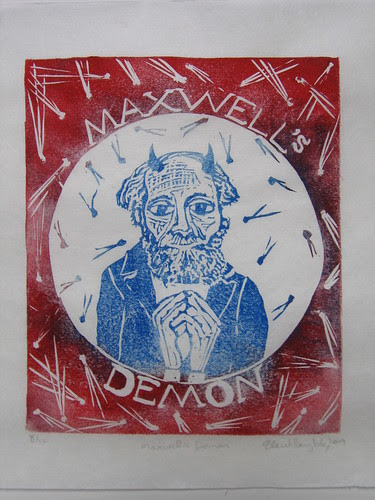
Maxwell's Demon
Maxwell's Demon, linocut
by Ele Willoughby

Mary began experimenting and published her first paper on "The magnetic properties of the violet rays of the solar spectrum", in the Proceedings of the Royal Society in 1826. Her results were praised and reproduced by others but ultimately shown to be incorrect, which crushed her confidence in performing her own experiments. The truth is that finding small errors in experimental design and correcting and improving them is part of the normal process of science. She was the first woman to publish scientific results under her own name. Had she not been a woman and an outsider, she might have realized she had no reason to feel embarrassed. In 1829, Sir David Brewster, inventor of the kaleidoscope, wrote that Mary Somerville was "certainly the most extraordinary woman in Europe - a mathematician of the very first rank with all the gentleness of a woman".

Antoine et Marie-Anne Paulze Lavoisier,
linocut with collaged washi,
2018 by Ele Willoughby
Meanwhile, her acquaintance Lord Brougham asked her to translate Laplace's Mécanique Céleste into English for the Society for the Diffusion of Useful Knowledge.  He even visited her in person to try and persuade her. She agreed on the condition she could work in secret and that it could be more technical than he had intended, for she felt the need to introduce the British public to Leibnizian calculus so they could understand Laplace. This became a labour of love, not just a translation, but an expanded version explaining all the mathematics of gravity and celestial mechanics that Laplace assumed the reader should intuit, and additional pertinent topics, under the title of The Mechanism of the Heavens. It took her three years. Brougham refused to publish it, deeming it too technical for his audience. William was determined her work would not go to waste and he brought the book to their friend geologist Charles Lyell's publisher John Murray. Murray eventually agreed to publish it (after John Herschel reviewed the manuscript and found it virtually flawless) in 1831, when Mary was 50. It sold well, made her famous and became the standard textbook for undergraduates at University of Cambridge until the 1880s. As Mary had been denied access to a university education as a woman this was very gratifying. In France, her book was so well received that Biot wrote to her to say colleagues were pestering him to hurry up his review of the book for the Journal des Savants. The next year when they travelled to Paris they were celebrated and made new scientific friends including physicist André-Marie Ampère and Marie-Anne Paulze Lavoisier Rumford (widow of and assistant to the famous chemist Antoine, and now also widow of the physicist Count Rumford). Mary Somerville was elected an honourary member of the Royal Astronomical Society along with Caroline Herschel. They were first two women admitted in any way, even if only honourary members of the society. She was also elected honorary member of the Royal Irish Academy, of the Bristol Philosophical Institution and the Société de Physique et d'Histoire Naturelle de Genève in 1834 and the British Crown granted her a pension of £200 a year for her contributions to science and literature. The pension was very timely, as the Somervilles' financial problems meant they quietly relied on the extra income she was able to earn (something not deemed appropriate for a middle class woman).

Her next book On the Connexion of the Physical Sciences (1834) was even grander in scope, connecting and summarizing the physical sciences of physics and astronomy with geography and meteorology. This book sold 15,000 copies establishing her reputation as amongst the elite of scientific authors. It was her publisher John Murray's most successful science book until Darwin published The Origin of Species in 1859. The book went through nine editions and she updated it for the rest of her life, even pointing out in the third edition that the challenges in calculating the position of Uranus hinted at the existence of  further possible undiscovered planets. She wrote that perhaps even the mass and orbit of this hypothetical planet could be deduced from observations of Uranus. Somerville's insight inspired British astronomer John Couch Adams who was able to mathematically predict the existence of Neptune in 1846. In his review of Connexion, polymath William Whewell introduced (for the first time in print) a new term he coined three years prior: 'scientist.' Many claim he praised her as the first scientist, but while he praised her text as "masterly" and praised her rare skill at mathematics, he did not apply the work scientist to any individual.

Though she had many male scientist friends and mentors, as a woman she was usually barred from  scientific societies. Her husband presented her papers to the Royal Society on her behalf, as did John Herschel. Their friend Arago presented her results on light and chemistry to the French Academy of Science. Faraday praised her explanations of his work, which was cutting edge research at the time of the publication of Connexion. Throughout her career, she had great instincts and open-mindedness about new ideas. She supported her friend Thomas Young's controversial wave theory of light, a real paradigm shift. Young explained his famous double-slit experiment by building on his French friend Augustin-Jean Fresnel's explanation of the diffraction of light in terms of waves and Christian Huygen's idea of the propagation of wavefronts of light, at a time when Biot and Laplace were still expounding on the particle nature of light. Likewise, she hinted at the revolution to come with the next generation of physicists who showed how seemingly disparate forces could be combined. Mary wrote, "Various circumstances render it more than probable that, like light and heat, [electricity] is a modification or vibration of that subtle ethereal medium, which, in a highly elastic state, pervades all space," which inspired the subsequent investigations by Hans Christian Ørsted (also written Oersted) and Michael Faraday. Mary noted that mariners observe lightening affects compasses. She described American John Henry's electromagnet, able to hold a ton of metal. And she traced the history of electrical and magnetic investigations since Coulomb. Later, the great physicist James Clerk Maxwell who combined the forces of electricity and magnetism in his laws for light, cited Somerville's book On the Connexion of the Physical Sciences for its hints of connections between light and magnetism, electricity and light, colour, electricity and magnetism and heat. He praised her insight and took the time to carefully explain why her experiment using violet light to magnetize a needle had failed. Mary may not have succeeded in establishing the connection between light and magnetism, but in searching for it she was on the vanguard of contemporary research.

In 1848 she published her most popular book,  Physical Geography, which was the first textbook on the subject in English. It went through six editions in her lifetime, was used until the early 20th century and won her the Victoria Gold Medal of the Royal Geographical Society in 1869. Physical Geography was influential, ignoring political divisions and viewing humanity as a part of nature, but a part able to affect its environment, emphasizing interconnectedness and interdependencies. While she was working on this book, she was initially discouraged by German naturalist Alexander von Humboldt’s publication of his first volume of Kosmos (1845), which covered similar subject matter but John Hershel encouraged her to continue and as she wrote, follow  "the noble example of Baron Humboldt, the patriarch of physical geography." She takes her readers through the place of the Earth in the solar system, its structure, features of land and water, formation of mountains, volcanoes, oceans, lakes and rivers, and what impacts temperature, electricity, magnetism and the auroras before turning to the distribution of life. Impressed, Humboldt himself wrote to her, "You alone could provide your literature with an original cosmological work." Her book also precipitated some backlash because her discussion of geology contradicted the biblical estimate of the age of the Earth, but she wrote, "facts are such stubborn things." Four years later, the Somerville family, Mary and William and their daughters Martha and Mary, moved to Italy for health reasons and because the cost of living was lower.

William Somerville died at 89 in 1860 and then her son Woronzow died suddenly, at age 60, in 1865, sending Mary into a deep grieving period. So when Maxwell published his theory of electromagnetism in 1865, Mary was preoccupied with grieving and took little notice of this monumental work she helped presage and inspire. Now in her 80s, she began work on her memoir. Mary had always put her fame and scientific credibility to work to support causes she believed in, including women’s suffrage, arguing that science was too often used for military purposes, the antivivisection movement and drawing attention to the way human activity was causing animal extinctions. A lifelong lover of birds, she had a pet mountain sparrow which would sleep on her arm as she wrote. She noted the decline in "feathered tribes" of Europe who would be "avenged by the insects." In 1866 when philosopher and economist John Stuart Mill organized a massive petition to Parliament to give women the right to vote, he asked Mary Somerville to be the first to sign. She was a member of the General Committee for Woman Suffrage in London, and petitioned London University unsuccessfully to grant degrees to women (noting that in France, Emma Chenu had been granted an MA in mathematics and a Russian lady, likely Sofia Kovalevski, had also taken a degree). She viewed her final book as a mistake. Published at age 88 in 1869, On Molecular and Microscopic Science, a popularization of science book, it was not as well received as her previous works, but was nonetheless sold well. She explained the latest thinking on atoms and molecules and revealed the lifeforms discovered with the microscope. But, she felt her time would have been better used if devoted more purely to mathematics, and began working to catch up on the latest mathematics research and returned to work on her 246-page manuscript on curves and surfaces. She enjoyed her old age and was glad to keep her faculties, work on mathematics and take an interest in current affairs until her own death, expressing only regret that she would not live to see results of scientific expeditions underway or the abolition of the slave trade. She died on November 28, 1872, while working on a mathematical paper on Hamilton's quaternions, approaching her 92nd birthday. Her obituary in The Morning Post read, "Whatever difficulty we might experience in the middle of the nineteenth century in choosing a king of science, there could be no question whatever as to the queen of science." Her daughter Martha edited her autobiography, Personal Recollections, from Early Life to Old Age (1873), and it was published posthumously.

In my portrait, I've shown Somerville with diagrams from her first two books, emphasizing the importance of her impact on astronomy and physics, and highlighting some of the cutting edge science she presented (like connections between electricity and magnetism, and Young's Double Slit Experiment).

References
Mary Somerville, Mechanism of the Heavens, London: John Murray 1831
Mary Somerville, On the Connexion of the Physical Sciences,  London: John Murray 1834 
Mary Somerville, PERSONAL RECOLLECTIONS FROM EARLY LIFE TO OLD AGE OF MARY SOMERVILLE WITH Selections from her Correspondence BY HER DAUGHTER, MARTHA SOMERVILLE.  London: John Murray, 1874

Robyn Arianrhod, Seduced by Logic: Émilie du Châtelet, Mary Somerville and the Newtonian Revolution, OUP, New York, 2012
James Secord, 'Mary Somerville's Vision of Science' Physics Today 71, 1, 46 (2018); doi: 10.1063/PT.3.3817
'Mary Somerville', Britanica, accessed November 2019 
Mary Sommerville, Wikipedia, accessed November 2019