Showing posts with label #mathart. Show all posts

Tuesday, June 4, 2024

Joseph Fourier and the Sinusoids

Joseph Fourier, linocut, 11" x 14", by Ele Willoughby, 2024

Sometimes people ask to commission a scientist portrait of someone I had already considered portraying. I don't think you can study physics for as long as I did and not think about Joseph Fourier. So when asked to make his portrait, I had a plan in mind.

French mathematician and physicist Jean-Baptiste Joseph Fourier (1768-1830) is best remembered for his work Fourier series, Fourier transforms, Fourier’s law of conduction, Fourier analysis and harmonic analysis and their use to solve heat transfer problems. He is also often credited with proposing the greenhouse effect as early as 1824.

Born in Auxerre, a son of a tailor, he was orphaned at age nine. Recommended to the Bishop of Auxerre, he was educated by the Benedictine Order of the Convent of St. Mark. Being a commoner he could not seek a commission in the scientific corps of the army but took a military lectureship in mathematics. He took a prominent part in promoting the French Revolution in his district. Nonetheless he was briefly imprisoned by the Terror. In 1795 he was appointed to the École Normale and later succeeded Lagrange at the École Polytechnique. After accompanying Napoleon as a scientific adviser on his Egyptian expedition in 1798 he was appointed secretary of the Institut d’Egypte, where he organized workshops for the French to make munitions, wrote several papers for the Egyptian Institute (now Cairo Institute). He returned to France in 1801 after the British victories, to resume work at the École Polytechnique but Napoleon appointed him Prefect of the Department of Isère in Grenoble. In Grenoble he began to experiment on the propagation of heat, and contributed to the comprehensive catalogue Description de l’Égype.

In 1820 he published his theorem on polynomial real roots, that a polynomial with real coefficients has a real root between any two consecutive zeros of its derivative. (This is technically a corollary of a theorem published by Budan in 1807 and 1811, also now known as Fourier’s theorem). In 1822 he succeeded Delambre as Permanent Secretary of the French Academy of Sciences, and he published his heat flow research in his Théorie analytique de la chaleur (The Analytical Theory of Heat) which included his important claim that any function of a variable, continuous or discontinuous, can be expanded in a series of sines of multiples of the variable. The idea is true (with some conditions, later discovered by Dirichlet) and a breakthrough. This is the foundation for what we call the Fourier transform, an invaluable tool in math, physics and engineering. During the 1820s he realized that the Earth, at its distance from the Sun should be colder is it is only heated by solar radiation. He wrongly thought Earth has must then receive significant radiation from interstellar space but he did consider the correct answer that the atmosphere acts as an insulator. He referred to experiments by Saussure who measured temperature in a vase with several inset panes of glass, who noted that the inner chambers (under more glass) become hotter. Fourier noted that if the atmosphere makes a layer like the glass in the vase we would get the same effect on Earth (though he noted that Saussure’s experiment did not account for the convection we get in the atmosphere). This is now recognized as the first conception of what we know as the greenhouse effect.

He became a foreign member of the Royal Swedish Academy of Science in 1830. He experienced heart aneurysms in both Egypt and Grenoble and died 16 May 1830. He was buried in Père Lachaise Cemetary in Paris in a tomb with an Egyptian motif and his name is one of 72 inscribed on the Eiffel Tower.

My portrait (inspired by the portrait by Boilly) alludes to Fourier decomposition: the sine waves sum to the violet waveform framing him. With an infinite series of sines, his very outline, as a function of x (the horizontal axis across the page) could be made. Likewise the circles in the background are another visualization of building up an image of Fourier himself from sine waves. If you trace the perimeter of a circle on a continuously advancing sheet of paper you produce a sine wave. (Mathematicians and physicists often use this equivalency to think of a real sinusoid as the real part of a complex function where a vector formed by by its real and imaginary parts traces a circle around the origin). So a simplified function tracing the main lines in Bouilly’s portrait can be produced by the sum of sine waves produced by tracing the series of these epicycle circles. 

There are a lot of great tutorials about this online, but a particular shout out to 3Blue1Brown on YouTube who not only has an excellent series of videos (it's everything you ever wanted to know about Fourier series but were afraid to ask) but he's also specifically made animations of producing a path that approximates Bouilly's portrait with rotating vectors or Fourier epicycles here.

Thursday, April 28, 2022

Virginia Ragsdale's Conjecture

Virginia Ragsdale linocut by Ele Willougby
Virginia Ragsdale, linocut, 11" x 14" on cream coloured washi, by Ele Willoughby, 2022


One of the unexpected delights of making a series of portraits of people in STEM is that people are interested in subjects because of their personal relationships. In hindsight, it should have been obvious; I am a scientist and have family and friends! But, it didn't occur to me that these "famous" (in some circle) great scientists would appeal as images of family members, or friends, and it's actually pretty touching when people contact me and tell me they are buying a print because the subject is someone they knew personally. This is a mathematician who was introduced to me by a repeat customer, because this is one of her ancestors. So not only to I get to learn of a new-to-me historic women in STEM, but I have a commission to make her portrait for someone's own personal connection to her.

This is a linocut portrait of mathematician Virginia Ragsdale (1870-1945) who is remembered for the Ragsdale conjecture (shown in the upper two inequalities). I'm always wary of including equations in talking about the history of math and science. What's important is that she proposed a way of approaching a difficult problem that was an inspiration for a lot of other mathematicians. The problem (which remains unsolved!) was included in David Hilbert's famous set of problems, namely, what are the possible arrangements of real algebraic curves embedded in the projective plane? She decided to set an upper bound for certain type of such curves. She proposed that they consider algebraic curve of degree 2k which are all topologically circles (or ovals) where some ovals are nested inside each other; others are not. An oval is defined as even if it is contained an an even number of other ovals of the curve, otherwise the oval is called odd. She conjectured that for an algebraic curve which contains p odd and n even ovals:


 equation.pdf


and

equation.pdf.


It was a very useful insight to consider even and odd ovals separately; the difference p-n is the Euler characteristic of a region bounded by the even and odd ovals. The Ragsdale conjecture, made in her 1906 dissertation, is amongst the earliest and most famous on the topology of real and algebraic curves, which stimulated a lot of 20th century research and was not disproved until 1979. A correct upper bound has yet to be found. I have also included an inequality she posed:


equation.pdf


later proved by Ivan Petrovsky. The diagrams of algebraic curves also appeared in her dissertation "On the Arrangement of the Real Branches of Plane Algebraic Curves," was published by the American Journal of Mathematics in 1906. In it she tackles the 16th of David Hilbert’s famous 23 unsolved problems in mathematics - one of only a few which remain unresolved today. 


Born in Jamestown, North Carolina just after the Civil War, she was class valedictorian at the Salem Academy, where she excelled at math and piano. She was went on to Guilford College where she helped set up a YMCA, and establish an Alumni Association as well and worked to expand college athletics. When she graduated with a B.S. in 1892, she won a scholarship to Bryn Mawr for the woman student with the highest grades, so she continued on, studying for her A.B. degree in physics. She won a fellowship to study in Europe for the class of 1896, which she delayed for a year, working as a physics demonstrator and beginning graduate studies in math. She then spent 1897-98 attending lectures by the renown mathematicians Felix Klein and David Hilbert at the University of Göttingen.


Upon returning the the US, she taught math for three years in Baltimore before another scholarship, awarded by the Baltimore Association for the Promotion of University Education of Women, allowed her to return to Bryn Mawr to complete her doctorate with Charlotte Scott. 


She moved to New York and taught at Dr. Sach’s School for Girls until 1905. She became the head of the Baldwin School in Bryn Mawr from 1906-1911 and worked as Charlotte Scott’s reader from 1908-1910. She accepted a mathematics position which brought her back to North Carolina in 1911 at the Women’s College in Greensboro (now UNC at Greensboro) where she stayed for almost two decades. She was department head from 1926-1928 and left a lasting impact, insisting on investing in a telescope and adding statistics to the curriculum. She held high standards but was known for her patience for students.


She retired to care for her ailing mother and run the family farm in 1928. When her mother died she built a lovely house at the edge of the Guilford College where she gardened, restored furniture and researched her family’s genealogy. Upon her death she left the home to the college and serves now as the home of the college president. 


References

Virginia Ragsdale, On the Arrangement of the Real Branches of Plane Algebraic Curves, American Journal of Mathematics, Volume 28, 1906

Virginia Ragsdale, Wikipedia, accessed April 2022

Ragsdale conjecture, Wikipedia, accessed April 2022

De Loera, Jesús; Wicklin, Frederick J. "Biographies of Women in Mathematics: Virginia Ragsdale". Anges Scott College. Retrieved April, 2022.

Thursday, January 27, 2022

Poincaré, Cubism, Non-Euclidian Geometry and Special Relativity

Cubist Poincaré, linocut, 8" x 8" by Ele Willoughby, 2022


This is a hand-printed lino block portrait in the Cubist style of mathematician Henri Poincaré. It’s one of a variable edition printed on Japanese kozo (or mulberry paper), 8” x 8” or (20.3 cm x 20.3 cm). The latest prompt for #printersolstice is Cubism.

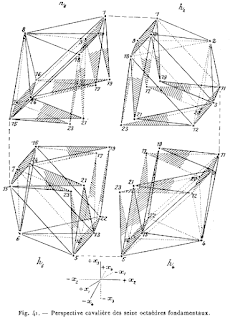
Jouffret diagram
Diagram from Jouffret's 'Traité élémentaire de géométrie à quatre dimensions'


This print is about how movements in art can be connected with contemporary math and physics (and other sciences). Specifically, the way Cubism breaks from a single favoured perspective or absolute frame of reference and attempts to break down subjects into geometrical shapes from multiple points of view can be tied to advancements in non-Euclidian geometry in mathematics, special relativity (published by Einstein in 1905) and the revolution in early 20th century physics. Picasso and his circle were specifically introduced to the mathematics of the fourth dimension and Non-Euclidian geometry by his actuary and enthusiastic amateur mathematician friend Maurice Princet, who gave him the book 'Traité élémentaire de géométrie à quatre dimensions' (Elementary Treatise on the Geometry of Four Dimensions) by Esprit Jouffret, a popularization of Henri Poincaré's 'La Science et l'Hypothèse' (Science and Hypothesis). Jouffret's book includes many diagrams of four dimensional objects like hypercubes projected on the 2D surface of a page. Princet also spoke to Picasso about the work of polymath Henri Poincaré. Picasso realized that this approach to 4D geometry captured the how he wanted to depict two points of view simultaneously and art historians can trace the influence of this geometry in his earliest Cubist paintings. So I have made a Cubist style portrait of mathematician, physicist, engineer and philosopher of science Henri Poincaré (1854-1912).

Henri Poincaré 
(photograph published in 1913, via Wikipedia)


Pointcaré was called "The Last Universalist" since he excelled in such a wide range of mathematics including pure and applied math, mathematical physics and celestial mechanics. Chaos theory and the idea that deterministic systems can have sensitive dependance on initial conditions (colloquially known as the butterfly effect) seemed to explode on the scene with increasing applications in the 1980s but in fact some foundations were laid a century earlier by Poincaré. He was the first person to discover a deterministic system which exhibits chaos in the three-body problem (or how a system of  3 masses behave over under Newton's Law of Universal Gravitation). The three circular shapes in the background allude to the 3-body problem and the spiral is a hint at the chaos in the trajectories. He is considered a founder of the study of topology (how geometric properties are preserved under deformations) and stressed the importance of the invariance of physical laws under various transformations. Special relativity tells us that light speed is the universal speed limit, and that space and time are not absolute. As things approach this speed limit they experience length contraction and time dilation. We use Lorentz transformations to compare length and duration in differing frames of reference. It was Poincaré who wrote the Lorentz transformations in their modern form. He discovered the Lorentz transformations for velocity and the invariance of Maxwell's equations (for electricity, magnetism and light), which was vital part of special relativity. He published a short paper in 1905 which Einstein did not see until after he had published his own independent and revolutionary paper on special relativity. Poincaré also proposed gravitational waves, travelling at light speed from masses. It's hard to over-state his importance to 20th century math and physics.

Pablo Picasso, Portrait of Ambroise Vollard, spring of 1910 (Pushkin Museum, Moscow)

Poincaré himself worked quite intuitively and wrote, "It is only through science and art that civilization is of value."

One of the ways in which Special relativity is strange is that we discovered the problem of simultaneity. If there is no absolute frame of reference, there is no simultaneity; observers in different inertial frames of reference (that is going different speeds*) will not agree on the sequence of events or even whether two things happen at the same time. This problem of simultaneity, it can be argued, is exactly what interested Picasso, when he chose to paint two different points of view on the same canvas. This is the argument made by Miller, author of 'Einstein, Picasso: Space, Time and the Beauty That Causes Havoc' makes. Leonard Schlain, in 'Art & Physics' makes the case that Picasso in painting all sides of an object simultaneously as if he was seeing space as all here in the everlasting now, was depicting what a viewer would see astride a beam of light at the universal speed limit when time has reached its maximum dilation to the present (and only the present). 

Earlier art historians, and in fact Einstein when asked, argued that Cubism wasn't connected to relativity or non-Euclidian geometry but I think each under appreciated the other. The art historians argued the artists had no knowledge of Einstein, or Minkowski (who combined space and time into the 4D spacetime), equations or pure math. Einstein preferred earlier classical painting and argued "This new artistic 'language' has nothing in common with the Theory of Relativity" but then, he felt contemporary art and music had both degenerated. If we are less literal, I think the connection between the two movements is quite clear. There is no absolute frame of reference and both art and physics were revolutionized by this realization.

Schlain makes a further argument connecting Cubism with relativity but noting that colours also change with speed, as length contracts (including the wavelengths or colours we would observe), and colours would be merge as what is in front and behind become one. He argues we would be left with neutrals at the speed of light: white (of white light), black (of its absence),  and muddy tones of mixed colours brown and grey. These are precisely the colours Picasso and Braque used in their early Cubist paintings, and the colours of my palette for my portrait of Poincaré.


*without acceleration and/or far from large masses, so we can ignore general relativity

References

William B. Ashworth, Jr., Scientist of the Day - Esprit Jouffret, Linda Hall Library blog, March 15, 2021.

Arthur I. Miller, Henri Poincaré the unlikely like between Einstein and Picasso, The Guardian, July 17, 2021

Did Picasso know about Einstein?, Physics World, November 1, 2002

Leonard Schlain, Art & Physics, Quill William Morrow, New York, 1991

Henri Poincaré, Wikipedia, accessed January, 2022

Wednesday, June 9, 2021

Hilbert's Grand Hotel


Hilbert's Grand Hotel, 8" x 10", linocut by Ele Willoughby, 2021

My latest linocut print illustrates the paradox of Hilbert's Grand Hotel, a thought experiment conceived by the great mathematician David Hilbert (1862-1943) in 1924 to show the paradox of infinite sets. If you imagine a regular hotel with a finite number of rooms, if they are all filled you can't add more guests. In an imaginary infinite hotel however, guests are always welcome! Even if all the (conveniently numbered 1, 2, 3, ...) rooms are filled, you simply shuffle all the guests over one room and make room for the next guest. You can repeat this argument for one more guest, two more guests, three more guests, ...infinity more guest... infinity groups of infinite guests, etcetera!

The print shows a grand hotel on a steep angle (with a vanishing point at infinity of course), labelled "Hilbert's Grand Hotel" below a cameo of Hilbert himself, and the slogan "No vancancy. Check in now!" Above the hotel is a glowing infinity symbol. The size of countably infinite sets, like all natural numbers {1,2,3, .... ∞ } is denoted by Aleph Nought ℵ0 shown on the two flags.

Thursday, April 1, 2021

Chomsky Hierarchies, where math meets linguistics and computer language


Linocut 'Chomsky Hierarchy' by Ele Willoughby, 2021


This is one of the #mathyear prompts I had previously skipped. Chomsky hierarchies are the place math meets computer language and linguistics, and is something I have never studied, so I didn't have a good idea how to protray them. This year, I'm trying to do all the prompts I previously skipped, and I had a visiual idea.

This is a linocut portrait of linguist Noam Chomsky with a Venn diagram illustrating  the Chomsky hierarchy (or Chomsky-Schützenberger hierarchy) for formal grammars in formal language theory. In 1956, Noam Chomsky described the hierarchy of formal grammars (how to form strings from a language's alphabet that are valid according to the language's syntax). These ideas and hierarchy are pertinent for applied mathematics, theoretical computer science, theoretical linguistics and other areas.

He categoried 4 types of grammars, shown in the Venn diagram behind his portrait. Type 0, in pale yellow, contains recursively enumerable grammars, such that there exists a Turing machine which will enumerate all valid strings of the language. Type 1, in umber, contains context-sensitive grammars, are recognized by non-deterministic linear-bounded automata. Type 2, in orange, are context-free grammars, recognized by non-deterministic pushdown automaton. Type 3, in pink, are regular grammars, recognized by finite state automata.