Showing posts with label geology. Show all posts

Sunday, March 2, 2025

Florence Bascom geologist

Florence Bascom, linocut print, 9.25" x 12.5" by Ele Willougby, 2025

As an Earth scientist, the #printerSolstice2425 prompt silicon made me think of the Earth's crust, so I took the opportunity to make a portrait of brilliant trailblazing US geologist and professor Florence Bascom (1862-1945) who championed women’s education, and, amongst other things, pioneered the use of microscopy in petrology (the field of geology describing the structure and minearlogic composition of rocks) and used polarizing microscopes for detailed petrographic analysis to show that rocks previously identified as sedimentary were in fact metamorphosed (that is, changed in composition through heat and pressure over time). She called these volcanic rocks she called aporhyolite (implying a change in rhyolite, a silica rich igneous rock, as in her thin sections like the ones in my print). Though she was the second US woman to complete her doctorate in geology, after paleontologist Mary Emilie Holmes (University of Michigan, 1888), Bascom, the most famous US early woman geologist, is often called the first US woman geologist.

A portrait of Florence Bascom (Public Domain). Smithsonian Institution Archives Collection:
Science Service Records, 1902-1965 (Record Unit 7091)

Unusually for the time, she was encouraged to pursue university education. She was born the youngest of five children in Williamstown, Massachusetts. Her father John, Bascom was a teacher, then professor of oratory and rhetoric at Williams College and supporter of women's suffrage and coeducation. He became president of University of Wisconsin in 1874 and by 1875 he had opened the school to women. Her mother was a teacher, firebrand suffragette and women’s rights activist Emma Curtiss Bascom. Florence herself, a quiet, self-possessed, brilliant student, entered the University of Wisconsin in 1877 at age 15. Women still had limited access to the library, gymnasium and classes with full male enrolment. If there were not enough seats for men in attendance, women were asked to leave the classroom. Her interest in science was fostered by trips exploring the outdoors with her father, who maintained an observatory and laboratory at home. She completed both a BA (1882) in literature and a BSc (1884) in natural science, at the University of Wisconsin. She taught at the Hampton Institute (now Hampton University, 1884-1885), created post-Civil War to educate freed Black formerly enslaved students and Indigenous students. Homesickness brought her back to Madison, Wisconsin. During a drive with her father and family friend, Ohio State University geologist Dr. Edward Orton, discussing the formation of the landscape around them, she became fascinated. With some encouragement and cajoling from her father, she re-enrolled and completed her M.Sc in geology at the University of Wisconsin in 1887. She was frustrated that the field did not allow her to participate as fully as her male peers and was barred from taking part in fieldwork, which was (and often still is) considered a fundamental part of the training of geologists. She taught high school at the Rockford Seminary for Women (later Rockford College) for two years but craved a greater challenge. Her professors encouraged her to pursue her doctorate at John Hopkins University, then the premier geology school.

Florence Bascom  in long skirt and hat holding a Brunton compass1. From: Sophia Smith Collection, Smith College
Florence Bascom holding a Brunton compass1. From: Sophia Smith Collection, Smith College

Despite her multiple degrees and glowing letters of recommendation from several geologists and her university president father, she still had to argue her case to be allowed as the first woman enter the doctoral program at John Hopkins University. The university's founder and president Daniel C. Gilman vehemently opposed coeducation. One of the trustees called women "the foreign enemy within the walls." She petitioned for admission, arguing that she could not receive an equivalent education elsewhere, and was successful with support of her professors. But even then, she was not an official student, and was ineligible for scholarships or fellowships. She needed her family's financial support to attend. She was unhelpfully limited in her library and classroom access to protect her from the “rougher influences” of the young men. Many sources claim that Bascom was forced to sit behind a screen during lectures to shield her from the men and avoid distracting them, but other scholars point out there is a lack of primary sources to support this story; whether the story is true or apocryphal, she certainly found herself quite isolated and singled out, the subject of sexism and animosity. In 1891, her father wrote to her that "you better put a stone or two in your pocket to throw at those heads that are thrust out of windows," in response to those who would gawk at the lone woman. She was forbidden as a woman to participate in fieldwork through the university, but her supervisor, renown geologist George Williams, who believed strongly in equal education for women, insisted fieldwork was a necessary part of a geologist's training. He also worked for the United States Geological Survey (USGS) so, he took her on his USGS field excursions, bringing his wife along to avoid unwanted rumours about a male professor alone in the woods with his female student. Bascom fell in love with fieldwork. She did all the physical work of field geology, hiking and hauling tools and samples, as her male peers, in a high necked gown. In her isolation at the university she decided to focus on petrology and became expert in crystallography and mineralogy. She worked in these nascent fields, trained by the leaders and earliest pioneers. Her thesis “A Contribution to the Geology of South Mountain, Pennsylvania” is regarded as a major contribution to Appalachian geology and she published part of it in the first volume of the Journal of Geology in 1893. Though other some faculty denounced the very idea of women PhD candidates, Williams supported her research and publication efforts and cited her research in his own publications. Tragically, Williams, then only 38, contracted typhoid fever while in the field in 1894. Knowing Bascom would face barriers to publication as a woman, as his health worsened, he submitted her work to the USGS and succeeded in having it published as USGS Bulletin 136 before he died. She used the very recent geologic technique of petrographic microscopy to correct misconceptions about the formation of rocks at the northernmost tip of the Blue Ridge Mountains. She furthered understanding of the east coast of the US and redefined the recognized cycles of erosion in Pennsylvania. She published more than 40 papers - still relevant today - about the crystallography and geomorphology of the Appalachian Piedmont, in Maryland and Pennsylvania, including length USGS Bulletins and Folios. After teaching for a couple of years at Ohio State (1893-1895), she was recruited by women's college Bryn Mawr President James Rhoads. She founded the Geology Department at Bryn Mawr in 1895, working out of a small spaced boarded off in the storage area of the biology, chemistry and physics building. After his death, his successor Martha Carey Thomas did not think geology would appeal to women, and discouraged it. Nonetheless, she persisted, working tirelessly to establish their mineral and literature collection for teaching over the course of two years, developing a lab and field-based curriculum. She became a full prof in 1906, and took a year-long sabbatical to the University of Heidelberg to train with renown crystallographer Victor Mordechai Goldschmidt, who had studied alongside Bascom's supervisor Williams. Bascom and Goldschmidt became true friends, and Florence gained a second devoted mentor and confidant with whom she corresponded for many years. She continued to correspond with his wife Leontine after his death.

In her research she was detail-oriented and driven by the data. Her writing was clear and incisive if sometimes terse, forceful and unapologetic. For instance, in correcting a poorly-determined age for certain igneous rocks previously published in the literature she wrote, "this determination was made on the basis of some rather dubious fossils submitted... by Persifor Frazer and cannot, therefore, be considered perfectly trustworthy." She proceeded to make her own case with clear and detailed illustrations, like those I included in my portrait. She also defended her turf fiercely, on occasion feuding with colleagues who published on her area of expertise but neglected to seek her review.

Florence Bascom (second from front, flat rather than pointy hat) on a field trip — possibly to the Grand Canyon — with students in 1906. Sophia Smith Collection (Smith College)
Florence Bascom (second from front, flat rather than pointy hat) on a field trip,
possibly to the Grand Canyon, with students in 1906. Sophia Smith Collection (Smith College)

Having benefited from great mentorship, Bascom followed suit and was an extraordinary mentor. A tough but innovative in teaching and a devoted mentor, she trained the next generation of women in geology, making one of the best geology departments in the country. She invited world-famous geologists to come lecture her students. She emphasized both lab and fieldwork for students. She argued fieldwork should count towards their physical education credit, clashing with university president Thomas who demanded that women wear appropriate apparel. The usual "athletic skirt" was not to be worn off-campus, and students would require walking skirts before being allowed in the field.  In 1932, she wrote, "I have considerable pride in the fact that some of the best work done in geology today by women, ranking with that done by men, has been done by my students... these are all notable young women who will be a credit to the science of geology." In 1937, of the women who had been made Fellows of the Society of America, 8 of 11 had been her students at Bryn Mawr. Hired to do fieldwork by the USGS in the summers, she returned to Bryn Mawr in to teach after her field seasons and write up her research. Working at the USGS gave her access to more books, labs and colleagues. The university president used her passion for fieldwork and her USGS work to argue that the geology program should be dissolved, but Bascom won that battle too. The strain of her double career and teaching load made things difficult and put a strain on her mental health. But she loved her work and wrote, "one finds a joy that is beyond expression in 'sounding the abyss of science' and the secrets of the infinite mind.
Photo of Bascom teaching in the field around 1915.6 Bryn Mawr College Archives (Public Domain)
Photo of Bascom teaching in the field around 1915. Bryn Mawr College Archives (Public Domain)

She was the first woman: hired by the USGS in 1896; to present a paper at the Geological Society of Washington in 1901; and she was the second women elected to the Geological Society of America in 1924; and elected VP of the GSA in 1930. She was associate editor of the American Geologist, 1896-1905. In 1906 she the only woman added to the list of 100 most influential geologists by the American publication Men in Science; she was recognized by her colleagues as one of the leading figures in the field. Though future editions included many of the women students she trained, it remained "Men" in Science until 1971. A lover of animals as well as the outdoors, she was known for hiding her horse Fantasy around campuses, and bicycling to work when wearing divided skirts to do so was still rather scandalous. She never married, commenting that women were too often lost to science due to marriage and domestic duties - an issue we still see today. She cut her hair short and often did not bother styling it, having other priorities and working from dawn to dusk in the field. She wrote, "This is the life, to plunge into the welcome isolation of the field, to return to the stimulating association of Bryn Mawr, to observe and in part to clear up geologic phenomena, to return to the exposition and interpretation of geologic phenomena." She retired in 1928 from Bryn Mawr to the Berkshires in western Massachusetts but kept working at the USGS until age 74 in 1936. She died June 18, 1945, in Williamstown, where she was born. The USGS Florence Bascom Geoscience Center, and several geological features including a glacial lake, Venusian crater and an asteroid are named in her honour. She left behind a tremendous record of important geological research and excellent mentorship and training of future geologists.


References 

Ball, Jessica. Dr Florence Bascom: Sounding the abyss of science. Finding Ada. April 1, 2021.
Bascom, F. and G. W. Stose. Description of the Coatesville and West Chester Quadrangles. US Geological Survey Atlas of the United States, Folio, 223. 1938.
Florence Bascom (1862-1945), Geological Digressions, September 26, 2024. 
Florence Bascom Wikipedia, accessed March, 2025.
Florence Bascom, Trailblazer of the U.S. Geological Survey, Communications and Publishing, USGS, March 1, 2023.
Hurler, Kevin. Florence Bascom, a geologic juggernaut. Advanced Science News, January 27, 2022.
Oglivie, Ida H. Florence Bascom 1862-1945. Science. Vol. 102, Issue 2648, pp. 320-321, September 28, 1945, DOI: 10.1126/science.102.2648.320
Schueth, Jon. The Stone Lady: Florence Bascom (Part 1). Bias in the Fossil Record. April 2, 2021.
Schueth, Jon. A "Woman's Sphere" - Florence Bascom (Part 2). Bias in the Fossil Record. April 12, 2021.
Schueth, Jon. On the Shoulders of Giants: Florence Bascom (Part 3). Bias in the Fossil Record. April 20, 2021.
Schueth, Jon. The Bascom-Goldschmidt Letters: Florence Bascom (Part IV). Bias in the Fossil Record. May 6, 2021.
Shillito, Lisa-Marie. Florence Bascom. Trowelblazers. July 14, 2014.
Sneiderman, Jill S. Rock Stars: A Life of Firsts: Florence Bascom. GSA Today, July 1997.
The Stone Lady Florence Bascom, Acadia National Park, National Park Service, last edited February 5, 2021.

Wednesday, July 7, 2021

Lyell's Amphibious Being


Lyell's Amphibious Being
Lyell's Amphibious Being, linocut, 10" x 8" by Ele Willoughby


So here's my latest Imaginary Friend of Science: Lyell's Amphibious Being. Dressed like geologist Charles Lyell himself, with sample bag, geological hammer, pick axe and magnifying glass, in front of the geological cross-section from the end papers of Lyell's 'Principles of Geology' and a couple of fossils from terrestrial and marine life (fern and nautiloid respectively). It's a two block linocut on Japanese kozo (or mulberry) paper, 10" x 8" and available here. Read more about the Amphibious Beast in the Imaginary Friend of Geology.

Friday, June 11, 2021

Imaginary Friends of Geology

Painting by Alexander Craig during the British Association meeting in Glasgow in 1840 when Lyell was 43 years old.
Charles Lyell, by Alexander Craig in 1840 when Lyell was 43 years old.
I’m always on the lookout for new “imaginary friends of science” and periodically I ask for suggestions. My series is made of the charismatic metaphors and thought experiments through the history of science. “Imaginary friend” is a bit tongue-in-cheek but my series includes Schrödinger’s cat, Maxwell’s Demon, Laplace’s Demon, Descartes’ Demon, Russell’s Teapot, Occam’s Razor, the Spherical Cow and Hilbert’s Grand Hotel. My series is skewed towards physics (with some math and philosophy) because that’s my background. I ask for suggestions and biologists just look quizzical but I suspect other fields do this too. It's not an obvious thing to research since this is not really a recognized category of metaphor/thought-experiment, and I coined the term "imaginary friend of science" but you sort of know one when you meet them. Tell me your favourites!

Maxwell's, Laplace's and Descartes' Demons

Recently I got a suggestion from geology for my ‘imaginary friends of science’ series (hat tip to Greg Priest). This imaginary friend is a bit obscure but fits perfectly. Early geologist Charles Lyell (1797-1875), in his famous ‘Principles of Geology’ wrote that to avoid some sources of prejudice in understanding geology would require an Amphibious Being, who could, say, compare processes happening today on land and those happening today below water with what we see in the geological record. Likewise the Amphibious Being would be better able to identify fossils, being familiar with life on land and in the sea. He wrote,

It should, therefore, be remembered, that the task imposed on those who study the earth's history requires no ordinary share of discretion; for we are precluded from collating the corresponding parts of the system of things as it exists now, and as it existed at former periods. If we were inhabitants of another element—if the great ocean were our domain, instead of the narrow limits of the land, our difficulties would be considerably lessened; while, on the other hand, there can be little doubt, although the reader may, perhaps, smile at the bare suggestion of such an idea, that an amphibious being, who should possess our faculties, would still more easily arrive at sound theoretical opinions in geology, since he might behold, on the one hand, the decomposition of rocks in the atmosphere, or the transportation of matter by running water; and, on the other, examine the deposition of sediment in the sea, and the imbedding of animal and vegetable remains in new strata. He might ascertain, by direct observation, the action of a mountain torrent, as well as of a marine current; might compare the products of volcanoes poured out upon the land with those ejected beneath the waters; and might mark, on the one hand, the growth of the forest, and, on the other, that of the coral reef. 

-Charles Lyell, 'Principles of Geology' 9th ed. 1853

James Hutton during fieldwork, by John Kay

He actually goes on to further propose other biases could be avoided only if one could live also in the subterranean world, and hence, a further imaginary friend, "some "dusky melancholy sprite," like Umbriel, who could "flit on sooty pinions to the central earth," but who was never permitted to "sully the fair face of light," and emerge into the regions of water and of air" but such a sprite would have biases due to his lack of access to life on land or in the sea! Here I'm just going to consider the Amphibious Being. 


The Geologist - Carl Spitzweg, circa 1860
While far less well-known than say, Maxwell's Demon or Schroedinger's Cat, the Amphibious Being absolutely performs the same purpose. He's a figment of Lyell's imagination who serves to elucidate and explore a problem in science. The Amphibious Being highlights the possibility that our conclusions about the origins of rocks or fossils  are biased since we only live on land, the same way Maxwell's Demon explores the mysterious nature of the Second Law of Thermodynamics or Schroedinger's Cat exposes the strangeness of the probabilistic nature of quantum mechanics and what that would mean if we saw it in the every day world of large things like well, cats, rather than the subatomic scale. So I plan to add the Amphibious Being to my collection.

Rise of Mr. de Saussure to the summit of Mont Blanc, aquarellée engraving of Christian of Mechel (1737- 1817).

Professor Owen, by Frederick Watty in Cartoon Portraits and Biographical Sketches of Men of the Day (1873)

My question is, what would such an Amphibious Being look like? I made my Demons (Maxwell's, Laplace's and Descartes') ressemble those who introduced them with some additional features like horns. There are a lot of images of Lyell at various ages. He is always wearing a suit, with a magnifying glass or monocle on a chain around his neck.  There are sadly no images of him in the field. I tried to find some images of early geologists or Victorian geologists in particular. It's easy to find depictions of James Hutton (1726-1797) in the field, but not Lyell. Even searching for Victorian geologists in general proved hard. The vast majority of paintings or later photographs show middle class men in suits at home. There are some hilariously heroic posed images of geologists with hammers looking like Classical heroes. I was pleased so see images of Mary Anning, Alice Wilson and other trail-blazing women in geology come up in my search. The Rise of Mr. de Saussure to the summit of Mont Blanc, an aquarellée engraving of Christian of Mechel (1737- 1817), shows that geologists of Lyell's time did in fact where suits in the field, and some of the simple tools they employed: walking sticks, rakes, shovels and packs of supplies. There are also a number of photographs of somewhat scruffier Gold Rush geologists in California or the Yukon. Along with simple tools, geological hammers, magnifying glasses, and collecting bags are common. I wondered also about Victorian caricatures? I have seen cariactures of various well-known historical scientists (even if scientists seem to rarely be the sort of recognizable public figure to appear in cartoons today). So I looked up cariatures of Charles Lyell and was not disappointed.

The caricature by De la Beches of Charles Lyell as Prof. Ichthyosaurus on the pages of Francis Trevelyan Buckland (Son of William B.). "Curiosities of Natural History".
'Awful Changes' - Caricature of Charles Lyell as Prof. Ichthyosaurus, by geologist Henry De la Beche (1796 -1855) on the pages of Francis Trevelyan Buckland (Son of William B.). "Curiosities of Natural History".


Ichthyosaurus caricature published in 1885 in the Punch magazine. The discovery of ichthyosaurus fossils lead to interest in reportings of sea monsters, including for Charles Lyell who wanted to support his idea that animals did not become extict, only rare. He wisely did not include this idea in his geology textbook. (via History of Geology)


The Professor Ichthyosaurus, though an actual, contemporary and amusing cariature of Lyell as a being, which in the cartoon at least, appears amphibious, isn't quite what I want. The itchyosaurus was a marine reptile, not an amphibian. The lecture setting does not suggest fieldwork, nor any greater insight into geology because of its amphibious nature. 

Henry de la Beche, incidentally, famously painted the first paleoart scene, Duria Antiquior, based largely on his friend Mary Anning's findings and he sold lithographic prints of his painting to raise funds to help support her. I thought of him as more modern and kind, in his loyalty and friendship with Mary Anning, a paleontologist who was largely excluded due to her sex, class and religion. But in researching this my opinion of him fell. While he understood slavery was an abomination, since his own income depended on an enheirtance of a sugar plantation in Jamaica worked by enslaved people, he (guiltily) opposed abolition in favour of in favour of gradual change. 'This is wrong but let's not be too hasty' is not an ethical stance.


Duria Antiquior – A more Ancient Dorset is a watercolour painted in 1830 by the geologist Henry De la Beche


And what about the all-important "amphibious" part of my Amphibious Being? My first thought was salmanders. I love the look of gill-stalks and perhaps they suggested Lyell's substantial sideburns. I find the axolotl looks quite anthropomorphic as it is (as reflected in Julio Cortazar's short story, Axolotl).  The axolotl is of course limited in range to Mexico, and though other salamanders go through a larval stage with gill-stalks, this didn't feel quite right or in any way an allusion to Lyell. My next thought was to look at Victorian cariatures of anthropomorphic frogs, which (for reasons I don't entirely understand) was very much a thing. Frog men cariatures and Christmas cards and other illustrations, sometimes to satirize society are pretty common, so I thought that was just the thing.


I am now sketching a Victorian frog-man geologist for my next Imaginary Friends of Science print!

Wednesday, June 13, 2018

Interstital Intro - My portraits of Canadian Women in STEM


Featuring artwork by me, Cheryl Hamilton and Paige Blumer, Curiosity Collider's artshow Interstitial: Science Innovations by Canadian Women is on exhibit until June 22. Since I was unable to attend the Opening in Vancouver, they asked me to share a short video introduction to me and my artwork. So now, I'm sharing the video with you. Comes complete with a peek inside my studio and some of the artwork you could find there. I think I was so focused on pronouncing "electrophoresis" that I slipped up on the more common "geneticist", but it tells about the work.


The exhibit is open from 11 am to 6 pm from Tuesday to Saturday until June 22 at The Beaumont Studios gallery spaces, located at 316/326 West 5th Street, Vancouver, BC, V5Y 1J0.

Thursday, May 3, 2018

Alice Wilson, tenacious geologist and paleontologist who persisted

Alice Wilson, linocut on collaged washi papers, 11" x 14" by Ele Willoughby, 2018
Some people are late bloomers. Some are slowed in their progress due to illness and battle serious illness throughout their life. Some scientists only pursue science a little later in life. Some experience all three. Alice Wilson did not at first study geology, and once a geologist her employer hindered her advance, as a woman, at every stage. Nevertheless, she persisted and made her greatest achievements later and took the greatest pleasure in her career after her retirement! Her extraordinary tenacity and glorious success late in life is such a satisfying story.

Geologist and paleontologist Alice Wilson (1881-1964) was outdoorsy as a girl. Her family spent its summers canoeing, camping and collecting fossils in the limestone formations near their home in Coburg, Ontario. The Wilsons valued scholarship and science. Her father was a professor of classics at the University of Toronto. She went to the University of Toronto to study modern languages and history, as preparation for one of the few career options for women: teaching. But her ill health prevented her from finishing her degree and she withdrew in her final year. When she recovered, she decided to pursue her fossil collecting first love, got a job in the Mineralogy Division of the University of Toronto Museum, and found an entry into her career in geology.

Then in 1909 she got a job as a museum assistant with the Geological Survey of Canada (GSC), in Ottawa, where she would work until 1946 and then maintain an office as an emeritus scientist until shortly before her death in 1964.  She was supervised by the GSC's chief paleontologist Percy Raymond and catalogued and labelled the invertebrate paleontology collections. Raymond encouraged her to complete her undergraduate degree, which she succeeded in doing in 1911, after which she was offered a permanent position with the survey - the first woman to hold a professional position there. Alice Wilson became the first female geologist in Canada, facing a series of roadblocks due to her sex. She had to fight for the right to do fieldwork, arguing to superiors that "with reference to further field work of the more strenuous type, I would like to point out that while not heavily built, I am muscularly very strong, and from earliest childhood have been accustomed to an out-of-door life both with canoe and tramping." Since she was forbidden to stay in remote field sites with male colleagues, she made a case that she could work alone during day trips which she made on foot or bicycle. Denied access to a government field vehicle provided to men she later used her own car. The GSC otherwise barred women from fieldwork until 1970. 

Her research interests focused on fossil invertebrates from the Paleozoic era (252–541 million years ago) from across Canada, and from the Ordovician era (444–485 million years ago) in her own backyard in Ontario and Quebec as well as Ordovician fauna from the Rockies and Arctic. She studied stratigraphy in Ontario and Quebec. Over the course of 50 years, she became an authority on fossils and rocks of the Ottawa - St. Lawrence Valley, as a direct response to the sexist limitations placed upon her. Her studies of the geology and paleontology around Cornwall, Ontario were vital to the construction of the St. Lawrence Seaway. She covered more than 16,000 square kilometers despite ill health, frail constitution and the limitations placed upon her.

Alice Wilson at Rigaud Mountain, Québec, May 1953, happy after retirement
(courtesy Natural Resources Canada/Photo number 165185-A)
She fought from 1915 for a decade for the right to take an education leave; paid leave was commonly awarded to her male peers. She despite repeated denials, she persisted and in 1926 she was allowed to apply for a scholarship from the Canadian Federation of University Women (CFUW), but when it was granted to her, she was again denied leave. CFUW campaigned on her behalf, even petitioning Cabinet members and eventually the GSC relented and allowed her leave. She earned her doctorate from the University of Chicago in 1929 at age 49! She returned to the GSC and was repeatedly denied promotions or the professional recognition she deserved. She had only been promoted from clerk to assistant paleontologist in 1919, and then to assistant geologist in 1926. She did not receive a raise, as was common practice, after completing her doctorate. Perhaps an unexpected champion, the government of Prime Minister R. B. Bennett was seeking a female federal civil servant to honour in 1935 and selected Wilson to become a Member of the Order of the British Empire. One suspects the GSC was shamed into action as they rapidly published her research for the first time in 10 years and gave her a promotion. Wilson became first the female Canadian Fellow of the Geological Society of America in 1936, and first female Fellow of the Royal Society of Canada in 1938. She finally was promoted from assistant to a full geologist position in 1940. By 1945, she finally was addressed by the well-earned title "Dr." Five people were hired to replace her upon her retirement! Following compulsory retirement at age 65, in 1946, she had what she thought of as the happiest stage of her career. She was afforded the opportunity to mentor protegés and share her love of geology with students and children. She taught paleontology at Carleton, wrote a children’s book about geology The earth beneath our feet. She maintained an office as emeritus scientist at the GSC until she was 82, visiting daily and continuing her fieldwork. She published more than 50 academic papers throughout her career. When she finally gave up her office, the survey's director James M. Harrison tried to disuade her but she told him that her "work was done." Alice Wilson is one of only 60 inductees in the Canadian Science and Engineering Hall of Fame. Alice Wilson is now a designated national historic person.

I’ve shown her with one of her geological maps of the Ottawa region, published at the official "end" of her career just before she retired, which was for her another beginning. Her publication in 1946, 'Geology of the Ottawa - St. Lawrence Lowland, Ontario and Quebec' was the first the first major geological publication about the region and we owe our knowledge of the area's geology and economic resources including building stone, sand, gravel, and drinking water to Wilson.

References

Alice Wilson, Libraries and Archives Canada, accessed May 2, 2018
Alice Wilson, The Canadian Encyclopedia, accessed May 2, 2018
Wilson, A E, Geology of the Ottawa - St. Lawrence Lowland, Ontario and Quebec, Geological Survey of Canada, Memoir 241, 1946, 66 pages (4 sheets)
Alice Evelyn Wilson 1881-1964; Canadian Science and Engineering Hall of Fame, Canada Science and Technology Museum. 
The History of the Geological Survey of Canada in 175 Objects
Trailblazer - Alice Evelyn Wilson, 1881-1964 First Woman Geologist Left her Mark in Stone 
Alice Wilson, Wikipedia, accessed May 2, 2018
Parks Canada This Week in History for Monday December 24, 2012, Nothing could stop Alice Wilson!

Saturday, May 16, 2015

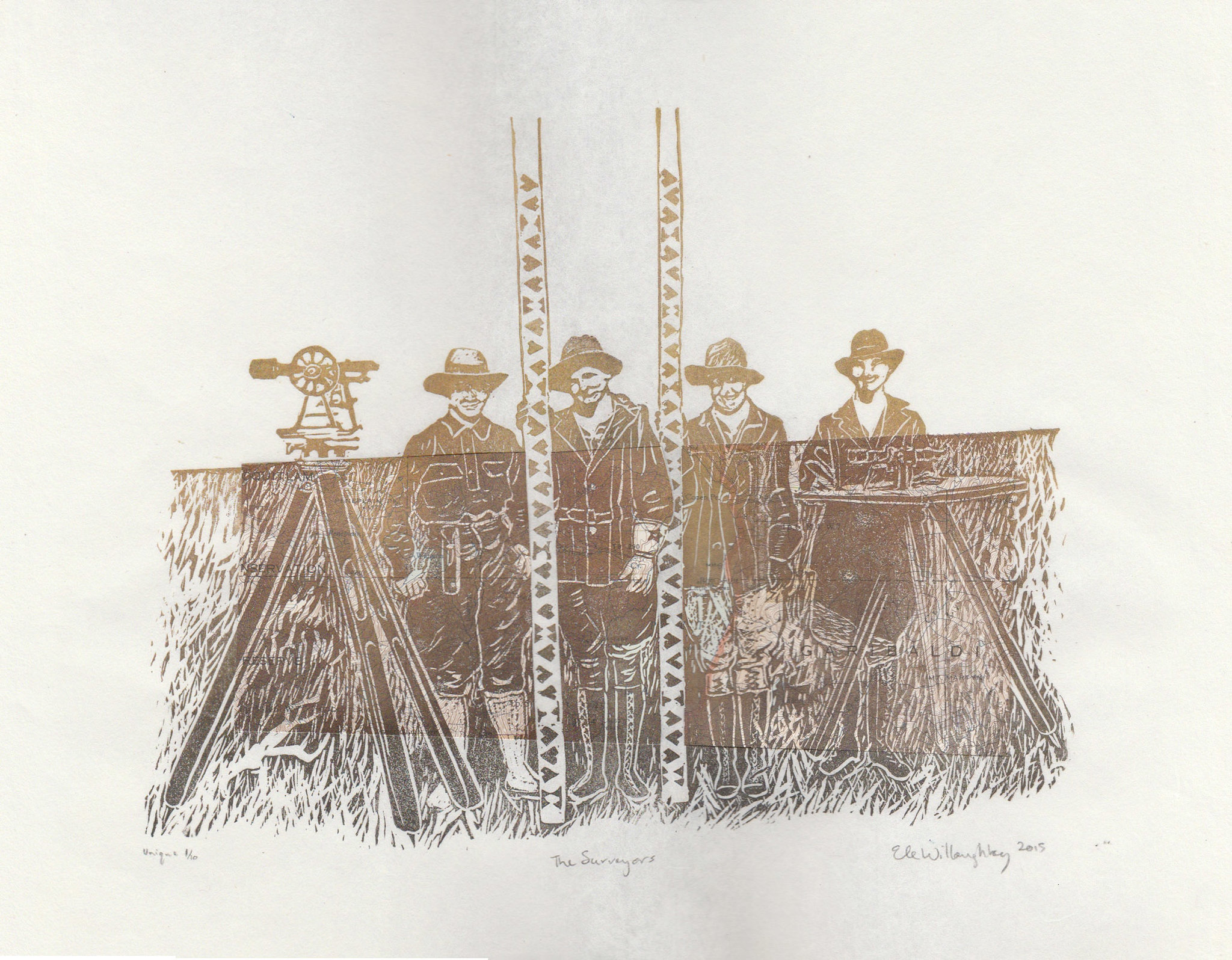
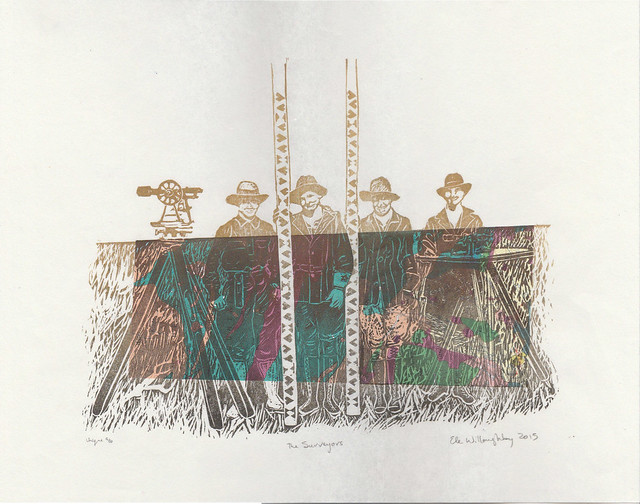
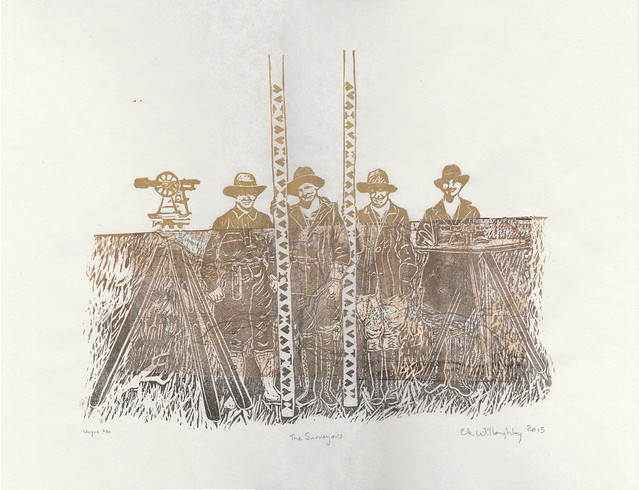
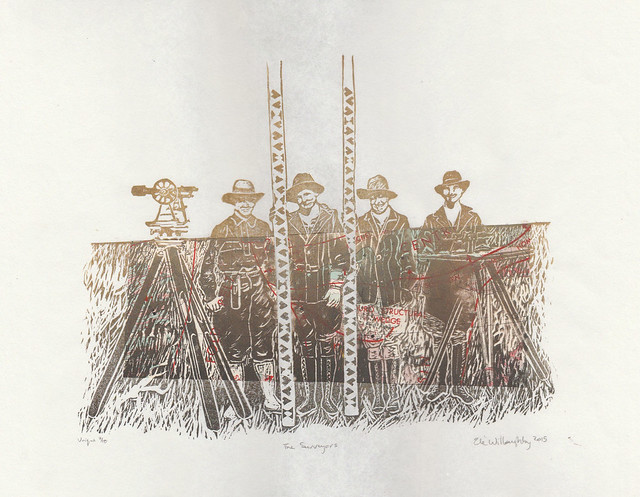
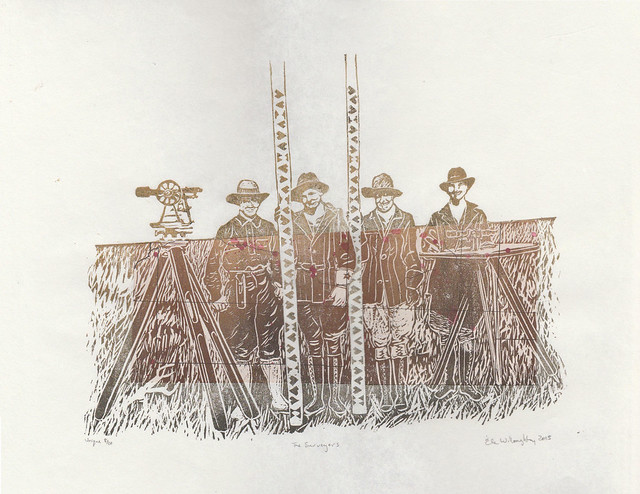
Surveyors, an all-female crew in the American west in 1918

Surveyors1
The Surveyors, linocut with vintage topographical map, 14" x 11", edition of 10 each unique, 2015 by Ele Willoughby

All female survey crew working on the Minidoka Project, Idaho, 1918.
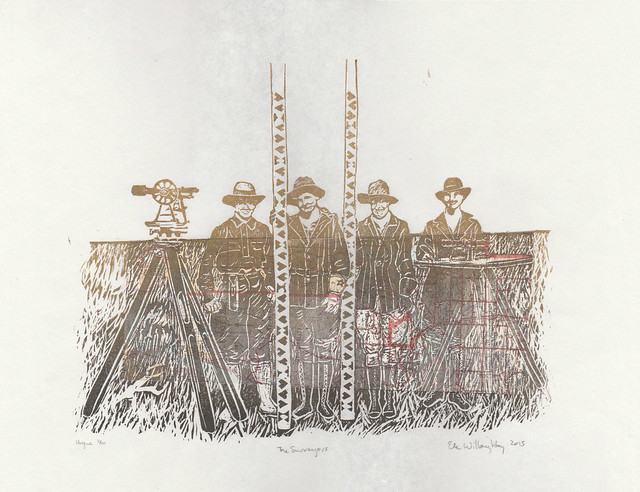
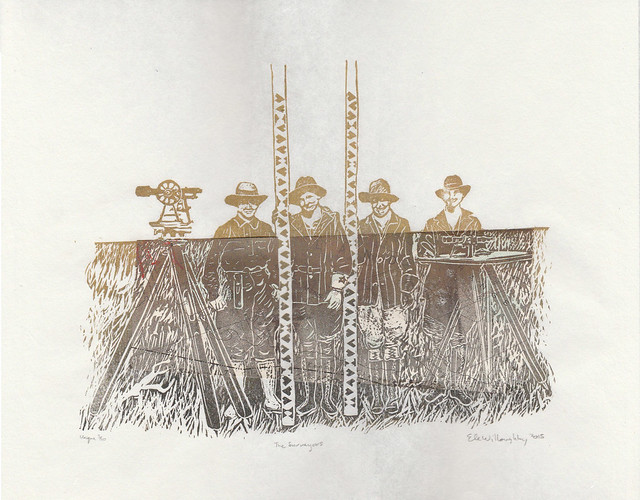
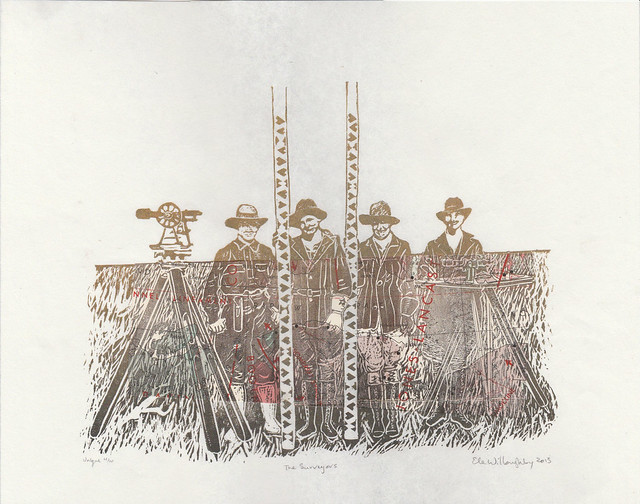
I love when people approach me about doing a fascinating custom order. An artist, Krista Caballero who has been collaborating with many others on a project called Mapping Meaning which brought together "artists, scientists and scholars to explore questions of social, mental, and environmental ecology. Inspired by a photograph from 1918 depicting an all-female survey crew, the project is rooted in a five-day experimental workshop that takes place biennially on the Colorado Plateau." She wanted to thank her collaborators with the gift of a print and wanted to know if I could make an edition inspired by this very 1918 photo. Since one of the things I do is communicate science through art with portraits of scientists (with a special focus on women in the history of science) and I have also done a variety of earth science surveys and mapping, this is very much my thing. In fact, I worry sometimes about hagiography... about only present heroes and heroines, or perpetuating the myth that science is a series the story of a series of lone geniuses. Plus, those survey rods with their odd symbols are so graphic and tempting to one who makes relief prints.

I proposed portraying these women and incorporating vintage geological, topographic and seismicity maps of the western North America, so that each print would be unique. All of the vintage maps came from the Geological Survey of Canada and were actually used in the field - as a tip of the hat to these women. I felt that any marking on the maps actually made them more app. The maps are also from western North America, and are decades old - a little further west and north, and later than these women worked... but they can be tied to similar pioneering surveying work. These hard-working women would have produced the sorts of data fundamental to producing the maps like these geological, topographic and seismicity (or earthquake) maps. The history of science is not only a series of exploits of well-known genius experimentalists, famous for their eureka moments; nor is it simply a tale of paradigm shifts brought about by wiser theorists who suddenly saw the need to shift the entire underpinnings of a given field of science. The history of science is also a tale of hard work by countless unknowns; an all-female survey crew from the early twentieth century seem especially unknown. We have no record of their names and they do not fit our preconceived notions of who explored and mapped the west, or who did fundamental scientific grunt work. I think Idaho in 1918 would still feel like the wild west and imagine these women to be quite fearless.

There are a few extra available here.

Surveyors2
The Surveyors, linocut with vintage topographical map, 14" x 11", edition of 10 each unique, 2015 by Ele Willoughby


Surveyors3
The Surveyors, linocut with vintage topographical map, 14" x 11", edition of 10 each unique, 2015 by Ele Willoughby
Surveyors4
The Surveyors, linocut with vintage geological map, 14" x 11", edition of 10 each unique, 2015 by Ele Willoughby

Surveyors5
The Surveyors, linocut with vintage geological map, 14" x 11", edition of 10 each unique, 2015 by Ele Willoughby

Surveyors6
The Surveyors, linocut with vintage topographical map, 14" x 11", edition of 10 each unique, 2015 by Ele Willoughby

Surveyors7
The Surveyors, linocut with vintage geological map, 14" x 11", edition of 10 each unique, 2015 by Ele Willoughby

Surveyors8
The Surveyors, linocut with vintage seismicity map, 14" x 11", edition of 10 each unique, 2015 by Ele Willoughby

And do check out Mapping Meaning - there's some very interesting stuff there!

Tuesday, October 15, 2013

Mary Anning, Great Fossil Hunter & Paleontology Pioneer for Ada Lovelace Day

AdaLovelaceIIToday is the fifth annual international day of blogging to celebrate the achievements of women in technology, science and math, Ada Lovelace Day 2013 (ALD13). I'm sure you'll all recall, Ada, brilliant proto-software engineer, daughter of absentee father, the mad, bad, and dangerous to know, Lord Byron, she was able to describe and conceptualize software for Charles Babbage's computing engine, before the concepts of software, hardware, or even Babbage's own machine existed! She foresaw that computers would be useful for more than mere number-crunching. For this she is rightly recognized as visionary - at least by those of us who know who she was. She figured out how to compute Bernouilli numbers with a Babbage analytical engine. Tragically, she died at only 36. Today, in Ada's name, people around the world are blogging 

I've been thinking for a while about whom I would like to portray, in a new print, and write about for Ada Lovelace Day. Emmy Noether has been on my 'to do' list for a while.  When I was taught Noether's Theorem, which related symmetries to conservation laws, I was absolutely flabbergasted. It's one of the most profound ideas in physics (and hence a pretty fundamental aspect of the universe as we know it). It's downright astounding that she isn't a household name (and remember, we do know the names of many male theoreticians even if an understanding of their work is uncommon). I experienced one of those - perhaps transcendental - flashes of insight where I suddenly 'saw' how the theorem was true. I think those moments actual explain why many people choose to be scientists; there's nothing like it. I don't know that I can explain it fully and I'm not sure I can explain the beauty of Noether's Theorem without spontaneously trying to teach anyone willing to listen a term of classical mechanics. I definitely do not know how to convey its meaning in a portrait... though as you can see from my portrait of Lady Ada Lovelace that I am willing to carve actual equations (in reverse, no less!) to show what a person accomplished, but the fact is that even if you do not understand the computation of Bernouilli numbers the meaning of the print is conveyed; Ada showed how the calculations could be done mechanically, on Charles Babbage's wondrous computing engine. To really let anyone understand Noether's tremendous accomplishment, I would need to make Noether's Theorem transparent... though I'm sure most artists would not feel constrained by this requirement. As I've yet to figure out how to do so, I wanted to select someone's whose achievements were more accessible and obvious to understand.
Mary Anning


Mary Anning (21 May 1799 – 9 March 1847) was the wrong class, the wrong sex and even the wrong religious denomination to gain the education, opportunity to work and communicate her results or to garner any respect as a pioneering paleontologist. Further, during her lifetime most people in Britain and elsewhere thought the Earth was a mere few thousand years old, based on a very literal interpretation of the Bible and found the idea of extinction did not fit in with the story of creation. Yet, her fossil discoveries, meticulous collection, documentation and independent work to fully understand the anatomy of the amazing Jurassic creatures she encountered in famed Blue Lias cliffs of Lyme Regis, Dorset, England, were so undeniable that she gained the recognition, admiration and respect of the paleontologists of the day. Others working in the field at the time were almost uniformly male, upper class and Anglican - most of them in fact were clergymen; while Dissenters like Anning were banned from university, the army and several professions. It's hard to fathom today the way that the contributions of working class people could be blatantly ignored or appropriated by their so-called 'betters'. During her lifetime she was barred from even attending meetings of the Geological Society of London (let alone applying for membership) because of her sex and many wealthy "paleontologists" published claims of discovery based on having purchased fossils from Anning and other working class fossil hunters (neglecting to mention Anning's name or contribution). Nonetheless, many contemporary geologists and paleontologists became so impressed with her knowledge that they would visit her to consult on the anatomy and classification of fossil finds as well as collaborate on what we would today call field studies, including her friend Henry De la Beche, William Buckland (who acknowledged her role in recognizing the significance of coprolite to the Geological Society), Richard Owen,  Thomas Hawkins (whom she chastised for 'enhancing' his fossil skeletons by mixing finds before this unscientific habit resulted in scandal), Roderick Murchison, the famed Swiss palaeontologist Louis Agassiz (who thanked her in his book Studies of Fossil Fish, and named two species in her honour). She corresponded with the foremost geologists of her day, Charles Lyell, and Adam Sedgwick who taught Darwin. 

MaryAnningDetail Her family was poor and her parents struggled with adequately support their 10 children (only two of whom survived infancy and childhood). Mary's formal education only included reading and writing which she was taught by the local Congregationalist school. Her father was a cabinet maker (who tragically died young) who like other locals supplemented his income by selling 'curios' to tourists, which were mainly ammonite fossils called 'snake stones' at the time. I've shown two of these spiral, fossil shells of these extinct cephalopods in my print. Mary made her living by selling fossils from a small roadside stand and ultimately a small store she set up in her home. She made her first significant find, the first ichthyosaur skeleton to be correctly identified, with her brother Joseph when she was only 12 years old. I've shown Mary Anning standing in front of the Blue Lias cliffs in front of an ichthyosaur skeleton, like the one she painstakingly excavated. She discovered and excavated the the first two plesiosaur skeletons ever found and the first pterosaur skeleton located outside Germany as well as many important fossil fish. I've also taken the artistic license to show a plesiosaurus fossil above her, based on one she herself found. The cliffs I've illustrated are so packed with fossils, not to underplay the work of finding these fossils, but to try and illustrate the some of the huge scope of her finds. She also worked on invertebrates. Her research showed that belemnite fossils contained fossilised ink sacs like those of modern cephalopods. She was also the first to recognize that coprolites, known as bezoar stones at the time, were fossilised... well, animal droppings (feces). While this sounds distinctly unglamorous, the study of coprolites pioneered by Anning and Buckland were vital to understanding ancient ecosystems. Her friend Henry De la Beche painted the first widely circulated representation of a prehistoric (deep time) scene, based on her finds, and he sold prints to benefit her financially.

Despite her limited formal education she read the scientific literature of the day, copying technical anatomical diagrams and made her own dissections of animals to make comparative studies with her fossil finds. Despite the many barriers to her, she did succeed in having her 1839 letter to the editor Magazine of Natural History published, which corrected an erroneous claim about the classification of extinct sharks.

Gathering fossils along the cliffs, especially following storms when new fossils could be found due to the recent erosion and during the winter months was dangerous work. The tides could come in quickly and the cliffs were not always stable. She narrowly escaped being crushed in a landslide which claimed the life of her faithful dog Tray.

MaryAnning - a detailThough she resented the way her own work was ignored or appropriated by others, she did become increasingly well-known, as her life advanced and posthumously. She struggled financially for most of her life, and she did receive help from colleagues who held her in high esteem. Nine years before her death she was given an annuity, raised by members of the British Association for the Advancement of Science and the Geological Society of London.  After she was diagnosed with cancer, in 1846 the Geological Society raised money from its members to help with her expenses and the council of the newly created Dorset County Museum made her an honorary member. When she died, Henry De la Beche wrote and read her eulogy at a Geological Society meeting beginning,
"I cannot close this notice of our losses by death without advertising to that of one, who though not placed among even the easier classes of society, but one who had to earn her daily bread by her labour, yet contributed by her talents and untiring researches in no small degree to our knowledge of the great Enalio-Saurians, and other forms of organic life entombed in the vicinity of Lyme Regis ..."
Members of the Society commissioned stained glass windows in her parish church in her memory. Charles Dickens wrote of her in 1865 that "[t]he carpenter's daughter has won a name for herself, and has deserved to win it." 


She has since been recognized for her scientific contributions by the Royal Society, paleontologists, geologists, historians of science and even in some popular culture. It is often repeated that she is the subject of the well-known tongue-twister
She sells seashells on the seashore
The shells she sells are seashells, I'm sure
So if she sells seashells on the seashore
Then I'm sure she sells seashore shells.
but there is no solid evidence to support this; in fact, this is likely metafolklore, a folktale about a tongue twister. She appears in in The French Lieutenant's Woman (1969) by John Fowles, and she is the subject of the historical novels Remarkable Creatures (2009) by Tracy Chevalier and Curiosity (2010) by Joan Thomas.

This post contains much information from the remarkably thorough wikipedia entry on Mary Anning, the Natural History Museaum biography of Mary Anning (which calls her "the greatest fossil hunter ever known") and though it was a novel and takes some license with personal relationships for the sake of an engaging story, the very enjoyable 'Curiosity' (2010) by Joan Thomas (which I reviewed here). Edited August 26, 2023 to correct myth about tongue twister.

Wednesday, August 21, 2013

Quartz

quartz

This is an apt little linocut for your cabinet of curiosity; a quartz crystal complete with iridescent facets. I printed a variable edition of eight prints, 6.25" by 7.5" (16 cm by 18.8 cm) on Japanese kozo (or mulberry) paper, with chine collé (collaged fine Japanese paper) facets in iridescent pink origami paper. Each print is unique, with a different selection of iridescent facets. Depending on the angle at which you view the print, these facets can appear to include a shimmering range of blue through pink through yellow. The specimen is labelled 'Quartz' in a printed script, so you can begin a hand-printed mineral portrait collection.

Quartz linocuts

Friday, September 9, 2011

Scarborough Bluffs

Last weekend, we went to the Scarborough Bluffs. Despite having grown up in Toronto, I've never been there. I confess, living in the city, we sometimes have a 'there be dragons' attitude about anything east of say, the end of Queen St, or Warden at the utmost, though like most Canadians, we think it's reasonable to get in the car and drive for many hours to visit some other city, or the woods.

Anyhow, it is quite extraordinary. RJH let me use his old camera.

view from bluffsScarborough bluffs
downbluffs
bluffsdown from bluffs
bluff peaks
pigeon summit
rootswildflowers
cornflowerswildflowers
wildflowers

Wednesday, June 15, 2011

Bay of Fundy and the Joggins Fossil Cliffs

Stick Woman in PerilSo we left the Hopewell Rocks and headed north, through Moncton, where we didn't stop. RJH had to live there for a year, and it remains on his list of least favorite places, though he confessed he may be biased. We stopped briefly in Sackville, where I had to photograph the ladies' room sign for my stickmen-in-peril series. The men's room figure did not show any such signs of desperation, so it was a pretty funny comment on gender (& bladder size/propensity to stop driving to let the other person use the facilities, etc.). We stopped again for ice cream, which was good, though served by the world's least enthusiastic ice cream scooper. "I hate ice cream," she said, "and it's nothing by ice cream, all summer. I do like popsicles though." After the 2 minute tour of Mount Allison University, we went across to Nova Scotia and headed for Joggins.

Joggins muralWe had read about the fossils, but were unsure of what to expect. It was almost 4 pm and we were worried about paying admission, closing time, and high tide, at this UNESCO World Heritage Site (for those keeping score, this was number four, after Peggy's Cove, Lunenberg, and the Hopewell Rocks). When we got there however, we found that there was no admission fee unless you go to the museum and we were free to explore on our own as long as we want, though we were given some stern advice about the tides as this is also on the Bay of Fundy. Incredibly, the museum at this amazing site -a site instrumental to Charles Lyell's thinking and hence to his friend Darwin's Theory of Evolution - receives no Provincial or Federal funding. RJH pointed out that there's really nothing stopping anyone from walking off with large pieces of fossilized Carboniferous (359 to 299 Million Years Ago) trees! I do think Canada should protect this place; it is part of World Heritage.

Actually, based on this stickman in peril panel, the warnings about walking the shoreline could have been more severe. In hindsight, we were too close to the cliffs, in an effort to avoid the rising tide. I started seeing fossils as soon as we got to the beach. Generally I use the geologist's trick of photographing rocks with something (a dime with the Bluenose, as this is Nova Scotia) for scale. It was very easy to pick out the coal stream in the cliff face strata. Click on any photo to see a larger version, or the full photo stream (where there are more fossils).

stickman in 3 types of peril

beach at JogginsJoggins rockfossils with dime
Joggins fossilfirst fossil found JogginsJoggins layers
fossil tree
See! It's a tropical tree. Right there. Nothing for scale - it was regular tree-trunk size.

leaf imprinttree with dimelayers Joggins
handheldonce a treeJoggins beach view
rocks Jogginsmermaid purse and rockfossils with dime
dime on rocktree on rocktree bits, dime for scalereeds and dimebeachparallel lines
looking downdime, bark, shadowdime plus imprint
Joggins beachJoggins cliffRocks Joggins beach
fossil cliff
both directions
fossil jutsfossil in rocktree fossil
fossil treedimeshoe + tree
Carboniferous treefossil tree

By the time we finished our walk, the museum was closed. Since we were concerned how far we could get before we would need a hotel for the night, we did not follow the coast along the Bay, but cut down to Parrsboro. We saw the coast from the highway and took a small road to the water, somewhere between Parrsboro and Economy. Because I'm silly I was highly amused by the town of 'Lower Economy'.

Nova Scotia view
arch
islands from showshorelinewetlands

We spent the night in Truro (also on RJH's list of least favorite places), but we did manage to find a restaurant which wasn't serving fast food. I'm glad to report we never resorted to McLobster.