{Image:
The South-Going Astronomer, a wonderful and topical etching I have on my wall, by
Lindsey Clark-Ryan, ole rattlesnake herself} I've made the error of waiting too long before writing about books again, but here goes...
28. The Measure Of All Things - The Seven-Year Odyssey That Transformed The World by Ken Alder Now
this is how you write a popular non-fiction book about science. Sit-up and take notice
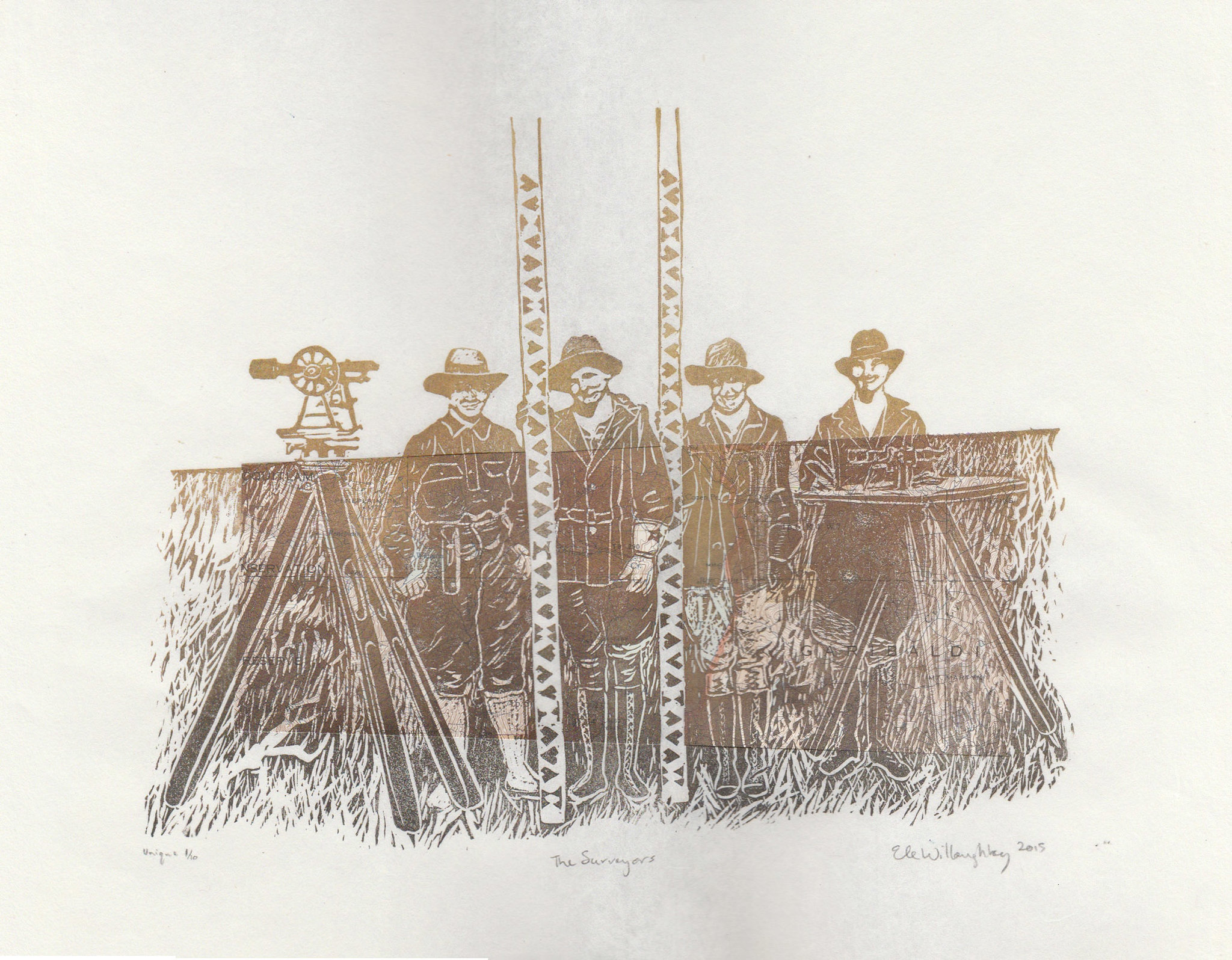
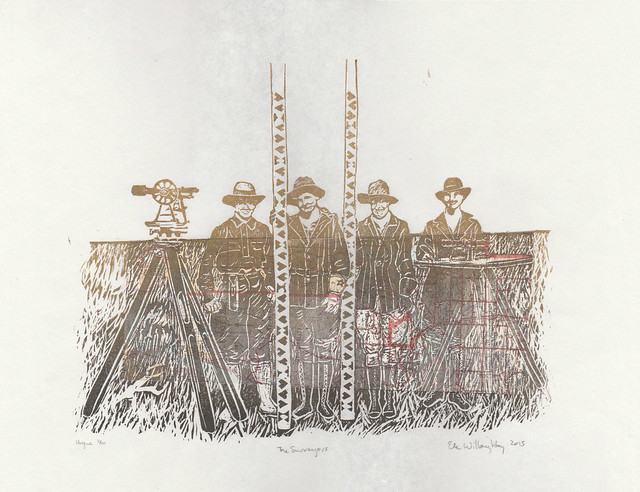
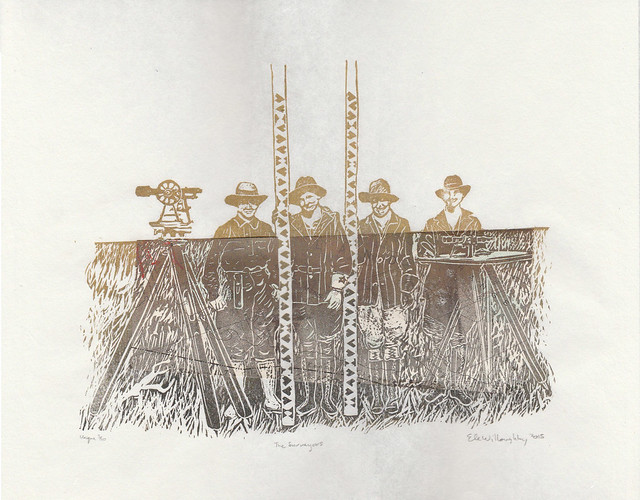
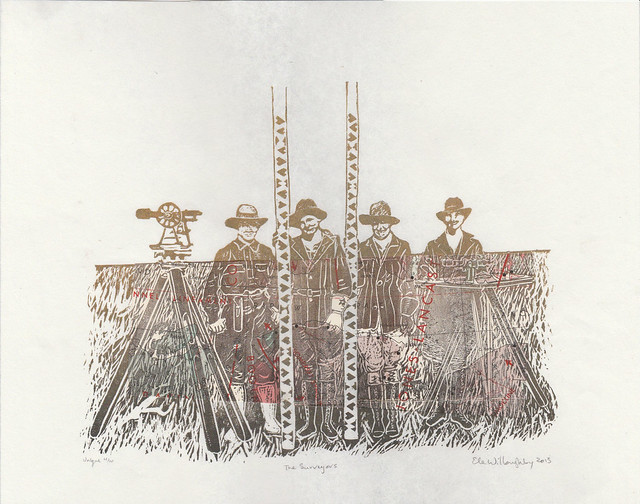
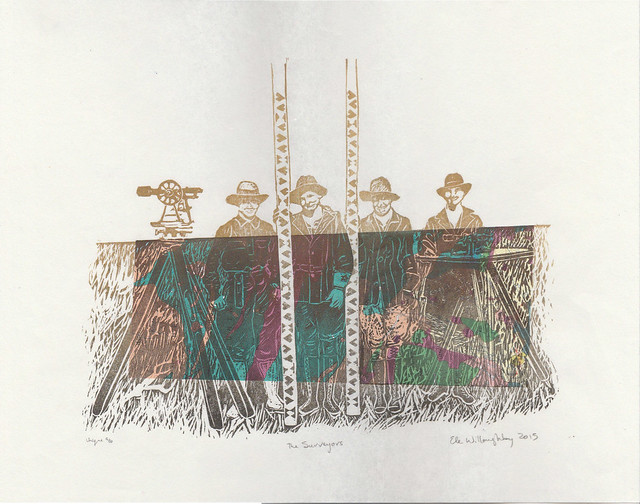
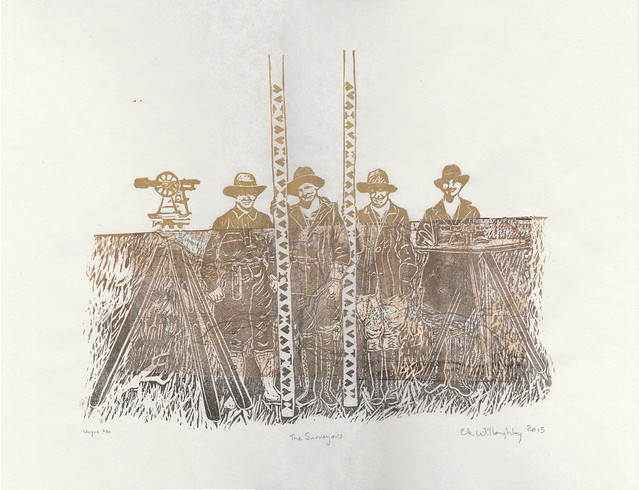
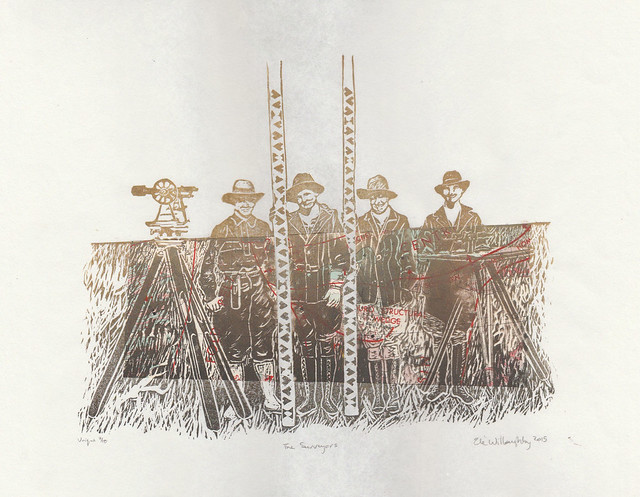
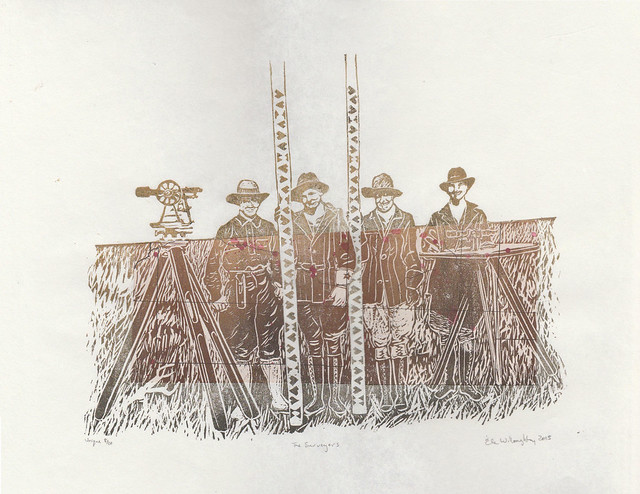
all ye of whom I have previously written. This marvelous book details the incredible, heroic story behind the birth of metric.* It should be required reading for undergraduates in science and physics in particular. As the image can attest, the story is one which can capture the imagination of an artist as well. Mid-eighteenth century revolutionary ideas about democracy, universality, human rights, trade and economics lead naturally to the realization that natural, universal units were a necessity (in the Old World and the New). We can little imagine the complete chaos of local units, based on the arms of merchants, or areas measured in days of labour expected to harvest a given crop which my vary depending on slope, or rocks, or who knows what all. It is in the last days of the
ancient régime, before the French Revolution, that two self-made astronomers, Jean-Baptiste-Joseph Delambre and Pierre-François-André Méchain (illustrated in the etching) were despatched on the epic adventure of measuring the meridian from Dunkerque to Barcelona. The goal was to set the length of the meter as 1/10000th of the quarter-meridian, the basis of length from the shape of the earth itself. Neither scholar imagined that they would face such incredible obstacles, including arrest, the
French Revolution**, ignorance of peasants at a time when accusations were often followed with prompt decapitation, war with Spain, life threatening illness and injury, the Terror, execution of loved ones and colleagues, dissolution of the
Academie, astronomical inflation and associated severe budgetary crises, Napoléon, on top of all the vagaries of weather, and the incredible scope of the expedition. Most troubling of all was dealing with the unprecedented precision from Borda's repeating circle, recognition of errors (before error analysis) and the complete mental break-down of Méchain in view of his own mistake. Not only does this book make their adventures come alive, it is one of the strongest explanations of the importance of errors in measurement I have ever read. The significance of this to science cannot be over-stated. The cast of supporting characters is wonderful, including the ugly, egalitarian yet womanizing astronomer Lalande, famed chemist and (tragically for him) tax-farmer Lavoisier, and one-and-only mathematician Legendre are priceless. Basically, go read this book!
29. The Selected Works of T.S. Spivet by Reif Larsen Reading this novel I thought, yes, this is what I want to do
all the time. Why can't I just get paid to read books like this? I would be happy doing this indefinitely. Of course, are there books like this one? That is a harder question to answer. Tecumseh Sparrow Spivet (best. name. ever.) is a gifted prodigy in cartography at 12 years old. He lives on a ranch near Divide, Montana, with his mother, stalled entomologist, Dr. Clair, his teenage sister, Gracie, who would love to escape their small town and peculiar family, and strong-silent cowboy father T.E. Spivet. His brother Layton, has died, and we slowly learn more. T.S. keeps different coloured notebooks*** for maps of people doing things; zoological, geological, and topographical maps; and insect anatomy (should Dr. Clair ever call on his help), respectively. for T.S. learns he has won the prestigious Baird Award from the Smithsonian, for his incredible mapping and scientific illustration work, and his adventure begins, as he decides to accept in person, but being 12, he sees his best means of transport as to hop on a freight train and hobo east. In this beautiful, whimsically illustrated book, T.S. maps
everything from the Continental divide, to beetle subspecies, to cowboy moves, to facial expressions, to geology, to how McDonald's "penetrates my permeable barrier of aesthetic longing", to concentration of litter in Chicago, to his family history, to a many-worlds interpretation of quantum mechanics and what this might have meant for his family. This book is beautiful, in terms of the sensitivity and originality of the story (Wormholes of the Midwest! the hobo hotline?), the love of knowledge expressed, down to the layout of the text and images on the page. Maybe we will be lucky enough to be recruited into the Megatherium club. The manner in which this child's mind breaks up the world is a reminder of why science is wonderful and the joy of unfettered thinking. The story is also interwoven with that of T.S.' ancestors, including his great-grandmother the early geologist. We get both 'when science was young' and 'the young scientist'.
30.Enemies of Promise - Publishing, Perishing, and the Eclipse of Scholarship by Lindsay Waters. I bought this little book published by the aptly named Prickly Paradigm Press, because I am sympathetic to the notion that publishing at all costs is not good for academia, because I thought it might teach me something about what my colleagues in the arts actually
do (i.e. how does one build knowledge without the standard of falsifiability), and because it was 50 cents. It was not a good investment. Unless you either a) believe that it is better for people to publish quantity than quality books or b) have a personal vendetta against Stanley Fish, I don't think you need to read this book.
31.Burnt Water by Carlos Fuentes I enjoyed this book of short stories, interwoven by linked incidental characters, buildings and Mexico City itself. Particularly, I enjoyed the magical realism of
Chac-Mol wherein the Aztec underpinnings seep through, or
In a Flemish Garden with its colonial ghosts. All the stories contained memorable characters and they work together to present a picture of a city of different classes, genders, and politics together as one cohesive whole.
32.You Don't Love Me Yet by Jonathan Lethem This was a very readable novel about art and music and love - and a kangaroo. Lucinda is a bassist in a band in LA. She gets a job answering phones as part of an art installation Complaint Line, wherein callers can complain about anything. Her depressed ex Matthew is the singer in the band, and works at the zoo. Denise the drummer, works in a 'masturbation boutique'. The band depends on their genius, socially inhibited songwriter, Bedwin, but he's suffering from writer's block.**** Lucinda begins to fall for a certain Complainer, and his complaints work their way into songs, and there are dire consequences. This is a short, fun, deceptively light novel. It somehow manages to blend the absurd with people and situations I swear I've seen. It feels real.
33. The Golden Notebook by Doris Lessing. Doris Lessing is the sort of writer who can write a memoir about her cats and it is profound, real and meaningful. This is a fascinating, book. This edition, published in 1971, just over a decade from his first edition, contains a Preface by the author, which instinct told me to save to the end. The novel has this interesting structure; it contains a small novel called 'Free Women' which is divided in five parts. Interspersed between these parts are the differently coloured notebooks of its protagonist, author (with writer's block) Anna Wulf. The notebooks contain her writing notes and issues (black), political life (red, as in Red, communist), her relationships (yellow) and a diary of everyday life (blue). It's a really interesting effect. We see the protagonist as she "is" (according to the author), as she is (according to herself), as she the writer chooses to represent in fiction (as Ella), and in non-fiction. All of these different facets come together to give a fuller expression of the whole. That is one of the messages of the book - that to be whole Anna must bring together her splintered life. Her insistence on separating aspects of herself has impacts on her mental health, though she is a highly intelligent, self-aware, psychoanalyzed person. The book culminates with the inauguration of a a new notebook, the Golden Notebook, for her full (no longer blocked) self. The novel tells the story of her life amongst bohemian socialists working for justice during WWII in Africa, deeply splintered by the colour bar. It tells the story of how a single woman could raise a child, with her fellow 'Free Woman' as support. It tells of the frustrations of the members of the C.P. and the disparity between their goals and the hypocrisy of reality and bureaucracy. It tells the story of her long afair, love, dependency and rejection. It tells of her psychoanalysis and attempts to work through her issues. Of her reacting to rejection by embracing a new personality. It tells of how she could finally reach wellness only through a breakdown in sanity. I was surprised by the idea that to represent the spirit of the times (1940s presumably Rhodesia and 1950s England) Lessing needed to write about a communist mindset, but it gives her a way to talk about not only specific politics and wars, but the failure of political systems. I was also surprised that it gives the impression that all married men in 1950s London were regularly having affairs. It is a strange book, at times difficult, at times funny, at times depressing but generally fascinating. I don't think I could explain more without writing at length, and what would be the point of that? Read it, if you are interested. She is a wise, if prickly, woman.
So I end with accomplishment through madness. Hmmm.....
{Series so far:
books read,
more books read,
books read,
books read continues,
more books read,
I,
II,
III,
IV,
V,
VI,
VII,
VIII,
IX,
X,
XI,
XII,
XIII,
XIV,
XV,
XVI,
XVII,
XVIII,
XIX,
XX,
XXI,
XXII,
XXIII XXIV,
XXV,
XXVI,
XXVII}
*I've just realized, this edition of Reading is sexy is all about the beautiful myth of oneness and universality.... and cartography.
**Forget the Spanish Inquisition. Nobody expects the French Revolution.
***I've just realized, this edition of Reading is sexy is all about characters who divide their lives into different coloured notebooks for different purposes.
****I've just realized, this edition of Reading is sexy is all about writer's block. Come to think of it, there is also the theme of women who make odd choices in men and sacrifice careers, the need for unbiased, unfettered thinking as well as mental break-downs which winds through these books.