Showing posts with label technology. Show all posts

Saturday, July 23, 2016

Ursual Franklin: physicist, thinker, feminist, pacifist, technology theorist, educator, role model

Ursula Franklin at work (via the Fisher Library, U of T)


Saddened to learn of Ursula Franklin's death. She was a hero of mine - a role model from before I was old enough to know I needed role models. As an undergrad in physics at U of T (one of a grand total of 2 female specialists in my year), I had zero female physics profs and she was the first female physicist I ever met. She has been a faculty member in Materials Science & Engineering (the first female engineering professor at the University). She was a fearless advocate for women in STEM and astonishingly incisive and astute. When I was a grad student, she joined a class action lawsuit against the University for paying women faculty less than comparably qualified men; they settled and acknowledged there had been gender barriers and pay discrimination.

She was perhaps best known for discovering radioactivity in the teeth of Canadian children and her subsequent advocacy for the atmospheric nuclear test ban treaty. She was such a strong voice telling us that both that technology isn't neutral, but also for what we now like to call 'evidence-based decision-making'. She reminded us that in advocacy it isn't enough to say no; why is a much stronger argument. She could have said I'm a pacifist, stop testing nuclear arms, but instead she showed unequivacally that such tests were impacting our children and needed to stop.

She also pioneered archeometry (the use of modern materials analysis in archeology, dating prehistoric artifacts made of metals and ceramics). She always put technology into human context in her science and her writing. She was a great thinker on the social implications of technology.

She was likewise fearless in standing up for peace and social justice; this was a formidable woman who survived being interned by the Nazis. I wrote more about her for Ada Lovelace Day in 2010 here. She was a great scientist, thinker, Canadian, human, and I was lucky to have met her.

When I was expecting Ursula was on my list of girl names because of her.

She's long been on my 'to do' list of portraits of scientists.

Wednesday, March 26, 2014

Hedy Lamarr, inventor of Frequency Hopping

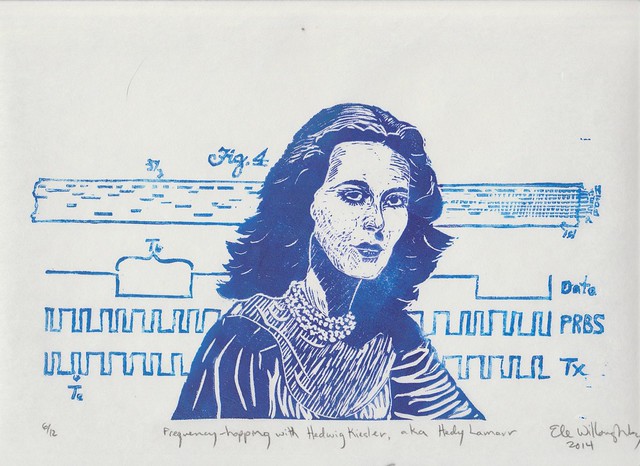
Hedy Lamarr linocut
Frequency-hopping with Hedwig Keisler, aka Heday Lamarr, linocut by minouette
This linocut portrait is of inventor and actress Hedy Lamarr (9 November 1914 – 19 January 2000), best known as a star of Hollywood's Golden Age. The linocut is printed in indigo and blue on Japanese kozo paper 9.25" by 12.5" (23.5 cm by 32 cm), inked à la poupée in an edition of 12.

Born Hedwig Keisler in 1914 in Vienna, Hedy became famous after her risqué and notorious starring role in Gustav Machatý's 1933 film Ecstasy. Friedrich Mandl, her first of six husbands (to whom she was married at the time), objected to what he felt was exploitation of his wife, including shots of her nude and simulating an orgasm. He tried unsuccessfully to buy up all copies of the film. Hedy objected to her husband, the munitions manufacturer, dealing with fascists including Mussolini and Hilter, despite the fact that she and her husband were both of Jewish heritage. Hedy had learned that the secret of her beauty was to, in her words "stand there and look stupid” though she was in fact highly intelligent, a mathematics prodigy, and an astute innovator. So while Axis leaders and arms dealers attended lavish parties at their castle home, Hedy gained a great deal of sensitive military intelligence, including intimate knowledge of the problems associate with radio-control of torpedoes. She decided to leave her controlling husband. She made her escape by disguising herself as her own maid (by drugging her and stealing her clothes), just in time to avoid the annexation of Austria. She took this intelligence with her to Paris, and on to London. In London she met Louis B. Mayer, who renamed her 'Hedy Lamarr' and hired her to work for MGM. She went on to make dozens of Hollywood films opposite all the big stars of the Golden Age, and was known as one of the most beautiful women in the world.

In 1940, spurned by the tragic sinking of a boatload of refugees, by a German U-boat torpedo, Hedy put her mind to the problem of national defense. She knew that torpedoes were guided by radio signals, of a single frequency, which were vulnerable to interference or "jamming". She had the idea that if multiple frequencies were employed, like a radio station which varied its channel unpredictably, it would not be possible for the enemy to find and interfere with the signal. This way the signal could be encoded across a broad spectrum. The difficulty would be in synchronizing the transmitter and the receiver, so they would be set at the appropriate frequency at all times. She met her neighbour, the avant-guard musician and composer George Antheil at a party. He had been working on automated control of musical instruments, including his music for Ballet Mécanique which involved synchronizing his melodies across twelve player pianos (or pianolas)! Is that not an excellent example of the wonderous region where art and science intersect? This was the answer. Together they developed Hedy's frequency-hopping idea, encorporating George's technology for synchronizing pianolas, and on the 11th of August, 1942, US Patent Number 2,292,387 for the "Secret Communications System" was granted to Antheil and to “Hedy Kiesler Markey”, which was her married name at the time. This early version of frequency hopping used a piano-roll to change among 88 frequencies (like the keys on a piano). Though the US navy did not adopt the method until 1962 (during their blockade of Cuba), and there other patents and inventors whose work contributed the modern methods, today, we recognize Hedy Lamarr as an important pioneer of wireless technology! Lamarr's and Antheil's frequency-hopping idea serves as a basis for modern spread-spectrum communication technology, such as Bluetooth, COFDM (used in Wi-Fi network connections), CDMA (used in some cordless and wireless telephones) and 4G LTE communications. You are probably using a device right now which relies on these ideas.

In the print, I show a portrait of Hedy in 1941, along with Fig.4 from Lamarr and Antheil's patent, which relates to the use of the piano roll. Below this, I show a diagram of how the modern the frequency-hopping code division multiple access (FH-CDMA) scheme works. The wide square wave labelled 'Data' is a signal to be encoded, with pulse width Tb. 'PRBS' means pseudo random binary sequence. It's the way the changes in frequency are introduced and plays the role of the piano roll today. It runs at a much higher rate than the data to be transmitted, with pulse width Tc. Data for transmission is combined via bitwise XOR (exclusive OR) with the faster code. This means that that if the two waveforms, the data and the PRBS are unequal, the transmitted signal (labelled Tx) will be high. Otherwise the transmitted signal will be low. The transmitted signal is spread across a spectrum of frequencies by a factor determined by the ratio of the two pulse widths; the bandwidth is increased by a factor of Tb/Tc. Since the PRBS, known as the "pseudo-noise" (PN) code can be can be reproduced in a deterministic manner by the intended receiver (which is equivalent to reproducing the imaginary piano roll), it can decode the signal. This spread spectrum encoding is at the heart of all our contemporary telecommunications and is only possible using the kind of frequency hopping that Hedwig Kiesler, also known as Hedy Lamarr, invented.


Monday, September 10, 2012

Hypatia (Part 1)

Hypatia3

Hypatia was the amongst the earliest woman mathematician recorded in Western history. This is my imagined portrait of her in a first edition linocut print in copper and purple-blue on lovely Japanese kozo (or mulberry) paper, 12.5 inches by 12 inches (31.7 cm by 30.5 cm). There are 12 prints in the edition.

Hypatia lived in the 3rd century AD in Alexandria, Egypt, which was part of the Roman Empire. She was born at some time between about 350 and 370 and died in 415 C.E. She was the head of school, where she taught Neoplatonist philosophy, astronomy and mathematics. She believed in empiricism and natural law. She was the daughter of a famous mathematician, Theon Alexandricus (ca. 335–405), with whom she worked and published edited versions of Classical texts in mathematics. She also pursued her education in Athens and Italy before returning to Alexandria.

It is difficult to precisely specify her own contributions to mathematics, since many documents have been lost and it was the tradition of the time to write commentaries on the great texts of Classical mathematics. These were essentially edited or annotated versions, which may have included corrections and new material, but which were known by the name of the original author. Also, her work and her father's work may be confused and conflated. This confusion of attribution is common for female scholars of the Classical world. It is known that she wrote commentaries on 13-volume Arithmetica by Diophantus, the Conics of Apollonius, and edited Ptolemy's Almagest and on Euclid's Elements. I've alluded to these in my print; the diagrams on her table, from right to left, show conic sections, Hipparchus' construction to calculate the distances to the Sun and Moon (which was part of Ptolemy's Almagest), and some basic Euclidean geometry. She is also credited with a more efficient means of doing long division - which is no mean feat when you recall she was using Roman numerals!

Hypatia detail of astrolabe She charted heavenly bodies. She built and instructed her pupils in the design and use of the astrolabe. The astrolabe, like the one she is holding in the print, was central to astronomy and navigation from antiquity through the Renaissance. It allowed people to measure the inclination of celestial bodies and could be used to locate or predict the positions of the Sun, Moon, planets, and stars, determine local time given local latitude and vice-versa, or for surveying and triangulation. You can see the outer circle is notated with the 24 hours of the day (in Roman numerals) and the inner circle with the symbols for the contellations of the Zodiac. Thus, she was not only a mathematician, but what we would today call an astronomer, a physicist and an engineer.

She met a terrible end. She became embroiled in a dispute between the Prefect and the Christian Patriach, later known as Saint Cyril, who spread rumors that she was a witch who had cast spells on the Prefect. Scolasticus, a contemporary Christian writer, wrote that she was kidnapped on her walk home, taken to a church, where she was stripped and torn limb from limb and then burned by an angry mob of Christians lead by a fanatic. News of her murder lead the community to be condemned. Scholasticus comments, "Surely nothing can be farther from the spirit of Christianity than the allowance of massacres, fights, and transactions of that sort".

Because of her violent and scandalous death, her story has been used by many groups of people with many competing interpretations of its meaning. She has been claimed by competing sects of Christian (who either defend or defame her) throughout history, Pagans, Wiccans, and feminists as a symbol. Somewhat ironically, though she was accused of being a Pagan "devoted at all times to magic, astrolabes and instruments of music, and she beguiled many people through her Satanic wiles" by the 7th-century Egyptian Coptic bishop John of Nikiû, she was later employed by Christians as a symbol of Virtue. She has appeared in literature, art, graphic novels (Alan Moore's Promethea) and cinema (including Agora (2009), by Alejandro Amenábar, staring Rachel Weisz) . Her murder has been called the first witch hunt, the end of Classical Antiquity and the beginning of the Dark Ages - but these claims are not well-founded in the actual historical events.

Chances are that many of these proponents of Hypatia and claims by various groups that she was one of their own are not really representative of the historical Hypatia, so much as her symbolic power. There is no unbiased contemporary evidence that she was either a true Pagan or a witch. She was a Neoplatonist, which was both a spiritual and philosophical tradition, so not truly a staunch secularist either. For all the competing Christian claims (Catholic versus Orthodox, Protestant versus Catholic, churches of Constantinople versus Alexandria) or the view that she was a tragic victim of the Church's conquest of science of the time, it seems likely that she was a political pawn in a battle between Patriarch and Prefect. But, it is very hard not to see that from the earliest known instance, a woman who excelled in science and math was the object of jealously, treachery, accusations of witchcraft and, in far too many cases, violence and murder. Though, she was not the only Classical woman in philosophy and mathematics and those who came before and those who followed did not share her terrible fate.

It was her fate which lead to her lasting fame but it is her achievements that should be remembered. One contemporary claimed she outshone her father, regarded the best mathematician of his generation. Perhaps most importantly, she preserved the mathematical heritage of ancient Greece and Roman and was talent and respected teacher. She was known to wear the robes of a scholar, usually reserved for men, as was the role she took as philosopher, mathematician and advisor to the leaders of her day. As Scholasticus wrote:

"There was a woman at Alexandria named Hypatia, daughter of the philosopher Theon, who made such attainments in literature and science, as to far surpass all the philosophers of her own time. Having succeeded to the school of Plato and Plotinus, she explained the principles of philosophy to her auditors, many of whom came from a distance to receive her instructions. On account of the self-possession and ease of manner which she had acquired in consequence of the cultivation of her mind, she not infrequently appeared in public in the presence of the magistrates. Neither did she feel abashed in going to an assembly of men. For all men on account of her extraordinary dignity and virtue admired her the more"

[Edited for accuracy February 3, 2022]

Wednesday, March 24, 2010

Ada Lovelace Day 2010 Profile: Ursula Franklin

Princess of Parallelograms Today is the second annual international day of blogging to celebrate the achievements of women in technology and science, Ada Lovelace Day 2010 (ALD10). I'm sure you'll all recall, Ada, brilliant proto-software engineer, daughter of absentee father, the mad, bad, and dangerous to know, Lord Byron, she was able to describe and conceptualize software for Charles Babbage's computing engine, before the concepts of software, hardware, or even Babbage's own machine existed! She foresaw that computers would be useful for more than mere number-crunching. For this she is rightly recognized as visionary - at least by those of us who know who she was. She figured out how to compute Bernouilli numbers with a Babbage analytical engine. Tragically, she died at only 36. Today, in Ada's name, people around the world are blogging about women in science and technology, whose accomplishments have all too often gone unrecognized or unacknowledged.

So I thought I'd tell you about of one my heroes, Ursula Franklin. I've heard her speak on more than one occasion and had the honour meeting Franklin. When I was an undergraduate in physics there were a grand total of zero female physics professors at this University, but Ursula Franklin was trained as a physicist and was working in metallurgy and material science, and had U of T's highest rank, a full University Professor, the first woman named to that post. Further she was not only a strong, fearless, advocate for women in science, but one of the more impressive individuals I've ever met. Her influence as a roll model of women in physics and engineering here cannot be overstated. I thought she was an apt choice to profile as beyond the importance and depth of her own scientific and technological output, she has been an influential writer on the politics and social impact of technology itself.

Franklin was born in Munich in 1921 and survived being interned by the Nazis. She received her PhD in physics from the Technical University of Berlin in 1948 and immigrated to Canada, where after a post-doc at U of T, she joined the faculty. She pioneered archeometry - the use of modern materials analysis in archeology, dating prehistoric artifacts made of metals and ceramics. Her science was always engaged with societal concerns. During the 60s she advocated for the atmospheric nuclear test ban treaty, citing her studies of strontium-90 radioactive fallout found in children's teeth. During the 70s she was part of the Science Council of Canada investigation of how we could better conserve resources and protect nature. She began to develop her ideas about complexities of modern technological society.

She consistently has stood up for her beliefs in peace and social justice. As a member of the Voice of Women (now called Canadian Voice of Women for Peace), she tried to persuade Parliament to disengage Canada from supplying any weapons to the US during the Vietnam war, to shift funding from weapons research to preventative medicin, to withdraw from NATO and disarm. She later fought to allow conscientious objectors to redirect part of their income taxes from military uses to peaceful purposes (though the Supreme Court declined to hear the associated case). She joined other retired female faculty in a class action law suit against the University of Toronto for claiming it had been unjustly enriched by paying women faculty less than comparably qualified men. The University settled in 2002 and acknowledged that there had been gender barriers and pay discrimination.

As an applied scientist, her writtings on technology benefit from the insight of an insider, but her priorities are justice and peace and she critiques and analyses technology in this light. She does not view technology as neutral; it is a comprehensive system that includes methods, procedures, organization, "and most of all, a mindset". It can be work-related or control-related, holistic and prescriptive. Franklin argues that the dominance of prescriptive technologies in modern society discourages critical thinking and promotes "a culture of compliance". She has investigated the relationship between technology and power. She has investigated how we interact with communication technologies and advocated for the right to silence.

Many of her articles and speeches on pacifism, feminism, technology and teaching are collected in The Ursula Franklin Reader (2006). Franklin is one of many respected scholars and thinkers to have delivered a series of Massey Lectures, in 1989. Hers were gathered and published as The Real World of Technology. She has been recognized for her work in many ways, including receiving the Order of Canada, Governor General's Award in Commemoration of the Persons Case for promoting the equality of girls and women in Canada and the Pearson Medal of Peace for her work in advancing human rights. Locals may know the Ursula Franklin Academy, a Toronto high school, named in her honour. I think this University, city, country and in fact, society at large are a better place because Ursula Franklin is a part of it. So, though she has received this recognition, I think she should be a household name, so that's why she's my choice for Ada Lovelace Day 2010.

{this post includes material from the surprisingly well-documented wikipedia entry on Ursula Franklin}

Read more Ada Lovelace Day posts on The Mad Scientists of Etsy Blog or at Ada Lovelace Day.

Wednesday, February 24, 2010

Ada Lovelace Day - March 24, 2010

One month from today, on March 24, 2010, the second anual international day of blogging to celebrate the achievements of women in technology and science, Ada Lovelace 2010 (ALD10).

Women’s contributions often go unacknowledged, their innovations seldom mentioned, their faces rarely recognised. We want you to tell the world about these unsung heroines, whatever they do. It doesn’t matter how new or old your blog is, what gender you are, what language you blog in, or what you normally blog about – everyone is invited. Just sign the pledge ... and publish your blog post any time on Wednesday 24th March 2010.


Over on the Mad Scientists of Etsy blog- many of whom are women in science or technology (or both) I'm hosting our own Ada Lovelace Day mashup! I hereby pledge to blog to draw attention to the achievements of women in technology and science on March 24th. Further, I will link to my team mates ALD10 posts and we will cross-post all our various entries here, on the Mad Scientists of Etsy Blog. Last year's event was a great success (my own post from 2009 is here) and this year, I'm looking forward to learning about other female innovators and heroines of my fellow Mad Scientists.

So, please get involved!
1. Go sign the pledge.
2. Read the MSOE ALD10 Mashup.
3. Blog on March 24th, 2010.


Ada, Countess Lovelace

The Enchantress of Numbers is calling on you


p.s. For the raving comix consumers/steam-punk fans: check out The Thrilling Adventures of Lovelace & Babbage.

Tuesday, April 21, 2009

modern technology angst

So Reynardin is worried about what the technocrats are up to. She worries about near-armaggedon when we destroy civilization as we know it, but some survive. She likes her iPod and assorted other amenities, and though she has a good conception of what they do, she could not make one from scratch. Well, I found her a tee-shirt for a different, but yet not-entirely-dissimilar concern: what if you find yourself back in time (a little harder to reconcile with physics as we know it, but nonetheless):


See, there you go. Just carry a cheat sheet.*

Now, if you could solve my evil-cashmere-eating moth invasion issue, we will call it even.

On an counter-productive note (because, after all, what could be less conducive to easing technological angst, and fears about what exactly are the technocrats up to, than giant robot spiders?), here is some footage of the 12-meter (40-ft) tall, 37-ton mechanical spiders was observed in the red brick warehouse area of Yokohama last Friday.


Now, I would say, "Only in Japan," however, since these steampunk giant spiders are made by La Machine of Nantes, France, that would be untrue. [via Pink Tentacle]

*The tip about Polaris being the brightest star and marking true north depends on time and how far back you go (further, it is none-too-helpful in the Southern Hemisphere)... but since we don't believe in time-like loops and rather doubt that time is two dimensional, it's rather moot.
Oh, and that icon of an atom is so early last century. Electrons come in clouds, not little orbiting things with precise locations.