Showing posts with label military history. Show all posts

Friday, November 1, 2019

Rear Admiral and Mathematician Grace Hopper Teaching Computers Something Like English

Grace Hopper, linocut on 11" x 14" Japanese kozo paper, 2019, by Ele Willoughby
The first modern computers were loud, room-sized monsters, essentially a collection of relays (electrical switches) patched together with electrical cords. Each "switch" could be one (1) or off (0) and could represent data (an input value) or an action applied to these data.  To talk to the computer, to tell it to do anything with these values, you needed to speak in machine code, in the natural language of the computer itself of zeroes and ones - and each machine had its one structure and associated code. The story of how these giant computing machines went from a rare, complex tool available only research scientists at a few select university or government labs to ubiquitous, multipurpose portable tools we carry with us everywhere and use daily, depends in part on the idea we could, and should, develop machine-independent programming languages and that these could be based on English. This revolutionary idea was popularized by American computer scientist and US Navy rear admiral Grace Brewster Murray Hopper (née Murray December 9, 1906 – January 1, 1992).

Born in on the Upper West Side of New York City, the eldest of three children, she was the sort of curious child who dismantled alarm clocks to discover how they work; she was seven when she was caught, having already taken seven clocks apart, and her mother limited her future exploration to working with a single clock. Her father owned an insurance business. She took after her mother, herself a mathematician. She was admitted to Vassar College at 17 and completed a Bachelor's degree in math and physics. By 1930, she had completed her Master's at Yale and married New York University comparative literature professor Vincent Foster Hopper (1906–1976). She began teaching at Vassar in 1931. By 1934, she completed her PhD on "New Types of Irreducibility Criteria" under the supervision of Øystein Ore at Yale. Unusually for a mathematics professor, she insisted her students write well; her first assignment would be an essay on her favourite formula. She felt studying mathematics without the ability to communicate math was pointless. Her own ability to translate real world problems into mathematics and math into English would serve her well throughout her career.

She became bored with an unexciting marriage and found teaching math less fulfilling than she hoped. When the US entered WWII she was on partial leave from Vassar, spending a year studying finite difference methods for solving partial differential equations with Richard Courant at New York University. She saw a way to change her life. At age 34, Hopper tried to enlist in the Navy, but was rejected. She was deemed too old, and a petite woman, her weight to height ratio was too low; further her job as a mathematician and professor at Vassar was considered valuable to the war effort.
Though Vassar promoted her to associate professor in 1941 she obtained a leave of absence. She persisted with her goal and got a special exemption for being 15 pounds (6.8 kg) below the Navy minimum weight of 120 pounds (54 kg) and volunteered for the the United States Navy Reserve women's branch (WAVES) in 1943. By 1945, she had divorced her husband, but chose to retain her husband's family name.

After graduating top of her class at the Naval Reserve Midshipman's School at Smith College in Massachusetts, she was assigned to the Bureau of Ships Computation Project at Harvard University as a lieutenant, junior grade. Howard H. Aiken, physicist and computing trailblazer, who had been a professor was now leading a team there as a commander in the Navy. His team was working on programming the giant IBM Automatic Sequence Controlled Calculator (ASCC), an electromechanical computer known as the Mark I. Hopper said she had to learn the languages of the different scientists and engineers whose problems they were running on the machine, the languages of the managers, and of the programmers, and her facility with these different modes of communication was why Aiken assigned her to write the first computer programming manual. Despite her doubt about writing a book, she produced a 561-page volume starting with a history of computing machines from Charles Babbage to the present. Like her forebearer Ada Lovelace, she saw the potential of a computer controlled by separate punch tape instructions (what we now know as software) rather than the need to reconfigure the machine hardware itself. Aiken had originally bristled at the thought of a woman on the team, but soon made Hopper primary programmer and his top deputy. She became known as irreverent, brilliant, sharp-tonged but a good collaborator. Together, Aiken and Hopper co-authored three papers on the Mark I. After the war, she requested to transfer to the regular Navy, but her request was declined due to her age. She opted nonetheless to remain at Harvard as Navy reserve research fellow under a Navy contract, until 1949, despite the offer of a full professorship at Vassar.

While working on the Mark I, Hopper perfected the use of the subroutine, the way programmers use a specific chunk of code to perform a specific task again and again, such as taking the sinusoid or logarithm of a value. This a concept Ada Lovelace wrote about in her Notes on the Analytical Engine.  She began thinking about the way to take her library of subroutines and enable its use on any machine, if her source code could be translated to machine code (which is machine-specific) by using a compiler.

Famously, while working on the Mark II, she and her colleagues had to do some literal "debugging" when a dead moth was discovered in a relay. The term "bug" already existed in engineering, but the process of systematical detecting and removing problems in computer programs came to be known as debugging partially because of this specific wayward moth and Hopper delighted to telling the story of the actual bug. It was dutifully recorded by taping its corpse labelled "First actual case of bug being found," in the log book dated September 9, 1947.

The Harvard Mark I, II and III, were reliable machines based on electromechanical relays, but these were slow. Hopper's work had help make these machines the most easily programmed but she recognized that the new electronic devices using vacuum tubes were so much faster, that easy of programming and reliability were not enough. Also, it became clear that she would not be promoted or granted tenure at Harvard. She left her post to join the Eckert–Mauchly Computer Corporation where she worked on the development of UNIVAC I, the first general purpose electronic digital computer design, made for business. When the company was taken over by Remington Rand in 1950, she was appointed UNIVAC director of Automatic Programming Development. She became convinced that since people were far better at writing English than in symbols, that they ought to be able to write programs in English and that the computer themselves should translate this into machine code. It took her three years to convince others. She wrote her first paper on compilers (now known as link-loaders, the tool computers use to translate English-like computer programs into machine code) and had developed a functional link-loader the A-0 in 1952, all while her peers thought computers could only do arithmetic. As a mathematics professor she realized only, "[v]ery few people are really symbol manipulators. If they are they become professional mathematicians, not data processors. It's much easier for most people to write an English statement than it is to use symbols. So I decided data processors ought to be able to write their programs in English, and the computers would translate them into machine code. That was the beginning of COBOL, a computer language for data processors. I could say 'Subtract income tax from pay' instead of trying to write that in octal code or using all kinds of symbols." Promoted to the company's first director of automatic programming, her department released some of the first compiler-based programming languages, including MATH-MATIC and FLOW-MATIC. In 1959, she was a technical consultant to the Conference on Data Systems Languages (CODASYL) where she and colleagues defined the new language COBOL (an acronym for COmmon Business-Oriented Language), extending on FLOW-MATIC and IBM's language COMTRAN. COBOL became a major computer language in data processing and even persists today as legacy code.

She sadly retired from the Navy Reserve at age 60, as required in 1967, at the rank of commander but was recalled to active duty in 1968 and served as the director of the Navy Programming Languages Group in the Navy's Office of Information Systems Planning. She retired again in 1971, but was again recalled in 1972. She became a captain in 1973. During the 70s she argued for the move away from giant centralized computers to networks of small, distributed machines. She worked on standards for computer systems, components and programming languages like FORTRAN and COBOL. In 1983 she was promoted to commodore and remained on active duty several years beyond mandatory retirement by special approval of Congress. In 1985 the rank commodore was renamed rear admiral making her one of few women to achieve that rank. She final retired in 1986 as the the oldest active-duty commissioned officer in the United States Navy at age 79. She then worked as a senior consultant to Digital Equipment Corporation (DEC) until her death at age 85 in 1992, lecturing on the history of computers in full dress uniform. By the end of her life she was a very well-recognized figure, earning more than 40 honourary degrees, many awards and had many things named in her honour. She became the first woman to win the National Medal of Technology, the highest technology award in the US. At the ceremony she said, “If you ask me what accomplishment I’m most proud of, the answer would be all the young people I’ve trained over the years; that’s more important than writing the first compiler.” After her death, the Navy commissioned the U.S.S. Hopper, a guided missile destroyer, and in 2016 Hopper was posthumously received the Presidential Medal of Freedom.

In my portrait I've shown her as she was in WWII in front of the Harvard Mark I, with a little nod to the famous "first" computer bug. I am the sort of nerd who actually looks up the actual moth recorded and then put some thought into species that may have fit the size and colour of the moth found at Harvard.

References
Gilbert, Lynn (1981). Women of Wisdom: Grace Murray Hopper. Lynn Gilbert, Inc.
Software Bug, Wikipedia, accessed October 2019 
Grace Hopper, Wikipedia, accessed October 2019 
COBOL, Wikipedia, accessed October 2019   
Harvard Mark IWikipedia, accessed October 2019   
Walter Isaacson, Grace Hopper, computing pioneer, The Harvard Gazette, December 3, 2014
Grace Murray Hopper (1906-1992): A legacy of innovation and service, Yale News, February 10, 2017

Wednesday, March 26, 2014

Hedy Lamarr, inventor of Frequency Hopping

Hedy Lamarr linocut
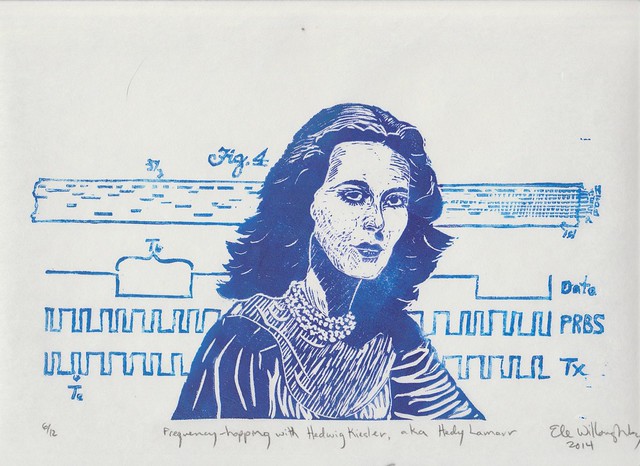
Frequency-hopping with Hedwig Keisler, aka Heday Lamarr, linocut by minouette
This linocut portrait is of inventor and actress Hedy Lamarr (9 November 1914 – 19 January 2000), best known as a star of Hollywood's Golden Age. The linocut is printed in indigo and blue on Japanese kozo paper 9.25" by 12.5" (23.5 cm by 32 cm), inked à la poupée in an edition of 12.

Born Hedwig Keisler in 1914 in Vienna, Hedy became famous after her risqué and notorious starring role in Gustav Machatý's 1933 film Ecstasy. Friedrich Mandl, her first of six husbands (to whom she was married at the time), objected to what he felt was exploitation of his wife, including shots of her nude and simulating an orgasm. He tried unsuccessfully to buy up all copies of the film. Hedy objected to her husband, the munitions manufacturer, dealing with fascists including Mussolini and Hilter, despite the fact that she and her husband were both of Jewish heritage. Hedy had learned that the secret of her beauty was to, in her words "stand there and look stupid” though she was in fact highly intelligent, a mathematics prodigy, and an astute innovator. So while Axis leaders and arms dealers attended lavish parties at their castle home, Hedy gained a great deal of sensitive military intelligence, including intimate knowledge of the problems associate with radio-control of torpedoes. She decided to leave her controlling husband. She made her escape by disguising herself as her own maid (by drugging her and stealing her clothes), just in time to avoid the annexation of Austria. She took this intelligence with her to Paris, and on to London. In London she met Louis B. Mayer, who renamed her 'Hedy Lamarr' and hired her to work for MGM. She went on to make dozens of Hollywood films opposite all the big stars of the Golden Age, and was known as one of the most beautiful women in the world.

In 1940, spurned by the tragic sinking of a boatload of refugees, by a German U-boat torpedo, Hedy put her mind to the problem of national defense. She knew that torpedoes were guided by radio signals, of a single frequency, which were vulnerable to interference or "jamming". She had the idea that if multiple frequencies were employed, like a radio station which varied its channel unpredictably, it would not be possible for the enemy to find and interfere with the signal. This way the signal could be encoded across a broad spectrum. The difficulty would be in synchronizing the transmitter and the receiver, so they would be set at the appropriate frequency at all times. She met her neighbour, the avant-guard musician and composer George Antheil at a party. He had been working on automated control of musical instruments, including his music for Ballet Mécanique which involved synchronizing his melodies across twelve player pianos (or pianolas)! Is that not an excellent example of the wonderous region where art and science intersect? This was the answer. Together they developed Hedy's frequency-hopping idea, encorporating George's technology for synchronizing pianolas, and on the 11th of August, 1942, US Patent Number 2,292,387 for the "Secret Communications System" was granted to Antheil and to “Hedy Kiesler Markey”, which was her married name at the time. This early version of frequency hopping used a piano-roll to change among 88 frequencies (like the keys on a piano). Though the US navy did not adopt the method until 1962 (during their blockade of Cuba), and there other patents and inventors whose work contributed the modern methods, today, we recognize Hedy Lamarr as an important pioneer of wireless technology! Lamarr's and Antheil's frequency-hopping idea serves as a basis for modern spread-spectrum communication technology, such as Bluetooth, COFDM (used in Wi-Fi network connections), CDMA (used in some cordless and wireless telephones) and 4G LTE communications. You are probably using a device right now which relies on these ideas.

In the print, I show a portrait of Hedy in 1941, along with Fig.4 from Lamarr and Antheil's patent, which relates to the use of the piano roll. Below this, I show a diagram of how the modern the frequency-hopping code division multiple access (FH-CDMA) scheme works. The wide square wave labelled 'Data' is a signal to be encoded, with pulse width Tb. 'PRBS' means pseudo random binary sequence. It's the way the changes in frequency are introduced and plays the role of the piano roll today. It runs at a much higher rate than the data to be transmitted, with pulse width Tc. Data for transmission is combined via bitwise XOR (exclusive OR) with the faster code. This means that that if the two waveforms, the data and the PRBS are unequal, the transmitted signal (labelled Tx) will be high. Otherwise the transmitted signal will be low. The transmitted signal is spread across a spectrum of frequencies by a factor determined by the ratio of the two pulse widths; the bandwidth is increased by a factor of Tb/Tc. Since the PRBS, known as the "pseudo-noise" (PN) code can be can be reproduced in a deterministic manner by the intended receiver (which is equivalent to reproducing the imaginary piano roll), it can decode the signal. This spread spectrum encoding is at the heart of all our contemporary telecommunications and is only possible using the kind of frequency hopping that Hedwig Kiesler, also known as Hedy Lamarr, invented.


Wednesday, March 19, 2014

Florence Nightingale

Florence Nightingale portrait
Florence Nightingale, linocut inked à la poupée with chine collé in an edition of four, on Japanese kozo paper 9.25" by 12.5" (23.5 cm by 32 cm), by Ele Willoughby (aka minouette)

I confess that Florence Nightingale wasn't on my shortlist of women in science I wished to portray. I felt a little like she was an old-fashioned heroine, from a time where if a woman wasn't going to be defined strictly as a person who served and cared for her family, it was okay if (and only if) she cared for other people. This bias was somewhat reinforced by my own family history: my mother is a nurse, her mother was a nurse, whereas I am a physicist. I know my grandmother wanted to be a pharmacist, and my mother felt her career options were school teacher or nurse. Plus, I take after my father's side of the family and have been known to have a vasovagal response to the mere description of medical procedures; I have a high pain threshold, but am squeemish, and faint like the rest of them. I tend to find watching or thinking about others induring something is worse than say, being injured myself.* All of which means I partially define myself by not being a nurse. However, I was (luckily) commissioned to make a portrait of Florence Nightingale. The more I read, the more interesting she became to me.


Nightingale earned the nickname "The Lady with the Lamp" during the Crimean War, from a phrase used by The Times, describing her as a “ministering angel” making her solitary rounds of the hospital at night with “a little lamp in her hand”. The image was immortalized by Henry Wadsworth Longfellow's 1857 poem Santa Filomena in the stanza:

Lo! in that house of misery
A lady with a lamp I see
Pass through the glimmering gloom,
And flit from room to room.

So, I’ve shown Nightingale with her little lamp, based on contemporary photos and illustrations. But inventing modern nursing wasn't her only accomplishment. Taking up a profession, travelling to a war zone, nursing the wounded, taking on hospital administration and the training of a professional class of nurses weren't the only things she did which were so unusual for a woman of her time to do. It turns out that her father fostered her gift for mathematics, and she made significant contributions to statistics and data visualization too.

Behind Nightingale is her own ‘Diagram of Causes of Mortality in the Army in the East’ plotted as a polar area diagram – though not her own statistical and data visualization innovation, sometimes called a Nightingale Rose Diagram. It illustrates the causes of death in the military hospital she managed during the Crimean War. April 1855 to March 1856 is shown on the left and April 1854 to March 1855 to the right. When she researched the causes of mortality, looking back at the data, she saw clearly that the lack of hygiene was a far greater risk to soldiers’ lives than being wounded. The sections represent one month of data {J,F,M,A,M, J,J,A,S,O,N,D} for each month of the year. The green “wedges measured from the centre of the circle represent area for area the deaths from Preventible or Mitigable Zymotic diseases, the [yellow] wedges measured from the centre the deaths from wounds, & the [orange] wedges measured from the centre the deaths from all other causes. The […] line across the [yellow] triangle in Nov. 1854 marks the boundary of the deaths from all other causes during the month. In October 1854, & April 1855, the [orange] area coincides with the [yellow], in January & February 1856, the [green] coincides with the [orange]. The entire areas may be compared by following the [green], the [yellow], & the […] lines enclosing them.” This "Diagram of the causes of mortality in the army in the East" was published in Notes on Matters Affecting the Health, Efficiency, and Hospital Administration of the British Army and sent to Queen Victoria in 1858.

This experience influenced her later career and she campaigned for sanitary living conditions, knowing how dangerous unsanitary conditions can be to survival. She also made extensive use of similar polar area diagrams on the nature and magnitude of the conditions of medical care in the Crimean War, or sanitation conditions of the British army in rural India, to make such statistics transparent to Members of Parliament and civil servants who would have been unlikely to read or understand traditional statistical reports.

In 1859, Nightingale was elected the first female member of the Royal Statistical Society. She later became an honorary member of the American Statistical Association.

Though her own opinion  of other women was often harsh, she has been credited with contributing to feminist literature with a book she wrote while sorting out her thoughts on her role in the world, including the essay Cassandra, which protested the over-feminisation of women into near helplessness. She helped abolish laws regulating prostitution that were overly harsh to women. She also clearly expanded the acceptable forms of female participation in the workforce.

This, and in particularly, the way she insisted on making decisions based on scientific evidence, and using data to save lives, makes her an apt addition to the women in science portrait series.

*My grandfather was a very strong man, who fainted when diagnosed with a fully treatable skin cancer, despite enduring rhematoid arthritis without complaint. My father famously fainted during his pre-natal class. My brother fainted during a presentation on why junior high school students shouldn't smoke, which included an image of a damaged lung. My other brother  famously fainted during Indiana Jones and the Temple of Doom, twice. I fainted during a tour of McMaster Medical School, while they explained what happened to corpses at the morgue. They sat me down, got me water and told me not to be discouraged from a career in medicine, while I looked at them in disbelief and insisted I never wanted one.