Showing posts with label portrait. Show all posts

Tuesday, July 27, 2021

Mathematician Karen Uhlenbeck, Bubbles and Bubbling

Karen Keskulla Uhlenbeck, linocut detail, 9.25" x 12.5", variable edition on Japanese kozo paper with chine collé with suminagashi marbling, by Ele Willoughby, 2021


My latest #sciart (or, maybe #mathart) portrait is of mathematician Karen Uhlenbeck. Though a lot of her work is pertinent to physics, this was still a challenge to work out how to tell the story of her mathematics. A founder of modern geometric analysis, she won the 2019 Abel Prize for "her pioneering achievements in geometric partial differential equations, gauge theory, and integrable systems, and for the fundamental impact of her work on analysis, geometry and mathematical physics." Partial differential equations are pretty central to doing physics, and a sort of mathematics I really enjoy, but apart from that, I know what all the words mean in that previous sentence, but things like gauge theory and analysis aren't part of the math I've studied or used in my own research. As we move forward in time, depicting contemporary (or near contemporary) mathematics is increasingly challenging because it's beyond my ken.

I looked up several of her important papers, seeking geometrical diagrams as a way to tell the story of her research pictorially. Though she describes herself as a visual, geometric (and messy!) thinker, I didn't find anything but a lot of algebra (which I would have had to work hard to follow, let alone use to speak to a wide audience, or painstakingly carve in reverse!) But I found an "in" for depicting minimal surfaces and her methods for removing singularities, through Fields Medalist Sir Simon Donaldson's review of her work, including a schematic of "bubbling" and also some of the great science/math communication and articles about her and her work, which were published when she won the Abel Prize.

Born in Clevland to an engineer father Arnold Keskulla and teacher and artist mother Carolyn Windeler Keskulla, her family moved to New Jersey when she was a child. She spent her childhood enjoying nature, playing football and secretly reading science texts, imagining a job where she could avoid people. She started a degree in physics but switched to math at the University of Michigan. In the wake of the Soviet Union's launch of Sputnik the US Congress passed the National Defense Education Act, to encourage more participation in STEM including encouraging women and minorities in those fields. The university added an honours math course in response, which showed her there was more to math than she ever knew and it changed her life. “The structure, elegance and beauty of mathematics struck me immediately, and I lost my heart to it,” she wrote. She switched majors. She chose the Courant Institute of Mathematical Sciences at New York University, for graduate school, avoiding applying to more prestigious schools where she feared the competitive male math culture wouldn't suit her. She married biophysicist Olke C. Uhlenbeck, the son of European intellectuals; his father is well-known physicist George Uhlenbeck. She was quite influenced by her new in-laws. Her parents valued ideas but put an emphasis on earning an income, but her in-laws valued intellectual things and encouraged her pursuit of mathematics. Her husband moved to Harvard and she opted to switch to graduate school at Brandeis University, where she earned her PhD in 1968 with advisor Richard Palais. Palais was exploring the space between analysis (a generalization of calculus) and topology (the study of shapes) and Uhlenbeck enjoyed this in-between world. With Smale, Palais had made advances in the study of harmonic maps, which came out of the calculus of variations and the search for shapes in equilibrium with physical measurements. Uhlenbeck's research built on this.

She found temporary jobs at MIT and Berkeley but was hampered by the classic "two-body problem" for academic spouses (where an couple cannot find two professorships in the same place) and anti-nepotism rules - though she later noted that the institutions which claimed they were precluded from hiring both her and her husband, even in different departments, did not officially have any such anti-nepotism rules on the books. Schools like MIT, Stanford and Princeton which courted her husband, simply declined to hire a woman in math. Her husband generously declined to work at institutions where she could not.

Eventually they both got faculty positions at the University of Illinois at Urbana–Champaign in 1971. But she could not stand life in Urbana, where she was often dismissed as an "academic wife" rather than a professor in her own right. She lacked professional support, did not enjoy teaching, felt undervalued and struggled to find the right research topic for her. But, while there, she met post-doc Jonathan Sacks and they began working whether certain problems converge to harmonic maps; eventually they discovered a sort of "awkward point" or singularity called a bubble where systems cannot converge on a harmonic map. The mathematical concept of a minimal surface minimizes area (or surface tension or energy) the way a soap bubble does in the natural world. They showed there were a finite number of these singularities and that when you rescale a map near them you have "bubbling" as in the diagram in my print. This trick of rescaling was one of her and Sacks' most important contributions.

 She moved to the University of Illinois at Chicago in 1976, separating from her husband. In 1983, she moved to the University of Chicago, where there were other women math professors and peers who took her seriously. She received a Sloan Fellowship and finally knew she could support herself and her research. She learned the value of a professional support network and realized that isolating herself was hurting her and her career. Her work with Sacks was foundational to the development of the new mathematical field of geometrical analysis. This bubbling phenomenon was found in many different sorts of mathematical physics. She took her intuition and techniques honed working on minimal surfaces and began ground-breaking work in gauge theory and the nature of exotic n-spaces, a means of connecting observations at different places that comes up in the quantum mechanical world of fundamental forces, building on the work of mathematical physicists like Weyl, Yang and Mills. With C.H. Taubes, she analyzed Yang-Mills equations in four dimensions; she proved her removable singularities theorem, showing that bubbling cannot occur around isolated points, so if a finite-energy solution exists to the Yang-Mills equations near a point, the solution will extend smoothly to the point. Simon Donaldson's extension of this research won him the prestigious Fields Medal for mathematics in 1986. Uhlenberck won a MacArthur Prize Fellowship or "genius grant" (1983-1988) which made her feel, "obliged to become more ambitious.”

She married mathematician Robert F. Williams, then in 1988, moved to the University of Austin as the Sid W. Richardson Foundation Regents Chairholder and won the Noether Lecture award from the Association for Women in Mathematics. In 1990, she was only the second woman in math to give the plenary lecture at the International Congress of Mathematicians in Kyoto, after none other than mathematical giant Emmy Noether. She founded the Park City Mathematics institute and with Chuu-Lian Terng she co-founded the IAS Women and Mathematics (WAM) program to recruit and retain more women in math, encouraging collaboration and mentorship at all stages of their careers, a complete turn-around from the isolation she sought at the beginning of her career and her avoidance of her fellow women in math because “It was self-evident that you wouldn't get ahead in mathematics if you hung around with women.” Together, they've created a network of nearly 1500 women mathematicians. She realized that one needs role models - not examples of perfection, but people who make errors but pick themselves back up. When asked if she had a role model, she cited beloved chef and TV presenter Julia Child! "She had these fantastic television programs, and she was a real person. She could pick the turkey up off the floor and serve it," Uhlenbeck said. She founded the Distinguished Women in Mathematics Lecture Series at the University of Texas at Austin. Uhlenbeck won the National Medal of Science in 2001 and the 2007 Steele Prize for a Seminal Contribution to Mathematical Research from the American Mathematical Society. Granted yearly by the King of Norway, rather like a math equivalent to the Nobel, the Abel Prize includes a $700,000 award, and recognizes a mathematician’s entire career. Uhlenbeck became the first (and so far only) woman to win the Abel Prize in 2019.  She donated half the funds to organizations encouraging underrepresented (that is, traditionally excluded) minorities in mathematics. She further donated to environmental organizations and the National Academy of Science. She is now an emeritus professor at Austin, as well as a visiting associate at the Institute for Advanced Study and senior research scholar at Princeton University.

Like so many of my subjects, I've found she also loves art and began drawing more than a decade ago, mostly landscapes. She notes, “I discovered the fascinating fact that the problem of scale occurs both in mathematics and in drawing.” In drawing you want to capture the full forest as well as the details of individual plants, just as you want to capture all scales in math. “The hardest part with both is fitting the two scales together. You need the right tools.” Uhlenbeck has provided the world of mathematics and physics with so many of just the right tools.

References

Donaldson, S.. “Karen Uhlenbeck and the Calculus of Variations.” Notices of the American Mathematical Society 66 (2019): 1. DOI:10.1090/noti1806

Sioban Roberts, "In Bubbles, Karen Uhlenbeck Sees a Mathematical Universe," The New York Times, April 8, 2019

Karen Uhlenbeck, Wikipedia, accessed July 2021.

Rachel Crowell, "Karen Uhlenbeck Becomes First Woman To Win Abel Prize For Mathematics," Forbes, March 20, 2019

Dale DeBakcsy, How Mathematical Lone Wolf Karen Uhlenbeck Found Her Pack, Women You Should Know, November 29, 2017.

Karen Uhlenbeck, Karen Uhlenbeck on Being the First Woman to Receive the Abel Prize, remarks made at reception at the Institute for Advanced Study on March 19, 2019.

Karen Uhlenbeck, Coming to grips with success: a profile of Karen Uhlenbeck, Celebratio Mathematica, 1996

Jessica Atlee, Crossing Fields: Karen Uhlenbeck’s pioneering work marries math with physics, Symmetry Magazine, August 15, 2019.

Erica Karreich, Karen Uhlenbeck, Uniter of Geometry and Analysis, Wins Abel Prize, Quanta Magazine, March 19, 2019

Marianne Freiberger, The Abel Prize 2019, Plus magazine, University of Cambridge, March 19, 2019.

Wednesday, October 7, 2020

Rosalind Franklin, revealing the the double helix of DNA, the structures in carbon materials and the shapes of viruses

Roaslind Franklin, linocut, 11" x 14", by Ele Willoughby 2020


Rosalind Elsie Franklin (25 July 1920 – 16 April 1958), the English chemist and x-ray crystallographer whose x-ray diffraction images were instrumental to discovering the double-helix structure of DNA, has been on my to do list for scientist portraits for years and I've finally got around to it. I think it's the messiness and tragedy of her story that made it a challenge. The version of Franklin which is best known by the general public, is the version presented by the Nobel laureate once described by E. O. Wilson as "the most unpleasant human being I had ever met" James Watson, in his biography The Double Helix, published in 1968. Not only does he call her patronizingly Rosy, he presents her as a dowdy data-hoarding scold who "had to go or be put in her place". Ironically, his biography hurt his own reputation (though he's quite skilled at hurting his reputation more recently, what with the repeated pro-eugenics, racist, homophobic and sexist comments). Watson confessed, “Rosy, of course, did not directly give us her data. For that matter, no one at King's realized they were in our hands.” Strangely, after the publication of their DNA structure papers, Watson and Franklin were on friendly terms, exchanged letters and he even once offered her a lift across the US. His version of her as the villain emerged years after her death, when he wrote the book; some (like Franklin's biographer Maddox) suggest guilty feelings about the irregular way her data was accessed and insufficiently cited are the explanation. Before the book was published, Francis Crick, Maurice Wilkins, Linus Pauling, Max Perutz and Rosalind's brother Colin all protested angrily at her portrayal (as well, often, as the portrayal of themselves and other scientists), especially as she could not defend herself. This forced Watson to add an epilogue praising her as a scientist and claiming he hadn't sufficiently appreciated the experience of women in science at that time. Wilkins wrote to Harvard University Press that the book remained disgraceful and they dropped it; it was published instead by Athenaeum Press, becoming a bestseller.

There's a joke amongst scientists that goes, "What did Watson and Crick discover?" "Rosalind Franklin's notes." And while it's important that her contributions are now recognized posthumously, there's more to her story and to the story of DNA research. Ironically, the famous Photo 51 produced by Franklin's graduate student Raymond Gosling, which Maurice Wilkins quietly shared with Watson and Crick and cemented their thinking about molecular structure, is a photo that Franklin had previously presented at a seminar attended by Watson (where he failed to notice it, presumably thinking patronizing thoughts about "Rosy"). Watson, Crick and Wilkins were awarded Nobel prizes in 1962, after her death.  Though this was prior to the institution of the informal rule against awarding posthumous Nobels, Franklin was not nominated. Before her life was cut tragically short by ovarian cancer, both prior to and after her DNA research, Franklin also made invaluable contributions across disciplines of physics, chemistry and biology, working to determining the structure of RNA, viruses, coal and graphite. Even aside from her role in determining the structure of DNA, her research was a great benefit to society. I wanted to make sure my portrait represented all of this.

But first, this is a wonderful comic by the one and only Kate Beaton:


by Kate Beaton
by Kate Beaton from Hark, A Vagrant

Rosalind was born in 1920, the second of five children born to a liberal, affluent and influential London Jewish family. Her father was a merchant banker and his uncle had been Home Secretary, the first practising Jew to serve in the British Cabinet. Her father taught electricity, magnetism and history of the Great War, at the Working Men's College and eventually became Vice Principal. Her family helped settle Jewish refugees fleeing the Nazis, especially children from the Kindertransport. They took two of the children into their home. Rosalind attended St. Paul's school, a leading girls' private school, one of few girls' schools which taught physics and chemistry. She excelled at sciences, languages and sports and won a scholarship for university. Her father asked her to donate the funds to a refugee student. She studied chemistry at Newnham College, Cambridge, completing her undergraduate studies in 1941. Due to the sexist attitudes of the day, women were not granted full degrees, but "degrees titular," until 1948 (when previous women's degrees were retroactively awarded). In her last year at Cambridge she met a French refugee and former student of Marie Skłodowska-Curie, Adrienne Weill; this friendship was an opportunity to practice her French and became important in her career.

She began a PhD project on the polymerisation of acetaldehyde and formic acid under the supervision of Ronald Norrish, Professor of Physical Chemistry at Cambridge and later a Nobel laureate. It was not a fruitful collaboration. His own biographer described Norrish as "obstinate and almost perverse in argument, overbearing and sensitive to criticism" and Franklin grew to despise him and resigned. She gladly took an opportunity to transfer to the British Coal Utilisation Research Association (BCURA) at Kingston-upon-Thames. She began focusing on the porosity and density of coal, to learn how to increase the efficiency of the widely used fossil fuel resource. Her work also had important implications for the effectiveness of the activated-charcoal filters in Second World War gas masks, issued to the entire British populace in case of gas attack. In working to accurately determine the porosity of coal, she made what was likely the first demonstration that coal acts as a molecular sieve (letting helium molecules through but not larger hexane and benzene). This property is still important to industry today.

She completed her doctorate on the structure of carbon materials in 1945 (and once again, as a woman, had to wait to be awarded her full degree until 1948). Her friend Adrienne Weill suggested she attend a Royal Institution meeting in London where she might meet Marcel Mathieu and Jacques Méring. At this conference her interest was sparked in x-ray diffraction and she met the great crystallographer J.D. Bernal (with whom she would later work). Impressed with her paper Méring offered her a researcher post in Paris to continue her work on carbons for four happy years. Méring was a x-ray crystallographer, who employed the way substances diffracted x-rays to deduce their structure and he taught her how to apply this method. By 1950 she had published a paper in Nature about the structure of carbon, and by the following year had learned that as carbon in the form of coal burns, it can form one of two structures: graphitizing and non-graphitizing (terms she coined). In my portrait, the pattern on her jacket is based on her own publication of the structure of non-graphitizing carbon. She showed these two structures explained the difference between the two possible products of burning coal: cokes and chars, and how they burn. This research had important industrial applications. She continued to write papers about the structure of carbon until she died. 

She returned to England in 1950 to work with John Randall, head of the Biophysics Research Unit at King’s College, on a three-year Turner-Newall Fellowship. She planned to look at protein structure but he suggested she work on DNA, as Maurice Wilkins was doing. Randall did not clarify whether Franklin or Wilkins would lead this research, which set their relationship off on the wrong foot. Randall reassigned Wilkin's graduate student Raymond Gosling as her assistant; this surely also did not help things between them. Franklin refined and adjusted the fine-focus X-ray tube and microcamera ordered by Wilkins, improved upon his technique by manipulating the critical hydration of her specimens and employing all her physical chemistry expertise. Wilkins inquired about this and felt her reply was superior. Her directness and enjoyment of a good debate were a bad match for his shyness and distaste for arguments, and their personalities clashed badly.

As early as November 1951, Franklin presented their data at King's College London and noted,

"The results suggest a helical structure (which must be very closely packed) containing 2, 3 or 4 co‐axial nucleic acid chains per helical unit, and having the phosphate groups near the outside."

Franklin and Gosling found there were two forms of DNA: long and thin when wet (dubbed B-DNA) and short and fat when dry (dubbed A-DNA). Because of their conflicting personalities, Randall divided the labour so Franklin and Gosling studied the A form and Wilkins the B. They produced beautiful images of DNA during this time, including Gosling's famous Photo 51 (represented in blue in my portrait). By 1951, the King's researchers all believed B-DNA was a helix, but Franklin felt the evidence for A-DNA was still conflicting. Through painstaking work, by January 1953, Franklin reconciled the conflicting data, concluding both forms had two helices. She drafted three papers, and two noted the double helical DNA backbone. She had also decided to leave the unpleasant atmosphere at King's and move to Birkberk College. Randall insisted that the DNA research stay at King's and Gosling would be reassigned back to Wilkins.

Meanwhile in Cambridge, James Watson and Francis Crick were simultaneously working on the problem and had seen a preprint of Linus Pauling's incorrect proposal for DNA. They came to King's to urge collaboration to win the race before Pauling discovered his error. Thanks to Franklin's identification of the nature of the symmetry of the DNA crystals (that is, its space group), Crick understood that DNA strands were antiparallel (and that both Pauling's model and Watson and Crick's previous model were incorrect). Unable to find Wilkins they spoke with Franklin who was unimpressed by Watson's implication she could not interpret her own data; they argued. Wilkins arrived, commiserated with them, and showed Watson Franklin's work and Gosling's DNA image.  From Wilkins' perspective, Franklin was leaving, and Gosling was now his student; but it seems he did not let Franklin know he had done this. In February 1953, Watson and Crick began working on a molecular model of B-DNA, something Franklin felt was premature, with much of the data based on work at King's. Crick got access to many of Franklin's crystallographic calculations when his advisor Max Perutz gave him a report written for a Medical Research Council biophysics committee visit to King's in December 1952. Though not explicitly marked confidential there was an expectation that such a report would not be shared and Perutz later defended this action with inexperience with administrative matters. Franklin's A-DNA paper was submitted 6 March 1953, one day before Crick and Watson had completed their model on B-DNA. She had not seen Watson and Crick's work when she submitted her paper (though they had of course benefited from seeing her, Gosling and Wilkin's work). Her laboratory notebooks reveal that she had already Franklin noted that ‘an infinite variety of nucleotide sequences would be possible to explain the biological specificity of DNA’ all on her own. Franklin got to see the model built by Watson and Crick on April 10 and apparently commented, "It's very pretty, but how are they going to prove it?" Her philosophy as an experimentalist was to be able to rigourously prove a model correct before publishing. Franklin did modify her paper while in press, after seeing the others' work to acknowledge their work. A trio of DNA papers were published as 25 April 1953 Nature articles. Watson and Crick's paper only acknowledged "having been stimulated by a general knowledge of" Franklin and Wilkins' "unpublished" contribution. Due to agreements between the directors of the King's and Cambridge labs, Wilkins and Franklin published the two other DNA articles with x-ray diffraction data supporting Watson and Crick's model (rather than presenting them as the data which underpinned the model). Watson and Crick invited Wilkins to be a co-author but he declined because he had not help build the model. He later lamented that they can not discussed authorship more thoroughly. 

It may have been less than obvious to Watson and Crick how to cite materials they used, including Photo 51 and the MRC report, but it is something that they could have been done and ethically, many argue that they should have done. Likewise, Watson and Crick were aware of Franklin and Gosling's paper (which included Photo 51), submitted before she saw their work, but they merely noted that their model was not inconsistent.  Any mention they made of Franklin is in combination with, and after naming Wilkins. There is a strong case to be made that Franklin's work was insufficiently credited, and its value and role in determining the structure of DNA has only be recognized posthumously. There's no evidence that Watson and Crick ever let Franklin know what they later acknowledged, that they could not have made their model without out her work, or that she felt insufficiently recognized in their publication. They remained friends during her life and continued to correspond about their respective research projects.

By mid-March, Franklin moved to the much less fancy but much more pleasant Birkberk College, having been recruited by physicist John Desmond Bernal. She was much more comfortable at the non-denominational Birkbeck than the Anglican King's. Though Bernal wanted her to move on from nucleic acid, she continued to mentor Gosling and aid him with the completion of his thesis. The two published the first evidence of the double helix in the A form of DNA in the 25 July issue of Nature. With funding from the Agricultural Research Council, she was able to start her own research group and begin working on RNA and the structure of the Tobacco Mosaic Virus (TMV), an RNA virus. In my portrait her brooch is a model of TMV. She published her first major TMV paper in 1955 in Nature, in opposition of prominent and powerful virologist Norman Pirie, who wrote her angry, condescending letters and refused to ever again supply her with virus samples to study. But her careful observational work was once again correct. With her grad student Kenneth Holmes she found the protein covering was molecules arranged in helices. Early in 1954, she happened to meet Aaron Klug on the stairs at work. She showed him her photo of the TMV and he wrote, it sealed his fate. Captivated, he sought permission to switch to virus research. They began a long and fruitful collaboration. She oversaw a group with her students, Aaron Klug and his student John Finch and the group published on TMV, cucumber virus 4, turnip yellow mosaic virus and other plant viruses. She had a student James Watt supported by the National Coal Board and continuing her longstanding research interest in carbon. With postdoc Donald Caspar she showed that the RNA was wound on the inner surface of the hollow TMV.  She had begun working on the structure of the Polio virus, receiving with Krug the large grant ever at Birkbeck. While traveling in the US in 1956, she noticed her stomach had swelled and she went to the doctor upon her return. They found two tumours. She had ovarian cancer. She continued working when not hospitalized or convalescing with family and friends (including Francis and Odile Crick, with whom she remained close). Her group produced seven papers in 1956 and six in 1957, despite the cancer. She  was promoted to Research Associate in Biophysics on the 25th of February. Tragically she was not able to proceed with the polio research as her health rapidly deteriorated. She was invited to display a large model of TMV in Brussels at Expo 58, the first major international fair after World War II; the fair opened the April 17, but she died April 16, 1958 of bronchopneumonia, secondary carcinomatosis, and ovarian cancer. It's possible that x-ray exposure played a role in the cancer. Science during the 1950s was far too laissez-faire about radiation shielding. The following year, Klug and Finch published the polio virus structure and dedicated the paper to her memory.

By 1962 the scientific community at large was convinced of the structure of DNA, and Watson, Crick and Wilkins were awarded the Nobel Prize in Physiology or Medicine. The rules preclude splitting the award more than 3 ways and Wilkins' inclusion was based not only on his role in discovery but his later work providing data to support the model. As Franklin foresaw, it took years of work to actually convincingly prove the "pretty" model. But, even Watson suggested that Wilkins and Franklin might instead have shared the Nobel in Chemistry. Franklin was never nominated, even though this predates their rule against posthumous prizes.

Also, her long-term collaborator on virus structure, Aaron Klug continued the work he began with Franklin, winning the 1982 Nobel Prize in Chemistry for his development of crystallographic electron microscopy and his structural elucidation of biologically important nucleic acid-protein complexes. Her staunchest defender, and beneficiary of her will, he spoke of her and her impact upon him in his acceptance speech.

Today, she has become one of the most widely recognized researchers in the history of science, with many awards, buildings, plaques and monuments in her honour, worldwide. Elucidating the structure of DNA has perhaps had the most impact on society at large, but her research in carbon and on viruses also has lasting significant impacts in science.  

References

Brenda Maddox,  'Rosalind Franklin, The Dark Lady of the DNA,' HarperCollins, 2002.

Brenda Maddox, The double helix and the 'wronged heroine'. Nature 421, 407–408 (2003). https://doi.org/10.1038/nature01399

Peter J. F. Harris and Irene Suarez-Martinez, 'Rosalind Franklin, Carbon Scientist', Carbon, vol. 171,  January 2021, pp. 289-293 https://doi.org/10.1016/j.carbon.2020.09.022 

'Rosalind Franklin was so much more than the ‘wronged heroine’ of DNA', editorial, Nature 583, 492 (2020)

'Rosalind Franklin,' Wikipedia, accessed October 2020.

Mathew Cobb, 'Sexism in science: did Watson and Crick really steal Rosalind Franklin’s data?' The Guardian, Tuesday 23 June, 2015. 

, Rosalind Franklin

 Dainton, Sir Frederick Sydney (1981). "Ronald George Wreyford Norrish, 9 November 1897 – 7 June 1978". Biographical Memoirs of Fellows of the Royal Society. 27: 379–424. doi:10.1098/rsbm.1981.0016. JSTOR 769878. S2CID 72584163

Wednesday, June 17, 2015

The Keeling Curve, Keeling and the atmospheric CO2 trend linocut

Keeling and the Keeling Curve
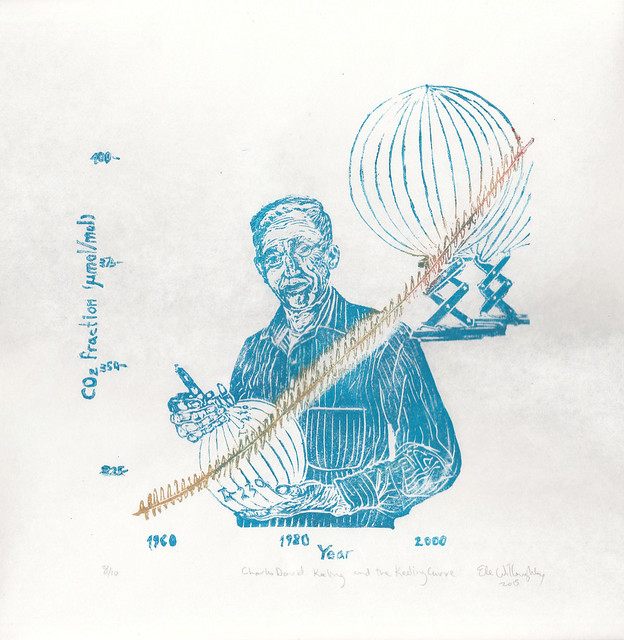
Charles David Keeling and the Keeling Curve, linocut 12" x12", 2015 by Ele Willoughby

Sometimes, I take suggestions for prints subjects, especially the scientists series. This is a portrait of American geochemist Charles David Keeling (1928 - 2005) whose decades long observations of carbon dioxide (CO2) in air samples at the Mauna Loa Observatory were some of the first direct data to show the human contribution to the greenhouse effect and global warming. He was suggested for an upcoming Art.Science.Gallery show about climate change. The 'Keeling Curve' shown in copper and red shows both the seasonal variations (the wiggles) and the strong upward trend with time as CO2, a known greenhouse gas (which traps solar radiation), built up in the atmosphere. It turns out this is topical, not only because climate change is always topical, but this week, the American Chemical Society honoured the Keeling Curve as a National Historic Chemical Landmark at a ceremony at Scripps.

After completing his PhD in chemistry at Northwestern in 1954, he did a postdoc in geochemistry at the California Institute of Technology where he developed the first instrument to measure carbon dioxide in atmospheric samples. He then joined the Scripps Institute of Oceanography at UCSD, where he remained for his career, as a professor of oceanography. He had good timing; 1957 - 1958 marked the International Geophysical Year and he was able to get IGY funding to set up a base 3000 m above sea level at the Mauna Loa Observatory in Hawai'i, where he put his CO2 measuring methods to work. He also gathered similar data series at Big Sur, California and in Antarctica. Prior to his studies, scientists believed that CO2 levels were simply variable, without the sort of clear patterns he observed. Between 1958 to 1960, we was able to show the daily pattern of change due to respiration from local plants and soils as well as the seasonal variations in CO2 levels; by 1961 it was clear there was also a strong upward trend in the 'Keeling Curve' which roughly matched the amounts of CO2 released by our own burning of fossil fuels.

The National Science Foundation cut off his funding, arguing that the results were "routine" though they nonetheless used his data to warn of the risk of global warming. He was forced to abandon his studies in Antarctica, but managed to keep the Mauna Loa experiment going. These measurements at Mauna Loa continue to this day and are the longest continuous record of atmospheric CO2. They show a rise of 315 parts per million by volume (ppmv) in 1958 to 401 ppmv as of April 2014 and this increase has been accelerating in recent years with serious implications for climate change.

Due to the seriousness of these data, the National Oceanic and Atmospheric Administration (NOAA) lanunched their own worldwide CO2 monitoring program in the 1970s, including at Mauna Loa, alongside the Scripps experiment. After CD Keeling's death in 2005, the Scripps measuring experiment was taken over by his son, Ralph Keeling, professor of geochemistry.

Keeling received many accolades during his lifetime. In 1986, he was elected a fellow of the American Academy of Arts and Sciences and a member of the National Academy of Sciences in 1994. In 2002 Keeling was awarded the National Medal of Science, the highest award for lifetime achievements in science granted by the US. He received the Tyler Prize for Environmental Achievement for his data collection and interpretation in 2005.

Monday, January 12, 2015

How the Earth's Crust is Born: Marie Tharp "girl talk" and the Mid-Atlantic Ridge

Marie Tharp and the Mid-Atlantic Ridge Linocut
Marie Tharp and the Mid-Atlantic Ridge,
9" x 12" linocut on Japanese paper, by Ele Willoughby, 2015
This is a linocut portrait of American geologist and oceanographic cartographer Marie Tharp (1920-2006), whose pioneering, thorough and complete ocean floor maps made with her partner in science Bruce Heezen revealed the Mid-Atlantic Ridge. The mid-ocean ridge itself, based on their 1957 physiographic map, is illustrated behind her, along with the sort of echo sounder or precision depth recorder tracks she used, in front of her. The first edition is a variable run of 10 prints, each 9" by 12" (22.9 cm by 30.5 cm), on white Japanese kozo paper with "chine-collé" teal somegami paper.

Tharp had struggled to find the the right university major; she wanted something she could do, and enjoy, but there were not many options for women in her day. More opportunities opened up during WWII and she took the chance to return to school and study geology and then math. Looking for something challenging (but not tedious) she contacted Maurice 'Doc' Ewing at Lamont-Doherty Earth Observatory at Columbia, who hired her to draft data, including the thousands of echo sounder profiles they were gathering. Women were still not allowed to participate in research cruises, but they could work with the data. Before long, Heezen came to Lamont and required so much drafting work that Tharp worked exclusively with him.

Scientists once imagined the ocean floor as a largely featureless plain. Early depth measurements were taken with lead weights (such as canon balls) and a whole lot of rope! As early as the late 19th century, such laboriously collected datasets began to hint at a broad rise in the centre of the Atlantic. By the mid 20th century, there was a push to try and map these submarine mountains.

Tharp spent months painstakingly "plotting, drawing, checking, correcting, redrawing and rechecking" profiles of the North Atlantic. The ship tracks across the Atlantic were a sparse web, but when Tharp compared half a dozen more or less parallel transects she noticed no only the general similarities of the ridge, but a V-shaped notch in the centre of all the profiles. She suspected they coincided because they indicated a rift valley all along the ridge crest. The early ideas about plate tectonics or the "continental drift" theory were still quite controversial and unpopular. Heezen dismissed Tharp's observation as "girl talk" for looking too much like continent drift - as in fact it was indeed a vital piece of the plate tectonics puzzle. We now know that surface of the Earth is itself a jigsaw puzzle of pieces known as tectonic plates, jostling one another at a stately, geological pace. Mid-ocean ridges are underwater volcanic mountain chains which roughly bisect all ocean basins. They are all cut by a rift valley which is the spreading centre. These rifts are where new crust is born, pushing upwards and outward. This drives the two plates on either side slowly apart over geological time. On our own timescales of everyday life, we notice the bumps in this slow ride: the sporadic earthquakes, rather than the slow creep (though today, we can meticulously measure both).

Tharp believed the rift was real though her contour maps hadn't convinced Heezen. In 1952, they began working on physiographic maps, which would show seafloor topography as if you were flying just above it, and the water were drained away. These had the advantage of really giving a sense of the variety of geology, from plains to mountains, seamounts to trenches. Also, unlike detailed contour maps, physiographic maps were not US Navy classified information, so Tharp and Heezen would be able to publish what they produced. Further, they were beginning to gather much better precision depth recorder data, which revealed far more features, along with better navigation to plot ships' positions along tracks more accurately. A second project in their research group involved plotting earthquakes, and Heezen insisted they work at the same scale. Heezen then noticed that ocean earthquake epicentre data also formed long lines - and in fact, when one map was placed above the other on a light table they found the earthquakes formed near continous lines along the Mid-Atlantic ridge right where Tharp had indicated there was a rift valley. Using the earthquake data to extrapolate and plot the rift position where there was no seafloor sounding data, they found that the rift extend landward into the Rift Valley of East Africa - a well-known, easy to observe terrestrial rift valley. Heezen was then convinced. They had discovered a worldwide mid-ocean ridge system, tens of thousands of kilometres long. Tharp was able to mine existing data to show the Mid-Atlantic Ridge extended to the south Atlantic and found similar features in other oceans. These all similarly lined up neatly with earthquake epicentres. Ewing and Heezen announced their findings in 1956. In 1957 Tharp and Heezen published their North Atlantic physiographic map; I've shown my version of their map behind her. The ridge snakes from top to bottom (north to south-south-west), above and almost mimicking the line of her arm.

They continued this work, extending to other oceans over the next 25 years, ultimately producing detailed physiographic maps of the world oceans. Their pioneering work mapping the oceanic plate boundaries, and showing their clear alignment with seismic data helped fuel the revolution in geology and geophysics, the paradigm shift of plate tectonics.

Tharp's work was largely in the background during her university career, though she won a number of prizes during her retirement and has continued to gain posthumous recognition for the importance of her work and observations. I was very pleased to see her recognized recently in Neil DeGrasse Tyson's Cosmos reboot. I want to bring her incredible insight and excellent work to a wider audience as both artist and marine geophysicist myself.

I've already sent one Tharp portrait to a seismologist friend in Australia and a second to her biographer Hali Felt!  Tharp has been on my 'to do' list for a while, but I finally completed her portrait, thanks to Hali. She stumbled upon my Etsy shop and asked me if I had ever considered making Tharp's portrait. I told her she had come to the right place and found a marine geophysicist/artist. I'm looking forward to reading her Tharp biography, Soundings. Now, we're swapping portrait for biography. How cool is that?

Tuesday, October 14, 2014

Ada Lovelace Day 2014: The hard-earned fame of Marie Skłodowska-Curie

Ada Lovelace, 3rd edition
Ada, Countess Lovelace, 3rd edition linocut by Ele Willoughby
Today is the 6th annual international day of blogging to celebrate the achievements of women in technology, science and math, Ada Lovelace Day 2014 (ALD14). I'm sure you'll all recall, Ada, brilliant proto-software engineer, daughter of absentee father, the mad, bad, and dangerous to know, Lord Byron, she was able to describe and conceptualize software for Charles Babbage's computing engine, before the concepts of software, hardware, or even Babbage's own machine existed! She foresaw that computers would be useful for more than mere number-crunching. For this she is rightly recognized as visionary - at least by those of us who know who she was. She figured out how to compute Bernouilli numbers with a Babbage analytical engine. Tragically, she died at only 36. Today, in Ada's name, people around the world are blogging.


This year I'm participating in an entire group art show celebrating Ada Lovelace Day. The Art.Science.Gallery show Go Ahead and Do It: Portraits of Women in STEM culminates today! I will share all of my portraits of women in science (and links to where I tell their stories) below.


Marie Curie linocut glows in the dark
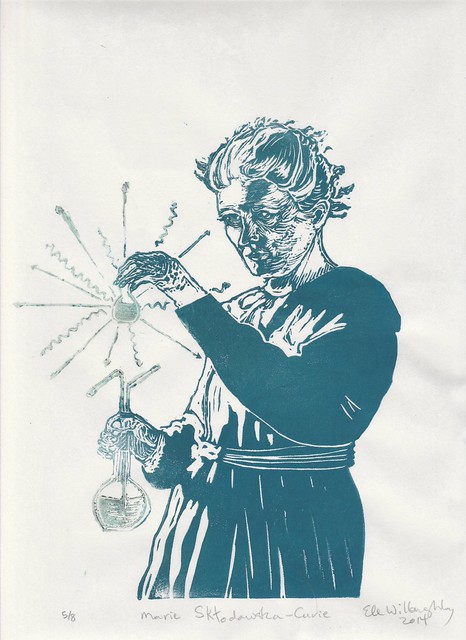
Marie Skłodowska-Curie, linocut with glow-in-the-dark ink by Ele Willoughby, 2014

In previous years, I've specifically avoided writing about Marie Curie because she is often the one historical figure people can name. I don't like to do the obvious thing and particularly want to highlight the under appreciated heroines of science. However the result is that her truly remarkable achievements haven't been celebrated here, just because of her fame. So, with a collection of portraits and stories written on the less well known, today I'll write about the well-known and why she in fact deserves her fame.

Marie Skłodowska-Curie (7 November 1867 – 4 July 1934), Polish-born, naturalized-French physicist and chemist, as the first woman to win a Nobel prize, the only woman to ever win TWO Nobel prizes, and the only person ever to win in two different sciences: physics and chemistry! She was also the first female professor at the University of Paris, and in 1995 became the first woman to be entombed on her own merits in the Panthéon in Paris. Born Maria Salomea Skłodowska in Warsaw, she studied secretly at the Floating University there before moving to Paris where she earned higher scientific degrees, met her PhD supervisor and future husband Pierre.

She was one of the pioneers who helped explain radioactivity, a term she coined. She was the one who first developed a means of isolating radioacitve isotopes and discovered not one, but two new elements: polonium (named for her native country) and radium. She also pioneered radioactive medicine, proposing the treatment of tumors with radioactivity. She founded medical research centres, the Curie Institutes in Paris and Warsaw which are still active today. She created the first field radiology centres during World War I. Each one of these achievements alone would warrant being memorialized in the annals of science and medicine; she did all of these things. She died in 1934 from aplastic anemia brought on by exposure to radiation, including carrying test tubes of radium in her pockets during research and her World War I service in her mobile X-ray units.

Her pioneering work explaining radioactivity earned her the 1903 Nobel Prize in Physics with her husband Pierre Curie and with physicist Henri Becquerel. At first, the Committee intended to honour only Pierre and Becquerel, but Swedish mathematician Magnus Gösta Mittag-Leffler, an advocate of women in science, alerted Pierre to the situation. (You may recall that it was the same man who helped Sofia Kovalevski secure a University position in Stockholm and that she collaborated on works of literature and had what was called a "romantic friendship" with his sister Duchess Anne-Charlotte Edgren-Leffler).  After Pierre's complaint, Marie's name was added to the nomination. The 1911 Nobel Prize in Chemistry was awarded to her "in recognition of her services to the advancement of chemistry by the discovery of the elements radium and polonium, by the isolation of radium and the study of the nature and compounds of this remarkable element."

Her life and legacy are truly extraordinary!

MarieCurie_glow
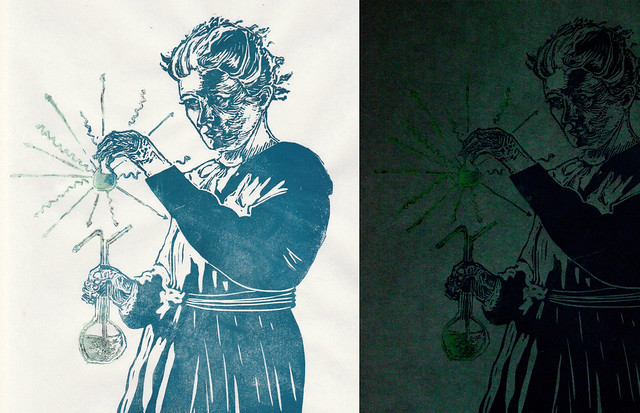
Marie Skłodowska-Curie, linocut with glow-in-the-dark ink show in the light and dark by Ele Willoughby, 2014

Not only was her work original and providing revolutionary insight on the theoretical side at the time, but the sheer heroic dedication and labour involved in her experimental work cannot be overstated. Having recognized that pitchblende ore must contain multiple elements which were giving off radiation, she and Pierre were able to show in 1898 that two new elements Polonium and Radium were needed to explain their observations. They then sought to actually isolate these elements. From a ton of pitchblende, she separated one-tenth of a gram of radium chloride in 1902. In 1910 Marie Curie isolated pure radium metal - a full 12 years after she and Pierre published their preliminary evidence for its existence. This involved working in a shed, meticulously separating the radioactive material from the inert and then dividing the radioactive material into its various sources for many years - all the while raising their young daughter when not at the lab.

Both of the elements she discovered are radioactive, meaning that they spontaneously give off radiation. All of the isotopes of polonium emit alpha particles, but Polonium-210 will emit a blue glow which is caused by excitation of surrounding air. Radium emits alpha, beta and gamma particles - that is 2 protons and 2 neutrons, electrons as well as x-rays. Thus, I've shown her sample surrounded by the symbols of these particles: the straight and wiggly lined arrows for the massive particles and high-energy light photons or gamma rays respectively, and made the sample with glow-in-the-dark ink. While the materials she discovered and worked with would have glowed due to radioactivity, never fear... these prints glow due to phosphorescence - a different process which is not dangerous. The ink will absorb UV light (for instance, from sunlight) and re-emit it in the dark.

The linocut is printed on Japanese kozo paper 9.25" by 12.5" (23.5 cm by 32 cm) in an edition of eight.

You will soon find links to my previous Ada Lovelace Day posts and other short bios and portraits of heroines of science in my next post.

Wednesday, March 19, 2014

Florence Nightingale

Florence Nightingale portrait
Florence Nightingale, linocut inked à la poupée with chine collé in an edition of four, on Japanese kozo paper 9.25" by 12.5" (23.5 cm by 32 cm), by Ele Willoughby (aka minouette)

I confess that Florence Nightingale wasn't on my shortlist of women in science I wished to portray. I felt a little like she was an old-fashioned heroine, from a time where if a woman wasn't going to be defined strictly as a person who served and cared for her family, it was okay if (and only if) she cared for other people. This bias was somewhat reinforced by my own family history: my mother is a nurse, her mother was a nurse, whereas I am a physicist. I know my grandmother wanted to be a pharmacist, and my mother felt her career options were school teacher or nurse. Plus, I take after my father's side of the family and have been known to have a vasovagal response to the mere description of medical procedures; I have a high pain threshold, but am squeemish, and faint like the rest of them. I tend to find watching or thinking about others induring something is worse than say, being injured myself.* All of which means I partially define myself by not being a nurse. However, I was (luckily) commissioned to make a portrait of Florence Nightingale. The more I read, the more interesting she became to me.


Nightingale earned the nickname "The Lady with the Lamp" during the Crimean War, from a phrase used by The Times, describing her as a “ministering angel” making her solitary rounds of the hospital at night with “a little lamp in her hand”. The image was immortalized by Henry Wadsworth Longfellow's 1857 poem Santa Filomena in the stanza:

Lo! in that house of misery
A lady with a lamp I see
Pass through the glimmering gloom,
And flit from room to room.

So, I’ve shown Nightingale with her little lamp, based on contemporary photos and illustrations. But inventing modern nursing wasn't her only accomplishment. Taking up a profession, travelling to a war zone, nursing the wounded, taking on hospital administration and the training of a professional class of nurses weren't the only things she did which were so unusual for a woman of her time to do. It turns out that her father fostered her gift for mathematics, and she made significant contributions to statistics and data visualization too.

Behind Nightingale is her own ‘Diagram of Causes of Mortality in the Army in the East’ plotted as a polar area diagram – though not her own statistical and data visualization innovation, sometimes called a Nightingale Rose Diagram. It illustrates the causes of death in the military hospital she managed during the Crimean War. April 1855 to March 1856 is shown on the left and April 1854 to March 1855 to the right. When she researched the causes of mortality, looking back at the data, she saw clearly that the lack of hygiene was a far greater risk to soldiers’ lives than being wounded. The sections represent one month of data {J,F,M,A,M, J,J,A,S,O,N,D} for each month of the year. The green “wedges measured from the centre of the circle represent area for area the deaths from Preventible or Mitigable Zymotic diseases, the [yellow] wedges measured from the centre the deaths from wounds, & the [orange] wedges measured from the centre the deaths from all other causes. The […] line across the [yellow] triangle in Nov. 1854 marks the boundary of the deaths from all other causes during the month. In October 1854, & April 1855, the [orange] area coincides with the [yellow], in January & February 1856, the [green] coincides with the [orange]. The entire areas may be compared by following the [green], the [yellow], & the […] lines enclosing them.” This "Diagram of the causes of mortality in the army in the East" was published in Notes on Matters Affecting the Health, Efficiency, and Hospital Administration of the British Army and sent to Queen Victoria in 1858.

This experience influenced her later career and she campaigned for sanitary living conditions, knowing how dangerous unsanitary conditions can be to survival. She also made extensive use of similar polar area diagrams on the nature and magnitude of the conditions of medical care in the Crimean War, or sanitation conditions of the British army in rural India, to make such statistics transparent to Members of Parliament and civil servants who would have been unlikely to read or understand traditional statistical reports.

In 1859, Nightingale was elected the first female member of the Royal Statistical Society. She later became an honorary member of the American Statistical Association.

Though her own opinion  of other women was often harsh, she has been credited with contributing to feminist literature with a book she wrote while sorting out her thoughts on her role in the world, including the essay Cassandra, which protested the over-feminisation of women into near helplessness. She helped abolish laws regulating prostitution that were overly harsh to women. She also clearly expanded the acceptable forms of female participation in the workforce.

This, and in particularly, the way she insisted on making decisions based on scientific evidence, and using data to save lives, makes her an apt addition to the women in science portrait series.

*My grandfather was a very strong man, who fainted when diagnosed with a fully treatable skin cancer, despite enduring rhematoid arthritis without complaint. My father famously fainted during his pre-natal class. My brother fainted during a presentation on why junior high school students shouldn't smoke, which included an image of a damaged lung. My other brother  famously fainted during Indiana Jones and the Temple of Doom, twice. I fainted during a tour of McMaster Medical School, while they explained what happened to corpses at the morgue. They sat me down, got me water and told me not to be discouraged from a career in medicine, while I looked at them in disbelief and insisted I never wanted one.

Friday, March 7, 2014

Women Scientist Portraits on Scientific American.com

Inge Lehmann print
Inge Lehmann and the Earth's Inner Core linocut on Japanese kozo paper, 2011, 20.5 cm x 20.5 cm

Just in time for International Women's Day, Scientific American has published Maia Weinstock's photo essay about female scientists portrayed in art: 15 Works of Art Depicting Women in Science; Visualizing notable women in the STEM fields through the lens of fine art. There are some really wonderful portraits of great scientists. She writes about each artist and their inspiration. I'm flattered to be included, along with my portrait of the great Danish pioneer of whole Earth seismology, Inge Lehmann. Lehmann is an apt selection; not only did she make the revolutionary discovery of the Earth's inner core (and find the evidence in what others had mistaken for noise), but she wasn't shy about frankly discussing how women's contributions to science were all too often overlooked.

I love also how she points out that the idea that science and art are divorced is only recent, and the contemporary move to go from STEM (science, technology, engineering and math) back to STEAM (science, technology, engineering, art and math). If you read carefully, you'll also glean the inspiration for my most recent portraits of female scientists: Maia will be curating a women-in-STEM art exhibit at the Art.Science.Gallery. in Austin, Texas, from September 13 through October 15, 2014, which will include some of the works and artists from her article, like me!

Tuesday, February 11, 2014

Bell Burnell and the Little Green Men

Jocelyn Bell and the LGM-1

This year, I plan to grow my collection of portraits of women in STEM. I thought I'd get an early start on this project, with my first portrait of a scientist who is still working.

This is a linocut portrait of Jocelyn Bell (now Bell Burnell) and the incredible radioastronomy dataset she gathered when only a graduate student in 1967, working with Anthony Hewlish. The block is inked "à la poupeé" in dark blue grey and green on Japanese kozo paper. The first edition is a variable run of 10 prints, each 10" by 12.5" (25.4 cm by 31.8 cm).

In November, 1967, Jocelyn Bell (Burnell) was just a graduate student when she discovered the first radio pulsar (or pulsating star), a highly magnetized, rotating neutron star that emits a beam of electromagnetic radiation. This radiation (light in the radio frequency band) can only be observed when the star is pointed towards us; so, like the light from a distant lighthouse, it appears to pulse at a precise frequency. Jocelyn Bell had been working with her supervisor Antony Hewish and others to construct a radio telescope to study quasars (quasi-stellar objects which emit radio waves). She noted some "scruff" on her chart-recorder, and then that the pulses were incredibly regular, occurring every 1.337 seconds. Hewish was initially scornful and insisted the regular pulses must be noise from a human made source. He first dubbed this object, emitting with such regularity 'LGM 1' for "Little Green Men 1", a playful joke about their uncertainty about what could emit radiation so regularly - obviously it could only be a communication from extraterrestrials hahaha! After she found other such sources, in different places with different frequencies, her colleagues became convinced. These discoveries lead to the development of the pulsar model. LGM-1 is now known PSR B1919+21.

The 1968 paper announcing this discovery in Nature has five authors, lead by Hewish, followed by Jocelyn Bell. In 1974, Hewish won the Nobel Prize for this discovery, (along with fellow radioastronomer Marlin Ryle). Jocelyn Bell was not included as it was assumed that the "senior man" was responsible for the work. This was controversial and has been condemned by many leading astronomers like Fred Hoyle (who with Thomas Gold was first able to explain the signals as due to a rapidly rotating neutron star). Jocelyn Bell Burnell herself has stated she was not upset. Bell Burnell has a great career and won many honours after her impressive start, but her exclusion from the Nobel win, based on her own research strikes me and many others as one of the more blatant and egregious examples of gender bias in the selection of Nobel prize recipients.

Cover of Joy Division's 1979 album 'Unknown Pleasures'
designed by Peter Saville, using the pulsar data
from the Cambridge Encyclopaedia of Astronomy
Not only the discovery, but the presentation of the data is impressive and elegant. The famous diagram (I've included behind her, and shown above) shows superimposed images of successive pulses. Stripped down to their essential information like sparklines (chart lines without annotation or axes, but drawn of course to a common scale) so their regularity really stands out, and they can be easily compared and contrasted. If you are used to looking at time series, you'll know that since they can be easily superimposed and the pulses line up, that the frequency is quite regular. The diagram is downright eloquent, and visually appealing, so it has been included in books on data visualization and was used in the iconic design of Joy Division's 'Unknown Pleasures' album. From there the diagram itself has become a sort of visual meme and can be found in all sorts of different media and reinterpreted in everything from tattoos to fashion. (You can read my take on this meme itself here: Astrophysical Meme: Jocelyn Bell Burnell's Pulsar, Little Green Me, Joy Division and Beautiful Data ).