Showing posts with label #histsci. Show all posts

Friday, January 24, 2025

Dorothy Crowfoot Hodgkin, chemist, crystallographer, Nobel laureate, mother, arthritis patient, peace and disarmament activist

Dorothy Crowfoot Hodgkin, linocut print, 11" x 14", by Ele Willoughby, 2025

The next prompt for PrinterSolstice is cobalt, an element animals including humans require for their metabolism, in the form of vitamin B12. So I made the portrait of English chemist and x-ray crystallographer Dorothy Mary Crowfoot Hodgkin (née Crowfoot, 1910-1994) won the Nobel Prize in chemistry for her models of biomolecules like penicillin, vitamin B12 and insulin, which were essential to structural biology.

The eldest of four daughters of English parents who were in the colonial administration of North Africa and the Middle East, and later, archeologists, Dorothy was born in Cairo, Egypt. The family escaped the heat of the summers by returning to England. When Dorothy was 4, her mother left her and her sisters Joan (2) and Elizabeth (7 months) with her Crowfoot grandparents near Worthing and returned to her husband and life in Egypt. The girls grew up with grandparents in England with parental support from afar. Dorothy became interested in chemistry as early as 4 and interested in crystals by age 10; "captured for life by chemistry and crystals," she later wrote. Her mother, a proficient botanist, encouraged her interests. She found a dark rock when visiting her parents in north Africa and asked a family friend, soil scientist A.F. Joseph if she could analyse it; he gave her a surveyor's box of reagents and minerals to encourage her.  She and her sisters would use a portable mineral kit to analyse pebbles they found in the stream.  During WWI, Dorothy lost four uncles on her mother's side influencing her to become an ardent supporter of the League of Nation and later a peace and disarmament activist. Her parents moved to Sudan where her father was in charge of eduction and archeology until 1926. In 1921, she entered Sir John Leman Grammar School, one of two girls allowed to study chemistry rather than domestic science usually assigned to girls.  She had one extended trip to spend time with her parents in Khartoum when she was 13.  A distant cousin who was a chemist, Charles Harrington (later Sir Charles) recommended D.S. Parsons' 'Fundamentals of Biochemistry' to her at age 14. She set up a a small lab in her attic, using chemicals she got from the local pharmacist. On her 16th birthday her mother gave her W.H. Bragg's 'Concerning the Nature of Things' about x-ray crystallography, which used the scatter pattern of x-rays through crystals at different angles, recorded on photographic plates to image crystals and use mathematics to then deduce their structure from these patterns. As Latin, required for entry to Oxford, was not on her school curriculum, the headmaster personally tutored her so she was able to pass the entrance exam. 

Post-WWI her parents eventually returned to their habit of summering in England to spend time with their children and escape the heat while working abroad. After retiring from the Sudan Civil Service in 1926, her father took job as Director of the British School of Archeology in Jerusalem and her parents lived there until 1935.

Dorothy joined her parents at the archeological site Jerash (present day Jordan) and documented patterns of mosaics of several 5th to 6th century Byzantine era churches, taking a year to finish her drawing just as she entered Oxford to study chemistry. There she also performed chemical analyses of glass tesserae from these sites. Her precise and meticulous drawings are now housed at Yale. She so enjoyed field archeology she considered switching her field of study. Her attention to detail in documenting patterns would later serve her well as a chemist. She graduated Oxford with a first class degree in chemistry in 1932.

She entered the PhD programme at Cambridge later that year studying with John Desmond Bernal and became interested in the use of x-ray crystallography to study the structure of proteins. She worked with Bernal on the first application of the method to image a biomolecule, pepsin. Previously, the method had only been used for inorganic crystals. Bernal believed in equal opportunities for women in chemistry and helped make x-ray crystallography one of the few fields with significant representation from women scientists. He followed in the example of William Bragg himself, who had 11 women amongst his 18 students. In 1933 she was awarded a research fellowship at Somerville College and returned to Oxford in 1934  to teach with her own lab equipment. She missed the day Bernal made the first photo of an x-ray of a protein crystal for health reasons. She was only 24 when she began experiencing pain in her hand which was diagnosed as chronic rheumatoid arthritis. She went to a clinic in Bruton for thermal baths and gold treatments before returning to work. The disease caused her hands to swell and become distorted; she had to add a special lever to the allow her to continue to use the main switch on the x-ray equipment. The disease is progressive and caused increasingly debilitating pain, problems and deformities in her hands and feet. She was appointed the college's first fellow and tutor in chemistry in 1936, a roll she held until 1977. She earned her PhD in 1937 on the x-ray crystallography and chemistry of sterols. In 1945 with C.H. Carlisle, she published the first structure of a steroid, chloresterol iodide. From 1941 through 45, she worked with colleagues including Barbara Low, on solving the structure of penicillin. She made her calculations manually with a set of specially printed paper strips and with her team plotted 108,00 points in the molecule to make two-dimensional contours of electron densities. With help from her sister, she drew the contour sheets on perspex so these 2D slices could be stacked to visualize the molecule in three dimensions. Only then could she make the traditional ball and stick model (like I have shown in my portrait); she surrounded hers with 2D contour plots of electron density. Country to scientific opinion, they found that penicillin contained a β-lactam ring. She was doing all this intense work while Thomas was teaching in Newcastle; she had to send him a telegram to alert him the arrival of their second child was imminent. The research was characterized as a wartime secret. She sent Thomas a postcard, 'Think we really have found out something for certain about P. Am extremely cheerful.' They completed the work on VE day in 1945. She became a Fellow of the Royal Society in 1947. They published their penicillin results in 1949; she bowed to social pressure at this point and added Hodgkin to her name, though she had up to this point published as Dorothy Crowfoot.

In 1948, Merck discovered vitamin B12, one of the most complex vitamins then known, and Hodgkin created some new crystals. Merck only published its refractive indices. When she realized it contained cobalt, she knew the almost completely unknown structure could be established with x-ray crystallography, but its size and largely unidentified atomic components would make it a challenge. Since the crystals were pleochroic, that is, they displayed different colours at different angles, she deduced the presence of a ring structure, confirmed by x-ray crystallography. Her 1954 published study was described by Nobel Laureate Lawrence Bragg as being as significant as "breaking the sound barrier." She published the final structure in 1955 and 56. 

In 1953, she, Sydney Brenner, Jack Dunitz, Leslie Orgel, and Beryl Oughton (later Rimmer), were the first people to drive from Oxford to Cambridge in two cars to see the model of the double helix of DNA built by James Watson and Francis Crick, informed by x-ray crystallography by Maurice Wilkins and Rosalind Franklin and their student Gosling. 

In 1957 the Royal Society awarded her the Royal Medal and she became a reader at Oxford, gaining a full, modern laboratory in 1958. She was appointed the Royal Society's Wolfs Research Professor in 1960 through 1970 which provided salary, research expenses and assistance and she was a fellow of Wolfson College, Oxford from 1977 to 1983. 

Insulin, illustrated by Dorothy Crowfoot Hodgkin
Insulin, illustrated by Dorothy Crowfoot Hodgkin. This drawing was presented to crystallographer Dr. Helen Megan who was organizing the Festival Pattern Group in Britain in 1951. Hodgkin refused a fee or to copyright an image found in nature. Megaw organized an exhibit of the wonders of scientific patterns applied in design as part of the Festival of Britain. I decided life is too short to try and make a relief print of a molecule this complex!

One of her most important and celebrated studies was the longest lasting. She first received a sample of insulin in 1934. The size and complexity of the molecule was too great to explore with x-ray crystallography at that time, but the importance of the hormone captured her imagination. She had paused this research to work on the structure of penicillin, which contains 17 atoms, and vitamin B12, which contains 181 atoms, but returned to it later. By 1969, 35 years later, she was finally able to work with an international team of young scientists to reveal the structure of insulin. Insulin contains 788 atoms! It's hard to overstate the size of the task and the sheer number of calculations involved. This work was instrumental in our ability to mass-produce insulin and treat diabetes and also to allow scientists to alter the structure of the molecule to create even better drug options. She remained active in collaborating on insulin production and drug development to better treat diabetes. 

Sample of insulin wallpaper design made for the Festival of Britain
Sample of insulin wallpaper design made for the Festival of Britain. This simplified and stylized insulin design inspired the blouse she's wearing in my portrait.

Soft-spoken and gentle but determined and hardworking, Hodgkin inspired her students, whom she encouraged to address her simply as Dorothy. Her most famous student moved on from chemistry to politics; conservative UK PM Margaret Thatcher (née Roberts), hung Hodgkin's portrait in her office, out of respect for her former tutor, the livelong Labour supporter, sometime Communist Party of Britain member and pacifist Hodgkin. Hodgkin's politics were greatly influenced by her mentor Bernal, an open and vocal communist and supporter of the Soviet regime until it invaded Hungary in 1956. She always called him "Sage" and they briefly had a relationship (unconventionally, Bernal had an open marriage) before she met Thomas Hodgkin. Thomas was teaching adult education classes in northern English mining and industrial communities, after resigning from the Colonial Office. Intermittently a member of the Communist Party, he later wrote several works on African politics and history and lectured at Balliol College, Oxford. The two married in 1937 and had three children, Luke (1938-2020), Elizabeth (1941), and Toby (1946). Thomas spent a much time in west Africa, supporting and chronicling emerging postcolonial states. A lifelong advocate for peace, Dorothy campaigned against nuclear arms and the Vietnam war. Because of Dorothy's political activities and her husband's communist party membership she was banned from entering the US in 1953, and subsequently not allowed in without CIA waiver. 

She was in Ghana, where her husband was an advisor to president in 1964 when she learned she had been awarded the Nobel Prize for Chemistry her work on the structure of biomolecules. She served as President of the International Union of Crystallography, an organization she helped found, from 1972 to 1975 and worked to foster international collaboration. She worked to include Chinese and Soviet scientists through the Cold War. In 1976 she won the prestigious Copley Medal, the first woman to do so (the second wasn't until Jocelyn Bell Burnell in 2021). Concerned about social inequities and preventing war and in 1976 she became the longest-serving president of the international Pugwash Conference on Science and World Affairs, which brings scientists and public figures to work together to reduce the risk of armed conflict and seek solutions to global security threats. She stepped down in 1988 after the signing of the Intermediate-Range Nuclear Forces Treaty ban on short and long-range nuclear weapons. She accepted the Lenin Peace Prize from the Soviet government in 1987 for her peace and disarmament work. Fellow chemist, peace activist and Nobel laureate Linus Pauling had recommended her for the award.

In later years she spent a great deal of time in a wheelchair because of the progress of the rheumatoid arthritis, but she was able to remain an active scientist. She skipped the 1987 Congress of the International Union of Crystallography in Australia, but attended the 1993 Congress in Beijing. She died by stroke in 1994 in her husband's village of Ilmington. 

The Royal Society now awards the Dorothy Hodgkin Award in her honour to outstanding early career scientists requiring flexible work due to caring or health reasons. The Council offices in Hackney, university buildings at the universities of York, Bristol and Keele and the science block at her old school Sir John Leman High School are named in her honour. Oxford International Women's Festival presents the annual Dorothy Hodgkin Memorial Lecture in her honour.

Her work helped in the rapid production of penicillin, considered a miracle drug at the time, mapping vitamin B12 helped the fight against pernicious anemia and her structure of insulin greatly improved our ability to treat diabetes. She left her mark on science and society both.

References,

All or Nothing,  Back From the Dead exhibit website from The Museum of the History of Science, 2021

Alman, Margaret. Art in the Atoms: Chemist Dorothy Crowfoot Hodgkin, blog post, February 3, 2010.

Cole, Rupert. Happy Birthday Dorothy Hodgkin. Science Museum blog. May 11, 2018

Dorothy Crowfoot Hodgkin, Nobel Prize website, accessed January, 2025

Dorothy Hodgkin, Wikipedia, accessed January, 2024

Hodgkin, Dorothy Mary Crowfoot, Jennifer Kamper, June Lindsey, Maureen F. Mackay, Jenny Pickworth, John H. Robertson, Clara Brink Shoemaker, J. G. White, R. J. Prosen and Kenneth N. Trueblood. “The structure of vitamin B12. I. An outline of the crystallographic investigation of vitamin B12.” Proceedings of the Royal Society of London. Series A. Mathematical and Physical Sciences 242 (1957): 228 - 263.


Thursday, February 23, 2023

Kathleen Lonsdale, crystallographer, pacifist and prison reformer


Kathleen Lonsdale linocut print by Ele Willoughby
Kathleen Lonsdale, 11" x 14" linocut print on Japanese kozo by Ele Willoughby, 2023

I chose Kathleen Lonsdale DBE FRS (née Yardley, 1903-1971) for the #printerSolstice prompt shape because she solved a longstanding chemistry conundrum of the shape of benzene & her drawing of electron density for hexachlorobenzene (green) & model of hexamethylbenzene explore shape in different forms. 

Going to Holloway prison was the single most formative experience for Kathleen Lonsdale’s scientific career and it gave her the ability to speak to anyone. Her husband said, “Before prison it might have bothered her to go to Buckingham Palace. Afterwards, Holloway or Buckingham Palace were all the same.” Born the tenth child of a poor family in Ireland, with four brothers who died in infancy, pacifist, prison reformer and physicist Dame Kathleen Lonsdale DBE FRS (née Yardley, 1903-1971) served time, as she was unwilling to compromise her beliefs. She was also a trail blazing crystallographer who solved a conundrum which had plagued chemists for decades: the shape of the benzene ring, proving it was flat using x-ray diffraction on hexamethylbenzene in 1929. She was the first to employ Fourier spectral methods and used them to solve the structure of hexachlorobenzene in 1931. In 1945 she was one of the first two women elected Fellow of the Royal Society and was the first woman in several roles including: tenured professor at University College London, president of the International Union of Crystallography and president of the British Association for the Advancement of Science.

Her father, a soldier and then a postmaster Harry Yardley and her mother, a strict fundamentalist Baptist of Scottish descent Jessie Cameron did not have a happy marriage. Between the unrest in Ireland and her father’s alcoholism, her mother decided to divorce and move the children to Seven Kinds, Essex, England when Kathleen was five. She won a scholarship to the Ilford County High School for Girls but had to go to the boys’ school in her final two years as the girls’ school did not offer mathematics and science. During WWI her home was on the Zeppelin route; she did homework by candlelight during air raids and first developed her opposition to war. Anxious to get to university as soon as possible she went to the Bedford College for Women in London on a county scholarship. After her first year she won a university scholarship and switched from mathematics to physics, against all advice (especially that of her old headmistress who told her she would never distinguish herself in physics). She graduated in physics with the highest score ever for a London University, with a BSc in 1922, which brought her to the attention of physics Nobel laureate William Henry Bragg, one of her examiners.

Bragg offered her a spot on his team at University College (and then the Royal Institution), and a grant of a £180 a year! She lived at home and contributed to family expenses, gaining her MSc from University College London in 1924. She worked with Bragg until she married in 1927 and followed her husband, research chemist Thomas Lonsdale to Leeds, where he had been offered a job at the Silk Research Association. Shortly after her marriage, she applied for an 1851 Exhibition Fellowship which Bragg expected she would win, as several of his other (all male) students had done. Not only did they turn her down for the award, they wrote they “would be breaking the spirit of the regulations in awarding an exhibition to a married woman.” Luckily Bedford College offered her a research grant and she continued to correspond with Bragg. She worked part-time as a physics demonstrator and doing lab work in Leeds. It was here that she was given crystals of hexamethylbenzene, the first important structure she solved. Debate had been raging between organic chemists and crystallographers whether benzene was flat or  had a zigzag shape like cyclohexane, but benzene itself was a challenge to crystallize. Lonsdale had the insight that she could instead look at the benzene within hexamethylbenzene and in the process of solving its form, she proved that the benzene ring (which it contained) was flat. She followed this with solving the structure of hexachlorbenzene; this was important as she was the first to investigate an organic compound with Fourier analysis. She had cleverly found a project she could do with calculations rather than lab work while she focused on starting their family. She also developed popular crystallographic reference tables with W.T. Astbury. She considered giving up science, but Thomas supported her research told her he “had not married to get a free housekeeper.” He encouraged her to continue in research. When they had their first daughter in 1929, Bragg convinced the Royal Institution to grant her £50 to employ some childcare  so she could work on calculations. Then they moved back to London for Thomas’ new job, and had a second daughter in 1931. Bragg, anxious to have her back, was able to find a further £200 to assist her at home so she could  return to work in 1931. They had their son in 1934. She earned her doctorate from the University of London in 1936 while working at the Royal Institution, where she stayed for 15 years. She worked with Bragg until his death in 1942, then with Sir Henry Dale, as a Dewar Fellow from 1944 through 1946.


She was raised a Baptist, but in 1935, she and her husband, both committed pacifists, became Quakers. She became a Sponsor of the UK Peace Pledge Union, which meant she signed the pledge "War is a crime against humanity. I renounce war, and am therefore determined not to support any kind of war. I am also determined to work for the removal of all causes of war.” They turned the top floor of their house into a flat where they welcomed refugees from Germany. When she was required to register for civil defence duties during WWII she refused to do so and refused to pay the small fine for not registering. She believed there should be an exemption for conscientious objection. She was sentenced to serve a month in Holloway prison, where the grim conditions lead to a life-long commitment to prison reform. While she was imprisoned, she found the clothing unclean, medical exam sketchy and she collapsed under her workload, scrubbing and cleaning; only then did they lighten her workload. Sir Henry Dale requested that she be given access to papers and instruments and she was allowed to work in her cell in the evenings.  Her colleagues worried she would be bored; she was in fact absorbed, talking to fellow prisoners about their lives and crimes. Her second fine for refusing to register for civil defence was paid anonymously, much to her chagrin; she would have rather stood on her principles and serve another prison term. She contributed to a pamphlet on Prison for Women about her experiences in Holloway and the need for prison reform.

In 1945 Lonsdale and Marjory Stephenson were the first women elected Fellows of the Royal Society. Then she finally got a permanent position. In 1946 she was appointed Reader in Crystallography and then Professor of Chemistry and Head of the Department of Crystallography at the University College London in 1949, finally beginning to teach and run her own research group, mentoring future crystallographers. She was their first tenured female professor. She researched the use of x-ray imaging at different temperatures and the structure and texture of crystals. She worked on the synthesis of diamonds. She won the Royal Society’s Davy Medal for significant discoveries in chemistry in 1957. Later she worked on solid state reactions, pharmacology and structure of methonium compounds and stones and minerals produced by the human body like kidney stones. She became an emeritus professor after 1968. Nobel laureate Dorothy Hodgkin wrote, "There is a sense in which she appeared to own the whole of crystallography in her time.


In 1953 she delivered the keynote Swathmore Lecture at the Yearly Meeting of British Quakers, “Removing the Causes of War”. She wrote about peaceful dialogue was appointed the first secretary of Churches' Council of Healing by the Archbishop of Canterbury. 


When Thomas retired at 60, they moved to Brexill-on-Sea; this meant 5 hours a day commute for Kathleen, but she felt it worthwhile though she was tired. Thomas helped with her tremendous amount of correspondence about peace and prison reform, and would bring her dinner in bed as soon as she got home. She was someone who never stopped working, even when she became ill and was hospitalized. She died in hospital 1971 from anaplastic cancer, at age 68, the day after Thomas' 70th birthday.

References

Kathleen Lonsdale, Wikipedia, accessed February, 2023

Hodgkin, Dorothy M.C., Kathleen Lonsdale, 28 January 1903 - 1 April 1971, Biographical Memoirs of Fellows of the Royal Society, Volume 21, Issue 21, November 1975

Melinda Baldwin, The Royal Society’s first woman physicist, Physics Today, 25 January, 2018. DOI: 10.1063/PT.6.4.20180125a

One crystal model of hexamethyl benzene, Science Museum Group, Object Number: 1993-421/4/11, Gift of University College London, in memory of Dame Kathleen Lonsdale 

Wednesday, July 7, 2021

Lyell's Amphibious Being


Lyell's Amphibious Being
Lyell's Amphibious Being, linocut, 10" x 8" by Ele Willoughby


So here's my latest Imaginary Friend of Science: Lyell's Amphibious Being. Dressed like geologist Charles Lyell himself, with sample bag, geological hammer, pick axe and magnifying glass, in front of the geological cross-section from the end papers of Lyell's 'Principles of Geology' and a couple of fossils from terrestrial and marine life (fern and nautiloid respectively). It's a two block linocut on Japanese kozo (or mulberry) paper, 10" x 8" and available here. Read more about the Amphibious Beast in the Imaginary Friend of Geology.

Wednesday, October 7, 2020

Rosalind Franklin, revealing the the double helix of DNA, the structures in carbon materials and the shapes of viruses

Roaslind Franklin, linocut, 11" x 14", by Ele Willoughby 2020


Rosalind Elsie Franklin (25 July 1920 – 16 April 1958), the English chemist and x-ray crystallographer whose x-ray diffraction images were instrumental to discovering the double-helix structure of DNA, has been on my to do list for scientist portraits for years and I've finally got around to it. I think it's the messiness and tragedy of her story that made it a challenge. The version of Franklin which is best known by the general public, is the version presented by the Nobel laureate once described by E. O. Wilson as "the most unpleasant human being I had ever met" James Watson, in his biography The Double Helix, published in 1968. Not only does he call her patronizingly Rosy, he presents her as a dowdy data-hoarding scold who "had to go or be put in her place". Ironically, his biography hurt his own reputation (though he's quite skilled at hurting his reputation more recently, what with the repeated pro-eugenics, racist, homophobic and sexist comments). Watson confessed, “Rosy, of course, did not directly give us her data. For that matter, no one at King's realized they were in our hands.” Strangely, after the publication of their DNA structure papers, Watson and Franklin were on friendly terms, exchanged letters and he even once offered her a lift across the US. His version of her as the villain emerged years after her death, when he wrote the book; some (like Franklin's biographer Maddox) suggest guilty feelings about the irregular way her data was accessed and insufficiently cited are the explanation. Before the book was published, Francis Crick, Maurice Wilkins, Linus Pauling, Max Perutz and Rosalind's brother Colin all protested angrily at her portrayal (as well, often, as the portrayal of themselves and other scientists), especially as she could not defend herself. This forced Watson to add an epilogue praising her as a scientist and claiming he hadn't sufficiently appreciated the experience of women in science at that time. Wilkins wrote to Harvard University Press that the book remained disgraceful and they dropped it; it was published instead by Athenaeum Press, becoming a bestseller.

There's a joke amongst scientists that goes, "What did Watson and Crick discover?" "Rosalind Franklin's notes." And while it's important that her contributions are now recognized posthumously, there's more to her story and to the story of DNA research. Ironically, the famous Photo 51 produced by Franklin's graduate student Raymond Gosling, which Maurice Wilkins quietly shared with Watson and Crick and cemented their thinking about molecular structure, is a photo that Franklin had previously presented at a seminar attended by Watson (where he failed to notice it, presumably thinking patronizing thoughts about "Rosy"). Watson, Crick and Wilkins were awarded Nobel prizes in 1962, after her death.  Though this was prior to the institution of the informal rule against awarding posthumous Nobels, Franklin was not nominated. Before her life was cut tragically short by ovarian cancer, both prior to and after her DNA research, Franklin also made invaluable contributions across disciplines of physics, chemistry and biology, working to determining the structure of RNA, viruses, coal and graphite. Even aside from her role in determining the structure of DNA, her research was a great benefit to society. I wanted to make sure my portrait represented all of this.

But first, this is a wonderful comic by the one and only Kate Beaton:


by Kate Beaton
by Kate Beaton from Hark, A Vagrant

Rosalind was born in 1920, the second of five children born to a liberal, affluent and influential London Jewish family. Her father was a merchant banker and his uncle had been Home Secretary, the first practising Jew to serve in the British Cabinet. Her father taught electricity, magnetism and history of the Great War, at the Working Men's College and eventually became Vice Principal. Her family helped settle Jewish refugees fleeing the Nazis, especially children from the Kindertransport. They took two of the children into their home. Rosalind attended St. Paul's school, a leading girls' private school, one of few girls' schools which taught physics and chemistry. She excelled at sciences, languages and sports and won a scholarship for university. Her father asked her to donate the funds to a refugee student. She studied chemistry at Newnham College, Cambridge, completing her undergraduate studies in 1941. Due to the sexist attitudes of the day, women were not granted full degrees, but "degrees titular," until 1948 (when previous women's degrees were retroactively awarded). In her last year at Cambridge she met a French refugee and former student of Marie Skłodowska-Curie, Adrienne Weill; this friendship was an opportunity to practice her French and became important in her career.

She began a PhD project on the polymerisation of acetaldehyde and formic acid under the supervision of Ronald Norrish, Professor of Physical Chemistry at Cambridge and later a Nobel laureate. It was not a fruitful collaboration. His own biographer described Norrish as "obstinate and almost perverse in argument, overbearing and sensitive to criticism" and Franklin grew to despise him and resigned. She gladly took an opportunity to transfer to the British Coal Utilisation Research Association (BCURA) at Kingston-upon-Thames. She began focusing on the porosity and density of coal, to learn how to increase the efficiency of the widely used fossil fuel resource. Her work also had important implications for the effectiveness of the activated-charcoal filters in Second World War gas masks, issued to the entire British populace in case of gas attack. In working to accurately determine the porosity of coal, she made what was likely the first demonstration that coal acts as a molecular sieve (letting helium molecules through but not larger hexane and benzene). This property is still important to industry today.

She completed her doctorate on the structure of carbon materials in 1945 (and once again, as a woman, had to wait to be awarded her full degree until 1948). Her friend Adrienne Weill suggested she attend a Royal Institution meeting in London where she might meet Marcel Mathieu and Jacques Méring. At this conference her interest was sparked in x-ray diffraction and she met the great crystallographer J.D. Bernal (with whom she would later work). Impressed with her paper Méring offered her a researcher post in Paris to continue her work on carbons for four happy years. Méring was a x-ray crystallographer, who employed the way substances diffracted x-rays to deduce their structure and he taught her how to apply this method. By 1950 she had published a paper in Nature about the structure of carbon, and by the following year had learned that as carbon in the form of coal burns, it can form one of two structures: graphitizing and non-graphitizing (terms she coined). In my portrait, the pattern on her jacket is based on her own publication of the structure of non-graphitizing carbon. She showed these two structures explained the difference between the two possible products of burning coal: cokes and chars, and how they burn. This research had important industrial applications. She continued to write papers about the structure of carbon until she died. 

She returned to England in 1950 to work with John Randall, head of the Biophysics Research Unit at King’s College, on a three-year Turner-Newall Fellowship. She planned to look at protein structure but he suggested she work on DNA, as Maurice Wilkins was doing. Randall did not clarify whether Franklin or Wilkins would lead this research, which set their relationship off on the wrong foot. Randall reassigned Wilkin's graduate student Raymond Gosling as her assistant; this surely also did not help things between them. Franklin refined and adjusted the fine-focus X-ray tube and microcamera ordered by Wilkins, improved upon his technique by manipulating the critical hydration of her specimens and employing all her physical chemistry expertise. Wilkins inquired about this and felt her reply was superior. Her directness and enjoyment of a good debate were a bad match for his shyness and distaste for arguments, and their personalities clashed badly.

As early as November 1951, Franklin presented their data at King's College London and noted,

"The results suggest a helical structure (which must be very closely packed) containing 2, 3 or 4 co‐axial nucleic acid chains per helical unit, and having the phosphate groups near the outside."

Franklin and Gosling found there were two forms of DNA: long and thin when wet (dubbed B-DNA) and short and fat when dry (dubbed A-DNA). Because of their conflicting personalities, Randall divided the labour so Franklin and Gosling studied the A form and Wilkins the B. They produced beautiful images of DNA during this time, including Gosling's famous Photo 51 (represented in blue in my portrait). By 1951, the King's researchers all believed B-DNA was a helix, but Franklin felt the evidence for A-DNA was still conflicting. Through painstaking work, by January 1953, Franklin reconciled the conflicting data, concluding both forms had two helices. She drafted three papers, and two noted the double helical DNA backbone. She had also decided to leave the unpleasant atmosphere at King's and move to Birkberk College. Randall insisted that the DNA research stay at King's and Gosling would be reassigned back to Wilkins.

Meanwhile in Cambridge, James Watson and Francis Crick were simultaneously working on the problem and had seen a preprint of Linus Pauling's incorrect proposal for DNA. They came to King's to urge collaboration to win the race before Pauling discovered his error. Thanks to Franklin's identification of the nature of the symmetry of the DNA crystals (that is, its space group), Crick understood that DNA strands were antiparallel (and that both Pauling's model and Watson and Crick's previous model were incorrect). Unable to find Wilkins they spoke with Franklin who was unimpressed by Watson's implication she could not interpret her own data; they argued. Wilkins arrived, commiserated with them, and showed Watson Franklin's work and Gosling's DNA image.  From Wilkins' perspective, Franklin was leaving, and Gosling was now his student; but it seems he did not let Franklin know he had done this. In February 1953, Watson and Crick began working on a molecular model of B-DNA, something Franklin felt was premature, with much of the data based on work at King's. Crick got access to many of Franklin's crystallographic calculations when his advisor Max Perutz gave him a report written for a Medical Research Council biophysics committee visit to King's in December 1952. Though not explicitly marked confidential there was an expectation that such a report would not be shared and Perutz later defended this action with inexperience with administrative matters. Franklin's A-DNA paper was submitted 6 March 1953, one day before Crick and Watson had completed their model on B-DNA. She had not seen Watson and Crick's work when she submitted her paper (though they had of course benefited from seeing her, Gosling and Wilkin's work). Her laboratory notebooks reveal that she had already Franklin noted that ‘an infinite variety of nucleotide sequences would be possible to explain the biological specificity of DNA’ all on her own. Franklin got to see the model built by Watson and Crick on April 10 and apparently commented, "It's very pretty, but how are they going to prove it?" Her philosophy as an experimentalist was to be able to rigourously prove a model correct before publishing. Franklin did modify her paper while in press, after seeing the others' work to acknowledge their work. A trio of DNA papers were published as 25 April 1953 Nature articles. Watson and Crick's paper only acknowledged "having been stimulated by a general knowledge of" Franklin and Wilkins' "unpublished" contribution. Due to agreements between the directors of the King's and Cambridge labs, Wilkins and Franklin published the two other DNA articles with x-ray diffraction data supporting Watson and Crick's model (rather than presenting them as the data which underpinned the model). Watson and Crick invited Wilkins to be a co-author but he declined because he had not help build the model. He later lamented that they can not discussed authorship more thoroughly. 

It may have been less than obvious to Watson and Crick how to cite materials they used, including Photo 51 and the MRC report, but it is something that they could have been done and ethically, many argue that they should have done. Likewise, Watson and Crick were aware of Franklin and Gosling's paper (which included Photo 51), submitted before she saw their work, but they merely noted that their model was not inconsistent.  Any mention they made of Franklin is in combination with, and after naming Wilkins. There is a strong case to be made that Franklin's work was insufficiently credited, and its value and role in determining the structure of DNA has only be recognized posthumously. There's no evidence that Watson and Crick ever let Franklin know what they later acknowledged, that they could not have made their model without out her work, or that she felt insufficiently recognized in their publication. They remained friends during her life and continued to correspond about their respective research projects.

By mid-March, Franklin moved to the much less fancy but much more pleasant Birkberk College, having been recruited by physicist John Desmond Bernal. She was much more comfortable at the non-denominational Birkbeck than the Anglican King's. Though Bernal wanted her to move on from nucleic acid, she continued to mentor Gosling and aid him with the completion of his thesis. The two published the first evidence of the double helix in the A form of DNA in the 25 July issue of Nature. With funding from the Agricultural Research Council, she was able to start her own research group and begin working on RNA and the structure of the Tobacco Mosaic Virus (TMV), an RNA virus. In my portrait her brooch is a model of TMV. She published her first major TMV paper in 1955 in Nature, in opposition of prominent and powerful virologist Norman Pirie, who wrote her angry, condescending letters and refused to ever again supply her with virus samples to study. But her careful observational work was once again correct. With her grad student Kenneth Holmes she found the protein covering was molecules arranged in helices. Early in 1954, she happened to meet Aaron Klug on the stairs at work. She showed him her photo of the TMV and he wrote, it sealed his fate. Captivated, he sought permission to switch to virus research. They began a long and fruitful collaboration. She oversaw a group with her students, Aaron Klug and his student John Finch and the group published on TMV, cucumber virus 4, turnip yellow mosaic virus and other plant viruses. She had a student James Watt supported by the National Coal Board and continuing her longstanding research interest in carbon. With postdoc Donald Caspar she showed that the RNA was wound on the inner surface of the hollow TMV.  She had begun working on the structure of the Polio virus, receiving with Krug the large grant ever at Birkbeck. While traveling in the US in 1956, she noticed her stomach had swelled and she went to the doctor upon her return. They found two tumours. She had ovarian cancer. She continued working when not hospitalized or convalescing with family and friends (including Francis and Odile Crick, with whom she remained close). Her group produced seven papers in 1956 and six in 1957, despite the cancer. She  was promoted to Research Associate in Biophysics on the 25th of February. Tragically she was not able to proceed with the polio research as her health rapidly deteriorated. She was invited to display a large model of TMV in Brussels at Expo 58, the first major international fair after World War II; the fair opened the April 17, but she died April 16, 1958 of bronchopneumonia, secondary carcinomatosis, and ovarian cancer. It's possible that x-ray exposure played a role in the cancer. Science during the 1950s was far too laissez-faire about radiation shielding. The following year, Klug and Finch published the polio virus structure and dedicated the paper to her memory.

By 1962 the scientific community at large was convinced of the structure of DNA, and Watson, Crick and Wilkins were awarded the Nobel Prize in Physiology or Medicine. The rules preclude splitting the award more than 3 ways and Wilkins' inclusion was based not only on his role in discovery but his later work providing data to support the model. As Franklin foresaw, it took years of work to actually convincingly prove the "pretty" model. But, even Watson suggested that Wilkins and Franklin might instead have shared the Nobel in Chemistry. Franklin was never nominated, even though this predates their rule against posthumous prizes.

Also, her long-term collaborator on virus structure, Aaron Klug continued the work he began with Franklin, winning the 1982 Nobel Prize in Chemistry for his development of crystallographic electron microscopy and his structural elucidation of biologically important nucleic acid-protein complexes. Her staunchest defender, and beneficiary of her will, he spoke of her and her impact upon him in his acceptance speech.

Today, she has become one of the most widely recognized researchers in the history of science, with many awards, buildings, plaques and monuments in her honour, worldwide. Elucidating the structure of DNA has perhaps had the most impact on society at large, but her research in carbon and on viruses also has lasting significant impacts in science.  

References

Brenda Maddox,  'Rosalind Franklin, The Dark Lady of the DNA,' HarperCollins, 2002.

Brenda Maddox, The double helix and the 'wronged heroine'. Nature 421, 407–408 (2003). https://doi.org/10.1038/nature01399

Peter J. F. Harris and Irene Suarez-Martinez, 'Rosalind Franklin, Carbon Scientist', Carbon, vol. 171,  January 2021, pp. 289-293 https://doi.org/10.1016/j.carbon.2020.09.022 

'Rosalind Franklin was so much more than the ‘wronged heroine’ of DNA', editorial, Nature 583, 492 (2020)

'Rosalind Franklin,' Wikipedia, accessed October 2020.

Mathew Cobb, 'Sexism in science: did Watson and Crick really steal Rosalind Franklin’s data?' The Guardian, Tuesday 23 June, 2015. 

, Rosalind Franklin

 Dainton, Sir Frederick Sydney (1981). "Ronald George Wreyford Norrish, 9 November 1897 – 7 June 1978". Biographical Memoirs of Fellows of the Royal Society. 27: 379–424. doi:10.1098/rsbm.1981.0016. JSTOR 769878. S2CID 72584163

Monday, July 6, 2020

Gladys West, mathematician and geodesist who found the Earth's shape for GPS

Gladys West, linocut, 11" x 14" by Ele Willoughby, 2020


Geodesy is the study of the shape of the Earth. The Earth isn’t a ball so much as an oblate spheroid- that means it’s a bit of a flattened oval in cross-section. Further there are bumps and divots, deviations from the reference ellipsoid. Measuring these deviations teaches us about our Earth and oceans, and the orbital dynamics of satellites. This mathematician and geodesist only started to get the recognition she deserves in recent years for the role she played in various satellite programs, including most famously the Global Positioning System (GPS).  

Gladys Mae West (née Brown) was born in 1930 in in Sutherland, Dinwiddie County, in rural Virginia. Her family were farmers in a community of share-croppers; her mother also worked at a tobacco company and her father also worked for the railroad. She decided early on that she needed an education if she didn't want to work in a factory or in the cotton, corn or tobacco fields. She secured a scholarship to Virginia State University, a HBPU (Historically Black Public University) as her high school class valedictorian. A great all-around student, she was unsure what subject to pursue but was encouraged to major in science and math since fewer people had the aptitude to tackle them. She choose the male-dominated field of mathematics, and joined the Alpha Kappa Alpha sorority. She graduated with a Bachelor of Science in Mathematics in 1952 and taught math and science for two years before returning to complete her Masters in Mathematics at VSU in 1955. She taught again briefly before starting her career at the Naval Proving Ground in Dahlgren, Virginia (now the Naval Surface Warfare Center) in the US in 1956. There were only 3 other Black people there, one woman and two men, and she says felt the pressure to always do everything right and set an example. She was hired as a computer programmer in the Naval Surface Warfare Center Dahlgren Division and a project manager for satellite data-processing systems. All the while, she earned a second Master's in public administration from the University of Oklahoma.

She fell in love with one of her two male, Black mathematician colleagues, Ira West. They married, had three children (and now seven grandchildren) and have been together for over 60 years.

In the 1960s, she participated in an award winning study which  proved the regularity of Pluto’s motion relative to Neptune. She then began using satellite altimeter data to model the Earth's shape, particularly the oceans. Her hard work paid off, when her department head recommended her for a commendation 1979 and she became the project manager for the Seasat radar altimetry project, the first remote sensing satellite for the oceans. From the mid 70s through the 80s West developed complex algorithms for an IBM 7030 “Stretch” computer in order to model distortions in the Earth's shape due to gravitational, tidal and other forces. Her calculations produced an extremely accurate geodetic Earth model, or geoid, optimized to determine the sallite orbits of what we now know as the Global Positioning System. She thus played a pivotal role in the development of technology which is so central to our lives, as GPS is embedded in industry, navigation, telecommunications and applications which exceed anything the US Navy could ever have imagined.

In 1986, West also published Data Processing System Specifications for the Geosat Satellite Radar Altimeter, a 51-page technical report for the Naval Surface Weapons Center (NSWC), a guide to increase the accuracy of the estimation of geoid heights and vertical deflection, based on Geosat radio altimetry data.

My portrait features three of the satellites central to her carreer: Seasat, a GPS satellite and GEOS-3, as well as the satellite paths for Geosat based on her own publications.

After 42 years, she retired 1998. She and Ira travelled, but she decided to return to academia and pursue a doctorate. She suffered a stroke which impacted her hearing, vision, balance and mobility, but despite this, she persisted and completed a PhD in Public Administration from Virginia Tech in 2018 at age 88!

Her acheivements only started to receive recognition when a sorority sister from Alpha Kappa Alpha read the brief bio she submitted for an alumni function and pointed out to her that she was a "Hidden Figure" of GPS. Her story started to be covered in the press. She was officially recognised by the Virginia Senate and she was inducted into the United States Air Force Hall of Fame in 2018, one of the highest honors bestowed by Air Force Space Command (AFSPC).

Edited January 19, 2026: Gladys West died January 17, 2026 at age 95, surrounded by her family.

References

Amelia Butterly, '100 Women: Gladys West - the 'hidden figure' of GPS,' BBC.com, May 20, 2018

Air Force Space Command Public Affairs, 'Mathematician inducted into Space and Missiles Pioneers Hall of Fame,' December 07, 2018
 
Cathy Dyson, 'Gladys West's work on GPS 'would impact the world,' January 19, 2018,
The Free Lance Star, Fredericksburg.com. 

Gladys West, wikipedia, accessed July 6, 2020 

West, Gladys B. (June 1986). "Data Processing System Specifications for the Geosat Satellite Radar Altimeter" (PDF). Naval Surface Weapons Center, Report NSWC TR 86-149.

Thursday, January 16, 2020

Finding our predecessors as women in STEM, Pitfalls and Mistaken Identity of Merit Ptah

Merit Ptah, Chief Physician, linocut by Ele Willoughby, 11" x 14", 2018
An astronomy professor of mine memorably told our class that Tycho Brahe lost his nose in a dwell over a "woman of ill repute" - while colourful, this isn't true. The aristocrat Brahe was not supposed to marry a commoner, but he did, and she, like his sister, was involved in his scientific enterprise and does not deserve to be remembered vaguely and inaccurately as a "woman of ill repute".

Being a woman on the Internet, sometimes I receive none-too-polite "corrections" to history of science I present. Once I posted on Twitter about Marie Tharp and how she found the Mid-Atlantic ridge. I got a blunt reply from a professor of crystallography that this knowledge predates her by centuries. He was wrong. He was confusing knowledge of the rise (the geographic feature indeed known in broad strokes for centuries) with knowledge of the ridge (which is a geophysical feature where we now know new crust is born) which helped usher in the plate tectonics revolution in the latter part of the twentieth century. The fact that my doctorate in marine geophysics is a lot closer in subject matter than his did not protect me from being chastised, publicly, and wrongly. But, I am keenly aware that scientists themselves are not always the most accurate re-tellers of the history of science, and that we can fall into the pitfalls of repeating misinformation provided by fellow scientists. Sometimes, we can't resist a good story.

I was once told one of my scientist portraits was "an insult" because, though I had used several references, my anonymous critic has correctly inferred I had included a portrait of the subject's sister-in-law (which can be commonly found online, mislabelled as the scientist herself). While dismayed, I don't think this strident critic was reasonable or communicating productively. I used the incorrectly labelled portrait mainly as a reference for her clothing, so I think my error is regretable but not historically misleading. Sadly this critic's antagonism is all too common online.

In complete contrast, I'm quite impressed at the kindness and consideration of a recent message I received from medical historian Jakub Kwiecinski who has been researching Merit Ptah, reputedly the earliest recorded woman in medicine and subject of one of my portraits. He wrote me to say though he's a fan of my portrait (and has bought two), he's quite certain she didn't exist! He generously assumed I suspected as much. To be honest, I did not, but as I wrote about her here I was clear that information about her online was surprisingly thin, repetitive and often inaccurate. I had seen that the same information was repeated again and again, without ever seeming to find anything independent. I had also noted that there were no credible images of her, which seemed weird since there was allegedly an inscription about her made by her son. I also noted the existence of other documented near-contemporary ancient Egyptian doctors. I hadn't concluded that in fact this self-referential nest of authors citing each other was all perpetuating an untrue story. He included his article on the subject, where he carefully traces all information about her back to a single source from almost a century ago. He explains why it appeared that there were independent sources and gives a very credible explanation how the author who introduced her, Canadian feminist medical doctor Kate Campbell Hurd-Mead, likely made an innocent error, misinterpreting a report and conflating two people. The healer and Overseer of Healer Woman that did exist was  Peseshet (5th Dynasty, 2465-2323, later than supposed for Merit Ptah). Since the name, tomb location and date were confused with someone a bit earlier, that gave "Merit Ptah" priority. Kwiecinski's article is one half detective story, showing how all online sources and even published popular histories are interconnected and link back to Hurd-Mead and how she likely misinterpreted a report about Peseshet. The second half is a study of the role of popular histories, and how "Merit Ptah" became a feminist hero. While pointing out the dangers of secondary sources, and how amateur historians or scientists seeking female predecessors in their fields have different interests than historians (none of whom had written about Merit Ptah) the article doesn't chastise those who did write about Merit Ptah. Instead, it documents how the supposed existence of this doctor, has been very important to contemporary women in science and medicine. I, and this blog, actually make a cameo appearance in his article. As mentioned in footnote 87, my post was apparently the only one he found which cast doubt on Merit Ptah, pointing out that online images that purport to be her are clearly mislabelled (either men, or another woman who was named Merit Ptah who lived a full millennium later).  I'm tickled to have been cited in this scholarly publication for actually looking at online images and information with a critical eye!

The article 'Merit Ptah, “The First Woman Physician”: Crafting of a Feminist History with an Ancient Egyptian Setting' in the Journal of the History of Medicine and Allied Sciences is paywalled though the abstract is here. But the story has been picked up by the press, for instance this National Post article where Kwiecinski argues, “She is a very real symbol of the 20th-century feministic struggle to write women back into the history books, and to open medicine and STEM to women.”

So now, I have to figure out what to do with my portrait. As a print, I think it works. But, I don't want to perpetuate misconceptions. I could reimagine her as a symbol of legendary predecessors, of the feminist drive to point out that women did play a role in many historical endeavours, including science, though they have been left out of the story, rather than a portrait of an actual documented individual. I could also revise the print, change the hieroglyphics and making my Old Kingdom female doctor into Peseshet. Interestingly, I was able to find the actual inscription about Peseshet online. What to do when your historical portrait turns out to be of an imaginary person is an interesting problem. I think I might do both. I will continue to make the remaining Merit Ptah prints available, with a new description and I may also carve a new ancient Egyptian incription and print a second print with my doctor with real text which was written about a real woman Peseshet. What would you do?

Depiction of the Stela of the lady Peseshet from John F. Nunn, Acient Egyptian Medicine,
University of Oklahoma Press, 2002


Tuesday, January 9, 2018

Looking back at 2017: science, art and life

Wunderkammer, interactive multimedia: linocut, collage, wooden box, electronics, sound files, 2017 by Ele Willoughby
With the new year, like many, I often like to look back. I find sometimes you don't see things accumulate or note acheivements. So, briefly, on a personal front, 2017 was a very interesting year. It was challenging, but over all, I'm quite proud. On one hand it's funny to start off talking about the acheivement of being in the running for a job I didn't get, but astronaut is no ordinary job. I was proud that I even had the guts to submit my application in the summer of 2016 for the Canadian Space Agency's job search. Each step of the year-long search, as I continued to advance I was a strange mixture of astonished yet confident that after all, it was something I could learn to do if selected. So I was very proud to be  one of the top 72 people selected from 3772 initial applicants, who were invited to the Astronaut Recruitment Assessment Centre! It was a unique experience; 3 and half days of gruelling mental, psychological and physical assessment, along with a very impressive and fascinating cohort of fellow applicants (only a third of whom were women). I've had so many questions and comments from people since this experience that I didn't expect. People I just met told me they were proud. Parents told me that they followed my progress with their kids, or asked me advice about how to encourage the next generation of potential astronauts. I wouldn't have imagined that even making it that far in their job search could impact people, but I'm humbled that it did and thank you all for your kindness, encouragement and support.

Another new experience this year was running an art gallery! I'm so glad that Emma talked me into taking on the Toronto Etsy Street Team Gallery, because truth is, I think I would have shied away from the financial risk. But it was a great experience and I'm proud of what we pulled off. I curated my first show, Wunderkammer, with a wonderful collection - a cabinet of curiosity in fact, of science art from some favourite and new-to-me artists. I went on to curate and organize shows about Canada, help foster Rebecca Vaughan curate and participate in Love Your Body, curate and participate in a Mesozoic themed the Dinovember show. I was also really pleased to take part in Tosca Terran's UnNatural History show at the gallery, where I showed my entire unnatural print collection.

2017 also some some great collaborations. WWEST's Phylo Women in STEM trading cards came out this spring. Definitely my favourite commission of 2016, was making and submitting five of my portraits of women. I have previously submitted some art for UBC's Dave Ng's earlier project to use trading cards as a natural historian's version of Pokemon. This latest set brings attention to women in science and technology, throughout history, and the hurdles facing women and under-represented groups. He told me he had seen my blog post about the death of physicist, material scientist and archeometry pioneer Ursula Franklin and it encouraged him to include her, as a great scientist, role model and Canadian. As you can see (above), I've also illustrated marine geologist Marie Tharp, physicist Lise Meitner, seismologist Inge Lehmann and proto-computer scientist Ada Lovelace. The sets are available from Phylo and you are even free to download and print your own! 

Because life is odd, the day after I learned that I did not advance to the top 32 astronaut candidates, Anthropologie approached me about collaborating on tee shirts. They loved my 'terms of venery' series of group nouns for animals.  They licensed two of my existing prints, 'An Ostentation of Peacocks' and 'A Kaleidoscope of Butterflies' and commissioned a third work. They wanted my portrait of my beloved, late, great Minouette the cat, but wanted it to fit in the venery series. While a group of cats is often known as a clowder, I remembered that it can also be called a glaring, and I thought that was a perfect combination for her fierce "Stop carving lino and feed me now!" look. I was very excited to work with one of my favourite clothing stores and it was a lovely experience to work with them. I was gratified that they wanted artwork that I had made simply because I wanted to.

 2017 also saw my home, studio and peculiar combination of jobs and interests as the subject of this Toronto Star article. I participated in another Bees (& the Birds) show. I did all the Toronto Etsy Street Team craft shows: the Midsummer Market, Etsy Made in Canada (where I enjoyed playing second fiddle for the first time) and the Christmas Maket. I sold at the One of a Kind Christmas show once again. I had artwork selected for the Leftovers VI Silent Auction, in Boise, Idaho, and 'Life as we knew it' and 'LUNAR' art shows at Art.Science.Gallery in Austin, Texas.

On the home front, our son turned four at the end of November, which means that he was able to start kindergarten in September. This is a big shift and I'm still getting used to it. He's now at school 6 hours a day, which frees me up to have much more freedom and control of my time and schedule and he loves it and is flourishing!

I love most of all that this list is very mixed: art, science, family life, and I'm keeping people guessing. When I was young I thought I had to choose, but I think in 2017 I did a good job of not choosing and being as much of a Renaissance woman as I can. I'm rather enjoying not having to define myself one way. This year once again promises new things and I'm looking forward to seeing what it brings.


Monday, October 26, 2015

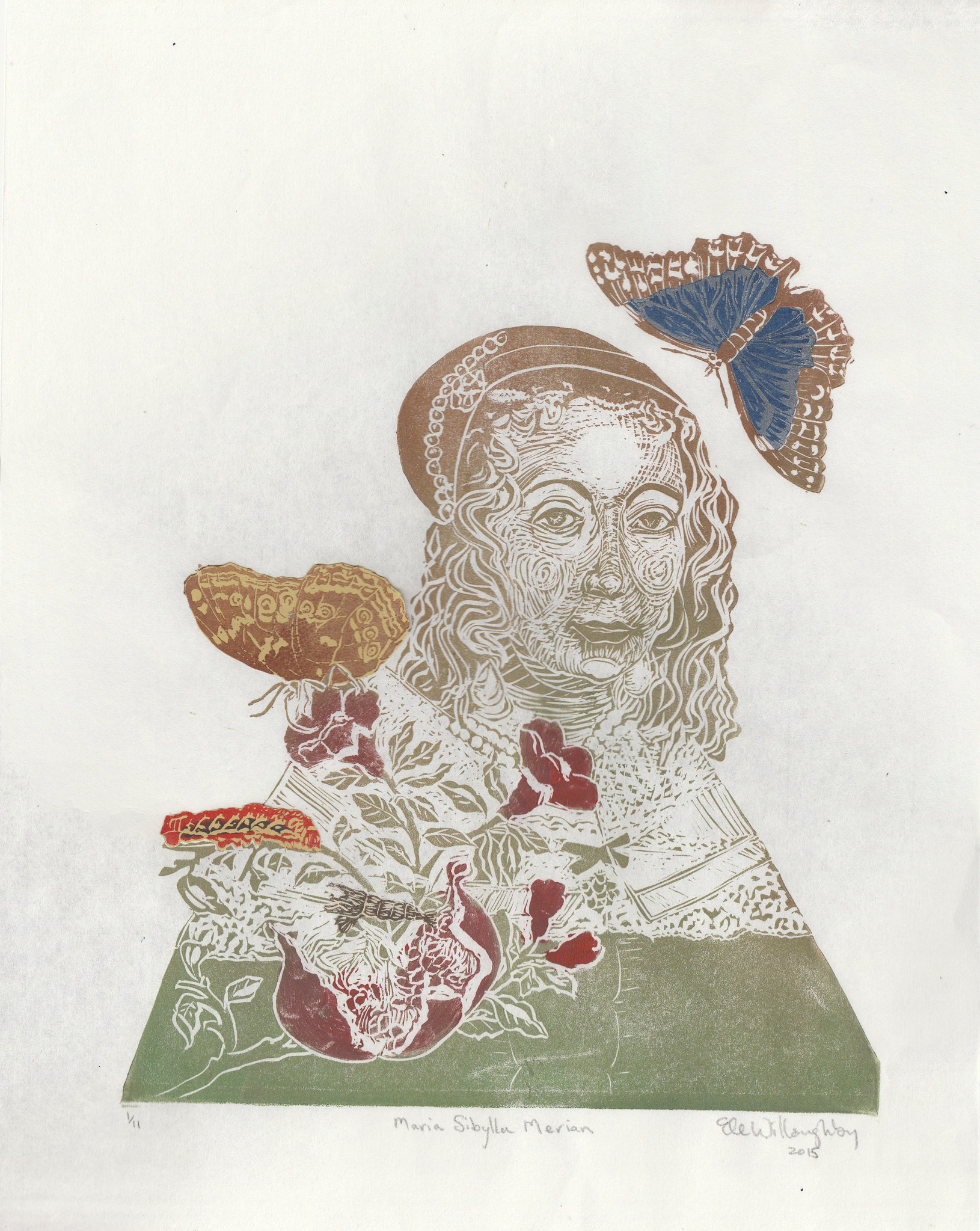
Maria Sibylla Merian, Entomologist, Scientific Illustrator, Explorer of Gardens and the New World

Maria Sibylla Merian
Linocut portrait 'Maria Sibylla Merian' by Ele Willoughby, 2015

This is a linocut portrait of Maria Sibylla Merian (1647-1717), leading entomologist of her day, traveller and scientific illustrator. She is shown complete with pomegranate branch and the life cycle of a morpho butterfly from caterpillar, to chrysalis in its cocoon to butterfly, inspired by her famous work 'Metamorphosis insectorum Surinamensium' - a process she carefully documented and explained. Each print is 11" by 14" (27.9 cm by 35.6 cm), on white Japanese kozo paper with collaged or "chine-collé" hand printed Japanese papers in beige, umber for the cocoon, caterpillar and two views of the butterfly in umber and blue.

The German-born naturalist came from a Swiss family who founded one of one of Europe's largest publishing houses in the 17th century. This allowed her early access to many books on natural history. After she lost her father at age three, and her mother remarried still life painter Jacob Marrel. Her step-father and his students trained her as an artist. She began painting insects and plants by 13. She wrote, "I spent my time investigating insects. At the beginning, I started with silk worms in my home town of Frankfurt. I realized that other caterpillars produced beautiful butterflies or moths, and that silkworms did the same. This led me to collect all the caterpillars I could find in order to see how they changed".

She married her step-father's apprentice Johann Andreas Graff, they had a daughter Johanna Helena, and moved to his home city of Nurenburg. She was able to contribute to the family income by painting, creating embroidery designs, and teaching drawing lessons to unmarried daughters of wealthy families, something which also allowed her access to the finest gardens where she continued collecting and documenting. She published her first book of natural illustrations, titled Neues Blumenbuch, in 1675 at age 28. In 1679, she first published her insect research in a two-volume, illustrated book focusing on insect metamorphosis. She moved twice to be with her mother after her step-father's death, then to join her half-brother at a Labadist religious community. She also split with her husband. After her mother's death, she moved to Amsterdam in 1691 and divorced her husband in 1692.

In Amsterdam, she was able to observe some of the collections of insects which had been brought back from Suriname. She became curious whether the life cycles of the exotic butterflies and other insects mirrored those Europe species she knew well. She was able to secure the city of Amsterdam's permission and and travel grant to travel to Suriname in South America, along with her younger daughter Dorothea Maria. She further funded her travels by selling 255 paintings. She planned a five year mission to study insects, making her perhaps the first person to plan a proper scientific expedition!

She travelled throughout the colony sketching insects and plants. She criticized the Dutch planters treatment of indigenous people and black slaves (though she relied upon amerindian slaves in her residence and her excursions, and brought a young amerindian woman named Indianin back with her to Holland). She used local native names for the plants and described local uses. Malaria likely cut her expedition short and forced her return to the Dutch Republic in 1701. She sold her collected specimen and in 1705 she published Metamorphosis Insectorum Surinamensium about the insects of Suriname.

She suffered a stroke in 1715 which left her partially paralysed and died a pauper in 1717. Her daughter Dorothea published Erucarum Ortus Alimentum et Paradoxa Metamorphosis, a collection of her mother's work, posthumously. Both Dorothea and Johanna followed their mother's lead and became botanical illustrators.

Modern scholars now appreciate her pioneering scientific work as well as the beauty of her scientific illustrations. During her life time insects were still reviled and people still put credence in the Aristotelian idea that they were spontaneously generated or "born of mud". She meanwhile detailed the life cycle of 186 species and explained the poorly-understood or even unknown process of metamorphosis. Science was conducted in Latin and her publications were in the vernacular, making them more popular with high society than contemporary scientists. Despite her knowledge and original research contributions she was not really recognized as a scientist in her day (though Carl Linnæus (1707-1778), father of taxonomy, did cite her in his Systema Naturæ of 1753). It was very unusual for a woman in her day to pursue science, let alone travel the world in its pursuit. She was able to do so because she began her studies with the accessible - animals she could find in her own backyard, and become the leading expert on metamorphosis. During her great expedition, she also noted their habitats, feeding habits and uses to indigenous people. Her classification of butterflies and moths are still relevant today. She detailed plants, frogs, snakes, spiders, iguanas, and tropical beetles and was the first European to describe both army ants and leaf cutter ants as well as their effect on other organisms.

Her work had a strong influence on future scientific illustration. Her work shows great accuracy and she was the first to illustrate the complete life cycle of insects. In her time, funding her expedition and her unladylike devotion to insects was ridiculed, but she is remembered as one of the best insect and flower illustrators of all time. Her daughters and student Rachel Ruysch (1664-1750) all went on to be renown botanical illustrators.

Shortly after her death, Peter the Great saw and purchased a large number of her works in Amsterdam. Her portrait was printed on the 500 DM note before Germany converted to the euro. Her portrait has also appeared on a 0.40 DM stamp and two American 32 cent stamps. Many schools, place names, a scientific research vessel and a crater on Venus have been named in her honour.

One last tidbit (or two) for you history of science buffs: Dorothea's daughter, Maria Sibylla Merian's granddaughter married mathematician Leonhard Euler (1707-1783). Maria Sibylla Merian was also first cousin to Jacob Christoph Le Blon (1667-1741), painter and engraver who invented the four colour printing process (using an RYBK color model similar to the modern CMYK system).

Wednesday, June 17, 2015

The Keeling Curve, Keeling and the atmospheric CO2 trend linocut

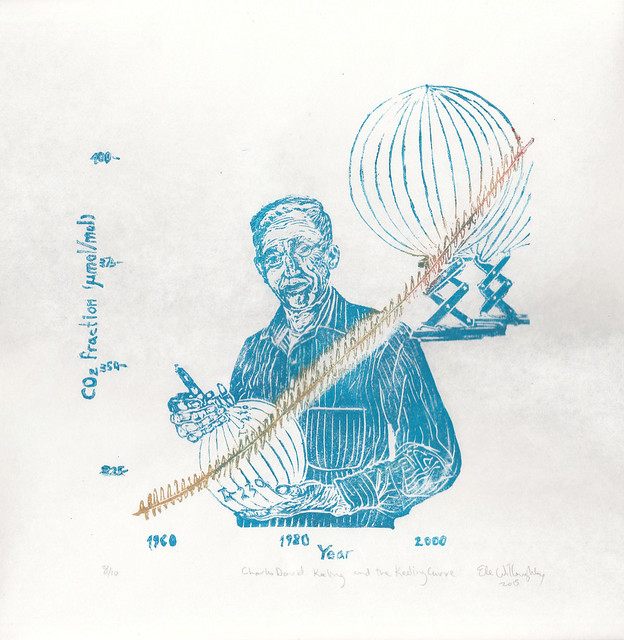
Keeling and the Keeling Curve
Charles David Keeling and the Keeling Curve, linocut 12" x12", 2015 by Ele Willoughby

Sometimes, I take suggestions for prints subjects, especially the scientists series. This is a portrait of American geochemist Charles David Keeling (1928 - 2005) whose decades long observations of carbon dioxide (CO2) in air samples at the Mauna Loa Observatory were some of the first direct data to show the human contribution to the greenhouse effect and global warming. He was suggested for an upcoming Art.Science.Gallery show about climate change. The 'Keeling Curve' shown in copper and red shows both the seasonal variations (the wiggles) and the strong upward trend with time as CO2, a known greenhouse gas (which traps solar radiation), built up in the atmosphere. It turns out this is topical, not only because climate change is always topical, but this week, the American Chemical Society honoured the Keeling Curve as a National Historic Chemical Landmark at a ceremony at Scripps.

After completing his PhD in chemistry at Northwestern in 1954, he did a postdoc in geochemistry at the California Institute of Technology where he developed the first instrument to measure carbon dioxide in atmospheric samples. He then joined the Scripps Institute of Oceanography at UCSD, where he remained for his career, as a professor of oceanography. He had good timing; 1957 - 1958 marked the International Geophysical Year and he was able to get IGY funding to set up a base 3000 m above sea level at the Mauna Loa Observatory in Hawai'i, where he put his CO2 measuring methods to work. He also gathered similar data series at Big Sur, California and in Antarctica. Prior to his studies, scientists believed that CO2 levels were simply variable, without the sort of clear patterns he observed. Between 1958 to 1960, we was able to show the daily pattern of change due to respiration from local plants and soils as well as the seasonal variations in CO2 levels; by 1961 it was clear there was also a strong upward trend in the 'Keeling Curve' which roughly matched the amounts of CO2 released by our own burning of fossil fuels.

The National Science Foundation cut off his funding, arguing that the results were "routine" though they nonetheless used his data to warn of the risk of global warming. He was forced to abandon his studies in Antarctica, but managed to keep the Mauna Loa experiment going. These measurements at Mauna Loa continue to this day and are the longest continuous record of atmospheric CO2. They show a rise of 315 parts per million by volume (ppmv) in 1958 to 401 ppmv as of April 2014 and this increase has been accelerating in recent years with serious implications for climate change.

Due to the seriousness of these data, the National Oceanic and Atmospheric Administration (NOAA) lanunched their own worldwide CO2 monitoring program in the 1970s, including at Mauna Loa, alongside the Scripps experiment. After CD Keeling's death in 2005, the Scripps measuring experiment was taken over by his son, Ralph Keeling, professor of geochemistry.

Keeling received many accolades during his lifetime. In 1986, he was elected a fellow of the American Academy of Arts and Sciences and a member of the National Academy of Sciences in 1994. In 2002 Keeling was awarded the National Medal of Science, the highest award for lifetime achievements in science granted by the US. He received the Tyler Prize for Environmental Achievement for his data collection and interpretation in 2005.

Wednesday, May 20, 2015

SciArt meet-up

Austin Monthly for October 2014 included my linocut of
Florence Nightingale in their write-up of the 'X Marks the Spot' show
at Art.Science.Gallery
Today I got to meet-up with a group of scientists/artists: Hayley Gillespie (ecologist, artist and founder of Art.Science.Gallery), Peggy Muddles (aka the Vexed Muddler, who works on the genetics of bacteria in lungs of CF patients by day, and amazing SciArt ceramics by night) and Rovena Tey (cancer researcher on mat leave and science-inspired cardmaking genius behind Handmade By Rovena)* and have a tour behind the scenes at the Royal Ontario Museum! The ROM is a rightfully famous museum, which boasts not only a world class archeological (especially Egyptian) collection, but a proper natural history museum, which has always meant that it was a research institution as well as a public museum. One of Hayley's friends from grad school is the curator of freshwater fish, and he was kind enough to give us a tour of the freshwater fish, and mammals and enlist his colleague to show us the invertebrate collection. Sadly, photographs were not allowed for security reasons (as it's best not to publicize the inner workings of a museum which houses some very valuable artifacts).

As token physical scientist, when the conversation turned to finer details of genetics and mapping family trees (if you will) of huge datasets of species, I felt like saying, "Oh! Bayesian regression! I know what that means!" with a little wink. The physical specimen themselves and the tour was fascinating. I could certainly relate to the problems of data archiving and preserving physical specimen, as these are serious problems for earth scientists too (especially the marine ones, as some ocean bottom cores need to be frozen and pressurized to avoid essentially melting or exploding, or both). I wouldn't have guessed that most of the ROM's collection of fishes is housed outside of the city, because that many tens of thousands of alcohol filled jars is deemed too great a fire risk downtown! It really is an incredible feat for these scientists to have even gathered all these species, let alone all the work of detailing and studying them, tracing their evolution, afterwards - and an invaluable resource.

We saw a few thousand sample jars of fishes, as well as some mammals (like bats) which are stored in alcohol. We saw their large collection of mammal pelts, which sort of takes your breathe away. The ROM is a museum of a certain age; at some time in the past they were gifted a large collection of mounted mammal heads (presumably from the estate of a hunter). I saw the head of a black rhino, now on the brink of extinction. It was staggering in size, even compared to the other rhino head. There were more heads of assorted quadrupeds than I knew how to identify.

I was pleased to happen to see a giraffe weevil along with a fabulous, large bronze sculpture of a giraffe weevil, on a plinth in the hallway between offices for scientists. I had only seen photos when I made my linocut. The invertebrates curator was an expert on leeches (which yes, are gathered the hard way... as any Canadian who has portaged a canoe through swampy water will be familiar). There were marvellous and/or scary arthropods including a mantis shrimp the size of my forearm, a roughly metre long South American earthworm, delicate and beautiful shell of a paper nautilus (or argonaut), adorable slipper lobster, and all sorts of other crustaceans... as well and swapped tales of fieldwork and labwork (mis)adventure.

Afterwards we were joined by Hayley's husband Cole (a psychiatrist) for a lovely lunch and discussion about that inspiring intersection of art and science. It was a real treat!

Hayley also brought me a copy of the Austin Monthly from October 2014. They included (part of) my portrait of Florence Nightingale in their write-up of the 'X Marks the Spot' exhibit at Art.Science.Gallery. It's always great to see my artwork in print, but I especially like that they've selected the perhaps unexpected. People will know her name, but as a nursing pioneer, rather than a statistician and data visualization pioneer, but she was both. She also brought me Ada Lovelace bookmarks from the 'Go Ahead and Do It' women in STEM show. Gabriel promptly ate one when I got home.

*We missed Glendon Mellow (aka the Flying Trilobite), scientific illustrator, SciArtist and Scientific American blogger, who couldn't make it.