Showing posts with label scientific illustration. Show all posts

Wednesday, March 29, 2023

Love and Butterflies: Victorian Lepidopterist, Scientific Illustrator and Diarist


Margaret Fountaine linocut, 11" x14" by Ele Willoughby, 2023

Margaret Elizabeth Fountaine (1862-1940)'s posthumous books featured the somewhat salacious bits of her diaries of her "wild and fearless life," but she was a also trailblazing Victorian lepidopterist, who published in many papers in The Entomologist's Record and Journal of Variations, and was an expert on tropical butterflies, discovering, documenting, breeding and gathering specimen in 60 countries on 6 continents, a talented scientific illustrator, who gathered a collection of 22,000 (bequeathed to the Norwich Castle Museum). She became the only female fellow in the Royal Entomological Society in 1898. She gave scientific lectures internationality on things like "the sagacity of caterpillars." She was the most famous woman lepidopterist of the late 19th and early 20th centuries.
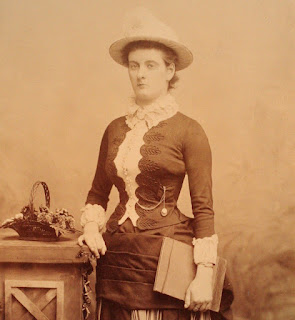

Margaret Fountaine
Margaret Fountaine wore many hats 


The eldest daughter of seven children born to a family of modest means of clergyman John Fountaine
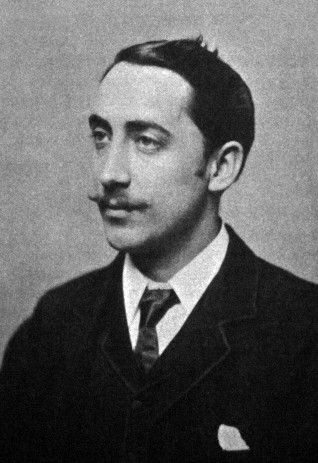
Septimus Hewson,
swindler & object of her affection

and his wife (also a clergyman's daughter) Mary Isabella Lee, Margaret was born in Norwich.  The family moved to Eaton Grange, Norwich, when her father died. The next year, at 15, Margaret began keeping a diary, a habit she kept up until her death in 1940. Teenage Margaret spent her time in nature, or gossiping with siblings about her crushes. She had already developed her interest in natural history, and her habit of falling for men she saw but didn't know... and recording her anguished feelings in her diary. She spent seven years yearning after an Irish chorister, Septimus Hewson, at her local church, pretending she was painting interior scenes of the church as an excuse to essentially stalk him. She wrote angrily in her diary if she spotted him talking to other women, though she herself had never dared speak to him. Sadly for Margaret, Septimus was a drunk and a swindler who thrown out of Norwich in disgrace. So Margaret claimed she was visiting some respectable ladies in Dublin, but snuck away to follow Septimus to Limerick and profess her love. He apparently reciprocated and she considered herself engaged. She returned home and wrote to him of her joy that her years secretly pinning after him would end with their marriage. After weeks of silence his own relatives wrote to her that she would be best to forget him; he had betrayed everyone he knew and squandered all his money on booze. She found herself nearing 30, a spinster by Victorian standards, with no prospects and no plan. But the death of a wealthy uncle when she was 27 had giving her and her sister the freedom to make choices that few of her contemporaries could enjoy. 
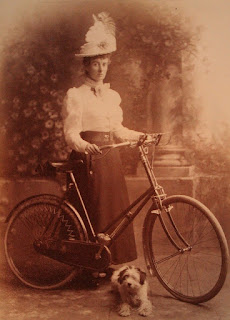
Margaret Fountaine with bike
Margaret Fountaine 
with bicycle and fabulous hat   

Her first move was to leave, and escape her painful memories of unrequited love. So she headed to the continent with her sister, touring France and Switzerland by bicycle, where she found a way to dull her pain by encouraging a series of men's affections and then scorning them She wrote, "it was the pleasure of inflicting that pain that my soul was craving for. I could do it - I had the power. I had learnt it now at last." She became more serious in her butterfly collecting, using Latin rather than common names. She settled in Milan, encouraged by a teacher who told her she could have a career in opera. The workload, training, lifestyle and uncertainty of success were not for her but she kept up her studies until 1895 when she met Henry John Elwes,  Fellow of the Royal Society, vice-president of the Horticultural Society and a passionate butterfly collector, at his UK estate. Butterfly collecting was not uncommon for Victorian ladies, but Margaret did not do things by half-measures.  Margaret realized this could be her life's purpose. Unlike hobbyists Margaret sought out not just to gather, but to document and breed species and to travel anywhere, no matter how inhospitable, to do so, tracking elusive species through European mountains, African deserts, South American jungles, Indian plains, Australia and islands of the South Pacific.  
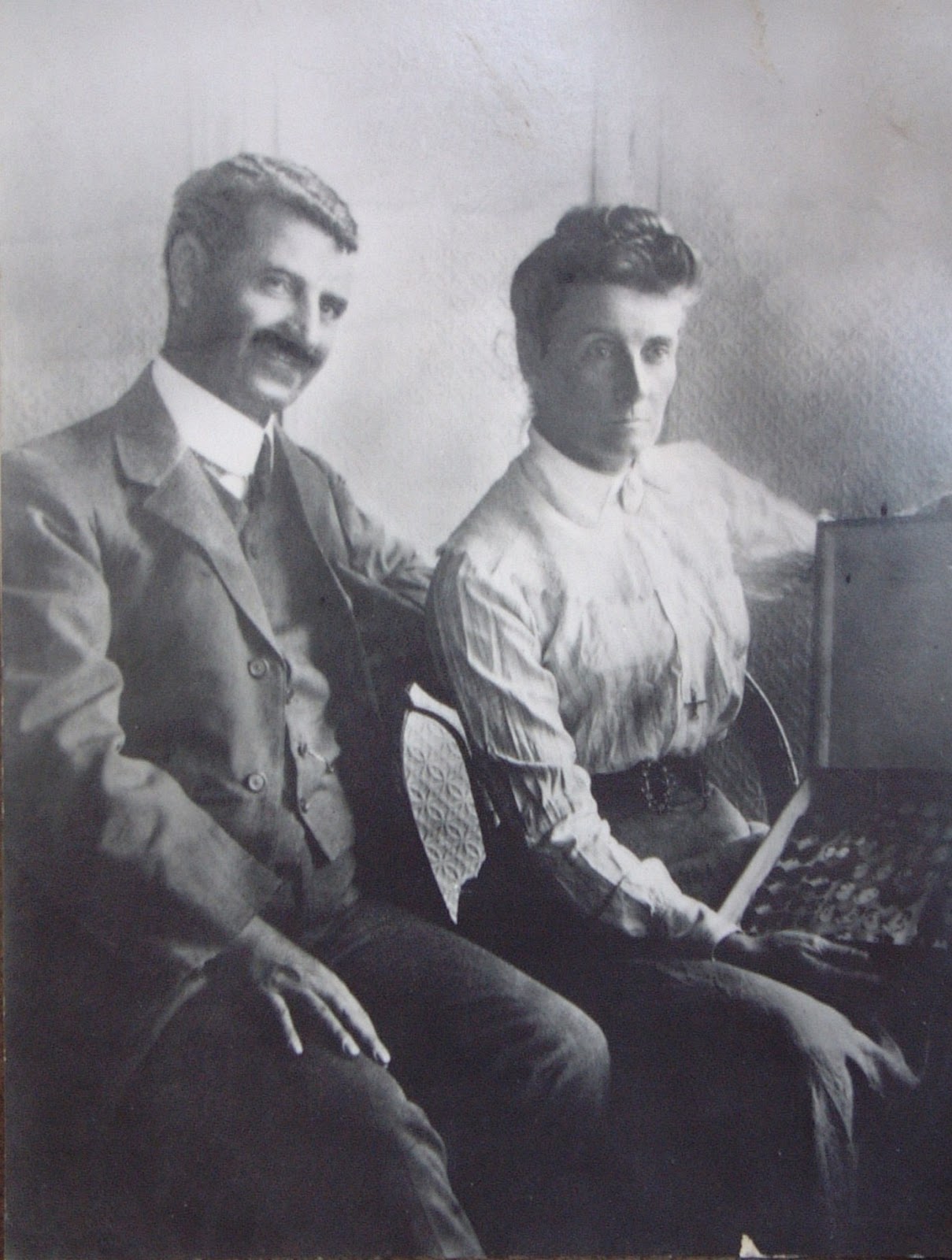
Margaret and Kalil, around 1912

Much of this work, for better or worse, was done in partnership with a dragoman (a sort of local fixer/interpreter and guide) Khalil Neimy, 15 years her junior, which
we know because she noted his help (when many peers did not bother) whom she met in Damascus. Though secretly married, he declared his love for her, and they spent many years of a tumultuous relationship together, travelling the world and collecting butterflies, and, in while South America, she developed means of rearing butterflies. She shared her knowledge freely with fellow collectors and entomologists, and though not dedicated to writing up her scientific results, her reputation was such that she was invited to join the prestigious Linnean Society in 1912. 
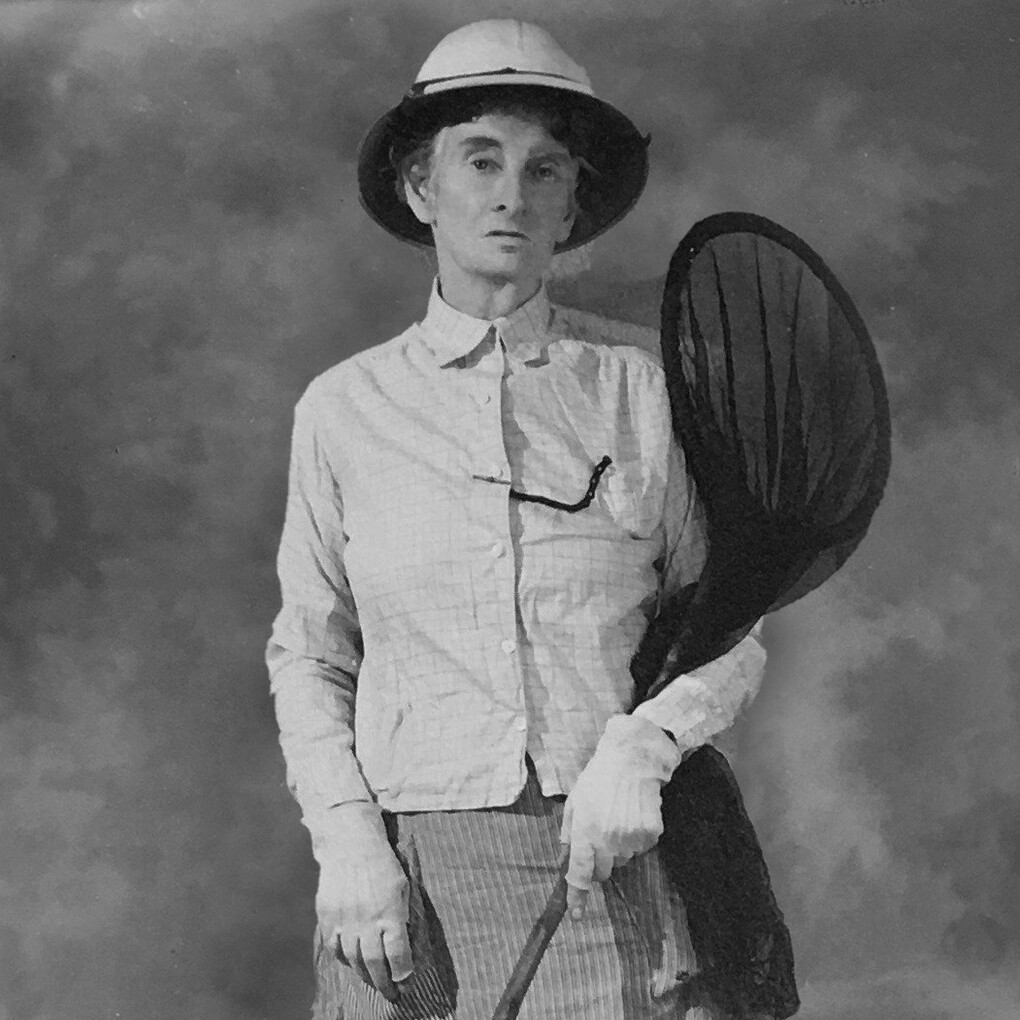
Margaret with her butterfly net
WWI hit her income as her investments plummeted in value, and for the first time she needed to earn money. She worked first as a simple cataloguer for a private collection in California and then, with her reputation for being able to find species no one else could, she started to receive collection commissions. This allowed her to continue to finance her travels and expeditions. Neimy confessed he was secretly married and was slow to get a divorce so they could marry. Also, as an Ottoman citizen, if they did marry, she would automatically become an Ottoman citizen, which she did not want. He struggled to get UK citizenship, seemingly forgetting that he also had US citizenship. But he died in 1928, and then Margaret discovered she was still seeing his wife, and fathering children while pursuing her. His loss, along with her sister's death and other family woes left her with less enjoyment of her life. But, she began to receive professional recognition and find herself the star of entomological gatherings, as she continued her fieldwork into her seventies. She died butterfly net in hand in the jungle, likely of a heart attack, discovered by a local monk. 

References

Dale DeBakcsy, Love and Butterflies The Adventures of Victorian Lepidopterist Margaret Fountaine, Women You Should Know, January 15, 2020

David Waterhouse, A Love of Butterflies - The Fountaine-Neimy Collection, Norwich Castle Museum and Art Museum, July 2, 2021

Florien Duijsens, Podcast # 27: Margaret Fountaine, Dead Ladies Show, November 19, 2019

The captivating life of a leading lepidopterist, KL Magazine, accessed March, 2023

Margaret Fountaine, Norfolk Women in History, accessed March, 2023

Margaret Fountaine, Wikipedia, accessed March, 2023

Monday, October 26, 2015

Maria Sibylla Merian, Entomologist, Scientific Illustrator, Explorer of Gardens and the New World

Maria Sibylla Merian
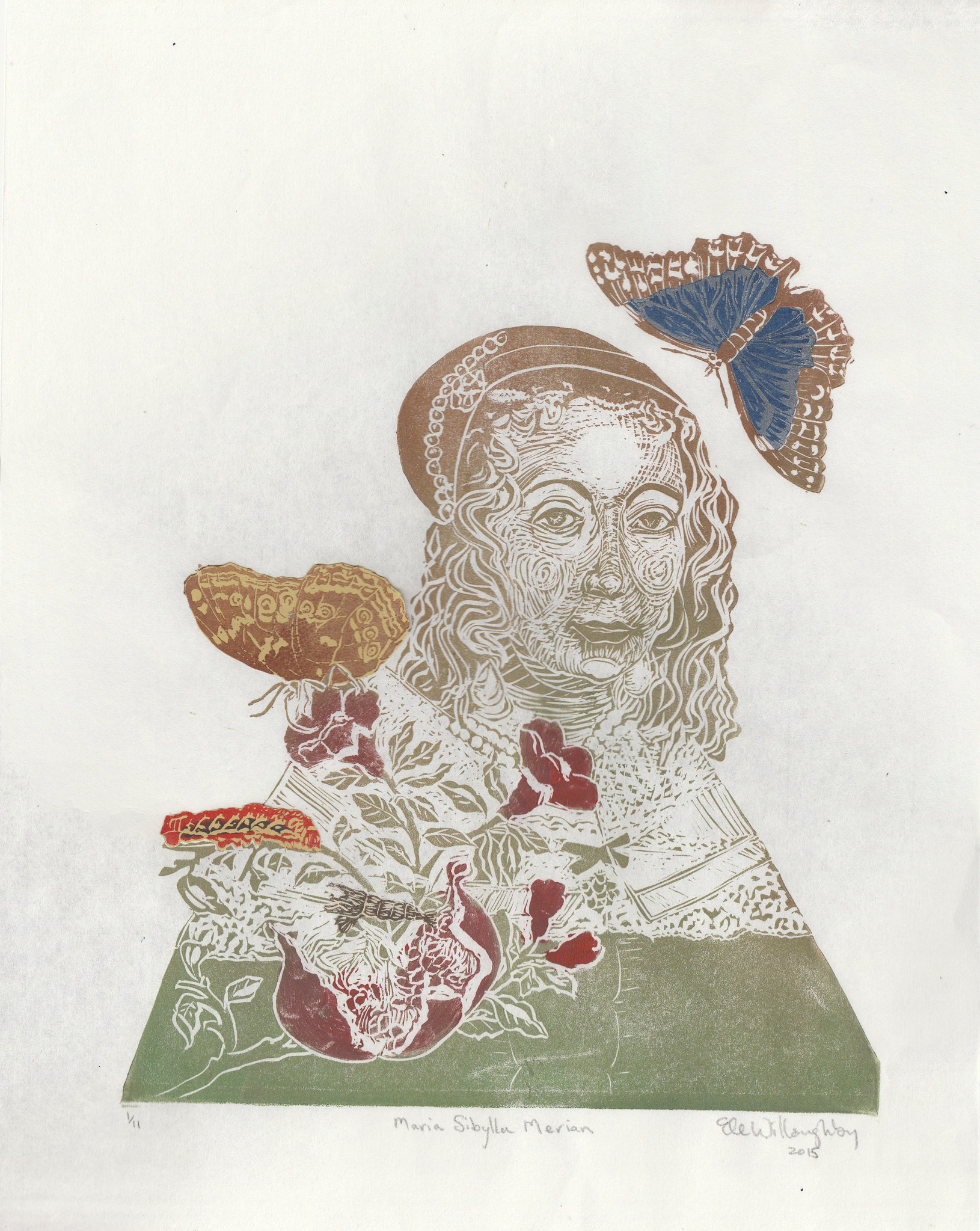
Linocut portrait 'Maria Sibylla Merian' by Ele Willoughby, 2015

This is a linocut portrait of Maria Sibylla Merian (1647-1717), leading entomologist of her day, traveller and scientific illustrator. She is shown complete with pomegranate branch and the life cycle of a morpho butterfly from caterpillar, to chrysalis in its cocoon to butterfly, inspired by her famous work 'Metamorphosis insectorum Surinamensium' - a process she carefully documented and explained. Each print is 11" by 14" (27.9 cm by 35.6 cm), on white Japanese kozo paper with collaged or "chine-collé" hand printed Japanese papers in beige, umber for the cocoon, caterpillar and two views of the butterfly in umber and blue.

The German-born naturalist came from a Swiss family who founded one of one of Europe's largest publishing houses in the 17th century. This allowed her early access to many books on natural history. After she lost her father at age three, and her mother remarried still life painter Jacob Marrel. Her step-father and his students trained her as an artist. She began painting insects and plants by 13. She wrote, "I spent my time investigating insects. At the beginning, I started with silk worms in my home town of Frankfurt. I realized that other caterpillars produced beautiful butterflies or moths, and that silkworms did the same. This led me to collect all the caterpillars I could find in order to see how they changed".

She married her step-father's apprentice Johann Andreas Graff, they had a daughter Johanna Helena, and moved to his home city of Nurenburg. She was able to contribute to the family income by painting, creating embroidery designs, and teaching drawing lessons to unmarried daughters of wealthy families, something which also allowed her access to the finest gardens where she continued collecting and documenting. She published her first book of natural illustrations, titled Neues Blumenbuch, in 1675 at age 28. In 1679, she first published her insect research in a two-volume, illustrated book focusing on insect metamorphosis. She moved twice to be with her mother after her step-father's death, then to join her half-brother at a Labadist religious community. She also split with her husband. After her mother's death, she moved to Amsterdam in 1691 and divorced her husband in 1692.

In Amsterdam, she was able to observe some of the collections of insects which had been brought back from Suriname. She became curious whether the life cycles of the exotic butterflies and other insects mirrored those Europe species she knew well. She was able to secure the city of Amsterdam's permission and and travel grant to travel to Suriname in South America, along with her younger daughter Dorothea Maria. She further funded her travels by selling 255 paintings. She planned a five year mission to study insects, making her perhaps the first person to plan a proper scientific expedition!

She travelled throughout the colony sketching insects and plants. She criticized the Dutch planters treatment of indigenous people and black slaves (though she relied upon amerindian slaves in her residence and her excursions, and brought a young amerindian woman named Indianin back with her to Holland). She used local native names for the plants and described local uses. Malaria likely cut her expedition short and forced her return to the Dutch Republic in 1701. She sold her collected specimen and in 1705 she published Metamorphosis Insectorum Surinamensium about the insects of Suriname.

She suffered a stroke in 1715 which left her partially paralysed and died a pauper in 1717. Her daughter Dorothea published Erucarum Ortus Alimentum et Paradoxa Metamorphosis, a collection of her mother's work, posthumously. Both Dorothea and Johanna followed their mother's lead and became botanical illustrators.

Modern scholars now appreciate her pioneering scientific work as well as the beauty of her scientific illustrations. During her life time insects were still reviled and people still put credence in the Aristotelian idea that they were spontaneously generated or "born of mud". She meanwhile detailed the life cycle of 186 species and explained the poorly-understood or even unknown process of metamorphosis. Science was conducted in Latin and her publications were in the vernacular, making them more popular with high society than contemporary scientists. Despite her knowledge and original research contributions she was not really recognized as a scientist in her day (though Carl Linnæus (1707-1778), father of taxonomy, did cite her in his Systema Naturæ of 1753). It was very unusual for a woman in her day to pursue science, let alone travel the world in its pursuit. She was able to do so because she began her studies with the accessible - animals she could find in her own backyard, and become the leading expert on metamorphosis. During her great expedition, she also noted their habitats, feeding habits and uses to indigenous people. Her classification of butterflies and moths are still relevant today. She detailed plants, frogs, snakes, spiders, iguanas, and tropical beetles and was the first European to describe both army ants and leaf cutter ants as well as their effect on other organisms.

Her work had a strong influence on future scientific illustration. Her work shows great accuracy and she was the first to illustrate the complete life cycle of insects. In her time, funding her expedition and her unladylike devotion to insects was ridiculed, but she is remembered as one of the best insect and flower illustrators of all time. Her daughters and student Rachel Ruysch (1664-1750) all went on to be renown botanical illustrators.

Shortly after her death, Peter the Great saw and purchased a large number of her works in Amsterdam. Her portrait was printed on the 500 DM note before Germany converted to the euro. Her portrait has also appeared on a 0.40 DM stamp and two American 32 cent stamps. Many schools, place names, a scientific research vessel and a crater on Venus have been named in her honour.

One last tidbit (or two) for you history of science buffs: Dorothea's daughter, Maria Sibylla Merian's granddaughter married mathematician Leonhard Euler (1707-1783). Maria Sibylla Merian was also first cousin to Jacob Christoph Le Blon (1667-1741), painter and engraver who invented the four colour printing process (using an RYBK color model similar to the modern CMYK system).

Tuesday, October 13, 2015

Botanist and Photographic Pioneer Anna Atkins - for Ada Lovelace Day


Ada Lovelace, 3rd edition
Ada, Countess Lovelace, 3rd edition linocut by Ele Willoughby
Today is the 7th annual international day of blogging to celebrate the achievements of women in technology, science and math, Ada Lovelace Day 2015 (ALD15). I'm sure you'll all recall, Ada, brilliant proto-software engineer, daughter of absentee father, the mad, bad, and dangerous to know, Lord Byron, she was able to describe and conceptualize software for Charles Babbage's computing engine, before the concepts of software, hardware, or even Babbage's own machine existed! She foresaw that computers would be useful for more than mere number-crunching. For this she is rightly recognized as visionary - at least by those of us who know who she was. She figured out how to compute Bernouilli numbers with a Babbage analytical engine. Tragically, she died at only 36. Today, in Ada's name, people around the world are blogging.
You can find my previous Ada Lovelace Day posts here. 
This year, I thought I'd take the opposite approach from last year. I wrote about Marie Skłodowska-Curie last year, despite her fame and the risk that she was likely the only women in STEM that many people can name. I chose to write about her because it was artificial to avoid her; she really did make incredible discoveries and lived an extraordinary life. This year, I've selected a scientist who is rather new to me, and who was not an icon of science. She was nonetheless a pioneer. I've selected her because she is precisely the sort of scientist we forget - especially if female. What she did was important, and cutting edge in her time, and while it may not have been epochmaking it was the sort of important, incremental, methodical work which represents much of the scientific entreprise, and most of the advance of science throughout history. I believe the concept of the "paradigm shift" might be useful, but it is often dangerously simplistic and leads to a false narrative of a series of great men (almost invariably it is a man who is selected to represent the bringer of the new idea) revolutionizing science. Science, and its history, is more often much more involved, non-linear, over-lapping and interwoven than this type of narrative presents. Lastly, I love that this particular scientist was working at the intersection of art and science.


Anna Atkins with ferns
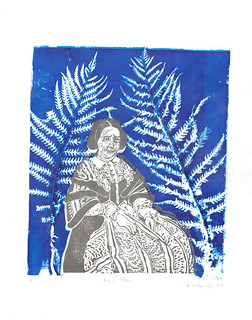
This is a portrait of English botanist and photographer Anna Atkins (1799-1871), née Children. It combines both a hand-carved lino block portrait in dark silver ink, and a screenprint of the silhouette of fern leaves in cobalt blue ink, mimicking the cyanotypes she was known for. It is printed by hand on lovely Japanese kozo (or mulberry) paper, 11" x 14" (28 cm x 35.6 cm). (c) Ele Willoughby, 2015

Anna Atkins (1799-1871), née Children, was an English botanist and photographer. She is the first person to have illustrated a book using photographs, Photographs of British Algae: Cyanotype Impressions in October 1843. Note that: not the first woman, the first person. She lived at a time when it was possible to be a self-trained scientist, especially if you were middle or upper class and received an education and the financial freedom to devote your time to pursue your subject. (The Mary Annings of the world, who managed to make a name for themselves in science despite her class, religions and complete lack of financial ressources, are rare indeed). She was raised and instructed by her father, a naturalist, and her social circle included those who were developing (no pun intended) the latest, brand new photographic technology. So, she was at the right place at the right time. But that doesn't take away from the fact that she had the knowledge, skill, insight and ability to immediately see the utility of the method for descriptive science and to document a specific field of sub-field of botany, with her collection of the algae (seaweeds) of Britain. I think this should be understood as equivalent to a modern-day scientist keeping abreast of other fields of study and rapidly mastering a new high-tech tool to apply it to her field. Even William Henry Fox Talbot, who who invented the salted paper and calotype processes, precursors to modern photographic methods, was not able to publish The Pencil of Nature the first commercially printed photographic book, until eight months after she produced Photographs of British Algae: Cyanotype Impressions.

Her mother died when she was still an infant, but she was close with her naturalist father and received a much more scientific education than was common for women in her time. Her 250 detailed engravings of shells were used to illustrate her father's translation of Lamarck's 'Genera of Shells'. This translation was important to the nomenclature of shells, because her illustration allowed readers to properly identify Lamarck's genera. She married John Pelly Atkins in 1825 and devoted herself to botany and collecting specimen, including for Kew Gardens. In 1839, she became a member of the Botanical Society of the British Isles, one of the few scientific organizations open to women. She became interested in algae, after William Henry Harvey published A Manual of the British marine Algae in 1841.

Through her father, she was friends with both William Henry Fox Talbot and Sir John Herschel, who (amongst other things) invented the cyanotype photographic process in 1842. Within a single year of its invention, she self-published the first known book of illustrated with cyanotype photographs and was likely one of the two first women to make a photograph. She recorded her seaweed specimen for posterity by making photograms by placing the unmounted dried-algae original directly on the cyanotype paper. Atkins self-published her photograms in the first installment of Photographs of British Algae: Cyanotype Impressions in October 1843, and two further volumes in the next decade. She collaborated with Anne Dixon (1799–1864) to produce further books of cyanotypes on ferns and flowering plants and also published other non-scientific or photographic books. In 1865, she donated her collections to the British Museum.

I've shown her based on an early photographic portrait, along with some fern leaves which I've worked with directly, much how she illustrated her own specimen.

Have a look at her cyanotypes and a video of one of the surviving copies of her book.


Thursday, September 5, 2013

The Selected Works of T.S. Spivet


I seem to have fallen out of the habit of regularly reviewing books on my blog. I used to be more disciplined about it, and there is a series of reviews on the minouette blog (and here), including the one below for one of my favorite books of the last several years. I've also mentioned The Selected Works of T.S. Spivet on magpie&whiskeyjack, comparing the whimsical maps and scientific illustration of everything incorporated into the work of artist Simon Evans with those of the more strictly empirical modern-day Humboltian cartography protegy Spivet. If you, like me, are inspired by the fertile intersection of art and science, this is a novel for you. You should go read it right away, because as I was very pleased to read this morning, Jean-Pierre Jeunet (director of Amelie, or Le Fabuleux Destin d'Amélie Poulain in French) has adapted the novel for a movie to be released in France (filmed in English, with French subtitles) in October.


The Selected Works of T.S. Spivet by Reif Larsen


Reading this novel I thought, yes, this is what I want to do all the time.  Why can't I just get paid to read books like this? I would be happy  doing this indefinitely. Of course, are there books like this one? That  is a harder question to answer. Tecumseh Sparrow Spivet (best. name.  ever.) is a gifted prodigy in cartography at 12 years old. He lives on a  ranch near Divide, Montana, with his mother, stalled entomologist, Dr.  Clair, his teenage sister, Gracie, who would love to escape their small  town and peculiar family, and strong-silent cowboy father T.E. Spivet.  His brother Layton, has died, and we slowly learn more. T.S. keeps  different coloured notebooks for maps of people doing things:  zoological, geological, and topographical maps; and insect anatomy  (should Dr. Clair ever call on his help), respectively. T.S. learns  he has won the prestigious Baird Award from the Smithsonian, for his  incredible mapping and scientific illustration work, and his adventure  begins, as he decides to accept in person, but being 12, he sees his  best means of transport as to hop on a freight train and hobo east. In  this beautiful, whimsically illustrated book, T.S. maps everything  from the Continental divide, to beetle subspecies, to cowboy moves, to  facial expressions, to geology, to how McDonald's "penetrates my  permeable barrier of aesthetic longing", to concentration of litter in  Chicago, to his family history, to a many-worlds interpretation of  quantum mechanics and what this might have meant for his family. This  book is beautiful, in terms of the sensitivity and originality of the  story (Wormholes of the Midwest! the hobo hotline?), the love of  knowledge expressed, down to the layout of the text and images on the  page. Maybe we will be lucky enough to be recruited into the Megatherium  club. The manner in which this child's mind breaks up the world is a  reminder of why science is wonderful and the joy of unfettered thinking.  The story is also interwoven with that of T.S.' ancestors, including  his great-grandmother the early geologist. We get both 'when science was  young' and 'the young scientist'.


Maybe I'll go reread it myself now.  (cross-posted to magpie & whiskeyjack)