Showing posts with label butterflies. Show all posts

Tuesday, June 17, 2025

The Future of Pollination - Manufactured Ecosystems


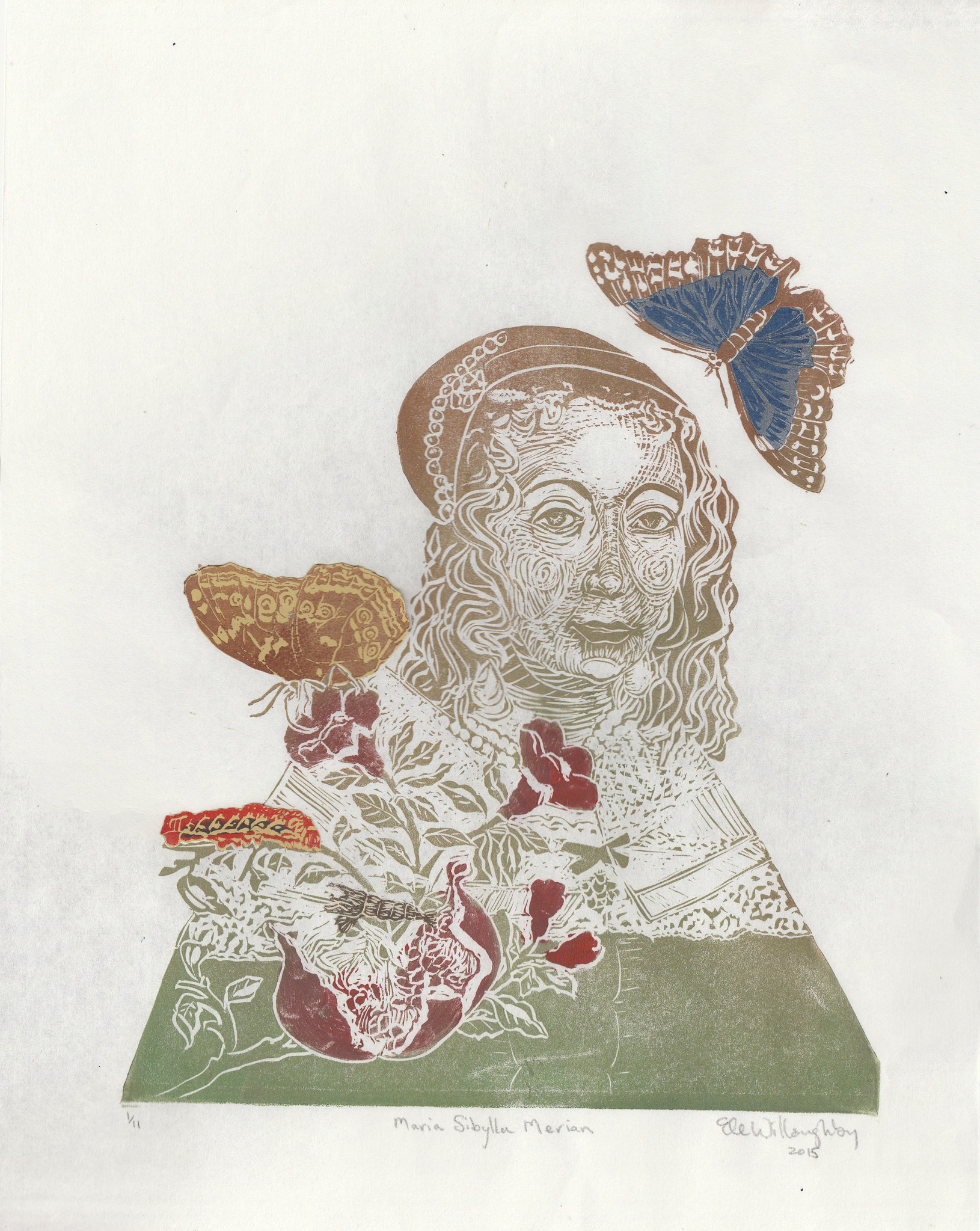
Our Fate Is Tied To That Of The Insects, linocut print, 16" x20", Ele Willoughby, 2025

Pollinator Week is a great time to share this print, which expresses the central theme of my work about the Future of Pollination for Manufactured Ecosystems. I have been working on a collection of 15 prints for this show for the last several months. Our food sources and ecosystems around us are dependent on pollinators (mostly bees & other insects, some birds & mammals) but insects populations have lost huge numbers and many species altogether. Our future will be linked to their fate. Each of the bees, moths, butterflies and beetles in my print are native species here. 

Next week our art show will open at Zavitz Art Gallery at the University of Guelph. Each of the visual artists has produced work on various themes in various media about our ecological future looking forward the wake of climate change and habitat loss and at what we can learn from nature. I’m really excited to see what the others have produced! I hope you’ll come see the show if you’re able. 

Photosynthesis
Artist: Yulia Shtern @magical_zoo

Soil Formation
Artist: Lynx @amour.lynx

Cultural Services
Artist: Pablo Rios @the_amazing_world_of_redacted

Biodiversity
Artist: Melanie Barnett
@melanie.barnett.ceramics

Climate Regulation
Artist: Amanda White @thetiniestseed

Wednesday, March 29, 2023

Love and Butterflies: Victorian Lepidopterist, Scientific Illustrator and Diarist


Margaret Fountaine linocut, 11" x14" by Ele Willoughby, 2023

Margaret Elizabeth Fountaine (1862-1940)'s posthumous books featured the somewhat salacious bits of her diaries of her "wild and fearless life," but she was a also trailblazing Victorian lepidopterist, who published in many papers in The Entomologist's Record and Journal of Variations, and was an expert on tropical butterflies, discovering, documenting, breeding and gathering specimen in 60 countries on 6 continents, a talented scientific illustrator, who gathered a collection of 22,000 (bequeathed to the Norwich Castle Museum). She became the only female fellow in the Royal Entomological Society in 1898. She gave scientific lectures internationality on things like "the sagacity of caterpillars." She was the most famous woman lepidopterist of the late 19th and early 20th centuries.
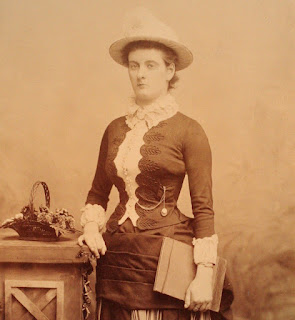

Margaret Fountaine
Margaret Fountaine wore many hats 


The eldest daughter of seven children born to a family of modest means of clergyman John Fountaine
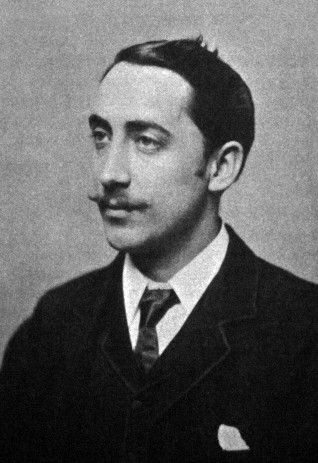
Septimus Hewson,
swindler & object of her affection

and his wife (also a clergyman's daughter) Mary Isabella Lee, Margaret was born in Norwich.  The family moved to Eaton Grange, Norwich, when her father died. The next year, at 15, Margaret began keeping a diary, a habit she kept up until her death in 1940. Teenage Margaret spent her time in nature, or gossiping with siblings about her crushes. She had already developed her interest in natural history, and her habit of falling for men she saw but didn't know... and recording her anguished feelings in her diary. She spent seven years yearning after an Irish chorister, Septimus Hewson, at her local church, pretending she was painting interior scenes of the church as an excuse to essentially stalk him. She wrote angrily in her diary if she spotted him talking to other women, though she herself had never dared speak to him. Sadly for Margaret, Septimus was a drunk and a swindler who thrown out of Norwich in disgrace. So Margaret claimed she was visiting some respectable ladies in Dublin, but snuck away to follow Septimus to Limerick and profess her love. He apparently reciprocated and she considered herself engaged. She returned home and wrote to him of her joy that her years secretly pinning after him would end with their marriage. After weeks of silence his own relatives wrote to her that she would be best to forget him; he had betrayed everyone he knew and squandered all his money on booze. She found herself nearing 30, a spinster by Victorian standards, with no prospects and no plan. But the death of a wealthy uncle when she was 27 had giving her and her sister the freedom to make choices that few of her contemporaries could enjoy. 
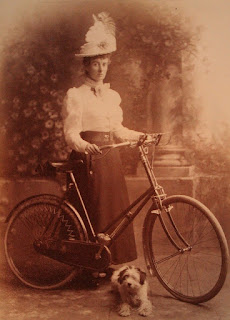
Margaret Fountaine with bike
Margaret Fountaine 
with bicycle and fabulous hat   

Her first move was to leave, and escape her painful memories of unrequited love. So she headed to the continent with her sister, touring France and Switzerland by bicycle, where she found a way to dull her pain by encouraging a series of men's affections and then scorning them She wrote, "it was the pleasure of inflicting that pain that my soul was craving for. I could do it - I had the power. I had learnt it now at last." She became more serious in her butterfly collecting, using Latin rather than common names. She settled in Milan, encouraged by a teacher who told her she could have a career in opera. The workload, training, lifestyle and uncertainty of success were not for her but she kept up her studies until 1895 when she met Henry John Elwes,  Fellow of the Royal Society, vice-president of the Horticultural Society and a passionate butterfly collector, at his UK estate. Butterfly collecting was not uncommon for Victorian ladies, but Margaret did not do things by half-measures.  Margaret realized this could be her life's purpose. Unlike hobbyists Margaret sought out not just to gather, but to document and breed species and to travel anywhere, no matter how inhospitable, to do so, tracking elusive species through European mountains, African deserts, South American jungles, Indian plains, Australia and islands of the South Pacific.  
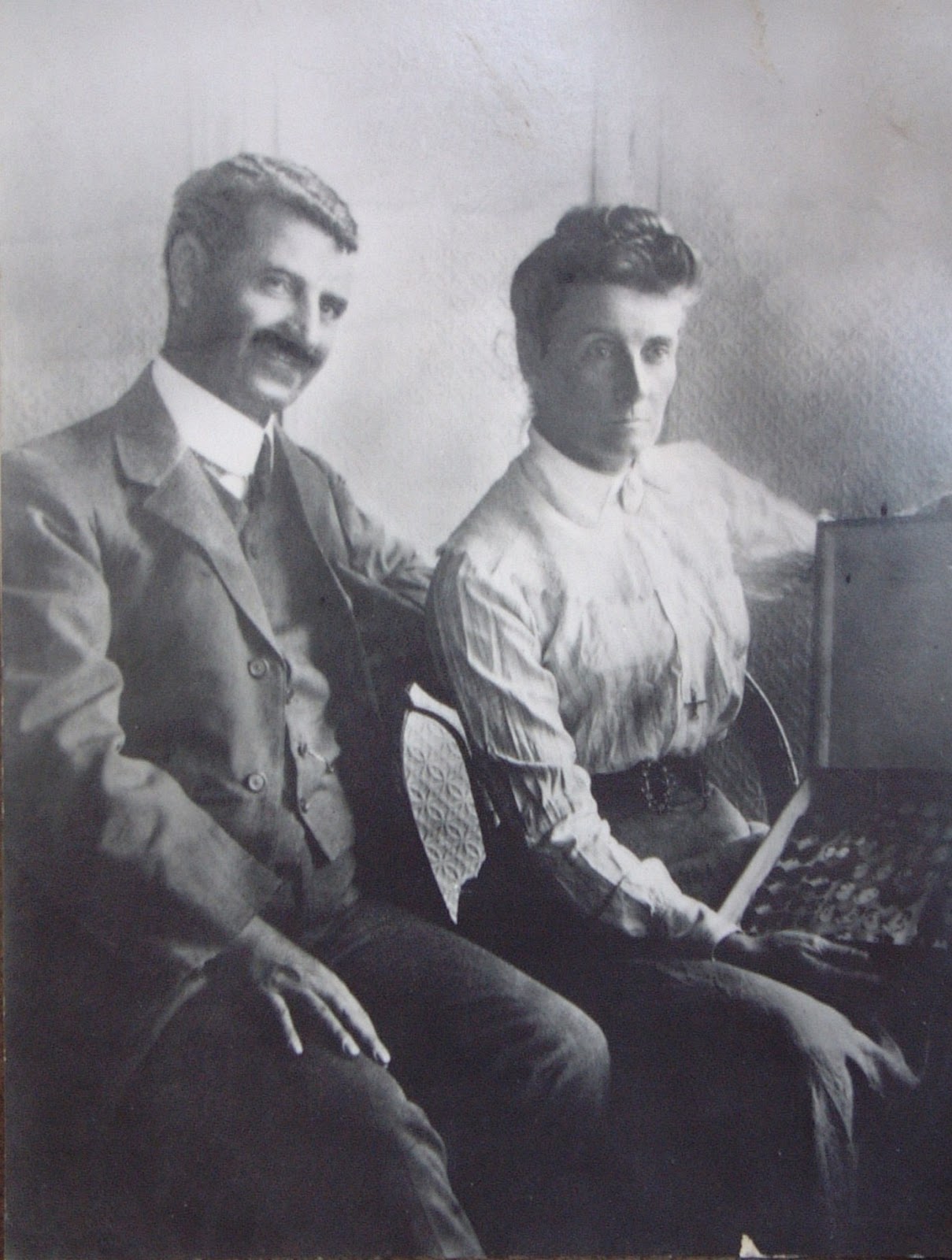
Margaret and Kalil, around 1912

Much of this work, for better or worse, was done in partnership with a dragoman (a sort of local fixer/interpreter and guide) Khalil Neimy, 15 years her junior, which
we know because she noted his help (when many peers did not bother) whom she met in Damascus. Though secretly married, he declared his love for her, and they spent many years of a tumultuous relationship together, travelling the world and collecting butterflies, and, in while South America, she developed means of rearing butterflies. She shared her knowledge freely with fellow collectors and entomologists, and though not dedicated to writing up her scientific results, her reputation was such that she was invited to join the prestigious Linnean Society in 1912. 
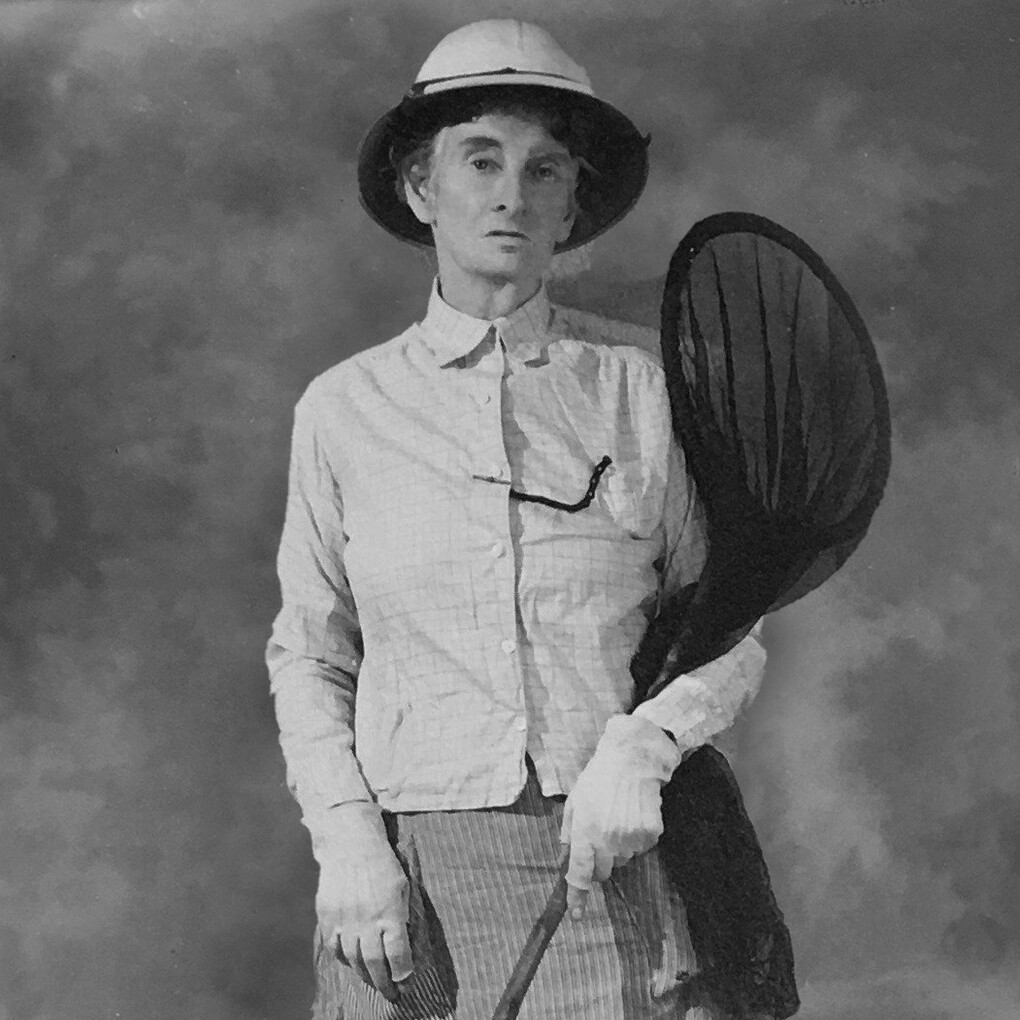
Margaret with her butterfly net
WWI hit her income as her investments plummeted in value, and for the first time she needed to earn money. She worked first as a simple cataloguer for a private collection in California and then, with her reputation for being able to find species no one else could, she started to receive collection commissions. This allowed her to continue to finance her travels and expeditions. Neimy confessed he was secretly married and was slow to get a divorce so they could marry. Also, as an Ottoman citizen, if they did marry, she would automatically become an Ottoman citizen, which she did not want. He struggled to get UK citizenship, seemingly forgetting that he also had US citizenship. But he died in 1928, and then Margaret discovered she was still seeing his wife, and fathering children while pursuing her. His loss, along with her sister's death and other family woes left her with less enjoyment of her life. But, she began to receive professional recognition and find herself the star of entomological gatherings, as she continued her fieldwork into her seventies. She died butterfly net in hand in the jungle, likely of a heart attack, discovered by a local monk. 

References

Dale DeBakcsy, Love and Butterflies The Adventures of Victorian Lepidopterist Margaret Fountaine, Women You Should Know, January 15, 2020

David Waterhouse, A Love of Butterflies - The Fountaine-Neimy Collection, Norwich Castle Museum and Art Museum, July 2, 2021

Florien Duijsens, Podcast # 27: Margaret Fountaine, Dead Ladies Show, November 19, 2019

The captivating life of a leading lepidopterist, KL Magazine, accessed March, 2023

Margaret Fountaine, Norfolk Women in History, accessed March, 2023

Margaret Fountaine, Wikipedia, accessed March, 2023

Tuesday, February 28, 2023

Kitchen Table Mathematics and the Pentagonal Tilings of Marjorie Rice


Marjorie Rice's Pentagonal Tilings
Marjorie Rice and her Pentagonal Tilings, linocut, 11" x 14", by Ele Willoughby, 2023

This is a linocut print of Marjorie Rice (née Jeuck, 1923–2017) who discovered four new pentagonal tilings of the Euclidian plane. Each print is 11" x 14" and printed by hand. Each of her 4 new pentagonal tilings is shown and the design on her shirt is based on her own "Butterflies" tessellation using the Type 13 pentagon (with two right angles and two sides of the same length). I made this portrait for the "pattern" prompt of #printerSolstice.

Born 100 years ago, she grew up poor in Florida, attending a one-room school house, where she skipped two grades, but college was never an option for her. She married conscientious objector Gilbert Rice in 1945 and they moved to Washington, D.C., where he worked in a military hospital and she worked as a commercial artist. They moved to San Diego with their infant son, who did not survive infancy, but went on to have five more healthy children.

Rice had no training as a mathematician, having completed half of a correspondence art course after high school, but she was always interested in mathematics, puzzles and art. She began to follow Scientific American writer and amateur mathematician Martin Gardner's monthly column, rushing to devour the magazine before her son (who had the subscription) could get it. Gardner had reported in July, 1975, in his article, "On Tessellating the Plane with Convex Polygon Tiles," that mathematician Richard Brandon Kershner had finally completed the task of finding all the remaining convex polygons which could make tessellations to tile the plane, an open mathematical problem which had intrigued thinkers since Ancient Greece. But by the next month, one of his readers, Richard James III, had reported that he had found a new convex pentagon tiler. Rice was inspired to start her own search. 

She spent her spare time discretely drawing diagrams on the kitchen table when no one was around which she hid when her husband, kids or friends stopped by. Her daughter assumed she was simply doodling, not discovering new mathematics. She succeeded in her search by February, 1976, and wrote Gardner of her new pentagon type and its variations in shape with which she could tile the plane. Lacking any math education, she had also developed her own notation system to describe shapes. Gardner forwarded Rice's letter to mathematician and tiling pattern expert Doris Schattschneider. Though she was skeptical of Marjorie's odd and unique notation system, which she likened to "hieroglyphics" Schattschneider was able to validate Rice's results. Rice did not stop there. By October she had found 58 pentagon tilings (most previously unknown) of two paired pentagons which could tile "transitively" which she categorized in 12 classes. By December she had found two more new convex pentagon tilers and 75 distinct tessellations by pentagons that were in blocks that could be seen as "double hexagons". By the following December (1977), she found her fourth convex pentagonal tiler and 103 "2-block transitive" pentagon tilings. Through the next decade she continued to find more pentagonal tiling patterns and explored aperiodic tilings and she used her discoveries to make Escher-like tessellation patterns of flowers, shells, butterflies and bees overlain on the geometric shapes (which can still be seen on her website).

Martin Gardner included Rice's discoveries in a collection of his columns 'The Mathematical Gardner', in 1988 and Doris Schattschneider’s article 'In Praise of Amateurs.' Though she was too shy to ever publish her own results or give any talks about her work, Schattschneider convinced Rice and her husband to attend her talk about Rice's work at  a meeting of the Mathematical Association of America held in Los Angeles, in 1995. When she was pointed out in the audience, she received a standing ovation! In 1996, she was the subject of a documentary on CBC's 'The Nature of Things.'

The Mathematical Association of America in Washington, D.C. had one of the ceramic tiles of one of the tilings discovered  installed in the foyer of the headquarters of 1999. Rice's papers and research notes are preserved at the Eugène Strens Recreational Mathematics Collection at the University of Calgary Library. Michaël Rao, with a computer-aided mathematical proof in 2017, established that there are a total of precisely 15 families of convex pentagons, including Rice's 4. He employed her same approach: considering how corners could come together at vertices. Rice was tickled to be recognized and loved being able to discover something new, long sought after by mathematicians 

Sources

Marjorie Rice, Wikipedia, accessed February, 2023

Marjorie Rice, Intriguing Tessellations, accessed February, 2023

Natalie Wolchover, Marjorie Rice's Secret Pentagons, Quanta Magazine Abstractions Blog, July 11, 2017

Anna Weltman, Marjorie Rice, Inspired by Math, and Subways, Math Munch, February 25, 2013

Monday, October 26, 2015

Maria Sibylla Merian, Entomologist, Scientific Illustrator, Explorer of Gardens and the New World

Maria Sibylla Merian
Linocut portrait 'Maria Sibylla Merian' by Ele Willoughby, 2015

This is a linocut portrait of Maria Sibylla Merian (1647-1717), leading entomologist of her day, traveller and scientific illustrator. She is shown complete with pomegranate branch and the life cycle of a morpho butterfly from caterpillar, to chrysalis in its cocoon to butterfly, inspired by her famous work 'Metamorphosis insectorum Surinamensium' - a process she carefully documented and explained. Each print is 11" by 14" (27.9 cm by 35.6 cm), on white Japanese kozo paper with collaged or "chine-collé" hand printed Japanese papers in beige, umber for the cocoon, caterpillar and two views of the butterfly in umber and blue.

The German-born naturalist came from a Swiss family who founded one of one of Europe's largest publishing houses in the 17th century. This allowed her early access to many books on natural history. After she lost her father at age three, and her mother remarried still life painter Jacob Marrel. Her step-father and his students trained her as an artist. She began painting insects and plants by 13. She wrote, "I spent my time investigating insects. At the beginning, I started with silk worms in my home town of Frankfurt. I realized that other caterpillars produced beautiful butterflies or moths, and that silkworms did the same. This led me to collect all the caterpillars I could find in order to see how they changed".

She married her step-father's apprentice Johann Andreas Graff, they had a daughter Johanna Helena, and moved to his home city of Nurenburg. She was able to contribute to the family income by painting, creating embroidery designs, and teaching drawing lessons to unmarried daughters of wealthy families, something which also allowed her access to the finest gardens where she continued collecting and documenting. She published her first book of natural illustrations, titled Neues Blumenbuch, in 1675 at age 28. In 1679, she first published her insect research in a two-volume, illustrated book focusing on insect metamorphosis. She moved twice to be with her mother after her step-father's death, then to join her half-brother at a Labadist religious community. She also split with her husband. After her mother's death, she moved to Amsterdam in 1691 and divorced her husband in 1692.

In Amsterdam, she was able to observe some of the collections of insects which had been brought back from Suriname. She became curious whether the life cycles of the exotic butterflies and other insects mirrored those Europe species she knew well. She was able to secure the city of Amsterdam's permission and and travel grant to travel to Suriname in South America, along with her younger daughter Dorothea Maria. She further funded her travels by selling 255 paintings. She planned a five year mission to study insects, making her perhaps the first person to plan a proper scientific expedition!

She travelled throughout the colony sketching insects and plants. She criticized the Dutch planters treatment of indigenous people and black slaves (though she relied upon amerindian slaves in her residence and her excursions, and brought a young amerindian woman named Indianin back with her to Holland). She used local native names for the plants and described local uses. Malaria likely cut her expedition short and forced her return to the Dutch Republic in 1701. She sold her collected specimen and in 1705 she published Metamorphosis Insectorum Surinamensium about the insects of Suriname.

She suffered a stroke in 1715 which left her partially paralysed and died a pauper in 1717. Her daughter Dorothea published Erucarum Ortus Alimentum et Paradoxa Metamorphosis, a collection of her mother's work, posthumously. Both Dorothea and Johanna followed their mother's lead and became botanical illustrators.

Modern scholars now appreciate her pioneering scientific work as well as the beauty of her scientific illustrations. During her life time insects were still reviled and people still put credence in the Aristotelian idea that they were spontaneously generated or "born of mud". She meanwhile detailed the life cycle of 186 species and explained the poorly-understood or even unknown process of metamorphosis. Science was conducted in Latin and her publications were in the vernacular, making them more popular with high society than contemporary scientists. Despite her knowledge and original research contributions she was not really recognized as a scientist in her day (though Carl Linnæus (1707-1778), father of taxonomy, did cite her in his Systema Naturæ of 1753). It was very unusual for a woman in her day to pursue science, let alone travel the world in its pursuit. She was able to do so because she began her studies with the accessible - animals she could find in her own backyard, and become the leading expert on metamorphosis. During her great expedition, she also noted their habitats, feeding habits and uses to indigenous people. Her classification of butterflies and moths are still relevant today. She detailed plants, frogs, snakes, spiders, iguanas, and tropical beetles and was the first European to describe both army ants and leaf cutter ants as well as their effect on other organisms.

Her work had a strong influence on future scientific illustration. Her work shows great accuracy and she was the first to illustrate the complete life cycle of insects. In her time, funding her expedition and her unladylike devotion to insects was ridiculed, but she is remembered as one of the best insect and flower illustrators of all time. Her daughters and student Rachel Ruysch (1664-1750) all went on to be renown botanical illustrators.

Shortly after her death, Peter the Great saw and purchased a large number of her works in Amsterdam. Her portrait was printed on the 500 DM note before Germany converted to the euro. Her portrait has also appeared on a 0.40 DM stamp and two American 32 cent stamps. Many schools, place names, a scientific research vessel and a crater on Venus have been named in her honour.

One last tidbit (or two) for you history of science buffs: Dorothea's daughter, Maria Sibylla Merian's granddaughter married mathematician Leonhard Euler (1707-1783). Maria Sibylla Merian was also first cousin to Jacob Christoph Le Blon (1667-1741), painter and engraver who invented the four colour printing process (using an RYBK color model similar to the modern CMYK system).

Thursday, August 1, 2013

New Monograms

FforFrog004
aardvark005
BforBear001

I've been making more monograms with the aim of producing a set of soft blocks with every letter of the alphabet included. In the meanwhile, I'm printing on a variety of papers of different colours, textures and patterns.

Wednesday, June 6, 2012

A Kaleidoscope of Butterflies

kaleidoscope-b1

A collection of butterflies, like those in this linocut, is called 'a kaleidoscope'. Isn't that perfect? I think it suggests a flutter of colourful, symmetric, beauties. This is the fifth in a series of the weird and wonderful terms of venery (collective nouns for animals) prints.

This lino block print is printed in black ink on Japanese kozo (or mulberry) paper 12.5 inches by 12 inches, or 31.7 cm by 30.5 cm in dimension, in an edition of twelve. Each butterfly involves 'chine collé' (collaged, delicate, Japanese paper) for their glorious colour. They are arrayed with a three-fold symmetry, like images in a toy kaleidoscope. There are three each of the orange Isabella's Longwings (Nymphalidae Eueides isabella), three yellow Eastern tiger swallowtails (Papilio glaucus), and three blue Red-Spotted Purples (Limenitis arthemis astyanax).

For this series, I'm designing the typography to match the subjects. The word 'kaleidoscope' has clean, simple, and where possible circular or linear lines, like images in the toy itself. The word 'Butterflies' starts with a butterfly 'B', and encorporates one butterfly in its midst and wing shapes in the 'f' and 'l' and even a tiny butterfly in the dot on the 'i'.

As you might imagine, I do love butterflies, and, like moths, they have figured previously in my prints. Butterflies are quite amazing creatures and its not surprising that they are an important symbol to many cultures. I think they are growing in popularity, and like to say, "Butterflies are the new pirates," but I'm not sure anyone believes me. This print was rather complex to design, carve and print, but I think it's worth it.

You might recall my feelings about moths.

kaleidoscope738

There is a butterfly in the middle of the word 'Butterflies' because butterflies tend to land in the middle of things. That's my story... it's definetly not a clever fix. It's not like I started thinking to myself I could make butterfly shapes for the 'B' and the calligraphic 'f', but then thought butterflies have two sets of wings, requiring 4 loops, so subconciously decided that there needed to be a second 'f'... because that would be illogical, and my spelling can't possibly be that bad... no, that never happened.

Thursday, October 13, 2011

Winged Walrus

I wanted to make a linocut which would qualify for a mini-print competition. The printed area must only be 10 cm by 10 cm (3.9 inches to 3.9 inches) on a 18 cm by 18 cm (7.1 inches by 7.1 inches) sheet. So, I returned to an idea I've played with before: the winged walrus.

Winged Walrus

The walrus is printed on Japanese kozo (or mulberry) paper with collaged or chine collé wings pale yellow Japanese tama paper (a lightweight watermark tissue). There are 15 prints in this first edition.

I like the idea of a massive walrus supported by delicate butterfly wings. Here are some of the ways I've interpreted this before:

Walter, the winged walrusWilt, winged walrus, topwingedwalrus