Anthotype of raspberry leaves made on paper coated with juice from day lily petals
Anthotype of plants made on paper coated with older day lily blooms
Making art using plants lead me to experimenting with anthotypes, an early photographic method of coating paper with juice from photosensitive plants and then exposing them, for hours or even days, to sunlight. I've had varied results. It can be a little unpredictable. Some argue that this medium is always ephemeral, and always subject to fading, but some anthotypes exist which were made a century ago. So if carefully stored or displayed (away from direct sunlight and/or under UV-resistant glass), they can be long-lasting.
Reading up about the method I learned that it was invented by none other than great mathematician, writer and polymath,Mary Somerville (1780-1872).
My linocut portrait of Mary Somerville
She wrote about her findings in a letter to Sir John Herschel (nephew of Caroline, also in my women in STEM series). Herschel presented her results to the Royal Society* & did a lot of further research on early photographic methods, so he is often credited with this invention too.
Sir John Herschel's own accomplishments include the discovery of the cyanotype method to make images first used in 1842, which produces a cyan blue print used today for monochromatic art or blueprints. It is made using a slow-reacting, photographic printing formulation sensitive to a limited near ultraviolet and blue light spectrum, the range 300nm to 400nm known as UVA radiation. Two chemicals are mixed: potassium ferricyanide and ferric ammonium citrate, and coated on a surface.
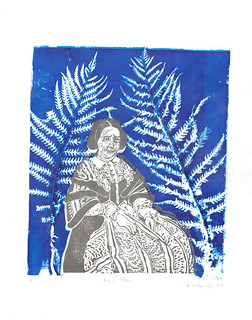
The first person to publish a book with photographs was botanist and scientific illustrator Anna Atkins. A friend of both William Henry Fox Talbot, who invented the salted paper and calotype processes, and Sir John Herschel, she was well positioned to understand what these methods could mean to scientific illustration, and as such she was acting as a science employing the high tech imaging of her day. When I made her portrait, I carved her as a linocut and then combined that with a blue screen print of fern leaves to mimic the look of the cyanotypes that she used in her books on seaweed and ferns. I have long wanted to make her portrait with actual cyanotypes so, that was my first goal when I started experimenting with making cyanotypes on paper and fabric.
Anna Atkins, linocut and cyanotype by Ele Willoughby, 2022
I have also been making a number of cyanotypes of plants and sometimes incorporating my linocut images on acetate. These are mediums which have a lot of potential and I'm experimenting!
Cyanotype of Queen Anne's Lace by Ele Willoughby
Cyanotype with linocuts of moths, flowers, grasses, and narcomedusa by Ele Willoughby
Cyanotype of my Narcomedusa linocut
*On the Action of the Rays of the Spectrum on Vegetable Juices. Extract of a Letter from Mrs. M Somerville to Sir J.F.W. Herschel, Bart., dated Rome, September 20, 1845. Communicated by Sir J. Herschel. Received November 6, -Read November 27, 1845, published in the Philosophical Transactions of the Royal Society of London, 136 (1846), p. 111-120.
Today is the 7th annual international day of blogging to celebrate the achievements of women in technology, science and math, Ada Lovelace Day 2015 (ALD15). I'm sure you'll all recall, Ada, brilliant proto-software engineer, daughter of absentee father, the mad, bad, and dangerous to know, Lord Byron, she was able to describe and conceptualize software for Charles Babbage's computing engine, before the concepts of software, hardware, or even Babbage's own machine existed! She foresaw that computers would be useful for more than mere number-crunching. For this she is rightly recognized as visionary - at least by those of us who know who she was. She figured out how to compute Bernouilli numbers with a Babbage analytical engine. Tragically, she died at only 36. Today, in Ada's name, people around the world are blogging.
This year, I thought I'd take the opposite approach from last year. I wrote about Marie Skłodowska-Curie last year, despite her fame and the risk that she was likely the only women in STEM that many people can name. I chose to write about her because it was artificial to avoid her; she really did make incredible discoveries and lived an extraordinary life. This year, I've selected a scientist who is rather new to me, and who was not an icon of science. She was nonetheless a pioneer. I've selected her because she is precisely the sort of scientist we forget - especially if female. What she did was important, and cutting edge in her time, and while it may not have been epochmaking it was the sort of important, incremental, methodical work which represents much of the scientific entreprise, and most of the advance of science throughout history. I believe the concept of the "paradigm shift" might be useful, but it is often dangerously simplistic and leads to a false narrative of a series of great men (almost invariably it is a man who is selected to represent the bringer of the new idea) revolutionizing science. Science, and its history, is more often much more involved, non-linear, over-lapping and interwoven than this type of narrative presents. Lastly, I love that this particular scientist was working at the intersection of art and science.
This is a portrait of English botanist and photographer Anna Atkins (1799-1871), née Children. It combines both a hand-carved lino block portrait in dark silver ink, and a screenprint of the silhouette of fern leaves in cobalt blue ink, mimicking the cyanotypes she was known for. It is printed by hand on lovely Japanese kozo (or mulberry) paper, 11" x 14" (28 cm x 35.6 cm). (c) Ele Willoughby, 2015
Anna Atkins (1799-1871), née Children, was an English botanist and photographer. She is the first person to have illustrated a book using photographs, Photographs of British Algae: Cyanotype Impressions in October 1843. Note that: not the first woman, the first person. She lived at a time when it was possible to be a self-trained scientist, especially if you were middle or upper class and received an education and the financial freedom to devote your time to pursue your subject. (The Mary Annings of the world, who managed to make a name for themselves in science despite her class, religions and complete lack of financial ressources, are rare indeed). She was raised and instructed by her father, a naturalist, and her social circle included those who were developing (no pun intended) the latest, brand new photographic technology. So, she was at the right place at the right time. But that doesn't take away from the fact that she had the knowledge, skill, insight and ability to immediately see the utility of the method for descriptive science and to document a specific field of sub-field of botany, with her collection of the algae (seaweeds) of Britain. I think this should be understood as equivalent to a modern-day scientist keeping abreast of other fields of study and rapidly mastering a new high-tech tool to apply it to her field. Even William Henry Fox Talbot, who who invented the salted paper and calotype processes, precursors to modern photographic methods, was not able to publish The Pencil of Nature the first commercially printed photographic book, until eight months after she produced Photographs of British Algae: Cyanotype Impressions.
Her mother died when she was still an infant, but she was close with her naturalist father and received a much more scientific education than was common for women in her time. Her 250 detailed engravings of shells were used to illustrate her father's translation of Lamarck's 'Genera of Shells'. This translation was important to the nomenclature of shells, because her illustration allowed readers to properly identify Lamarck's genera. She married John Pelly Atkins in 1825 and devoted herself to botany and collecting specimen, including for Kew Gardens. In 1839, she became a member of the Botanical Society of the British Isles, one of the few scientific organizations open to women. She became interested in algae, after William Henry Harvey published A Manual of the British marine Algae in 1841.
Through her father, she was friends with both William Henry Fox Talbot and Sir John Herschel, who (amongst other things) invented the cyanotype photographic process in 1842. Within a single year of its invention, she self-published the first known book of illustrated with cyanotype photographs and was likely one of the two first women to make a photograph. She recorded her seaweed specimen for posterity by making photograms by placing the unmounted dried-algae original directly on the cyanotype paper. Atkins self-published her photograms in the first installment of Photographs of British Algae: Cyanotype Impressions in October 1843, and two further volumes in the next decade. She collaborated with Anne Dixon (1799–1864) to produce further books of cyanotypes on ferns and flowering plants and also published other non-scientific or photographic books. In 1865, she donated her collections to the British Museum.
I've shown her based on an early photographic portrait, along with some fern leaves which I've worked with directly, much how she illustrated her own specimen.
Have a look at her cyanotypes and a video of one of the surviving copies of her book.