Showing posts with label data visualization. Show all posts

Sunday, October 26, 2014

Data as art: X Marks the Spot

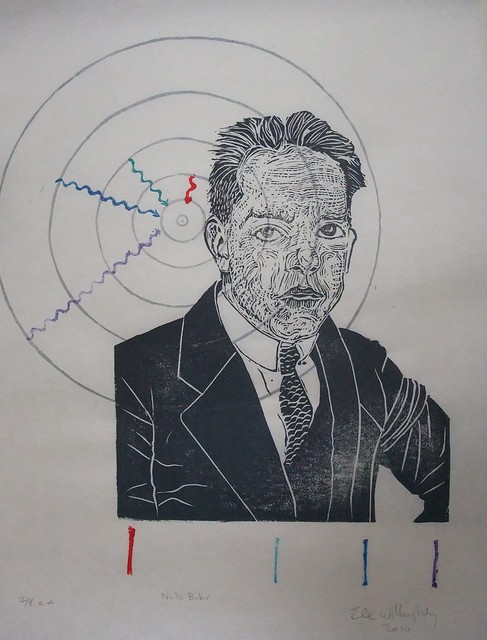
Niels Bohr portrait 4
Hayley Gillespie at Art.Science.Gallery in Austin noticed that some of my prints submitted for previous shows would also fit for their latest: X Marks the Spot. She describes the show thus:

Quantitative or categorical, discrete or continuous, dependent or independent, variables allow scientists to measure and describe properties of the world around us. They are common to every scientific discipline and assume a wide range of possible values. With gravity and humor, precision and abstraction, record-keeping and experimentation, variables are made visible through the works of eight contemporary artists.


So, from October 25 to November 23, 2014, you can find my portraits of Niels Bohr, Caroline Herschel and Florence Nightingale, on exhibit. The show features eight artists, many of whom are 'data artists' and the images online look fascinating.

Caroline HerschelIt's particularly interesting to me, since I haven't really thought of my work as illustrating data or variables, per se, so much as illustrating the scientists themselves, since their work is integral to a full portrait. I believe mine are the only portraits and other works are more abstract, less figurative.

Each of these portraits does actually, now that I think about it, contain some precise representations of variable data. Niels Bohr's portrait contains the Balmer series of spectral lines given off by excited hydrogen gas. Caroline Herschel's portrait contains her own diagrams of the night sky and her observation of one of the several comets she discovered (hence, a mapping of position over time). Florence Nightingale's portrait shows her own statistical investigation of the causes of mortality amongst British troops during the Crimean War, shown plotted as a polar area diagram – her own statistical and data visualization innovation, sometimes called a Nightingale Rose Diagram.

Florence Nightingale portraitThe other artists involved in the show have taken data -both their own personal life data, they have gathered themselves and freely available datasets and created artworks where they have developped their own methodologies for representing the data. They are working with everything from an artist's own personal experience of cancer care, the weather (where storms themselves are involved in the mark making), using algorithms to turn winds into drawing, to the instances where H.G. Wells specifies colour in his novels!

One of the artists involved had been turning her own data into art - things like walks she takes, daily activities and nightly EEG sleep data - and then recognized that she is doing something algorithmically which could be translated into a phone app which would allow anyone to make art from their own daily lives. If you're in Austin, check out the artist's talk by Laurie Frick on November 8. She'll explain her process and her smartphone app FRICKBits, and how you can use it to make art of your daily life too. How cool is that?! The app is for iPhone, and I have an Android, so I might have to ask RJH if I can play with his phone.


In other news, if you happen to be in Europe and read German, check out the Christmas/New Year issue of Happinez magazine, which will be featuring my Chinese Zodiac series!

Tuesday, April 22, 2014

Caroline Herschel, Household Drudge to Sweeper of Comets

Caroline Herschel
Caroline Herschel, linocut by Ele Willoughby (aka minouette), 2014

This linocut of astronomer Caroline Herschel (16 March 1750 – 9 January 1848) shows her and her own observations of comets, in dark black-gold and blue-black ink on lovely handmade Japanese kozo (or mulberry) paper, 8.1" by 9.25" (20.8 cm by 23.5 cm). There are 12 prints in the hand-printed edition.

German-born Caroline Herschel, while overshadowed by her brother William (who discovered Uranus, amongst his other astronomical accomplishments), was a real pioneer as a woman in astronomy and made her own important contributions. In fact, she became the first salaried female scientist, when King George III hired her to assist her brother, at a time when there were few professional scientists anywhere. Hers was a real life sort of Cinderella story, where rather than marrying a prince, she made a life and career for herself. Marriage was the expected role for a woman of her time, but she was deemed unmarriageable, since a childhood bout of typhus stunted her growth. Her mother thought she should train to be a servant, and purposely stood in the way of her learning French, or music, to prevent her from seeking employment as a governess. She wanted a perpetual unpaid maid. Her father sometimes managed to include her in William's lessons when their mother was absent. William had fled to England after the Seven Years War and made a life as a musician and composer in Bath. William managed to rescue his younger sister from their mother's clutches, under the pretext that she might have the voice to be a solo singer in Handel's oratorios, as she too was a natural musician. Of course, he also wanted a woman to manage his bachelor household. Meanwhile, he developed a real passion for astronomy. So, by the time she arrived, all his spare time away from music was devoted to astronomy and she found that despite her singing talent, she was roped into assisting with the construction of telescopes, rather than receiving music lessons. By 1781, William had discovered a new planet - Uranus , which he cannily dubbed the 'Georgian Star' after King George III. This had the desired effect of securing himself a pension, so that he could spend his time on astronomy (so long as he would present it to the King when asked).

William and Caroline worked together at Slough, observing the night sky with a variety of telescopes. William built some very large telescopes and had Caroline take notes of what he observed, while she used smaller 'sweeper' telescopes to sweep the skies for interesting object. She discovered 11 nebulae (2 of which turned out to be galaxies) which were previously unknown! She also found 8 or 9 comets, as well as making and sharing observations of comets discovered by others. The portrait is based on a miniature of Caroline, as well as her own notes and diagrams from 1 August 1786, when she discovered her first comet, now known as Comet C/1786 P1 (Herschel). On the left, her sketches of the object "like a star out of focus" which she correctly identified as a comet, is at the centre of the three circular diagrams labelled I, II and III. On the right, her Fig I and Fig II show her observations the following night, noting the position of the comet relative to the constellations of Ursa Major and Coma Berenices.

She also independently re-discovered Comet Encke in 1795, first recorded by Pierre Méchain in 1786. Later, in 1819, her observations help Johann Franz Encke recognize it was a periodic comet, like Halley's comet. Encke was able to calculate its orbit, partially due to her observations. The comet shown behind Caroline is based on a recent photo of Comet Encke, which returns every 3 years.

In order to calculate orbits of newly discovered comets, it was important to let other astronomers know as soon as possible. The letter post was often not fast enough, if the weather turned cloudy. She discovered her 8th comet while her brother was away. So, she took matters into her own hands. After an hour's sleep, she saddled a horse, and road the roughly twenty-six miles to the Greenwich Observatory of the Astronomer Royal, Nevil Maskelyne, much to his astonishment.

One of her important impacts on astronomy was that her early success showed her brother how even an amateur using a small telescope could find previously unobserved nebulae, and hence that there was real value in making systematic sweeps of the night sky. Partnering together, with William sweeping the sky with his 20 foot telescope and Caroline taking notes by lamplight just inside the window, they went on to discover 2507 nebulae and clusters over two decades of work. Further, she acted as 'computer', doing the mathematical grunt work for her brother's observations. William's study completely revolutionized astronomy, and it couldn't have happened without Caroline's help.

They worked side by side nightly until 1788, when William married (at age 49). Caroline was no longer needed to run his household, and he offered her money as compensation. She, however, convinced him to request her own salary from the King, which she received. She moved to a cottage in the garden. She did a lot of her own observing for the next nine years (while William was otherwise occupied at nights), and gained more fame in her own right.

In 1797 the standard star catalogue used by astronomers was published by John Flamsteed. It was tough to use since it appeared in two volumes, with discrepancies. William suggested that a proper cross-reference would be a great help and a project for Caroline. She produced the resulting Catalogue of Stars, published by the Royal Society in 1798. It contained a index of all of Flamsteed's observed stars, all of the errors in his volumes and a further 560 additional stars.

When William died in 1822, she returned to Hanover, where she was born, but she continued her cataloguing and confirming of William's observations. Her catalogue of nebulae aided her nephew John Herschel in his astronomical work. The Royal Astronomical Society presented her with their Gold Medal in 1828 for this catalogue. She was the first woman to receive the honour (and remained the only woman until Vera Rubin in 1996).

She and Mary Sommerville were the first women admitted to the Royal Astronomical Society, when they were elected Honorary Members in 1835. In 1838 she was elected an honorary member of the Royal Irish Academy in Dublin. In 1846, at age 96 she also received a Gold Medal from the King of Prussia, for her astronomical work (presented by none other than Alexander von Humboldt). An asteroid and moon crater have been named in her honour.

You can find more in the great article  on Caroline Herschel by Micheal Hoskin AAS Comittee on the Status of Women site (to which this blog post is indebted), Caroline Herschel's wikipedia entry,  and the ROYAL ASTRONOMICAL SOCIETY/SCIENCE PHOTO LIBRARY entry on her notes.

Wednesday, March 19, 2014

Florence Nightingale

Florence Nightingale portrait
Florence Nightingale, linocut inked à la poupée with chine collé in an edition of four, on Japanese kozo paper 9.25" by 12.5" (23.5 cm by 32 cm), by Ele Willoughby (aka minouette)

I confess that Florence Nightingale wasn't on my shortlist of women in science I wished to portray. I felt a little like she was an old-fashioned heroine, from a time where if a woman wasn't going to be defined strictly as a person who served and cared for her family, it was okay if (and only if) she cared for other people. This bias was somewhat reinforced by my own family history: my mother is a nurse, her mother was a nurse, whereas I am a physicist. I know my grandmother wanted to be a pharmacist, and my mother felt her career options were school teacher or nurse. Plus, I take after my father's side of the family and have been known to have a vasovagal response to the mere description of medical procedures; I have a high pain threshold, but am squeemish, and faint like the rest of them. I tend to find watching or thinking about others induring something is worse than say, being injured myself.* All of which means I partially define myself by not being a nurse. However, I was (luckily) commissioned to make a portrait of Florence Nightingale. The more I read, the more interesting she became to me.


Nightingale earned the nickname "The Lady with the Lamp" during the Crimean War, from a phrase used by The Times, describing her as a “ministering angel” making her solitary rounds of the hospital at night with “a little lamp in her hand”. The image was immortalized by Henry Wadsworth Longfellow's 1857 poem Santa Filomena in the stanza:

Lo! in that house of misery
A lady with a lamp I see
Pass through the glimmering gloom,
And flit from room to room.

So, I’ve shown Nightingale with her little lamp, based on contemporary photos and illustrations. But inventing modern nursing wasn't her only accomplishment. Taking up a profession, travelling to a war zone, nursing the wounded, taking on hospital administration and the training of a professional class of nurses weren't the only things she did which were so unusual for a woman of her time to do. It turns out that her father fostered her gift for mathematics, and she made significant contributions to statistics and data visualization too.

Behind Nightingale is her own ‘Diagram of Causes of Mortality in the Army in the East’ plotted as a polar area diagram – though not her own statistical and data visualization innovation, sometimes called a Nightingale Rose Diagram. It illustrates the causes of death in the military hospital she managed during the Crimean War. April 1855 to March 1856 is shown on the left and April 1854 to March 1855 to the right. When she researched the causes of mortality, looking back at the data, she saw clearly that the lack of hygiene was a far greater risk to soldiers’ lives than being wounded. The sections represent one month of data {J,F,M,A,M, J,J,A,S,O,N,D} for each month of the year. The green “wedges measured from the centre of the circle represent area for area the deaths from Preventible or Mitigable Zymotic diseases, the [yellow] wedges measured from the centre the deaths from wounds, & the [orange] wedges measured from the centre the deaths from all other causes. The […] line across the [yellow] triangle in Nov. 1854 marks the boundary of the deaths from all other causes during the month. In October 1854, & April 1855, the [orange] area coincides with the [yellow], in January & February 1856, the [green] coincides with the [orange]. The entire areas may be compared by following the [green], the [yellow], & the […] lines enclosing them.” This "Diagram of the causes of mortality in the army in the East" was published in Notes on Matters Affecting the Health, Efficiency, and Hospital Administration of the British Army and sent to Queen Victoria in 1858.

This experience influenced her later career and she campaigned for sanitary living conditions, knowing how dangerous unsanitary conditions can be to survival. She also made extensive use of similar polar area diagrams on the nature and magnitude of the conditions of medical care in the Crimean War, or sanitation conditions of the British army in rural India, to make such statistics transparent to Members of Parliament and civil servants who would have been unlikely to read or understand traditional statistical reports.

In 1859, Nightingale was elected the first female member of the Royal Statistical Society. She later became an honorary member of the American Statistical Association.

Though her own opinion  of other women was often harsh, she has been credited with contributing to feminist literature with a book she wrote while sorting out her thoughts on her role in the world, including the essay Cassandra, which protested the over-feminisation of women into near helplessness. She helped abolish laws regulating prostitution that were overly harsh to women. She also clearly expanded the acceptable forms of female participation in the workforce.

This, and in particularly, the way she insisted on making decisions based on scientific evidence, and using data to save lives, makes her an apt addition to the women in science portrait series.

*My grandfather was a very strong man, who fainted when diagnosed with a fully treatable skin cancer, despite enduring rhematoid arthritis without complaint. My father famously fainted during his pre-natal class. My brother fainted during a presentation on why junior high school students shouldn't smoke, which included an image of a damaged lung. My other brother  famously fainted during Indiana Jones and the Temple of Doom, twice. I fainted during a tour of McMaster Medical School, while they explained what happened to corpses at the morgue. They sat me down, got me water and told me not to be discouraged from a career in medicine, while I looked at them in disbelief and insisted I never wanted one.

Tuesday, February 11, 2014

Bell Burnell and the Little Green Men

Jocelyn Bell and the LGM-1

This year, I plan to grow my collection of portraits of women in STEM. I thought I'd get an early start on this project, with my first portrait of a scientist who is still working.

This is a linocut portrait of Jocelyn Bell (now Bell Burnell) and the incredible radioastronomy dataset she gathered when only a graduate student in 1967, working with Anthony Hewlish. The block is inked "à la poupeé" in dark blue grey and green on Japanese kozo paper. The first edition is a variable run of 10 prints, each 10" by 12.5" (25.4 cm by 31.8 cm).

In November, 1967, Jocelyn Bell (Burnell) was just a graduate student when she discovered the first radio pulsar (or pulsating star), a highly magnetized, rotating neutron star that emits a beam of electromagnetic radiation. This radiation (light in the radio frequency band) can only be observed when the star is pointed towards us; so, like the light from a distant lighthouse, it appears to pulse at a precise frequency. Jocelyn Bell had been working with her supervisor Antony Hewish and others to construct a radio telescope to study quasars (quasi-stellar objects which emit radio waves). She noted some "scruff" on her chart-recorder, and then that the pulses were incredibly regular, occurring every 1.337 seconds. Hewish was initially scornful and insisted the regular pulses must be noise from a human made source. He first dubbed this object, emitting with such regularity 'LGM 1' for "Little Green Men 1", a playful joke about their uncertainty about what could emit radiation so regularly - obviously it could only be a communication from extraterrestrials hahaha! After she found other such sources, in different places with different frequencies, her colleagues became convinced. These discoveries lead to the development of the pulsar model. LGM-1 is now known PSR B1919+21.

The 1968 paper announcing this discovery in Nature has five authors, lead by Hewish, followed by Jocelyn Bell. In 1974, Hewish won the Nobel Prize for this discovery, (along with fellow radioastronomer Marlin Ryle). Jocelyn Bell was not included as it was assumed that the "senior man" was responsible for the work. This was controversial and has been condemned by many leading astronomers like Fred Hoyle (who with Thomas Gold was first able to explain the signals as due to a rapidly rotating neutron star). Jocelyn Bell Burnell herself has stated she was not upset. Bell Burnell has a great career and won many honours after her impressive start, but her exclusion from the Nobel win, based on her own research strikes me and many others as one of the more blatant and egregious examples of gender bias in the selection of Nobel prize recipients.

Cover of Joy Division's 1979 album 'Unknown Pleasures'
designed by Peter Saville, using the pulsar data
from the Cambridge Encyclopaedia of Astronomy
Not only the discovery, but the presentation of the data is impressive and elegant. The famous diagram (I've included behind her, and shown above) shows superimposed images of successive pulses. Stripped down to their essential information like sparklines (chart lines without annotation or axes, but drawn of course to a common scale) so their regularity really stands out, and they can be easily compared and contrasted. If you are used to looking at time series, you'll know that since they can be easily superimposed and the pulses line up, that the frequency is quite regular. The diagram is downright eloquent, and visually appealing, so it has been included in books on data visualization and was used in the iconic design of Joy Division's 'Unknown Pleasures' album. From there the diagram itself has become a sort of visual meme and can be found in all sorts of different media and reinterpreted in everything from tattoos to fashion. (You can read my take on this meme itself here: Astrophysical Meme: Jocelyn Bell Burnell's Pulsar, Little Green Me, Joy Division and Beautiful Data ).