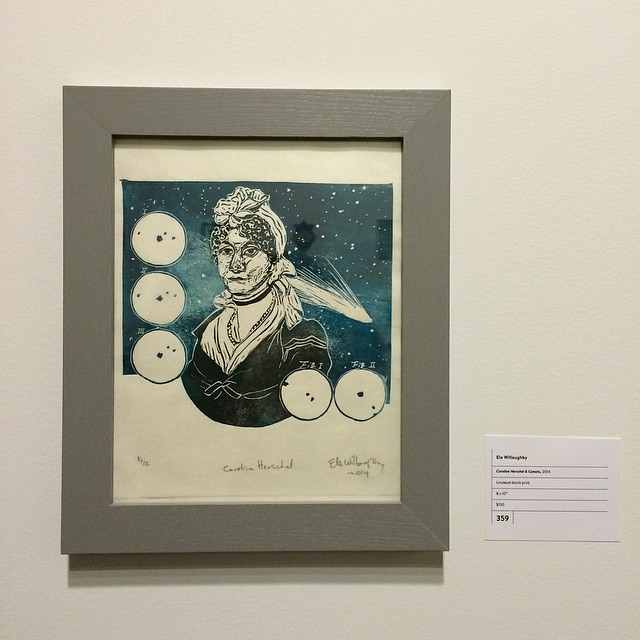
This
linocut of astronomer Caroline Herschel (16 March 1750 – 9 January 1848) shows her and her own observations of comets, in dark black-gold and blue-black ink on lovely handmade Japanese kozo (or mulberry) paper, 8.1" by 9.25" (20.8 cm by 23.5 cm). There are 12 prints in the hand-printed edition.
German-born Caroline Herschel, while overshadowed by her brother
William (who discovered Uranus, amongst his other astronomical accomplishments), was a real pioneer as a woman in astronomy and made her own important contributions. In fact, she became the first salaried female scientist, when King George III hired her to assist her brother, at a time when there were few professional scientists anywhere. Hers was a real life sort of Cinderella story, where rather than marrying a prince, she made a life and career for herself. Marriage was the expected role for a woman of her time, but she was deemed unmarriageable, since a childhood bout of typhus stunted her growth. Her mother thought she should train to be a servant, and purposely stood in the way of her learning French, or music, to prevent her from seeking employment as a governess. She wanted a perpetual unpaid maid. Her father sometimes managed to include her in William's lessons when their mother was absent. William had fled to England after the Seven Years War and made a life as a musician and composer in Bath. William managed to rescue his younger sister from their mother's clutches, under the pretext that she might have the voice to be a solo singer in Handel's oratorios, as she too was a natural musician. Of course, he also wanted a woman to manage his bachelor household. Meanwhile, he developed a real passion for astronomy. So, by the time she arrived, all his spare time away from music was devoted to astronomy and she found that despite her singing talent, she was roped into assisting with the construction of telescopes, rather than receiving music lessons. By 1781, William had discovered a new planet - Uranus , which he cannily dubbed the 'Georgian Star' after King George III. This had the desired effect of securing himself a pension, so that he could spend his time on astronomy (so long as he would present it to the King when asked).
William and Caroline worked together at Slough, observing the night sky with a variety of telescopes. William built some very large telescopes and had Caroline take notes of what he observed, while she used smaller 'sweeper' telescopes to sweep the skies for interesting object. She discovered 11 nebulae (2 of which turned out to be galaxies) which were previously unknown! She also found 8 or 9 comets, as well as making and sharing observations of comets discovered by others. The portrait is based on a miniature of Caroline, as well as her own notes and diagrams from 1 August 1786, when she discovered her first comet, now known as Comet C/1786 P1 (Herschel). On the left, her sketches of the object "like a star out of focus" which she correctly identified as a comet, is at the centre of the three circular diagrams labelled I, II and III. On the right, her Fig I and Fig II show her observations the following night, noting the position of the comet relative to the constellations of Ursa Major and Coma Berenices.
She also independently re-discovered Comet Encke in 1795, first recorded by
Pierre Méchain in 1786. Later, in 1819, her observations help
Johann Franz Encke recognize it was a periodic comet, like Halley's comet. Encke was able to calculate its orbit, partially due to her observations. The comet shown behind Caroline is based on a recent photo of Comet Encke, which returns every 3 years.
In order to calculate orbits of newly discovered comets, it was important to let other astronomers know as soon as possible. The letter post was often not fast enough, if the weather turned cloudy. She discovered her 8th comet while her brother was away. So, she took matters into her own hands. After an hour's sleep, she saddled a horse, and road the roughly twenty-six miles to the Greenwich Observatory of the Astronomer Royal,
Nevil Maskelyne, much to his astonishment.
One of her important impacts on astronomy was that her early success showed her brother how even an amateur using a small telescope could find previously unobserved nebulae, and hence that there was real value in making systematic sweeps of the night sky. Partnering together, with William sweeping the sky with his 20 foot telescope and Caroline taking notes by lamplight just inside the window, they went on to discover 2507 nebulae and clusters over two decades of work. Further, she acted as 'computer', doing the mathematical grunt work for her brother's observations. William's study completely revolutionized astronomy, and it couldn't have happened without Caroline's help.
They worked side by side nightly until 1788, when William married (at age 49). Caroline was no longer needed to run his household, and he offered her money as compensation. She, however, convinced him to request her own salary from the King, which she received. She moved to a cottage in the garden. She did a lot of her own observing for the next nine years (while William was otherwise occupied at nights), and gained more fame in her own right.
In 1797 the standard star catalogue used by astronomers was published by
John Flamsteed. It was tough to use since it appeared in two volumes, with discrepancies. William suggested that a proper cross-reference would be a great help and a project for Caroline. She produced the resulting Catalogue of Stars, published by the Royal Society in 1798. It contained a index of all of Flamsteed's observed stars, all of the errors in his volumes and a further 560 additional stars.
When William died in 1822, she returned to Hanover, where she was born, but she continued her cataloguing and confirming of William's observations. Her catalogue of nebulae aided her nephew
John Herschel in his astronomical work. The Royal Astronomical Society presented her with their Gold Medal in 1828 for this catalogue. She was the first woman to receive the honour (and remained the only woman until Vera Rubin in 1996).
She and
Mary Sommerville were the first women admitted to the Royal Astronomical Society, when they were elected Honorary Members in 1835. In 1838 she was elected an honorary member of the Royal Irish Academy in Dublin. In 1846, at age 96 she also received a Gold Medal from the King of Prussia, for her astronomical work (presented by none other than
Alexander von Humboldt). An asteroid and moon crater have been named in her honour.
You can find more in the great article on Caroline Herschel by Micheal Hoskin AAS Comittee on the Status of Women site (to which this blog post is indebted), Caroline Herschel's wikipedia entry, and the