Showing posts with label engineering. Show all posts

Wednesday, April 15, 2026

Polymath Claude Shannon and Theseus the Electromechanical Mouse in a Maze


Claude Shannon, linocut print, 11" x 14" by Ele Willoughby, 2026

I was recently commissioned to make a portrait of Claude Shannon. It seemed clear that it would need some binary to represent his work, and the math and computer science in particular. I opted to also include Theseus in his maze, which hits on the electrical engineering, and the humour in what he did.

This is my linocut portrait of Claude Elwood Shannon (1916-2001), mathematician, electrical engineer, computer scientist and cryptographer credited with laying the foundations for the Information Age. Each hand-printed linocut on 11" x 14" Japanese kozo (or mulberry paper) shows Shannon in front of binary numbers and with his electromechanical mouse Theseus with its maze. Though partially behind him, the binary numbers represent the standard ASCII code for "CLAUDESHANNON". 

At the University of Michigan, he took two degrees: one in electrical engineering and the second in mathematics, graduating in 1936. His MIT masters thesis is arguably one of the most impactful ever completed. In it, "A Symbolic Analysis of Relay and Switching Circuits", he showed that we can construct any logical numerical relationship through the electrical applications of Boolean algebra. This is now the underlying theoretical basis for   digital computing and digital circuits. He completed his doctorate at MIT in 1940 on mathematical genetics.

During WWII he worked in the field of cryptanalysis for US national defence, doing fundamental work on codebreaking and secure telecommunications, and writing a paper which is considered one of the foundational pieces of modern symmetric-key cryptography.

His 1948 paper "A Mathematical Theory of Communication" laid the foundations for the field of information theory. This paper was important to the invention of the compact disc, the internet, mobile phones and even our understanding of blackholes. He introduced the term "bit," invented the signal-flow graph and co-invented pulse-code modulation and the first wearable computer. 

In 1950, he designed and built a learning machine, with the help of his wife mathematician and research collaborator Betty Shannon. They built an adjustable maze with sensors (an electromechanical relay circuit) which followed the path of an electromechanical mouse whimsically named Theseus. Theseus could search corridors until it found a target (the penny in my portrait). Then, the mouse could be moved to anywhere in the maze. If the location was known, it would go immediately to the target. If the location was unknown, the mouse would search until it found a known position, adding this knowledge to its memory, and proceed from the known position. This way it could eventually find the most direct route. This is the first known artificial learning device.

In 1951 he joined the CIA's  Special Cryptologic Advisory Group. He was a professor at MIT from 1956 to 1978. His work was also foundational for artificial intelligence. He was a co-organizer of the 1956 Dartmouth workshop, considered to be the discipline's founding event. He published papers on the programming of chess computers. His Theseus machine was the first electrical device to learn by trial and error, being one of the first examples of artificial intelligence.

Tuesday, October 14, 2025

Aeronautical Engineer and Queen of the Hurricanes, Elsie MacGill for Ada Lovelace Day

Elsie MacGill, linocut print, 9.25" x 12.5" on Japanese paper by Ele Willoughby, 2025


It is once again Ada Lovelace Day, the 16th annual international day of blogging to celebrate the 

Ada Lovelace, 3rd edition
Ada, Countess Lovelace, 3rd edition linocut by Ele Willoughby 

achievements of women in technology, science and math, Ada Lovelace Day 2025 (ALD25). I'm sure you'll all recall, Ada, brilliant proto-software engineer, daughter of absentee father, the mad, bad, and dangerous to know, Lord Byron, she was able to describe and conceptualize software for Charles Babbage's computing engine, before the concepts of software, hardware, or even Babbage's own machine existed! She foresaw that computers would be useful for more than mere number-crunching. For this she is rightly recognized as visionary - at least by those of us who know who she was. She figured out how to compute Bernouilli numbers with a Babbage analytical engine. Tragically, she died at only 36. Today, in Ada's name, people around the world are blogging.

 
You can find my previous Ada Lovelace Day posts here.

I am working on a new woman in STEM portrait for ALD25 and an upcoming #Spacetober print, but sometimes life gets in the way. We had a family emergency this week, so I am quite behind. But I want to share what I can, so read on to find my yearly - if a bit shortened - biography of aeronautical engineer Elsie MacGill (March 27, 1905 – November 4, 1980). Elizabeth Muriel "Elsie" Gregory MacGill was born in Vancouver, in 1905, and became the first woman aeronautical engineer and professional aircraft designer in North America, and likely the world. She was the first and, usually, only woman through her education at four different universities and engineering departments. She collaborated on many of Canada's famous and innovative bush planes and aircraft components, was entirely responsible for Canada's Maple Leaf Trainer II, a military flight trainer aircraft, and most famously, as chief aeronautical engineer at Canadian Car and Foundry (CC&F) in Fort William, Ontario (now Thunder Bay), she oversaw the manufacturing of 1,451 Hawker Hurricane fighter aircraft during WWII for the Royal Canadian Air Force (RCAF) and the British Royal Air Force (RAF), as well as 835 Curtiss Helldivers for the US Navy, becoming known as "The Queen of the Hurricanes." Her work helped make Canada a powerhouse of aircraft manufacturing. Later, she served as a Commissioner of the Royal Commission on the Status of Women in Canada, which published their report in 1970. Elsie came by her aptitude for social justice and blazing her own trail honestly. Her mother Helen MacGill was a suffragette like her mother before her, a journalist, a judge and a leader in Canada's women's movement. Her father James Henry MacGill, was a prominent Vancouver lawyer, part-time journalist, and Anglican deacon and supporter of women's suffrage. Elsie grew up with two older step-brothers and an older sister. Early home-schooling including drawing lessons with renown Canadian artist Emily Carr and swimming lessons with prominent lifeguard Joe Fortes. Then she attended King George Secondary, associated with McGill University, before entering UBC Applied Science, but the dean asked her to leave after one term. She moved on to the University of Toronto, where, she wrote, "My presence in the University of Toronto's engineering classes in 1923 certainly turned a few heads." She spent her summers working in machine shops, where she gained practical hands on skills to go with the classroom theory, and where she was exposed to aeronautical engineering. When Elsie graduated from the University of Toronto in 1927, she was the first woman electrical engineer in Canada. She got a junior job with Austin Aircraft Company in Pontiac, Michigan and began part-time graduate studies, then enrolling full-time at the University of Michigan. Two years later, she graduated from the University of Michigan, as the first woman with a master's in aeronautical engineering, anywhere. Just prior to completing her master's she fell ill with polio and found herself paralyzed from the waist down. She spent much of the subsequent three years in bed or relying on a wheelchair, told she would never walk again. She nevertheless fought to regain her mobility and taught herself to walk again using two canes. She treated her disability as a mere inconvenience. She continued to pursue her doctorate from MIT from 1932-1934, supplementing her income with writing magazine articles about aircraft and flying. At MIT she was finally not the lone woman, as a contemporary of aeronautical engineer and technical writer, M. Elsa Gardner. Upon graduating she returned to Canada, taking a job as assistant aeronautical engineer at Fairfield Aircraft in Longueuil, Quebec. There, she worked on the Fairchild Super 71(the first aircraft designed and built in Canada featuring a metal fuselage), the Fairchild 82 (a bush plane), and the Fairchild Sekani(twin-engined transport aircraft) and presented her paper, "Simplified Performance Calculations for Aeroplanes", to the Royal Aeronautical Society in Ottawa, on March 22, 1938, which was later published in The Engineering Journal. She took part in the CBC's six-part series 
The Engineer in War Time in a segment called "Aircraft Engineering in Wartime Canada."  In 1938 she was also first woman elected to corporate membership in the Engineering Institute of Canada (EIC).

In 1942, she was hired as Chief Aeronautical Engineer at Canadian Car and Foundry (CanCar, or CC&F), where she designed a training aircraft, and oversaw its production: the Maple Leaf Trainer II. It did not end up being used by Commonwealth forces, but Mexico purchased ten of them because of their excellent high-altitude performance. Then, the company was selected to manufacture Hawker Hurricanes for the RAF. She became responsible for increasing the workforce from 500 to 4,500 mainly women workers and the tooling of 25,000 precision parts which had to be interchangeable with the British made Hawker Hurricanes, and streamline the mass production of these aeroplanes. This involved designing the manufacturing tools and adaptations to the plane, including de-icing controls and landing skis, for use during Canadian winters. She wrote and presented a paper about the experience, "Factors Affecting Mass Production of Aeroplanes", later published in The Engineering Journal. It won the Gzowski Medal from the Engineering Institute of Canada in 1941. The work made her famous and she even appeared in comic book biography in an issue of True Comics in 1942, using her nickname, "Queen of the Hurricanes”.

Seeking a job to replace the Hurricanes, CC&F in 1943, they were awarded a contract from the US Navy for the SB2C Helldiver. Production did not go smoothly; MacGill and CC&F were foiled by repeated changes in specifications making mass production all but impossible. The US Navy, frustrated with delays fired MacGill and line production manager Bill Soulsby, rather than figure out the source of the problem. Soulsby and MacGill got married two weeks later.

The couple moved to Toronto and set up a consulting firm. MacGill wrote the International Air Worthiness regulations for the design and production of commercial aircraft, as a Technical Advisor to the International Civil Aviation Organization (ICAO). These regulations, with their updates, are still important to safety of commercial aircraft.  She became the first woman to chair a U.N. committee, in 1947 as chairman of the United Nations Stress Analysis Committee. MacGill presented her paper "The Initiative in Airliner Design", to the Society of Women Engineers (SWE) and subsequently published it in The Engineering Journal. The next year the SWE awarded her their annual Achievement Award. 

While recovering from a broken leg, in 1953, she sorted through her mother's papers. This in turn lead to writing her biography, My Mother, the Judge: A Biography of Judge Helen Gregory MacGill, which she published in 1955.

She followed her mother's example and worked on women's issues, serving as national president of the Canadian Federation of Business and Professional Women’s Clubs from 1962 to 1964. Prime Minister Lester Pearson appointed her to the Royal Commission on the Status of Women in Canada and she is a co-author of their 1970 report. She filed a "Separate Statement" so she could voice her opinions which differed from the majority on the commission, including her belief that abortion should be removed from the entirety of the Criminal Code. Abortion had become legal in 1969, through the Criminal Law Amendment Act, but only if a 3-doctor committee determined that the pregnancy posed a danger to the parent's health. In 1988, the Supreme Court agreed with MacGill, striking down the remaining Criminal Code provisions restricting abortion as unconstitutional; abortion is healthcare. MacGill was also a member of the Ontario Status of Women Committee, an affiliate of the National Action Committee on the Status of Women. This work along with her engineering career earned her the Order of Canada in 1971. She wrote, "I have received many engineering awards, but I hope I will also be remembered as an advocate for the rights of women and children."

She was granted honorary doctorates in law from the University of Toronto in 1973, and in science from the University of Windsor in 1976. The Ninety-Nines: International Organization of Women Pilots, awarded her the Amelia Earhart Medal in 1975. In 1977 she received the Queen's Silver Jubilee Medal. In 1979, the Ontario Association of Professional Engineers presented her with their gold medal. She was inducted in the Canadian Aviation Hall of Fame in 1983 and she was a a founding inductee in the Canadian Science and Engineering Hall of Fame in 1992. She has been honoured with a stamp, a commemorative loonie dollar coin, schools and cadet squadrons have been named in her honour and she was a subject of a Heritage Minute for her work during WWII.

References
Bourgeois-Doyle, Dick. QUEEN OF THE HURRICANES — The Elsie MacGill Story, Vintage Wings of Canada, accessed October, 2025

Queen of the Hurricanes Engineer Elsie MacGill, Canadians At Arms, accessed October, 2025

Elsie MacGill, Wikipedia, accessed October, 2025

Schiedel, Bonnie. Soaring High - Elsie MacGill was the world’s first female aeronautical engineer. Canada's History, February-March, 2025.

Friday, February 19, 2021

Hertha Ayrton, Mathematician, Physicst, Engineer and Inventor


Hertha Ayrton, linocut by Ele Willoughby
Hertha Ayrton, linocut, 9.25" x 12.5" by Ele Willoughby, 2021.


This is my linocut portrait of British engineer, mathematician, physicist & inventor Hertha Ayrton (1854-1923). She is remembered for her research on the electric arc lamp, on ripple marks in sand & water, and her inventions including of mathematical line dividers which allowed artists, architects & engineers to enlarge or diminish drawings. I’ve shown her with a diagram of the dividers from her 1st of 26 patents, one of her diagrams about the origin & growth of ripple marks & one of her diagrams of an electric arc lamp (a subject on which she literally wrote the textbook).⁠

Born Phoebe Sarah Marks in Portsea, Hampshire, she was the third of eight children of a Polish Jewish immigrant watchmaker father & seamstress mother. After her father’s death when she was 7 in 1851, the family was left penniless and her mother returned to work as a seamstress. Sarah, as she was then known, had to care for her younger siblings. When she was 9, her maternal aunt Marion Hartog, who ran a school in north-west London with her husband Alphonse Hartog, invited her to join their household and attend their school. Though a hardship to her family, her mother recognized her potential and supported the move to London and the opportunities for her daughter. Her cousins introduced her to math and science. In her family, she was known as a fiery and occassionally crude character. By 16, she was living independantly, employed as a governess.

Her friend Ottilie Blind nicknamed her Hertha after the poem by Algernon Swinburne. They coached each other to prepare for the Cambridge entrance exam. Blind introduced Hertha to her mentor feminist, suffragette and founder of Girton College (the first residential college for women in England), Barbara Bodichon, after who she would later name her daughter. Her extended family and the suffrage community helped her get a higher education; author George Eliot* (a friend whom she met through Bodichon) wrote in support her application to Girton College, at Cambridge. She did not win a scholarship and would not have been able to afford tuition but she was supported with loans and donations from the suffrage community. While there studying math, she founded the fire brigade, led the choral society, and with fellow student and mathematician Charlotte Scott, formed a mathematics club. She also developed her first patented invention, the line divider and developed and built a sphygmomanometer (for measuring a person's pulse) while still an undergraduate. She passed the famous Mathematical Tripos in 1880, but Cambridge wouldn’t grant women degrees. She was able to take and pass a University of London equivalency exam, and they granted her a BSc in 1881.⁠

She earned an income teaching embroidery and math. She ran a club for working girls and looked after her invalid sister. By 1884 she had her first patent for a line divider; she also sought a US patent for it in 1885. Lady Goldsmid and Barbara Bodichon provided the funding she needed to seek these patents. The invention was well-received and got good reviews in the scientific press. She presented a paper on her invention to the Physical Society in 1885 and the device was manufactured in six sizes by a scientific instrument maker. Supporters encouraged her to become an entreprenneur and inventor but she wanted to pursue a scientific career.

She began evening classes on electricity with Professor Will Ayrton, trailblazer in engineering education at Finsbury Technical College. She was one of 3 women among 121 students. He was a widower with a young daughter, and a supporter of women's education and fight for voting rights. They married in 1885 and began collaborating on physics experiments and she was able to work from the lab in their home. A year later, they had a daughter, Barbara Bidochon Ayrton. From 1888 she taught practical and domestic electricity to women. Between this, domestic chores and raising her young daughter she had little time for research.

When her mentor Bodichon died in 1891, she left Ayrton enough money to support her mother and hire a housekeeper. Will supported her research but was also careful to not always collaborate with her, so that her work would be recognized as independant from his. He once told a friend “you and I are able people, but Hertha is a genius.” She began her own studies of the electric arc, solving the pressing problem of why they would flicker and hiss. She showed this was a result of oxygen coming into contact with carbon rods used to create the arcs. She patented a number of improvements to arc lights and published 12 articles on her advances. She was the first woman to deliver a paper to the Institution of Electrical Engineers (IEE), which was more progressive than other institutions and always allowed women to attend meetings. She was also able to present three papers to the British Association for the Advancement of Science (BAAS, now the British Science Association) in 1895, 1896 and 1898. She was elected a member of the IEE, recognized a professional qualification, in 1899; she was the sole female full member of the institution until 1958. Her cousin Marcus Hartog used her 1900 lecture at the International Electrical Congress in Paris to argue that the British Association for the Advancement of Science shouls allow women on their committees. Denied the right to present her paper to the Royal Society due to her sex, renown engineer John Perry (and Will's former colleague) presented it on her behalf in 1901. After she published her textbook The Electric Arc, Perry proposed her as Fellow of the Royal Society but they rejected this (as she was married, and hence had no independant legal standing). But in 1904, she became the first woman to present her own paper ‘The Motion of Ripples in Sand and Wave’ to the Royal Society. By 1906 she was the first woman to win the Hughes Medal, for her work on ripples and the electric arc.⁠

In Paris in 1903 she met Marie Curie and they became close friends, both physicists who collaborated with their physicist husbands and dedicated to social causes, and concerned about the role of women in society. They visited whenever Ayrton was in France. Ayrton vocally defended Marie, when Pierre died and the British press identified him (rather than Marie) as the discovered of radium, writing ‘Errors are notoriously hard to kill, but an error that ascribes to a man what was actually the work of a woman has more lives than a cat.’ Then in 1911, Marie won the Nobel for chemistry but endured a scandal in when her affair with married physicist Paul Langevin. Ayrton defended her again, and Marie and her daughters took refuge with the Ayrtons in England for two months. She was deeply involved in the women’s suffrage movement, marched in many marches (and recruited her friend Marie Curie to the cause).⁠

After poisoned gas was used as a weapon during WWI, she put her expertise in fluid dynamics to work trying to develop a means of removing gas from the trenches. She also invented a fan and despite initial resistance from the War Office was able to demonstrate its effectiveness in protecting soldiers from poison gas and she herself organized production of her first manually operated fans in 1916. By 1917 she had developed a new, mechanically operated fan, more resistant to high winds, and she again fought War Office bureaucracy and organized the production of 104,000 sent to the Western Front.⁠ Her research on fans was later used to improve ventilation in mines and sewers. She continued to study vortices until she died. She left much of her estate to the IEE.

*Apparently, the character Mirah, in George Eliot's novel Daniel Deronda, is based on Hertha. You might recall that George Eliot was also friends with another mathematician I've portrayed, Sofia Kovalevski. The sentence "In short, woman was a problem which, since Mr. Brooke's mind felt blank before it, could hardly be less complicated than the revolutions of an irregular solid," from Eliot's Middlemarch, is undoubtedly due to her friendship with Kovalevski. I like to imagine George Eliot was quietly a math groupie. 

 References 

Elizabeth Bruton, The life and material culture of Hertha Marks Ayrton (1854–1923): suffragette, physicist, mathematician and inventor, Science Museum Group Journal, Autumn 2018, Issue 10 Article DOI: http://dx.doi.org/10.15180/181002

Ayrton, Hertha. “The origin and growth of ripple-mark.Proceedings of the Royal Society of London. Series A, Containing Papers of a Mathematical and Physical Character 84, no. 571 (1910): 285-310.

Kim Martini, The origin of ripples and other fantastic fluid experiments by Hertha Marks Ayrton, Deep Sea News, April 28, 2016.

Hertha Ayrton, Wikipedia, accessed February, 2021.

Joan Meiners, Meet Hertha Ayrton, the mathematician who cleared WW1 trenches of poisonous gas, Massive Sci, June 5, 2020.

Archives Biographies: Hertha Ayrton, The Institute of Engineering Technology, accessed February, 2021

Thursday, August 9, 2018

Mary Golda Ross, mathematician, aerospace engineer and the Space Race

Mary Golda Ross, linocut handprinted on Japanese kozo paper, 11" x 14", 2018 by Ele Willoughby
Today would have been Mary Golda Ross' 110 birthday. Known as Gold to her family, Mary Golda Ross (1908-2008) was a mathematician, aeronautical engineer, philanthropist and Cherokee “hidden figure” of the space race. Great-great-granddaughter of Chief John Ross, longest-serving chief of the Cherokee Nation who was forced to lead his people on the long march known as Trail of Tears, Ross attributed her success in math to the Cherokee tradition of encouraging equal education for boys and girls. She went to Northeastern State Teacher’s College in Tahlequah, Oklahoma and earned a bachelor’s in math by the time she was 20. She taught science and math in rural schools through the Depression then got her Master’s at the University of Colorado, taking the opportunity to also take as many astronomy classes as she could. She aimed to put her education to work to try to help Indigenous people by working as a statistician with the Bureau of Indian Affairs, until she was reassigned as an advisor to girls at the Santa Fe Indian School.

When WWII broke out her father suggested she find a technical job in California. Lockheed Martin hired her as mathematician in 1942, troubleshooting the P-38 Lighting fighter plane (as shown). She knew already that her interest was in interplanetary flight, but didn’t mention it in 1942 for fear that her credibility would be questioned. As it turned out, she was indeed farsighted. After the war Lockheed Martin sent her to UCLA to study engineering and celestial mechanics. She was one of the 40 engineers selected to start Skunk Works, their Advanced Development Program, an in-house top-secret think tank. She was the only woman and only Indigenous person and much of her work there remains classified! The engineers were working long hours, often to 11 pm at night, during the rush of the Space Race. Some of her work included
feasibility studies of ballistic missile and other defense systems. More interesting to me is her work on the pressure from ocean surface waves would effect submarine-launched vehicles; the effect of pressure from ocean surface waves on the seafloor was central to my own doctoral research. She worked on preliminary design concepts for interplanetary travel, crewed and uncrewed space flights and the earliest plans for orbiting satellites. She worked on the Agena rocket, so important to the Apollo moon mission (shown in my portrait), the Polaris reentry vehicle and was an author of the NASA Flight Handbook Vol. III about flight to Mars and Venus.

After retiring in 1973, she devoted her time to recruiting and mentoring women and Indigenous people to engineering. At 96 she participated in the opening ceremony for the National Museum of the American Indian, wearing her first traditional Cherokee dress made by her niece, and she left the museum $400,000 upon her death.


References

Erin Blakemore, 'This Little-Known Math Genius Helped America Reach the Stars : It’s time for Mary Golda Ross to be remembered as an aerospace pioneer,' smithsonian.com, March 29, 2017

What's My Line? - Andy Griffith; Jack Lemmon [panel] (Jun 22, 1958)

Mary G. Ross, wikipedia, accessed July 11, 2018

Ariel Sandburg, Remembering Mary Golda Ross, The Michigan Engineer News Center, June 14, 2017

Cherokee Almanac: Mary Golda Ross, YouTube, June 13, 2015

Graham Lee Brewer, Rocket Woman, Oklahoma Today Magazine, July/August 2018

Kara Briggs, Cherokee rocket scientist leaves heavenly gift, Cherokee Pheonix, 12/18/2008 07:22 AM

Jenny Howard, Meet Mary Golda Ross, one of the First Native Americans in Engineering, Massivesci.com, May 17, 2018, accessed July 11, 2018

"Mary G. Ross blazed a trail in the sky as a woman engineer in the space race, celebrated museum". The National Museum of the American Indian. 2009-10-07. Retrieved July 11, 2018

"The Cherokee Nation Remembers Mary Golda Ross, the First Woman Engineer for Lockheed". Cherokee Nation. 2008-05-13. Retrieved July 11, 2018

"Mary Golda "GOLD" Ross (1908 - 2008)". Find A Grave Memorial. Retrieved July 11, 2018.


Tuesday, October 11, 2016

Ursula Franklin for Ada Lovelace Day #ALD16

Ursula Franklin, linocut, 11" x 14" by Ele Willoughby, 2016
This year, to celebrate the international celebration of the achievements of women in science, technology, engineering and math, Ada Lovelace Day (ALD16), I am returning again to my first subject: Ursula Franklin (16 September 1921 – 22 July 2016). Every year since 2009, people have devoted the 2nd Tuesday in October to blogging about (and otherwise celebrating) the under-recognized and under-appreciated women who have made pivotal contributions to STEM throughout history, in the name of Countess Ada Lovelace. (I hope you'll all recall, Ada, brilliant proto-software engineer, daughter of absentee father, the mad, bad, and dangerous to know, Lord Byron, she was able to describe and conceptualize software for Charles Babbage's computing engine, before the concepts of software, hardware, or even Babbage's own machine existed! She foresaw that computers would be useful for more than mere number-crunching. For this she is rightly recognized as visionary - at least by those of us who know who she was. She figured out how to compute Bernouilli numbers with a Babbage analytical engine. Tragically, she died at only 36.)

A preliminary mock-up of one of the Phylo cards
in this new Women in Science and Engineering set
featuring my portrait of today's namesake: Ada Lovelace
I began participating in Ada Lovelace Day in 2010, and I knew immediately I should write about Ursula Franklin. For me she really personifies the goals of ALD; not only did she represent excellence in science and engineering, but she was a great, perhaps even visionary, thinker on the very role of technology in our society, as well as a fearless and tireless advocate for women in STEM, peace and social justice. Her research interests and achievements were clearly guided by her principles, including gathering evidence of the harmful health effects of radiation from atmospheric testing of nuclear weapons to or her work on the political and societal impacts of support of the technologies and their use. When she died earlier this year, I wrote about her life, work and how she has been one of my heroes since I was too young to fully appreciate the importance of role models in my scientific career. Her influence as a roll model of women in physics and engineering here cannot be overstated. She was one of the most impressive people I have ever met. I got some encouragement from friends to do something I had long contemplated: add her portrait to my growing collection of scientists. When I finally sat down to do so this September, I was really tickled to open my email and receive a commission to do precisely that! I'm really pleased to say I'm going to be contributing some artwork to latest edition of the Phylo Project from Dave Ng and the Advanced Molecular Biology Laboratory (the science education facility within the Michael Smith Laboratories, UBC): a trading card game about Women in Science and Engineering! Sometimes you get several hints of what work you should do next; this portrait's time clearly had arrived.

Franklin was born in Munich in 1921 and survived being interned by the Nazis. She received her PhD in physics from the Technical University of Berlin in 1948 and immigrated to Canada, where after a post-doc at U of T, she joined the faculty. She pioneered archeometry - the use of modern materials analysis in archeology, dating prehistoric artifacts made of metals and ceramics. In my portrait I include an image of an ancient Chinese ding vessel to represent both her metallurgical research and archeometry and her writing about "prescriptive" versus "holistic" technologies used in mass production versus technologies used by craft workers and artisans. Her science was always engaged with societal concerns. During the 60s she advocated for the atmospheric nuclear test ban treaty, citing her studies of strontium-90 radioactive fallout found in children's teeth. Strontium-90 (90Sr) is called a "bone-seeker" because biochemically it behaves like calcium and when absorb it in our bodies what isn't excreted finds its way to our bones. Thus, this radioactive product of nuclear fission (for instance, in atmospheric tests of nuclear weapons) is particularly dangerous and can cause cancers. It decays by beta decay, giving off electrons, as shown by the child's tooth in my portrait. During the 70s she was part of the Science Council of Canada investigation of how we could better conserve resources and protect nature. She began to develop her ideas about complexities of modern technological society.

She consistently has stood up for her beliefs in peace and social justice. As a member of the Voice of Women (now called Canadian Voice of Women for Peace), she tried to persuade Parliament to disengage Canada from supplying any weapons to the US during the Vietnam war, to shift funding from weapons research to preventative medicine, to withdraw from NATO and disarm. She later fought to allow conscientious objectors to redirect part of their income taxes from military uses to peaceful purposes (though the Supreme Court declined to hear the associated case). She joined other retired female faculty in a class action law suit against the University of Toronto for claiming it had been unjustly enriched by paying women faculty less than comparably qualified men. The University settled in 2002 and acknowledged that there had been gender barriers and pay discrimination.

As an applied scientist, her writings on technology benefit from the insight of an insider, but her priorities are justice and peace and she critiques and analyses technology in this light. She does not view technology as neutral; it is a comprehensive system that includes methods, procedures, organization, "and most of all, a mindset". It can be work-related or control-related, holistic and prescriptive. Franklin argues that the dominance of prescriptive technologies in modern society discourages critical thinking and promotes "a culture of compliance". She investigated the relationship between technology and power. She investigated how we interact with communication technologies and advocated for the right to silence - long before our contemporary concern with these issues.

Many of her articles and speeches on pacifism, feminism, technology and teaching are collected in The Ursula Franklin Reader (2006). A nod to her pacifism and feminism is built into the structure of her portrait which encompasses the symbols for peach and women in the negative space. Franklin is one of many respected scholars and thinkers to have delivered a series of Massey Lectures, in 1989. Hers were gathered and published as The Real World of Technology. She has been recognized for her work in many ways, including receiving the Order of Canada, Governor General's Award in Commemoration of the Persons Case for promoting the equality of girls and women in Canada and the Pearson Medal of Peace for her work in advancing human rights. She was inducted into the Canadian Science and Engineering Hall of Fame in 2012. Locals may know the Ursula Franklin Academy, a Toronto high school, named in her honour. I think this University, city, country and in fact, society at large were made a better place because Ursula Franklin was a part of it. So, though she has received this recognition, I think she should be a household name, so that's why I am happy to add her to my portrait pantheon of scientists and write about her again this Ada Lovelace Day 2016. I also think that it is very apt to combine making her portrait using holistic technologies of the artisan and sharing it through more prescriptive digital technologies with the world.

Saturday, July 23, 2016

Ursual Franklin: physicist, thinker, feminist, pacifist, technology theorist, educator, role model

Ursula Franklin at work (via the Fisher Library, U of T)


Saddened to learn of Ursula Franklin's death. She was a hero of mine - a role model from before I was old enough to know I needed role models. As an undergrad in physics at U of T (one of a grand total of 2 female specialists in my year), I had zero female physics profs and she was the first female physicist I ever met. She has been a faculty member in Materials Science & Engineering (the first female engineering professor at the University). She was a fearless advocate for women in STEM and astonishingly incisive and astute. When I was a grad student, she joined a class action lawsuit against the University for paying women faculty less than comparably qualified men; they settled and acknowledged there had been gender barriers and pay discrimination.

She was perhaps best known for discovering radioactivity in the teeth of Canadian children and her subsequent advocacy for the atmospheric nuclear test ban treaty. She was such a strong voice telling us that both that technology isn't neutral, but also for what we now like to call 'evidence-based decision-making'. She reminded us that in advocacy it isn't enough to say no; why is a much stronger argument. She could have said I'm a pacifist, stop testing nuclear arms, but instead she showed unequivacally that such tests were impacting our children and needed to stop.

She also pioneered archeometry (the use of modern materials analysis in archeology, dating prehistoric artifacts made of metals and ceramics). She always put technology into human context in her science and her writing. She was a great thinker on the social implications of technology.

She was likewise fearless in standing up for peace and social justice; this was a formidable woman who survived being interned by the Nazis. I wrote more about her for Ada Lovelace Day in 2010 here. She was a great scientist, thinker, Canadian, human, and I was lucky to have met her.

When I was expecting Ursula was on my list of girl names because of her.

She's long been on my 'to do' list of portraits of scientists.

Wednesday, March 26, 2014

Hedy Lamarr, inventor of Frequency Hopping

Hedy Lamarr linocut
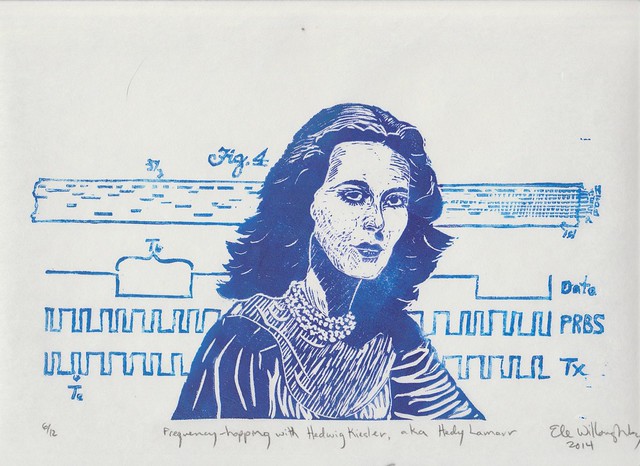
Frequency-hopping with Hedwig Keisler, aka Heday Lamarr, linocut by minouette
This linocut portrait is of inventor and actress Hedy Lamarr (9 November 1914 – 19 January 2000), best known as a star of Hollywood's Golden Age. The linocut is printed in indigo and blue on Japanese kozo paper 9.25" by 12.5" (23.5 cm by 32 cm), inked à la poupée in an edition of 12.

Born Hedwig Keisler in 1914 in Vienna, Hedy became famous after her risqué and notorious starring role in Gustav Machatý's 1933 film Ecstasy. Friedrich Mandl, her first of six husbands (to whom she was married at the time), objected to what he felt was exploitation of his wife, including shots of her nude and simulating an orgasm. He tried unsuccessfully to buy up all copies of the film. Hedy objected to her husband, the munitions manufacturer, dealing with fascists including Mussolini and Hilter, despite the fact that she and her husband were both of Jewish heritage. Hedy had learned that the secret of her beauty was to, in her words "stand there and look stupid” though she was in fact highly intelligent, a mathematics prodigy, and an astute innovator. So while Axis leaders and arms dealers attended lavish parties at their castle home, Hedy gained a great deal of sensitive military intelligence, including intimate knowledge of the problems associate with radio-control of torpedoes. She decided to leave her controlling husband. She made her escape by disguising herself as her own maid (by drugging her and stealing her clothes), just in time to avoid the annexation of Austria. She took this intelligence with her to Paris, and on to London. In London she met Louis B. Mayer, who renamed her 'Hedy Lamarr' and hired her to work for MGM. She went on to make dozens of Hollywood films opposite all the big stars of the Golden Age, and was known as one of the most beautiful women in the world.

In 1940, spurned by the tragic sinking of a boatload of refugees, by a German U-boat torpedo, Hedy put her mind to the problem of national defense. She knew that torpedoes were guided by radio signals, of a single frequency, which were vulnerable to interference or "jamming". She had the idea that if multiple frequencies were employed, like a radio station which varied its channel unpredictably, it would not be possible for the enemy to find and interfere with the signal. This way the signal could be encoded across a broad spectrum. The difficulty would be in synchronizing the transmitter and the receiver, so they would be set at the appropriate frequency at all times. She met her neighbour, the avant-guard musician and composer George Antheil at a party. He had been working on automated control of musical instruments, including his music for Ballet Mécanique which involved synchronizing his melodies across twelve player pianos (or pianolas)! Is that not an excellent example of the wonderous region where art and science intersect? This was the answer. Together they developed Hedy's frequency-hopping idea, encorporating George's technology for synchronizing pianolas, and on the 11th of August, 1942, US Patent Number 2,292,387 for the "Secret Communications System" was granted to Antheil and to “Hedy Kiesler Markey”, which was her married name at the time. This early version of frequency hopping used a piano-roll to change among 88 frequencies (like the keys on a piano). Though the US navy did not adopt the method until 1962 (during their blockade of Cuba), and there other patents and inventors whose work contributed the modern methods, today, we recognize Hedy Lamarr as an important pioneer of wireless technology! Lamarr's and Antheil's frequency-hopping idea serves as a basis for modern spread-spectrum communication technology, such as Bluetooth, COFDM (used in Wi-Fi network connections), CDMA (used in some cordless and wireless telephones) and 4G LTE communications. You are probably using a device right now which relies on these ideas.

In the print, I show a portrait of Hedy in 1941, along with Fig.4 from Lamarr and Antheil's patent, which relates to the use of the piano roll. Below this, I show a diagram of how the modern the frequency-hopping code division multiple access (FH-CDMA) scheme works. The wide square wave labelled 'Data' is a signal to be encoded, with pulse width Tb. 'PRBS' means pseudo random binary sequence. It's the way the changes in frequency are introduced and plays the role of the piano roll today. It runs at a much higher rate than the data to be transmitted, with pulse width Tc. Data for transmission is combined via bitwise XOR (exclusive OR) with the faster code. This means that that if the two waveforms, the data and the PRBS are unequal, the transmitted signal (labelled Tx) will be high. Otherwise the transmitted signal will be low. The transmitted signal is spread across a spectrum of frequencies by a factor determined by the ratio of the two pulse widths; the bandwidth is increased by a factor of Tb/Tc. Since the PRBS, known as the "pseudo-noise" (PN) code can be can be reproduced in a deterministic manner by the intended receiver (which is equivalent to reproducing the imaginary piano roll), it can decode the signal. This spread spectrum encoding is at the heart of all our contemporary telecommunications and is only possible using the kind of frequency hopping that Hedwig Kiesler, also known as Hedy Lamarr, invented.


Tuesday, March 24, 2009

Ada Lovelace Day!

Ada Lovelace linocut by Ele Willoughby
Today is Ada Lovelace Day! I've blogged about the brilliant proto-software engineer before. Daughter of absentee father, the mad, bad, and dangerous to know, Lord Byron, she was able to describe and conceptualize software for Charles Babbage's computing engine, before the concepts of software, hardware, or even Babbage's own machine existed! She foresaw that computers would be useful for more than mere number-crunching. For this she is rightly recognized as visionary - at least by those of us who know who she was. She figured out how to compute Bernouilli numbers with a Babbage analytical engine. Tragically, she died at only 36.

In honour of her, Ada Lovelace Day is an international day of blogging to draw attention to women excelling in technology. Almost 2000 people have pledged to blog about a women in technology, to help remedy the fact that women in technology and their "contributions often go unacknowledged, their innovations seldom mentioned, their faces rarely recognised."

Frequency Hopping with Hedwig Keisler, aka Hedy Lamarr, by Ele Willougby
So apart from Ada Lovelace herself, I thought I would tell you about another, historic, under-appreciated figure: Hedy Lamarr. It's not often one gets to talk about a Hollywood star/scientist and innovator (as well as mother), but this woman could do it all. Austrian, of Jewish heritage, she worked as an actress in film, until she married. Though her arms-manufacturer husband was part Jewish, he was a Nazi-sympathizer which infuriated her. She escaped from Europe where in 1937, by disguising herself as her maid. She came to Hollywood and made 18 films in 9 years. Meanwhile she was working with her neighbour, avant garde composer George Antheil and experimenting with automated control of instruments. Together, the two submitted the idea of a Secret Communication System in June 1941 and were granted a patent (U.S. Patent 2,292,387). This early version of frequency hopping* used a piano roll to change between 88 frequencies and was intended to make radio-guided torpedoes harder for enemies to detect or jam.

They were ahead of their time and the mechanical technology did not exist for decades. "It was not implemented in the USA until 1962, when it was used by U.S. military ships during a blockade of Cuba, after the patent had expired. Neither Lamarr nor Antheil (who died in 1959) made any money from the patent. Perhaps owing to this lag in development, the patent was little-known until 1997, when the Electronic Frontier Foundation gave Lamarr an award for this contribution." [wikipedia]

The frequency-hopping idea lives on in modern spread-spectrum communication technology - a basis for a lot of wireless communications. It's also popular in my field; geophysical electromagnetic researchers often transmit pseudo-random binary sequences (PRBS) into the earth to get a spread in frequencies and take advantage of the wider bandwidth (which means more information about a larger array of different depths below the earth's surface - different frequencies penetrate to different depths).

"Lamarr wanted to join the National Inventors Council, but she was told that she could better help the war effort by using her celebrity status to sell War Bonds. She once raised $7,000,000 at just one event." [wikipedia]

So there you go.

I write about these late, great women inventors, not to say that women in technology were extraordinary figures from the past, but rather to highlight that crucial innovations have been made by women for a long time, and that even when they had the good fortune to also have fame, fortune and beauty, as well as brilliance and innovation, they remained in the shadows.

If you want a living local hero, my favorite is Ursula Franklin. Definitely one of my heroines. Maybe I'll blog about her next....

I am so going to do a lino block print of Countess Lovelace.