Showing posts with label computer science. Show all posts

Wednesday, April 15, 2026

Polymath Claude Shannon and Theseus the Electromechanical Mouse in a Maze


Claude Shannon, linocut print, 11" x 14" by Ele Willoughby, 2026

I was recently commissioned to make a portrait of Claude Shannon. It seemed clear that it would need some binary to represent his work, and the math and computer science in particular. I opted to also include Theseus in his maze, which hits on the electrical engineering, and the humour in what he did.

This is my linocut portrait of Claude Elwood Shannon (1916-2001), mathematician, electrical engineer, computer scientist and cryptographer credited with laying the foundations for the Information Age. Each hand-printed linocut on 11" x 14" Japanese kozo (or mulberry paper) shows Shannon in front of binary numbers and with his electromechanical mouse Theseus with its maze. Though partially behind him, the binary numbers represent the standard ASCII code for "CLAUDESHANNON". 

At the University of Michigan, he took two degrees: one in electrical engineering and the second in mathematics, graduating in 1936. His MIT masters thesis is arguably one of the most impactful ever completed. In it, "A Symbolic Analysis of Relay and Switching Circuits", he showed that we can construct any logical numerical relationship through the electrical applications of Boolean algebra. This is now the underlying theoretical basis for   digital computing and digital circuits. He completed his doctorate at MIT in 1940 on mathematical genetics.

During WWII he worked in the field of cryptanalysis for US national defence, doing fundamental work on codebreaking and secure telecommunications, and writing a paper which is considered one of the foundational pieces of modern symmetric-key cryptography.

His 1948 paper "A Mathematical Theory of Communication" laid the foundations for the field of information theory. This paper was important to the invention of the compact disc, the internet, mobile phones and even our understanding of blackholes. He introduced the term "bit," invented the signal-flow graph and co-invented pulse-code modulation and the first wearable computer. 

In 1950, he designed and built a learning machine, with the help of his wife mathematician and research collaborator Betty Shannon. They built an adjustable maze with sensors (an electromechanical relay circuit) which followed the path of an electromechanical mouse whimsically named Theseus. Theseus could search corridors until it found a target (the penny in my portrait). Then, the mouse could be moved to anywhere in the maze. If the location was known, it would go immediately to the target. If the location was unknown, the mouse would search until it found a known position, adding this knowledge to its memory, and proceed from the known position. This way it could eventually find the most direct route. This is the first known artificial learning device.

In 1951 he joined the CIA's  Special Cryptologic Advisory Group. He was a professor at MIT from 1956 to 1978. His work was also foundational for artificial intelligence. He was a co-organizer of the 1956 Dartmouth workshop, considered to be the discipline's founding event. He published papers on the programming of chess computers. His Theseus machine was the first electrical device to learn by trial and error, being one of the first examples of artificial intelligence.

Tuesday, September 21, 2021

Optimizer of compilers, code and parallel computing trailblazer Fran Allen


Frances Allen, linocut 9.25" x 12.5", by Ele Willoughby, 2021
 

This is my linocut portrait of trailblazing American computer scientist Frances Elizabeth Allen (August 4, 1932 – August 4, 2020) who made foundational contributions to optimizing compilers (which translate code written in computer languages to the machine code in ones and zeroes actually used by computers), optimizing programs and parallel computing. This work has made computers and everything they do faster and more efficient. Compiler expert Graydon Hoare told the New York Times that her work is in “every app, every website, every video game or communication system, every government or bank computer, every onboard computer in a car or aircraft.” She was the first woman to become an IBM Fellow, where she worked from 1957 to 2002 and as an emeritus fellow afterwards. She was the first woman to win the prestigious A.M. Turing Award or contributions "of lasting and major technical importance to the computer field". I made this portrait for the #mathyear prompt: Turing Award.

She grew up the eldest of six kids on a farm near Lake Champlain; her mother was a teacher and her father a farmer. She went to elementary school in a one-room schoolhouse before attending a local high school and then the New York State College for Teachers where she graduated with a degree in mathematics in 1954. She worked as a teacher, back at her old high school, before returning to study at the University of Michigan for a MSc in mathematics in 1957.
 
IBM Research was recruiting and Allen needed to pay off student loans so she took the job. They wanted  their employees to learn and use FORTRAN (FORmula TRANslation, the first and newly introduced high-level programming language).  With her teaching experience and some basic computing courses under her belt, she was assigned to teach FORTRAN while simultaneously learning it herself. She said she had to teach these unhappy scientists (who were skeptical that a high-level language could work as well as assembly code) and became enamored with FORTRAN and its possibilities for productivity and performance. As Grace Hopper argued, "It's much easier for most people to write an English statement than it is to use symbols. So I decided data processors ought to be able to write their programs in English, and the computers would translate them into machine code." Her goal became to make those compilers, the translators, more efficient. Allen had intended to return to her first love, teaching high school math, but instead stayed with IBM for 45 years. 

In 1959 Allen managed the compiler-optimization teams for Harvest and Stretch, IBM's first transitorized 100 kW supercomputer. With its 2048 kB of memory the goal was to make it 100 times faster than contemporary machines! While it was not a hit with clients (as it apparently still took 18 hours to produce a 24-hour weather forecast), it impressed the National Security Agency. Allen was then assigned to the Harvest project for code breaking (of messages from the Soviet Union intercepted by American spies) and she spent a year leading an NSA team on classified projects. Harvest was such a success, thanks to Allen's optimization of the compiler, it was used for 14 years despite the pace of technological innovation. She also worked on the Alpha computer language which could run on Stretch and could create new alphabets beyond the system-defined alphabets. She  In '62 she moved from the IBM facility in Poughkeepsie to Yorkton Heights, where she worked on further supercomputer (ACS-1) and language projects (PL/I). She collaborated with John Cocke on a series of fundamental papers about compiler optimization to improve how higher level languages are translated to machine code. The diagrams in the portrait are from their crucial 1971 paper, 'A Catalogue of Optimizing Transformations'. Their work introduced the concept of using such graph-theoretical structures to encode a program content in order to efficiently and automatically understand how its parts function together and find ways to optimize code.

She did a sabbatical at NYU in 1971 and was thence an adjunct professor there, and a sabbatical at Stanford in 1977. From 1980 to 1995 she led IBM's parallel computing team, developing tools which became broadly used in commercial compilers in personal computers, and developing software for their Blue Gene project. She became the first woman IBM Fellow in 1989. In 1995 she was named president of the IBM Academy of Technology, an internal steering group for the company. In this role she focused on mentoring and women in tech. After her retirement in 2002 she remained as an Emeritus Fellow and continued to work on programs encouraging women and girls to work in computing.

She was a fellow of the IEEE, the AAAS, the American Philosophical Society, the Association for Computing Machinery and the Computer History Museum. She was elected to the National Academy of Sciences. In 1997 she won the IEEE Computer Society Charles Babbage Award and was inducted in the Women in Technology Hall of Fame. She won the IEEE Computer Society Computer Pioneer Award in 2004. She won the Association for Women in Computing Augusta Ada Lovelace Award in 2002 and the ABIE Award for Technical Leadership from the Anita Borg Institute in 2004. In 2006, she won the Associating of Computing Machinery A.M. Turing Award,  for contributions "of lasting and major technical importance to the computer field" in recognition of her work with supercomputers.  She was the first woman to win the prestigious award in its 40 year history.

When she wasn't working she enjoyed other challenges and adventures, as an avid runner, mountain climber and participant in expeditions to the to the Artic and on the Chinese/Tibet border. 


In 2022, the IEEE will present the IEEE Frances E. Allen Medal for the first time for innovative work in computing leading to lasting impact on other fields of engineering, technology, or science.

References

Frances Allen, wikipedia, accessed September, 2021

Allen, Frances E.; Cocke, John (1971). Rustin, Randall (ed.). A Catalogue of Optimizing Transformations. Design and Optimization of Compilers. Thomas J. Watson IBM Research Center. Prentice Hall. 

Kim Lyons, Computer scientist Frances Allen, known for her work on compiling, dies at 88, The Verge,

Friday, November 1, 2019

Rear Admiral and Mathematician Grace Hopper Teaching Computers Something Like English

Grace Hopper, linocut on 11" x 14" Japanese kozo paper, 2019, by Ele Willoughby
The first modern computers were loud, room-sized monsters, essentially a collection of relays (electrical switches) patched together with electrical cords. Each "switch" could be one (1) or off (0) and could represent data (an input value) or an action applied to these data.  To talk to the computer, to tell it to do anything with these values, you needed to speak in machine code, in the natural language of the computer itself of zeroes and ones - and each machine had its one structure and associated code. The story of how these giant computing machines went from a rare, complex tool available only research scientists at a few select university or government labs to ubiquitous, multipurpose portable tools we carry with us everywhere and use daily, depends in part on the idea we could, and should, develop machine-independent programming languages and that these could be based on English. This revolutionary idea was popularized by American computer scientist and US Navy rear admiral Grace Brewster Murray Hopper (née Murray December 9, 1906 – January 1, 1992).

Born in on the Upper West Side of New York City, the eldest of three children, she was the sort of curious child who dismantled alarm clocks to discover how they work; she was seven when she was caught, having already taken seven clocks apart, and her mother limited her future exploration to working with a single clock. Her father owned an insurance business. She took after her mother, herself a mathematician. She was admitted to Vassar College at 17 and completed a Bachelor's degree in math and physics. By 1930, she had completed her Master's at Yale and married New York University comparative literature professor Vincent Foster Hopper (1906–1976). She began teaching at Vassar in 1931. By 1934, she completed her PhD on "New Types of Irreducibility Criteria" under the supervision of Øystein Ore at Yale. Unusually for a mathematics professor, she insisted her students write well; her first assignment would be an essay on her favourite formula. She felt studying mathematics without the ability to communicate math was pointless. Her own ability to translate real world problems into mathematics and math into English would serve her well throughout her career.

She became bored with an unexciting marriage and found teaching math less fulfilling than she hoped. When the US entered WWII she was on partial leave from Vassar, spending a year studying finite difference methods for solving partial differential equations with Richard Courant at New York University. She saw a way to change her life. At age 34, Hopper tried to enlist in the Navy, but was rejected. She was deemed too old, and a petite woman, her weight to height ratio was too low; further her job as a mathematician and professor at Vassar was considered valuable to the war effort.
Though Vassar promoted her to associate professor in 1941 she obtained a leave of absence. She persisted with her goal and got a special exemption for being 15 pounds (6.8 kg) below the Navy minimum weight of 120 pounds (54 kg) and volunteered for the the United States Navy Reserve women's branch (WAVES) in 1943. By 1945, she had divorced her husband, but chose to retain her husband's family name.

After graduating top of her class at the Naval Reserve Midshipman's School at Smith College in Massachusetts, she was assigned to the Bureau of Ships Computation Project at Harvard University as a lieutenant, junior grade. Howard H. Aiken, physicist and computing trailblazer, who had been a professor was now leading a team there as a commander in the Navy. His team was working on programming the giant IBM Automatic Sequence Controlled Calculator (ASCC), an electromechanical computer known as the Mark I. Hopper said she had to learn the languages of the different scientists and engineers whose problems they were running on the machine, the languages of the managers, and of the programmers, and her facility with these different modes of communication was why Aiken assigned her to write the first computer programming manual. Despite her doubt about writing a book, she produced a 561-page volume starting with a history of computing machines from Charles Babbage to the present. Like her forebearer Ada Lovelace, she saw the potential of a computer controlled by separate punch tape instructions (what we now know as software) rather than the need to reconfigure the machine hardware itself. Aiken had originally bristled at the thought of a woman on the team, but soon made Hopper primary programmer and his top deputy. She became known as irreverent, brilliant, sharp-tonged but a good collaborator. Together, Aiken and Hopper co-authored three papers on the Mark I. After the war, she requested to transfer to the regular Navy, but her request was declined due to her age. She opted nonetheless to remain at Harvard as Navy reserve research fellow under a Navy contract, until 1949, despite the offer of a full professorship at Vassar.

While working on the Mark I, Hopper perfected the use of the subroutine, the way programmers use a specific chunk of code to perform a specific task again and again, such as taking the sinusoid or logarithm of a value. This a concept Ada Lovelace wrote about in her Notes on the Analytical Engine.  She began thinking about the way to take her library of subroutines and enable its use on any machine, if her source code could be translated to machine code (which is machine-specific) by using a compiler.

Famously, while working on the Mark II, she and her colleagues had to do some literal "debugging" when a dead moth was discovered in a relay. The term "bug" already existed in engineering, but the process of systematical detecting and removing problems in computer programs came to be known as debugging partially because of this specific wayward moth and Hopper delighted to telling the story of the actual bug. It was dutifully recorded by taping its corpse labelled "First actual case of bug being found," in the log book dated September 9, 1947.

The Harvard Mark I, II and III, were reliable machines based on electromechanical relays, but these were slow. Hopper's work had help make these machines the most easily programmed but she recognized that the new electronic devices using vacuum tubes were so much faster, that easy of programming and reliability were not enough. Also, it became clear that she would not be promoted or granted tenure at Harvard. She left her post to join the Eckert–Mauchly Computer Corporation where she worked on the development of UNIVAC I, the first general purpose electronic digital computer design, made for business. When the company was taken over by Remington Rand in 1950, she was appointed UNIVAC director of Automatic Programming Development. She became convinced that since people were far better at writing English than in symbols, that they ought to be able to write programs in English and that the computer themselves should translate this into machine code. It took her three years to convince others. She wrote her first paper on compilers (now known as link-loaders, the tool computers use to translate English-like computer programs into machine code) and had developed a functional link-loader the A-0 in 1952, all while her peers thought computers could only do arithmetic. As a mathematics professor she realized only, "[v]ery few people are really symbol manipulators. If they are they become professional mathematicians, not data processors. It's much easier for most people to write an English statement than it is to use symbols. So I decided data processors ought to be able to write their programs in English, and the computers would translate them into machine code. That was the beginning of COBOL, a computer language for data processors. I could say 'Subtract income tax from pay' instead of trying to write that in octal code or using all kinds of symbols." Promoted to the company's first director of automatic programming, her department released some of the first compiler-based programming languages, including MATH-MATIC and FLOW-MATIC. In 1959, she was a technical consultant to the Conference on Data Systems Languages (CODASYL) where she and colleagues defined the new language COBOL (an acronym for COmmon Business-Oriented Language), extending on FLOW-MATIC and IBM's language COMTRAN. COBOL became a major computer language in data processing and even persists today as legacy code.

She sadly retired from the Navy Reserve at age 60, as required in 1967, at the rank of commander but was recalled to active duty in 1968 and served as the director of the Navy Programming Languages Group in the Navy's Office of Information Systems Planning. She retired again in 1971, but was again recalled in 1972. She became a captain in 1973. During the 70s she argued for the move away from giant centralized computers to networks of small, distributed machines. She worked on standards for computer systems, components and programming languages like FORTRAN and COBOL. In 1983 she was promoted to commodore and remained on active duty several years beyond mandatory retirement by special approval of Congress. In 1985 the rank commodore was renamed rear admiral making her one of few women to achieve that rank. She final retired in 1986 as the the oldest active-duty commissioned officer in the United States Navy at age 79. She then worked as a senior consultant to Digital Equipment Corporation (DEC) until her death at age 85 in 1992, lecturing on the history of computers in full dress uniform. By the end of her life she was a very well-recognized figure, earning more than 40 honourary degrees, many awards and had many things named in her honour. She became the first woman to win the National Medal of Technology, the highest technology award in the US. At the ceremony she said, “If you ask me what accomplishment I’m most proud of, the answer would be all the young people I’ve trained over the years; that’s more important than writing the first compiler.” After her death, the Navy commissioned the U.S.S. Hopper, a guided missile destroyer, and in 2016 Hopper was posthumously received the Presidential Medal of Freedom.

In my portrait I've shown her as she was in WWII in front of the Harvard Mark I, with a little nod to the famous "first" computer bug. I am the sort of nerd who actually looks up the actual moth recorded and then put some thought into species that may have fit the size and colour of the moth found at Harvard.

References
Gilbert, Lynn (1981). Women of Wisdom: Grace Murray Hopper. Lynn Gilbert, Inc.
Software Bug, Wikipedia, accessed October 2019 
Grace Hopper, Wikipedia, accessed October 2019 
COBOL, Wikipedia, accessed October 2019   
Harvard Mark I,  Wikipedia, accessed October 2019   
Walter Isaacson, Grace Hopper, computing pioneer, The Harvard Gazette, December 3, 2014
Grace Murray Hopper (1906-1992): A legacy of innovation and service, Yale News, February 10, 2017

Wednesday, June 13, 2018

Interstital Intro - My portraits of Canadian Women in STEM


Featuring artwork by me, Cheryl Hamilton and Paige Blumer, Curiosity Collider's artshow Interstitial: Science Innovations by Canadian Women is on exhibit until June 22. Since I was unable to attend the Opening in Vancouver, they asked me to share a short video introduction to me and my artwork. So now, I'm sharing the video with you. Comes complete with a peek inside my studio and some of the artwork you could find there. I think I was so focused on pronouncing "electrophoresis" that I slipped up on the more common "geneticist", but it tells about the work.


The exhibit is open from 11 am to 6 pm from Tuesday to Saturday until June 22 at The Beaumont Studios gallery spaces, located at 316/326 West 5th Street, Vancouver, BC, V5Y 1J0.

Monday, April 23, 2018

Beatrice "Trixie" Worsley - One of the World's First Computer Science Doctorates

Trixie Worsley, linocut 11" x 14" by Ele Willoughby, 2018

Trixie Worsley earned one of the very first doctorate in computer science, supervised by Douglas Hartree and Alan Turing at Cambridge. Amongst the first computer scientists in Canada, she was certainly the first woman in the field here. She focused on writing software, development of computer libraries, scientific computation and was co-author of the first compiler Transcode (vital to physicists) as well as teaching in the new field of computer science. Her work provides insight into the history of the nascent field of computer science. She published her computational insights and solutions for problems in physics, biology and computer science.

Beatrice Helen Worsley (1921-1972), a quiet and accommodating girl known as Trixie, was born in Queretaro, Mexico, to English parents who had moved to Mexico so her father could work in her mother's family's textile mill. This mill had been destroyed by rebels in 1917, and Trixie's future parents had had to move again so her father could instead work for Rio Grande group’s CIMSA mills. Trixie's mother home-schooled her and her older brother, and the family remained cut off from the local community for safety during this turbulent time in Mexico's history. In 1929, the family moved to Toronto, mainly for the sake of the children's education. Trixie attended Brown public school for a few years before going to the private Bishop Strachan School, where as the top student of her day, she excelled in the university track classes. She graduated with honours in 1939, winning awards for math and science and the Governor General's Award for the highest grades in the school. She entered Trinity College at the University of Toronto with both a general proficiency entrance award and the Burnside Scholarship in Science. Getting top marks in most of her classes she won more scholarships and transferred to Math and Physics in 1940, specializing in applied math. She first saw computers during a summer job in the actuarial department of the Manufacturers Life Insurance Company in Toronto in 1942.

As soon as she completed her bachelor's in mathematics at the University of Toronto in 1944, she enlisted in the Women’s Royal Canadian Naval Service, known as the Wrens. As a researcher at the Naval Research Establishment at Her Majesty’s Canadian Ship Establishment Stradacona, in Halifax, NS, she focused on harbour defence. Worsley was one of 6 Wrens amongst 50 scientists, officers and support staff, who were responsible for things like degaussing ships to limit their magnetic signature and vulnerability to German magnetic mines, torpedo guidance and researching different techniques for harbour defence. Most of this group left the service within a year of the end of the war to pursue further education, with the special opportunities offered to veterans. A small number including Worsley, the only remaining Wren, stayed on. The newly promoted Lieutenant Worsley began researching the badly understood electrochemistry of hull corrosion in 1945, performing experiments at sea. She set the Wrens' record for time at sea, at 150 days, including during the rough mid-winter months. Her endurance and knowledge earned her the respect of the crews, even doing what she called a man's job. She demobilized in 1946 to pursue further education.

She went to MIT for a master's in math and physics with Henry Wallman, at the Radiation Laboratory, where she was exposed to computers and wrote a thesis called Mathematical Survey of Computing Devices with an Appendix on Error Analysis of Differential Analyzers. There were only really a handful of computers out there at the time, in universities, industry and national labs and she surveyed the literature on all of them as well as those planned, and began to be an expert on this new technology and to wish for a future in the field.

Returning to Canada in 1947, where there were not yet any available jobs in computers, she worked at the National Research Council (NRC) in Ottawa as an aerodynamics research officer in the mechanical engineering division, but it didn't hold her interest. She managed to negotiate a move to the new University of Toronto Computation Centre - the only existing Canadian computer R&D program - as one of two project assistants in 1948 (hired for $200 month). She and her colleagues worked on tabulating results for Atomic Energy Canada (AEC) in Chalk River. Worsley used Meccano to build her own differential analyzer with small improvements on the design published by Douglas Hartree and Arthur Porter in 1935. This was a cheap device, one of about 15 ever built worldwide, that was accurate enough to solve many scientific problems. Worsley and the other project assistant were sent to Cambridge to learn about EDSAC at the Cambridge Mathematical Laboratory in 1949. Worsley co-wrote the first program to run on EDSAC and her report on the machine's first run was published in the proceedings of a meeting on high-speed computing at Cambridge that June. She didn't return to Canada because she started her doctorate at Newnham College, with Douglas Hartree as supervisor (with Alan Turing and Maurice Wilkes). She returned to Canada before completing her dissertation but math professor Byron A. Griffith agreed to supervisor her till she completed her work. Hartree approved her thesis, Serial Programming for Real and Idealized Digital Calculating Machines, and she was awarded a PhD in 1952 and then published her first scientific paper. Hers is amongst the first doctorates awarded involving modern computers.

The FERUT computer from the Univerisyt of Toronto Archives
Meanwhile, the ambitious (and expensive) design and construction project of Canada’s first computer, the University of Toronto Electronic Computer Mark I (UTEC) was underway, aiming to produce a nationally-shared university, government and military resource. Plagued by mechanical problems and tube failure, the head of the AEC argued that funding should be withdrawn and moved to purchasing a completed system, the Ferranti Mark I in 1952. Worsley herself named the machine FERUT for “Ferranti computer at the University of Toronto,” and operated the new machine, creating software for everything from problems in atomic physics to the St. Lawrence Seaway calculations. With her colleague Gottlieb she taught courses on its use, but it was notoriously difficult and almost all their students quit. Worsley then worked with physics professor J.N. Patterson Hume, to write a compiler called Transcode, to make higher-order programming possible - a much easier method, if slower to execute. Allowing users to program in a language, rather than machine code, and enter numbers in decimal, rather than binary, hugely simplifier their task and had a huge impact on computing in Canada. It allowed dozens of research groups nationwide to use FERUT to solve a wide-array of scientific problems. Transcode was an immediate success and hundreds of people learned it before the FERUT was replaced with an IBM 650 in 1958. Despite her education, publications and teaching track-record, Worsley was repeatedly passed over for promotion and received less recognition than her (male) peers. She was only promoted from Computation Centre mathematician to assistant professor of physics in 1960. Worsley published more papers than any of the other staff of the Computation Centre in the 1960s as her career veered towards teaching. She was promoted to associate professor of physics and computer science when U of T started a graduate department of computer science in 1965.

She left U of T in 1965 to join Queen's University Computing Centre in Kingston, Ontario, likely influenced by her slow career advancement and treatment as a woman researcher at U of T. It caught her colleagues by surprise as she was moving to a University without a computer science program, only an outdated IBM 1620 and would be computing advisor to the Computing Centre with teaching duties, but not a professor. But, she was lured there to start the new Computing Centre and start anew. A new department of Computing and Information Science was created in 1968 complete with master's program thanks largely to Worsley's efforts and she was promoted to associate professor. In 1971 she took a sabbatical at the Department of Applied Analysis and Computer Science at the University of Waterloo to study assembler coding and computer architecture, but she had a fatal heart attack at age 50 on May 8, 1972.

After her untimely death, Worsley left her entire estate to Cambridge University to set up the Lundgren Fund, in honour of Helge Lundgren, for doctoral math or science students with preference to those in computer science "whose research has been interrupted by national service or personal misfortune." Scott M. Campbell who wrote the great biography of Worsley for the IEEE has been unable to identify this Helge Lundgren, though he suspects this might be tied to whatever it was that drew Worsley suddenly back to Canada before she had finished her doctorate.

Her report on the first run of the EDSAC was included in Brian Randell's classic 1973 book, The Origins of Digital Computers, leading to posthumous fame in the history of computer science. The Canadian Association of Computer Science / Association d'Informatique Canadienne (CACS/AIC) honoured her with a lifetime achievement award in 2015, alongside her former colleagues Hume and Gottlieb. A second Canadian woman supervised by Douglas Hartree at Cambridge, professor emerita of Vanderbilt University Charlotte Froese Fischer established a U of T computer science graduate scholarship in Worsley’s name, for doctoral candidates who have taken an active role in promoting women in the field of computer science. Froese Fischer met Worsley when they both worked in the Computing Centre and remembers her insights, wry humour and "way of expressing herself in a few memorable words.”

I was surprised how much of Trixie's career I could relate to directly. I've spent much more than 150 days doing research at sea, but never (in the Northern Hemisphere) later than a fairly miserable, snowy October. I have a pretty good sense of what it would have been like on the North Atlantic in the mid-winter. Her work as a WREN was on electrochemistry of hull corrosion. As someone who has done marine electromagnetics, I know this is still an active research topic for my naval colleagues. Her doctoral thesis included a great variety of problems, but one, the calculation of second-order corrections to the value of gravity from pendulum measurements at sea is something I know about as my own doctorate involved adapting a gravimeter to use at sea. I've shown Trixie based on a photo of her seated in front of the FERUT, and other images of the machine. I was influenced by my former colleague at U of T Physics, Gordon West's descriptions of the first computers they used and peering directly into the memory of the machine themselves through its output oscilloscopes. MIT makes her master's thesis available, so I looked it up but ended up opting to try and allude to her career as a programmer (rather than a hardware researcher) by reproducing the structure of a flow chart from one of her papers about computation methods in atomic physics.

References
Nina Haikara, 'Honouring Canada's first female computer scientist: U of T's Trixie Worsley,' U of T news, May 26, 2015

Scott M. Campbell, "Beatrice Helen Worsley: Canada's Female Computer Pioneer," IEEE Annals of the History of Computing, volume 25, no. 4 (Oct-Dec 2003), p.51--62.

Beatrice H. Worsley, 'The Self-Consistent Field with Exchange for Neon by FERUT Program,' Can. J. Physics, Vol. 36, 1958

Beatrice Worsley, The Canadian Encyclopedia, accessed April 20, 1018

Smillie, Keith (2002). "Beatrice (Trixie) Worsley". The Computer and Me - A Restrospective Look at Some Computers and Languages.

Beatrice H. (Trixie) Worsley | CS-CAN | INFO-CAN, accessed April 20, 2018

Wednesday, March 26, 2014

Hedy Lamarr, inventor of Frequency Hopping

Hedy Lamarr linocut
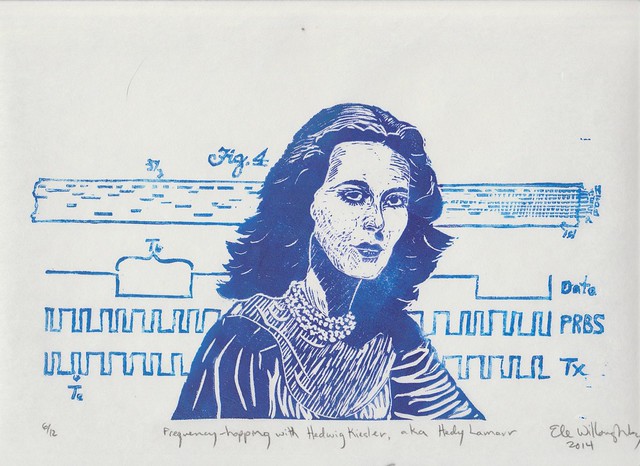
Frequency-hopping with Hedwig Keisler, aka Heday Lamarr, linocut by minouette
This linocut portrait is of inventor and actress Hedy Lamarr (9 November 1914 – 19 January 2000), best known as a star of Hollywood's Golden Age. The linocut is printed in indigo and blue on Japanese kozo paper 9.25" by 12.5" (23.5 cm by 32 cm), inked à la poupée in an edition of 12.

Born Hedwig Keisler in 1914 in Vienna, Hedy became famous after her risqué and notorious starring role in Gustav Machatý's 1933 film Ecstasy. Friedrich Mandl, her first of six husbands (to whom she was married at the time), objected to what he felt was exploitation of his wife, including shots of her nude and simulating an orgasm. He tried unsuccessfully to buy up all copies of the film. Hedy objected to her husband, the munitions manufacturer, dealing with fascists including Mussolini and Hilter, despite the fact that she and her husband were both of Jewish heritage. Hedy had learned that the secret of her beauty was to, in her words "stand there and look stupid” though she was in fact highly intelligent, a mathematics prodigy, and an astute innovator. So while Axis leaders and arms dealers attended lavish parties at their castle home, Hedy gained a great deal of sensitive military intelligence, including intimate knowledge of the problems associate with radio-control of torpedoes. She decided to leave her controlling husband. She made her escape by disguising herself as her own maid (by drugging her and stealing her clothes), just in time to avoid the annexation of Austria. She took this intelligence with her to Paris, and on to London. In London she met Louis B. Mayer, who renamed her 'Hedy Lamarr' and hired her to work for MGM. She went on to make dozens of Hollywood films opposite all the big stars of the Golden Age, and was known as one of the most beautiful women in the world.

In 1940, spurned by the tragic sinking of a boatload of refugees, by a German U-boat torpedo, Hedy put her mind to the problem of national defense. She knew that torpedoes were guided by radio signals, of a single frequency, which were vulnerable to interference or "jamming". She had the idea that if multiple frequencies were employed, like a radio station which varied its channel unpredictably, it would not be possible for the enemy to find and interfere with the signal. This way the signal could be encoded across a broad spectrum. The difficulty would be in synchronizing the transmitter and the receiver, so they would be set at the appropriate frequency at all times. She met her neighbour, the avant-guard musician and composer George Antheil at a party. He had been working on automated control of musical instruments, including his music for Ballet Mécanique which involved synchronizing his melodies across twelve player pianos (or pianolas)! Is that not an excellent example of the wonderous region where art and science intersect? This was the answer. Together they developed Hedy's frequency-hopping idea, encorporating George's technology for synchronizing pianolas, and on the 11th of August, 1942, US Patent Number 2,292,387 for the "Secret Communications System" was granted to Antheil and to “Hedy Kiesler Markey”, which was her married name at the time. This early version of frequency hopping used a piano-roll to change among 88 frequencies (like the keys on a piano). Though the US navy did not adopt the method until 1962 (during their blockade of Cuba), and there other patents and inventors whose work contributed the modern methods, today, we recognize Hedy Lamarr as an important pioneer of wireless technology! Lamarr's and Antheil's frequency-hopping idea serves as a basis for modern spread-spectrum communication technology, such as Bluetooth, COFDM (used in Wi-Fi network connections), CDMA (used in some cordless and wireless telephones) and 4G LTE communications. You are probably using a device right now which relies on these ideas.

In the print, I show a portrait of Hedy in 1941, along with Fig.4 from Lamarr and Antheil's patent, which relates to the use of the piano roll. Below this, I show a diagram of how the modern the frequency-hopping code division multiple access (FH-CDMA) scheme works. The wide square wave labelled 'Data' is a signal to be encoded, with pulse width Tb. 'PRBS' means pseudo random binary sequence. It's the way the changes in frequency are introduced and plays the role of the piano roll today. It runs at a much higher rate than the data to be transmitted, with pulse width Tc. Data for transmission is combined via bitwise XOR (exclusive OR) with the faster code. This means that that if the two waveforms, the data and the PRBS are unequal, the transmitted signal (labelled Tx) will be high. Otherwise the transmitted signal will be low. The transmitted signal is spread across a spectrum of frequencies by a factor determined by the ratio of the two pulse widths; the bandwidth is increased by a factor of Tb/Tc. Since the PRBS, known as the "pseudo-noise" (PN) code can be can be reproduced in a deterministic manner by the intended receiver (which is equivalent to reproducing the imaginary piano roll), it can decode the signal. This spread spectrum encoding is at the heart of all our contemporary telecommunications and is only possible using the kind of frequency hopping that Hedwig Kiesler, also known as Hedy Lamarr, invented.