Friday, May 30, 2014

Mae Jemison, Astronaut

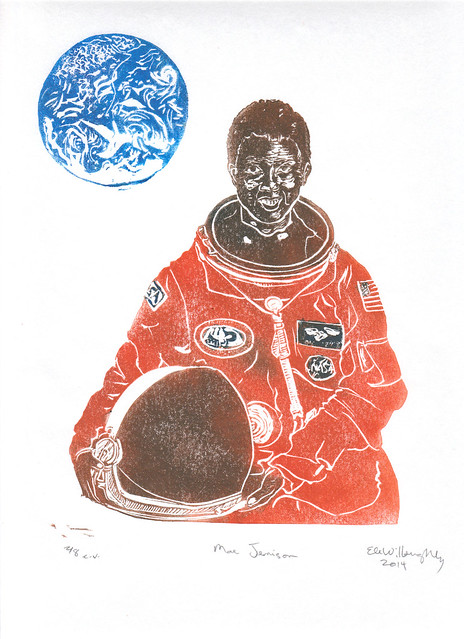
I'm working on my series of women in science protraits for the show in the fall. The latest in my scientist portrait series is American astronaut Mae Jemison. Astronauts are generally extraordinary, but I love that not only was she a trailblazer, she is someone with twin passions for art and science, who danced professionally, was well as being a chemical engineer and medical doctor.

Mae Jemison linocut
Mae Jemison, linocut on Japanese kozo paper, 9.25" by 12.5" (23.5 cm by 32 cm) in an edition of eight by Ele Willoughby, 2014

Mae Jemison (born October 17, 1956), is a physician who became the first African American woman to travel in space when she went into orbit aboard the Space Shuttle Endeavour for NASA, on September 12, 1992. She also has a B.S. in chemical engineering, served in the Peace Corps, is a dancer and choreographer, formed and runs her own company researching the application of technology to daily life, and even appeared on Star Trek: The Next Generation. Inspired to join NASA by Nichelle Nichols, who portrayed Lieutenant Uhura on Star Trek, she was the first real astronaut to appear on any Star Trek show.

Jemison is a Professor-at-Large at Cornell University and was a professor of Environmental Studies at Dartmouth College from 1995 to 2002. As well as her own company the Jemison Group, she founded the Dorothy Jemison Foundation for Excellence with projects like The Earth We Share (TEWS), an international science camp for students, ages 12 to 16, and biotech company BioSentient Corp.

Yesterday, in history

quebec 518 I meant to post his yesterday, but I ran out of time.

In the early morning fog of 29 May 1914, the ocean liner RMS Empress of Ireland was steaming down the St. Lawrence on its return trip to England, just offshore Rimouski, Quebec, when it collided with the Norwegian collier SS Storstad, or more precisely, when the Storstad collided with her (though there is evidence to suggest both Captains made errors of judgement). Both Captains should have known to maintain their headings due to the dense fog - both, it seems did not. Of the 1,477 persons on board the ship, 1,012 died, making this the largest of any Canadian maritime accident in peacetime, and second only to the the sinking of the Titanic at the time - though now something largely forgotten by most Canadians. The Storstad did not sink.

quebec 517The immense lost of life was not a failure to provide lifeboats or a design failure like the Titanic, but a combination of where she was struck, a failure to close watertight doors and the fact that so many pothole windows were left open to try and air out staterooms, despite maritime regulations requiring them to be shut once the vessel left port. The ship went down rapidly.

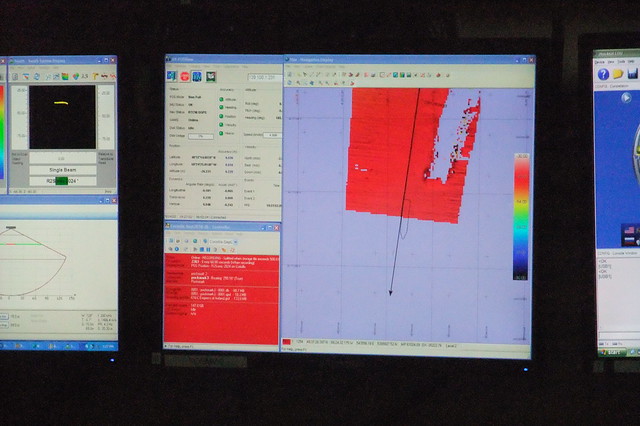
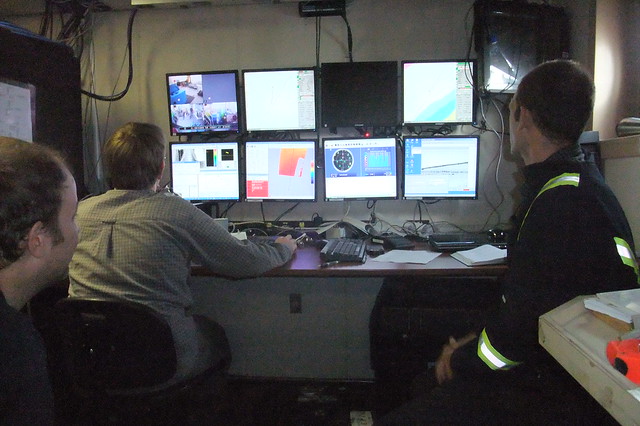
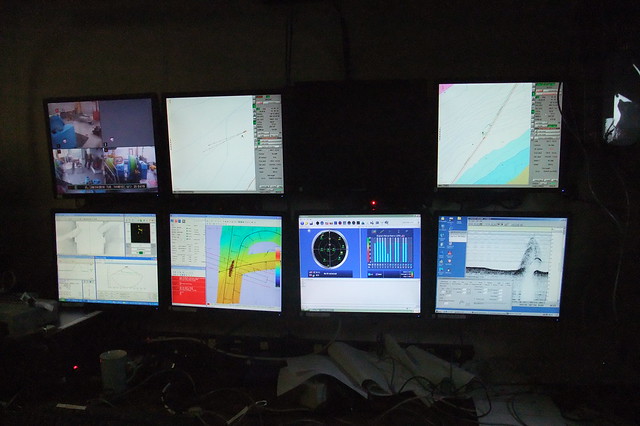
quebec 526While doing fieldwork sailing to and from Rimouski in 2010, we allowed another research group some shiptime to test their multibeam bathymetric system. The RMS Empress of Ireland make a logical target in just 40 m of water. Seeing the undisturbed wreck apear on the screens in the lab was really a fascinating experience.

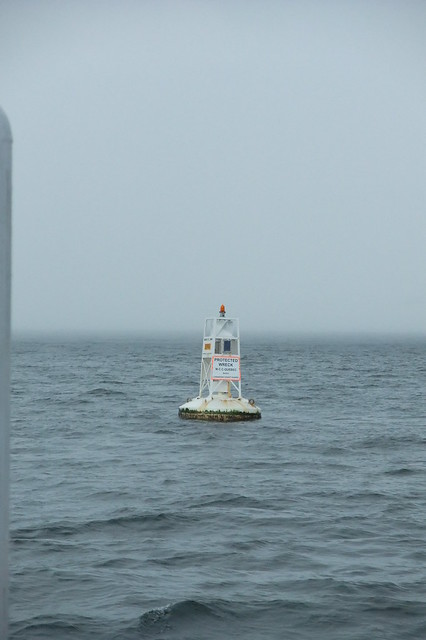
On the surface, there was nothing to see but river and fog, and the one buoy to warn of a shallow obstruction. Below, clear as day on all our screens were bright reflections on the depth sounder and multibeam screens, indicating hard surfaces. It was so unusual to see straight lines, and in fact, the clear outline of a ship, despite the near century of sediment build up, decay, and any incursion of life. Most of what we see has the organic, smooth lines of naturally formed and eroded geology. Even when we do see human-made objects (like our own equipment), it's never so large that you can read its very shape. It was haunting to see the clear outline of the Empress, silently lying on the seabed.

quebec 529 The St. Lawrence is deceptive. In French, we have the word Fleuve to better describe this mighty river which drains into the sea. We do say 'seaway' in English... but river is insufficient. While sometimes calm, the waters are brakish, the tides surprisingly large and the currents stronger than you would imagine for a protected river. I certainly made sure my porthole window was shut. But, a cruise liner is filled with passengers with little to no experience of being at sea. In the dense fog as we surveyed, it was easy to imagine the chaos, especially in the early morning dark. Many passengers may not even have awoken. The story of the sinking, and subsequent inquiry makes for some dramatic and in fact scandalous reading.

The crew of our vessel viewed the ship somewhat solemnly, not so much because they felt the connection to events of a century previous, but because more recently, the wreck itself had claimed more lives. In only 40 m of water, skilled scuba divers can explore it. But in cold water with low visibility, it is a dangerous dive. In 2009, the year before our survey, six divers had died.

Wednesday, May 21, 2014

Cat woes

turkey-dazed

I haven't posted much lately, because baby - and now cat. Our beloved, if persnickety cat Minouette is getting to be a certain age for a cat. She is 17.5 years old. She started demanding a lot of water. Then we noticed puddles of clear, odorless liquid in the kitchen, which we did not immediately recognize.  We thought she had spat up, as cats do. It turns out that these are common symptom in older cats: peeing on things, especially cool, flat, surfaces like kitchen tiles, and drinking excessively. The odorlessness confused us. After a couple of trips to the vet, we've discovered she is diabetic. This is serious, but it is a liveable disease, and there is no sign she's in distress. It could have been worse. We were scared we would get a diagnosis of kidney failure, and it was stressful waiting for her test results. Cause, we love that damn cat. So, she's now on a high-protein diet and gets insulin twice a day, subcutaneously. I'm happy to report that I am able to administer the insulin, despite my anxiety about needles. I can't even watch someone get an injection in a movie, but luckily these needles are so small that I can handle it.

On the flip side, she decided to pee directly into the air vent in the kitchen, which is bad news for us. 'Odorless' is a relative term. RJH turned the heat on the other day (it's been that sort of spring) and guess what? Even watered down cat pee sure stinks when heated. We have done all we can to clean the vent, but we may have to tear down the ceiling in the basement and replace the vent altogether. Worst of all, while she is adjusting to the diet, and barely notices the injections, she has kept up the wayward peeing.

Also RJH and I got some terrible cold, from my nephew I think. RJH actually took some time off and he never does that... so that tells you how dreadful it's been. I just hope the baby doesn't get it!

To top it off, our internet was down for the better part of 2 days, which may be a mere 'first world problem' but it is a bother.

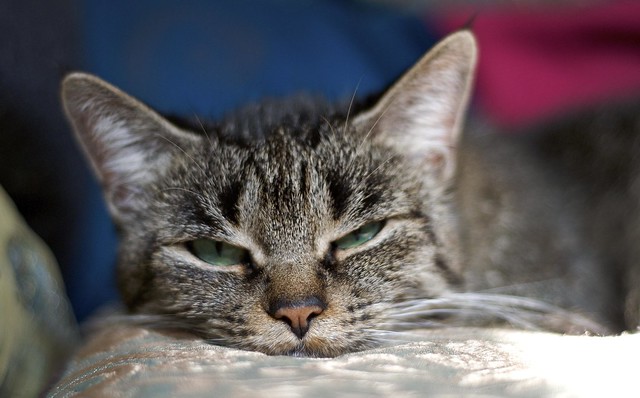
That's an older photo of Minouette, above, by RJH, but it's one of my favorites.

Saturday, May 3, 2014

Etsy Summit

Team Captain Summit

It was a busy week! Monday and Tuesday, along with Etsy admin, sponsors and team captains & leaders from across Canada, I took part in the Etsy Summit at MaRS. In fact, Etsy invited me to give a short talk about how to grow your team, and lead some break-out group discussions too. I started my talk by apologizing for not sticking around for extra meals and maybe being a little distracted, since this is the first time I left Gabriel with a sitter (Mom) and logical or no, it's part of the job description of a mother to worry. (I joked Tuesday that I wasn't sure if I should be relieved or hurt to find him happy and relaxed when I got home.) I got a lot of positive feedback, so I think I managed to give a good talk despite any concerns or distractions. The meeting was a success - we have some exciting plans. We're working on a pan-Canadian extravaganza! September 27, there will be simultaneous marketplaces in 30+ cities from coast to coast, called 'Etsy: Made in Canada'. You can read more on the TEST blog. I think it's a great idea to actually gain some national attention.

The rest of the week was filled with some doctors appointments for baby (who is healthy and "robust", thank you, it turns out). Apart from that, I had another birthday, so there was sushi and multiple chocolate cakes. There was some actual sunshine on Mayday, so we managed to go outside, which is great, because most years it rains. RJH has been busy photographing (and playing in) a charity hockey tournament, and the baby and I are just taking it easy.  I think we'll just eat cake and giraffe toes, respectively, and maybe take some photos with my exciting new camera. If it stops raining, we might go watch the bonfire down the street, but it's nice some days to have no bigger ambitions than cuddling.

Tuesday, April 22, 2014

Caroline Herschel, Household Drudge to Sweeper of Comets

Caroline Herschel
Caroline Herschel, linocut by Ele Willoughby (aka minouette), 2014

This linocut of astronomer Caroline Herschel (16 March 1750 – 9 January 1848) shows her and her own observations of comets, in dark black-gold and blue-black ink on lovely handmade Japanese kozo (or mulberry) paper, 8.1" by 9.25" (20.8 cm by 23.5 cm). There are 12 prints in the hand-printed edition.

German-born Caroline Herschel, while overshadowed by her brother William (who discovered Uranus, amongst his other astronomical accomplishments), was a real pioneer as a woman in astronomy and made her own important contributions. In fact, she became the first salaried female scientist, when King George III hired her to assist her brother, at a time when there were few professional scientists anywhere. Hers was a real life sort of Cinderella story, where rather than marrying a prince, she made a life and career for herself. Marriage was the expected role for a woman of her time, but she was deemed unmarriageable, since a childhood bout of typhus stunted her growth. Her mother thought she should train to be a servant, and purposely stood in the way of her learning French, or music, to prevent her from seeking employment as a governess. She wanted a perpetual unpaid maid. Her father sometimes managed to include her in William's lessons when their mother was absent. William had fled to England after the Seven Years War and made a life as a musician and composer in Bath. William managed to rescue his younger sister from their mother's clutches, under the pretext that she might have the voice to be a solo singer in Handel's oratorios, as she too was a natural musician. Of course, he also wanted a woman to manage his bachelor household. Meanwhile, he developed a real passion for astronomy. So, by the time she arrived, all his spare time away from music was devoted to astronomy and she found that despite her singing talent, she was roped into assisting with the construction of telescopes, rather than receiving music lessons. By 1781, William had discovered a new planet - Uranus , which he cannily dubbed the 'Georgian Star' after King George III. This had the desired effect of securing himself a pension, so that he could spend his time on astronomy (so long as he would present it to the King when asked).

William and Caroline worked together at Slough, observing the night sky with a variety of telescopes. William built some very large telescopes and had Caroline take notes of what he observed, while she used smaller 'sweeper' telescopes to sweep the skies for interesting object. She discovered 11 nebulae (2 of which turned out to be galaxies) which were previously unknown! She also found 8 or 9 comets, as well as making and sharing observations of comets discovered by others. The portrait is based on a miniature of Caroline, as well as her own notes and diagrams from 1 August 1786, when she discovered her first comet, now known as Comet C/1786 P1 (Herschel). On the left, her sketches of the object "like a star out of focus" which she correctly identified as a comet, is at the centre of the three circular diagrams labelled I, II and III. On the right, her Fig I and Fig II show her observations the following night, noting the position of the comet relative to the constellations of Ursa Major and Coma Berenices.

She also independently re-discovered Comet Encke in 1795, first recorded by Pierre Méchain in 1786. Later, in 1819, her observations help Johann Franz Encke recognize it was a periodic comet, like Halley's comet. Encke was able to calculate its orbit, partially due to her observations. The comet shown behind Caroline is based on a recent photo of Comet Encke, which returns every 3 years.

In order to calculate orbits of newly discovered comets, it was important to let other astronomers know as soon as possible. The letter post was often not fast enough, if the weather turned cloudy. She discovered her 8th comet while her brother was away. So, she took matters into her own hands. After an hour's sleep, she saddled a horse, and road the roughly twenty-six miles to the Greenwich Observatory of the Astronomer Royal, Nevil Maskelyne, much to his astonishment.

One of her important impacts on astronomy was that her early success showed her brother how even an amateur using a small telescope could find previously unobserved nebulae, and hence that there was real value in making systematic sweeps of the night sky. Partnering together, with William sweeping the sky with his 20 foot telescope and Caroline taking notes by lamplight just inside the window, they went on to discover 2507 nebulae and clusters over two decades of work. Further, she acted as 'computer', doing the mathematical grunt work for her brother's observations. William's study completely revolutionized astronomy, and it couldn't have happened without Caroline's help.

They worked side by side nightly until 1788, when William married (at age 49). Caroline was no longer needed to run his household, and he offered her money as compensation. She, however, convinced him to request her own salary from the King, which she received. She moved to a cottage in the garden. She did a lot of her own observing for the next nine years (while William was otherwise occupied at nights), and gained more fame in her own right.

In 1797 the standard star catalogue used by astronomers was published by John Flamsteed. It was tough to use since it appeared in two volumes, with discrepancies. William suggested that a proper cross-reference would be a great help and a project for Caroline. She produced the resulting Catalogue of Stars, published by the Royal Society in 1798. It contained a index of all of Flamsteed's observed stars, all of the errors in his volumes and a further 560 additional stars.

When William died in 1822, she returned to Hanover, where she was born, but she continued her cataloguing and confirming of William's observations. Her catalogue of nebulae aided her nephew John Herschel in his astronomical work. The Royal Astronomical Society presented her with their Gold Medal in 1828 for this catalogue. She was the first woman to receive the honour (and remained the only woman until Vera Rubin in 1996).

She and Mary Sommerville were the first women admitted to the Royal Astronomical Society, when they were elected Honorary Members in 1835. In 1838 she was elected an honorary member of the Royal Irish Academy in Dublin. In 1846, at age 96 she also received a Gold Medal from the King of Prussia, for her astronomical work (presented by none other than Alexander von Humboldt). An asteroid and moon crater have been named in her honour.

You can find more in the great article  on Caroline Herschel by Micheal Hoskin AAS Comittee on the Status of Women site (to which this blog post is indebted), Caroline Herschel's wikipedia entry,  and the ROYAL ASTRONOMICAL SOCIETY/SCIENCE PHOTO LIBRARY entry on her notes.

Tuesday, April 15, 2014

Two weevils, one stone

I don't know about you, but I have some unrepentant punsters in my life. I swear, you hear enough puns, it changes the way you think. Soon, you find yourself researching weevils.


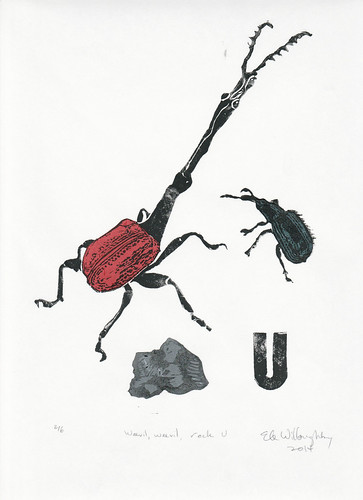
Weevil, weevil rock U
Weevil, weevil, rock U by minouette


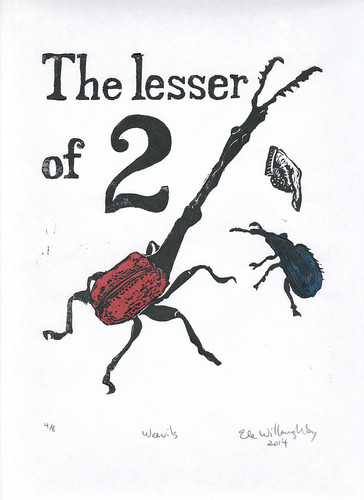
This linocut on Japanese paper illustrates a terrible pun: 'Weevil weevil rock U' rather than "We will, we will rock you," of course. The larger of these two weevils is the extravagant, long-necked red and black giraffe weevil (or giraffe-necked weevil or Trachelophorus giraffa) from Madagascar which can grow to as long as an inch or 2.5 cm in length. The smaller of these 2 is Neocoenorrhinus germanicus, a blue-black weevil, merely 3.9 mm (0.15 inches) found in Southwest Asia, southern Siberia, Russia, and parts of Europe. They are shown roughly 4 times life-sized.

I found a way to use a single block for two terrible puns. It's the lesser of 2 weevils rather than the lesser of two evils, of course.

The lesser of 2 weevils
Weevils by minouette


This print would make a great gift for the entomologist with a sense of humour or a passion for music, the bug-loving fan of Queen or idiom or typography, the punsters and those who always seem get song lyrics hilariously bumbled. We all have a friend like that, no?


Sunday, April 13, 2014

Territories

NWT
Northwest Territories by minouette

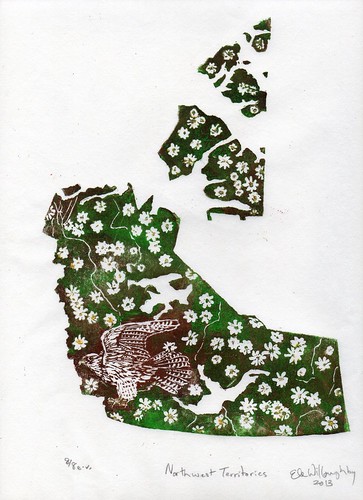
I got a really interesting message from a customer this week. After purchasing my Northwest Territories and Nunavut linocuts, he let me know why. The Collège André Malraux de Granville in France has created an 'artothèque' (great word no? like a bibliothèque or library, except for art) on the theme of territories. They've gathered art from 13 artists from France, Algeria, Canada and Ukraine. My prints will be representing Canada!

I love that my prints are making their way in to some institutional collections and the idea of international artists representing what 'territories' mean to them is fascinating. I'd love to see what else they've purchased.

Nunavut
Nunavut by minouette