Showing posts with label chine collé. Show all posts

Tuesday, April 15, 2014

Two weevils, one stone

I don't know about you, but I have some unrepentant punsters in my life. I swear, you hear enough puns, it changes the way you think. Soon, you find yourself researching weevils.


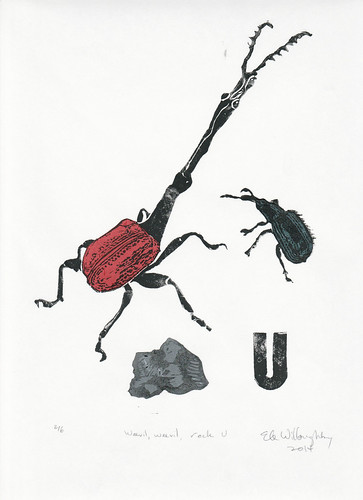
Weevil, weevil rock U
Weevil, weevil, rock U by minouette


This linocut on Japanese paper illustrates a terrible pun: 'Weevil weevil rock U' rather than "We will, we will rock you," of course. The larger of these two weevils is the extravagant, long-necked red and black giraffe weevil (or giraffe-necked weevil or Trachelophorus giraffa) from Madagascar which can grow to as long as an inch or 2.5 cm in length. The smaller of these 2 is Neocoenorrhinus germanicus, a blue-black weevil, merely 3.9 mm (0.15 inches) found in Southwest Asia, southern Siberia, Russia, and parts of Europe. They are shown roughly 4 times life-sized.

I found a way to use a single block for two terrible puns. It's the lesser of 2 weevils rather than the lesser of two evils, of course.
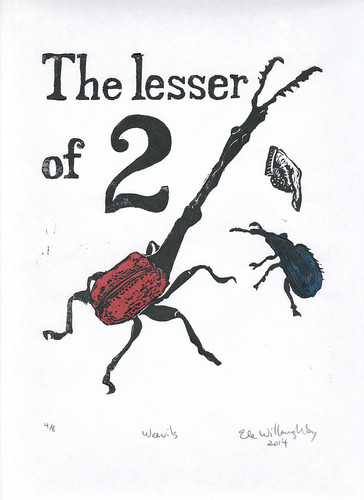
The lesser of 2 weevils
Weevils by minouette


This print would make a great gift for the entomologist with a sense of humour or a passion for music, the bug-loving fan of Queen or idiom or typography, the punsters and those who always seem get song lyrics hilariously bumbled. We all have a friend like that, no?


Wednesday, August 21, 2013

Quartz

quartz

This is an apt little linocut for your cabinet of curiosity; a quartz crystal complete with iridescent facets. I printed a variable edition of eight prints, 6.25" by 7.5" (16 cm by 18.8 cm) on Japanese kozo (or mulberry) paper, with chine collé (collaged fine Japanese paper) facets in iridescent pink origami paper. Each print is unique, with a different selection of iridescent facets. Depending on the angle at which you view the print, these facets can appear to include a shimmering range of blue through pink through yellow. The specimen is labelled 'Quartz' in a printed script, so you can begin a hand-printed mineral portrait collection.

Quartz linocuts

Friday, July 19, 2013

It's Better With Bees

Bee biodiversity exhibit

If you missed the It's Better With Bees exhibit (March 30 to July 1, at the Ball's Falls Conservation Centre in Jordan, Ontario), here are a few photos. The exhibit was about bee biodiversity. Along with my prints - which were apparently a useful teaching tool for schoolkids - there was a bee audio box and bee trading cards by Sarah Peebles (check out Reasonating Bodies for more of Sarah's work, lots of resources and a wealth of information on bees), various beekeeping artifacts and a large collection of specimens of different species. I really enjoyed getting so see the exotic bees up close.

The Bees
Detail of The Bees
Detail of The Bees
Bee biodiversity exhibit with The Bees

You can find all of my available bee prints here, or at the gift shop at the Ball's Fall's Conservation Centre. It's a lovely spot, not too far from Hamilton, and only an hour from Toronto or Buffalo - a great place for a picnic. The large print showing all six bees around a hexagon (with lovely Japanese washi tissue paper with a honeycomb pattern) has sold, but I have more multi-bee works in mind! I wanted to comment on the fact that we always think about the honeybee, which is actually a bit atypical and a European import. Our native pollinators are often solitary bees, who live in the ground or simple nests (rather than hives), do not make honey, and can be very unexpected irridescent colours.


Wednesday, August 8, 2012

The latest bee: Melissodes

Melissodes860

This is a linocut with two sorts of (collaged) chine collé papers (pale yellow body and translucent paper with foil inclusions for the wings) on Japanese kozo (or mulberry), 8.25" by 6.125" or 21 cm by 15.6 cm. There are 18 prints in the edition. I used the two coloured papers to try to replicate the insect's lovely pale yellow body and translucent wings.

Meet another bee which is native to this part of the world (the new world, or western hemisphere). This is the Melissodes, or Long-horned bee. These are small to medium sized bees, ranging from 7.5 to 18 mm long (0.3 to 0.71 inches). They are robust with fuzzy yellow hairs and conspicuous hairy legs. When you look at an enlarged photo of a Melissodes their hairy legs remind me of a sheepdog. The front part of the female's face is usually yellow. Like most bees in the tribe Eucerini, males have long antennae. Males are long-bodied, while females have short antennae and are round-bodied. This print shows a female. These are solitary bees and live in individual nests rather than hives.

I'm planning to make a total of 6 bees, all of which can be found here in Ontario.

Thursday, July 12, 2012

Honey Bee

honeybee781
So I'm continuing my bee series with the ever-popular honey bee. Did you realize that there are no honey bees native to North America? They were introduced from Europe in the 1600s. This one is Apis mellifera, the Western or European Honey Bee.

This is a linocut with two sorts of (collaged) chine collé Japanese papers (a patterned pale yellow, and a translucent Mizutama tissue for the wings) on Japanese kozo (or mulberry), 9.25" by 8.25" or 23.5 cm by 21 cm. There are 12 prints in the edition.