Showing posts with label astronomer. Show all posts

Wednesday, March 18, 2026

Wang Zhenyi astronomer

Wang Zhenyi, linocut, 11" x14" by Ele Willoughby, 2026

For the 12th and final #PrinterSolstice2526 prompt multiplication, I have chose Qing era polymath - astronomer, mathematician, meteorologist and poet - Wang Zhenyi (
王贞仪), who amongst her accomplishments in her brief life, was a book on mathematics for young readers with simplified rules for multiplication and division, to help children learn even those she lived when formal education for girls was rare. In the absence of any known portraits, I made my print after researching Qing Dynasty pavilions, lanterns, tables and mirrors, along with women's fashions and available astronomical instruments in China in the 1790s.

Astronomer, mathematician, meteorologist and poet Wang Zhenyi (1768-1797) left her impact on Qing era China during her short life. Raised by her father and grandparents, her ancestral home was in Anhui province. Her grandfather, Wang Zhefu, an avid reader and collector of books, was governor of Fengcheng County and the Xuanhua District. When her father, Wang Xichen failed the imperial examination to enter the civil service, he decided instead to study medicine, and wrote a 4-volume Collection of Medical Prescriptions. While many Qing women were denied literacy and education, Zhenyi absorbed it all: astronomy from her grandfather, poetry from her grandmother Dong, medicine, geography and mathematics from her father. When she was 9, her grandfather died and the family travelled to Jilin near the Great Wall to mourn and attend his ornate funeral. They remained there for five years. While there, Zhenyi and three other upper-class girls studied under the Lady of Bu Qianyao, and she was able to read her grandfather's library with its full 75 bookcases. She also learned to ride, do archery on horseback and martial arts from the wife of the Mongolian General Aa. She became an expert mounted markswoman. On her own, she began further exploring mathematics and astronomy, reading Chinese texts, and Western classics like Euclid's Elements.

Zhenyi then travelled with her grandmother and father, visiting Beijing, Shaanxi, Hubei, Guangdong and Anhui. This unusual experience exposed her to more history and more breadth of society than was common for most young women. She and her father travelled south of the Yangtze river, before moving back to the capital and settling in Nanjing when she was 16. At 18, her poetry united her with female scholars in Jangling, and she began to focus on mathematics and astronomy. At 25, deemed late to marry at the time, she married Zhan Mei from Xuancheng in her home province. Their marriage was happy but they had no offspring. She gained fame from her poetry, mathematics and astronomy knowledge. She advanced meteorology to work on weather forecasts for farmers. She even took on some male students, an extraordinarily uncommon thing for a young woman scholar at the time. 

17th century Jesuit polymath Ferdinand Verbiest
Flemish Jesuit missionary and polymath Ferdinand Verbiest (1623-1688), known as Nan Huairen in Chinese, became Director of the Imperial Astronomical Bureau, introduced updated armillary spheres, sextants and celestial globes to China and had them adorned with Chinese motifs. He reformed the inaccurate Chinese calendar and diplomatically fostered Sino-European scientific exchange.
 
The Qing Dynasty closed door policy meant that astronomy in China was isolated from advancements that were being made in the West. Jesuit missionaries had shared the works of Copernicus, Galileo and Brahe. Copernicus' model was shared as a useful tool rather than a doctrine, so they could both avoid Church ire and respect local traditions. However, Newton's Principia, including his universal law of gravitation, was not available in a Chinese edition until 1850. When Wang Zhenyi took pains to explain how we could live on a globe without falling off, she was doing so without benefit of an explanation of gravity.

She wrote Dispute of the Procession of the Equinoxes using her observations of celestial phenomena, explaining how equinoxes, the two days each year in the spring and fall when days are nights are equal length, move and how to calculate their movements. Using both her observations and astronomical texts, she wrote about the number of stars, the direction of the revolution of the sun, moon, Venus, Jupiter, Mars, Mercury and Saturn, as well as describing lunar and solar eclipses. Only a small fraction of her works survive. Later articles included Dispute of Longitude and StarsExplanation of Lunar Eclipses, and Explanation of the Starry Sky. Zhenyi was interested in the causes of lunar eclipses and published her correct understanding in Explanation of Lunar Eclipses. She summarized astronomical theories, from Yu Xi (307-345) who discovered the precession of the equinoxes, to Gui Shoujing (1231-1316) who is credited with inventing the gnomon and a water powered armillary sphere, and managed to calculate the length of a year as 365.2425 days (mere seconds short of the modern value). She connected these scholars' work with Islamic, Western and modern calendars. At a time when many of her contemporaries would attribute an eclipse to the anger of the gods, she bluntly wrote, "In fact, it's definitely because of the moon." She made a demonstration in an outdoor pavilion to show that how these phenomena could be simply explained by the relative motion of Earth (represented by a round table), moon (represented by a mirror) and sun (represented by a suspended round crystal lamp). Moving these three, as celestial bodies would move she could explain lunar eclipses. She could show how the Earth's shadow could pass over the Moon. She explained that a lunar eclipse can only happen during a full moon, and a solar eclipse can only happen during a new moon, but only when the alignment is right. Her work also cleared up misunderstandings about celestial mechanics and addressed the gradual shift in stellar positions. She affirmed the Earth is a sphere, writing the Theory of the Earth's Roundness, refuting ideas of a flat Earth. In The Geocentric Theory of the Annual Cycle, she made the case for a heliocentric system. She was a proponent of the Western sun-based, heliocentric calendar over the lunar calendar, for its precision and advocated for its adoption. She argued people needed to be open to new scientific and mathematical ideas, regardless of their origin. 

To improve weather-forecasting she worked on calculating atmospheric humidity. She investigated making better predictions of floods and droughts, understanding that Chinese farmers suffered in extreme weather conditions. 

She mastered the book Principles of Calculation by famed early Qing dynasty mathematician Mei Wending (1633-1721). Knowing the challenge of trying to teach oneself mathematics, she rewrote it in simpler, more accessible language as The Musts of Calculation. To further make mathematics easier for beginners, she developed simplified means of performing multiplication and division. By the time she was 24, this work culminated in her writing The Simple Principles of Calculation. Another math text which she wrote and survives today, is the Explanation of the Pythagorean Theorem and Trigonometry.

She complained that anyone with access to medical books could believe themselves experts and dispense risky medical advice. Though widely read, and taught by her father, she refrained from treating her own ailments. On the other hand, she advised being wary of quacks, and speaking up on if necessary. When her female cousin was given a prescription, she checked her pulse and consulted books on female health. She condemned the physician's prescription as unsuitable for a woman. She emphasized the use of preventative medicine and clearly had practical medical knowledge.

She wrote 13 volumes of poetry which were well-received, praised for their strength and clarity. Her style was not feminine and flowery, as was more common amongst female poets. She wrote about the classics, the history she learned travelling with her father, ordinary working people, the plight of women and the contrast between rich and poor. Her poems showed her compassion for people she encountered. She wrote about the wealthy hoarding rice until it rotted, while the poor faced starvation and how the increasing tax burden impacted rural regions. She faced criticism when she published her poems for pursuing fame and literary writing. She wrote that she "dare not defend herself" since she should adhere to Confucian ethics and its prescriptions for the roles of women, but she also wrote that the classics were intended for both men and women. Thus, it was stubborn and careless to insist that women should not read. She wrote, 

    It's made to believe,

    Women are the same as Men;

    Are you not convinced?

    Daughters can also be heroic?

She pointed out that both women and men, "are all people, who have the same reasons for studying."

She died when she was only 29, likely after a relapse of malaria. Before she died, she entrusted her manuscripts to her friend Qian Yuling, who in 1803 passed them on to her nephew Qian Yiji. He compiled her mathematics texts and wrote a preface praising her achievements. Most of her works have since been lost and are known only through references from other writers. Her work helped bridge the gap between Western and Chinese astronomy and modernize Chinese astronomical understanding. Two hundred years later, her impact is being acknowledged. In 1994 the International Astronomical Union's Working Group for Planetary System Nomenclature approved a small crater on Venus has being named in her honour. We can only wonder what such a prolific and insightful scholar as she might have achieved had she lived a longer life.


References

Astronomy Week 2025: Honouring the Life and Legacy of Wang Zhenyi, School of Mathematics, University of Edinburgh. Accessed March, 2026.

Bernardi, Gabriela. Wang Zhenyi (1768-1797). In: The Forgotten Sisters. Springer Praxis Books(). Springer, Cham. https://doi.org/10.1007/978-3-319-26127-0_23

DeBakcszy, Dale. Champion of Chinese Heliocentrism: The Stellar Mathematics of Wang Zhenyi. The Women in Science Archive. April 25, 2023.

Lutz, R.C. Wang Zhenyi, EBSCO Knowledge Advantage. Accessed March, 2026.

Mehta, Devang. The prolific life of Wang Zhenyi, autodidact, astronomer and poet. Massive Science. November 3, 2017.

Wang Zhenyi (astronomer), Wikipedia, accessed March, 2026

Wang Zhenyi (王贞仪) – Mirror, Wellesley University blog, accessed March, 2026.

Wing-Chung Ho, Clara. The Cultivation of Female Talent: Views on Women's Education in China During the Early and High Qing Periods. Journal of the Economic and Social History of the Orient. Vol. 38, No. 2, Women's History (1995), pp. 191-223 (33 pages)

Yang, Binbin. Guardians of Family Health in Qing China: From the Exemplary Wife to the Reformer. Modern China. Vol. 41, No. 5 (September 2015), pp. 506-538 (33 pages). Published By: SAGE Publications, Inc.


Also, hat's off to this tumblr which carefully presents a full history of Qing Dynasty women's fashions and hairstyles:

Thursday, March 5, 2026

Elisabeth Koopmann-Hevelius Set Her Sight on Being an Astronomer

Elisabeth Koopmann-Hevelius, linocut print 11" x 14" by Ele Willoughby, 2026

For the 11th #PrinterSolstice2526 prompt angle, I've made a portrait of astronomer Elisabeth Koopman Hevelius using (sextant or ) an octant, literally measuring angles to astronomical bodies. 

One of the earliest recorded women astronomers, Elisabeth Catherina Koopmann-Hevelius (Elżbieta Heweliusz, 1647-1693) was born to a wealthy, land-holding, Dutch Lutheran, merchant Nicolas Koopman (1601-1672) and his wife Joanna Mennings (or Mennix; 1602-1676) in the largely German-speaking city of Danzig, then part of the Pomeranian Vovoidship of Royal Prussia in the Polish-Lithuanian Commonwealth, part of the Hanseatic League, now known as Gdańsk, Poland.  Her parents had been married in Amsterdam in 1633, then moved to Hamburg and again to Danzig by 1636. Her education included languages (including at some point Latin, the international language of science of the day) and natural sciences. Elisabeth was fascinated with astronomy from the time she was a child. The year she was born, local politician, brewer and astronomer Johannes Hevelius (1611-1687) published his beautifully and elaborately illustrated Selanographia, about the moon, the first geographical book about a body other than the Earth. By 1650 he already had an international reputation, a complex of three houses and 200 square metre observatory equipped with several large telescopes, the largest observatory in Europe. The young Elisabeth approached him and he promised he would show her the splendour of the night sky when she was older. In 1662, his first wife Katharina Rebeschke died. Elisabeth had become ever more fascinated by astronomy and had realized that Johannes was in fact a renown astronomer, and her admiration of him grew. She reminded the elder astronomer of his promise. Despite their age difference, based largely on their mutual love of astronomy, the two decided they could be happy together and wed when Elisabeth was 16 and he was 52, in 1663. Such an age gap would not have shocked their contemporaries, and for a young woman like Elisabeth, barred from university education, marriage would have been the only means for her to pursue astronomy. Elisabeth had to run the complicated Hevelius household and she both assisted Johannes and pursued her own astronomical interests. They had four children; a son, who died in infancy and three surviving daughters. 

Detail of Johannes and Elisabeth Hevelius observing the sky with a brass octant (1673).

While awaiting the arrival a new assistant, Elisabeth aided her husband in his observations; she excelled at the job and loved observing. In 1663, France awarded him a pension for his astronomical work, and Johannes began corresponding with Henry Oldenburg, secretary of the Royal Society in London. Elisabeth became his partner in observation from 1664 onwards. That year, Johannes was inducted as the first foreign member of the Royal Society of London. Also that year their son John Adeodatus was born but he died a year later. Their daughters Catherine Elisabeth, Julia Renata and Flora Constance were born in 1666, 1668 and 1672, respectively.  In 1668, Johannes published their work in Cometographia, listing comets and sunspots. Showing herself to be competent in the use of the large sextants and quadrants, when Johannes published his Machina coelestis in 1673 he included two engravings showing Elisabeth using the octant and sextant with him respectively. These are the first printed images of a woman astronomer at work. They employed advanced astronomical instruments such as brass quadrants, sextants and octants (named for the amount of a circle they encompassed) and their observatory was a hub of innovation. The large sextants and octants required two people to operate. Each were equipped with an alidade, a sort of ruler to fix on the distant object being observed, and then its position could be read off. Johannes had invented his own precise alidade with cylinder to fix an objects position. With her knowledge of language, Elisabeth corresponded and struck up friendships with other astronomers. The French physicist and astronomer François Arago recounted that that she was both making useful observations and preforming calculations. In 1677 they were visited by King Jan III Sobieski, who gave them a stipend. Despite owning telescopes with which he had for instance, carefully observed the surface of the moon, Johannes was a hold-out where it came to making observations of stellar positions with telescopes, first employed for astronomy by Galileo Galilei (1564-1642) in 1609.  Johannes feared that telescopic observations might introduce distortions in locations. He is considered the last great astronomer to make observations with the unaided eye. 

This unusual attitude towards telescopes lead Johannes into controversy. In England, at the Royal Society, Robert Hooke accused him of making inaccurate observations and sent fellow astronomer Edmond Halley to visit Danzig, from May 26, to July 18, 1679. While Hooke was right about the utility of using telescopes, Halley was very impressed with the precision of Johannes and Elisabeth's naked-eye observations. Though privately he doubted naked-eye observations were the way to go, he confessed that in his controlled test, he could not determine which observations were more accurate. Six separate observers, including Johannes, Elisabeth and Halley with his with a 2-foot quadrant with telescopic sights made the same observations and Halley compared the data. Hooke was quite rude about the entire debacle, and Hevelius responded in kind. Other astronomers, like John Wallis, defended Hevelius because they were annoyed with Hooke. None of the members of the Royal Society involved in the bitter dispute came away with their reputations unbesmirched, with the exception of Halley, who had more diplomatic sense than the rest of them. That summer, they published Machina coelestis par posterior 'Astronomical instruments, second part' including a biography of Johannes, description of their instruments and 1,564-star catalogue of stars based on their observations.  

Then September 26, 1679 they suffered a devastating fire which destroyed their home, their observatory, their instruments, their library and printing press. Luckily, as Johannes wrote, before the fire he was feeling uneasy and "To lift my spirits, I persuaded my young wife, the faithful assistant for my nightly observations, to spend the night in our country retreat outside the walls of the city..." so they were unharmed. People present, including their 13 year old daughter Catherine Elisabeth managed to save several books including Kepler's works (purchased from his son), his new and improved celestial globe, thirteen volumes of his correspondence with scientists and royalty and the most importantly, the star catalogue by breaking into the burning house and throwing them out the windows! Luckily, dozens of copies of Machina coelestis which had already been sent out were not destroyed, but they lost everything else. Elisabeth had asked Halley to buy her a silk dress in London, in exchange for three of Johannes' books, and he wrote how when choosing the fabric he was uncertain if she would be in mourning because, having heard about the fire, astronomers in England feared Johannes had perished. Both King Jan III Sobieski and King Louis XIV of France sent them thousands of thalers to help them rebuild, and Sobieski granted him a yearly stipend of 1,000 Danzig gulden for the remainder of his life,  but it was nowhere near the estimated value of what they lost, which was over thirty thousand thalers. Undetered, they rebuilt their observatory by August 1781 and resumed work on their star catalogue, incorporating 341 stars only visible in the southern hemisphere, reported to them by their friend Edmond Halley. Elisabeth did much of the mathematical calculations and editing of the text. 

Johannes and Elisabeth Hevelius observing the sky with a brass octant (1673)
Johannes and Elisabeth Hevelius observing the sky with a brass octant (1673), Engraving from Johannes Hevelius' Machine Colestis: Pars Prior fig. O, facing p. 254. 

In 1685, Johannes published Annus climacterius 'Climactic Year' documenting their most recent observations and retelling the tale of the 1679 fire. Swiss mathematician and astronomer, Johann III Bernouilli wrote that Elisabeth contracted smallpox and was badly marked by it. Though Johannes had never contracted the disease he nursed her and never left her sick-bed. They began working on what would be Johannes' final publication. He died on his 76th birthday in 1687. After his death, she secured funding, took over the completion and publication of the Prodomus Astronomicae, 'The Elements of Astronomy". In 1690 she published the Prodomus Astronomicae, documenting two decades of observations, in three parts: the Prodomus was a preface with unpublished observations, which Elisabeth completed as well as writing and signing the dedication to the king as "Elisabeth, widow of Hevelius";  Catalogus Stellar Fixarum 'Catalogue of the Fixed Stars' (dated 1687) was a star catalogue including the positions and relevant data for 1,888 stars; and Firmamentum Sobiescianum sive Uranographia 'Sobieksi's Heavens, or a Map of the Heavens' (dated 1687) was a 56 sheet atlas of constellations for both northern and southern hemispheres from the catalogue complete with seven new constellations he delineated which are still in use (Canes Venatici, Lecerta, Leo Minor, Lynx, Scutum, Sextans, and Vulpecula) plus three which are now obsolete (Cerebus, Mons Maenads, and Triangulum Minus). Hevelius named one of these constellations for the king (Scutum Sobiescianum, or 'Shield of Sobieski' shortened now to Scutum) and one for his precious sextant, as well as several animals. It represented a significant advancement in astronomical observations and knowledge, containing both more stars and more accurate positions than Johan Bayer's Uranometria (based on Tycho Brahe's measurements). Elisabeth had not only ushered the book through publication, she participated in observations and calculations in a meticulous and systematic way. She died three years later, December 22, 1693 at 46 and was buried in the same tomb as her late husband. Arago wrote, "A complimentary remark was always made about Madame Hevelius, who was the first woman, to my knowledge, who was not frighted to face the fatigue of making astronomical observations and calculations." Arago was unaware of how Sophia Brahe (1556 or 1559-1643) had aided her brother Tycho, or of their near-contemporary Maria Cunitz (1610-1664), who was rather isolated from the astronomical community, so we should say that Elisabeth was amongst the first but not the earliest woman bravely facing late night observing and astronomical calculations. But her correspondence and friendships with fellow astronomers, as well as her collaboration with her husband, appearance in his books and her publication of the Prodomus, means that she and her accomplishments were recognized and remembered. A minor planet discovered at the Palomar Observatory in 1960 was named 12625 Koopman and a crater on Venus is named Corpman, a variant on the spelling of her maiden name, were named in her honour.

References

Ashworth, William B. Scientist of the Day - Elisabeth Hevelius. Linda Hall Library, University of Missouri-Kansas City. December 22, 2017.

Elisabeth Hevelius, Wikipedia, accessed February, 2026.

Jardine, Lisa. The Curious Life of Robert Hooke - The Man Who Measured London. Harper Collins. New York. 2003.

Masters, Karen. The Astronomers' Library. Ivy Press. London. 2024. 

Lutz, R.C. Elisabeth Hevelius, EBSCO Knowledge Advantage, 2022.

O'Connor, J.J. and E.F. Robertson. Elisabetha Koopman (1647-1493) - Biography. MacTutor. School of Mathematics and Statistics, St Andrews University. December, 2008.

O'Connor, J.J. and E.F. Robertson. Johannes Hevelius (1611-1687) - Biography. MacTutor. School of Mathematics and Statistics, St Andrews University. December, 2008.

Popova, Maria. Ordering the Heavens: Hevelius's Revolutionary 17th-Century Star-Catalog and the First Moon Map. The Marginalian. 2014.

Sunday, February 9, 2025

Margaret Burbidge, B2FH and stellar nucleosynthesis

Margaret Burbidge, linocut, 11" x 14" by Ele Willoughby, 2025

The #printerSolstice2425 prompt this week is iron, so after talking last week about how certain numbers of nucleons are "magic" as you grow increasingly large nuclei, this week, we're talking about how you do that: how you grow nuclei from a single proton to the largest naturally-occurring transuranic elements. Astrophysicist Margaret Burbidge is one of the people instrumental in building our understanding stellar nucleosynthesis, how nuclei are produced in stars and you and I are all stardust. She was the first author of a monumental scientific paper Synthesis of the Elements in Stars, which became known as B2FH from the initials of its authors: Margaret Burbidge, Geoffrey Burbidge (her husband), William A. Fowler and Fred Hoyle. The landmark paper, one of the most-influential in astronomy and nuclear physics, reviewed everything then known stellar nucleosynthesis, how elements are made, backed up the theory with astronomical and laboratory data and in further explained how elements heavier than iron are made and the abundances of the various elements. Generations of astronomers apparently used to joke that "the early Universe made hydrogen and helium, Burbidge, Burbidge, Fowler and Hoyle made all the rest." Elements up to iron can be built up by nuclear fusion, both slow and rapid neutron-capture, in stars and  B2FH also explained how heavier elements are made. At the base of my print is a stellar absorption spectrum of the sort she gathered and used in arguments presented in B2FH and a cross-section of a supergiant star and how nucleosynthesis leads to a nested series of shells where increasingly heavy elements are burned as fuel producing new elements through fusion. The shells from outermost in are: hydrogen (H), helium (He), carbon (C), neon (Ne), oxygen (O), silicon (Si) and iron (Fe). Behind her is space with stars and galaxies to represent her observations.

Born in Davenport, UK, she was the sort of clever child who deduced that she was born exactly 9 months after the November 11 Armistice which ended the first world war, and concluded she was likely conceived when it was announced. Her father Stanley John Peachey was a lecturer in chemistry at  the Manchester School of Technology (now part of the University of Manchester) and her mother Marjorie Stott Peachey had been one of his students. As a small child her father got a patent related to the vulcanization of rubber, which made him enough money to move to the family to London where he set up his own industrial chemistry lab. She was "star-struck" on a ferry trip over the English Channel at the age of 4, away from the bright lights of London, and by 12, she was reading astronomy textbooks by James Jeans, a distant relative of her mother. She and her younger sister Audrey were expected to pursue education and careers. She gained experience working in her father's lab, before his death when she was 17.  She passed the university entrance exams a year early and thus had an extra year at her high school, taken under the wing of the science teacher, where she was given the run of the physics laboratory to perform her own experiments in electricity, magnetism and optics. This was a unheard of opportunity for a young woman in the mid-30s. She went to University College London (UCL) to study astronomy, where she graduated with her undergraduate with first class honours to little celebration with war looming in 1939. She studied spectroscopy at Imperial College and then she proceeded to pursue graduate school at the University of London Observatory. She split her time between her studies and fabricating optical instruments for the armed forces. Her 1943 thesis was on the spectrum of the star Gamma Cassiopeiae. Many of the men in the department were busy with war work, so she was granted more independence and responsibility than might otherwise have been the case. She made observations at Mill Hill observatory, in the cramped space, in the cold under the open dome while German bombs fell nearby. She never complained, being determined always in her work. “Those nights, standing or sitting on a ladder in the dome of the [J. G.] Wilson reflector [at Mill Hill] . . . fulfilled my early dreams,” she later recalled. Upon seeing a photographic plate of a spiral galaxy for the first time, she said it felt almost sinful to be enjoying astronomy so much and be employed as an astronomer.

Since women were denied access to Mount Wilson Observatory, (on the basis there was no women's bathroom), Margaret's 1945 application to use the telescope was rejected.  She wrote about the experience that a “guiding operational principle in my life was activated: If frustrated in one’s endeavor by a stone wall or any kind of blockage, one must find a way around — another route towards one’s goal. This is advice I have given to many women facing similar situations.” She stayed on in London as Assistant Directory of the observatory.

She met theoretical physicist Geoffrey Burbidge who was in grad school at UCL in 1947 and the two were married in 1948. Their personalities and persons contrasted; Geoff was a large guy who enjoyed arguing pugnaciously whereas Margaret was petite and known for her demure, friendly but quiet demeanour. But he was supportive, loyal and good friends even with colleagues with whom he disagreed and her quietness hid her steely resolve. They were a good match and proved a symbiotic team. Her passion for astronomy was so strong she convinced him to switch to theoretical astrophysics and the two collaborated regularly throughout their subsequent careers. They moved to the US for jobs at observatories at Harvard and the University of Chicago (where Margaret was excited to attend a workshop held by Harold Urey and Maria Goeppert Mayer on the abundance of the elements), before returning to the UK. Seeking two positions and telescope accessed required them to move repeatedly. Willy Fowler recalled a "wonderful Charles Laughton replica," that is Geoff looking and sounding like the famous British-American actor, walked into his office, where he was on sabbatical at Cambridge and said, "why don't you work on problems important for astrophysics?" Hoyle had been working on nuclear reactions in stars since before WWII. When Fowler returned to the US he recommended the Burbidges accompany him; Fred Hoyle was already a frequent visitor. Margaret could work at the Mount Wilson Observatory and Geoff at CalTech. But the Director of Mount Wilson wrote to say the single toilet precluded hiring a woman, still, ten years after her application to do a post-doc there. So, ever-pragmatic, they swapped jobs; Geoff took the Mount Wilson job and Margaret the one at CalTech. She had to pose as Geoffrey's assistant every time he purported went to Mount Wilson and live on a separate cottage on the grounds, as a means to gain access. Geoff worked in the dark room and smoked cigars while Margaret did the observing at night. It took until 1965 for Mount Wilson to officially allow women observers. Once in California they worked on their famous 108-page paper with Fowler and Hoyle, after having first collaborated while at Cambridge. The Burbidges had been looking at spectra of stars with unusual surface conditions; these could be due to upward mixing of nuclear reaction products and proved useful in the paper. They suspected neutron-capture. Fowler's nuclear physics group had been calculating cross-sections of reactions necessary to build heavier elements. Margaret wrote the paper while pregnant. The paper showed how elements were formed at various stages of the lifecycle of stars, explained the existence of of all but the lightest elements (which we now know were in fact formed in the Big Bang) and showed how we, and everything but some of those lightest elements are made of stardust.

They had a daughter, Sarah, in 1956. In 1962 they were both hired by UCSD; to get around anti-nepotism rules, Geoffrey was hired by the physics department and Margaret was hired by the chemistry department, until the rule was changed and she too joined the physics department.

Though her observations helped provide evidence of the Big Bang, Margaret and Geoffrey both followed Fred Hoyle into the "steady state" camp, and were skeptical of the Big Bang theory. Hoyle in fact had derisively coined the term "Big Bang" to poke fun at the idea. His idea was that maker was more or less continuously in a steady state. created and density remained constant. Nonetheless, the name Big Bang stuck and the theory is now become accepted by the field at large. Though Margaret, the observational astronomer, unlike Geoff, rarely commented on theoretical matters, so she is not strongly associated with choosing the wrong side of the Big Bang versus Steady State cosmology debate. She rather worked to keep an open mind.

In the '50s and '60s she measured flat rotational curves for spiral galaxies based on optical observations. Later Vera Rubin got similar results and was able to infer the existence of dark matter galactic haloes. In the '60s and '70s she worked on galaxies and quasars, helping to determine their distance, luminosity and internal processes, finding the most distance object then known (which remained the most distant known object for a decade). With access to the Lick Observatory telescope she was in the right place to join the race to find new and more distant quasars, and known for literally racing to work in the couple's 1961 Jaguar Mark II. Geoff on the other hand never learned to drive, though they both loved that car.  Margaret's work on quasars was very important and lead to advancements like the understanding that galaxies have black holes at their centres. The shear distance to these objects was another blow to Geoff's favoured Steady State model; the expansion of the universe due to the Big Bang was needed to explain objects at the cosmological distances. 

In 1972 she declined the American Astronomical Society's Annie Jump Canon Medal because it is only awarded to women. She wrote, It is high time that discrimination in favor of, as well as against, women in professional life be removed.” This sparked conversation and forced the AAS to look into discrimination on the basis of sex for the first time and lead eventually to the formation of the AAS Committee on the Status of Women in Astronomy. They also changed the rules of the Annie Jump Canon Medal, awarding it only to early career women who choose to apply for it. 

Burbidge was director of the Royal Greenwich Observatory (1972–1973), She was the first woman in any of these roles. She was notably, the first director of the Royal Greenwich Observatory in 300 years who was not made the Astronomer Royal (and the title was bestowed instead on one of her male peers). At various times she attributed this to sexism or a political desire to reduce the influence of the Royal Greenwich Observatory; either way she resigned after 18 months. She was president of the American Astronomical Society (1976–1978), and following her election, she took US citizenship. As president, she got to introduce the first woman to receive the Russel Lecture Award for lifetime excellence in astronomical research: Cecelia Payne-Gaposchkin. Burbidge herself later received the award in 1984. When the US Equal Rights Amendment (ERA) was introduced, but failed to pass in the required minimum of 38 states, Margaret proposed that AAS meetings be banned in states which had not passed the ERA. The proposal was contentious but she succeeded in having it passed. In the '80s and '90s she worked on the development and use of the Faint Object Spectrograph on the Hubble Space Telescope. She was president of the American Association for the Advancement of Science (1983). In 1983, Fowler received the Nobel Prize for his work on stellar nucleosynthesis and expressed his surprise that Burbidge was not included; she of course was circumspect and did not comment. She was the first female president of the International Astronomical Union's commission on galaxies. She was the first woman to win the Bruce Medal. She was awarded the Medal of Science by President Reagan in 1985, was a fellow of the Royal Society, and the Gold Medal from the Royal Astronomical Society. Burbidge was the first director of the Center for Astronomy and Space Sciences at UCSD and worked there until retirement in 1988. Fowler died in 1995. Hoyle died in 2001. Geoffrey died in 2010. Margaret was the sole surviving author of B2FH, until her death at age 100 in 2020 after a fall. She had been one of the great observational astronomers of the 20th century, a role model and trail blazer for women in the field and a strong voice for eliminating bias against women that she had faced in her career.

References

Alpha process, Wikipedia, accessed January, 2025

B2FH, Wikipedia, accessed January, 2025

Burbidge, E. Margaret, Geoffrey Burbidge, William A. Fowler, and Fred Hoyle, Synthesis of the Elements in Stars, Reviews of Modern Physics, vol 29, 4, October, 1957.

Clark, Stuart. Margaret Burbidge Obituary. The Guardian. April 22, 2020.

Cohen, Adam D. In Memoriam: Margaret Burbidge, Pioneering Astronomer and Advocate for Women in Science. American Association for the Advancement of Science, April 8, 2020.

Dillon, Cynthia. Trailblazing astronomer Margaret Burbidge turns 100 years old. University of California. October 17, 2019.

Margaret Burbidge, Wikipedia, accessed January, 2025

Ostriker, Jeremiah, and Freeman Kenneth ; Eleanor Margaret Burbidge. Physics Today 1 September 2020; 73 (9): 60. https://doi.org/10.1063/PT.3.4575

Rubin, Vera C. E. Margaret Burbidge, President-Elect. Science. Vol. 211, Issue 4485, pp. 915-916, DOI: 10.1126/science.7008193 February 21, 1981.

2021Eleanor Margaret Burbidge. 12 August 1919—5 April 2020Biogr. Mems Fell. R. Soc.7111–35http://doi.org/10.1098/rsbm.2021.0017

Skuse, Ben. Celebrating Astronomer Margaret Burbidge, 1919-2020. Sky & Telescope. April 6, 2020

Smith, Harrison. Margaret Burbidge: Pioneering astrophysicist who showed we are all made of stardust. The Independent. April 22, 2020.

Stellar nucleosynthesis, Wikipedia, accessed January, 2025

Trimble, Virginia. E. Margaret Burbidge (1919-2020). Nature. April 27, 2020.


Friday, February 2, 2024

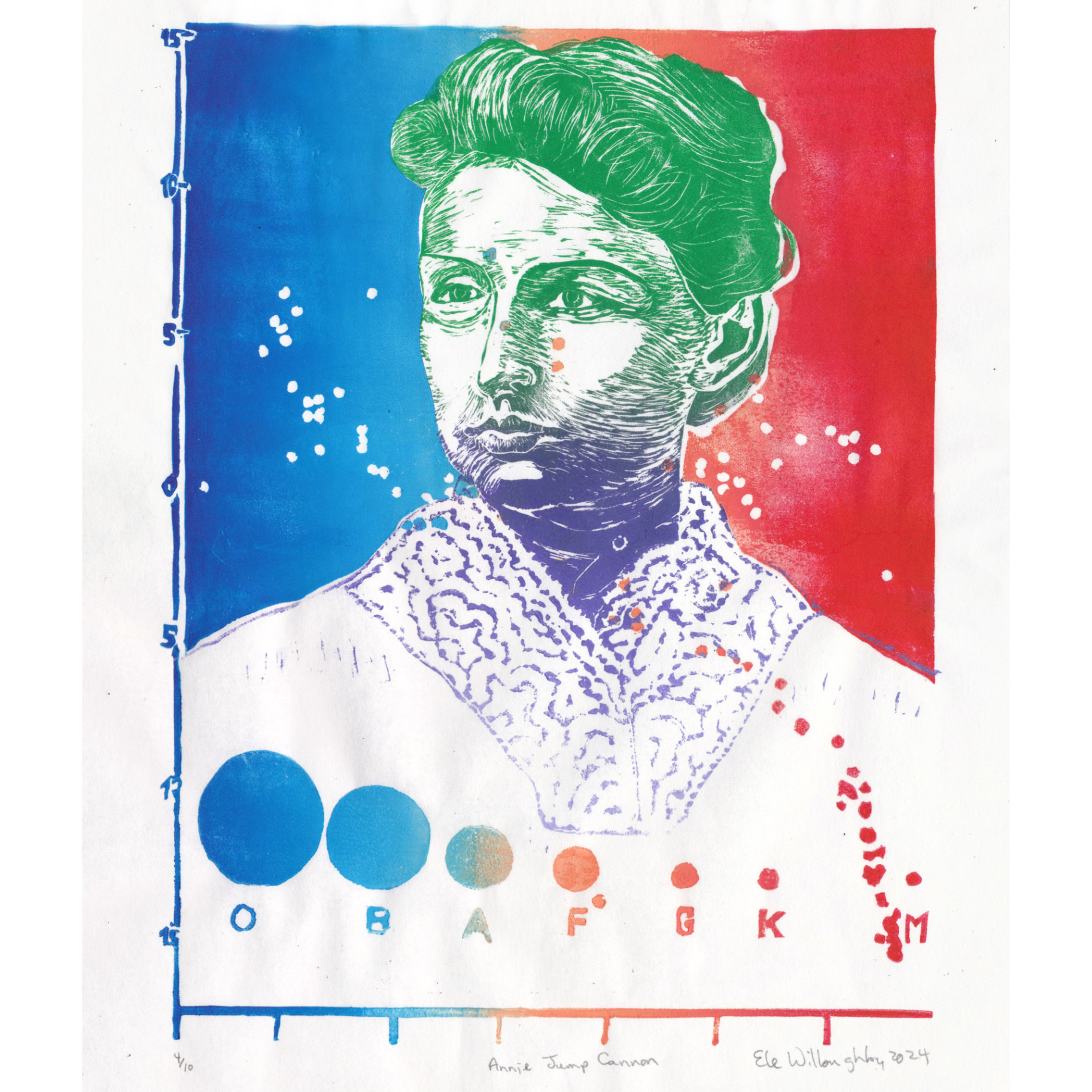
Annie Jump Cannon, Census Taker of the Sky

Annie Jump Cannon, 11" x 14" linocut by Ele Willoughby, 2024

I knew the #PrinterSolstice prompt "spectrum" called for another scientist portrait!

My hand printed lino block portrait of trailblazing American astronomer Annie Jump Cannon (December 11, 1863 – April 13, 1941) shows her with her stellar classification system which sorted stars based on spectral types and turned out to reveal their temperature from hot blue stars through cool red stars into O,B,A, F, G, K and M, as shown on the Hertzsprung-Russell diagram behind her. Along with her supervisor Edward C. Pickering, she is credited with the creation of the Harvard Classification Scheme, the first serious stellar classification scheme. The name, citing Harvard rather than Cannon herself, who still lacked a university appointment, makes her achievement less visible than it might have been.

The eldest of three daughters of Delaware shipbuilder and state senator Wilson Cannon and his second wife Mary Jump, Annie was born in Dover, Delaware. Her mother taught her the constellations, home economics (and the organization skills she would later need) and encouraged her to pursue her own interests. Annie and her mother used old astronomy textbooks to identify stars they could see by climbing out a trapdoor onto their roof. She studied mathematics, chemistry, and biology at Wellesley College, a top school for women, where she excelled at math. She studied physics with Sarah Frances Whiting, one of the few US women physicists at the time, and became the valedictorian. She graduated with a degree in physics in 1884 and returned home to Delaware. Over the next decade she studied the new art of photography, photographing her travels through Europe with her Blair box camera. The Blair company published her photos and prose about Spain, "In the Footsteps of Columbus" and distributed it as a souvenir at the Chicago World's Columbian Exposition of 1893.

A cheerful and energetic person, she lost most of her hearing as a young adult, possibly due to scarlet fever. She found it made it hard to socialize. Then her mother died in 1894, which made family life difficult too. She wrote Sarah Frances Whiting seeking a job and was hired as a junior physics teacher, which allowed her to take graduate physics and astronomy classes and study spectroscopy on her own. She gained access to a better telescope by enrolling in Radcliffe College (a women's college affiliated with Harvard) in 1894 as a "special student" which allowed her to use the he Harvard College Observatory. Harvard astronomer Edward C. Pickering hired her as his assistant in 1896. He was running a program to map and catalogue every visible star in the sky to a photographic magnitude of about 9 (16 times fainter than visible by human eye alone) to complete the Henry Draper Catalogue, a research program fund by the widow of a wealthy physician and amateur astronomer. He hired men to do the physical jobs of operating heavy telescopes and making photographs. He hired and supervised a group of women (whom he could pay as little as 25 cents an hour to work seven hours a day, six days a week) known as the Harvard Computers to do examine data, do calculations and catalogue photos - work he did not deem proper scientific analysis. Though hired as mere "computers" this team included such astronomy luminaries as Cannon, Henrietta Swan Leavitt, Williamina Fleming and Antonia Maury who made important advancements in the field. Pickering wanted the optical spectra of as many spectra as possible with the goal of indexing and classifying stars by spectra. The Draper Catalogue became an indispensable tool for astronomers.

Cannon worked at the Observatory until 1940. In her first three years, she classified 1000 stars. By 1911 she was made the Curator of Astronomical Photographs at Harvard and by 1913 she had learned to accurately classify 200 stars an hour! She published her first star catalogue in 1901. She finished her studies at Wellesley and was awarded a master's in 1907. In 1927, Pickering  said "Miss Cannon is the only person in the world—man or woman—who can do this work so quickly," about her skills in star classification.

The classification work was begun by Nettie Farrar, but she left the Observatory after a few months to get married. Antonia Maury (the first person to detect an calculate the orbit of a spectroscopic binary, and Draper's niece) took over. She insisted on a complex scheme, to the dismay of project manager Williamina Fleming (who catalogues ten thousand stars, 59 gaseous nebulae, over 310 variable stars, 10 novae and other astronomical phenomena including discovering the Horsehead Nebula) who wanted a simpler scheme. Cannon negotiated a compromise, applying a scheme dividing of stars into the spectral classes O, B, A, F, G, K, M, based on the Balmer absorption lines of hydrogen. Later when the scheme was understood to reflect stellar temperatures her initial sequence of the classes was reordered to go from hot to cold.

Cannon excelled at the work thanks to her organizational skills and patience with the tediousness of the work. Her calm, friendly and hardworking personality lead her to a sort of ambassador-like role, brokering exchanges of equipment between male colleagues.  Nicknamed "Census Taker of the Sky,"  she catalogued an estimated  350,000 stars, more than any other person. She also discovered 300 variable stars, five novas, and one spectroscopic binary.

In 1914, she was admitted as an honorary member of the Royal Astronomical Society. Awarded an honorary doctor's degree in math and astronomy from Groningen University in 1921, she became one of the first women to receive an honorary doctorate from a European university. On May 9, 1922, the International Astronomical Union passed the resolution to formally adopt Cannon's stellar classification system. With minor changes (to include intensity as well as temperature) Annie Jump Cannon's classification system is still in use today. She got the opportunity to spend six months in Arequipa, Peru, photographing stars in the Southern hemisphere. In 1925 she became the first woman to receive an honorary science doctorate from Oxford and was elected to the American Philosophical Society. In 1929 she chosen as one of the "greatest living American women" by the League of Women Voters. In 1931, she was the first woman to win the Henry Draper Medal. In 1932 she won the Ellen Richards prize from the Association to Aid Scientific Research by Woman. She represented professional woman at at the World's Fair in Chicago in 1933. She became the William C. Bond Astronomer at Harvard University in 1938.

Cecilia Payne (later Payne-Gaposchkin) used Cannon's data to show that stars are mainly composed of hydrogen and helium.

Cannon retired in 1940 but kept working at the Observatory until a few weeks before she died at 77. Her work helped women gain acceptance and respect in the field. A dedicated suffragette she was also a member of the National Women’s Party. As The Woman Citizen’s noted in 1924, despite her achievements “The traffic policeman on Harvard Square does not recognize her name. The brass and parades are missing. She steps into no polished limousine at the end of the day’s session to be driven by a liveried chauffeur to a marble mansion.” But her legacy lives on in the discoveries she made, the classification system she developed, and the trail she blazed for women in astronomy. In 1935 she created the Annie J. Cannon Prize, awarded by the American Astronomical Society, for "the woman of any country, whose contributions to the science of astronomy are the most distinguished." The first recipient became the first woman full professor of astronomy at Harvard: Cecilia Payne-Gaposchkin. Like her mother before her, and her first physics professor Sarah Frances Whiting, Annie was able to mentor and promote the next generation of women astronomers. Payne-Gaposchkin wrote in Science, upon her death, “On the thirteenth of April, 1941, the world lost a great scientist and a great woman, astronomy lost a distinguished contributor and countless human beings lost a beloved friend by the death of Miss Annie J. Cannon.” Harlow Shapely, Directory of the Harvard Observatory wrote, “Her official position at the Harvard Observatory was the William Cranch Bond Astronomer and Curator of the Photographic Collection. Her unofficial position was dean of women astronomers of the world and a leading and most honored woman scientist.”


References

Annie Jump Cannon, wikipedia, accessed February 2024 

Christ, Marian., Annie Jump Cannon, American Philosophical Society, January 16, 2022.

Geiling,  Natasha., The Women Who Mapped the Universe and Still Couldn’t Get Any Respect, Smithsonian Magazine, September 18, 2013

Murphy, Norah M., Eyes to the Sky: Annie Jump Cannon and the Harvard Observatory, The Harvard Crimsom, May 5, 2017

Stellar classification, wikipedia, accessed February 2024


Thursday, February 2, 2023

Vera Rubin and What Can't Be Seen

Vera Rubin, linocut on Japanese paper, 11" x 14", by Ele Willoughby, 2023
Vera Rubin, linocut on Japanese paper, 11" x 14", by Ele Willoughby, 2023. The orbital velocity of galaxies is plotted against distance (on top of a galaxy, from its centre outwards). There's a wide gulf between the drop off that would be predicted by Kepler's laws and what was observed. Here, I have left that region white to emphasize that it was evidence of something missing and unseen. So I selected her for the #printerSolstice prompt space, so I could allude to outer space and have the space within the composition be what was telling the story.

This is a linocut print of renown astronomer Vera Rubin (neé Cooper, 1928-2016) and her discovery that the angular motion of galaxies deviates considerably from predictions, which we now know was the first evidence for dark matter, confirmed in the decades since. 

Her parents, Eastern European Jewish immigrants, electrical engineer Pesach Kobchefski (anglicized to Philip Cooper) from Lithuania, and Rose Applebaum from what is now Moldova, met in Philadelphia, working at Bell Telephone; though her mother's job ended when she married. When Vera was 10 they moved to Washington, DC, where she watched stars from her window and first fell in love with astronomy. “What fascinated me was that if I opened my eyes during the night, they had all rotated around the pole and I found that inconceivable. I just was captured,” she later told AIP in 1995.  With her father she built a simple cardboard telescope and tracked meteors. Her older sister went to law school. After she finished high school in '44 she ignored her physics teacher's advice to pursue art rather than science and went to the women's college Vassar, where astronomy trailblazer Maria Mitchell had been a professor as early as 1865. She graduated with honours, the sole astronomy graduate of 1948.

She wanted to pursue graduate studies at Princeton but was barred due to her sex; Princeton took 27 more years to admit women astronomy graduate students. She turned down an offer from Harvard, and instead opted for Cornell where her new husband, physicist Robert Joshua Rubin was a graduate student. During her masters (Cornell, 1951) she studied the motions of 109 galaxies. Hubble flow (or the Hubble-Lemaître law) states that galaxies are moving away from us at speeds proportional to their distance. Rubin was one of the first to observe a deviation from this law. She studied under Philip Morrison, Hans Bethe, and Richard Feynman and worked with astronomer Martha Stahr Carpenter to find a thesis topic on galaxy dynamics. She said that Carpenter's "course in galaxy dynamics really set me off on a direction that I followed almost my entire career.”  Her husband brought her a paper by renown physicist and cosmologist George Gamow who pondered whether galaxies moved like solar systems and it inspired her to start investigating how galaxies move. She found a plane of higher density of galaxies, which years later we would recognize as was some of the earliest evidence of the super galactic plane, the equator of our supercluster of galaxies. 

One of her advisors, Robert Shaw told her that her work was sloppy but should be presented to the American Astronomical Society (AAS) meeting. Since she was not a member, and very pregnant, he could do that - under his own name, not hers. So, she said she could go. She found the discussion after was acrimonious and she felt like an imposter. Her paper was never published. 

She took 6 months maternity leave but found it immensely difficult being at home with their lovely baby but watching her husband going to work daily to pursue what he loved. It was her husband who insisted she return to grad school. He took a job at the National Bureau of Standards in Washington, D.C. She gained experience working summers at the Naval Research Laboratory and the US Naval Observatory. She was admitted to the PhD program at Georgetown University, the only university in Washington, D.C. with a graduate astronomy program, at age 23, expecting their second child. The Jesuit astronomer Fr. Francis Heyden taught his courses at night, a real challenge with a young family. She encountered sexism, and recounted how she was not allowed to meet her advisor in his office as women were barred from that area of the Catholic university. When writing her thesis, Heyden got her in contact with George Gamow, who worked at the nearby Applied Physics Laboratory and was an adjunct professor at George Washington University. Gamow took her on as a student. In her 1954 thesis she noted that galaxies clump together rather than being randomly distributed - a largely ignored idea it took the field decades to catch up with. 

While her four children were very young, she taught at Georgetown and Montgomery College for several years before gaining a research position at the Carnegie Institution of Washington's Department of Terrestrial Magnetism (which operated the Wilson Observatory in California and had a new high-tech magnetically focused electronic image tube which could increase the sensitivity of telescopes). She worked for a year with Geoffrey and Margaret Burbidge observing rotating galaxies using the McDonald Observatory's 82" telescope. She was the first woman to use the Palomar Observatory in 1965, pragmatically solving the lack of washrooms by claiming one by going to her room, cutting out a little paper skirt and pasting it to the little man icon on the door.  "There you go; now you have a ladies' room." At Carnegie she met physicist and astronomical instrument maker Kent Ford. Together they made the most sensitive spectrometer of the day using the magnetically focused image tube- an instrument which divided light into its constituent frequencies and importantly allowed astronomers to study small regions of galaxies previously too dim to observe, not just galaxies in their entirety. They started looking at the newly discovered quasars but she did not enjoy the competition from astronomers with more access to world-class telescopes and the race to explain these objects. She wanted to carve out a niche to themselves. They decided to look at Andromeda Galaxy, returning to her interest in galaxy dynamics with Ford's spectrometer allowing them to see if galaxies did rotate like our solar system. Since mass and hence gravity is clustered in the centre, nearer objects should go faster than objects at the periphery. But, when they looked at areas of hydrogen gas where new stars form, at various distances from the centre of the galaxy, they all seemed to be going at the same speed. The expected drop off with distance simply wasn't there. They spent years on the project, travelling to various telescopes across the country for observing time. Rubin spent long hours analyzing data on punchcards and always seeing the same thing: no drop-off with distance from the centre of Andromeda. So they looked at other galaxies, and more and more galaxies. They gathered dozens of rotation curves and they were all flat. It contradicted theory and they did not know why but their data was undeniable. (You can see a video of how galaxies were predicted to move next to how they are observed to move here).

The concept of dark matter was proposed by Jan Oort (1932) and Fritz Zwicky (1933) to explain how physics seemed to imply more mass than astronomers could see, but they were largely ignored and no one has developed any theory of how galaxies who behave in the presence of dark matter, nor had anyone gathered observational evidence of dark matter. Rubin and Ford simply did not know what their observations meant. "One day I just decided that I had to understand what this complexity was that I was looking at, and I made sketches on a piece of paper, and suddenly I understood it all," Rubin said. A halo of dark matter - that is, matter which is not luminous, which we cannot see with telescopes, perhaps better imagined as invisible or unseeable rather than "dark," around galactic cores would spread out the mass throughout the galaxies, and hence and speeds would remain flat with distance from the centre. This unseen matter that Rubin and Ford first observed is now understood as the stuff that dictates how galaxies move, and even the origin and fate of our universe. 

Since their discovery, a theoretical frame work was set out which fits their model and the Planck satellite measured dark matter by observing the cosmic microwave background. It imaged clumping in the early universe which otherwise would have been homogeneous but which instead, because of this dark matter, evolved into the superclusters of galaxies we know today. We now believe there is five times as much invisible dark matter and the luminous matter we can see. The discovery of dark matter revolutionized astronomy and lead to entire new subfields of astronomy and particle physics. She was a favourite to win the Nobel Prize for many years, but died before that ever happened. Twenty years after Rubin's research revealed dark matter, dark energy was discovered, and its discoverers received the Nobel in 2011. In 2019, three years after her death, James Peebles shared the Nobel Prize in physics for work on evolution of our universe- notably theoretical work on existence of dark matter and dark energy. Many physicists and astronomers lamented the egregious snub of Vera Rubin, by waiting until she had died rather than including her.

She also found evidence that some stars and gas within galaxies move counter to the prevailing motion, some of the first evidence of galaxy mergers.

Throughout her career she was a champion of women in science, writing, “I live and work under three basic assumptions. One: There is no problem in science that can be solved by a man that cannot be solved by a woman. Two: Worldwide, half of all brains are in women. Three: We all need permission to do science, but, for reasons that are deeply ingrained in history, this permission is more often given to men than to women.” She likewise championed scientific literacy.

She published more than 100 peer reviewed scientific papers, a collection of essays, was on the editorial boards of journals and a member of the National Academy of Sciences (the second woman astronomer admitted, after Margaret Burbidge) and won the National Medal of Science. She won the gold medal of the Royal Astronomical Society in 1996; she was only the second woman to do so, 168 years after Caroline Herschel. Carnegie named a post-doc fellowship in her honour and the American Astronomical Society named a Vera Rubin Early Career Prize. There is Vera Rubin Ridge on Mars and Asteroid 5726 Rubin, a satellite and the Vera C. Rubin Observatory named in her honour. All four of her children grew up to be PhD mathematicians and scientists and they credit their mother for making it look like desirable and fun. 

References

Vera Rubin, Wikipedia, accessed January 2023.

Meet Vera Rubin, November 17, 2021, Air And Space Museum, Smithsonian Museum.

Sarah Scoles, How Vera Rubin confirmed dark matter, Astronomy, Tuesday, October 4, 2016 

Matt Schudel, Vera Rubin, astronomer who proved existence of dark matter, dies at 88, Washington Post, December 26, 2016

Rachel Feltman, In memory of Vera Rubin, the woman the Nobel Prize forgot, Popular Science, December 27, 2016

Ethan Siegal, Who Really Discovered Dark Matter, Fritz Zwicky or Vera Rubin? Forbes, August 24, 2021

Chanda Prescod-Weinstein, The Disordered Cosmos, Bold Type Books, New York, 2022.

Kelsey Johnson, We're Sorry, Vera Rubin, Scientific American, October 16, 2019

Shannon Connellan, Nobel Prize in Physics awarded to scientists, some rally behind one who never got one, Mashable, October 8, 2019

Wednesday, February 1, 2023

Jack Frost, astronomers Kepler and Lepaute and bees in snail shells

 I haven't kept up with posting all my recent prints, so today, we're playing catchup! I've been doing #printerSolstice so I have managed to make a print weekly tie to their prompts. This year the prompts are elements of art and design: value, form, line, balance, texture and upcoming are space, shape, contrast, proportion, unity, pattern and variety. I'm trying to interpret these prompts in light on my ongoing series of prints of various sorts. The first one, value (or the lightness and darkness of colours), I applied to another slightly sinister winter folktale: Jack Frost and made a print in tints and shades of cobalt blue.


Jack Frost, linocut on cardstock, 5" x 7" by Ele Willoughby, 2022

For form, I thought of Kepler and how he arrived at his laws from thinking about music and then the Platonic Solids!

Johannes Kepler, linocut by Ele Willoughby, 2023
Johannes Kepler, linocut, 11" x 14" on Japanese kozo paper, by Ele Willoughby 2023

This is my linocut of mathematician and astronomer Johannes Kepler (1571-1630). We remember him for his role in the Scientific Revolution, and his three laws of planetary motion in particular. His laws modified Copernicus’ heliocentric model; he replaced the circular orbits with elliptical ones & described velocities of planets. Today we know them as:

1) Planetary orbits are ellipses with the Sun as one of the foci (top magenta ellipse)

2) A line from Sun to planet sweeps out equal areas in equal time periods (middle ellipse)

3) The square of the planet’s orbital period (or year) is proportional to the cube of the semi-major axis (shown as the horizontal arrow in the bottom ellipse).

But, I find it fascinating- & important to note- that he came to these laws exploring mystical ideas about music, geometry and congruence with physical phenomena. Sometimes we tell simple, but misleading stories about scientific progress. 

First he argued that the spacing of the 6 known planets from the Sun were related to the 5 Platonic solids, each encased in a sphere and nested one inside another. He had to order them selectively: octahedron, icosahedron, dodecahedron, tetrahedron and cube. He then related the size of the spheres to the  orbital periods of the planets (Mercury, Venus, Earth, Mars, Jupiter and Saturn). But this formula was not precise enough…. But we can see this as the seed of his 3rd law. The gold shapes are the nested Platonic solids from his Mysterium Cosmographicum

He also took the medieval idea of the “music of the spheres” literally and translated planetary angular speed as measured from the Sun as musical notes and finds that the minimum and maximum speeds of neighbouring planets approximate harmonies. Though unrelated to our modern ideas about our solar system these explorations of geometry and music ultimately lead to his correct models, which in turn were a significant steps towards Newton’s Law of Universal Gravitation.

Next came line, and I made it about the line traced by an eclipse:

Nicole-Reine Lepaute, linocut by Ele Willoughby, 2023
Nicole-Reine Lepaute, linocut, 11" x 14" on Japanese kozo paper, by Ele Willoughby, 2023

This is my linocut portrait of Nicole-Reine Lepaute, née Étable de la Brière, (5 January 1723 – 6 December 1788). She was a French astronomer, mathematician and human computer. My print celebrates how she calculated the path of the solar eclipse of 1764. She also worked with Alexis Clairaut and Jérôme Lalande to much more precisely calculate the date of the return of Halley’s Comet. This is no mean feat when you realize this was essentially solving the notorious three-body by hand (as the gravitational pull of Jupiter and Saturn affect its orbit around the sun). They worked in parallel, calculating for 6 months straight, barely stopping to eat! She also produced astronomical almanacs from 1759 to 1783 and was also a member of the Scientific Académie de Béziers.

Some of the historic women of science whose names and achievements were recorded, are known to us because of their wealth and privilege. Though Nicole-Reine Lepaute was born in Luxembourg Palace, she was not an aristocrat; she was the sixth of nine children of the valet of the duchess de Barry and her sister. A bright child, she was self-taught and devoured all the books in the library. Her later friend and long-time collaborator, astronomer Jérôme Lalande wrote that she had "too much spirit not to be curious." 

She married the royal clockmaker Jean-André Lepaute, in the Luxembourg Palace, in 1764. She became responsible for the household accounts but her marriage also allowed her to pursue her interest in mathematics and astronomy. She applied her skills to document, observe and calculate the workings of all her husband's inventions. The Académie des Sciences sent Lalande to inspect her husband's new type of pendulum clock. The three worked on the theory of clockmaking and added to her husband's "Traité d'horlogerie," which he had published in 1755. Though she was not included as a co-author, Lalande was nothing but praise for her, writing, "Madame Lepaute computed for this book a table of numbers of oscillations for pendulums of different lengths, or the lengths for each given number of vibrations, from that of 18 lignes, that does 18000 vibrations per hour, up to that of 3000 leagues"

Though Newton's Law of Universal Gravitation, published in 1687, allowed astronomers to calculate planetary orbits around the sun, to do so they considered only the two bodies: the mass and position of a single planet and the sun. The truth is more complex, because all masses exert gravity, and as soon as we introduce even a third mass there is no general closed-form solution and some systems are even chaotic. The first problem studied was the Sun-Earth-Moon 3-body problem, which Newton could not solve and succeeding generations continued to pursue. Early physicists became so frustrated that they began to doubt Newton's Law of Universal Gravitation. Renown mathematician Leonard Euler even wrongly argued against the inverse square law. Being able to accurately predict the Moon's orbit had huge implications for navigation and determination of longitude at sea. Competing polymaths Jean le Rond d'Alembert and Alexis Clairaut each presented their analyses of the problem to the Académie Royale des Sciences in 1747. Clairaut had found a brilliant approximate solution to the 3-body problem for which he received the 1750 prize of the St Petersburg Academy for his essay "Théorie de la lune". 

In 1757, Lalande decided he improve on the predictions of a different 3-body problem: the return of Halley's Comet, last seen in 1682. Because the gravitational pull of Jupiter and Saturn cannot be neglected, Halley himself was only able to calculate that the comet would return "around the end of the year 1758 or the beginning of the next." He enlisted the help of Clairaut and Lepaute.  The divided up the calculations required and worked in parallel for more than 6 months, barely even stopping to eat! They were in a race to make their prediction before the comet itself arrived. By November 1758 they gave a two-month window for comet's perihelion (closed point to the sun) of the 15th of March to the 15th of May, centered around the 13th of April 1759.  They missed the comet's arrival, the 13th of March, 1759 by only a couple of days. Sour grapes Jean d'Alembert griped that their work was "more laborious than deep". In fact, their heroic efforts were a huge technical feat and ten-fold improvement on Haley's vague two-year window. Their error was only due to employing the less-than-accurate accepted masses for Jupiter and Saturn. Notorious ladies' man Clairaut unfortunately removed any mention of Lepaute from his 1760, "Théorie du mouvement des comètes", alledgedly to please another woman, whereas in Lalande's "Théorie des Comètes" he insists they could never have made the calculations without her. 

Lepaute went on to collaborate with Lalande and his calculations for decades. In 1759 Lalande became the director of the  Académie des Sciences astronomical almanac Connaissance des Temps (Knowledge of the times) and appointed Lepaute as his assistant. He prepared computing plans and she did the calculations for the almanac. Her work included calculations on a 1762 comet, and a table of parallactic angles, work on the Éphémerides, annual guides for astronomers and navigators, calculating the daily position of Saturn from 1775 to 1784 (for the seventh volume, in 1774). She calculated on her own the daily positions of the Sun, Moon and planets for the eighth volume (in 1784).

In 1762 she calculated the exact time and path of the annular solar eclipse of 1st of April, 1764. Under her own name, she published a map which showed the eclipse's extent over Europe (shown in green in my print), as well as the its successive phases in 15-minutes intervals as would be visible over Paris (shown in blue in my print).

She and her husband were childless but adopted his nephew, Joseph Lepaute Dagelet in 1768 and she trained him as a mathematician and astronomer. He became a professor and was inducted in the French Royal Academy of Sciences in 1785.

Despite how vital, and Lalande's vocal appreciation, her work remained largely unrewarded and unrecognized during her lifetime. She worked as computer for Lalande for 15 years while he was a professor and director of the Paris Observatory. She did became a member of the distinguished Scientific Academy of Béziers in 1761, and calculated the ephemeris of the 1761 transit of Venus for them. Her eyesight after decades of calculation deteriorated to the point that she had to retire in 1783. She spent the end of her life caring for her terminally ill husband. After her death in 1788, Lalande wrote a biography of her contributions which he included in his Astronomical Bibliography. Both an asteroid (7720 Lepaute) and a lunar crater have posthumously been named in her honour.

For Balance, I made my portrait of Zhang Heng (see previous post).

For Texture, I made a print of an Eastern Snail Shell Mason Bee, Osmia conjuncta

Eastern Snail Shell Mason Bee, linocut by Ele Willoughby, 2023
Eastern Snail Shell Mason Bee, linocut 8" x 8" on Japanese kozo paper, by Ele Willoughby, 2023

The Packer Lab at York University posted an image of this mason bee, Osmia conduct, and explained that these adorable little blue snail shell nesting bees had now been observed in Canada (southern Ontario) and to be honest, I'm completely obsessed with the idea. I think it's the cutest thing I've ever heard. Apparently, they think these bees have become more common here because there are now so many of the Cepaea snails, introduced from Europe. So, while I couldn't find any images of this bee nesting, I illustrated it with a Cepaea shell. You can find images and video of other Osmia bees nesting in snail shells online. Many thanks to the friendly and helpful Entomology Twitter folks who helped me track down the right type of snail shell and even introduced me to researchers who said they would try to get video of these cuties next field season!

I will miss Science Twitter when it's gone.

References for scientist bios

Johannes Kepler, Wikipedia, accessed January 2023

Nicole-Reine Lepaute, Wikipedia, accessed January 2023

Jérôme Lalande, Wikipedia, accessed January 2023

Alexis Clairaut, Wikipedia, accessed January 20223

Lynn, W. T. (2 January 1911). "Madame Lepaute". The Observatory. 34: 77–78. Bibcode:1911Obs....34...87L

Bernardi, Gabriella (21 March 2016). The Unforgetten Sisters: Female Astronomers and Scientists before Catherine Herschel. Springer. pp. 121–127. ISBN 9783319261270.

De La Lande, Jérôme (1803). Bibliographie astronomique avec l'histoire de l'astronomie depuis 1871 jusqu'à 1802 (in French). Paris: Imprimerie de la République. ISBN 978-2329549170. Archived from the original on 4 May 2010. 

Connor, Elisabeth (November 1944). "Mme. LePaute, An Eighteenth Century Computer". Astronomical Society of the Pacific Leaflets. 4 (189): 314–321. Bibcode:1944ASPL....4..314C.