


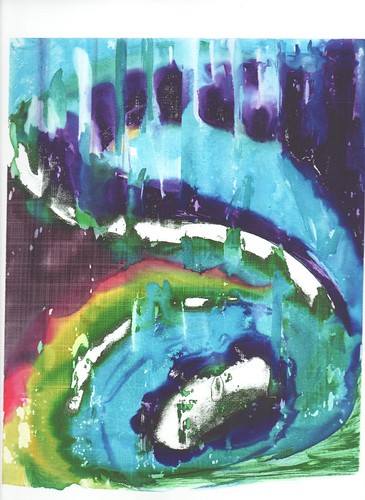
There are white areas where the pigment was too thick, and actually blocked the screen - but I like them.Also, you can see the mesh, which is interesting to me. I also tried paper stencils (snowflakes) combined with a silk paint + wallpaper paste monoprint:
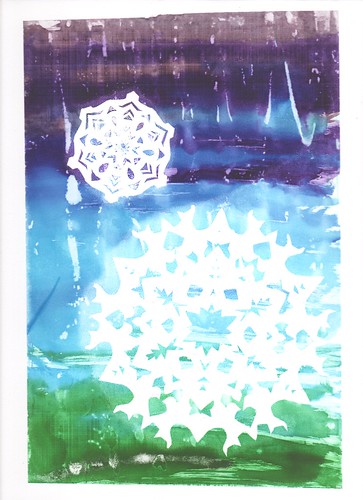
 Then, I tried the crayons (also with cut-paper snowflake stencils). My first attempt wasn't quite what I intended (but still sort of pretty I think). The instructor pointed out that there was still pigment on the screen, and with more medium and pressure (a recurring problem for me, I feel like a weakling) that I might be able to get another print. He gave it a try and got much better results: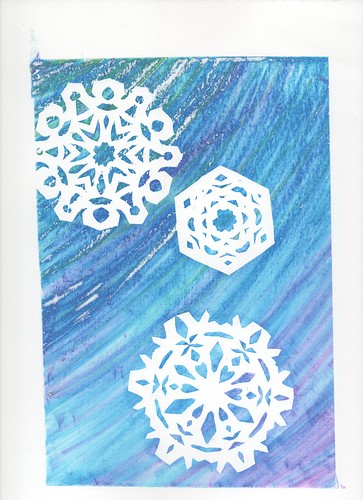
Lastly, I drew a discomedusa jellyfish directly onto the screen with colour pencils and crayons. This proved harder than expected. The screen itself is not an ideal medium for drawing. The mesh tends to hinder smooth, curved lines (which are sort of necessary, at least if you are me, and you are attempting to draw the least rectilinear animal in the world). Here's my first attempt, which is pale, but appeals to me:
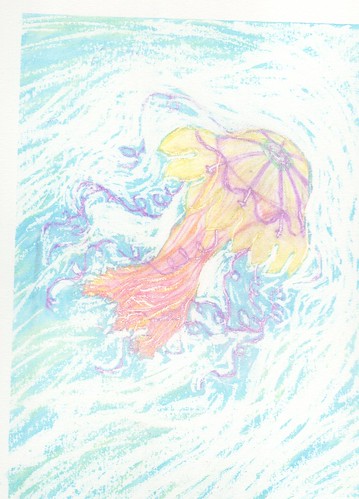
Again, there are places where the pigment blocked the mesh, but I think it works. There is white, often, within water, and I think it helps give a sense of movement. Here's the no-nonsense instructor's 2nd attempt:
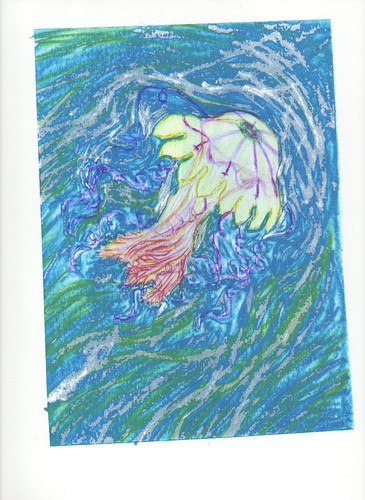
which shows hom much more can be transferred with more strength and experience. I also like the surviving snowflake stencils. The ones made from strong Japanese kozo paper survived:
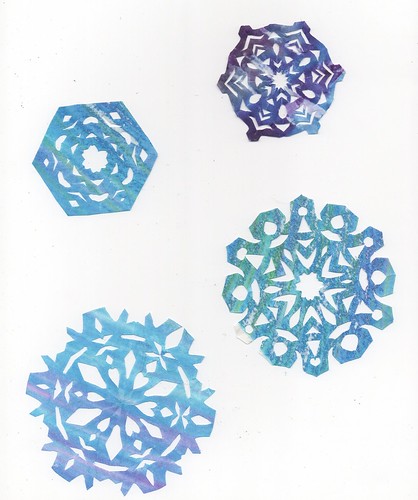
I feel I should do something with the screenprinted snowflakes, but I'm not sure what.

No comments:
Post a Comment